warning AUDI S4 2018 Owners Manual
[x] Cancel search | Manufacturer: AUDI, Model Year: 2018, Model line: S4, Model: AUDI S4 2018Pages: 403, PDF Size: 66.81 MB
Page 375 of 403

Emergency situations
Emergency situations
General
This chapter is intended for trained emergency crews and working personnel who have the nec
essary tools and equipment to perform these
operations.
Starting by pushing or
towing
(D Note
Vehicles with an automatic transmission
cannot be started by pushing or towing.
Starting with jumper
cables
If necessary, the engine con be started by con
necting it to the battery of another vehicle.
If the engine should fail to start because of a dis
charged or weak battery, the battery can be con
nected to the battery of
another vehicle, using a
pair of jumper cables to start the engine.
Jumper cables
Use only jumper cables of sufficiently large cross
section
to carry the starter current safely. Refer
to the manufacturer's specifications.
Use only jumper cables with
insulated terminal
clamps which are distinctly marked :
plus(+) cable in most cases colored red
minus(-) cable
in most cases colored black.
A WARNING
Batteries contain electricity, acid, and gas.
Any of these can cause very serious or fatal in
jury. Follow the instructions below for
safe
handling of your vehicle's battery.
-Always shield your eyes and avoid leaning
over the battery whenever possible.
-A dead battery can freeze at temperatures
around 32 °F (0 °C) . If the vehicle battery is
frozen, you must thaw it before connecting
the jump start cables.
If you do not, this in-
374
creases the risk of an explosion and chemi
cal burns. After jump starting the vehicle,
drive to an authorized Audi dealer or author ized Audi Service Facility immediately to
have the vehicle battery checked.
- Do not allow battery acid to contact eyes or
skin . Flush any contacted area with water
immediately.
- Improper use of a booster battery to start a
vehicle may cause an explosion .
- Vehicle batteries generate explosive gases.
Keep sparks, flame and lighted cigarettes
away from batteries.
- Do not try to jump start any vehicle with a
low acid level in the battery.
- The voltage of the booster battery must also
have a 12-Volt rating. The capacity (Ah) of
the booster battery should not be lower
than that of the discharged battery. Use of
batteries of different voltage or substantial
ly different
"Ah" rating may cause an explo
sion and personal injury.
- Never charge a frozen battery. Gas trapped
in the ice may cause an explosion.
- Never charge or use a battery that has been
frozen. The battery case may have be weak
ened.
- Use of batteries of different voltage or sub
stantially different capacity (Ah) rating may
cause an explosion and injury. The capacity (Ah) of the booster battery should not be
lower than that of the discharged battery.
- Before you check anything in the engine
compartment, always read and heed all
WARNINGS
r=:> poge 323.
([) Note
-Applying a higher voltage booster battery
will cause expensive damage to sensitive electronic components, such as control
units, relays, radio, etc.
- There must be no electrical contact between
the vehicles as otherwise current could al
ready start to flow as soon as the positive
(+) terminals are connected.
Page 376 of 403

@ Tips
The discharged battery must be properly con
nected to the vehicle's electrical system .
When jump starting or charg ing the battery,
never connect the negative ground cable to
the battery negative post because the battery
manager system must be able to detect the
battery's state of charge. Always connect the
negative ground cable to the negative ground
post of the battery manager control unit.
Using the jump start
cable
Both jump start cables must be connected in the
correct order!
Fig. 295 Engine compartment: connec tors for jump start
cables and a charger
Fig. 296 Ju mp starting us ing a battery in another vehicle:
@ -providing current, @-drained
The procedure described below for connecting
jumper cables is intended to prov ide a jump start
for your vehicle .
Vehicle with discharged battery
•Turnoff lights and accessories, move the auto
matic transmission* selecto r lever to N (Neu
tral) or P (Par k), and set the park ing brake.
Emergency situations
Connecting the positive cable (red) to the
positive terminal
• Open the red cover on the positive terminal
c:>fig. 295 .
1. Secure one end of the positive cable (red) to
the jump start pin
c:> fig. 296 (D (pin under
the red cover = "posit ive") on the vehicle that
needs to be started @.
2. Secure the other end of the positive cable
(red) to the positive termina l@ on the
bat
tery provid ing the current @.
Connecting the negative cable (black) to the
negative terminal
3. Secure one end of the negative cable (black)
to the nega tive term inal @ on the battery
that is providing the current @.
4. Secure the other end of the negative cable
(black) to the jump start
pin @ (hex head pin
= "negative") on the vehicle that needs to be
started @.
Starting the engine
• Start the engine on the vehicle providing the
jump start @and let it run at idle.
• Now start the engine on the vehicle with the
drained battery @.
• If the engine does not start, stop the starting
procedure after 10 seconds and then repeat it
after approx imately 30 seconds.
• Remove the cables when the engines are run
ning. Remove them in reverse order from the
way they were installed.
• Close the red cover on the positive terminal.
T he battery is vented to the outside to prevent
gases from enter ing the vehicle interior . Make
sure that the jumper clamps are well connected
with their
metal parts in full contact with the
battery terminals.
_& WARNING
-To avoid serious personal injury and damage to the vehicle, heed all warnings and instruc
tions of the jumper cable manufacturer. If in
doubt, call for road service.
-Jumper cables must be long enough so that
the vehicles do not touch .
..,_
375
Page 377 of 403
Emergency situations
-When connecting jumper cables, make sure
that they cannot get caught in any moving
parts in the engine compartment.
-Do not bend over the batteries -danger of
chemical burns!
-The battery cell locking screws must be
tightened securely.
-Before you check anything in the engine
compartment, always read and heed all
WARNINGS
c> page 323.
(D Note
Improper hook-up of jumper cables can ruin
the generator.
- Always connect POSITIVE(+) to POSITIVE
(+), and NEGATIVE(-) to NEGATIVE(-)
ground post of the battery manager control
unit.
- Check that all screw p lugs on the battery
cells are screwed in firmly. If not, tighten
plugs prior to connect ing clamp on negative
battery terminal.
-Please note that the procedure for connect
i ng a jumper cable as described above ap
plies specifically to the case of your vehicle
being jump started . When you are giving a
ju mp start to another vehicle, do
not con
nect the negative (-) cable to the negative
(-) terminal on the discharged batte ry @
c> fig. 296. Instead, securely connect the
negative( -) cab le to either a solid metal
component that is firm ly bolted to the en
gine block or to the engine block itself. If
the battery that is being charged does not
vent to the outside, escap ing battery gas
could ignite and explode!
Towing with a tow truck
General hints
Your Audi requires special handling for towing.
The following information is to be used by com
mercial tow truck operators who know how to op
erate the ir equipment safely.
-Never tow your Audi, towing will cause dam
age to the engine and transmission.
376
-Never wrap the safety chains or winch cables
around the brake lines .
- To prevent unnecessary damage, your Audi
must be transported with a flat bed truck .
- To load the vehicle on to the flat bed, use the
towing loop found in the vehicle tools and at
tach to the front or rear anchorage
i:>page 376 and i:>page 377 .
A WARNING
A vehicle being towed is not safe for passen
gers. Never allow anyone to ride in a vehicle
being towed, for any reason.
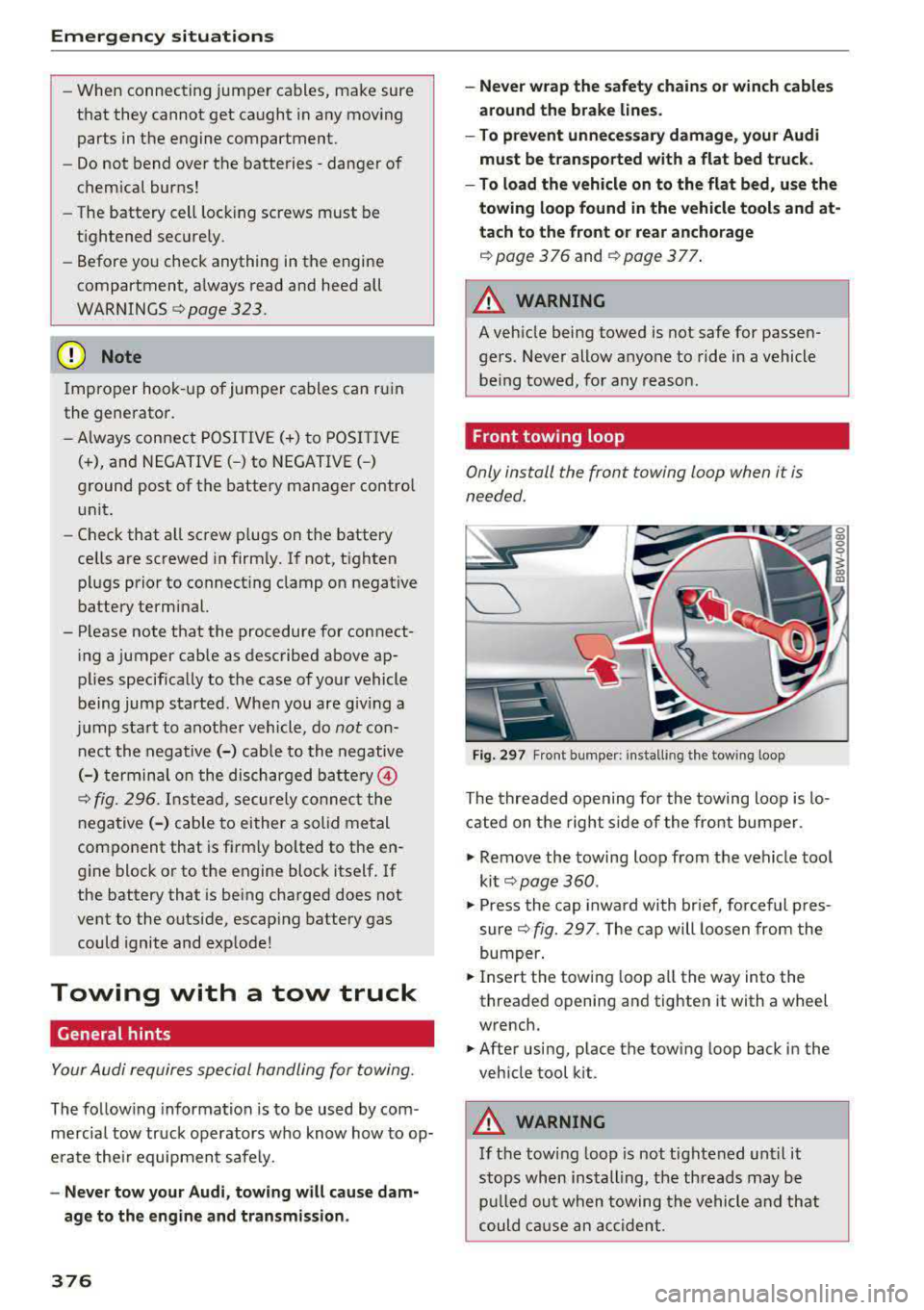
Front towing loop
Only install the front towing loop when it is
needed.
Fig. 297 F ront bumper: installing the towing loop
The threaded opening for the towing loop is lo
cated on the right s ide of the front bumper.
.,. Remove the towing loop from the vehicle too l
ki t
c> page 360 .
.,. Press the cap inward with brief, forceful p res
sure
c> fig. 297 . The cap will loosen from the
bumper .
.,. Insert the towi ng loop all the way into the
threaded opening and tighten it with a wheel
wrench.
.,. After using, place the towing loop back in the
vehicle tool kit .
A WARNING
If the towing loop is not tightened until it
stops when installing, the threads may be
pulled out when towing the vehicle and that
could cause an accident.
-
Page 378 of 403
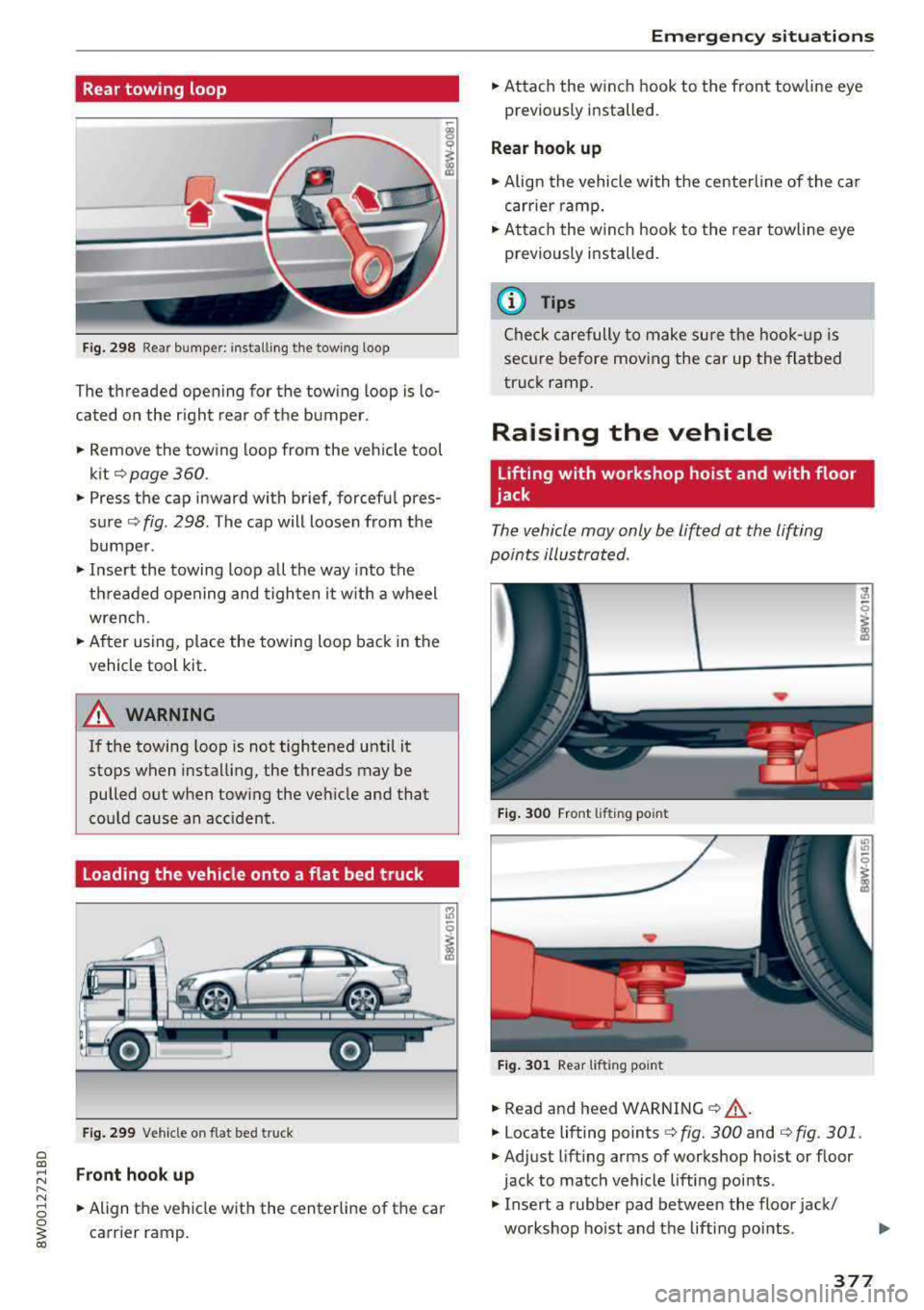
Rear towing loop
Fig. 298 Rea r bumper: install ing the tow ing loop
The threaded opening for the towing loop is lo
cated on the r ight rear of the bumper.
.. Remove the towing loop from the vehicle tool
kit¢ page 360.
.. Press the cap inward with brief, forcefu l pres
sure ¢ fig. 298. The cap will loosen from the
bumper .
.,. Insert the towing loop all the way into the
threaded opening and tighten it w ith a wheel
wrench .
.. After using, place the towing loop back in the
vehicle tool kit.
A WARNING
If the towing loop is not tightened until it
stops when installing, the threads may be
pulled out when tow ing the vehicle and that
cou ld cause an accident .
Loading the vehicle onto a flat bed truck
Fig. 299 Vehicle on flat bed truck
Front hook up
-
.. Align the vehicle with the centerline of the car
carrier ramp.
Emergency situations
.. Attach the winch hook to the front towline eye
previously installed.
Rear hook up
.. Align the vehicle with the centerline of the car
carrier ramp .
.. Attach the w inch hook to the rear towline eye
previously installed.
(D Tips
Check carefully to make sure the hook-up is
secure before moving the car up the flatbed
truck ramp.
Raising the vehicle
Lifting with workshop hoist and with floor
jack
The vehicle may only be lifted at the lifting
points illustrated .
Fig. 300 Front lifting point
Fig. 301 Rear lif tin g po int
.. Read and heed WARNING ¢&, .
.. Locate lifting points¢ fig. 300 and ¢ fig. 301.
.,. Adjust lifting arms of workshop hoist or floor
jack to match vehicle lifting points .
.. Insert a rubber pad between the floor jack/
workshop hoist and the lifting points .
.,.
377
Page 379 of 403
Emergency situations
If you must lift your vehicle with a floor jack to
work underneath , be sure the vehicle is safely
supported on stands intended for this purpose .
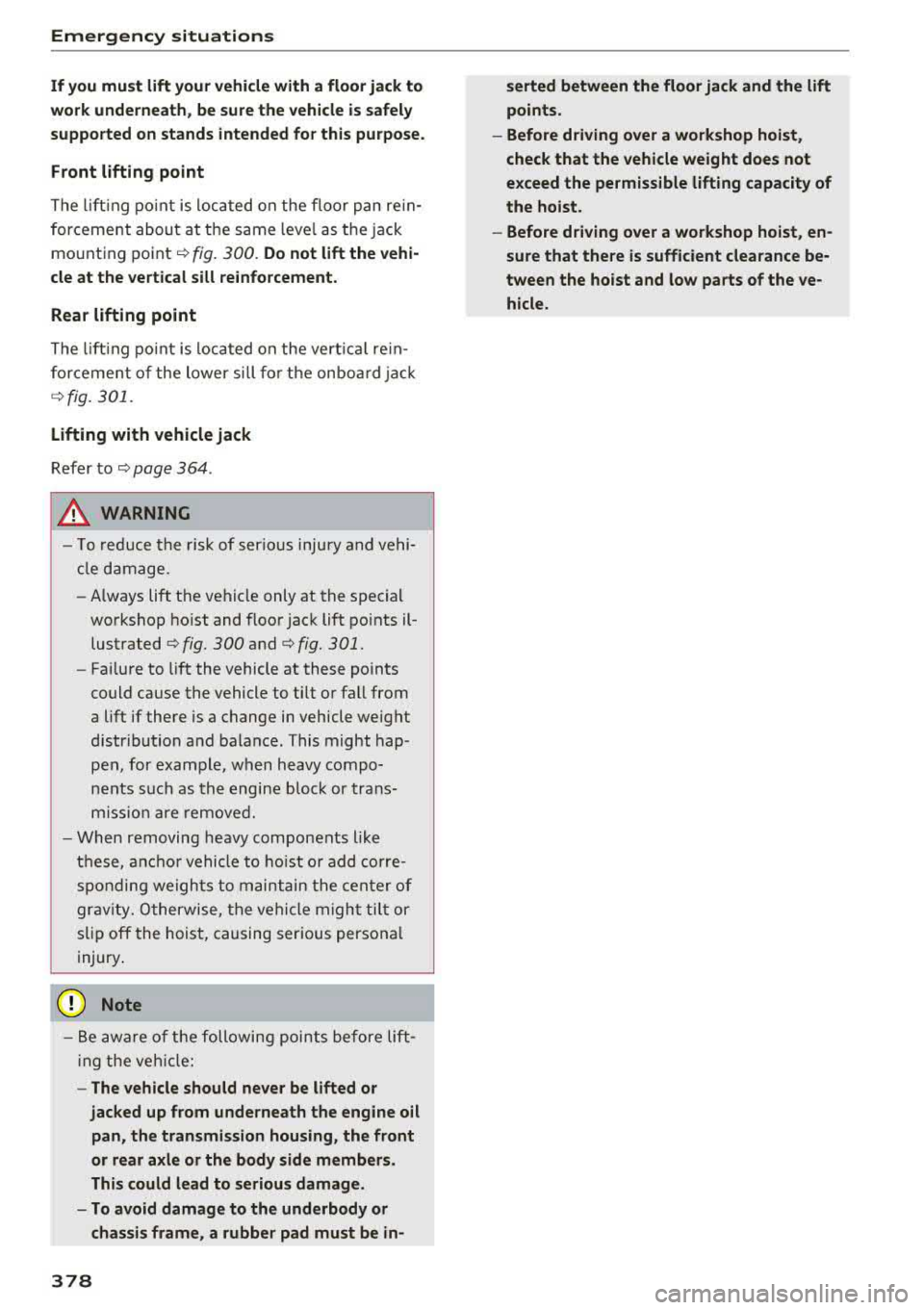
Front lifting point
T he lift ing po int is loc ated on the floo r pan re in
for cement about at the same leve l as t he jack
mounting po int <=:>
fig. 300. Do not lift the veh i
cle at the vertical sill re inforcement.
Rear lifting point
T he lift ing po int is loca ted on the vert ica l re in
for cement of the lower sill fo r t he on b oard ja ck
<=:>fig . 301 .
Lifting with vehicle jack
Refer to <=:> page 364.
A WARNING
- To reduce the risk of ser io us injury and vehi
cl e d amage.
- Always lift t he ve hicle only at the special
wo rkshop ho ist and floo r jack lift po ints il
lustrated <=:>
fig. 300 and <=:> fig. 301.
- Fa ilure to lift the vehicle at these poin ts
could cause the vehicle to til t or fa ll from
a lift if there is a change in vehicle weight
distr ibut io n and balance . This might hap
pen, for exam ple, when heavy co mpo
n e nts s uch as the engine b lock or tra ns
mi ssio n are removed.
- When removing heavy components like
t h ese , a nch or vehicle to hoist o r add cor re
s pon ding weigh ts t o ma in ta in t he ce nte r o f
gr avit y. Ot herwise, t he ve hicl e migh t tilt or
s lip
off the hoist, causing ser ious perso na l
injury .
(D Note
- Be awa re o f th e followi ng poi nts before li ft
in g th e ve hicle:
-The vehicle should never be lifted or
jacked up from underneath the engine oil
pan, the transmiss ion housing, the front
or rear axle or the body side members .
This could lead to serious damage.
- To avoid damage to the underbody or
chassis frame, a rubber pad must be in-
378
serted between the floor jack and the lift
points.
- Before driving over a workshop hoist ,
check that the vehicle weight does not
exceed the permissible lifting capacity of
the hoist.
- Before driving over a workshop hoist , en
sure that there is sufficient clearance be
tween the hoist and low parts of the ve
hicle .
Page 380 of 403

Technical data
Vehicle specifications
F ig. 302 W indshield (front left): Ve hicle Ident ification
Number (VIN)
XXXXX XX -X -XX XX X XX XX
CD+ ~t :1 :: xxxxxxxx xx x x x xxx xxx
TVP/fffl XXX XXX
XX XXXXXXX XX X X XX
XXX
KW XXX
®i ~:J ·f lfils~~ XXXX XXX XXX
®-+ ~N:a=i~l xxxx ; xxxx xx x ; xx
11. • AUSS, I OPTIONS
E0 A
7D 5 4UB 6
XM 5SG 5R W
2E H
J0Z lL B l
A S lB A
3FC SM U 7Xl
F 0 A 9G3 0G7 0YH 0JF
TL 6 3KA 8EH UlA X 98 Q Z7
lXW 803 908 824 020
7T6 C V7 7 K0 4 X3 2K2
3L4
4KC 3Y0 413
502
lSA 7GB 01 A 4G0
XX . X XX X XX X xxxx
Fig. 303 Vehicle identification label
Vehicle Identification Number (VIN) in the
Infotainment system
• Select in the Infotainment system: the I MENU I
button > Vehicle > left control button > Service
& checks> Vehicle information .
Vehicle Identification Number (VIN)
The VIN can be found in the Infotainment sys
tem, on the vehicle data label, and under the
windshield on the front left side*
q fig. 302 . The
VIN is also in the right side of the luggage com
partment.
Technical data
Vehicle identification label
The vehicle identification label ¢ fig. 303 is locat
ed in the luggage compartment under the cargo
floor cover .
T he information of the vehicle identif ication label
can also be found in your Warranty
& Mainte
nance booklet.
The sticker contains the follow ing vehicle data:
(D Vehicle Identification Number (VIN)
@ Vehicle type, eng ine output, transm ission
@ Engine and transmission codes
@ Paint and interior codes
® Optional equipment numbers
Safety compliance sticker
The safety compliance sticker is your assurance
that your new vehicle complies w ith all applicable
Federal Motor Vehicle Safety Standards which
were in effect at the time the vehicle was manu
factured. You can find this sticker on the driver's
side B -pillar respect ively on the front end of the
driver's door.
It shows the month and year of
production and the vehicle identification number
of your veh icle (perforation) as well as the Gross
Vehicle Weight Rat ing (GVWR) and the Gross
Axle Weight Rating (GAWR) .
High voltage warning label
The high voltage warning label is located in the
engine compartment next to the engine hood re
lease. The spark ignition system complies with
the Canadian standard ICES-002 .
Notes about technical
data
The values may vary based on special equipment
as well as market-specific equipment and meas
uring methods.
Please note that the specifications listed in the
vehicle documentation a lways take precedence.
0) Tips
Missing technical data was not available at
the time of pr int ing.
379
Page 381 of 403
Tech nical data
Weights
Gross V ehicl e We ight Rat ing
The G ross Vehicle Weight Ra ting (GVWR), and
the Gross Axle Weight Rating (GAWR) for front
and rear are listed on a sticker on the driver's side
B-pillar respective ly on the front end of the driv
er's door.
The G ross Vehicle Weight Rating includes the
weight of the basic vehicle plus full fuel tank, oil
and coolant, plus maximum load, which includes
passenger weight (150 lbs/68 kg per designated
seating position) and luggage
we ight¢ &..
Gros s Ax le Weight Rating
The Gross Axle Weight Rating is the maximum
load that can be applied at each axle of the vehi
cle¢&_ .
Vehicle c apacity w eight
The vehicle capacity we ight (max . load) is listed
on the driver 's side B -p ill ar respectively on the
front end of the driver's door.
_& WARNING
-The actual Gross Axle Weight Rating at the
front and rear axles should not exceed the
permissible weights, and their comb inat ion
must not exceed the Gross Veh icle Weight
Rating.
- Exceeding permiss ible weight ratings can
result in veh icle damage, acc idents and pe r
sonal i njury .
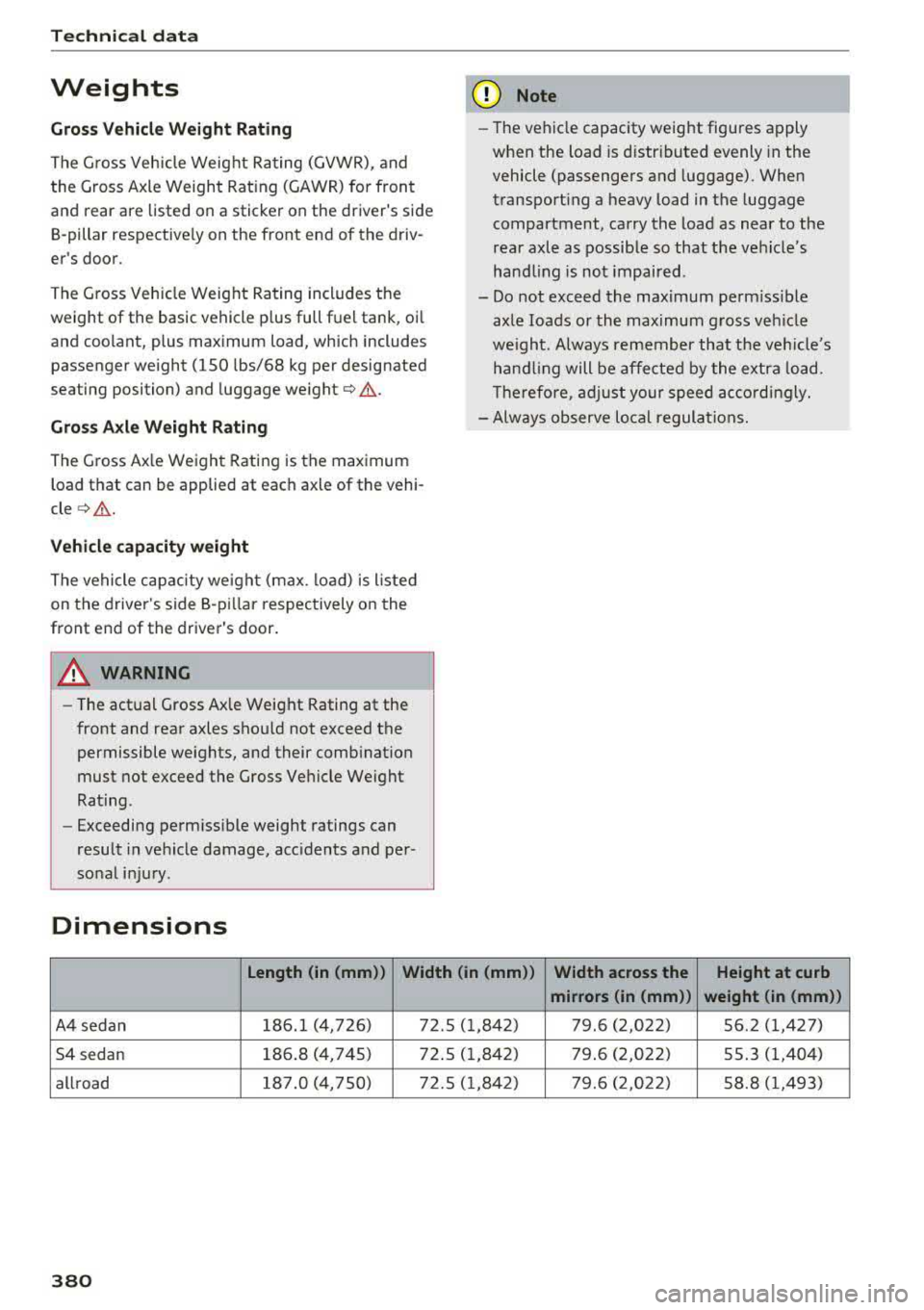
Dimensions
(D Note
-The veh icle capacity weight figures apply
when the load is d istr ibuted evenly in the
vehicle (passengers and luggage). When
transport ing a heavy load in the luggage
compartment, carry the load as near to the
rea r axle as possible so that the ve hicle's
hand ling is not impaired .
- Do not exceed the maximum perm iss ible
axle loads or the maximum gross veh icle
we ight. Always remember that the ve hicle's
hand ling will be affected by the extra load.
Th erefore, a djust your speed acco rdingly.
- Always observe local regulations.
Length (in (mm )) Width (in (mm ))
Width across the Height at curb
mirrors (in (mm )) weight (in (mm))
A4 sedan 186.1 (4,726) 72.5 (1,842) 79.6 (2,022) 56.2 (1,427)
54 sedan 186
.8 (4,745) 72 .5 (1,842) 79 .6 (2,022) 55 .3 (1,404)
all road 187.0 (4,750) 72.5 (
1,842) 79.6 (2,022) 58.8 (1,493)
380
Page 385 of 403
Consumer Info rmation
today's a utomo biles, have steadily reduced the
scope of maintenance and repairs which can be
carried out by veh icle owners.
Also , sa fet y and
en vironmental
concerns place very strict limits
on the nature of repairs and adjustmen ts to en
g ine and transmission parts wh ich an owner can
perform .
Maintenance, adjustments and repairs usually re
qu ire special tools, testing devices and other
equ ipment available to specially trained work
shop personnel in order to assure proper per
forma nce, re liability and safety of the veh icle and
its many systems .
Improper maintenance, adjustments and repairs
can impair the operation and reliab ility of your
ve hicle and eve n void your vehicle warranty .
Therefo re, proof of se rvicing in a ccordance w ith
the m aintenance sched ule may be a condition for
up ho ld ing a possible wa rranty claim made within
the wa rranty pe riod.
Above all , ope rational safety can be adversely af
fected, cre ating unne cessa ry risks fo r you and
your passengers.
I f in doubt about any servicing, have it done by
your author ized Audi dealer or any other properly
eq uipped and qualified workshop . We strongly
urge you to g ive your author ized Audi dealer the
opportunity to perform a ll scheduled mainte
nance and necessa ry repairs. Your dealer has the
facilities, origina l parts and tra ined specialists to
keep your veh icle runn ing prope rly.
Performing limited maintenance yourself
The fo llow ing pages describe a limited number of
procedures whic h can be performed on your vehi
cle with ordinary tools, should the need arise and
tra ined personnel be unava ilable. Before per
forming any of these procedures, always thor
ough ly read all of the app licab le text and carefu l
ly follow the instructions g iven . A lways rigorously
observe the
WARNINGS prov ided .
Befo re yo u check anything in the engine com
partment, always read and heed all WARNINGS
c::> & and c::> & in Working in the engine compart
ment on page 323 .
384
A WARNING
-
-Ser ious personal in jury may occur as a result
of imp roperly performed maintenance, ad
justments or repairs .
- Always be extreme ly careful when work ing
on the vehicle . Always follow commonly ac
cepted safety practices and general com mon sense. Never r is k personal in jury.
- Do not attempt any of the mainte nance,
checks or repairs described on the following pages if you are no t fu lly fam iliar with these
or other proce dures with respect to the ve
hicle, o r are uncert ain how to p ro ceed.
- Do not do any work wi thout the prope r tools
a nd equi pmen t. H ave the necess ary wo rk
done by your authorized Au di dealer or an
other properly equipped and qualified work
shop.
- The engine compartment of any motor veh i
cle is a potentially hazardous area . Never
reach into the a rea around or touch the radi
ator fan. It is temperature controlled and
can switch on suddenly - even when the en
gine is off and the ignition key has been re
moved. The rad iator fan switches on auto
mat ica lly when the coolant reaches a certain
temperature and will con tinue to ru n until
the coolant temperat ure drops.
- Always remove the igni tion key before any
one gets u nder the vehicle.
- Always support your vehicle with safety
stands if it is necessary to work underneath
the vehicle. The ja ck* s upplied w ith the vehi
cle is no t ad equate fo r thi s pu rpose and
could collapse causing se rious personal in
jury .
- If you must wor k underne ath the vehicle
with the wheels on t he ground, always make
sure the vehicle is on level ground, that the
wheels a re always sec urely blocked and that
the engine cannot be started.
- Always make sure the transmission se lector
lever (automatic t ransm iss ion) is in P (Park
position) and the park b rake is applied.
Page 386 of 403
a co .... N ,....
N .... 0 0
3 co
@ For the sake of the environment
-Changing the engine settings wi ll adversely
affect emission leve ls. Th is is detrimental to
the env ironment and increases fuel con
sumption.
- Always observe environmental regu lations
when disposing of old engine o il, used brake
flu id, d irty engine coolant, spent batteries
or worn out tires .
- Undeployed airbag modules and pretension
ers might be classified as Perchlorate Mate
rial -spec ial handling may apply, see
www .dtsc.ca.gov/hazardouswaste/perchlo
rat e. When the vehicle or pa rts of the re
straint system including airbag modules
safety be lts with pretens ioners are scrap
ped, a ll applicab le laws and regulations
must be observed. Your a uthorized Audi
dealer is familiar with these requirements
and we recommend that you have your deal er perform this service for you.
Accessories and
technical changes
Additional accessories and parts
replacement
Always consult on authori zed Audi dealer before
purchasing accessories.
Audi vehicles that are constructed w ith advanced
materials like Steel/Aluminum (Hybrid construc
tion), Aluminum (Audi Space Frame), and/or Alu minum/Carbon Fiber (Ultra Advanced Light
We ight Materials) are as unique as the ir drivers .
Therefore, the ava ilability of certain parts needed
for repair , restoration , or reconstruction wi ll be
restricted , or parts will be unava ilable, if the ve
hicle is not repaired at an a uthorized Audi colli
sion repair facility. This includes but is not limit
ed to structura l parts which require specialized
training and equipment to restore their crash
worthiness back to the original NHTSA and IIHS performance.
Your vehicle incorporates the latest safety design
features ensuring a high standard of active and
passive safety.
Consumer Inf ormation
This safety could be compromised by non-ap
proved changes to the vehicle. For this reason, if
parts have to be rep laced, please observe the fol
lowing points when install ing additional accesso
ries:
Approved Audi accessories and genuine Audi parts are avai lab le from authorized Aud i dea lers.
T hese dea le rs also have the necessa ry facilities,
tools and trained specialists to install the parts
and accessories properly .
A WARNING
-Using the wrong spare parts or using non-ap-
proved accessories can cause damage to the
vehicle and serious personal injury.
- Use on ly accessories expressly approved by
Aud i and genuine Audi spare parts
- These parts and accessor ies have been spe
cially designed to be used on your vehicle.
- Do not use license plate brackets in the
front area that are different from the one
installed at the factory, or add additional
li
cense plate brackets.
- Never install accessor ies such as telephone
cradles or beverage holders on airbag covers
or w ith in the airbag deployment zones . Do
ing so will increase the risk of injury if a ir
bags are triggered in an accident!
- Before you check anyth ing in the engine
compartment, always read and heed all
WARNINGS
9poge 323.
(D Note
- If items other than genu ine Audi spare
parts, add -on equipment and accessory
items are used or if repair work is not per
formed according to specified methods, this
can result in seve re damage to your vehi
cle's engine and body (such as corrosion)
and adversely affect your vehicle's warranty.
- If emergency repa irs must be performed
elsewhere, have the vehicle exam ined by an
authorized Audi dealer as soon as possib le .
- The manufacturer cannot be held liable for
damage which occurs due to failure to com
ply with these stipulations .
385
Page 387 of 403

Consumer Info rmation
Technical Modifications
Our guidelines must be complied with when tech
nical modifications are made .
Always consult an authorized Audi dealer before
starting work on any modificat ions.
This will he lp ensure that vehicle function, per
formance and safety are not impaired
9 & .
Attempting to work on electronic components
and the software used with them can cause mal
functions. Because of the way electronic compo nents are interconnected with each other, such
malfunctions can also have an adverse affect on
other systems that are not directly involved. This
means that you risk both a substantial reduction
in the operational safety of your veh icle and an
i n creased wea r of ve hicle parts
9 ,&. .
Author ized Audi dealers w ill perform this work in
a profess ional and competent manner or, in spe
cial cases, refer you to a professional company
that spec ial izes in such modifications.
_& WARNING
Improper repairs and modifications can
change the way veh icle systems work and
cause damage to the veh icle and ser ious per
sonal injury.
([) Note
I f emergency repa irs mus t be pe rformed else
where, have the vehicle examined by an a u
t horized Audi dealer as soon as possib le .
Declaration of
Compliance, Telecom munications and
Electronic Systems
Radio Frequency Devices and Radiocommunica
tion Equipment User Manual Notice .
The manufacturer is not responsible for any radio
or TV interference caused by unauthorized modi
fications to this equipment .
386
Devices
The following devices each comply wi th FCC Part
15.19, FCC Part 15.21 and RSS-Gen Issue 1:
- Audi adapt ive cru ise cont rol*
- Audi side assist*
- Cell phone package*
- Conven ience key*
- Electronic immobilize r
- Garage door opener (Homelink)*
- Remote cont rol key
FCC Part 15.19
This device complies with part 15 of the FCC
R ules . Ope ration is subject to the follow ing two
cond it ions:
(1) T his dev ice may not cause harmful interfer
ence, and
(2) this device must accept any interference re
ce ived, includ ing interference that may cause un
desired operation.
FCC Part 15.21
CAUTION:
Changes or modificat io ns not express ly approved
by the pa rty responsible fo r compliance cou ld
vo id the user's a uthority to operate the equ ip
ment.
RSS-G en Issue 1
Operat ion is s ubject to the following two cond i
tions:
(1) this device may not cause interference, and
(2) this device must accept any interference, in
clud ing interference that may cause undesired
operation of the device.