weight AUDI S4 2018 Owner's Manual
[x] Cancel search | Manufacturer: AUDI, Model Year: 2018, Model line: S4, Model: AUDI S4 2018Pages: 403, PDF Size: 66.81 MB
Page 309 of 403
Child safety
-Never put the forward-facing child restraint
up, against or very near the instrument pan
el.
- Always move the front passenger seat to
the highest position in the up and down ad
justment range and move it back to the
rearmost position in the seat's fore and aft
adjustment range, as far away from the air
bag as possible, before installing the for
ward-facing child restraint.
- Always make sure that the safety belt upper
anchorage is behind the child restraint and
not next to or in front of the child restraint
so that the safety belt will be properly posi
tioned.
- Make sure that the
PASSENGER AIR BAG
OFF~ ; light comes on and stays on all the
time whenever the ignition is switched on.
A WARNING
Rearward-facing child restraints:
- A child in a rearward-facing child safety seat
installed on the front passenger seat will be
seriously injured and can be killed if the
front airbag inflates -even with an Ad
vanced Airbag System.
- The inflating airbag will hit the child safety
seat or infant carrier with great force and
will smash the child safety seat and child
against the backrest, center armrest, door
or roof .
- Always be especially careful if you must in
stall a rearward facing child safety seat on
the front passenger seat in exceptional cir
cumstances .
- Make sure that the
PASSENGER AIR BAG
OFF~; light comes on and stays on all the
time whenever the ignition is switched on.
- If the
PASSENGER AIR BAG OFF~; light
does not come on and stay on, immediately
install the rear-facing child safety seat in a
rear seating position and have the airbag
system inspected by your Audi dealer .
308
· Activating the convertible locking retractor
Use the convertible locking retractor to secure a
child restraint.
Always heed the child safety seat manufacturer 's
instructions when installing a child restrain t in
your vehicle . To activate the convertible locking
retractor:
.. Place the child restraint on a seat, preferably
on the rear seat .
.. Slowly pull the belt all the way out.
.. Route it around or through the child restraint
belt path
~ ,&. .
.. Push the child safety seat down with your full
weight to get the safety belt really tight.
.. Insert the belt tongue into the buckle for that
seating position.
.. Guide the safety belt back into the retractor un
til the belt lies flat and snug on the child safety
seat.
.. You should hear a "clicking" noise as the belt
winds back into the inertia reel. Test the con
vertible locking retractor by pulling on the belt.
You should no longer be able to putt the belt
out of the retractor. The convertible locking re
tractor is now activated .
.. Make sure that the red release button is facing
away from the child restraint so that it can be
unbuckled quickly.
.. Pull on the belt to make sure the safety belt is
properly tight and fastened so that the seat
cannot move forward or sideways more than
one inch (2 .5 cm) .
A WARNING
Using the wrong child restraint or an improp
erly installed child restraint can cause serious
personal injury or death in a crash.
- Always make sure that the safety belt re
tractor is locked when installing a child
safety seat. An unlocked safety belt retrac
tor cannot hold the child safety seat in place
during normal driving or in a crash.
- Always buckle the child safety seat firmly in
place even if a child is not sitting in it. A
loose child safety seat can fly around during
a sudden stop or in a crash.
Page 337 of 403

Wheel s
® Mud and snow capability
"M/5" or "M+S" indicates the tire
is sui table for driving on mud and
snow.
& indicates a winter tire.
@ Composition of the tire cord
and materials
The number of plies indicates the
number of rubberized fabric lay
ers in the t ire. In general: the
more layers, the more weight a
tire can carry . Tire manufacturers
must also specify the materials
used in the tire. These include
steel, nylon, po lyester and other
materials.
@ Maximum permitted load
This number indicates the maxi
mum load in kilograms and
pounds that the tire can carry .
@Uniform tire quality grade
standards for treadwear,
traction and temperature resist ance
Treadwear, traction and tempera
ture
ranges ¢ page 351.
@ Running direction
The arrows indicate the running
direction of unidirectional t ires .
You must always follow the speci
fied running direction
¢page 366 .
336
@ Maximum permitted
inflation pressure
This number indicates the maxi
mum pressure to which a tire can
be inflated under normal operat
ing condit ions.
Glossary of tire and loading
terminology
Acces sory we ight
means the combined weight (in
excess of those standard items
which may be replaced) of auto matic transmission, power steer
ing, power brakes, power win
dows, power seats, radio, and
heater, to the extent that these
items are available as factory-in
stalled equipment (whether in
stalled or not) .
Aspect ratio
means the ratio of the height to
the width of the tire in percent .
Numbers of 55 or lower indicate a
low sidewall for improved steer
ing response and better overall
handling on dry pavement.
Bead
means the part of the tire that is
made of steel wires, wrapped or
reinforced by ply cords and that is
shaped to fit the r im .
...
Page 338 of 403
0 C0 .-< N ..... N .-< 0
~ a:,
Bead separa tion
means a breakdown of the bond
between components in the bead.
Cord
means the strands forming the
plies in the tire .
Cold tire inflation pressure
means the tire pressure recom
mended by the vehicle manufac
turer for a tire of a designated size that has not been driven for
more than a couple of miles (kilo
meters) at low speeds in the
three hour period before the tire
pressure is measured or adjusted .
Curb weight
means the weight of a motor ve
hicle with standard equipment in
c luding the maximum capac ity of
fuel, oi l, and coolant, a ir condi
tioning and add itional weight of
optional equipment.
E xtra load tire
means a tire designed to operate
at higher loads and at h igher in
flation pressures than the corre sponding standard tire. Extra load
tires may be identified as
"X L",
"xl", "E XTRA LOAD" , or "RF" on
the s idewal l.
Wheels
Gross Axle Weight Rating
( " GAWR")
means the load-carrying capacity
of a single axle system, measured
at the tire -ground interfaces.
Gross Vehicle Weight Rating
(" GVWR ")
means the max imum total loaded
weight of the vehicle.
Groove
means the space between two ad
jacent tread ribs .
Load rating (code)
means the maxim um load that a
tire is rated to carry for a given in
flat ion pressure . You may not f ind
this informat ion on all tires be
cause it is not required by law.
Maximum load rating
means the load rating for a tire at
the maximum permissible infla
tion pressure for that tire .
Maximum loaded vehicle
weight
means the sum of:
(a) Curb weight
(b) Accessory weight
(c) Vehicle capacity we ight , and
(d) Production options we ight
33 7
Page 339 of 403

Wheel s
Maximum (permissible)
inflation pressure
means the max imum cold infla
tion pressure to which a t ire may
be inflated . Also called "maxi
mum inflation pressure."
Normal occupant weight
means 150 lbs. (68 k ilograms)
times the number of occupants seated in the vehicle up to the to
tal seating capacity of your vehi
cle .
Occupant distribution
means distribution of occupants
in a vehicle.
Outer d iameter
means the overall diamete r of an
inflated new tire.
Overall width
means the linear distance be
tween the exteriors of the side
walls of an inflated tire , including
elevations due to labeling, deco rations, or protective bands or
ribs .
Ply
means a layer of rubber-coated
para llel cords.
338
Production options we ight
means the combined weight of
those installed regular product ion
options weighing over 5 lbs . (2 .3
kg) in excess of those standard
items which they replace, not pre
viously considered in curb weight or accessory weight , including
heavy duty brakes, ride levelers,
roof rack, heavy duty battery, and
special trim.
Radial ply ti re
means a pneumatic tire in which
the ply cords that extend to the beads are la id at substantially 90
degrees to the centerline of the
tread.
Recommended inflation
pressure
see ¢ page 33 7, Cold tire infla
tion pressure.
Reinforced tire
means a tire designed to operate
at higher loads and at higher in
flation pressures than the corre
sponding standard tire . Rein
forced tires may be identified as
"XL", "xl", "EXTRA LOAD", or "RF"
on the sidewall. ...
Page 341 of 403
Wheels
comparisons among tires. The
UTQG is not a safety rating and not a guarantee that a tire will
last for a prescribed number of
miles (kilometers) or perform in a
certain way. It simply gives tire
buyers additional information to
combine with other considera
tions, such as price, brand loyalty
and dealer recommendations. Un
der UTQG, tires are graded by the
tire manufacturers in three areas:
treadwear, traction, and tempera
ture resistance. The UTQG i nfor
mation on the tires, molded into
the sidewalls .
U.S. DOT Tire Identification
Number (TIN)
T his is the tire's "serial number".
It begins with the letters "DOT"
and indicates that the tire meets
all federal standards. The nex t
two numbers or letters indicate
the plant where it was manufac
tured, and the last four numbers represent the week and year of
manufacture. For example,
DOT ... 2216 ...
means that the tire was produced
in the 22nd wee k of 2016. The
other numbers are marketing co
des that may or may not be used
3 4 0
by the t ire manufacturer . This in
formation is used to contact con
sumers if a tire defect requ ires a
recall.
Vehicle capacity weight
means the rated cargo and lug
gage load pl us 150 lbs. (68 k ilo
grams) times the vehicle's desig na ted seating capacity .
Vehicle maximum load on the
tire
means that load on an individual
tire that is determined by distrib
uting to each axle its sha re of the
maximum loaded vehic le we ight
and dividing
by two.
Vehicle normal load on the tire
means that load on an individual
tire that is determined by d istrib
ut ing to each axle its share of the
curb weight, accessory weight,
and normal occupan t weight (dis
tr ibuted in accordance with
¢ ta
ble on page 346) and d ividing by
two.
Occupant loading and distri bution for vehicle normal load
for various designated seating capacities
Refer to the tire inflation p res -
sure label
¢page 3 4 4, fig. 277 .,.
Page 348 of 403
0 C0 .-< N ..... N .-< 0
~ a:,
.&_ WARNING
Please note the important safe
ty precautions regarding tire
pressure
¢ page 344 and load
limits
¢ page 347 .
Tires and vehicle load limits
There are limits to the amount of
load or weight that any vehicle
and any tire can carry. A vehicle
that is overloaded will not handle
well and is more difficult to stop.
Overloading can not only lead to
loss of vehicle control, but can al
so damage important parts of the
vehicle and can lead to sudden
tire failure, including a blowout and sudden deflation that can
cause the vehicle to crash.
Your safety and that of your pas sengers also depends on making
sure that load limits are not ex
ceeded. Vehicle load includes ev
erybody and everything in and on
the vehicle. These load limits are
technically referred to as the vehi cle's
Gross Vehicle Weight Rat
ing
("GVWR").
The "GVWR" includes the weight
of the basic vehicle, all factory in
stalled accessories , a full tank of
fuel, oil, coolant and other fluids
Wheels
plus maximum load. The maxi
mum load includes the number of
passengers that the vehicle is in
tended to carry ("seating capaci
ty") with an assumed weight of
150 lbs (68 kg) for each passen
ger at a designated seating posi
tion and the total weight of any
luggage in the vehicle. If you tow
a trailer, the weight of the trailer
hitch and the tongue weight of
the loaded trailer must be includ ed as part of the vehicle load .
The
Gross Axle Weight Rating
( " GAWR ") is the maximum load
that can be applied at each of the
vehicle's two axles.
The fact that there is an upper
limit to your vehicle 's Gross Vehi
cle Weight Rating means that the
total weight of whatever is being
carried in the vehicle (including
the weight of a trailer hitch and
the tongue weight of the loaded
trailer) is limited. The more pas
sengers in the vehicle or passen
gers who are heavier than the
standard weights assumed mean
that less weight can be carried as luggage.
The Gross Vehicle Weight Rating and the Gross Axle Weight Rating
.,.
347
Page 349 of 403
Wheels
are listed on the safety compli
ance sticker on the driver's side B pillar respectively on the front
end of the driver's door.
& WARNING
-
Overloading a vehicle can cause
loss of vehicle control, a crash
or other accident, serious per
sonal injury, and even death.
-Carrying more weight than your vehicle was designed to carry will prevent the vehicle
from handling properly and increase the risk of the loss of
vehicle control.
-The brakes on a vehicle that
has been overloaded may not
be able to stop the vehicle
within a safe distance .
-Tires on a vehicle that has been overloaded can fail sud
denly, including a blowout and
sudden deflation, causing loss of control and a crash .
-Always make sure that the to tal load being transported -
including the weight of a trail
er hitch and the tongue
weight of a loaded trailer -
does not make the vehicle
heavier than the vehicle's
Gross Vehicle Weight Rating.
348
Determining correct load
limit
Use the example below to calcu
late the total weight of the pas
sengers and luggage or other
things that you plan to transport so that you can make sure that
your vehicle will not be overload
ed.
Steps for Determining Correct Load Limit
1. Locate the statement "THE
COMBINED WEIGHT OF OCCU
PANTS AND CARGO SHOULD
NEVER EXCEED XXX KG OR XXX
LBS" on your vehicle's placard
(tire inflation pressure label)
¢ page 344, fig. 277.
2. Determine the combined
weight of the driver and pas sengers that will be riding in
your vehicle.
3. Subtract the combined weight
of the driver and passengers
from
"XXX" kilograms or "XXX"
pounds shown on the stick
er ¢ page 344, fig. 2 77.
4. The resulting figure equals the
available amount of cargo and luggage load capacity . For ex
ample, if the "XXX" amount
equals 1400 lbs. and there will
.,.
Page 379 of 403
Emergency situations
If you must lift your vehicle with a floor jack to
work underneath , be sure the vehicle is safely
supported on stands intended for this purpose .
Front lifting point
T he lift ing po int is loc ated on the floo r pan re in
for cement about at the same leve l as t he jack
mounting po int <=:>
fig. 300. Do not lift the veh i
cle at the vertical sill re inforcement.
Rear lifting point
T he lift ing po int is loca ted on the vert ica l re in
for cement of the lower sill fo r t he on b oard ja ck
<=:>fig . 301 .
Lifting with vehicle jack
Refer to <=:> page 364.
A WARNING
- To reduce the risk of ser io us injury and vehi
cl e d amage.
- Always lift t he ve hicle only at the special
wo rkshop ho ist and floo r jack lift po ints il
lustrated <=:>
fig. 300 and <=:> fig. 301.
- Fa ilure to lift the vehicle at these poin ts
could cause the vehicle to til t or fa ll from
a lift if there is a change in vehicle weight
distr ibut io n and balance . This might hap
pen, for exam ple, when heavy co mpo
n e nts s uch as the engine b lock or tra ns
mi ssio n are removed.
- When removing heavy components like
t h ese , a nch or vehicle to hoist o r add cor re
s pon ding weigh ts t o ma in ta in t he ce nte r o f
gr avit y. Ot herwise, t he ve hicl e migh t tilt or
s lip
off the hoist, causing ser ious perso na l
injury .
(D Note
- Be awa re o f th e followi ng poi nts before li ft
in g th e ve hicle:
-The vehicle should never be lifted or
jacked up from underneath the engine oil
pan, the transmiss ion housing, the front
or rear axle or the body side members .
This could lead to serious damage.
- To avoid damage to the underbody or
chassis frame, a rubber pad must be in-
378
serted between the floor jack and the lift
points.
- Before driving over a workshop hoist ,
check that the vehicle weight does not
exceed the permissible lifting capacity of
the hoist.
- Before driving over a workshop hoist , en
sure that there is sufficient clearance be
tween the hoist and low parts of the ve
hicle .
Page 380 of 403

Technical data
Vehicle specifications
F ig. 302 W indshield (front left): Ve hicle Ident ification
Number (VIN)
XXXXX XX -X -XX XX X XX XX
CD+ ~t :1 :: xxxxxxxx xx x x x xxx xxx
TVP/fffl XXX XXX
XX XXXXXXX XX X X XX
XXX
KW XXX
®i ~:J ·f lfils~~ XXXX XXX XXX
®-+ ~N:a=i~l xxxx ; xxxx xx x ; xx
11. • AUSS, I OPTIONS
E0 A
7D 5 4UB 6
XM 5SG 5R W
2E H
J0Z lL B l
A S lB A
3FC SM U 7Xl
F 0 A 9G3 0G7 0YH 0JF
TL 6 3KA 8EH UlA X 98 Q Z7
lXW 803 908 824 020
7T6 C V7 7 K0 4 X3 2K2
3L4
4KC 3Y0 413
502
lSA 7GB 01 A 4G0
XX . X XX X XX X xxxx
Fig. 303 Vehicle identification label
Vehicle Identification Number (VIN) in the
Infotainment system
• Select in the Infotainment system: the I MENU I
button > Vehicle > left control button > Service
& checks> Vehicle information .
Vehicle Identification Number (VIN)
The VIN can be found in the Infotainment sys
tem, on the vehicle data label, and under the
windshield on the front left side*
q fig. 302 . The
VIN is also in the right side of the luggage com
partment.
Technical data
Vehicle identification label
The vehicle identification label ¢ fig. 303 is locat
ed in the luggage compartment under the cargo
floor cover .
T he information of the vehicle identif ication label
can also be found in your Warranty
& Mainte
nance booklet.
The sticker contains the follow ing vehicle data:
(D Vehicle Identification Number (VIN)
@ Vehicle type, eng ine output, transm ission
@ Engine and transmission codes
@ Paint and interior codes
® Optional equipment numbers
Safety compliance sticker
The safety compliance sticker is your assurance
that your new vehicle complies w ith all applicable
Federal Motor Vehicle Safety Standards which
were in effect at the time the vehicle was manu
factured. You can find this sticker on the driver's
side B -pillar respect ively on the front end of the
driver's door.
It shows the month and year of
production and the vehicle identification number
of your veh icle (perforation) as well as the Gross
Vehicle Weight Rat ing (GVWR) and the Gross
Axle Weight Rating (GAWR) .
High voltage warning label
The high voltage warning label is located in the
engine compartment next to the engine hood re
lease. The spark ignition system complies with
the Canadian standard ICES-002 .
Notes about technical
data
The values may vary based on special equipment
as well as market-specific equipment and meas
uring methods.
Please note that the specifications listed in the
vehicle documentation a lways take precedence.
0) Tips
Missing technical data was not available at
the time of pr int ing.
379
Page 381 of 403
Tech nical data
Weights
Gross V ehicl e We ight Rat ing
The G ross Vehicle Weight Ra ting (GVWR), and
the Gross Axle Weight Rating (GAWR) for front
and rear are listed on a sticker on the driver's side
B-pillar respective ly on the front end of the driv
er's door.
The G ross Vehicle Weight Rating includes the
weight of the basic vehicle plus full fuel tank, oil
and coolant, plus maximum load, which includes
passenger weight (150 lbs/68 kg per designated
seating position) and luggage
we ight¢ &..
Gros s Ax le Weight Rating
The Gross Axle Weight Rating is the maximum
load that can be applied at each axle of the vehi
cle¢&_ .
Vehicle c apacity w eight
The vehicle capacity we ight (max . load) is listed
on the driver 's side B -p ill ar respectively on the
front end of the driver's door.
_& WARNING
-The actual Gross Axle Weight Rating at the
front and rear axles should not exceed the
permissible weights, and their comb inat ion
must not exceed the Gross Veh icle Weight
Rating.
- Exceeding permiss ible weight ratings can
result in veh icle damage, acc idents and pe r
sonal i njury .
Dimensions
(D Note
-The veh icle capacity weight figures apply
when the load is d istr ibuted evenly in the
vehicle (passengers and luggage). When
transport ing a heavy load in the luggage
compartment, carry the load as near to the
rea r axle as possible so that the ve hicle's
hand ling is not impaired .
- Do not exceed the maximum perm iss ible
axle loads or the maximum gross veh icle
we ight. Always remember that the ve hicle's
hand ling will be affected by the extra load.
Th erefore, a djust your speed acco rdingly.
- Always observe local regulations.
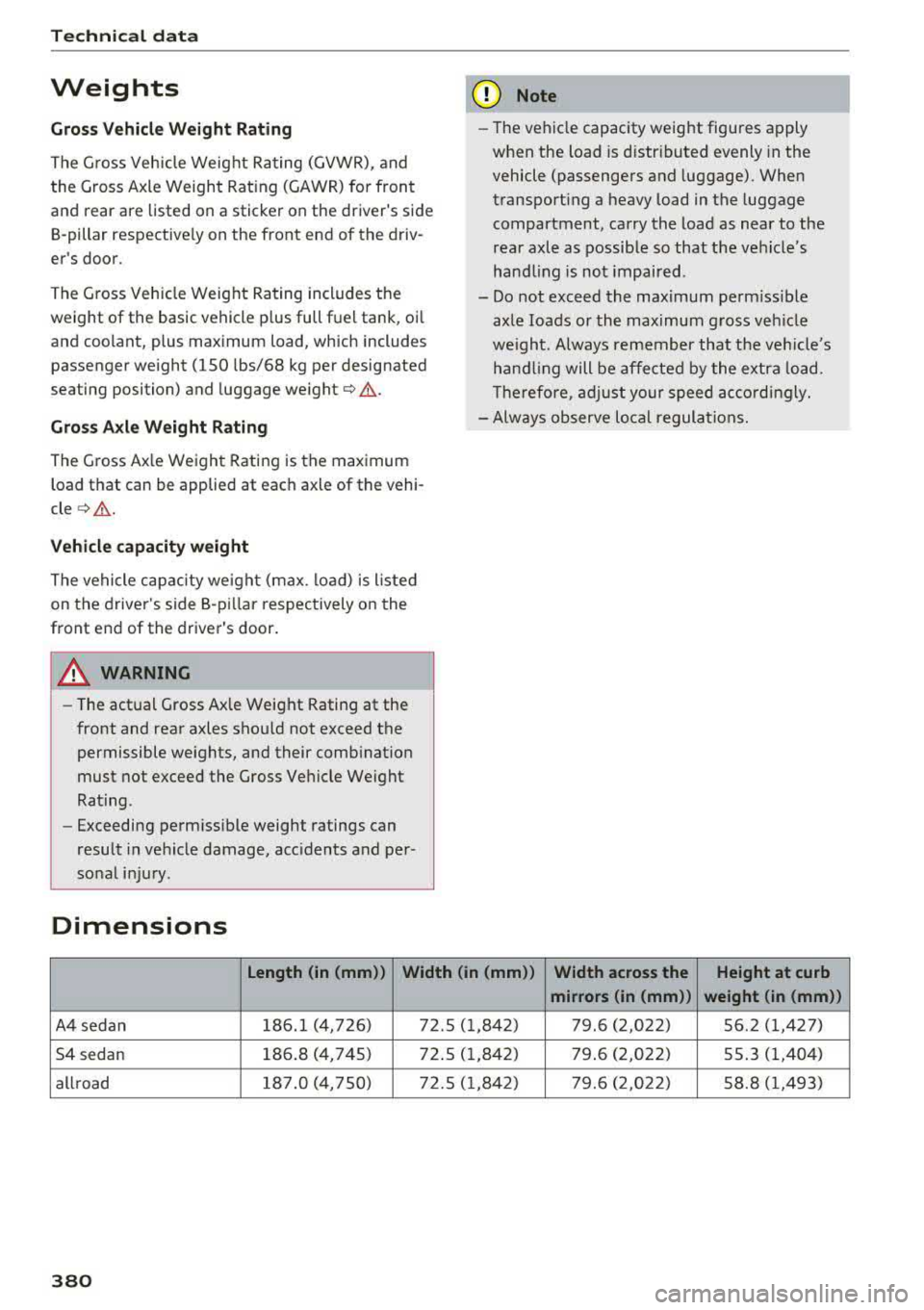
Length (in (mm )) Width (in (mm ))
Width across the Height at curb
mirrors (in (mm )) weight (in (mm))
A4 sedan 186.1 (4,726) 72.5 (1,842) 79.6 (2,022) 56.2 (1,427)
54 sedan 186
.8 (4,745) 72 .5 (1,842) 79 .6 (2,022) 55 .3 (1,404)
all road 187.0 (4,750) 72.5 (
1,842) 79.6 (2,022) 58.8 (1,493)
380