wheel AUDI S4 2018 Owner's Manual
[x] Cancel search | Manufacturer: AUDI, Model Year: 2018, Model line: S4, Model: AUDI S4 2018Pages: 403, PDF Size: 66.81 MB
Page 91 of 403
a co .... N ..... N .... 0 0
3 co
~ Applies to: automatic transmission: Select the
P selector lever position .
~ Turn the eng ine off ¢,&. .
~ Applies to: manual transmission: Engage 1st
gear.
~ Turn the steering wheel when parking on in
clines so that the wheels will roll into the curb
if the veh icle starts moving .
A WARNING
-Never accelerate or release the clutch pedal
carelessly when a gear or a selector lever
posit ion (automatic transmission) is engag
ed whi le the vehicle is stationary and the en
gine is running. Otherwise, the vehicle will
start to move immediately and this cou ld re
sult in an accident.
- Emergency braking should only be used in
an emergency, when the normal brake peda l
has failed or the brake pedal is obstructed.
During emergency braking, your veh icle will
brake sim ilar to heavy brak ing . ESC and the
associated components (ABS, ASR, EDL)
cannot overcome the laws of physics,
Around curves and when road or weather
conditions are bad, a full brake application
can cause the vehicle to skid or the rear end
to swerve, which increases the risk of an ac
c ident.
- If the power supply fails, you cannot set the
park ing brake if it is released . If th is is the
case, stop the veh icle on leve l ground and
secure it by engaging 1st gear (manual
transmiss ion) or select ing the P selector lev
er position (automatic transm iss ion). See an
authorized Aud i dealer or autho rized Aud i
Service Facility for assistance .
- Always take the vehicle key with you when
leaving your vehicle, even if for a short pe ri
od of time. This applies particu larly when
children remain in the vehicle. Otherwise,
children could start the engine, release the
parking brake or operate electrical equip
ment such as powe r windows, which in
creases the risk of an acc ident.
- No one, especially children, shou ld remain
in the vehicle when it is locked. Locked
doors make it more difficult for emergency
D riving
workers to get into the vehicle, which puts
lives at risk.
(D Tips
Ap plies to : vehicles with auto matic transmissions
When stopp ing at a traff ic signa l or stopp ing
i n city traffic, you can set the park ing brake
manually . The vehicle does not have to be
held with the brake pedal. The park ing brake
eliminates the tendency to creep when a se
l ector lever position is engaged. As soon as
you press the a ccelerator peda l, the parking
brake releases automatically and your vehicle
starts to move r=;,
page 89.
(j) Tips
-Occasional noises when the pa rking brake is
set and released are normal and are no t a
cause for concern.
- The parking brake goes through a self-test
cycle at regular intervals when the vehicle is
stopped. Any noises assoc iated with this are
normal.
- If there is a power failure, the parking brake
wi ll not set if it is released, and it will not
re lease if it is
set ¢.&. . See an a uthorized
Audi dealer or authorized Audi Service Fa cility for assistance.
Starting to drive
Various convenience and safety funct ions may be
available when the vehicle begins driving, de
pending on vehicle equipment .
Starting on hills with the p arking brake set
Requirement: the driver's door must be closed .
~ To start driving comfortably when on a hill , set
the parking brake and begin driving as usual.
The braking force of the parking brake does not
release a utomatically until the wheels build up
enough driving force.
Starting on hills with hill hold assist
Hi ll ho ld assist makes it easier to start on hills.
Requirement: the driver's door must be closed
and the engine must be running.
89
Page 92 of 403

Driving
"'T o activate hill hold assist, press and hold the
brake peda l for several seconds. The vehicle
must be in an uph ill direction of travel.
Afte r releasing the bra ke pedal, the brak ing pow
er is ma intained for a brie f
moment¢ A to pre
vent the vehicle from rolling back when starting .
During this time, you can eas ily beg in to move
your veh icle.
A WARNING
- If you do not begin dr iving immediately or
the engine stalls after releas ing t he brake
peda l, yo ur vehicle may begi n to roll back
ward . Press t he b rake pedal o r set the park
i ng bra ke immed iate ly.
- The intelligent techno logy of hill hold assist
c annot overcome the lim itations imposed by
n atu ral physical laws. The incre ased comfo rt
offered by h ill hold assist sho uld not cause
yo u to take safety risks .
- Hill ho ld assis t can not hold the veh icle in
place on all h ills ( for example, i f the gro und
is slippery or icy) .
- T o reduce the risk of an ac cident, always
make sure the vehicle is si tuated safely
whi le stat ionary.
Driving offroad
General information
A ppl ies to: a ll r oad
The electro nic stabilization co ntrol (ESC) func
tions were e nhanced for dr iv ing offroad. Offroad
mode c an be ac tivated whe n driving in situat ions
where slipp age or a different ia l loc k func tion is
necessary ¢ page 147. The h ill descent ass ist is
a lso available, which automatica lly brakes the
ve
h icle and mainta ins a constant speed as a result
¢ page 148. In add ition, your Audi prov ides con
tinuous all wheel drive.
However , you r Audi is not an offroad vehicle.
Only drive in terrain that is su itable for the vehi ·
cle and your driving abilit y. Never take an y un·
neces sary risks!
90
Afte r driving offroad
- After driving off road , remove b ranches and
other debris from the rad iator grille, under
body, and wheels . Look especially fo r foreign
objects (such as stones) that may be st uck in
the t ire tread.
- Clean the vehicle body and underbody and
in
spect the vehicle for possible damage.
- Clean the windows, headlights, tail lights and
the license p late if they are dirty.
- Per form a brake test (especia lly after d riving
throug h water) .
A WARNING
-Be especially aware and attentive when d riv
ing under diff icu lt cond itions. Vehicle dam
age and in juries may occur when driving at
excess ively high speeds or with incorrect
driving maneuvers.
- Always ad just yo ur speed and driving sty le
to the roads, terrain, traffic and weat her
conditions . Drive especially slowly if there is
low visibility when off road.
- Please note that t he wheels can sp in mo re
and the vehicle can swerve when in offroad
mode, espe cially when the road is slippery
or h as loose s urfa ce mate rial.
- D riving stability is reduce d when in offroad
mode.
@ For the sake of the environment
Avo id harm ing the env ironmen t and show
conside ration fo r nat ure.
(D Tips
Only drive where it is permitted and always
stay on the prov ided roads and paths .
Driver messages
Applies to : allroad
There is only one right way to drive in difficul t
conditions: slowly and with caution!
Observe the following when driving on unpaved
r oads :
1111>
Page 93 of 403
.. Only drive in terrain that is suitable for the ve
hicle and your driving ability. Never take any
unnecessary risks!
.. Drive slowly and carefully.
.. Pay attention to the ground cl eara nce of your
vehicle .
.. Activate the o ffroad mod e as needed
~page 147 .
.,. Use the hill de sce nt ass is t when dr iving down
steep h ills
¢page 148.
Difficult ter rain
When driving in unfamiliar areas and offroad,
drive slowly and keep on the watch for unexpect
ed obstacles (such as potholes, rocks, tree
stumps, etc.).
To prevent the veh icle from bottoming out and to
reduce the risk of underbody damage, you sho uld
d rive across uneven ground on only one side of
the veh icle so that only two of your wheels cross
the uneve n are a, instead of driving across the
center of the uneven area with a ll four wheels .
Drive quick ly through sandy or marshy off-road
sections and do not stop, if at all possible.
Driving through water
Also read the information found i n¢ page 80.
Automatic transmission
Introduction
Applies to: vehicles with automatic transm issions
The automat ic transmission is controlled elec
tronically. The transmission shifts up o r down au
tomatically depend ing on which drive program is
se lected .
When a
moderate drivi ng style is used, the
transmission selects the most economical driving
mode. The transmiss ion upshifts at a lower RPM
and downshifts at a higher RPM to improve fuel
efficiency .
The transm ission switches to a sporty mode after
a kick-down or when the driver uses a
s po rty
d rivi ng style
character ized by quick accelerator
pedal movements, heavy acceleration, frequent
D rivi ng
changes in sp eed and traveling at the maximum
speed.
If des ired, t he d river can also se lect the gea rs
manually (tiptronic mo de) ¢ page 94 .
S tronic transmission
The S tron ic is a dual-clutch transmission . Power
is transferred using two clutches that work inde
pendent ly from one another. They rep lace the
torque conve rter used in convent io nal automatic
transm issions and allow the vehicle to accelerate
without a noticeable interruption in traction.
tiptronic transmission
In th e tiptronic transmission, power is t ransfer
red by a torque conve rter.
Selecting a selector lever position
Applies to: vehicles with automatic transmissions
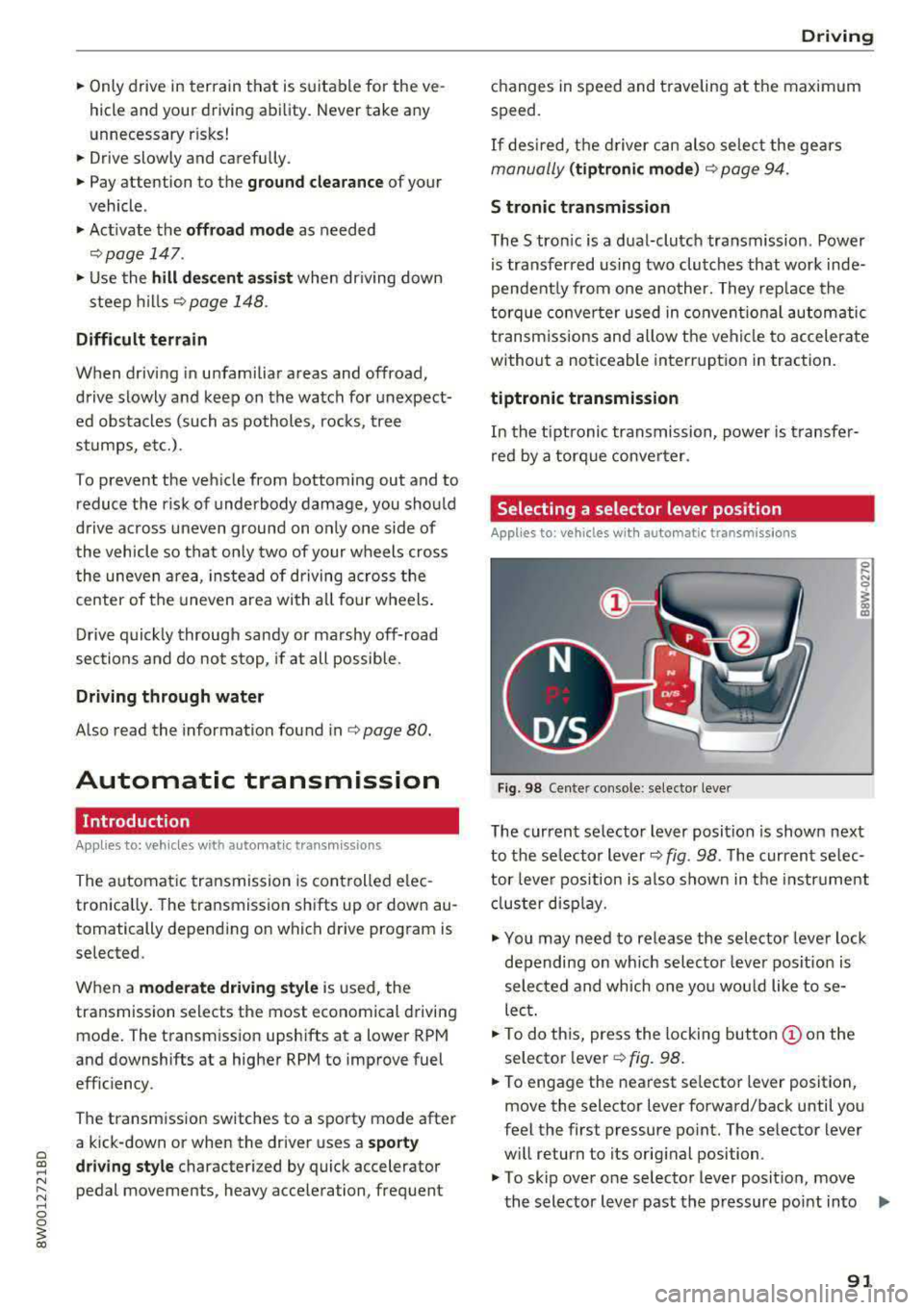
Fig. 98 Center console : se lector lever
The current se lector lever position is shown next
to the se lector lever
c::> fig. 98 . The current se lec
tor leve r position is a lso shown in the instr ument
cl uster disp lay.
.. You may need to release the selector lever lock
depending on wh ich selector leve r pos ition is
selec ted and which one you would like to se
lect.
.. To do th is, press the locking button (!) on the
selector
l ever¢ fig. 98.
.,. To engage the nearest se lector lever position,
move the selector lever forward/back until you
feel the first pressure po int. The selector lever
w ill return to its original position .
.,. To skip over one selector lever position, move
the selector lever past the pressure point into .,,.
91
Page 95 of 403

In the no rmal mode D, the transmission a uto
matica lly selects the suitab le gear ratio. It de
pends on eng ine load, vehicle speed and driving
style.
Select the
sport mode S for sporty driving. The
vehicle makes full use of the engine's power.
Shifting may become noticeable when accelerat ing.
The S selector lever position engages automati
cally when you se lect
Dynamic mode in drive se
l ect*.
A WARNING
Read and follow all WARNINGS.
-The vehicle can roll even if the ignition is
switched off.
-Power is sti ll transmitted to the wheels
when the eng ine is running at idle . To pre
vent the veh icle from "creeping", you must
keep your foot on the brake in all selector
lever positions (except P and N) when the
engine is running .
-Before opening the hood, select the P selec
tor lever position and set the parking brake.
This reduces the risk of an accident. Always
read and fo llow the applicable warnings
¢ page 323, Working in the engine com
partment.
@ Tips
If you accidentally se lect N wh ile d riving, take
your foot off the accelerator pedal and wa it
for the engine to slow down to idle before se
lect ing Dor S.
Driving tips
Appl ies to: vehicles with automatic transmissions
Starting the engine
.,. The P or N position must be selected.
Starting from a stop
.. Press and hold the brake pedal.
~ .. Start the engine ¢ page 83 .
;::; .,. Press the lock ing button @ on the selector Lev-,....
:::l er and select the D, E, So r R position 0
3 ¢page 91 .
.. Wait a moment until the transmission shifts.
You will notice a slight movement when the
gear engages .
.. Release the brake pedal and press the accelera-
tor
pedal ¢&, .
Various convenience functions are available for
start ing on h ills
¢ page 89.
Stopping temporarily
.,. Press the brake pedal to stop the vehicle, for
examp le at a traffic light. Do not press the ac
celerator pedal when doing this .
.. To prevent the vehicle from rolling when you
start driving, set the parking brake when stop
ping on steep
hills ¢&, .
.. The parking brake will release automatically
and the vehicle will start moving once you press
the accelerator pedal.
Stopping /parking
If the selector lever is not in the P position when
you open the driver's door, the vehicle could roll.
.. Press and hold the brake peda l¢ &, .
.. Set the parking brake.
.. To select the P selector lever posit ion, press the
P button
@ on the selector lever¢ page 91 ,
fig . 98 .
Under certain conditions, such as driving in the
mountains or when towing a trailer, it may be
helpful to switch to manual mode temporar ily
and shift
manually to adapt to the driv ing cond i
t ions ¢ page 94 .
On hills, activate the park ing brake first and then
shift into the P
position ¢ page 88. This prevents
too much stress from being placed on the locking
mecha nism .
A WARNING
--The vehicle can roll even when the engine is
switched off.
-Unintended vehicle movement can lead to
. . . . serious mJunes .
-To reduce the r isk of an accident, do not
press the accelerator pedal when changing
the selector lever position while the vehicle
is stationary and the engine is running.
93
Page 96 of 403

Driving
-To reduce the risk of an accident, never select the R or P positions while driving.
-Do not inadvertently press the accelerator
pedal when the vehicle is stationary. Other
wise the risk of an accident increases be
cause the vehicle will start to move immedi
ately, even if the parking brake is set.
(D Tips
For safety reasons, the parking brake only re
leases automatically when the driver's door is
closed.
Hill descent control
A pp lies to: ve hicles w ith automat ic tra nsmissio ns
The hill descent control system assists the driver
when driving down hills.
Hill descent control activates when the transmis
sion is in the Dor S position and you press the
brake pedal. The transmiss ion automatically se
lects a gear that is suitable for the hill. Hill de
scent control tries to maintain the speed ach
ieved at the time of braking, within physical and
technical limitations. If may still be necessary to
adjust the speed with the brake pedal.
Hill descent control switches off once the hill lev
els out or you press the accelerator pedal.
When operating the cru ise contro l system*
c:;, page 102, hill descent control is also activated
when the speed is set.
A WARNING
Hill descent control cannot overcome physical
limitations, so it may not be able to maintain
a constant speed under all conditions. Always
be ready to apply the brakes.
94
Shifting manually (tiptronic mode )
Applies to : vehicles wit h automatic transmissions
The tiptronic mode allows the driver to shift the
gears manually .
Fig. 99 Cente r console: sh if ting ma nually with the selecto r
lever
Fig. 100 Steering wheel: sh ift ing manual ly
Shifting with the selector lever
You can shift into tiptronic mode while stationary
and while driving.
.,. To shift into tiptronic mode, push the selector
lever from the D/S position to the right. As
soon as the transmission switches over, the
M
transmission setting will appear in the instru
ment cluster display .
.,. To shift up a gear, tap the selector lever for
ward
0 c:;, fig. 99 .
.,. To shift down a gear, tap the selector lever back
0-
11> To switch t iptronic mode off, push the selector
lever back into the D/S position.
Shift ing with the shift paddles
You can operate the shift paddles in the D/S or M
selector lever positions .
.,. To shift up a gear, tap the shift paddle 0
c:;, fig. 100.
Page 97 of 403

a co .... N ,....
N .... 0 0
3 co
.,. To shift down a gear, tap the 0 shift paddle.
.. To engage the lowest gear, hold the 0 shift
paddle.
.. If you do not press a shift button within a short
time while in the D/S position, the transmission
will return to automatic mode. To keep shifting using the shift paddles, move the selector lever
to the right out of the D/S position .
.,. When you want to shift out of tiptronic mode,
press and hold the
0 shift paddle for a longer
period of time or move the selector lever back
and release it.
The transmission automatically shifts up or down before critical engine speed is reached.
The transmission only allows manual shifting
when the engine speed is within the permitted
range.
@ Tips
- If you shift to the next lowest gear, the
transmission will only shift if the engine will
not be over-revved.
- With kick-down, the transmission shifts to a
lower gear, depending on vehicle speed and
engine speed.
- tiptronic does not work if the transmission
is running in emergency mode.
Kick-down
Applies to: vehicles with automatic transm issions
Kick-down enables maximum acceleration.
When you press the accelerator pedal down be
yond the resistance point, the automatic trans
mission downshifts into a lower gear and the en
gine utilizes its full power , depending on vehicle
speed and engine RPM. It shifts up into the next
higher gear once the maximum specified engine
RPM is reached.
A WARNING
Please note that the wheels could spin on
slick or slippery roads when kick-down is ac
tive .
-
Driving
Launch control program
Applies to: vehicles with S tronic transmission
The launch control program provides the best
possible acceleration when starting from a stop .
Requirement: the engine must be at operating
temperature and the steering wheel must not be
turned .
.. Deactivate the Start/Stop system* c> page 87 .
The LED in the ICA> ~I button turns on .
.. Applies to: seda n: Press the I.B OFFI button
briefly while the engine is running
c> page 147.
The II indicator light turns on and the mes
sage
Stabilization control (ESC): sport. Warn·
ing! Restricted stability
appears in the instru
ment cluster display .
.. Applies to: allroad: Press the i.i, O FF I button
briefly while the engine is
running ¢ page 147.
The II indicator light turns on and the mes
sage
Stabilization control (ESC): offroad.
Warning! Reduced stability
appears in the in
strument cluster display .
.. Pull the selector lever back out of the D/S posi
tion briefly to select the S position or select the
Dynamic driving mode in drive se-
lect* ¢ page 134 .
.,. Press the brake pedal firmly with your left foot
and hold it all the way down for at least one
second .
.. At the same time, press the gas pedal all the
way down with your right foot until the engine
reaches and stays at a high RPM level.
.. Remove your foot from the brake pedal within
five
seconds ¢,,&. .
A WARNING ~
-Always adapt your driving to the traffic flow.
- Only use the Launch control program when
road and traffic conditions allow it and oth
er drivers will not be endangered or both
ered by your driving and the vehicle's accel
eration.
- Please note that the drive wheels can spin
and the vehicle can break away when sport
mode/offroad mode is switched on, espe
cially when the road is slippery.
95
Page 100 of 403

Driving
"' Keep the brake pedal pressed and engage the
fo llowing se lector lever positions one after the
other: N, D and back to N.
"' Turn the eng ine off again .
"' Grasp the socket wrench w ith both hands and
pull it up and out carefully to remove
<=> (D .
"' Reinsert the cover and rubbe r mat.
When the parking lock emergency re lease is
used, the
mJ ind icator light and the N selector
lever position tu rn on in the instrument cluster .
The message
Dang er of rolling away! P not pos
s ible . Please apply parking brake
a lso appea rs .
.&_ WARNING
- Only activ ate the emerge ncy re le ase while
on a level s urface o r a slig ht slope.
- T he pa rking lock may only be released using
the emergency release if the parking brake
is set. If i t is not functioning, secure the ve
hicle from rolling using the brake peda l or
other s uitab le means, s uch as blocking a
front and a rear wheel. An unsec ured vehicle
may roll away, wh ich increases the r isk of an
acc ident.
- To reduce the risk of an accident, you m ust
not drive when the eme rgency re lease is ac
t ivated.
(D Note
- Read and fo llow the impo rtant instr uctions
abo ut towing<=>
page 376.
- The risk of damage increases if you do not
r emove the socket wrench carefully when
resett ing the pa rking lock.
98
-
Page 103 of 403

a co .... N ,....
N .... 0 0
3 co
Backing up is difficult and requires pract ice .
Backing up with a trailer generally requires steer
i ng action oppos ite to that when backing up your
ve hicle w ithout a trailer.
M ain tain a greater d istance between your vehicle
and the one in front of you. Yo u wi ll nee d more
room to stop. To compensate fo r th e tra iler, yo u
will need a larger than no rmal turn ing rad ius.
When pass ing, remembe r th at you ca nnot accel
erate as fast as you norma lly wou ld because of
the added load. Make s ure yo u have eno ugh room
to pass. After passing , allow plenty of room fo r
your tra ile r before changing lanes again.
Avoid jerky starts, s harp turns or ra pid lane
changes .
(D Tips
-Do not tow a trailer during t he br eak -in per i
o d of yo ur vehicle .
-If you tow a trailer, your Audi may require
more frequent maintenance due to the ex
tra load
~ page 3 83.
Parking on a slope
D o not pork on o slope with o trailer . If it canno t
be avoided, do so only ofter doing the following:
When parking:
.. Apply the f oot brake .
.. Have someone p lace chock s under both the ve
hicle and the tra il e r whee ls .
.. Wi th chocks in p lace, slowly release t he b rakes
u nti l the w hee l chocks absor b the load .
.. Turn the wheels towa rds the curb .
.. Apply the pa rking brake .
.. Move the se lector lever to P (a utomat ic t rans
mission) respectively select first gear (manual
t ransm iss io n).
When restarting after parking:
.. Apply the foot b rake .
.. Start the engine .
.. Applies to: vehicles with automatic transmis
sion: Move the selector lever to D/S .
.. Release t he pa rking bra ke and s low ly pull ou t
and away from t he whee l chocks .
Trailer towing
.. Stop an d have someone retrieve the whee l
choc ks.
101
Page 108 of 403

Assistance systems
The vehicle is in a country where the function is
not available.
Lap timer
Introduction
App lies to: ve hicles w ith la p timer
You can measure and analyze lap times with the
lap timer in the display.
Opening the lap timer
~ Open the first Vehicle tab (trip computer) using
the
l
wheel.
~ Select on the multifunction steering wheel: left
control button
> Lap times.
Operating the lap timer
~ On the multifunction steering wheel, turn the
left thumbwheel
(J) <=> page 13 until the desired
menu item is displayed in the instrument clus
ter .
~ Press the left thumbwheel to confirm the selec
tion.
_& WARNING
Your focus should always be on driving your
vehicle safely. As the drive r, you have com
plete responsibility for safety in traffic. Only
use the functions s uch as the lap timer in such
a way that you always maintain comp lete con
trol over your vehicle in all traffic situations.
@ Tips
You can retrieve information from the trip
computer while the lap timer stopwatch is running.
Lap times and timing
A ppl ies to: ve hicles w ith la p timer
Requirement: the lap timer must be open
<=> page 106.
Timing laps
~ To start timing manually, se lect Start lap 1 in
the menu.
106
~ T o start timing automatically as soon as you
begin to drive, select
Start lap 1 by driving off
or Start by driving off i n the menu.
~ To measure the lap time, select New lap in the
menu. This starts timing the next lap at the
same time.
After completing a lap, the difference between
the last lap and the previous best lap time will be
indicated with
a"-" or" +".
Pausing timing and displaying a split time
~ To insert a pause m, select Pause in the menu.
~ To resume timing, select Resume in the menu.
~ To display a split time, select Split time in the
menu. The split
time (~] appears for approxi
mately 10 seconds in the instrument cluster.
The timing of the current lap continues.
Resetting timing
~ Using the multifunction steering wheel, select
Reset times in the menu.
(D Tips
- A maximum of 99 lap times can be meas
ured.
-If timing is paused, you can continue it later
even if you switch the ignition
off.
-Saved lap times cannot be individually de
leted from the total results.
-The saved lap timer values w ill remain after
switching the ignition
off.
Lap statistics
App lies to: vehicles wi th lap t imer
Displaying lap statistics
You can display the number of laps driven, the
fastest lap" +", the slowest
lap" -", and the aver
age time
"0" in the instrument cluster.
~ On the multifunction steering wheel, select the
left control button
> Lap statistics or Statis·
tics.
~ Turn the thumbwheel down or up to d isplay the
individual lap times.
~ To return to the lap timing that was begun,
press the left thumbwheel.
Page 111 of 403

General information
Appl ies to: ve hicles with Audi adaptive cruise contro l
Fig. 108 Fro nt of the vehicle: sensors and video camera
The areas with the radar and ultrasonic sensors
and the video camera
c:> fig . 108 must not be cov
ered by stickers, deposits or any other objects, because this can inte rfere with the adaptive
cr uise control funct ion. For information on clean
ing, see
c:> page 354 . The same app lies for any
modifications made in the front area.
In some d riving situations, the adaptive cru ise
control funct ion is restr icted:
- Vehicles can only be detected when they are within the sensor detection zones
c:> page 108,
fig. 107.
- The system has a limited abil ity to detect
vehicles that are a short distance ahead, off to
the side of your vehicle or moving into your
lane .
- Objects that are difficult to detect such as mo
torcycles, vehicles with high ground clearan ce
or an overhanging load are detected late or not dete cted at all.
- When driving through curves
c:> page 110 .
-When the vehicle is stat ionary c:> page 110.
..&, WARNING
Always pay attent ion to the traffic aro und you
when adap tive cruise contro l is swi tched o n.
As the driver, you are s till responsible for your
own speed and the distance to other vehicles .
The adaptive cruise control is used to assist
you. The driver must a lways take action to
avoid a collision. The driver is a lways responsi
ble for brak ing at the correct time.
A ss is ta nce syst ems
-For safety reasons, do not use adaptive
cru ise control when the road surface is in
poor condition and/or in bad weather condi
tions (such as ice, fog, gravel, heavy rain and
hydroplaning). Using the system under
these conditions increases the r isk of an ac
cident.
- Sw itch adaptive cruise control off tempora
rily when dr iv ing in turning lanes, on ex
p ressway ex its (except if predictive con trol
is switched on) or in const ruct ion zones.
This prevents the vehicle from acce lerating
to the stored speed when in these situa
tions.
- The adaptive cruise contro l system will not
brake by itself if you put your foot on the ac
celerator pedal. Doing so can override the
speed and distance regulation.
- When approaching stationary obstacles
such as stopped traffic, adaptive cruise con
trol will respond with limited function.
- Adaptive cr uise control does not respond to
peop le, animals, or crossing or oncoming
objects.
- The funct ion of the radar sensors can be af
fected by reflective objects such as guard rails, the entrance to a tunnel, heavy rain or
ice.
(D Note
The sensors can be displaced by impacts or
damage to the bumper, wheel housing and underbody. This can impair the adaptive
cruise control. Have an authorized Audi dealer
or authorized Audi Service Facility check
the ir
f u nct ion.
(D Tips
For an explanation on conformity with the
FCC regulations in the United States and the
Industry Canada regu lations, see
c:> page 38 6.
109