brake AUDI S4 2018 Workshop Manual
[x] Cancel search | Manufacturer: AUDI, Model Year: 2018, Model line: S4, Model: AUDI S4 2018Pages: 403, PDF Size: 66.81 MB
Page 148 of 403
Intelligent Technology
Intelligent Technology
Electronic stabilization
control (ESC)
Description
Elect ronic stabilization control (ESC) supports
driver safety.
It red uces the risk of slipping and
improves driving stability. ESC detects crit ica l sit
uations such as when the vehicle is oversteering
and understeering or the wheels are spinning.
The vehicle is stabilized by applying the brakes or reducing eng ine torq ue. When the ESC engages,
the hJ ind icator light blinks in the instrument
cluste r.
The fo llow ing systems are integrated in the ESC:
Ant i-loc k bra king system (ABS)
ABS prevents the whee ls from locking when brak
ing. The vehicle can sti ll be steered even during
hard brak ing. Apply steady pressure to the brake
pedal. Do not pump the pedal. A puls ing in the
brake pedal indicates that the system is acting to
stabilize the vehicle .
Brake assist system
The brake assist system can decrease brak ing dis
tance . It increases braking power when the driver
presses the brake pedal quick ly in emergency sit
uations . You must press and hold the b rake pedal
until the dangerous situat io n is over . In veh icles
with adapt ive cr uise control*, the bra ke assist
sys tem is more sensitive if the d ista nce detec ted
t o the vehicle dr iv ing ahead is too small.
Anti -Slip Regulation (ASR )
ASR reduces eng ine power when the drive wheels
begin sp inning a nd adapts the force to the road
conditions . This makes it easie r to start, acceler
a te and dr ive up h ills.
Electron ic differenti al lock (EDL )
The EDL applies the brakes to a wheel that starts
spinning and transfers the drive power to the
other driving wheel or wheels ( if the veh icle is
eq uipped w ith all whee l dr ive*) . T his function is
not available at higher speeds.
146 In extreme cases,
ED L automat ically switches off
to keep the brake on the braked wheel from over heating. The veh icle is still working correct ly. ED L
will switch on again automatically when condi
tions have returned to normal.
Steering r ecommendat ion
The ESC he lps to stabilize the vehicle by changing
the steering torque.
In veh icles with dynamic s teer ing*, ESC a lso
helps to stab ilize the steering in cr it ica l situa
tions.
Selective wheel torque control
Se lective whee l torque cont rol is used when d riv
i ng on curves. The front whee l on the inside of
t h e curve or both whee ls on the i nside of the
curve are braked se lectively as needed. This al
l ows more precise driving in curves.
Automatic post -collision b raking system
The "automat ic post-collis io n braking system"
can help to reduce the risk of sliding and of addi
tiona l collisions after an acc ident. If the a irbag
contro l modu le detects a collision, the ve hicle is
braked by the ESC.
The veh icle does not bra ke automatically if:
-the dr iver presses the accelerator pedal, or
-the ESC, the brake system or the veh icle electri-
cal system are not functioning.
&_ WARNING
-The ESC and its integrated systems cannot overcome the lim its imposed by natura l
phys ica l laws. This is espec ially important
on sl ippery or wet roads. If the systems be
gin acting to stabilize your vehicle, you
should immediately alter your speed to match the road and traffic conditions. Do
not let the increased safety provided tempt
you into taking risks. This could increase
your r isk of a coll is ion.
-Please note the r isk of a coll is ion increases
when dr iv ing fast, especially through curves
and on slippery or wet roads, and when dr iv
ing too close to objects ahead . The ESC and
its integrated systems cannot always
Page 150 of 403
Intelligent Technology
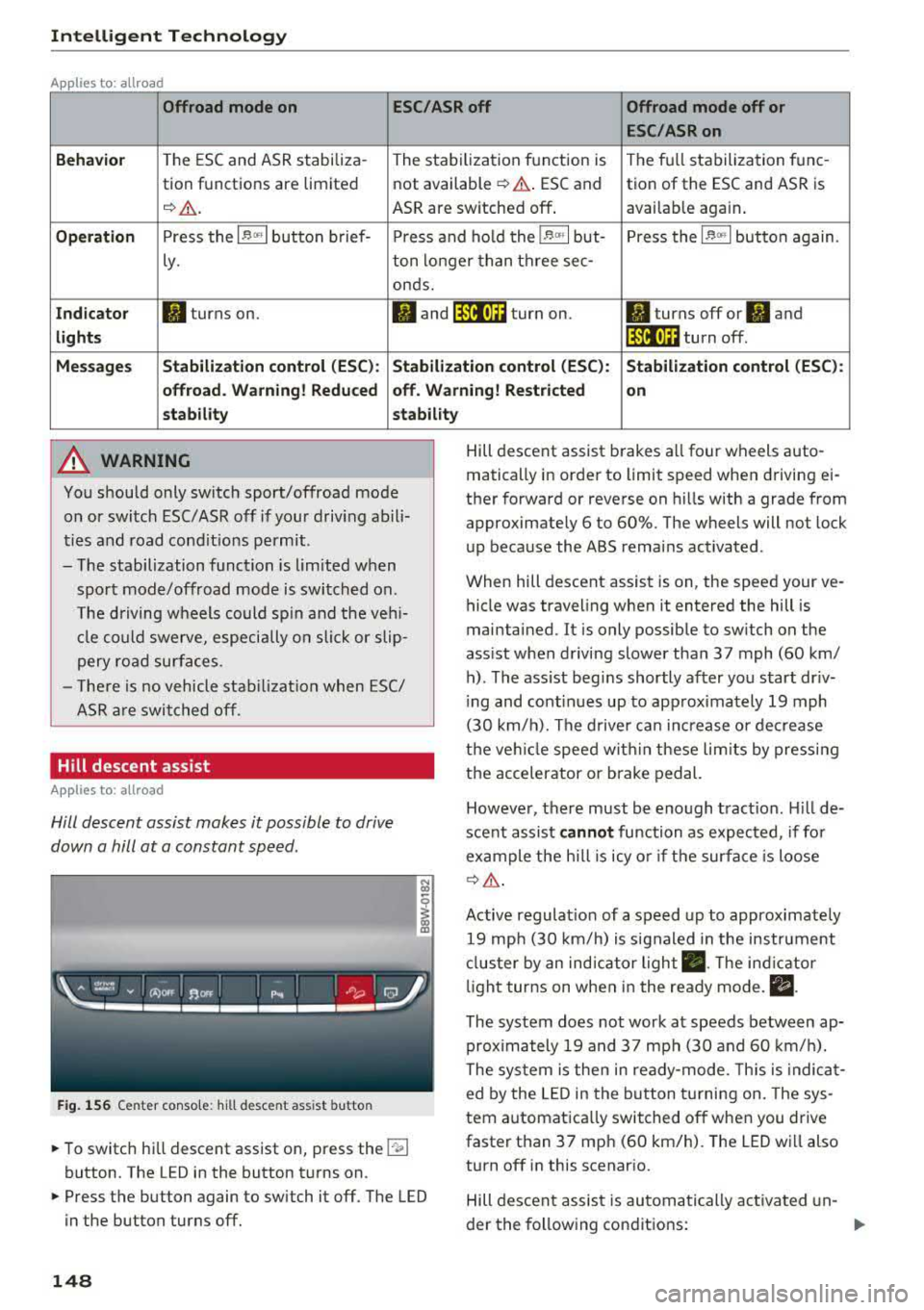
Applies to: allroad
Offroad mode on
ESC/ASR off Offroad mode off or
ESC /ASR on
Beha vior
T he ESC and ASR stabiliza -The stabi lization f unction is The f ull stabilization tune -
tion functions are limited not available
¢ .&. . ESC and tion of the ESC and ASR is
¢ & . ASR are sw itched off . available aga in .
Operation Press the l~ m l button b rief- Press an d ho ld the l~ "'' I but- Press the l~ "" I button again .
ly. ton longer than three sec-
onds.
Indicator II turns on. Iii and lf'tii•)H turn on. II turns off or II and
light s li'tii•)H turn off .
Message s Stabilization cont
rol (ESC ): Stabiliza tion control (ESC ): Stabilization cont rol (ESC ):
offroad . Warning! Redu ced off . Warning! Restricted
on
s tability stability
A WARNING
You should only switch sport/offroad mode
on or switch ESC/ASR off if you r drivi ng abili
ties and road cond it ions permit .
- The stabilization function is lim ited w hen
sport mode/offroad mode is swi tched on.
T he driving w heels could sp in and the veh i
cl e could swerve, especi ally o n slick or slip
pery road sur faces.
- T here is no vehicle sta biliz at ion when ESC/
ASR a re swi tched off.
Hill descent assist
Applies to: allroad
Hill descent assist makes it possible to drive
down a hill at a constant speed.
F ig. 1 56 Center co nso le: hil l desce nt ass ist button
~ To switc h hill descent assist on, press the !"~I
button. The LED in the button t urns on.
~ Press the button again to switch it off. The LED
in the button turns off.
148
Hill descent assist brakes a ll four wheels auto
matically in order to limit speed when d riving ei
ther forward or reverse on hills with a grade from
approximately 6 to 60%. The wheels will not lock
u p because the ABS remains activated.
When hill descent assist is on, the speed your ve
hicle was traveling when it entered the hill is
maintained. It is only possib le to sw itch on the
ass ist when driving slower tha n 37 mph (60 km/
h) . The ass ist beg ins shortly af ter you start dr iv
i ng and cont inues up to app roxima tely 19 mph
(30 km/h). The d rive r ca n in crease o r de crease
t h e ve hicle spee d wit hin these lim its by press ing
t h e accelerator or brake pedal.
However, there must be enough t ract ion . Hill de
sce nt assist
cannot function as e xpec ted, if fo r
ex ample the h ill is icy o r if t he surface is loose
¢ &.
Active regulat io n of a speed up to approximate ly
19 mp h (30 km/h) is s ignaled in the instr ument
cl us ter by an ind ic a tor light
• . The in dica tor
li gh t tur ns on when i n the ready mode.
II.
The system does not work at speeds between ap
prox imately 19 and 37 mph (30 and 60 km/ h).
The system is the n in ready-mode. This is indica t
ed by the L ED in the b utton t urnin g on. The sys
tem a utomatica lly switched o ff when you drive
faster than 37 mph (60 km/h). The LED w ill also
turn off in this scenar io.
Hill descen t assis t is au tomatically ac tiva ted un-
der the fo llowing cond itions:
.,.
Page 151 of 403
a co .... N ..... N .... 0 0
3 co
-the LED in the button turns on
-the vehicle speed is lower than 19 mph (30 km/
h)
-the h ill angle is at least app rox imately 6%
_& WARNING
-Always adapt yo ur speed to the weather,
road and traffic conditions. Do not let the
increased safety provided tempt you into
tak ing risks, because this increases the risk
of an accident.
-
-T he hill descent assist system cannot over
come the laws of physics. Your driving style
must a lways be adapted to the current road
and traffic conditions.
- Hill descent assist may not be able to hold your vehicle at a constant speed under a ll
condit ions while driving on a hill (for exam
ple if ground under the veh icle is loose) .
Brakes
New brake p ads
New brake pads do not ach ieve the ir full braking
effect during the first 250 mi (400 km). They
must be "broken
in" first. However, you can com
pensate for the slightly reduced brak ing fo rce by
p ressing firmly o n the brake pedal. Avoid heavy
b raking during t he b reak-in per iod.
Wear
B rake pad
wear depends largely on the way the
veh icle is driven a nd on operat ing cond itions.
This is especia lly true if you are d riving frequently
in t he c ity and on c urves or wi th a sporty driving
style.
Operating noise
Noises may occur when braking depend ing on the
speed, braking force and outs ide cond itions such
as temperature and humidity .
Wet conditions or road salt
In certain situations, for example after driving
through water, in heavy ra in or after washing
your car, the brak ing effect may be reduced due
to moisture or ice on the brake rotors and brake
Intellig ent Technology
pads. The brakes m ust be "dried" first with a few
carefu l brake app lications.
At higher speeds and w ith the win dshield wipe rs
tu rned on, the brake pads press agains t the b rake
roto rs fo r a short amount of time. This action,
which is not felt by the driver, happens at regu lar
i nterva ls and ensures a better reaction t ime for
the b rakes in wet weather.
T he brak ing effec t can a lso be reduced if yo u are
driving on salted roads and yo u do not app ly the
brakes for long per iods of t ime. The layer of sa lt
on the brake rotors and pads m ust be worn off
first whe n the brakes are applied.
Corrosion
Leaving the vehi cle parked for long periods o f
time, low mileage and avoiding heavy b raking
can contrib ute to corros ion on the brake rotors
and to dirty brake pads.
If you usu a lly avoid heavy bra king or if there is
corrosion present, occasiona l heavy braking at
high speeds is recommended to clean the brake
roto rs and
pads ¢~ -
Brake system malfunction
If you notice that the bra ke pedal trave l has sud
denly increased, then a brake circuit in the dua l
ci rcuit brake system may have malfunctioned.
Drive to an authorized Audi dealer or authorized
Audi Service Facility immed iate ly to have the
problem corrected. On the way there, drive w ith
reduced speed and keep in mind t hat you will
need a longer distance to stop and you will need
to press the bra ke ped al ha rder.
Low brake fluid level
When the bra ke fluid level is low, malfunctions in
the brake system may occur. The brake fluid level is elec tronically monitored.
Brake booster
The brake booster ampli fies the p ressure you ap-
ply to the brake pedal.
.,..
149
Page 152 of 403
Intelligent Technology
& WARNING
- Only apply the brakes for the purpose of
cleaning the brake system whe n road and
t raffic conditions perm it . You must not en
dange r othe r road users . This increases the
risk of an accide nt.
- Never let the vehicle roll while the e ng ine is
stopped because this increases the risk of a n
a cci den t.
([) Note
- Neve r let the brakes " rub" by pressing the
pedal lightly when braki ng is not actually
necessa ry . T his ca uses the bra kes to over
h ea t an d inc reases br akin g d istance an d
c a uses wear .
- B efo re driv ing downhill a long distance on a
steep hi ll, decre ase your spee d an d se lec t a
l ower gear . This makes use of t he engine
b raking effe ct and re lieves the brakes . If
you nee d to b rake additionally, b rake in in
tervals and not continuously .
(D Tips
- If the brake booste r is no t working, yo u
must press the brake pedal with much more
fo rce than normal.
- If you retrofit you r vehicle with a front spoil
er, whee l covers o r similar items, ma ke sure
that the a ir flow to the front whee ls is not
i nte rr u pted. Othe rw ise the brake system
ca n become too hot.
Electromechanical
steering, Dynamic
steering
T h e electromechanical st eering supports the
driver's steering movements.
Power steering adapts electronically based on
the vehicle speed.
Indicator lights and messages
• St ee ring : malfunction! Plea se stop vehicle
150
If this indicato r light turns on and stays on and
this message appears, the power steering may
have failed.
Stop t he vehi cle in a sa fe location as soon as pos
s ible . Do
not contin ue driving . See an authorized
Audi dealer or authorized A udi Service Facility for
ass istance .
'I- ij Steering: malfun ction! You may continue
driving
I f the indicato r light turns on and the message
a ppears, the steeri ng wheel may be more d iffi
cu lt to move o r more sensitive than usu al. The
stee ring wheel may also be at a n ang le when
driving straight.
D rive slowly to an auth o rized Audi dea ler or au
thorized Aud i Serv ice Facili ty to have t he mal
f unct io n corre cted .
t$Jj Dynamic steering: correcting steering wheel
position
If the indicator light turns on and this message
appears , the dynamic steering * is re in it ia liz ing .
The s teer ing whee l will be easy to move afte r
st ar ting t he engine . Reinitializa tio n might be
ne cessary if the stee ring w heel was moved while
t h e engine was switched off. The disp lay t urns
off if the initialization was successfu l.
(D Tips
- If the . or krfl i ndi cato r ligh t only s tays on
f or a sho rt time, you may cont inue driving .
- Th e dynamic stee ring s tabili ty sys tem s
¢ page 14 6 are not av ailabl e in the event of
a system malfunction .
- For add ition al informa tion o n dynamic
s teering, see
¢ page 133.
ALL-wheel drive (quattro)
App lies to: vehicles wi th all wheel drive
General information
In all whee l dr ive, the dr iv ing power is dis trib ut-
ed between all fo ur whee ls when needed. This
happens automatically depending on your driving
behavior as we ll as the c urrent road conditions.
.,_
Page 155 of 403
a co .... N ,....
N .... 0 0
3 co
Notice about data
recorded by the Event
Data Recorder and
vehicle control modules
Event Data Recorder
This vehicle is equipped with an Event Data Re
corder (EDR) . The main purpose of an EDR is to
record, in certain crash or near crash-like situa
tions, such as an airbag deployment or hitting a
road obstacle, data that will assist in understand
ing how a vehicle's systems performed. The EDR
is designed to record data related to vehicle dy
namics and safety systems for a short period of
time, typically 30 seconds or less . The EDR in this
veh icle is designed to record such data as :
- How various systems in your vehicle were oper
at ing;
- Whether or not the driver and passenger safety
belts were buckled/fastened;
- How far (if at all) the driver was depressing the
accelerator and/or brake pedal; and,
- How fast the vehicle was traveling.
These data can he lp prov ide a better understand
ing of the circumstances in which crashes and in
juries occur. NOTE: EDR data are recorded by your
vehicle only if a non-trivial crash situation occurs;
no data are recorded by the EDR under normal
driving conditions and no personal data (e .g.,
name, gender, age, and crash location) are re
corded. Howeve r, other parties, such as law en
forcement, could combine the EDR data with the
type of personally identifying data routinely ac
quired during a crash investigation.
To read data recorded by an EDR, specia l equip
ment is required, and access to the vehicle or the
EDR is needed. In addition to the vehicle manu
facturer, other parties, such as law enforcement,
that have the specia l equipment, can read the in
formation if they have access to the vehicle or the
EDR.
Some state laws restrict the retrieval or down
l oading of data stored by ED Rs insta lled in a vehi
cle for the express purpose of retrieving data af
ter an accident or crash event without the own er's consent.
Intelligent Technology
Audi will not access the EDR and/or simi la r data
or give it to others -
- unless the vehicl e owner (or lessee if the vehi
cle has been leased) agrees; or
- upon the official request by the police; or
- upon the order of a court of law or a govern-
ment agency; or
- for the defense of a lawsuit through the jud ic ial
discovery process.
- Aud i may also use the data for research about
veh icle operation and safety performance or
prov ide the data to a th ird party for research
purposes without ide ntify ing the specific vehi
cle or information about the identity of its own
er or lessee and only after the reco rded vehicle
data has been accessed.
Vehicle control modules
Your vehicle is also equipped w ith a number of
electronic control modules for various vehicle
systems, such as engine management, emiss ion
contro l, airbags, and safety be lts.
T hese elect ronic contro l modu les record data
dur ing normal vehicle operation that may be
needed by trained technicians for diagnostic and
repair purposes. The recording capab ility of these
modules is limited to data (no sound is record
ed). Only a small amount of data is actually re
corded over a very limited period of time, or stor
ed when a system fault is detected by a control
module . Some of the data stored may relate to
vehicle speed, direction, or braking, as well as re
straint system use and performance in the event
of a crash. Stored data can also only be read and
down loaded w it h special equipment that is di
rectly connected to the vehicle .
(D Tips
Your vehicle may be equipped w ith Aud i con
nect. Your use of certain Audi connect fea
tures requires wire less services that are pro
vided by a third party wireless telecommuni
cations provider . For details regarding how in
formation obtained through Audi connect is
collected, processed, transmitted, used, and
shared, please see your contract with the
wireless telecommunications provider and the
IJJJ,-
153
Page 260 of 403
Pedal area
Pedals
The pedals must always be free to move and
must never be interfered with by a floor mat or
any other object.
Make sure that all pedals move freely without in
terference and that noth ing prevents them from
returning to their original positions .
Only use floor mats that leave the pedal area free
and can be secured with floor mat fasteners.
If a brake circuit fails, increased brake pedal trav
e l is required to bring the vehicle to a full stop.
A WARNING
Pedals that cannot move freely can cause loss
of vehicle control and increase the risk of seri
ous injury.
- Never place any objects in the driver's foot
well. An object could get into the pedal area and interfere w ith pedal function. In case of
sudden braking or an accident, you would not be ab le to brake or accelerate!
-Always make sure that nothing can fall or move into the dr iver's footwe ll.
Floor mats on the driver side
Always use floor mats that can be securely at
tached to the floor mat fasteners and do not interfere with the free movement of the pedals .
... Make sure that the floor mats are properly se
cured and cannot move and interfere with the
pedals
Q .&_ .
Use only floor mats that leave the pedal area un
obstructed and that are firmly secured so that
they cannot slip out of pos it ion . You can obtain
suitable floor mats from your authorized Audi
dealer.
Floor mat fasteners are installed in your Audi .
Fl oor mats used in your vehicle must be attached
to these fasteners. Properly securing the floor mats will prevent them from sliding into posi-
Driving safety
tions that could interfere with the pedals or im
pair safe operation of your vehicle in other ways.
.&_ WARNING
-
Pedals that cannot move freely can res ult in a
l oss of vehicle control and increase the risk of
serious personal injury.
-Always make sure that floor mats are prop
erly secured.
- Never p lace or install floor mats or other
f loor coverings in the vehicle that cannot be
proper ly secured in place to prevent them
from slipping and interfer ing with the ped
als o r the ab ility to control the vehicle.
- Never p lace or install floor mats or other
f loor cove rings on top of already installed
floor mats . Additional floor mats and other
cover ings will reduce t he si ze of the pedal
a rea and in terfere with the pedals.
- Always p roperly re insta ll and secure floor
mats that have been take n out fo r clean ing .
- Always make sure that objects cannot fall
into the d river footwell whi le the vehicle is
mov ing. Objec ts can become trapped under
the brake pedal and accelerator pedal caus
ing a loss of vehicle control.
Storing cargo correctly
Loading the luggage compartment
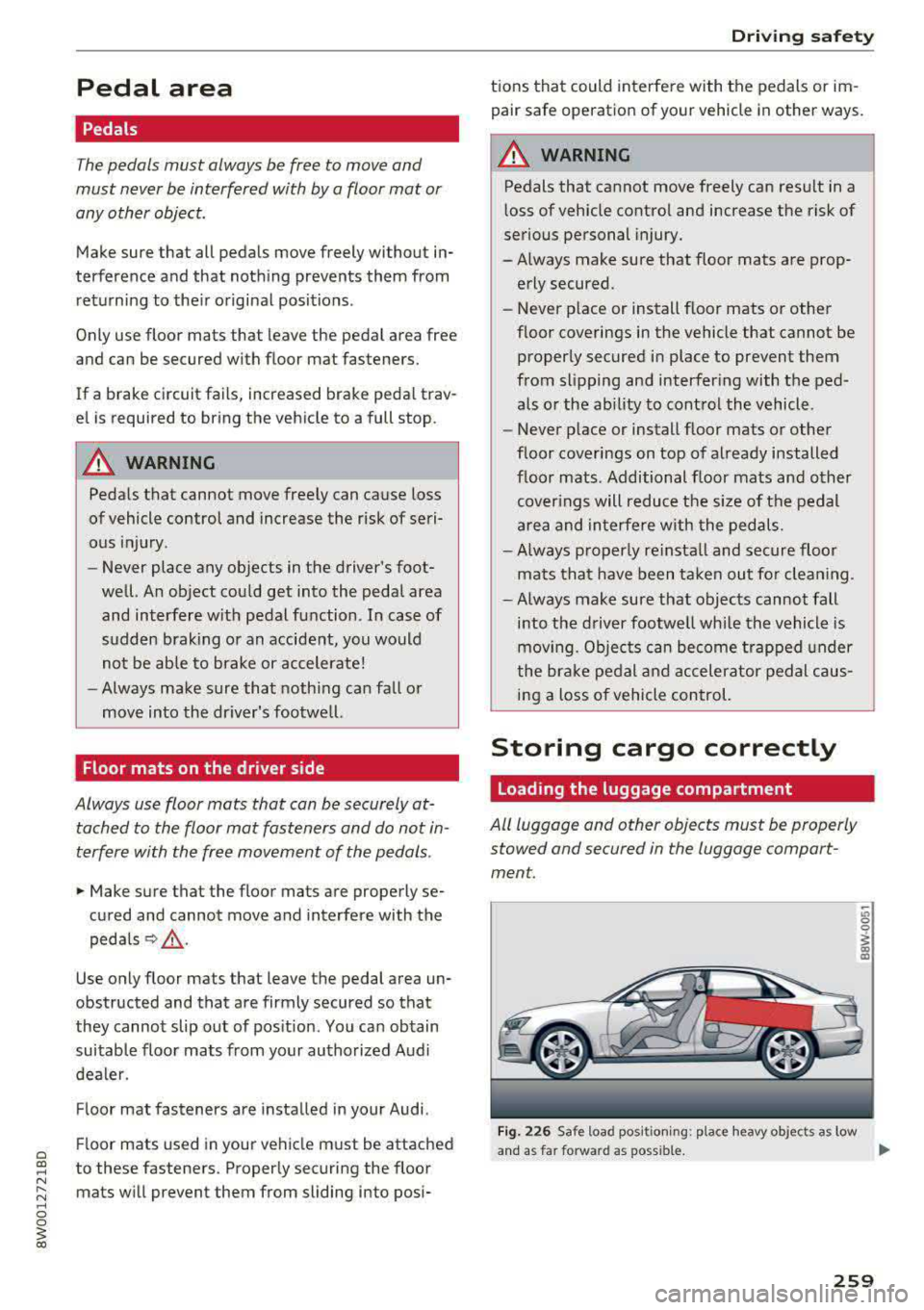
All luggage and other objects must be properly stowed and secured in the luggage compart
ment.
F ig. 226 Safe load positio ning: place heavy objects as low
;;:; 0 0
~
"" m
an d as far forward as poss ible. IJI,-
259
Page 324 of 403
a co .... N ,....
N .... 0 0
3 co
Engine compartment
Working in the engine compartment
Special care is required if you are working in the
engine compartment
F or wo rk in th e en gine c ompar tment , suc h as
ch eckin g and fi llin g flu id s, th ere is a risk of in
j u ry , sca lding , acci dent s, a nd b urn s. Fo r this
re aso n, follow all the warnin gs and ge nera l
safet y pr eca uti ons pr ov ided in the follow ing in
form ation . Th e e ng ine c ompartm en t is a d an
ger ous a re a .
~ ,&. .
_& WARNING
- T urn the engine off.
- Switch the ign ition off .
- Set the parking brake .
- Shift the gearshift lever to neutral in vehicles with a manual transm ission and se
lect the P selector lever posit ion in vehicles
with an automatic transmission .
- Let the engine coo l down.
- Never open the hood when there is steam or coolant escaping from the eng ine compart
ment, because there is a risk that you cou ld
be burned . Wait until no steam or coolant is
escaping.
- Keep children away from the engine com
partment.
- Never spill flu ids on a hot engine. These flu
ids (such as the anti-freezing agent con
tained in the coolant) can ignite.
- Avoid sho rt circu its in the e lectrical system.
- When working in the engine compartment,
remember that the radiator fan can sw itch
on even if the ign ition is switched off , which
increases the risk of inj ury .
- Never open the cap on the coolant expan
sion tank when the eng ine is warm. The
cooling system is under press ure.
- T o protect your face, hands, and arms from
hot steam or coolant, cover the cap with a
large cloth when opening.
- Do not remove the eng ine cover under any
c ircumstances . This increases the risk of
burns .
Check ing and Filling
-If tests need to be performed with the en
gine running, there is add itiona l danger due
to mov ing components (such as the ribbed
belt, alternator and radiator fan) and from
the high-voltage ignition system.
-Do not under any circumstances activate the
throttle inadvertently (for example, by hand
from the engine compartment) if the veh i
cle is stat ionary but the eng ine is running
and a gea r is engaged. Otherwise, the veh i
cle will start to move immed iate ly and this
could result in an accident.
- Pay attent ion to the following warn ings
when wor k on the fue l system is required :
- Do not smoke.
- Never work near open flames.
-Always have a working fi re extinguisher
nearby.
-All work on the battery or electrical system in your vehicle can result in injuries, chemi
cal burns, accidents or burns. Because of
this, all work must be performed
o nly by an
author iz ed Audi dealer or author iz ed Audi
Serv ice Facility.
-To reduce the r isk of electric shock and in
jury, never touch the following components
when the engine is runn ing or is being start
ed:
- Ign ition cable
- Other components in the e lectronic high-
vo ltage ign ition system
-I f you must check or perform wo rk on the
engine wh ile it is running:
-First, set the parking brake and and move
the gearshift lever to neutral (for manual
transm issions) or select the P selector lev
er position (for automatic transm iss ions).
- Always proceed w ith extreme caution so
that clothing, jewelry or long hair do not become caught in the radiator fan, fan
belt or other moving components or do
not come into contact with hot compo
nents. Tie bac k long hair befo re beginning
work and do not wear clothing that can hang down into the engine.
-Lim it your exposure to exhaust and chemi
cals to as short a time as possible
¢ .&. .
32 3
Page 326 of 403
-If the hood is not latched completely, it
could fly up while you are driving and ob
struct your vision.
Engine compartment overview
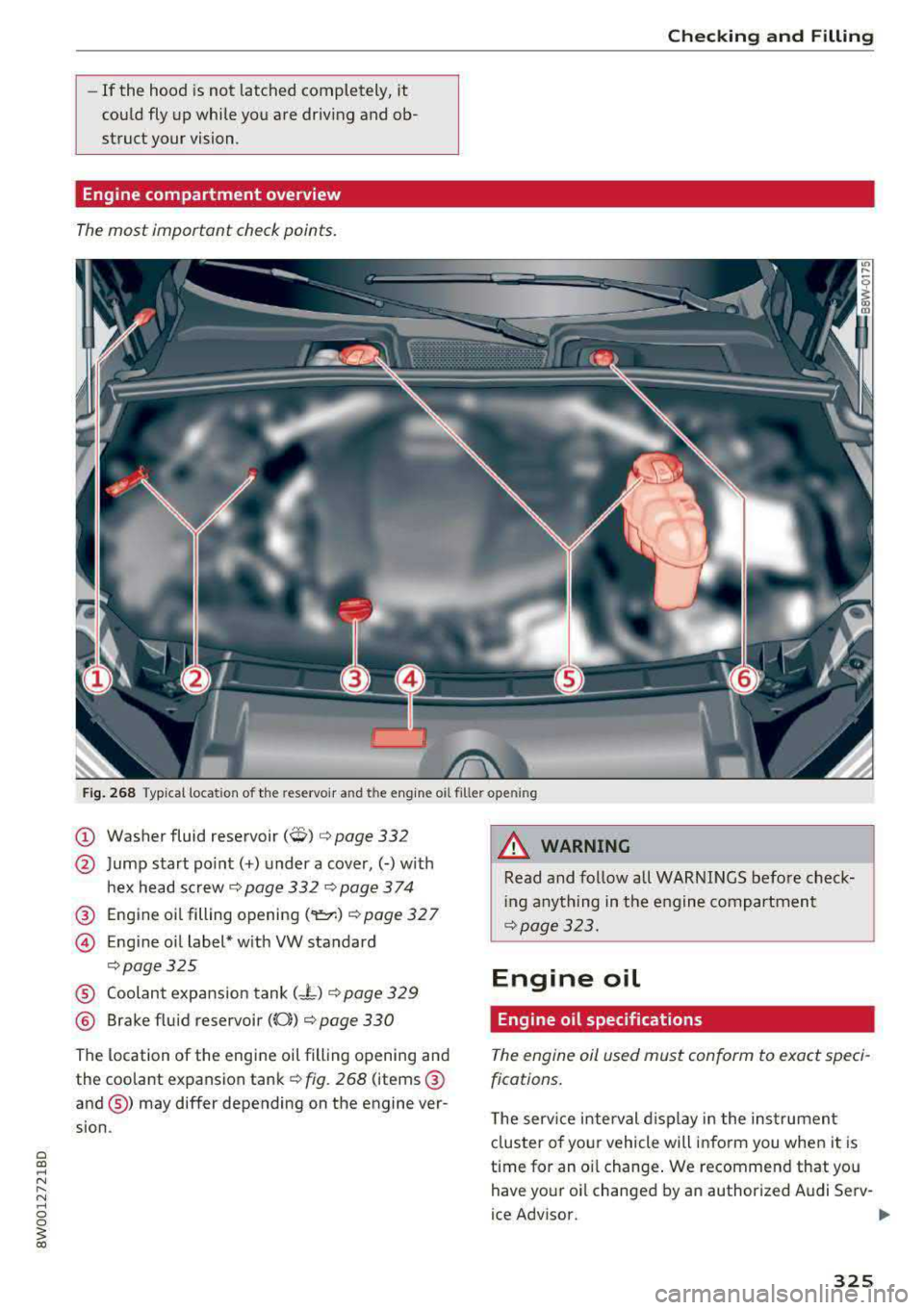
The most important check points.
Checking and Filling
Fig. 268 Typical location of the reservoir a nd t he engine o il filler ope ning
(!) Washer fluid reservoir (O) c::> page 332
@ Jump start po int( +) under a cover,(-) w ith
hex head screw
¢page 332 c:>page 374
@ Engine oil filling opening (
c:> page325
® Coolant expansion tank (- L) c::> page 329
® Brake fluid reservoir ((0) c::> page 330
The location of the engine oil filling opening and
the coolant expansion tank ¢
fig. 268 (items@
and@) may differ depending on the engine ver
sion .
_& WARNING
-Read and follow all WARNINGS before check-
in g anything in the engine compartment
c:> page 323.
Engine oil
Engine oil specifications
The engine oil used must conform to exact speci
fications.
The service interval display in the instrument
cluster of your vehicle will inform you when it is
time for an oi l change . We recommend that you
have your oil changed by an authorized Audi Serv-
ice Advisor.
.,..
325
Page 331 of 403
Checking and Filling
.,. Push the release button again and remove the
cap comp lete ly .
.,. Make sure that the fluid level rema ins stable.
Add more coolant if necessary .
.,. Turn the cap to the right to secure it until you
feel resistance a second t ime.
Coolant loss usually indicates there is a leak . Im
mediately drive your vehicle to an authorized
Audi dealer or authorized Audi Serv ice Facility
and have the cooling system inspected . If the
coo ling system is not leaking, a loss can come
from the coolant boiling through overheating
and being pushed out of the cool ing system.
_& WARNING
- T he coo ling system is under pressure. Do
not open the coolant expansion tank cap
when the engine is hot. This increases the
risk of burns.
- The coo lant add itive and the coolant can be
dangerous to your healt h. For this reason,
keep the coolant in the origina l container
and away from children. There is a risk of poison ing.
- When working in the engine compartment, remember that the radiator fan can switch
on even if the ign ition is switc hed off, which
increases the risk of in jury.
(D Note
Do not add coolant if the expansion tank is
empty. There may be air in the cooling sys
tem, wh ic h increases the risk of engine dam
age.
If th is is the case, do not continue dr iv
ing . See an a uthorized Aud i dea le r or author
ized Aud i Service Fa cil ity fo r assistance.
330
Brake fluid
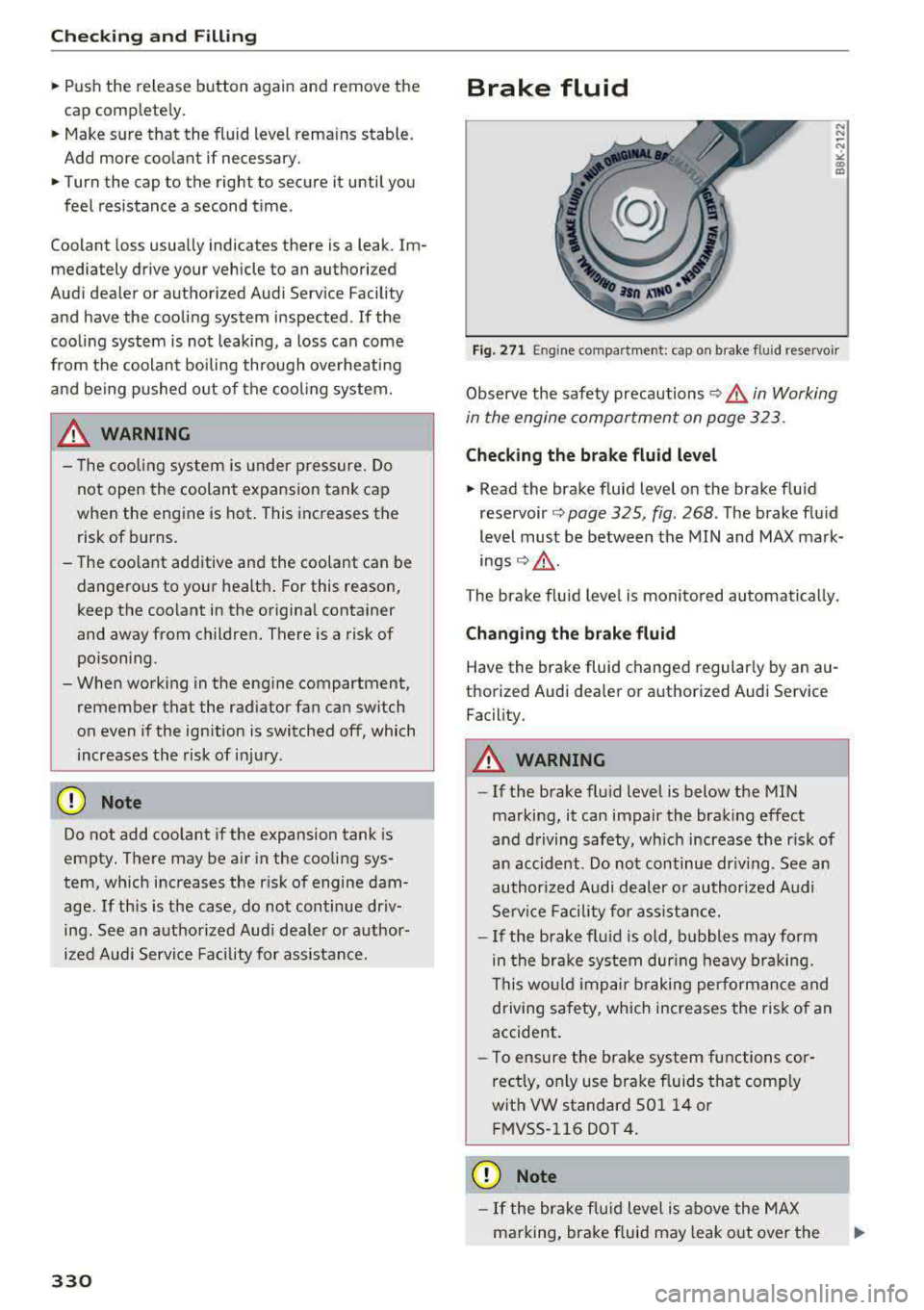
Fig. 271 En gine compa rtment: cap o n brake fluid reservo ir
Observe the safety precautions¢.&, in Working
in the engine compartment on page 32 3 .
Check ing the brake fluid level
.,. Read the brake fluid level on the brake fluid
reservoir ¢ page 325, fig . 268 . The brake flu id
level must be between the MI N and MAX ma rk
ings ¢.&, .
The brake f lu id level is monito red automatically.
Changing the brake fluid
Have the brake fluid changed regularly by an au
thorized Audi dea ler or authorized Audi Service
Facility.
_& WARNING -
- If the brake flu id leve l is below the MIN
marking, it ca n impair the brak ing effect
and driving safety, wh ich increase the r isk of
an accident. Do not continue dr iv ing . See an
author ized Audi dealer or au thori zed Audi
Serv ice Facility fo r ass ist ance.
- I f the brake fl uid is old, b ubbles may form
in the bra ke system dur ing heavy bra king.
This wo uld im pair b raking per formance and
driving safety, which increases the risk of an
accident.
- To ensure the brake system functions cor
rectly, only use bra ke fluids tha t comp ly
wit h VW standard 50 1 14 or
FMVSS- 116 DOT 4 .
(D Note
-If the bra ke f lu id leve l is ab ove the MAX
marking, bra ke fluid may le ak o ut over the
Page 332 of 403
a co .... N ,....
N .... 0 0
3 co
edge of the reservoir and result in damage
to the vehicle .
- Do not get any brake fluid on the vehicle
paint, beca use it will corrode the paint .
Battery
General warnings about batteries
Because of the complex power supply, all work
on batteries such as disconnecting, replacing,
etc. shou ld
onl y be performed by an a uthorized
Aud i dealer o r autho rized Aud i Serv ice Facility
¢ ,&. .
The term "vehicle battery" refers to the 12 Volt
battery in your veh icle.
Detailed warning s for th e vehicl e batter y:
®
Wear eye protection .
A
Battery acid is highly corrosive. Wear pro-
tective gloves and eye protect ion.
@
Fire, spa rks, open flame and smoking are
forbidden.
~
A highly explosive mixture of gases can
form when charging batteries.
®
Keep children away from battery acid and
batteries.
A WARNING
All work on the battery or electrical system in
your vehicle can result in injuries, chemical
burns, accide nts o r burns. Be cause of this, a ll
work m ust be perfo rmed
only by an a uthor
ized Aud i deale r or a utho rized Aud i Serv ice
Facility.
_&. WARNING
California Proposition 65 Warning:
- Battery posts , termina ls and re lated acces
sories contain lead and lead compounds,
chemicals known to the State of California
to cause cancer and reproductive problems.
Wash hands after handling.
Ch eck ing and Filling
(D Note
Protect the vehicle battery against freezing if
the veh icle w ill be parked for long periods of
time so that it is not destroyed by "free zing"
¢ page 332.
@ For the sa ke of the environment
i Batteries contain polluting substances such
as sulfur ic acid and lead. Contact an author
i zed Audi dealer or authorized Audi Service
Fac ility for more informat ion .
Vehicle battery
The term "vehicle ba ttery" refers to the 12 Vol t
ba ttery in your vehicle.
Not running th e vehicle fo r long p eriod s of
time
If you do not drive your vehicle for severa l days or
weeks, electrical equ ipment is gradually scaled
back or sw itched off . Th is reduces energy use and
ensures the vehicle will be able to start after long
per iods of t ime
¢ page 151. Some convenie nce
funct ions, such as inte rio r ligh ting or power seat
adjustment, may not be ava ilable under certain
c ircumstances. These convenience functions will
be available again once you switch the ignition on
and start the engine.
Even when elect rical equipment is switched off,
the eq uipment can sti ll drain the vehicle battery
if the vehicle is not driven for long periods of
time. Deep draining results in a chemica l reaction
that destroys the inside of the vehicle battery .
The veh icle battery must be charged every month
to reduce the risk of this happening
¢ page 332 .
Contact an authorized Aud i dealer or authorized
Audi Service Facility for more information .
Winter operation
Co ld weather places higher demands on the vehi
cle battery. Th is results in reduced starting ab ili
ty. Have the vehicle battery checked by an au
thorized Audi dea ler or authorized Audi Service
Facil ity before the cold time of year.
33 1