belt AUDI S4 CABRIOLET 2009 User Guide
[x] Cancel search | Manufacturer: AUDI, Model Year: 2009, Model line: S4 CABRIOLET, Model: AUDI S4 CABRIOLET 2009Pages: 340, PDF Size: 77.32 MB
Page 99 of 340
Moving the seat forward and backward (D
-Press t he swi tch fo rward or back ward h orizon ta lly => & -
Adjusting the seat height @ and 0 together
Pull the sw it c h eve nly at b oth ends to r aise th e sea t=> & .
-Pus h th e le ver e venl y at both ends to lo we r the seat =>& .
Angling the seat cushion up and down @ or 0
To an gle th e se at cush ion up, pull th e swit ch at t he front
on ly=>
&-
- Alter nativel y, push the sw it c h at the re ar onl y=> & .
- To ang le the seat cush io n down, pu sh the switch at th e
fron t o nly =>
&-
- Alt e rn ativ ely, p ull the switch at the r ea r only =>& .
& WARNING
• Never adjust the driver's or front passenger seat while the
vehicle is moving . If you do this while the vehicle is moving , you
will be out of position . Always adjust the driver's or front
passenger seat when the vehicle is not moving.
• Be careful when adjusting the seat height . Check to see that no
one is in the way, or serious injury could result!
• Because the seats can be electrically adjusted with the ignition
key removed , never leave children unattended in the vehicle. Unsu
pervised use of the electric seat adjustments may cause serious
injury. •
Contro ls and eq uip
ment
Ap plies to veh ic les : w ith powe r seats
Adjusting the seatback
Seats and storage
Fig . 109 Driver seat :
sw itch for seatback
adjustment
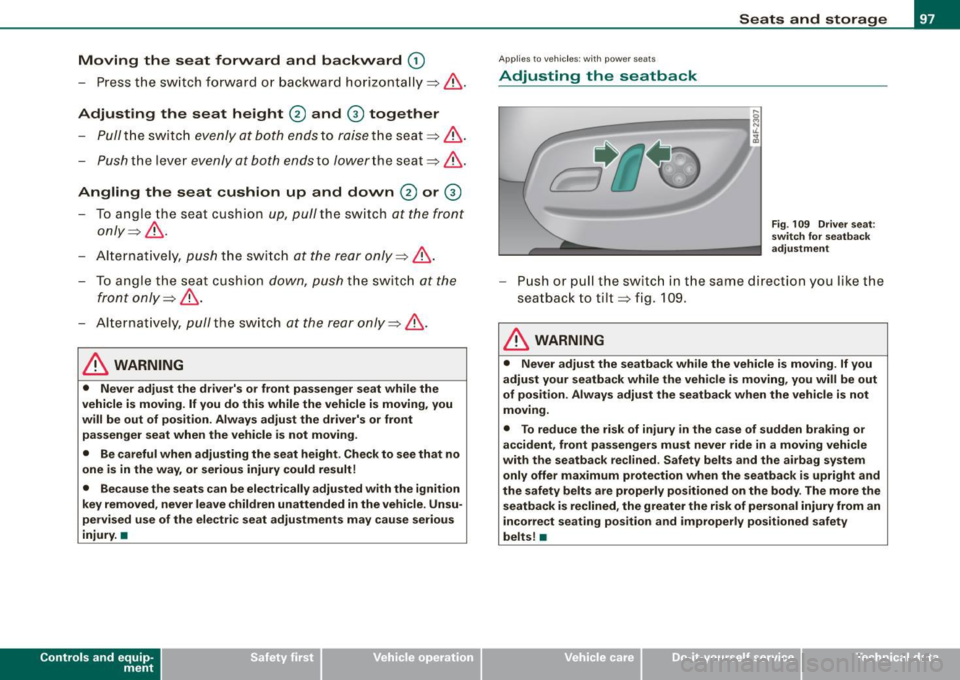
Push or pull th e swit ch in th e sa me dir ectio n y ou lik e the
s eat back t o tilt => fig. 1 09.
& WARNING
• Never adjust the seatback while the vehicle is moving . If you
adjust your seatback while the vehicle is moving, you will be out
of position . Always adjust the seatback when the vehicle is not
moving.
• To reduce the risk of injury in the case of sudden braking or
accident, front passengers must never ride in a moving vehicle
with the seatback reclined . Safety belts and the airbag system
only offer maximum protection when the seatback is upright and
the safety belts are properly positioned on the body . The more the
seatback is reclined , the greater the risk of personal injury from an
incorrect seating position and improperly positioned safety
belts !•
~ehicle care irechnical data
Page 105 of 340
__________________________________________________ S_ e_ a_t _s _ a_n _ d_ s_ t _ o_ r_a ...;:g ::.. e _ ___,_
Luggage compartment
Ski sack
Use the ski sack to transport and protect skis and other
long , light items in the passenger compartment.
Loading
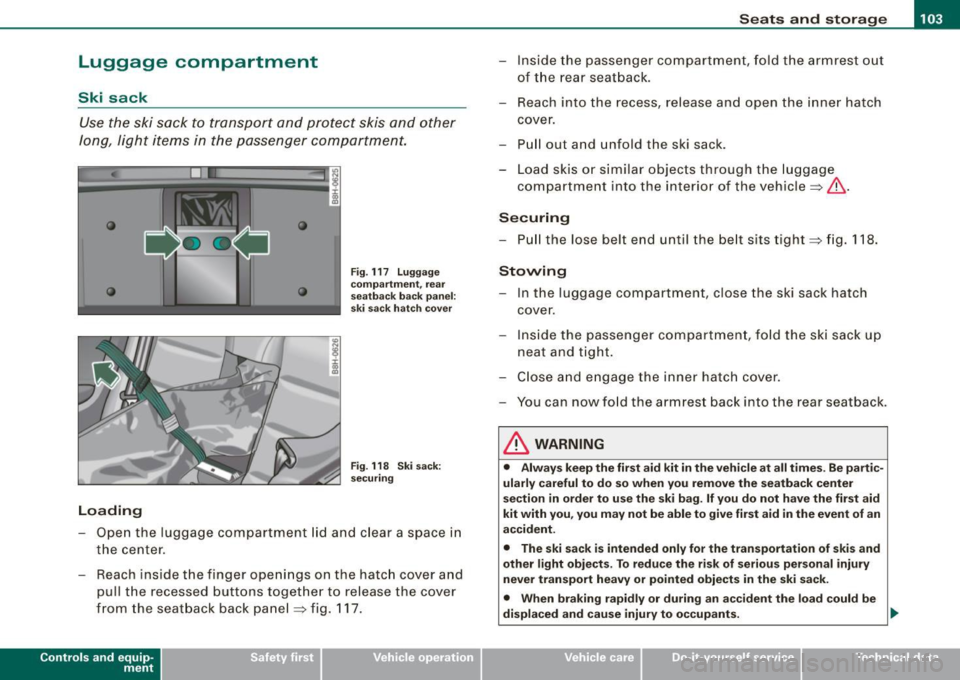
Fig . 117 Luggage
compartment, rear
seatback back panel:
ski sack hatch cover
Fig . 118 Ski sack:
securing
- Open the luggage compartment lid and clear a space in
the center.
- Reach ins ide the finger openings on the hatch cover and
pull the recessed buttons together to release the cover
from the seatback back panel :::;, fig. 117.
Contro ls and eq uip
ment
- Inside the passenger compartment, fold the armrest out
of the rear seatback.
- Reach into the recess, release and open the inner hatch
cover.
- Pull out and unfold the ski sack .
- Load skis or similar objects through the luggage
compartment into the interior of the vehicle :::;,,& .
Securing
-Pull the lose belt end until the belt sits tight :::;, fig. 118.
Stowing
- In the luggage compartment, close the ski sack hatch
cover .
- Inside the passenger compartment, fold the ski sack up
neat and tight.
- Close and engage the inner hatch cover.
- You can now fold the armrest back into the rear seat back.
& WARNING
• Always keep the first aid kit in the vehicle at all times . Be partic
ularly careful to do so when you remove the seatback center
section in order to use the ski bag. If you do not have the first aid
kit with you, you may not be able to give first aid in the event of an
accident.
• The ski sack is intended only for the transportation of skis and
other light objects . To reduce the risk of serious personal injury
never transport heavy or pointed objects in the ski sack.
• When braking rapidly or during an accident the load could be
displaced and cause injury to occupants. .,
~ehicle care irechnical data
Page 106 of 340
• .___S_ e_a _ t_ s_ a_ n_ d_ s_t _o _r_ a...; g==- e ________________________________________________ _
& WARNING (continued)
• Sharp edges on the load must be covered for protection.
Always fasten the belt tightly around the sack and its contents
~ page 103, fig. 118 .
[ i ] Tips
Never stow the ski sack away if it's wet or damp (for example, snow
melting from skis). Let it dry completely before you stow it away. •
Cupholder
Cupholder in the center consol e
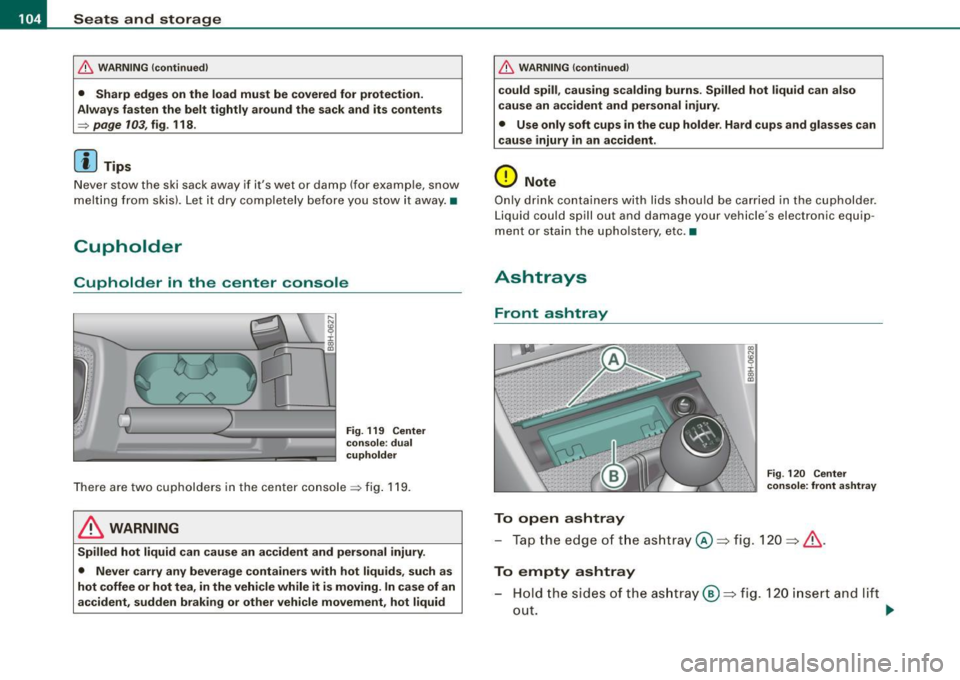
Fig. 119 Center
console : dual
cupholder
There are two cupholders in the center console~ fig. 119 .
& WARNING
Spilled hot liquid can cause an accident and personal injury.
• Never carry any beverage containers with hot liquids, such as
hot coffee or hot tea, in the vehicle while it is moving. In case of an
accident, sudden braking or other vehicle movement, hot liquid
& WARNING (continued)
could spill, causing scalding burns. Spilled hot liquid can also
cause an accident and personal injury.
• Use only soft cups in the cup holder . Hard cups and glasses can
cause injury in an accident.
0 Note
Only drink containers with lids should be carried in the cupholder.
Liquid could spill out and damage your vehicle 's electronic equip
ment or stain the upholstery , etc. •
Ashtrays
Front ashtray
To open ashtray
Fig. 120 Center
console: front ashtray
-Tap the edge of the ashtray@::::, fig . 120 ::::, &.
To empty ashtray
Hold the sides of the ashtray@::::, fig. 120 insert and lift
out.
~
Page 148 of 340
___ D_ ri_v _i_n ..;;:g::;,._ S_ a_ f _e__, ly'-- -------------------------------------------------
Driving Safely
General notes
Safe driving habits
Please remember -safety first!
This chapter contains important information, tips, instructions and
warnings that you need to read and observe for your own safety, the
safety of your passengers and others. We have summarized here
what you need to know about safety belts, the active rollover protec
tion system, airbags, child restraints as well as child safety. Your
safety is for us priority number 1 . Always observe the information
and warnings in this section -for your own safety as well as for that
of your passengers .
The information in this section applies to all model versions of your
vehicle. Some of the features described in this sections may be
standard equipment on some models, or may be optional equip
ment on others. If you are not sure, ask your authorized Audi dealer.
& WARNING
• Always make sure that you follow the instructions and heed
the WARNINGS in this Manual. It is in your interest and in the
interest of your passengers.
• Always keep the complete Owner's Literature in your Audi
when you lend or sell your vehicle so that this important informa
tion will always be available to the driver and passengers.
• Always keep the Owner's literature handy so that you can find
it easily if you have questions .•
Safety equipment
The safety features are part of the occupant restraint
system and work together to help reduce the risk of injury
in a wide variety of accident situations.
Your safety and the safety of your passengers should not be left to
chance. Advances in technology have made a variety of features
available to help reduce the risk of injury in an accident. The
following is a listing of just a few of the safety features in your Audi:
• sophisticated safety belts for driver and all passenger seating
positions,
• safety belt pre-tensioners for the outboard seating positions,
• front airbags,
• knee airbags for the front seats,
• side airbags in the front seats,
• LATCH anchorages for child restraints,
• head restraints for each seating position,
• adjustable steering column.
These individual safety features can work together as a system to
help protect you and your passengers in a wide range of accidents.
These features cannot work as a system if they are not always prop erly adjusted and properly used!
Safety is everybody's responsibility! •
Important things to do before driving
Safety is everybody's job! Vehicle and occupant safety
always depends on the informed and careful driver.
For your safety and the safety of your passengers, before
driving always: ..,
Page 149 of 340
________________________________________________ D_r_iv _ i _n...: g=--- S_ a_ fe--= ly'---------"'
- Make sure that all lights and signals are operating
correctly.
- Make sure that the tire pressure is correct.
- Make sure that all windows are clean and afford good
visibility to the outside.
- Secure all luggage and other items carefully~
page 107.
-Make sure that nothing can interfere with the pedals.
- Adjust front seat, head restraint and mirrors correctly for
your height.
- Instruct passengers to adjust the head restraints
according to their height.
- Make sure to use the right child restraint correctly to
protect children~
page 190, "Child Safety".
- Sit properly in your seat and make sure that your passen
gers do the same
~ page 92, "General recommenda
t ions" .
- Fasten your safety belt and wear it properly. Also instruct
your passengers to fasten their safety belts properly
~ page 159. •
What impairs driving safety?
Safe driving is directly related to the condition of the
vehicle, the driver as well as the driver's ability to concen
trate on the road without being distracted.
The driver is responsible for the safety of the vehicle and all
of its occupants. If your ability to drive is impaired, safety
risks for everybody in the vehicle increase and you also
Controls and equip
ment Safety first Vehicle operation
become a
hazard to everyone else on the road ~& .There
fore:
- Do not let yourself be distracted by passengers or by
using a cellular telephone.
- NEVER drive when your driving ability is impaired (by
medications, alcohol, drugs, etc.I.
- Observe all traffic laws, rules of the road and speed limits
and plain common sense.
- ALWAYS adjust your speed to road, traffic and weather
conditions.
- Take frequent breaks on long trips. Do not drive for more
than two hours at a stretch.
- Do NOT drive when you are tired, under pressure or when
you are stressed.
& WARNING
Impaired driving safety increases the risk of serious personal
injury and death whenever a vehicle is being used. •
Vehicle care Do-it-yourself service Technical data
Page 150 of 340
___ D_ r_ i_v _in -= g'- S _ a_f _e _ly.:,._ ______________________________________________ _
Proper occupant seating positi·ons
Proper seating position for the driver
The proper driver seating position is important for safe,
relaxed driving.
Fig. 154 The correct
distance between
driver and steering
wheel
Fig . 155 Correct head
restraint position for
driver
For your own safety and to reduce the risk of injury in the
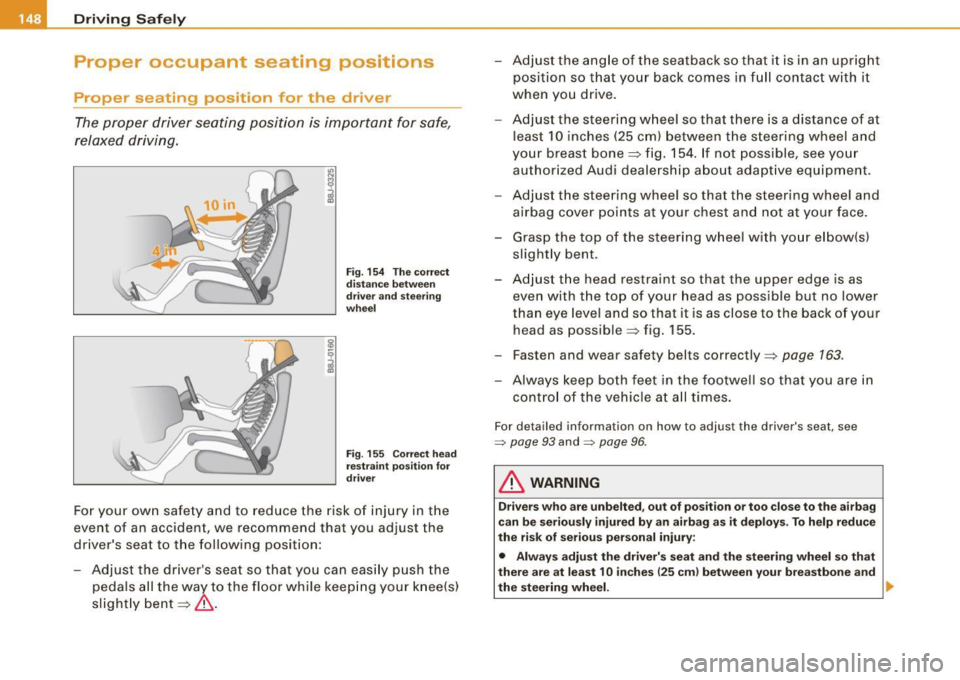
event of an accident, we recommend that you adjust the
driver's seat to the following position:
- Adjust the driver's seat so that you can easily push the
pedals all the way to the floor while keeping your knee(s)
slightly bent=:>& . - Adjust the angle of the seatback so that
it is in an upright
position so that your back comes in full contact with it
when you drive.
- Adjust the steering wheel so that there is a distance of at
least 10 inches (25 cm) between the steering wheel and
your breast bone=:> fig. 154. If not possible, see your
authorized Audi dealership about adaptive equipment.
- Adjust the steering wheel so that the steering wheel and
airbag cover points at your chest and not at your face.
- Grasp the top of the steering wheel with your elbow(s)
slightly bent.
- Adjust the head restraint so that the upper edge is as
even with the top of your head as possible but no lower
than eye level and so that it is as close to the back of your
head as possible =:> fig. 155.
- Fasten and wear safety belts correctly=:>
page 163.
- Always keep both feet in the footwell so that you are in
control of the vehicle at all times.
For detailed information on how to adjust the driver's seat, see
=> page 93 and :::::, page 96 .
& WARNING
Drivers who are unbelted, out of position or too close to the airbag
can be seriously injured by an airbag as it deploys. To help reduce
the risk of serious personal injury:
• Always adjust the driver's seat and the steering wheel so that
there are at least 10 inches
125 cm) between your breastbone and
the steering wheel. ...
Page 151 of 340
__________________________________________________ D _r_iv _ in_ g=- S_ a_f _e _l..:.. Y _ ....... 911
& WARNING (continued)
• Always adjust the driver's seat and the steering wheel so that
there are at least 4 inches 110 cm) between the knees and the
lower part of the instrument panel.
• Always hold the steering wheel on the outside of the steering
wheel rim with your hands at the 9 o'clock and 3 o'clock positions
to help reduce the risk of personal injury if the driver's airbag inflates .
• Never hold the steering wheel at the 12 o'clock position or with
your hands at other positions inside the steering wheel rim or on
the steering wheel hub. Holding the steering wheel the wrong way can cause serious injuries to the hands, arms and head if the
driver's airbag inflates
• Pointing the steering wheel toward your face decreases the
ability of the supplemental driver's airbag to protect you in a colli
sion .
• Always sit in an upright position and never lean against or
place any part of your body too close to the area where the airbags
are located.
• Before driving, always adjust the front seats and head
restraints properly and make sure that all passengers are properly
restrained.
• Never adjust the seats while the vehicle is moving. Your seat
may move unexpectedly and you could lose control of the vehicle.
• Never drive with the backrest reclined or tilted far back! The
farther the backrests are tilted back, the greater the risk of injury
due to incorrect positioning of the safety belt and improper
seating position.
• Children must always ride in child seats
=> page 190. Special
precautions apply when installing a child seat on the front
passenger seat
=> page 168. •
Controls and equip
ment Safety first
Vehicle operation
Proper seating position for the front
passenger
The proper front passenger seating position is important
for safe, relaxed driving.
For your own safety and to reduce the risk of injury in the
event of an accident, we recommend that you adjust the
seat for the front passenger to the following pos ition:
- Move the front passenger seat back as far as possible.
There must be a minimum of 10 inches (25 cm) between
the breastbone and the instrument panel =>
&.
- Adjust the angle of the seatback so that it is in an upright
position and your back comes in full contact with it
whenever the vehicle is moving.
- Adjust the head restraint so that the upper edge is as
even with the top of your head as possible but not lower
than eye level and so that it is as close to the back of your
head as possible =>
page 151.
-Keep both feet flat on the floor in front of the front
passenger seat.
- Fasten and wear safety belts correctly=>
page 163.
For detailed information on how to adjust the front passenger's
seat, see => page 92.
LJ}. WARNING
Front seat passengers who are unbelted, out of position or too
close to the airbag can be seriously injured or killed by the airbag
as it unfolds. To help reduce the risk of serious personal injury :
jll,,
Vehicle care Do-it-yourself service Technical data
Page 152 of 340
___ D_ r _i_v _i_n ..;;:g ::;,._ S_ a_ f_ e---= ly'----------------------------------------------------
& WARNING (continued)
• Passengers must always sit in an upright position and never
lean against or place any part of their body too close to the area
where the airbags are located.
• Passengers who are unbelted, out of position or too close to the
airbag can be seriously injured by an airbag as it unfolds with
great force in the blink of an eye.
• Always make sure that there are at least 10 inches (25 cm)
between the front passenger's breastbone and the instrument
panel.
• Always make sure that there are at least 4 inches (10 cm)
between the front passenger's knees and the lower part of the
instrument panel.
• Each passenger must always sit on a seat of their own and
properly fasten and wear the safety belt belonging to that seat.
• Before driving, always adjust the front passenger seat and
head restraint properly.
• Always keep your feet on the floor in front of the seat. Never
rest them on the seat, instrument panel, out of the window, etc .
The airbag system and safety belt will not be able to protect you properly and can even increase the risk of injury in a crash.
• Never drive with the backrest reclined or tilted far back! The
farther the backrests are tilted back, the greater the risk of injury
due to incorrect positioning of the safety belt and improper
seating position.
• Children must always ride in child seats~
page 190. Special
precautions apply when installing a child seat on the front
passenger seat~
page 168. •
Proper seating positions for passengers in
rear seats
Rear seat passengers must sit upright with both feet on
the floor consistent with their physical size and be prop
erly restrained whenever the vehicle is in use.
To reduce the risk of injury caused by an incorrect seating
position in the event of a sudden braking maneuver or an
accident, your passengers on the rear bench seat must
always observe the follow ing :
- Make sure that the seatback of the front seats are securely latched in the upright position~
page 99.
Keep both feet flat in the footwell in front of the rear seat .
Fasten and wear safety belts properly ~
page 163.
-Make sure that children are always properly restrained in
a child restraint that is appropriate for their size and age
~ page 190.
& WARNING
Passengers who are improperly seated on the rear seat can be
seriously injured in a crash.
• Each passenger must always sit on a seat of their own and
properly fasten and wear the safety belt belonging to that seat.
• Safety belts only offer maximum protection when the seatback
is securely latched in the upright position and the safety belts are
properly positioned on the body . By not sitting upright, a rear seat
passenger increases the risk of personal injury from improperly
positioned safety belts! •
Page 153 of 340
Driving Safely ---------------=------=~
Proper adjustment of head restraints
Correctly adjusted head restraints are an important part
of your vehicle's occupant restraint system and can help
to reduce the risk of injuries in accident situations.
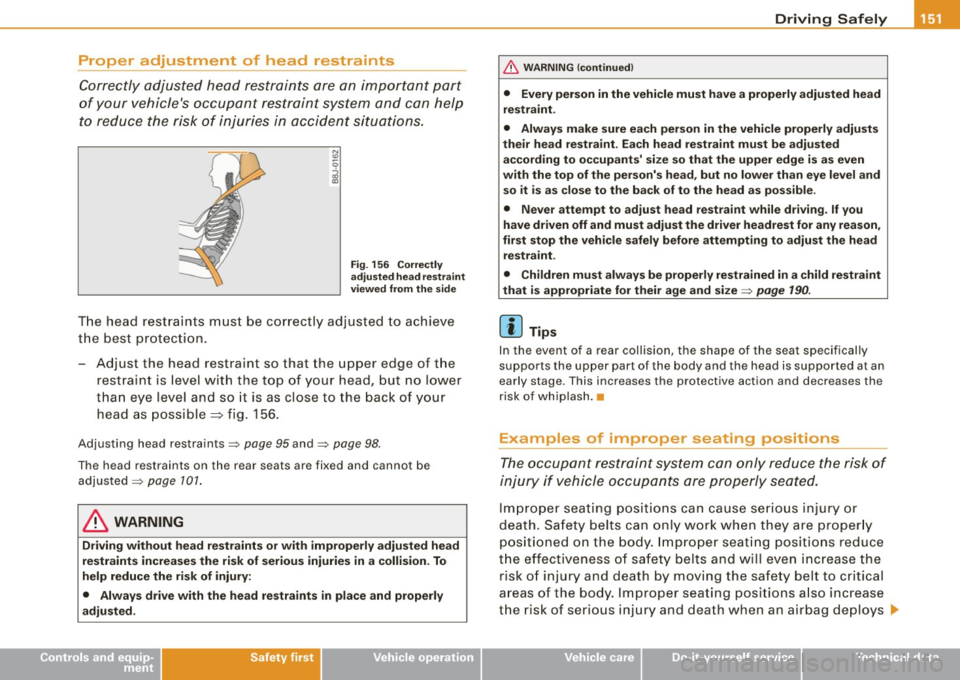
Fig . 156 Correctly
adjusted head restraint
viewed from the side
The head restraints must be correctly adjusted to achieve
the best protection.
- Adjust the head restraint so that the upper edge of the
restraint is level with the top of your head, but no lower
than eye level and so it is as close to the back of your
head as possible
=> fig . 156.
Adjusting head restraints=> page 95 and=> page 98.
The head restraints on the rear seats are fixed and cannot be
adjusted =>
page 101.
& WARNING
Driving without head restraints or with improperly adjusted head
restraints increases the risk of serious injuries in a collision . To
help reduce the risk of injury:
• Always drive with the head restraints in place and properly
adjusted .
Controls and equip ment Safety first Vehicle operation
& WARNING
(continued)
• Every person in the vehicle must have a properly adjusted head
restraint.
• Always make sure each person in the vehicle properly adjusts
their head restraint. Each head restraint must be adjusted
according to occupants' size so that the upper edge is as even
with the top of the person's head, but no lower than eye level and
so it is as close to the back of to the head as possible .
• Never attempt to adjust head restraint while driving. If you
have driven off and must adjust the driver headrest for any reason,
first stop the vehicle safely before attempting to adjust the head
restraint .
• Children must always be properly restrained in a child restraint
that is appropriate for their age and size=>
page 190.
[ i] Tips
In the event of a rear collision, the shape of the seat specifically
supports the upper part of the body and the head is supported at an
early stage. This increases the protective action and decreases the
risk of whiplash. •
Examples of improper seating positions
The occupant restraint system can only reduce the risk of
injury if vehicle occupants ore properly seated.
Improper seating positions can cause serious injury or
death. Safety belts can only work when they are properly
positioned on the body. Improper seating positions reduce
the effectiveness of safety belts and will even increase the risk of injury and death by moving the safety belt to critical
areas of the body. Improper seating positions also increase
the risk of serious injury and death when an airbag deploys ..,
Vehicle care Do-it-yourself service Technical data
Page 158 of 340
___ D_ r _i_v _i_n ..;::g =-- S_ a_ f_ e--= ly'----------------------------------------------------
Automatic rollover protection system
Function
The automatic roll over protection system helps to protect
the passengers in case the vehicle turns over.
1J ~
I ...
,
... . ' : :
: :
'
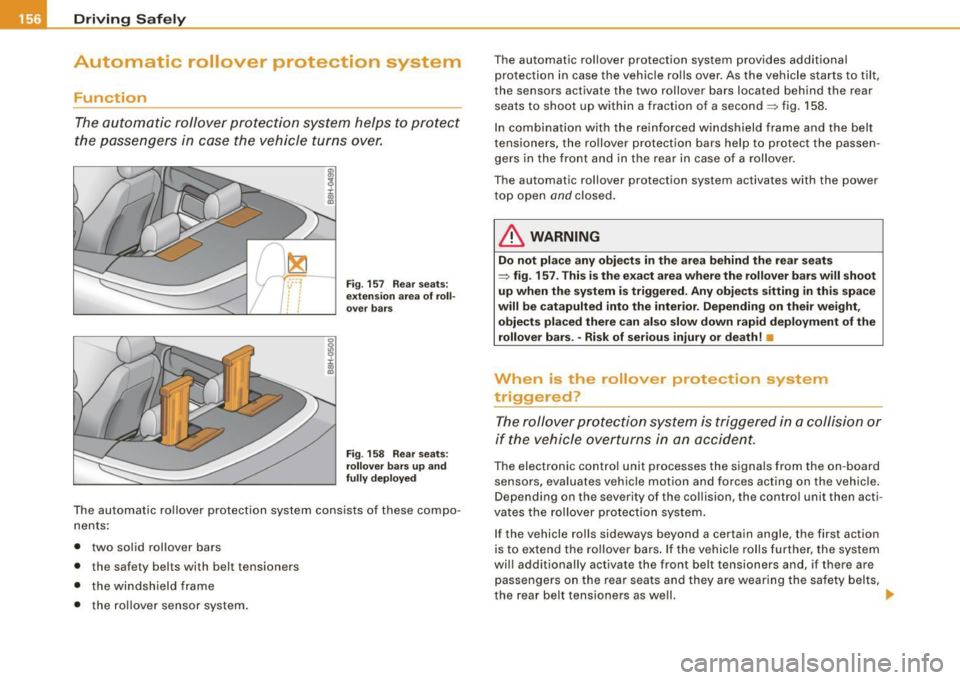
F ig . 157 Rear sea ts:
ex te n sio n area o f ro ll
over ba rs
F ig . 158 Rea r sea ts :
r ollo ver bars up and
full y dep loyed
The automatic rollover protection system cons ists of these compo
nents:
• two solid rollover bars
• the safety bel ts with belt tensioners
• the windshield frame
• the ro llover sensor system. The automatic rol
lover protection system provides additional
protection in case the vehicle ro lls over. As the vehicle starts to tilt,
the sensors activate the two rollover bars located behind the rear
seats to shoot up wi thin a fraction of a second~ fig. 158 .
In combinat ion with the reinforced windshield frame and the bel t
tensioners, the rollover p rotection bars help to protect the passen
gers in the front and in the rear in case of a rollover.
The automatic rollover protection system activates with the power
top open
and closed.
& WARNING
Do not place any obje cts in the ar ea be hind the r ear seats
~ fig . 157. T his is the e xact area where the rollover b ars will shoot
up wh en th e syst e m i s triggered . An y ob jects si tting in th is s pac e
w ill be cata p ulte d into the inter ior. Depending on the ir wei ght,
object s pl ace d there can also s lo w do wn rap id deploym ent of th e
r o llover bars. -Ri sk of seri ou s inj ur y or deat h! •
When is the rollover protection system
triggered?
T he rollover protection system is triggered in a collisi on or
if the vehicle overturns in an accident.
The electronic control unit processes the signals from the on -board
sensors, evaluates vehicle motion and forces act ing on the vehic le.
Depending on the severity of the co llision, the control unit then acti
vates the rol lover protection system .
If the vehicle rol ls sideways beyond a certain angle , the first action
is to extend the ro llover bars . If the vehicle rolls further, the system
wil l additional ly activate the front belt tensioners and, if there are
passengers on the rear seats and they are wearing the safety belts,
the rear belt tensioners as well. ..,