height AUDI S4 CABRIOLET 2009 User Guide
[x] Cancel search | Manufacturer: AUDI, Model Year: 2009, Model line: S4 CABRIOLET, Model: AUDI S4 CABRIOLET 2009Pages: 340, PDF Size: 77.32 MB
Page 149 of 340
________________________________________________ D_r_iv _ i _n...: g=--- S_ a_ fe--= ly'---------"'
- Make sure that all lights and signals are operating
correctly.
- Make sure that the tire pressure is correct.
- Make sure that all windows are clean and afford good
visibility to the outside.
- Secure all luggage and other items carefully~
page 107.
-Make sure that nothing can interfere with the pedals.
- Adjust front seat, head restraint and mirrors correctly for
your height.
- Instruct passengers to adjust the head restraints
according to their height.
- Make sure to use the right child restraint correctly to
protect children~
page 190, "Child Safety".
- Sit properly in your seat and make sure that your passen
gers do the same
~ page 92, "General recommenda
t ions" .
- Fasten your safety belt and wear it properly. Also instruct
your passengers to fasten their safety belts properly
~ page 159. •
What impairs driving safety?
Safe driving is directly related to the condition of the
vehicle, the driver as well as the driver's ability to concen
trate on the road without being distracted.
The driver is responsible for the safety of the vehicle and all
of its occupants. If your ability to drive is impaired, safety
risks for everybody in the vehicle increase and you also
Controls and equip
ment Safety first Vehicle operation
become a
hazard to everyone else on the road ~& .There
fore:
- Do not let yourself be distracted by passengers or by
using a cellular telephone.
- NEVER drive when your driving ability is impaired (by
medications, alcohol, drugs, etc.I.
- Observe all traffic laws, rules of the road and speed limits
and plain common sense.
- ALWAYS adjust your speed to road, traffic and weather
conditions.
- Take frequent breaks on long trips. Do not drive for more
than two hours at a stretch.
- Do NOT drive when you are tired, under pressure or when
you are stressed.
& WARNING
Impaired driving safety increases the risk of serious personal
injury and death whenever a vehicle is being used. •
Vehicle care Do-it-yourself service Technical data
Page 166 of 340
-Safety belts ___ .:,__ _____________________________________ _
Automatic safety belt retractors
Every safety belt is equipped with an automatic belt retractor on the
shoulder bel t. This featu re locks the bel t when the belt is pulled out
fast, during hard braking and in an accident. The belt may also lock
when you drive up or down a steep hill or through a sharp curve. During normal driving the bel t lets you move freely.
Safety belt pretensioners
The safety belts are equipped with a belt pretension er that helps to
tighten the safety belt and remove slack when the pretensioner is
activated. The function of the pretensioner is monitored by a
warning light:::::, page
20, "Airbag system @;".
Switchable locking feature
Every safe ty belt except the one on the driver seat is equipped with
a switchable locking feature that must be used when the safety belt
is used to attach a child seat . Be sure to read the important informa
tion about this feature:::::, page
200.
& WARNING
Improperly positioned safety belts can cause serious injury in an
accident :::::,
page 164, "Safety belt position" .
• Safety belts offer optimum protection only when the seat back
is upright and belts are properly positioned on the body.
• Never attach the safety belt to the buckle for another seat.
Attaching the belt to the wrong buckle will reduce safety belt
effectiveness and can cause serious personal injury.
• A passenger who is not properly restrained can be seriously
injured by the safety belt itself when it moves from the stronger
parts of the body into critical areas like the abdomen.
• Always lock the convertible locking retractor when you are
securing a child seat in the vehicle :::::,
page 202. •
Safety belt position
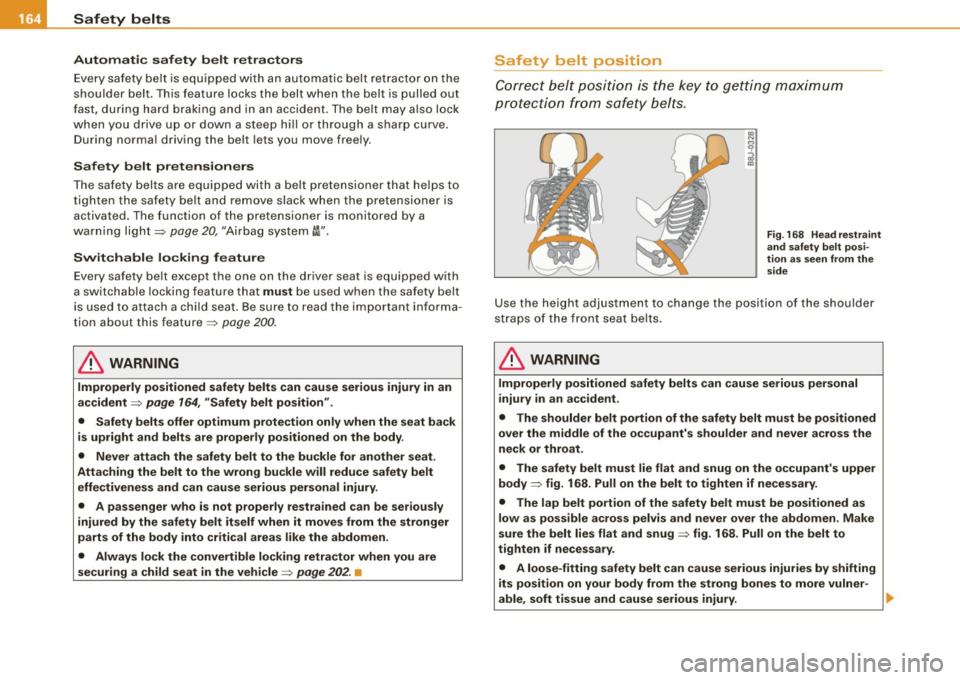
Correct belt position is the key to getting maximum
protection from safety belts.
Fig . 168 Head restraint
and safety belt posi
tion as seen from the
side
Use the height adjustmen t to change the position of the shoulder
straps of the front seat belts.
in. WARNING
Improperly positioned safety belts can cause serious personal
injury in an accident .
• The shoulder belt portion of the safety belt must be positioned
over the middle of the occupant's shoulder and never across the
neck or throat.
• The safety belt must lie flat and snug on the occupant's upper
body
:::::> fig. 168. Pull on the belt to tighten if necessary.
• The lap belt portion of the safety belt must be positioned as
low as possible across pelvis and never over the abdomen. Make
sure the belt lies flat and snug :::::, fig. 168. Pull on the belt to
tighten if necessary.
• A loose-fitting safety belt can cause serious injuries by shifting
its position on your body from the strong bones to more vulner-
able, soft tissue and cause serious injury. ..,.
Page 186 of 340
___ A_ ir_b _a_ g:-- s-=- y_s _t _e _m _________________________________________________ _
& WARNING
Item s s to red betwe en th e safe ty belt b uckle a nd th e cente r
co nso le can c au se the sen sors in the buc kle to send the wro ng
inf orm ation t o the e lec tronic c ontrol m odule and pre vent th e
Adv anced Airb ag System fr om working pr operly .
• Always make su re that n oth ing ca n int erfere with the saf ety
belt buckle s and that they ar e not ob structed.
<£> For the sake of the environment
Undeployed airbag modules and pretensioners might be c lassified
as Perchlorate Material -specia l handling may apply, see
www .dtsc.ca .gov/hazardouswaste/perchlorate. When the vehicle o r
parts of the restraint system including airbag modules safety be lts
with pretensioners are scrapped, all applicable laws and regula
tions must be observed . Your author ized Audi dealer is fami liar with
these requirements and we recommend that you have your dea ler
perform th is service for you. •
Knee airbags
Description of knee airbags
The airbag system can pr ovide supplemental protection
t o properly restrained fron t se at occu pants.
Fi g. 175 Dr iver's
ai rba g
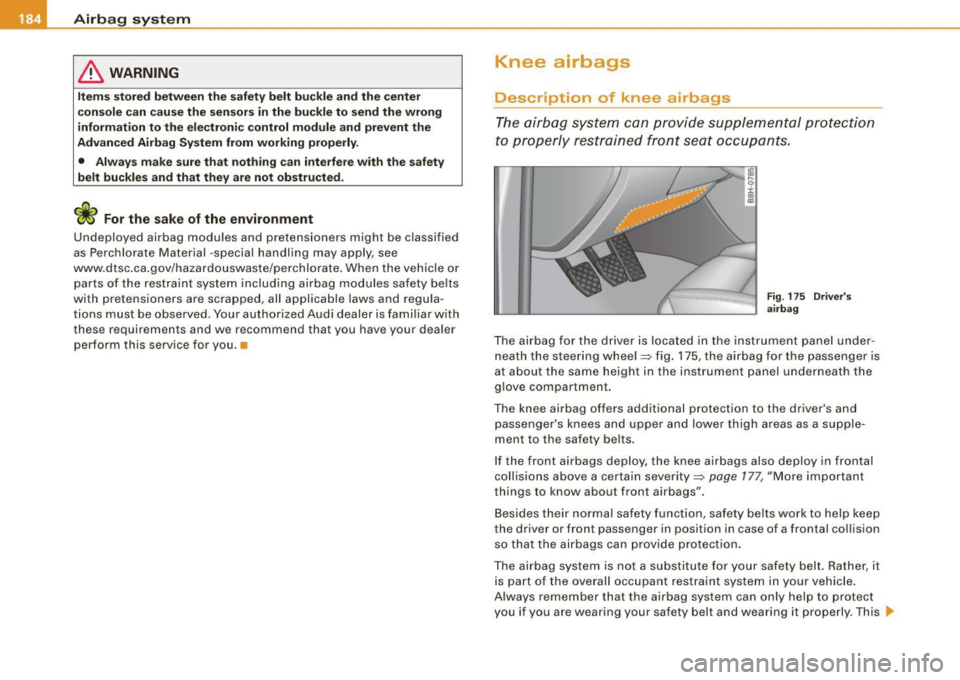
The airbag for the driver is located in the instrument panel under
neath the steering wheel=> fig. 175, the airbag for the passenger is
at about the same height in the instrument panel underneath the
g love compartment.
The knee airbag offers additional protection to the driver 's and
passenger's knees and upper and lower thigh areas as a supple
ment to the safety be lts.
If the front airbags deploy, the knee airbags also deploy in frontal
coll isions above a certain severity=>
page 177, "More important
things to know about front airbags".
Besides their normal safety function, safety be lts work to help keep
the driver or front passenger in position in case of a frontal collision
so that the airbags can provide protection.
The airbag system is not a substitute for your safety belt. Rather, it is part of the overall occupant restraint system in your vehicle.
Always remember that the airbag system can only help to protect
you if you are wearing your safety belt and wearing it properly. This
~
Page 281 of 340
__________________________________________________ T_ ir_e _ s_ a_ n _ d_ w_ h_ e_ e_ls _ _____,ffllll
In correct wheel alignment
Inc orrect wheel alignment can cause excessive tire wea r, impairing
the saf ety of the vehicle . If tires s how excessive wear , have the
whee l alig nment chec ked by an autho rized A udi deale r or q ualif ied
workshop .
All Wheel Drive
Vehicles with quattro ® must always have tires of the same si ze ,
cons tructi on and tread type . For details see => page 218 .
& WARNING
Sudden tire failure can lead to loss of control, a crash and serious
personal injury!
• Never drive a vehicle when the tread on any tire is worn down
to the wear indi cators .
• E specially in wet and slick driving situations , a preferably large
profile depth of the tires is necessary , and an approximately
similar profile depth of the front and rear axle tire s.
• The diminished driving safety , caused by too small of a tire
profile , is negatively perceivable especially in handling , in danger
of hydroplaning when driving through deep puddles and ponds ,
when driving around curve s, and in braking behavior.
• Worn t ires are a safety hazard , they do not grip well on wet
roads and increase your risk of "hydroplaning " and loss of control.
• Always keep chemicals that can cause tire damage , such a s
grease , oil , gasoline and brake flu id away from tires.
• Tires age even if they are not being used and can fail suddenly ,
espe cially at high speeds . Tires that are more than 6 years old can
only be used in an emergency and then with special care and at
lowe r speeds.
• Never mount used tire s on your vehicle if you are not sure of
their "previous history ." Old u sed tires may have been damaged
even though the damage cannot be seen that can lead to sudden
tire failure and los s of vehicle control. •
New tires and replacing tires and wheels
New tires and wheels ha ve to be bro ken in.
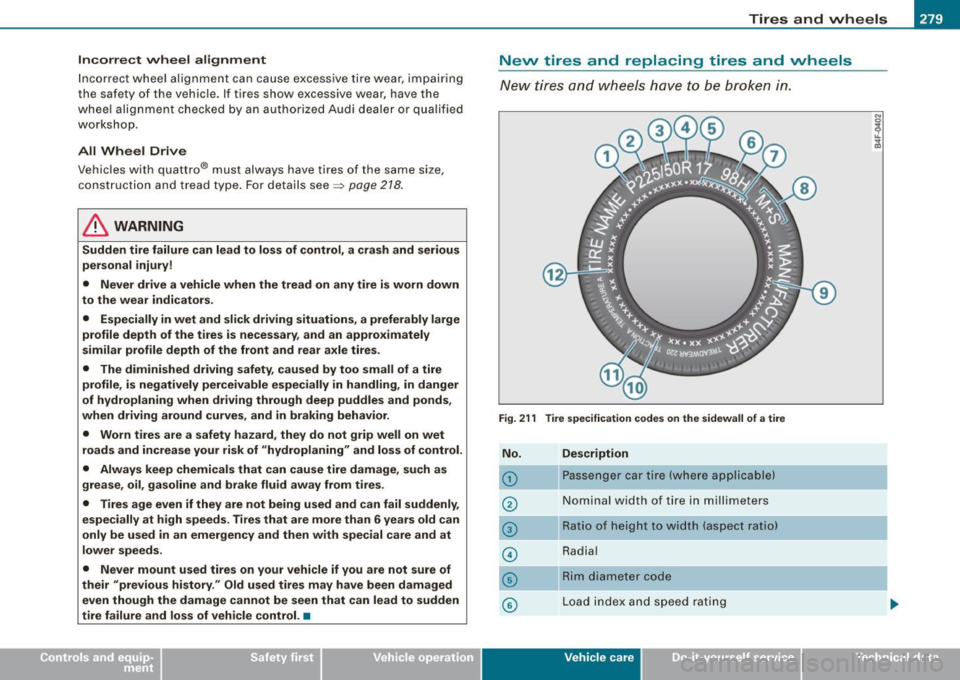
Fig. 211 Tire spe cification cod es on the sidewall of a tir e
No. Description
©
@
@
@
©
©
Passenger car tire (where applicable)
Nominal w id th of tire in mi llimeters
Ratio of height to width (aspect ratio)
Radia l
ii Rim diameter code
Load index an d sp eed ra ting
Vehic le care irechnical data
Page 282 of 340
-~_T_ ir_e_ s_ a_ n_d _ w_ h_ e_e _l_s _________________________________________________ _
0
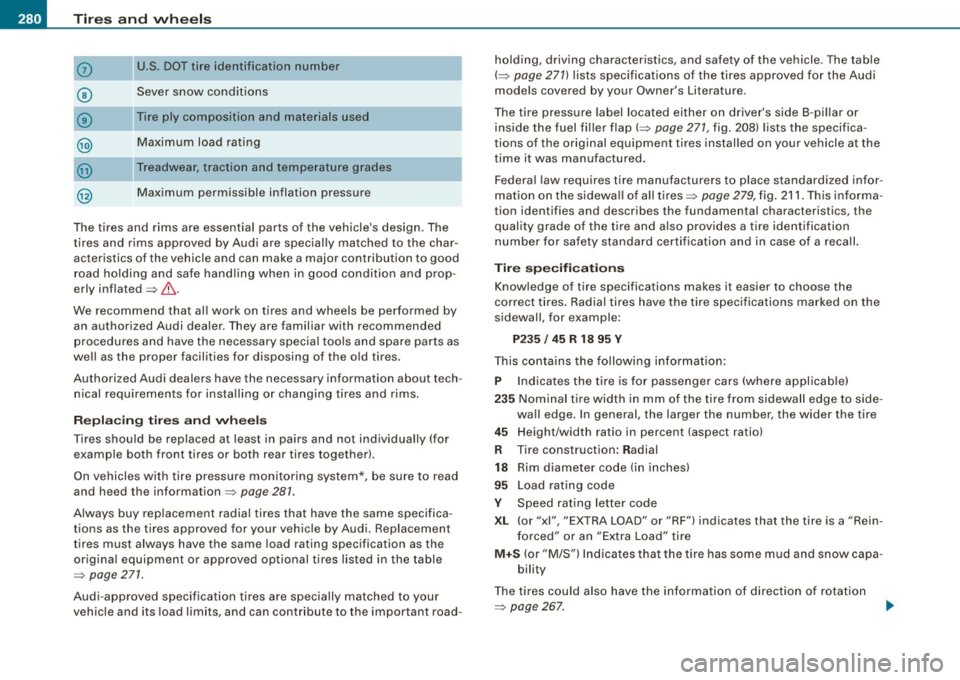
©
@
U.S. DOT tire identification number
Sever snow conditions
Tire ply composition and materials used
Maximum load rating
Treadwear, traction and temperature grades Maximum permissible inflation pressure
The tires and rims are essential parts of the vehicle's design. The
tires and rims approved by Audi are specially matched to the char acteristics of the vehicle and can make a major contribution to good
road holding and safe handl ing when in good condition and prop
erly inflated =>& .
We recommend that al l work on tires and wheels be performed by
an authorized Audi dealer . They are familiar with recommended
procedures and have the necessary special too ls and spare parts as
we ll as the proper facilities for disposing of the o ld tires .
Authorized Audi dealers have the necessary information about tech
n ical requirements for insta lling o r changing tires and rims .
Repl ac ing t ires and wheels
Tires should be replaced at least in pairs and not individually (for
example both front tires or both rear tires together).
On vehicles with tire pressure moni toring system*, be sure to read
and heed the information=>
page 287.
Always buy replace ment radia l tires tha t have the same specifica
tions as the tires approved for your vehicle by Audi . Replacement
tires must always have the same load rating specification as the
original equipment or approved optional tires listed in the table
=>
page 271.
A udi -appr oved specificat ion tires a re specially matched t o your
vehic le and its load limits, and can contribute to the important road- holding, driving characteristics, and safety of the vehicle
. T he tab le
( =>
page 271) lists specifications of the tires approved for the Audi
models covered by your Owner's Literature.
The tire pressure label located either on driver's side B -pi llar or
insi de the fuel filler flap(=>
page 271, fig. 208) lists the specifica
tions of the original equipment tires installed on your vehicle at the
time it was manufactured.
Federa l law requires tire manufacturers to place standardized infor
mation on the sidewa ll of all tires=>
page 279, fig. 211. This informa
tion identifies and descr ibes the fundamenta l characteristics, the
quality grade of the tire and a lso prov ides a tire identification
number for safety standa rd certif ication and in case o f a recall.
Tire sp ecifi cations
Knowledge of tire specifications makes it easier to choose the
correct t ires. Rad ial tires have the tire specifications mar ked on the
sidewal l, for example:
P235 / 45 R 18 95 Y
This c onta ins the fo llowing informatio n:
P Indicates the tire is fo r passenger cars (where appl icab le)
2 3 5 Nominal tire width in mm of the tire from sidewall edge to s ide -
wa ll edge. In general, the larger the number, the wider the tire
45 Height/width ratio in percent (aspect ratio)
R Tire construction: Radial
18 Rim d iameter c ode (in inches)
95 Load rat ing code
V Speed rating letter code
X L (or "xi", "EXTRA LOAD" or "RF") indicates that the tire is a "Rein
forced" or an "Ex tra Load" ti re
M +S (or "M/S") Indicates that the tire has some mud and snow capa
bility
The ti res cou ld also have the information of direction of rotation
=>
page 267 .
Page 288 of 340
IIIJIL_T~ ir~e =s~ a~n~ d~ w~ h ~e~e~ l~ s '.,_ ______________________________________________ _
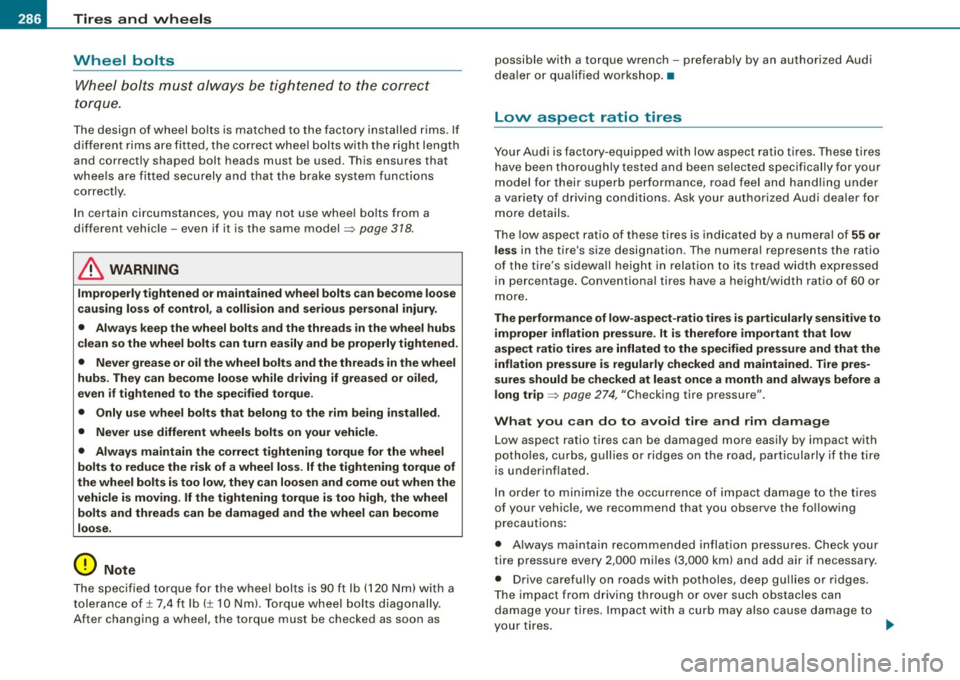
Wheel bolts
Wheel bolts must always be tightened to the correct
torque .
The design of wheel bo lts is matched to the factory installed rims . If
different rims are fitted, the correct wheel bolts with the right length
and correctly shaped bolt heads must be used. This ensures that
whee ls are fitted securely and that the brake system functions
correctly .
I n certain circumstances, you may not use wheel bolts from a
different vehicle -even if it is the same model~ page 318.
& WARNING
Improperl y tightened or maintained wheel bolt s can be come loose
c au sing lo ss of control , a co llis ion and seriou s personal injur y.
• Alwa ys keep the wheel bolt s and the th reads in the wheel hubs
c lean so the wheel bolt s can turn ea sily and be properl y tightened.
• Never gre ase or oil the wheel bolt s and the thre ad s i n the wheel
hub s. They can become lo ose while drivin g if gre ased or oiled ,
e ven if tig hten ed to th e specifi ed torque .
• Onl y use wheel bo lt s th at bel ong to the rim being in sta lled.
• Nev er use differ ent wheel s bolt s on your vehicle.
• Alway s m aintai n the corre ct t ightenin g to rq ue for the whee l
bo lt s to r edu ce the ri sk of a whe el los s. If the tighten ing torque of
t h e w heel bolt s is too l ow, they c an loose n a nd com e out when th e
v ehicl e is mov ing . If th e tighte ning torque is t oo high, the whe el
b ol ts an d threads can be dam ag ed and the whee l can become
loo se .
0 Note
The specified torque for the wheel bolts is 90 ft lb (120 Nm) with a
tolerance of ± 7,4 ft lb(± 10 Nm). Torque whee l bolts diagonally.
After changing a wheel, the torque must be checked as soon as possible with a torque wrench
-preferably by an authorized Audi
dea ler or qua lified workshop .•
Low aspect ratio tires
Your Audi is fac tory-equipped with low aspect ratio tires. These tires
have been thorough ly tested and been selected specifically for your
model for their superb performance, road feel and hand ling under
a variety of driving conditions . Ask your authorized Audi dealer for
more details.
The low aspect ratio of these t ires is ind icated by a numera l of 55 or
l e ss in the tire's size designation . The numera l represents the ratio
of the tire's sidewa ll height in relat ion to its tread w idth expressed
in percentage. Conventiona l tires have a height/width ratio of 60 or
more .
T he perform ance of lo w-as pect-rati o tire s is part ic ul arl y s ensit ive to
improp er infla tion pr essure. It i s there fore important that low
a s pect ra tio tir es are inflated to the sp ec ified pre ssure an d th at th e
i nfl ation pre ssure is regularl y checked and m aintained . T ir e pres
s ure s should b e checked a t lea st once a month and alw ays before a
long trip~ page 274, "Checking tire pressure".
What you can d o to avoid tire a nd rim dama ge
Low aspect ratio tires can be damaged more easi ly by impact with
potho les, curbs, gull ies or ridges on the road, particularly if the tire
is underinflated.
In order to minimize the occurrence of impact damage to the tires
of your vehic le, we recommend that you observe the fo llowing
precautions:
• Always maintain recommended inflation pressures . Check your
tire pressure every 2,000 miles (3,000 km) and add air if necessary .
• Drive careful ly on roads with potholes, deep gullies or ridges.
The impact from driving through or over such obstacles can
damage your tires. Impact with a curb may also cause damage to
your tires . .,_
Page 316 of 340
llftl __ D_a_ t_ a ___________________________________________________ _
Data
Applies to vehi cles : w ith 2.0 lite r 4-cyl. engi ne
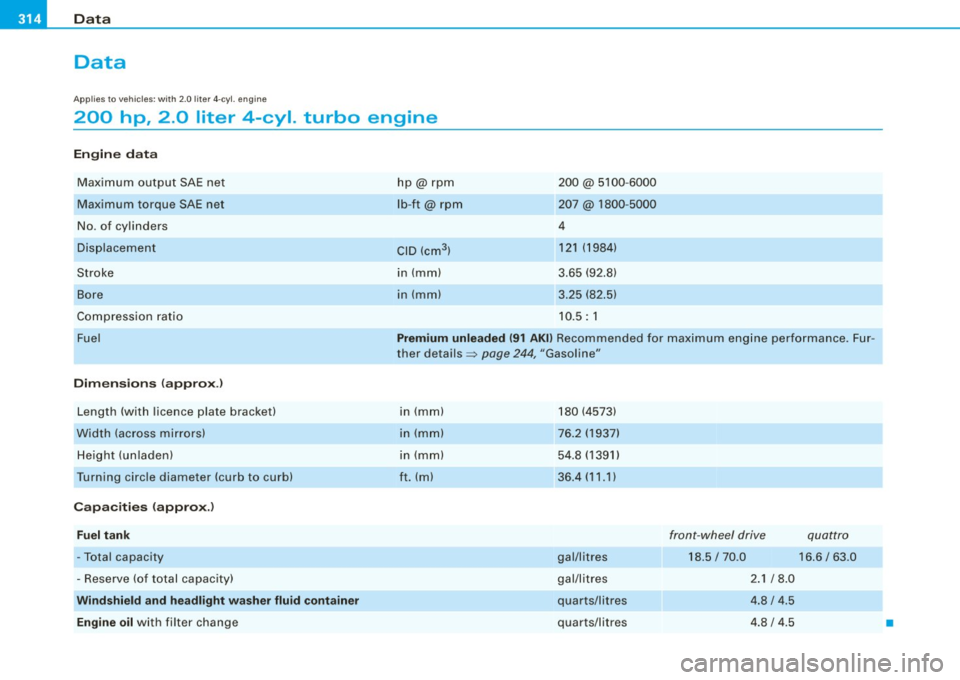
200 hp, 2.0 liter 4-cyl. turbo engine
En gin e da ta
Maximum output SAE net
Maximum torque SAE net
No . of cylinders
Disp lacement
Stroke
Bore
Compression ratio
Fuel
Dimen sion s (a pprox.)
Length (with licence plate bracket)
Width (across mirrors) Height (unladen)
Turning circle diameter (curb to curb)
Ca paci ties (a pprox.)
Fuel ta nk
-Total capacity
- Reserve (of total capacity)
Wind shield and h eadlight washer fluid containe r
Eng ine oil
with filter change hp@rpm
lb
-ft@ rpm
CID (cm
3 )
in (mm)
in (mm)
200 @ 5100 -6000
207
@ 1800-5000
4 121 (1984)
3.65 (92.8)
3 .25 (82 .5)
10.5: 1
Premium unleaded (91 AKI! Recommended for maximum eng ine performance . Fur
ther details =:,
page 244, "Gasoline"
in (mm)
in (mm)
in (mm)
ft. (ml
180 (4573)
76.2 (1937) 54.8 (1391)
36.4 (11.1)
gal/litres
gal/litres
qua rts/1 it res
quarts/litres
front -wheel drive
18.5 / 70 .0
2.1 / 8.0
4.8
I 4.5
4.8
I 4.5
quottro
16.6 / 63_0
•
Page 317 of 340
Data -----------------
Applies t o vehicl es: wi th 3.2 liter 6-c yl. engine
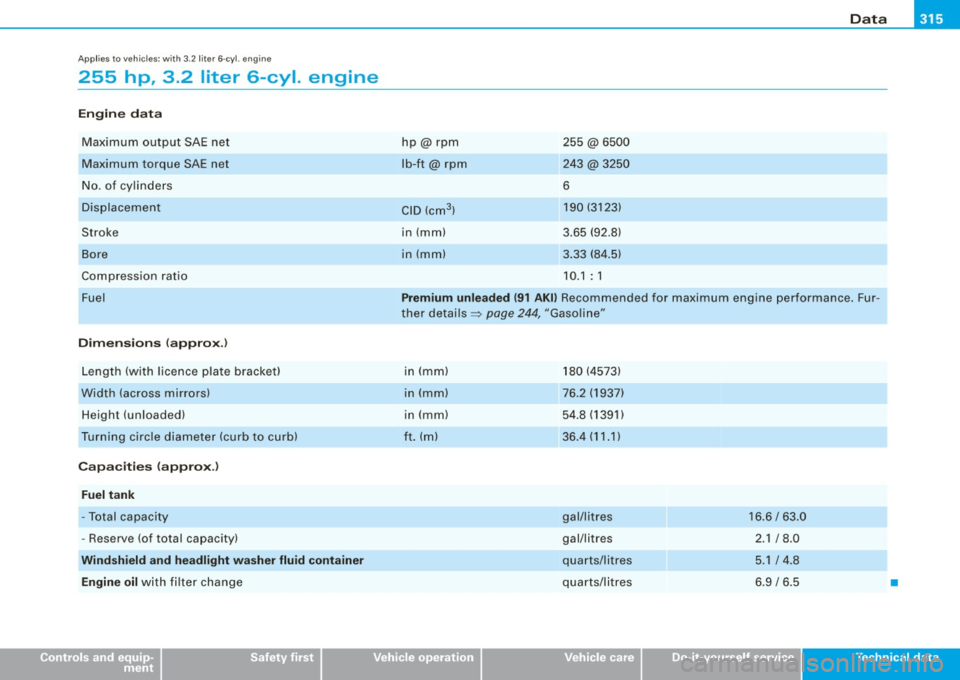
255 hp , 3.2 liter 6-cyl. engine
Engine data
Maximum output SAE net
Maximum torque SAE net
N o. of cy linders
Displacement
Stroke
Bore
Compression ratio
F uel
Dimensions (appro x.)
L e ngth (with licence plate bracke t)
Width (across m irrors)
Height (unloaded)
Turning circle diameter (curb to curb )
Capacities (appr ox .>
Fuel tank
- To tal capacity
- Reserve (of total capacity)
Windshield and he adlight wa sher fluid container
Engine oil
with filter change hp@rpm
lb
-ft@ rpm
C ID (cm
3
)
in (mm)
in (mm)
255@ 6500
243@3250
6
190 (3123)
3 .65 (92 .8)
3 .33 (8 4.5)
10.1 : 1
Premium unleaded 191 AKI)
Re commended for maximum engine performance . Fur
ther details =>
page 244, "Gasoline"
in ( mm)
in (mm)
in (mm)
ft. (ml
1 80 ( 4573)
76 .2 (1937)
54 .8 (139 1)
36.4 (11 .1)
gal/l itres
gal/litres
quarts /litres
qua rts/l itres 16.6 / 63.0
2 .1 / 8.0
5 .1 / 4.8
6.9 / 6 .5
•
Controls . and equip
ment . Safety first Vehicle operation
Vehicle care Do-it-yourself service Tec hn ica l da ta