tire pressure AUDI S4 CABRIOLET 2009 User Guide
[x] Cancel search | Manufacturer: AUDI, Model Year: 2009, Model line: S4 CABRIOLET, Model: AUDI S4 CABRIOLET 2009Pages: 340, PDF Size: 77.32 MB
Page 149 of 340
________________________________________________ D_r_iv _ i _n...: g=--- S_ a_ fe--= ly'---------"'
- Make sure that all lights and signals are operating
correctly.
- Make sure that the tire pressure is correct.
- Make sure that all windows are clean and afford good
visibility to the outside.
- Secure all luggage and other items carefully~
page 107.
-Make sure that nothing can interfere with the pedals.
- Adjust front seat, head restraint and mirrors correctly for
your height.
- Instruct passengers to adjust the head restraints
according to their height.
- Make sure to use the right child restraint correctly to
protect children~
page 190, "Child Safety".
- Sit properly in your seat and make sure that your passen
gers do the same
~ page 92, "General recommenda
t ions" .
- Fasten your safety belt and wear it properly. Also instruct
your passengers to fasten their safety belts properly
~ page 159. •
What impairs driving safety?
Safe driving is directly related to the condition of the
vehicle, the driver as well as the driver's ability to concen
trate on the road without being distracted.
The driver is responsible for the safety of the vehicle and all
of its occupants. If your ability to drive is impaired, safety
risks for everybody in the vehicle increase and you also
Controls and equip
ment Safety first Vehicle operation
become a
hazard to everyone else on the road ~& .There
fore:
- Do not let yourself be distracted by passengers or by
using a cellular telephone.
- NEVER drive when your driving ability is impaired (by
medications, alcohol, drugs, etc.I.
- Observe all traffic laws, rules of the road and speed limits
and plain common sense.
- ALWAYS adjust your speed to road, traffic and weather
conditions.
- Take frequent breaks on long trips. Do not drive for more
than two hours at a stretch.
- Do NOT drive when you are tired, under pressure or when
you are stressed.
& WARNING
Impaired driving safety increases the risk of serious personal
injury and death whenever a vehicle is being used. •
Vehicle care Do-it-yourself service Technical data
Page 157 of 340
• The tire pressure must correspond to the load -see the tire pres
s ur e s tick er on d river 's s ide B-p ill ar o r insid e t he f uel fill er fla p.•
Reporting Safety Defects
Applicable to U.S.A.
If you believe that your vehicle has a defect
which could cause a crash or could cause injury or death, you should immediately inform
the National Highway Traffic Safety Adminis
tration (NHTSA) in addition to notifying Audi of
America, Inc.
If NHTSA re ceives similar complaints, it may
open an investigation, and if it finds that a
safety defects exists in a group of vehicles , it
may order a recall and remedy campaign.
However , NHTSA cannot become involved in
individual problems between you , your dealer,
or Audi of America , Inc.
To contact NHTSA , you may call the Vehicle
Safety Hotline toll -free at:
Tel.: 1 -888 -327 -4236 (TTY: 1 -800 -424 -9153)
or write to:
Admini strator
NHTSA
1200 New Jersey Avenue , SE
Controls and equip
ment Safety first Vehicle operation
Driving Safely 1111
Washington
, D.C. 20590
You can also obtain other information about motor vehicle safety from:
http: //www.safercar.gov
Applicable to Canada
Canadian customers who wish to report a
safety -related defect to Tran sport Canada ,
Defect Investigations and Recall s, may tele
phone the toll free hotline:
Tel.: 1 -800 -333 -0371
or conta ct Transport Canada by mail at:
Road Safet y and Moto r Veh icle Regulation
Directorate
Transport Canada
Tower C, Place de Ville, 330 Sparks Street
Ottawa, ON K1 A 0N5
For additional road safety information , please
vi sit the Road Safety web site at:
http:/ /www.tc.gc.ca /roadsafety /menu.htm •
Vehicle care Do-it-yourself service Technical data
Page 214 of 340
-In
te llig ent tec hnolo gy --=---=-=-------------
Intelligent technology
Notice about data recorded by
vehicle control modules
Your vehicle is not equipped with an Event Data Recorder (EDRl,
installed by some manufacturers for the express purpose of
capturing data for retrieval after an accident or crash event . EDR's
are sometimes called "crash recorders" .
Some state laws restrict the retrieva l or downloading of data stored
by EDR's that were insta lled in a vehicle for the express purpose of
retrieving data after an accident or crash event without the owner's
consent.
Although your vehicle is not equipped with an EDR, it is equipped
with a number of electronic control modules for various vehicle systems such as, for examp le, engine function, emission control, as
we ll as for the airbags and safety belts.
T hese electronic control modules also record vehic le-rela ted da ta
during norma l ve hicle operation for diagnost ic and repair purposes .
The recording capacity of the electronic control modules is limited
to data (no sound is recorded) and only a small amount of data is
actually recorded over a very limited period of time and stored when
a system fault or other condition is sensed by a control unit. Some
of the data then stored may relate to vehic le speed, d irection,
braking as we ll as restraint system use and performance in the
event of a crash or other condition . Stored data can only be read and
down loaded with special equipment. •
Electronic Stabilization Program (ESP)
General information
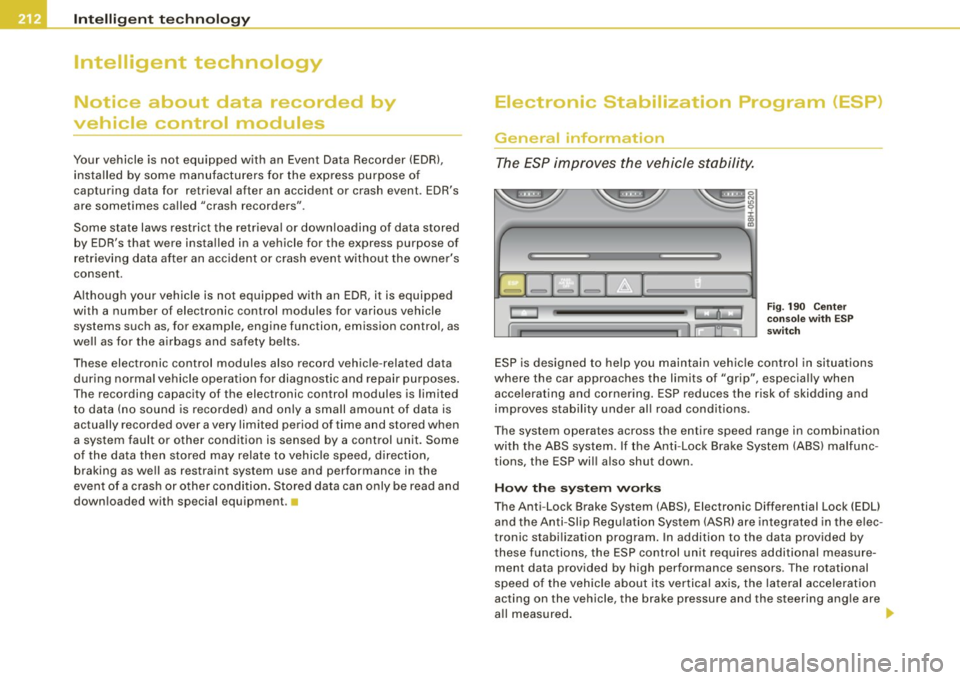
The ESP improves the vehicle s tability.
I
A F ig . 19 0 Cen ter
co nsol e w ith ESP
sw itch
ESP is designed to he lp you maintain vehic le control in situa tions
where the car approaches the limits of "grip", especially when acce lerating and cornering . ESP reduces the risk of skidding and
improves stability under all road conditions .
The syst em opera tes across the en tire speed range in combination
with the ABS system. If the Anti-Lock Brake System (ABS) malfunc
tions, the ESP wil l a lso shut down .
How th e sys te m work s
The Anti-Lock Brake System (ABS) , E lectronic Differential Lock (EDU
and the Anti -Sl ip Regu lation System (ASR) are integrated in the e lec
tronic stabi li z ation program. In addition to the data provided by
these functions, the ESP control unit requires additional measure ment data provided by high performance sensors . T he rotational
speed of the vehic le about its ver tica l axis, t he late ral acce leration
acting on the vehic le, the brake pressure and the steering ang le are
a ll measured .
Page 216 of 340
___ ln_ te_ ll..,,ig ..,_ e_ n_t _t_ e_ c_ h _ n_o _ l_o _,.g= y,_ __________________________________________ _
Driving off
When driving off, always be sure to keep road conditions in mind as
you accelerate. If one drive wheel spins because it is on a surface
with less grip, gradually increase the pressure on the accelerator
pedal until the car starts to move. The wheel less able to transfer
power spins.
Overheating of brakes
To prevent the disc brake of the braked wheel from overheating if
subjected to excessive loads, the EDL cuts out temporarily. The
vehicle remains operational and behaves in the same way as a
vehicle without EDL.
As soon as the brake has cooled down, EDL switches on again auto matically.
& WARNING
• When accelerating on slippery surfaces, such as on ice or snow,
always be careful when depressing the accelerator pedal. Even
with the EDL working, the drive wheels can spin and reduce your ability to control your car. -Risk of crash!
• The increased safety afforded by EDL does not mean that you
can take safety risks. Always adapt your driving style to the road
conditions and traffic situation.
[ i] Tips
If a fault occurs in the ABS, the EDL is also not functioning. This is
indicated by the ABS warning light=>
page 20. •
Anti-Slip Regulation System (ASR)
The Anti-Slip Regulation System prevents the driven
wheels from spinning when the car is accelerating.
General notes
The Anti-Slip Regulation System (ASR) is integrated in the electronic
stabilization program (ESP). When the vehicle starts up and acceler
ates, the wheels are prevented from spinning by adjusting the
engine power to match the amount of grip available from the road
surface.
How the system works
ASR performs automatically, i.e. without the driver's intervention.
With the aid of the ABS sensors=>
page 276, ASR monitors the
speed of the driven wheels. If the wheels start to spin, the engine
power is reduced automatically until the tires find enough grip to
lock onto the road surface. The system is active across the entire
speed range.
Th e ASR works in conjunction with the ABS. If a malfunction should
occur in the ABS, the ASR will also be out of action.
& WARNING
The increased safety afforded by ASR does not mean that you can
take safety risks. Always adapt your driving style to the road
conditions and traffic situation.
[ i] Tips
To ensure that the ASR works properly, all four wheels must be fitted
with identical tires Any differences in rolling radius of the tires can
cause the system to reduce engine power when this is not desired.
S ee also =>
page 279, "New tires and replacing tires and wheels". •
Page 218 of 340
___ ln_ te_ ll..,,ig ..,_ e_ n_t _t_ e_ c_ h _ n_o _ l_o _,.g= y,_ __________________________________________ _
& WARNING (continued)
• Do not "ride the brakes" by resting your foot on the pedal when
you do not intend to brake. This may cause the brakes to overheat, premature wear and increased stopping distance.
• Under certain climatic and operating conditions such as
passing through water, driving in heavy rain or after washing the
vehicle, the effectiveness of the brakes can be reduced. In winter,
ice can accumulate on the brake pads, linings, discs and drums .
Cautiously apply brakes for a test. Brakes will dry and ice coatings
will be cleaned off after a few cautious brake applications .
• Driving for an extended period of time on salt-covered roads
without using your brakes can also affect braking efficiency. Clean
off accumulated salt coating from brake discs and pads with a few
cautious brake applications.
• If you damage the front spoiler, or if you install a different
spoiler, be sure the air flow to the front brakes is not obstructed.
Otherwise the brake system could overheat reducing the effective
ness of the entire brake system.
• Failure of one brake circuit will impair the braking capability
resulting in an increased stopping distance. Avoid driving the
vehicle and have it towed to the nearest Audi dealer or qualified
workshop. u
Brake booster
The brake booster adds extra braking power.
The brake booster works with vacuum pressure which is created
only when the engine is running~ &.
& WARNING
• Never let the vehicle roll to a stop with the engine shut off.
• If the brake booster is not working, for example when towing
your vehicle, or because the brake booster has somehow been
& WARNING (continued)
damaged, the brake pedal must be pressed considerably harder to
make up for the lack of booster assistance. •
Functioning of Anti-Lock Brake System (ABS)
ABS prevents the wheels from locking up under braking.
The ABS contributes effectively to vehicle control since it prevents
the wheels from
locking when the brakes are applied. This means
that the vehicle remains steerable and is less likely to skid.
With ABS you do not need to pump the brake. Just hold the brake
pedal down.
However , do not expect that the ABS shortens braking distance
under
all circumstances. When driving on gravel or on newly fallen
snow on top of icy surfaces, braking distance may be even longer,
therefore, under these circumstances, it is especially important that
you drive slowly and with great care.
How the ABS system works
An automatic check is made when a speed of about 4 mph (6 km/h)
is reached. When this happens, a pumping noise can be heard.
If an individual wheel begins to rotate too slowly in relation to
vehicle speed and tends to lock, the ABS automatically reduces brake pressure to prevent that wheel from locking.
This automatic adjustment process will cause a
slight vibration of
the brake pedal and some noises to alert you that vehicle speed
must be adapted to existing road and traffic conditions.
& WARNING
Although the ABS is very effective, always remember that braking
capability is limited by tire traction . Always adjust your driving
speed according to the road and traffic conditions. Do not let the .,_
Page 226 of 340
___ T_ r _a_ il_e _r_ t_ o_ vv_ in__... g,_ __________________________________________________ _
Trailer towing
Driving with a trailer
General information
Your Audi was designed primarily for passenger transpor
tation.
If you plan to tow a trailer, please remember that the additional load
will affect durability, economy and performance.
Trailer towing not on ly p laces more stress on the vehicle, it a lso calls
for more concentration from the driver.
For this reasons, always fo llow the operating and driving instruc
tions provided and use common sense. •
Technical requirements
Trailer hitch
Use a weight -carrying hitch conforming to the gross trailer weight.
The hitch must be suitab le for your veh ic le and tra iler and must be
mounted securely on the vehicle's chass is at a technically sound
l ocation. Use only a trailer hitch with removable bal l mount. A lways
check with the trailer hitch manufacturer to make sure that you are
using the correct hitch .
Do not u se a bumper hit ch .
The hitch must be installed in such a way that it does not interfere
with the impact-absorbing bumper system . No modifications
should be made to the vehicle exhaust and brake systems . From
time to time, check that all hitch mount ing bo lts re main securely
fastened.
When you are not towing a trai ler, remove the trailer hitch ball
mount. This prevents the hitch from causing damage shou ld your
vehic le be struck from behind
=:, & .
Tire pre ssur e
When towing a trailer, inflate the tires of your vehic le to the cold tire
pressure listed under "Full load"on the s ticker on the right door
jamb . Inflate trai ler tires to trai ler and tire manufacturers' specifica
tions.
Lights
The head ligh t sett ings should be checked with the trai ler attached
before driving off. Have the head lights adjusted as necessary so
that you can see the road ahead but not blind oncoming traffic.
Check to make sure both vehicle and trailer lights are working prop
erly .
Engine cooling sy stem
Towing a trailer makes the engine work harder. It is important tha t
the cooling system's performance stands up to the additional
strain. Make sure that the coo ling sys tem has enough fluid .
Trailer brakes
If your traile r is equipped wi th a braking system, check to be sure
that it conforms to all regu lations .
The trailer hydraul ic brake system must not be direct ly connected to
the vehic le's hydraulic brake system .
Safety chains
Be sure trailer safety chains are properly connected from the trai ler
to the hitch on the vehicle. Leave enough slack in the chains to
permit turning corners. When you install safety chains, make sure
they will not drag on the road when you are driving.
The chains shou ld cross under the trailer tongue to prevent it from
dropping in case of separation from the hitch.
~
Page 227 of 340
Trailer lights
Trailer lights must meet all regulations. Be sure to check with your autho rized Audi dealer for correct wiring , switches and relays .
Mirrors
If you are unable to see the traffic behind you using the regular
outside mirrors, then you
must install extended mirrors. It is impor
tant that you always have clear vision to the rear .
& WARNING
After removing the trailer hitch, do not store it in your vehicle. In
case of sudden braking, the hitch could fly forward and injure you
or your passengers .
.1
Operating instructions
Maximum trailer weight
A trailer for your vehicle is limited to a typical class 1 or class 2
trailer .
Trailer load distribution
Be sure the load in the trailer is held securely in place to guard
against shifting, be it forward, backward or sideways.
Never allow a passenger to ride in a trailer~&, in "Driving instruc
tions".
Tire pressure
When towing a trailer, inflate the tires of your vehicle to the cold tire
pressure listed under "Full load" on the sticker on the right door
jamb. Inflate trailer tires to trailer and tire manufacturers' specifica
tions.
Controls and equip ment Safety first Vehicle operation
Trailer towing
Lights
The
headlight settings should be checked with the trailer attached
before driving off. Adjust as necessary so that you can see the road
ahead but not blind on -coming traffic.
Check proper working of vehicle and trailer lights .
Safety chains
Be sure trailer safety chains are properly connected from the trailer
to the hitch on the vehicle. Leave enough slack in the chains to
permit turning corners. When you install safety chains, make sure
they will not drag on the road when you are driving.
The chains should cross under the trailer tongue to prevent it from
dropping in case of separation from the hitch .•
Driving instructions
Driving with a trailer always requires extra care and
consideration.
To obtain the best possible handling of vehicle and trailer,
please note the following:
Do not tow a loaded trailer when your car itself is not
loaded.
- Be especially careful when passing other vehicles.
Observe speed limits.
Do not drive at the maximum permissible speed.
- Always apply brakes early.
Monitor the temperature gauge.
Vehicle care Do-it-yourself service Technical data
Page 234 of 340
-Cleaning and protection P':ft':I _______________ _
& WARNING
• Do not clean the underside of the chassis, fenders, wheel
covers, or other hard to reach parts without protecting your hands
and arms. You may cut yourself on sharp-edged metal parts.
• Always read and heed all WARNINGS and other information
~ page 230.
0 Note
• Never try to remove dirt, mud or dust if the surface of the vehicle
is dry. Never use a dry cloth or sponge, since this could scratch your
vehicle's paint or windows.
• Never wash your car in bright sunlight. Drops of water act as
magnifying lenses and may damage your paint .
• When you wash your car in the winter: if you rinse your vehicle
with a hose, be careful not to aim the stream of water directly at
locks, or at door or hatch openings - they can freeze shut.
• Never use sponges designed to remove insects, or any kitchen
scouring sponges or similar products. They can damage your paint
finish .
• Never use a dry cloth or sponge to clean the headlights. Only use
wet cloths or sponges to prevent scratches . It is best to use soapy
water.
<£> For the sake of the environment
In the interest of the environment, the vehicle should only be
washed in special wash bays. •
Washing your vehicle with a power washer
Cleaning the exterior of your car with a high-pressure
power washer is safe as long as you observe a few simple
rules.
- Before using the power washer, make sure you have read
and understood the WARNINGS~
& in "General infor
mation" on
page 230.
Always follow the operating instructions for the power
washer.
Make sure that the jet on the spray hose produces a "fan
shaped spray".
Do
not hold the spray nozzle too close to soft materials.
When cleaning the vehicle with a power washer always follow the
operating instructions. This applies particularly to the
operating
pressure and the spraying distance. Maintain a sufficient distance
to soft materials such as rubber hoses and sound/vibration dead ening materials {particularly on the underside of the engine hood).
Do not use a jet which sprays water in a
direct stream or one that
has a
rotating jet.
Water temperature should not exceed 140
°F (60 °C).
& WARNING
Never wash tires with a jet that sprays water in a direct stream.
This could cause invisible damage to the tires and weaken them,
even if the spray is from a relatively long distance and for a short
time . Damaged and weakened tires can fail and cause accidents
and personal injury.
0 Note
• Never use a power washer to clean the power top itself.
Page 269 of 340
Tires a nd wh eels BIii ________________________________ :....:.:.....::.=.....::.:..:..:..::..:___:___:..__ __
•
Tires and wheels
Tires
General notes
Tires may be the least appreciated and most abused parts
of a motor vehicle.
Tires may be the least appreciated and most abused parts of a
motor vehicle. Tires are, however, one of the most important parts
of a vehicle, particular ly considering the comparative ly sma ll patch
of rubber on each tire that assures that all -important contact
between you, your vehicle and the road .
Maintaining the correct tire pressure, making sure that your vehicle
and its tires do not have to carry more weight than they can safely
handle, avoiding damage from road hazards and regular ly
inspecting tires for damage inc luding cuts , slashes irregular wear
and overal l condition are the most important things that you can do
to help avoid sudden tire failure including tread separation and
b lowouts .
Avo iding d am age
If you have to drive over a curb or similar obstacle, drive very slowly
and as close as possible at a right angle to the curb.
A lways keep chemica ls including grease, oil, gasoline and brake
flu id off the ti res .
I nspect the tires regularly for damage (cuts, cracks or blisters, etc .!.
Remove any foreign bodies embedded in the treads .
Storing tire s
Mark tires when you remove them to indicate the direction of rota
tion. This ensures you to be ab le to mount them correctly when you
reinstall them. When removed, the whee
ls or tires should be stored in a coo l, dry
and preferably dark place.
Store tires in a vertical position i f they are not mounted on r ims, in
a horizontal position if they are mounted on rims.
N ew tire s
New tires have to be broken in => &.
The tread depth of new tires may vary, according to the type and
make of tire and the tread pattern.
Hidd en d am ag e
Damage to tires and rims is often not readily visible . If you notice
unusua l vibration or the vehic le pul ls to one side, this may indicate
that one of the tires has been damaged . The tires must be checked
immediately by an author ized Audi dealer or qualified workshop .
Uni dir ection al tire s
A unidirect ional tire can be identified by arrows on the sidewa ll, that
point in the direction the tire is designed to rotate. You must fo llow
the specified direction of ro tation . This is necessary so that these
tires can deve lop their optimum characteristics regarding grip, road
noise, wear and hydroplaning resistance . For more information
=> page 298.
Rim s with bolted rim ring *
Light-alloy wheels with a bo lted rim ring consist of several parts .
These parts are screwed together with special bo lts, using a specific
technique. This ensures proper function, seal, safety, and true running of the wheel. For this reason, damaged rims shou ld be
replaced, and you should never repair or dismantle them
=> & .
Rim s with screw -on decorative co vers *
Light-a lloy whee ls can be furnished with interchangeab le decora -
tive covers that are mounted to the rim with se lf -locking bolts. ...
Vehic le care
Page 270 of 340
-~_T_ ir_e_ s_ a_ n_d _ w_ h_ e_e _l_s _________________________________________________ _
Contact a dealership if you would like to replace damaged whee l
cove rs.
& WARNING
Never loo sen the screws on rim s with threaded rim rings* -danger
of accident!
& WARNING
New tires or tires that are old , worn or damaged cannot provide
maximum control and braking abil ity .
• New tires tend to be slippery and must be broken in. To reduce
the risk of losing control , a collision and serious per sonal injurie s,
drive with special care for the first 350 miles (560 km ).
Glossary of tire and loading terminology
Accessory weight
means the co mbined we ig ht (in excess o f those standar d ite ms
which may be rep laced) of automatic transmission, power stee ring,
power b rakes, power win dows, power seats, ra dio, a nd heater, to
the extent that these items are avai lab le as factory- installed equip
m ent (w hether i nstalled or not).
Aspect ratio
means the ratio o f the he ight to t he wid th of the t ire in perce nt.
N umbers of 5 5 or lower indicate a low sidewall for improved
steer ing respo nse and bette r overall handl ing on dry pave ment.
Bead
means the part of the tire that is made of stee l wires, wrapped or
reinforced by p ly cords and that is shaped to fit the rim.
& W ARNING (continued )
• Driving with worn or damaged tires can lead to loss of control,
sudden tire failure, including a blowout and sudden deflat ion ,
crashes and serious personal injuries . Have worn or damaged tires
replaced immediately.
• Tires age even if they are not being used and can fail suddenly,
e specially at high speeds. Tires that are more than 6 years old can
only be used in an emergen cy and then with special care and at
low speed.
• Never mount used tires on your vehicle if you are not sure of
their "p revious history. " Old used tire s may have been damaged
even though the damage cannot be seen that c an lead to sudden
tire failure and lo ss of vehicle control.
• If you notice unusual vibration or if the vehicle pulls to one side
when driv ing , always stop as soon as it is safe to do so and check
the wheels and tires for damage . •
Bead separation
m eans a brea kdow n of the bond be tween compo ne nt s in the bead.
Cord
means the strands forming the plies in the tire .
Cold tire inflation pressure
means the tire pressure recommended by the vehic le manufacturer
fo r a tire of a des ig nated size tha t h as not bee n dr iven for more than
a coup le of mi les (ki lometers) at low speeds in the three hour period
b ef or e the ti re pressu re is mea sured o r adj usted. _,,