warning AUDI S4 CABRIOLET 2009 Owners Manual
[x] Cancel search | Manufacturer: AUDI, Model Year: 2009, Model line: S4 CABRIOLET, Model: AUDI S4 CABRIOLET 2009Pages: 340, PDF Size: 77.32 MB
Page 299 of 340
_____________________________________________ W_ h_ a_t _d_ o _ l _d_o _ n_o_ w_ ? _ __,_
& WARNING
• You or your passengers could be injured while changing a
wheel if you do not follow safety precautions:
-Mounting the jack under the vehicle at any other place than
indicated above may damage the vehicle or may result in
personal injuries.
- A soft or unstable surface under the jack may cause the
vehicle to slip off the jack . Always provide a firm base for the
jack on the ground.
If necessary , use a sturdy board under the
jack .
- On hard, slippery surface (such as tiles ) use a rubber mat or
similar to prevent the jack from slipping .
• To help prevent injury to yourself and your passengers :
- Do not raise the vehicle until you are sure the jack is securely
engaged.
- Passengers must not remain in the vehicle when it is jacked
up.
- Make sure that passengers wait in a safe place away from
the vehicle and well away from the roadway and traffic .
- Make sure jack position is correct , adjust as necessary and
then continue to raise the jack. •
Taking the wheel off /putting the spare on
Follow thes e instru ctions s tep-by -step for chang ing the
wheel
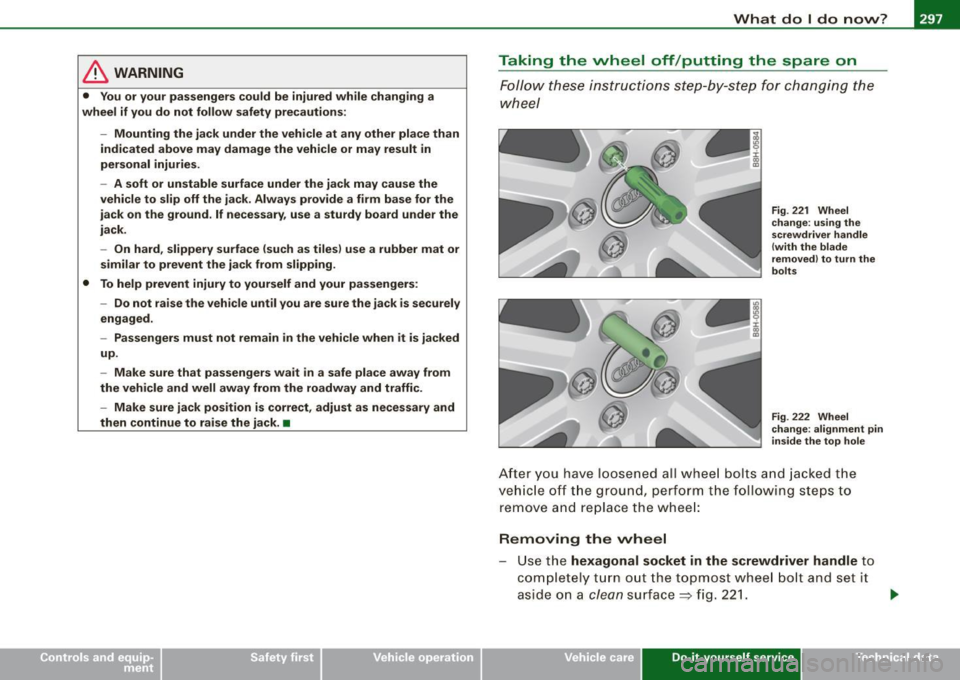
Fig . 2.21 Wheel
change : using the
screwdriver handle
( with the blade
removed) to turn the
bo lts
Fig .
222 Wheel
change : alignment pin
inside the top hole
Af te r yo u h ave l oo sened a ll wheel b olts and jacked the
vehicle off the gr ound, perform the fo llow ing steps to
remove and repla ce t he wheel:
Removing the wheel
Use th e hexagonal socket in the screwdriver handle t o
comple te ly turn ou t the t opmos t whe el b olt an d set i t
as ide on a
cl ean surfac e~ fig. 221. ..,
~ehicle care Do-it-yourse lf service irechnical data
Page 301 of 340
_____________________________________________ W_ h _a_t _ d_ o_ l _d _o _ n_o_ w_ ?_ . _ .... I'll
•
• Check the tire pressure on the spare immediately after
mounting.
• Have the wheel bolt t ightening torque checked with a torque
wrench as soon a s possible by your authorized Audi dealer or a
qualified se rvice station .
• On steel and alloy wheel rims , the wheel bolts are correctly tight
ened with a torque of 90
ft lb 1120 Nm ).
• If you notice while changing a tire that the wheel bolts are
corroded and diffi cult to turn while changing a tire , they should be
replaced before you check the tightening torque .
• Replace the flat tire with a new one and have it installed on your
vehicle as soon as possible . Remount the wheel cover.
Until then , drive with extra care and at reduced speeds .
& WARNING
• If you are going to equip your vehicle with tires or r ims which
differ from those which were factory installed , then be sure to read
the information
~ page 279 , "New tires and replacing tires and
wheels ".
• Always make sure the damaged wheel or even a flat tire and
the jack and tool kit are properly secured in the luggage compart
ment and are not loose in the passenger compartment .
• In an accident or sudden maneuver they could fly forward ,
injur ing anyone in the vehicle .
• Always store damaged wheel , jack and tools securely in
luggage compartment . Otherwise , in an accident or sudden
maneuver they could fly forward, causing injury to passengers in
the vehicle .
0 Note
Do not use commercially availab le ti re sealants. Otherw ise, the elec
t rica l compo nents of t he tir e pressure mon itor ing sys te m * w ill no longer work properly and the sensor for
the tire pressure moni
t o ring syste m will have to be re placed by a q ual ified work shop.•
Do-it-yourself service
Page 302 of 340
111!1...__F_ u_ s _ e_s _ a_n_ d_ b_ u_lb _ s _______________________________________________ _
Fuses and bulbs
Fuses
Replacing a fuse
A problem in the electrical system may be caused by a
blown fuse.
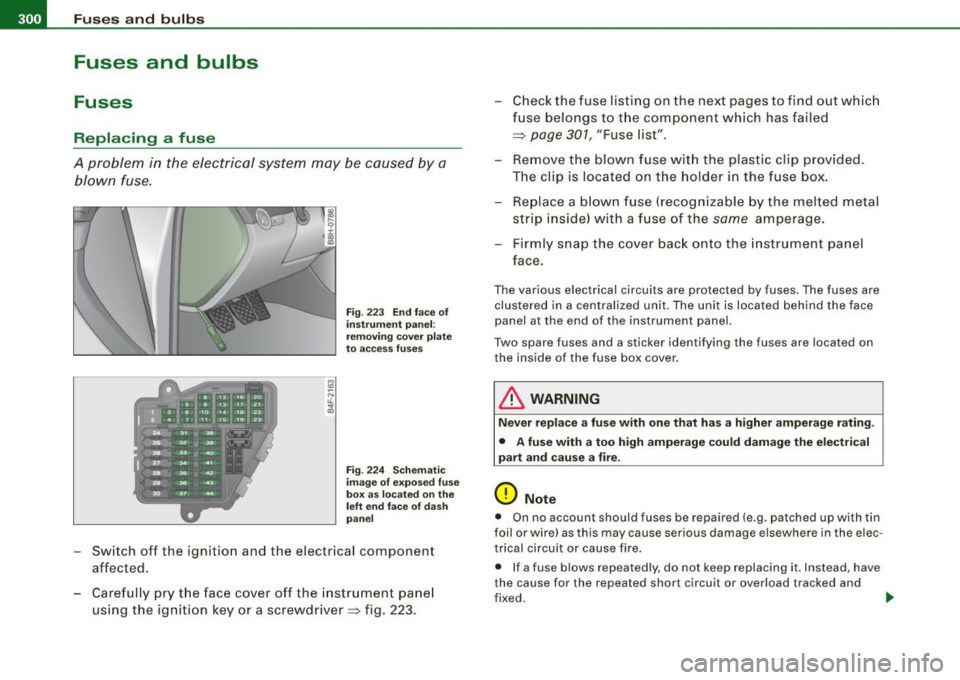
Fig. 223 End face of
instrument panel :
removing cover plate
to access fuses
Fig. 224 Schematic
image of exposed fuse
box as located on the
left end face of dash
panel
- Switch off the ignition and the electrical component
affected.
Carefully pry the face cover off the instrument panel
using the ignition key or a screwdriver~ fig . 223 . -
Check the fuse listing on the next pages to find out which
fuse belongs to the component which has failed
~ page 301 , "Fuse list".
- Remove the blown fuse with the plast ic clip provided.
The clip is located on the holder in the fuse box.
- Replace a blown fuse (recognizable by the melted metal
strip inside) w ith a fuse of the
some amperage.
- Firmly snap the cover back onto the instrument panel
face.
The various electrical circuits are protected by fuses . The fuses a re
clustered in a centralized unit. The unit is located behind the face
panel at the end of the instrument panel.
Two spare fuses and a sticker identifying the fus es are located on
the inside of the fuse box cover.
& WARNING
Never replace a fuse with one that has a higher amperage rating.
• A fuse with a too high amperage could damage the electrical
part and cause a fire.
(D Note
• On no account should fuses be repaired (e.g . patched up with tin
foil or wire) as this may caus e se rious damage elsewhere in the elec
trical circuit or cause fire.
• If a fuse blows repeatedly, do not keep replacing it. Instead, have
the cause for the repeated short circuit or overload tracked and
fixed. _,,
Page 304 of 340
111!11.--___;;F...; u::. s.::..:: e~s :.....:: a..:..n .:..; d::....; b.:..:. u..:..lb ;:..:: s _______________________________________________ _
No.
38
39
41
42
43
Equipment
Central electric, anti -theft alarm system, rear
lid/trunk release
Radio
Horn
Vacant
Electronic Stabilization Program (ESP)
Engine timing
Seat heating
Automatic circuit breakers: Amps
15
20
25
25
15
35
The electric power windows and the electric seat adjusters are
protected with circuit breakers which reset automatically after the
circuit overload has been corrected .
[ i] Tips
• Whenever replacing a fuse, always consult the sticker on the
inside of the fuse panel cover. It contains the most up-to-date infor
mation regarding the fuse arrangement . If in doubt, ask your autho
rized Audi Service advisor.
• Some of the equipment items listed are optional or only avail
able on certain model configurations. •
Bulbs
Replacing light bulbs
For your safety, we recommend that you have your autho
rized Audi dealer replace burned out bulbs for you.
It is becoming increasingly more and more difficult to replace
vehicle light bulbs since in many cases, other parts of the car must first be removed before
you are able to get to the bulb. This applies
especially to the light bulbs in the front of your car which you can
only reach through the engine compartment.
Sheet metal and bulb holders can have sharp edges that can cause
serious cuts, and parts must be correctly taken apart and then prop
erly put back together to help prevent breakage of parts and long
term damage from water that can enter housings that have not
been properly resealed.
For your safety, we recommend that you have your authorized Audi
dealer replace any bulbs for you, since your dealer has the proper
tools, the correct bulbs and the expertise.
Gas discharge lamps (xenon lights)*:
Due to the high electrical voltage, have the bulbs replaced by a qual
ified technician. Headlights with xenon light can be identified by the
high voltage sticker.
& WARNING
Contact with high-voltage components of the electrical system
and improper replacement of gas discharge (Xenon) headlight
bulbs can cause serious personal injury and death.
• Xenon bulbs are pressurized and can explode when being
changed.
• Changing Xenon lamps requires the special training, instruc
tions and equipment.
• Only an authorized Audi dealer or other qualified workshop
should change the bulbs in gas discharge lamps.
& WARNING
There are parts with sharp edges on the openings and on the bulb holders that can cause serious cuts .
~
Page 306 of 340
111!1.___E_ m __ e_r -=g :...e_ n_ c-=y _ s_ i_t _u _a _t_ i_o _n_ s _______________________________________________ _
Emergency situations
General
This chapter is intended for trained emergency crew s and working
personnel who have the necessary tools and equipment to perform
these operations. •
Starting by pushing or towing
0 Note
Vehicles with an automatic tran smission cannot be started by
push ing o r towing . •
Starting with jumper cables
If n ece ssa ry, th e engin e ca n be sta rte d by conne cti ng it to
the battery of another veh ic le .
If the engin e should fai l to start because of a discharge d or weak
b at te ry, the batt ery can be con nected t o the batt er y of
another
ve hic le, using a pair of jumper cables to start the engine.
Jumper cables
Use
only jumper cables of suffici ently large cross section to safely
c arry the st ar ter curre nt. Refer to th e m anuf actu rer's sp ec ificati ons.
Use on ly j umper ca bles with
isolated termi na l clam ps and properly
marked fo r distinct ion :
plus (+l cable in mo st c ases c olor ed red
minus (-l cable in most cases colored black.
& WARNING
Batteries contain electricity , acid, and gas. Any of these can cause
very serious or fatal injury. Follow the instructions below for safe
handling of your vehicle 's battery .
• Always shield your eyes and avoid leaning over the battery
whenever possible .
• A discharged battery can already freeze at temperatures just
below 32 °F (0 °C). Before connecting a jumper cable, the frozen
battery must be thawed completely, otherwise it could explode.
• Do not allow battery acid to contact eyes or skin . Flush any
contacted area with water immediately.
• Improper use of a booster battery to start a vehicle may cause
an explosion.
• Vehicle batteries generate e xplosive gases . Keep sparks , flame
and lighted cigarettes away from batteries.
• Do not try to jump start any vehicle with a low acid level in the
battery.
• The voltage of the booster battery must also have a 12-Volt
rating . The capacity (Ahl of the booster battery should not be
lower than that of the discharged battery . Use of batteries of
diffe rent voltage or substantially different "Ah " rating may cause
an explosion and personal injury .
• Never charge a frozen battery. Gas trapped in the ice may cau se
an explosion .
• Never charge or use a battery that has been frozen . The battery
case may have be weakened.
• Use of batteries of different voltage or substantially different
capacity (Ah ) rating may cause an explosion and injury . The
capacity (Ahl of the booster battery should not be lower than that of the discharged battery . ...
Page 307 of 340
______________________________________________ E_ m_ e_r -=g :...e _ n_ c __a. y_ s_it _u_ a_ ti_o _ n_ s _ __,11111
& WARNING (continued)
• Before you check anything in the engine compartment, always
read and heed all WARNINGS~ page 242, "Engine compartment".
0 Note
• Applying a higher voltage booster battery will cause expensive
damage to sensitive electronic components, such as control units,
relays, radio, etc .
• There must be no electrical contact between the vehicles as
otherwise current could already start to flow as soon as the positive
(+) terminals are connected.
[ i] Tips
The discharged battery must be properly connected to the vehicle's
electrical system. •
Use of jumper cables
Make sure to connect the jumper cable clamps in exactly
the order described below!
Fig. 225 Jump·
starting with the
battery of another
vehicle : A -discharged
vehicle battery, B -
booster battery
Vehicle with discharged battery:
- Turn off lights and accessories, move lever of automatic
transmission to
N (Neutral) or P (Park) and set parking
brake.
Connect POSITIVE (+) to POSITIVE (+) (red)
1. Connect clamp of plus cable to positive(+) terminal G)
~ fig. 225 of discharged vehicle battery@.
2. Connect clamp on opposite end of cable to positive(+)
terminal
® of booster battery@.
Connect NEGATIVE (-) to NEGATIVE (-) (black)
3. Connect clamp of minus cable (black) to negative( -)
terminal
0 of booster battery@.
4. Connect clamp on opposite end of negative cable to the
negative( -) terminal © of the discharged vehicle battery
@.
- Check that all screw plugs on the battery cells are
screwed in firmly. If not, tighten plugs prior to
connecting clamp on negative battery terminal.
Starting the engine
- Start the engine of the vehicle with the booster battery.
Run the engine at a moderate speed.
- Start engine with discharged vehicle battery in the usual
manner.
- If the engine fails to start: do not keep the starter
cranking for longer than 10 seconds. Wait for about 30
seconds and then try again. .,,.
~ehicle care Do-it-yourse lf service Technical data
Page 308 of 340
111!1.___E_ m __ e_r -=g :...e_ n_ c-=y _ s_ i_t _u _a _t_ i_o _n_ s _______________________________________________ _
-With en gine run ning, r em ove jum per ca bles from both
v ehi cle s in exact
reve rs e o rd er.
T he battery is ve nted t o th e outs ide to preve nt gases from enter ing
the vehicle interior.
M ake s ure t hat th e jum per cla m ps are well co nnecte d with th eir
metal parts in full contact with the battery t erminals .
& WARNING
To avoid serious personal injury and damage to the vehicle , heed
all warnings and instructions of the jumper cable manufacturer. If
in doubt , call for road service .
• Jumper cables must be long enough so that the vehicles do not
touch .
• When connecting jumper cables , make sure that they cannot
get caught in any moving parts in the engine compartment .
• Before you check anything in the engine compartment, always
read and heed all WARNINGS=>
page 242, "Engine compartment ".
0 Note
Improper hook -up of jumper cables can ruin the generator.
• Always connec t POSIT IVE( +) to POS ITIVE ( +J, and NEG ATIV E (- J to
N EGAT IVE(-) te rminal.
• C heck that a ll screw plugs on the battery cel ls are screwed in
firm ly . I f not, tighten plugs prior to connec ting cla m p on nega tive
battery te rminal.
• P lease no te tha t th e procedure fo r con nec ting a ju mp er ca ble as
described above app lies specifical ly to t he case of your vehicle
b eing j ump st arted. When yo u are g iv in g a jum p start to another
veh ic le, do
not conn ect the minus(-) ca ble to the m inus( -) te rmina l
on the discha rge d battery ©=>
page 305, fig. 225. In stead , secu rely
co nnect the m inus(-) cable to e ither a m ass ive metal compone nt
that is firmly bo lted to the engine bloc k or to the engine b lock itse lf. I
f th e battery that is b ein g charged does not vent to the outside,
escapi ng battery ga s cou ld ignit e a nd ex plod e!•
Emergency towing with commercial
tow truck
General hints
Yo ur A udi requires s pecial handl in g f or t owing.
The fol lowing information i s to be used by commercial tow truck
operators who know how to operat e their equ ipment safe ly.
• Never tow your Audi, towing will cause damage to the engine
and transmission.
• Never wrap the safety chains or winch cables around the brake
lines.
• To prevent unnecessary damage , your Audi must be transported
with a car carrier (flat bed truck ).
• To load the vehicle on to the flat bed , use the towing loop found
in the vehicle tools and attach to the front or rear anchorage
=> page 3 07 and => page 307.
& WARNING
A vehicle being towed is not safe for passengers. Never allow
anyone to ride in a vehicle being towed , for any reason. •
Page 309 of 340
________________________________________________ E_ m_ e_r ""g '-e_ n _ c..::y;..._ s_ i_t _u _a_ t_ i_o _n_ s _ __,_
Front towing loop
Do not install the front towing loop until it is needed.
Fig. 226 Front
bumper: removing the
cover cap
Fig . 227 Front
bumper: screwing in
the towing loop
The towing loop fits into the threaded hole located on the
right side of the front bumper and covered by a small cap
when not in use. -
Remove the towing loop from the vehicle tools
=> page 290.
-Press on the bottom edge of the cover cap to disengage
it from the bumper. The cap remains connected to the
bumper => fig. 226.
- Screw the towing loop into the threaded hole as far as it
will go
=> fig. 227, then tighten it with the wheel bolt
wrench.
When it is no longer needed , unscrew the towing loop and put it
back into the onboard toolkit. Make sure to have the towing loop
stored in the vehicle at all times .
& WARNING
If the towing loop is not screwed in as far as it will go, the thread
can pull out when the vehicle is towed -potential risk of an
accident. •
Rear towing loop
Fig. 228 Rear bumper,
right side: location of
rear towing loop
The rear towing eye is welded to the chassis under the rear bumper
on the right side.•
~ehicle care Do-it-yourse lf service Technical data
Page 310 of 340
111'1...__E_ m_ e_ r -'g==-- e_n _c_ y=---- s_ i_ t _u _a _ t_ i_o _n _ s _____________________________________________ _
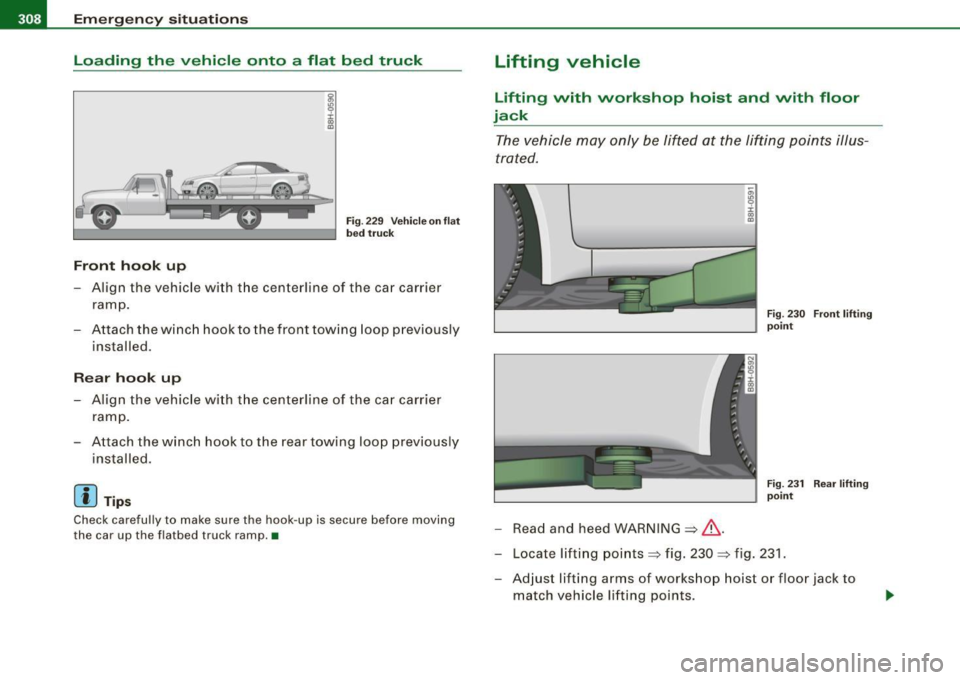
Loading the vehicle onto a flat bed truck
Front hook up
I
"' m
Fig . 229 Ve hicle on flat
b ed tru ck
- Align the vehicle w ith the centerline of the car carrier
ramp .
- Attach the winch hook to the front towing loop previously
installed .
Rea r hook up
-Align the vehicle wi th t he centerline of the ca r carrier
ramp .
- Attach the winch hook to the rear towing loop previously
i nstalled.
[ i ] Tips
Check careful ly to make sure the hook -up is secure before moving
the car up the flatbed truck ramp. •
Lifting vehicle
Lifting with workshop hoist and with floor
jack
T he vehicle may only be lifted at the lifting p oints illus
trated.
- Read and heed WARNING =>& .
m 9 :r
"' m
Fig . 2 30 F ront lift in g
po in t
F ig . 2 3 1 Rear lift in g
po int
- Locate lifti ng poi nts =:> fig. 230 =:> fig. 23 1.
- Ad just li fting arms of works hop hoist or floor jack to
match vehicle l ifting points.
Page 311 of 340
________________________________________________ E _m_ e_r.:g :;,. e_ n_c ...: y:.- s_ i_ t _u _a_ t_ i_ o _ n_ s ____ fflll
•
- In se rt a rubber pad betwee n th e floor jack/ wo rk sh op
h oi st and the li ftin g p oin ts .
If you must lift your vehicle with a floor jack to work underneath , be
sure the vehicle is safely supported on stands intended for this
purpose .
Fr ont lifting point
The lifting poi nt is located on the floo r pan rei nforceme nt about at
the same leve l as the jack mounting point~ page
308, fig. 230. Do
not lift the vehicle at the vertical sill reinforcement.
Rear lifting point
The li ftin g point is locate d on t he vert ical re inforceme nt of th e low er
sil l for the on board jack~ page
30 8, fig. 23 1.
Lifting with vehi cle ja ck
Refer to
~ page 296.
& WARNING
• To reduce the ri sk of serious injury and vehicle damage.
- Always l ift the vehicle only at the special workshop hoist and
floor jack lift points illustrated
~ page 308 , fig. 230 and
~ page 308, fig. 231.
- Failure to lift the vehicle at these points could cause the
vehicle to tilt or fall from a lift if there is a change in vehicle
weight distribution and balan ce . This might happen , for
e xample , when heavy components such as the engine block or
transmission are removed .
• When removing heavy components like these, anchor vehicle
to hoist or add correspond ing we ights to maintain the center of
gravity. Otherwise , the vehicle might tilt or slip off the hoist ,
causing ser ious personal injury .
0 Note
• Be aware of the fo llowing po ints be fore l ifting the ve hicle:
- The vehicle should never be lifted o r ja cked up from under
neath the engine oil pan , the tran smis sion housing , the front or
rear a xle or the body side members. This could lead to serious
damage.
- To avoid damage to the underbody or chassis frame , a rubber
pad must be inserted between the floor jack and the lift points .
- Before dr iving over a workshop hoist , check that the vehicle
weight does not exceed the permis sible lifting capacity of the
hoist .
- Before driving over a workshop hoist , en sure that there i s
sufficient clearance between the hoist and low parts of the
vehicle. •
Do-it-yourself service