automatic transmission AUDI S4 CABRIOLET 2009 Owner's Manual
[x] Cancel search | Manufacturer: AUDI, Model Year: 2009, Model line: S4 CABRIOLET, Model: AUDI S4 CABRIOLET 2009Pages: 340, PDF Size: 77.32 MB
Page 252 of 340
-~_C_ h_e _c _ k_ i_ n ...:::g:;..._ a_n_ d_ f_ i_ll _in ....;g:::;.._ ___________________________________________ _
Closing the engine hood
-Pull t he hood down until the pressure from the strut is
reduced.
- Let t he hood
drop down and latch in place. Do not try to
push it shut;
it may fai l to engage ~& .
& WARNING
A hood that is not completely latched could fly up and block your
view while driving.
• When you close the engine hood, check it to make sure the
safety catch has properly engaged. The hood should be flush with
the surrounding vehicle body parts.
• If you notice while driving that the hood is not secured prop
erly, stop at once and close it. •
Working in the engine compartment
Be especially careful whenever you work in the engine
compartment.
Whenever you must perform any work in the engine compartment,
for example checking and filling different fluids, there is a risk of injury, burns and accidents. To prevent personal injury always
observe the following WARNINGS. The engine compartment of any
vehicle is a hazardous area
~ 6 .
& WARNING
To help avoid injury, before you check anything under the hood :
• Turn off the engine.
• Remove the ignition key.
• Apply the parking brake.
& WARNING (continued)
• Move selector lever of automatic transmission to "P" (Park);
put manual transmission in Neutral.
• Always let the engine cool down. Hot components will burn
skin on contact.
• To reduce the risk of being burned, never open the hood if you
see or hear steam or coolant escaping from the engine compart
ment. Wait until no steam or coolant can be seen or heard before
carefully opening the hood .
• Keep children away from the engine compartment.
• Never spill fluids on hot engine components. They can cause a
fire.
• Never touch the radiator fan. The auxiliary electric fan is
temperature controlled and can switch on suddenly.
• Never open the coolant reservoir cap when the engine is still
warm. The coolant system is pressurized and hot coolant could
spray out.
• Protect your face, hands and arm from steam or hot engine
coolant by placing a thick rag over the cap when you open the
coolant reservoir.
• If work on the fuel system or the electrical system is necessary :
- Always disconnect the battery .
- Never smoke or work near heaters or open flames. Fluids in
the engine compartment could start a fire.
- Keep an approved fire extinguisher immediately available.
• To avoid electrical shock and personal injury while the engine
is running or being started, never touch :
- Ignition cables
- Other components of the high voltage electronic ignition
system.
• If you must perform a check or repair with the engine running:
~
Page 270 of 340
-~_T_ ir_e_ s_ a_ n_d _ w_ h_ e_e _l_s _________________________________________________ _
Contact a dealership if you would like to replace damaged whee l
cove rs.
& WARNING
Never loo sen the screws on rim s with threaded rim rings* -danger
of accident!
& WARNING
New tires or tires that are old , worn or damaged cannot provide
maximum control and braking abil ity .
• New tires tend to be slippery and must be broken in. To reduce
the risk of losing control , a collision and serious per sonal injurie s,
drive with special care for the first 350 miles (560 km ).
Glossary of tire and loading terminology
Accessory weight
means the co mbined we ig ht (in excess o f those standar d ite ms
which may be rep laced) of automatic transmission, power stee ring,
power b rakes, power win dows, power seats, ra dio, a nd heater, to
the extent that these items are avai lab le as factory- installed equip
m ent (w hether i nstalled or not).
Aspect ratio
means the ratio o f the he ight to t he wid th of the t ire in perce nt.
N umbers of 5 5 or lower indicate a low sidewall for improved
steer ing respo nse and bette r overall handl ing on dry pave ment.
Bead
means the part of the tire that is made of stee l wires, wrapped or
reinforced by p ly cords and that is shaped to fit the rim.
& W ARNING (continued )
• Driving with worn or damaged tires can lead to loss of control,
sudden tire failure, including a blowout and sudden deflat ion ,
crashes and serious personal injuries . Have worn or damaged tires
replaced immediately.
• Tires age even if they are not being used and can fail suddenly,
e specially at high speeds. Tires that are more than 6 years old can
only be used in an emergen cy and then with special care and at
low speed.
• Never mount used tires on your vehicle if you are not sure of
their "p revious history. " Old used tire s may have been damaged
even though the damage cannot be seen that c an lead to sudden
tire failure and lo ss of vehicle control.
• If you notice unusual vibration or if the vehicle pulls to one side
when driv ing , always stop as soon as it is safe to do so and check
the wheels and tires for damage . •
Bead separation
m eans a brea kdow n of the bond be tween compo ne nt s in the bead.
Cord
means the strands forming the plies in the tire .
Cold tire inflation pressure
means the tire pressure recommended by the vehic le manufacturer
fo r a tire of a des ig nated size tha t h as not bee n dr iven for more than
a coup le of mi les (ki lometers) at low speeds in the three hour period
b ef or e the ti re pressu re is mea sured o r adj usted. _,,
Page 292 of 340
1111...__W_ h_ a_ t_d_ o_ l _d _o_ n_ o_ vv_ ? ______________________________________________ _
What do I do now?
Trunk escape handle
In case of an emergency, the rear lid can be opened from
the inside using the trunk escape handle.
To open rear lid
Fig. 212 Rear lid: trunk
escape handle
-Pull the handle~ fig. 212 down towards the bumper.
The trunk escape handle inside the rear lid is made of fluorescent
material to glow in the dark.
& WARNING
The trunk escape handle is to be used only in an emergency.
[ i ] Tips
The emergency release lever should never be used as a handle for
closing the rear lid. •
Jack, tools and spare wheel
Applies to vehicles: with 6 -speed automatic transmission
Jack and tools
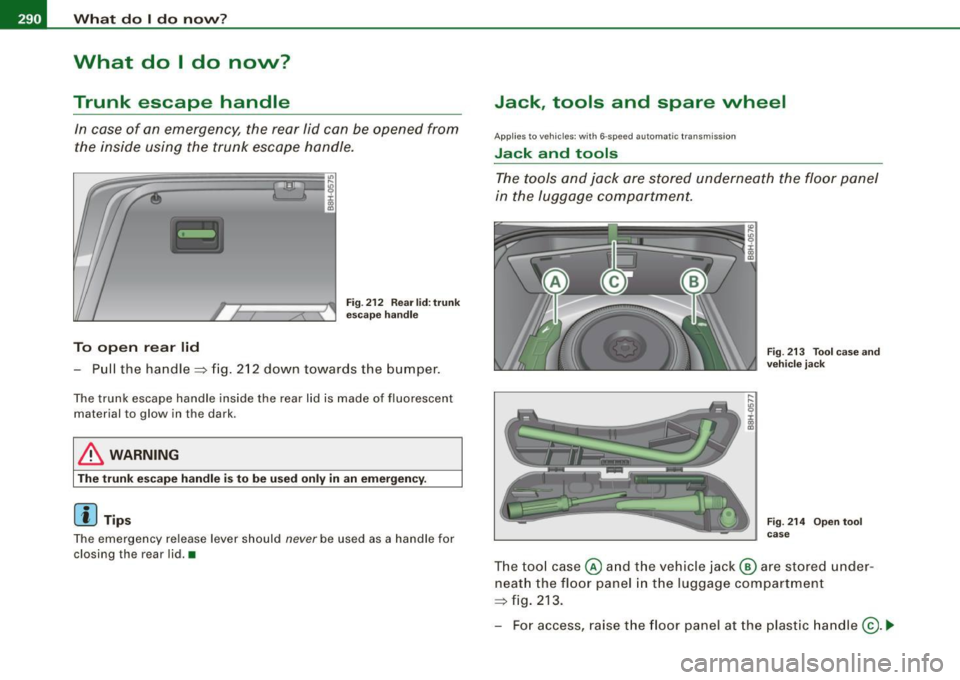
The tools and jack are stored underneath the floor panel
in the luggage compartment.
Fig. 213 Tool case and
vehicle jack
Fig. 214 Open tool
case
The tool case @ and the vehicle jack @ are stored under
neath the floor panel in the luggage compartment
~ fig. 213.
- For access, raise the floor panel at the plastic handle
@. ~
Page 295 of 340
_____________________________________________ W_ h _a_t _ d_ o_ l _d _o _ n_o_ w_ ?_ . _ ..... 19111
•
& WARNING (continued)
pressure table - risk of accident! Use the highest tire pressure in
the table.
• Do not drive faster than 50 mph (80 km/h) - risk of accident!
• Avoid full-throttle acceleration, sharp braking, and fast
cornering - risk of accident!
• Never drive using more than one space-saving spare wheel -
risk of accident!
• Normal summer or winter tires must not be fitted on the space
saving spare wheel rim. •
Wheel change
Before changing a wheel
Follow these points for your own and your passenger's
safety when replacing a wheel.
-After you experience a tire failure, pull the car well away
from moving traffic and try to reach level ground before
you stop => & .
- All passengers should leave the car and move to a safe
location (for instance, behind the guardrail)=>& .
- Apply the parking brake firmly=>&.
- Move selector lever to position Pon an automatic trans-
mission; put manual transmission in first gear =>& .
- If you are towing a trailer: unhitch the trailer from your
vehicle.
- Take the tool case and the spare tire=>
page 290 out of
the luggage compartment.
& WARNING
You or your passengers could be injured while changing a wheel if
you do not follow these safety precautions:
• If you have a flat tire, move a safe distance off the road. Turn off
the engine, turn the emergency flasher on and use other warning devices to alert other motorists .
• Make sure that passengers wait in a safe place away from the
vehicle and well away from the roadway and traffic.
• To help prevent the vehicle from moving suddenly and possibly
slipping off the jack, always fully set the parking brake and block
the wheel diagonally opposite the wheel being changed. When one
front wheel is lifted off the ground, placing the Automatic Trans
mission in "P" (Park), or engaging a gear in a manual transmission
will
not prevent the vehicle from moving .
• Before you change a wheel, be sure the ground is level and firm.
If necessary, use a sturdy board under the jack.
• After installing the spare wheel, make sure that you remount
the flat tire/wheel in its storage area properly and tighten the
knurled retaining screw securely. •
Changing a wheel
When you change a wheel, follow the sequence described
below step-by -step and exactly in that order.
1. Remove the decorative wheel cover*. For more details
see also =>
page 294, "Decorative wheel covers" or
=>
page 295, "Wheels with cap-covered wheel bolts".
2. Loosen the wheel bolts=>
page 295.
3. Locate the proper mounting point for the jack and align
the jack below that point=>
page 296.
4. Lift the car with the jack=> page 296. _,..
Do-it-yourself service
Page 303 of 340
![AUDI S4 CABRIOLET 2009 Owners Manual _________________________________________________ F_ u_ s_ e_s _ a_n _ d_ b_ u_lb _ s ____ llll
[ i ] Tip s No . Equipm ent Amps
You are wel l adv ised to keep a supply of spare fuses in you](/img/6/57654/w960_57654-302.png "AUDI S4 CABRIOLET 2009 Owners Manual _________________________________________________ F_ u_ s_ e_s _ a_n _ d_ b_ u_lb _ s ____ llll
[ i ] Tip s No . Equipm ent Amps
You are wel l adv ised to keep a supply of spare fuses in you")
_________________________________________________ F_ u_ s_ e_s _ a_n _ d_ b_ u_lb _ s ____ llll
[ i ] Tip s No . Equipm ent Amps
You are wel l adv ised to keep a supply of spare fuses in your vehic le.
15 Instrument c luster, Navigation system 10
Fuses with the proper ampere ratings are available at your Audi 16 Garage door opener 5
dea ler. •
17 Level , tire pressure control , park assist, 10 light/rain sensor
Fuse list Automatic headlig ht range control, left 5
Fuses which con be replaced. 19 Fog lights 15
Vacant
N o. Equipm ent Amps
21 Vacant
1 Air conditioner 10
22 Doors 15
2 Footwell illumination 5 23 Vacant
3 Heated washer jets 5 Central convenience electrical system 20
Radiator fan 5 25 Heater blower 30
5
Telephone, oil level sensor, multifunction 10 Rear window defogger 30 switch, rear heated seat, shift gate
Air conditioner (air quality sensor), air pressure
27 Socket for tra iler towing (controller) 30
6 5
sensor 28 Fuel pump 20
Electronic Stabil izat ion Program (ESP), bra ke 29 Vacant
7 light switch, clutch peda l switch, steering angle 10
sensor
30 Power top control un it 30
8 Telephone 5 31
Automatic transmission, mirror dimming, diag-15 nosis socket
9 Brake booster (vacuum pump) 15 Towing assembly 15
10
Automatic headl ight beam adjustment, auto -5 33 Cigarette
lighter 20 matic headlight range control, right
34 Electrical socket 20
11
Airbag control unit, front passenge r seat recog -10 nition USA (bladder mat) 35 Luggage compartment socket 20
Diagnosis socket 10 Windshield wiper system 30
13
Steering c olumn module 10
37 Pump for windshie ld an d head light washer* 30
14
Brake lights 10
system
• Do-it-yourself service
Page 307 of 340
______________________________________________ E_ m_ e_r -=g :...e _ n_ c __a. y_ s_it _u_ a_ ti_o _ n_ s _ __,11111
& WARNING (continued)
• Before you check anything in the engine compartment, always
read and heed all WARNINGS~ page 242, "Engine compartment".
0 Note
• Applying a higher voltage booster battery will cause expensive
damage to sensitive electronic components, such as control units,
relays, radio, etc .
• There must be no electrical contact between the vehicles as
otherwise current could already start to flow as soon as the positive
(+) terminals are connected.
[ i] Tips
The discharged battery must be properly connected to the vehicle's
electrical system. •
Use of jumper cables
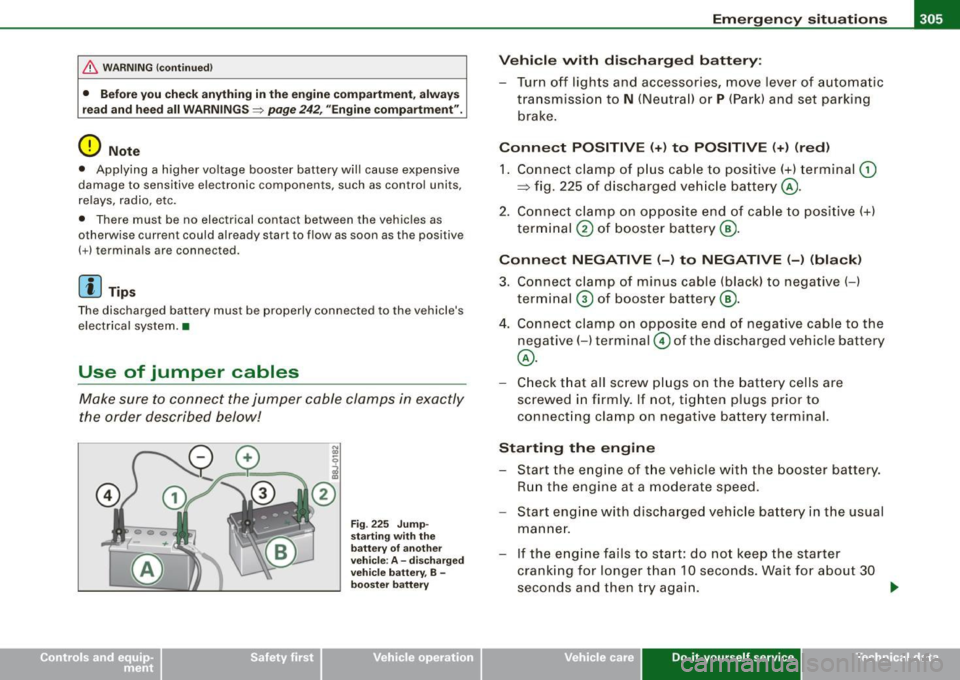
Make sure to connect the jumper cable clamps in exactly
the order described below!
Fig. 225 Jump·
starting with the
battery of another
vehicle : A -discharged
vehicle battery, B -
booster battery
Vehicle with discharged battery:
- Turn off lights and accessories, move lever of automatic
transmission to
N (Neutral) or P (Park) and set parking
brake.
Connect POSITIVE (+) to POSITIVE (+) (red)
1. Connect clamp of plus cable to positive(+) terminal G)
~ fig. 225 of discharged vehicle battery@.
2. Connect clamp on opposite end of cable to positive(+)
terminal
® of booster battery@.
Connect NEGATIVE (-) to NEGATIVE (-) (black)
3. Connect clamp of minus cable (black) to negative( -)
terminal
0 of booster battery@.
4. Connect clamp on opposite end of negative cable to the
negative( -) terminal © of the discharged vehicle battery
@.
- Check that all screw plugs on the battery cells are
screwed in firmly. If not, tighten plugs prior to
connecting clamp on negative battery terminal.
Starting the engine
- Start the engine of the vehicle with the booster battery.
Run the engine at a moderate speed.
- Start engine with discharged vehicle battery in the usual
manner.
- If the engine fails to start: do not keep the starter
cranking for longer than 10 seconds. Wait for about 30
seconds and then try again. .,,.
~ehicle care Do-it-yourse lf service Technical data
Page 320 of 340
___ C_ o_n_ s_ u_m _ e_ r_ ln_ f_o _r_m _ a_ t_ i_o _n ______________________________________________ _
& WARN ING (continued )
• The engine compartment of any motor vehicle is a potentially
hazardous area . Never reach into the area around or touch the
radiator fan . It is temperature controlled and can sw itch on
suddenly -even when the engine is off and the ignition key has
been removed . The radiator fan switches on automatically when
the coolant reaches a certain temperature and will continue to run until the coolant temperature drops .
• Always remove the ignition key before anyone gets under the
vehi cle .
• Always support your vehicle with safety stands if it is neces
sary to work underneath the vehicle . The jack suppl ied with the
vehicle is not adequate for this purpose and could collapse causing serious personal injury .
• If you must work underneath the vehicle with the wheels on
the ground, always make sure the veh icle is on level ground , that
the wheels are always securely blocked and that the engine
cannot be sta rted .
• Always make sure the transmission selector lever (automatic
transmission) is in "P " (Park position ) or Neutral (manual transm is
sion) and the park brake is firmly applied.
W For the sake of the environment
• Cha ng ing t he e ngine sett ings will adverse ly aff ect em iss ion
l eve ls. This is detrimenta l to the environment and increases fuel
co nsu mp tio n .
• Always observe environmental regu lations when disposing of
ol d eng ine oil, u sed br ake fluid , d irty e ngin e coo la nt , spe nt batter ies
or worn out tires.
• Undeployed airba g modu les and prete nsioners might be classi
fied as Perchlorate Material -specia l handling may apply, see
www .dtsc.ca .gov/ hazar douswaste/perc hlorat e. When the vehic le o r
parts of the restraint system including airbag modules safety be lts
w it h pr eten sion ers ar e sc ra p pe d, a ll ap pli cab le la w s and reg ula- tions must be observed. Your authorized Audi dealer is familiar with
t
hese requi re m ents and we re co m mend th at you h ave your dealer
perform this service for you .•
Additional accessories,
modifications and parts replacement
Additional accessories and parts
replacement
Always consult an author ized Audi dealer before
pu rchasin g acc ess ori es.
Your vehicle incorporates the latest safety design features ensuring
a high standa rd o f act ive and passiv e safety .
T his saf ety coul d be compromised by non -approved changes to the
vehic le . F or t his reason, if parts have to be replace d, p lease obse rve
t h e f ollow ing po ints when i nsta lling addi tio na l acc essor ies:
App roved Aud i accessories and genuine Audi pa rts a re avai lab le
fr om autho rize d Aud i dea lers.
T hese dealers also have the necessary fac ilities, tools and trained
spec ia lists t o ins tal l the part s and accessor ie s pr oper ly .
& WARNING
Using the wrong spare parts or using non -approved accessories
can cause serious personal injury.
• Use only accessorie s expressly approved by Audi and genuine
Audi spare parts.
• These parts and accessories have been specially designed to
be used on your vehicle .
• Never install accessories such as telephone cradles or
beverage holders on airbag covers or within the airbag deploy-
Page 327 of 340
Alph ab eti ca l ind ex -
-------------=----
AUTO
Climate controls .. ...... ..... .... . 112
Switching on .... .... .... .... .... 112
When should I use AUTO? ....... .. 112
Auto Safety Hotl ine .. ..... ... ... .... . 155
Auto-Check Control .. ... ... .... ... .. .. 28
Automat ic air recirculation ........... 114
Automatic belt retractor .... ...... .... 163
Automatic car wash
See Washing .. .... .... ... ...... .. 231
Automatic headlight con trol ....... .... 77
Automatic rollover protection system . . 156
Automatic Shift Lock (ASLl ....... 128, 135
Automatic transm ission
6 -spe ed automatic transmission .... 126
Automatic Shi ft Lock (ASLl .... . 128, 135
Driving ........ ..... ....... ..... 126
Dynamic shif t prog ram ... .... .... . 129
Fail-safe mode ... ...... ........ .. 13 1
Ignition key safety lock ... ... ... .. . 119
Kick-down ... .... .... .... ... .... . 129
Manual sh ift program . ... .... .... . 130
multitronic® ... ... ... .... ... ..... 131
Se lector lever ..... .... ...... . 127, 133
Shift but tons . ... .... .... .... 131, 137
Steering wheel with tiptronic® . 131,137
Average speed ... ... ... ... .. ...... ... 37
Avoid damaging the v ehicle .. ... .... . 22 1
Controls and equip
ment Safety first
B
Battery .
.... .... ...... .... ... .. 261, 264
Charging ...... .. ... ..... .. .. .... 265
Checking battery acid level . .... .... 264
Important warnings when working on the batte ry . .......... .... ... .. ... . 263
Low vol tage symbo l .. ....... .... ... 34
Replacing the battery . ...... .. .... 262
Winter opera tion ... .. ...... ...... 261
Working on the battery .......... .. 263
B efore driving ... ..... .. ...... ...... 146
Blended gasoline ... ... .. .. .. .... .... 244
Body cavity sealing .. .. .. ...... .... .. 237
Boos ter seats .... .... .... .... .... ... 198
How do I properly instal l a booster seat in
my vehicle? . .......... ...... ... 198
Sa fety instructions . .... .... .... ... 198
Brake f luid
Changing the brake fluid .......... 261
Checking the brake fluid leve l .. .... 260
Reservoir . ... .... .... ....... .... . 260
What is the correct brake fluid level? 260
What shou ld I do if the brake fluid warning
light comes on? . ..... ... .... .... 260
Brake system .. ...... .... .... .... ... 260
An ti- lo ck brake system (ABS) ... .... . 20
Brake ass istant . .... .. .... .... ... . 217
Brake booster .... .... .... .... .... 216
Brake flu id .... ... .... .... .... .... 260
Brake f luid specifications for refi ll and
rep lacement . ... ..... ... .... .... 261
Brake pads ...... .... .... .... .... 220
Genera l informa tion ....... .. .... . 215 How does the moisture or road salt affect
the brakes? ....... ... .... .... ... 215
Ma lfunction ... .. .... .... .... .. .. . 30
Warning/indicator lights .. .. .... .... 23
Worn brake pads symbol . ..... .. .. . 33
B reak -in period ...... .... .... .... ... 219
B rake pads ... .... .... .. . .... .... 220
Tires ..... .... .... .... ... .... .. .. 219
Bu lbs ... ... .... ... ... ... .... ...... . 302
C
California Proposition 65 Warning . .... 251
Battery specific ..... ...... .... .... 264
Capacities Eng ine oil .... .... .... ... .... .... 31 4
Fuel tank ..... ...... .. ...... .... . 314
Windshield washer fluid ... .... .... 314
Car care ... .. .... ... .... .... .... .. .. 230
Interior ... .... .... .... ... .... .... 238
Plastic and v inyl .... ... .... .... ... 234
Weatherstr ips . .... .... .... ...... . 236
Care of exterior ..... .... .... .... .. .. 230
Cargo area
See Loading the luggage compartment .
153
Catalytic converter .. ...... ...... .... 220
Centigrade Switching between Centig rade and
Fahrenheit ...... .... .. .. ... .. .. 11 3
Certification . ............ ...... .... . 320
Changing a flat tire ....... ... .... .. .. 293
Chan ging a wheel .... .... ... .... .... 293
Vehicle operation Vehicle care Do-it-yourself service Technical data
Page 328 of 340
ll'JI Alphabetical index _ __,__ ___ ____;_...::.:...::... ___________________________ _
Changing engine oil ...... ... ... .. ... 256
Chassis Undercoating ........ ...... .... .. 237
CHECK button . . . . . . . . . . . . . . . . . . . . . . . 16
Checking Battery acid level . . . . . . . . . . . . . . . . . 264
Engine coolant level .. ............ 258
Checking tire pressure ............... 274
Child restraint Danger of using child restraints in the
front seat . . . . . . . . . . . . . . . . . . . . . . 170
Child restraints What types of chi ld restraint anchors are
available? ..................... 203
Where can I get additional information
about child restraints? ... .... .... 204
Child safety .. ........ ....... ... 190, 195
Booster seats . . . . . . . . . . . . . . . . . . . . 198
Convertible child safety seats . . . . . . 196
Convertible locking retractor . . . . . . . 200
Guidance fixtures for lower anchorages 206
Important safety instructions for using
child safety seats .. ...... ....... 193
Important things to know when driving
with chi ldren ............. ...... 190
Infant seats . . . . . . . . . . . . . . . . . . . . . 195
Installing a child restraint using the
LATCH system .... ... .... ...... . 208
Lower anchorages .... .... ... ... . 205
Mounting and releasing the anchorage
hook ...... ...... .... .......... 209
O lder children and safety belts ... .. 199 Safety belts and oldler children
... .. 199
Which restraint system should my older chi ld wear? ........ .... ... .. ... 199
child safety seat LATCH system . .... .... .... ...... 208
Childsafetyseats .... ........ .... ... 195
Convertible locking retractor .... ... 200
How do I properly install a child safety seat in my vehicle? .. ...... .... .. 193
Installing .... .... ... .. .... .... .. 200
Safety instructions .............. .
Cigarette lighter .......... .... ..... .
Cleaning Alcantara (synthetic suede) ....... .
E . ngine compartment . .... ... .. .. .
Fabrics and fabric coverings ... ... .
Instrument panel ....... .... ..... . 193
105
241
242
238
239
I . ntenor ......................... 238
Leather .... ...... ... .. .... ...... 240
Plastic and vinyl . .... .... ... .. ... 234
P lastic parts ........... .... ... ... 239
Safety be lts ...... ............ ... 242
Trim strips ............. ... .... .. 234
trim strips ... .. ...... .... ..... ... 235
Cleaning and protection .......... ... 230
Climate controls .. .... ......... ..... 11
O
Air distribution . . . . . . . . . . . . . . . . . . 114
Air outlets . . . . . . . . . . . . . . . . . . . . . . . 115
Air recirculation .... .... .... .... .. 113
AUTO (standard setting) .... .... ... 112
Automatic air recirculation ... .. ... 114
Contro ls . . . . . . . . . . . . . . . . . . . . . . . . 111
Defrosting / Defogging . . . . . . . . . . . . 116
Description . . . . . . . . . . . . . . . . . . . . . . 11
O
ECON ... .. .. .. .... .... ..... .. ... 113
Fan .. ............ .... ... .... ... 114
Key coded setting ................ 11
O
Recommended settings ........... 11 O
Setting the temperature ........... 112
Switching between Fahrenheit and Centigrade ... .... .... ...... .... 113
Switching the air conditioning on or off .
113
Using the climate control economically . .
116
Warm and cold .................. 110
Clock .. ........... ........... .... ... 14
Closing Power top . . . . . . . . . . . . . . . . . . . . . . . . 62
Cold tire inflation pressure .. .... ..... 271
Coming -home -function .. ............. 80
Compartments in the door trims ... ... 109
Compass mirror .. .... ...... ... ..... . 90
Comp liance .......... ....... .... ... 320
Consumer Information ........... 155, 316
Contacting NHTSA .................. 155
Continuously Variable Transmission (CVT)
See multitronic® ........ ... ...... 131
Convenience close/open feature Power top . . . . . . . . . . . . . . . . . . . . . . . . 63
Windows ......................... 53
Convertible child seats How do I properly install a convertib le
chi ld seat in my vehic le? ...... ... 196
Safety instructions .. ...... .... ... 196
Page 333 of 340
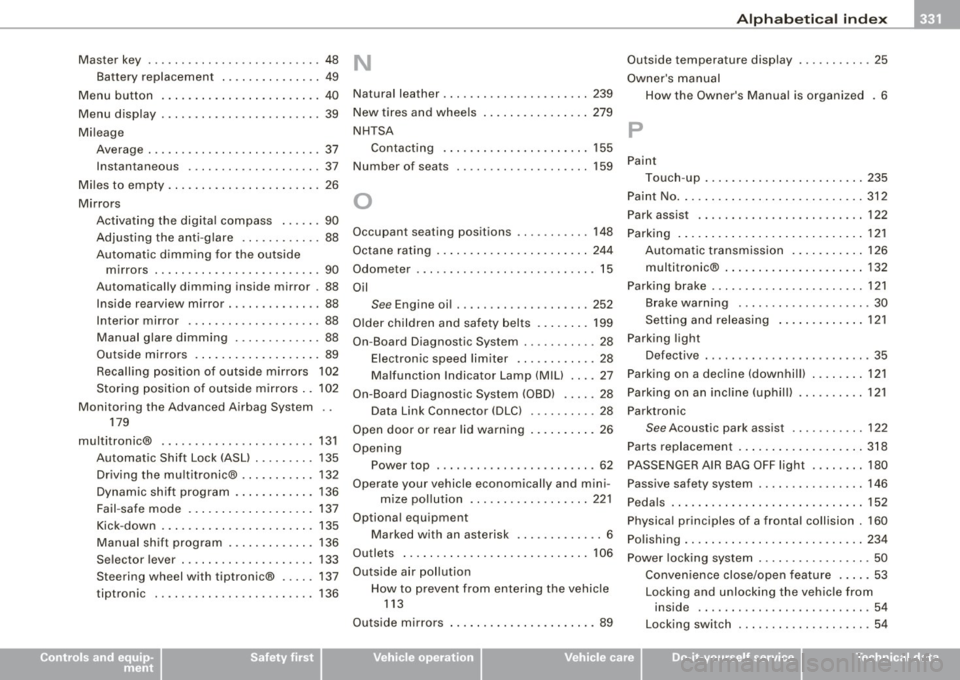
Alph ab eti ca l ind ex -
-------------=----
Master key ........ .... . .... .. .. .... . 48
Battery replacement . .... .... ...... 49
Menu button ... .. ...... .... ...... ... 40
Menu display .... .... .... ... .... .... . 39
Mi leage
Average . ...... .. .... .... .... ..... 37
Instantaneous .................... 37
Mi les to empty . ... .. .... .... ...... ... 26
Mirrors Activating the digita l compass ..... . 90
Adjusting the ant i-g lare ... .... .... . 88
Automatic dimming for the outside mirrors . .... .... ....... ....... .. 90
Automatically dimming inside mirror . 88
Inside rearview mirror . .... ...... ... 88
Interior mirror .... .... .... .. ...... 88
Manual glare dimming ............ . 88
Outs ide mirrors . ........ ... .... ... 89
Recalling posit ion of outside mirrors 102
Storing positio n of outside mirrors .. 102
Monitoring the Advanced Airbag System ..
179
multitronic® ... ..... ... .... .... .... 131
Automatic Shift Lock (ASU . .... .... 135
Dr iving the multitronic® . ..... .... . 132
Dynamic shift program ... .... .... . 136
Fail -safe mode ... .... .... .... .... 137
Kick -down ... .... .... .... ... .... . 135
Manual sh ift program .. ...... .... . 136
Selector lever . . . . . . . . . . . . . . . . . . . . 133
Steering wheel with tiptronic® ..... 137
tiptronic .. ... .... .... ... .... .... 136
Controls and equip
ment Safety first
N
Natural leather
... .... .... .... ... .... 239
New tires and whee ls ...... ... .... ... 279
NH TSA
Contacting . ...... ..... .. .... .... 155
Number of seats .................... 159
0
Occupant seating positions . .... ...... 148
Octane rating .... .... .... .... .... ... 244
Odometer ........ ..... .. .... .... ... . 15
Oil See Engine oi l ....... ....... .. .... 252
O lder chi ldren and safety bel ts . ...... . 199
On -Board Diagnostic System ... .. .. .. .. 28
Electronic speed limiter ............ 28
Malfunction Indicator Lamp (MIU .... 27
On-Board Diagnostic System (OBD) .... . 28
Data Link Connector (DLC) ...... .... 28
Open do or o r rear l id wa rn ing ... .. .... . 26
Opening Power top .... ...... .... ..... .... . 62
Operate your vehicle economically and mini -
mize po llution ...... .... .... .... 221
Optional equipment Marked with an asterisk ... .... .... .. 6
Outlets ... .. .... ..... .. .... .... .... 1 06
Outside air pollution How to prevent from entering the vehicle 113
Outside mirrors ..... .... .... .... .... . 89 Outside temperature display
...... ..... 25
Owner's manual How the Owne r's Manual is orga nized . 6
p
Paint
Touch -up ... .. .... .... ... .... .... 235
Paint No ... ... .... .... ....... .... ... 312
Park assist ... .... .... ... .... ..... .. 122
Parking ...... .... .... ... .... .... ... 1 21
Automatic transmission .. ..... .... 126
multitronic® ....... ... .... .... ... 1 32
Parking brake ........ .... ... ........ 121
B rake warn ing .................... 30
Set ting a nd re leasi ng ..... .... .... 121
Parking light Defective . .... ........ .... ........ 35
Parking on a decline (downhill) ... ... .. 121
Parking on an incline (uphill) ... .... ... 121
Parktronic See Acoustic park assist .. ... ..... . 122
Parts rep lacement . ....... ... .... .... 318
PASSENGER A IR BAG OFF light ........ 180
Passive safety system . .... ...... .... . 146
Pedals . ... .. .... .... .... ... .... .... 152
Physica l principles of a frontal collision . 160
Po lishing ... .. .... .... ... .... .... ... 234
Power lock ing system ..... .... .... .... 50
Conven ience close/open feature .... . 53
Lock ing and unlocking the vehicle fr om
inside ... .... .... ... .... ..... .. . 54
Locking switch .... .... ... .... ..... 5 4
Vehicle operation Vehicle care Do-it-yourself service Technical data