change time AUDI S4 CABRIOLET 2009 Owner's Manual
[x] Cancel search | Manufacturer: AUDI, Model Year: 2009, Model line: S4 CABRIOLET, Model: AUDI S4 CABRIOLET 2009Pages: 340, PDF Size: 77.32 MB
Page 266 of 340
•---=C:.:h..:. e=-= c..:.k :..:.in =-=-= g~ a..:.n :.:d::....:. f.:.:il .:.:li ..:.n :..::g:!..- ___________________________________________ _
& WARNING (continued )
battery to heat up very q uickly, which could lead to damage or
explo sion and per sonal injury .
• When a battery is charged , it produces hydrogen gas whic h i s
explo sive and could cause per son al injury .
• Always keep the battery well out of the re ach of children.
• Before work i s done on the electrical system , di sconne ct the
negative ground cable .
• Before per forming any work on the ele ctri cal system , switch off
the engine and ignition as well as any electrical equipment. The
negative cable on the battery must be disconnected .
If you are just
going to replace a light bulb , then it is enough to switch off the
light s.
• Before disconnecting the battery , switch off the anti -theft
alarm system! Otherw ise you will set off the alarm .
• When di sconne cting the battery , fir st di sconnect the negative
c able and then the positive cable .
• Before reconnecting the battery , make sure all electrical
c onsumers are sw itched off . Reconnect the posit ive cable first and
then the negative cable. Never interchange the cables -this could
start a fire !
• Never charge a frozen or a thawed -out battery. It could
e xplode! If a battery has frozen , then it must be replaced. A
discharged batte ry can freeze over at 32 °F (0 °C ).
• Make sure the vent hose is always attached to the opening on
the side of the battery.
• Never use batteries which are damaged . There is the danger of
an explosion! Alway s replace a damaged battery.
& WARNING
California Propo sition 65 Warning :
& WARNING (continued )
• Battery post s, terminals and related accessories contain le ad
and lead compounds , chemicals known to the State of California
to cause can cer and reproduct ive problems . Wash hand s after
handling .
0 Note
• Do not disco nnect t he vehicle battery when the igni tion is
switched on or when the engine is running , otherwise, you wi ll
damage e le ctronic c ompone nts in the electrical syst em.
• I f your vehicle is going to stand for a long period of time without
being dr iven, protect the battery from "freezing" otherwise it wil l be
damaged and wi ll then have to be replaced .•
Checking the battery acid level
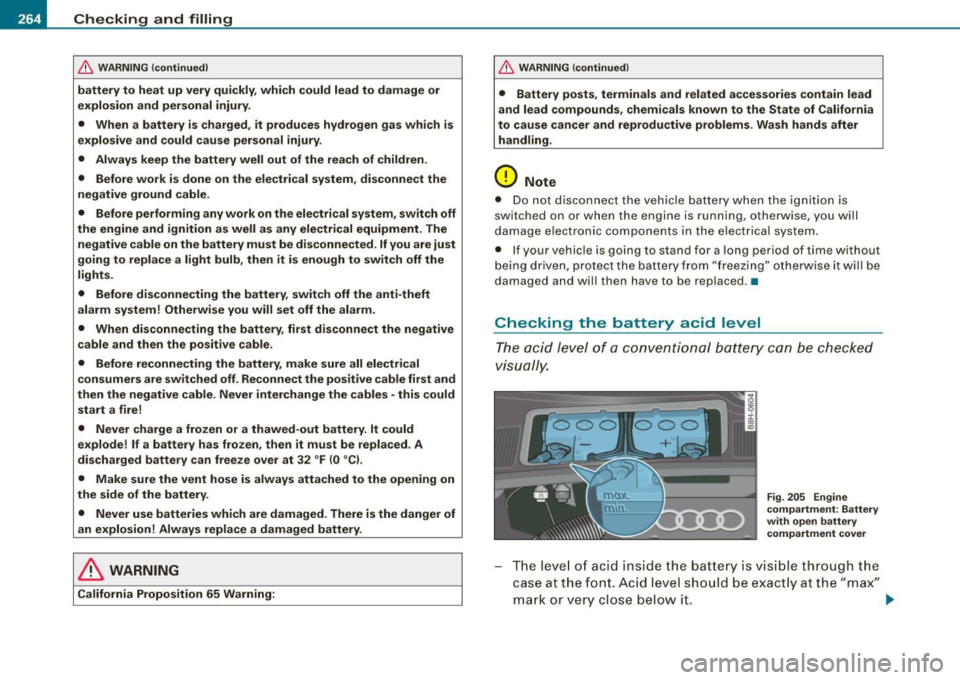
T he aci d l evel of a co nv enti onal ba ttery c an be c hecke d
vis ually.
·•
Fig . 2 05 Engine
c ompartment : Battery
w it h o pen b atter y
compartment cover
T he leve l of acid inside the b atte ry is vis ib le th rough the
case a t the fo nt. Ac id le ve l shou ld be ex actly at t he " max "
m ark or v ery clo se belo w it.
~
Page 272 of 340
-~_T_ ir_e_ s_ a_ n_d _ w_ h_ e_e _l_s _________________________________________________ _
Rei nf orced tire
means a tire designed to operate at higher loads and at higher inf la
tion pressures then the corresponding standard tire. Reinforced
tires my be identified as "XL",
"xi", "EXTRA LOAD", or "RF" on the
sidewall.
Rim
means a metal support for a tire or a tire and tube assembly upon
which the t ire beads are seated.
R im di am eter
means nomina l diameter o f the bead seat. If you change your wheel
size, you wi ll have to purchase new tires to match the new rim diam
eter.
R im size des ig nati on
means rim diameter and width.
Rim width
means nominal distance between rim flanges .
Sidewall
means that portion of a tire between the tread and bead.
Speed rating (le tter code )
means the speed at which a tire is designed to be driven for
extended periods of time . The ratings range from 93 mph ( 150 km/h)
to 186 mph (298 km/h)~
page 281. You may not find this informa
tion on a ll tires because it is not required by law .
The speed rating letter code, where appl icable, is molded on the tire
sidewal l and indicates the maximum permissible road speeds~
&
in "Winter tires" on page 284 .
Tire pres su re m onitoring s yste m*
means a system that detects when one or more of a vehicle's tires
are underinflated and i lluminates a low tire pressure warning te ll
tale .
Trea d
means that portion of a tire that comes into contact with the road .
Trea d se parati on
means pulling away of the tread from the tire carcass .
Treadw ear indi cato rs (TWI)
means the projections within the princ ipal grooves designed to give
a visual indication of the degrees of wear of the tread. See
~ page 278, "Tread Wear Indicator (TWI)" for more informatio n on
measuring tire wear.
Uniform Tire Q uality Gra ding
is a tire information system developed by the United States National
Highway Traffic Safety Administration (N HTSA) that is designed to
help buyers make relative comparisons among tires. The U TQG is
not a safety rating and not a guarantee that a tire wil l last for a
prescribed number of miles or perform in a certain way. It simply
gives tire buyers additiona l information to combine wit h other
considerations, such as price, brand loyalty and dea ler recommen
dations. Under UTQG, tires are graded by the tire manufacturers in
three areas: treadwear, traction and temperature resistance . The
UTQG information on the tires, molded into the sidewalls.
U.S . D OT T ir e Ident ifi ca tion Num ber (T IN )
This is the tire's "serial number" It begins with the le tters "DOT" and
indicates that the tire meets all federa l standards . The next two
numbers or letters indicate the plant where it was manufactured,
and the last four numbers represent the week and year of manufac
ture. For example,
D OT ... 2 209 ...
means that the tire was produced in the 22th week of 2009 . The
other numbers are marketing codes that may o r may not be used by
the tire manufacturer . This information is used to contact
consumers if a tire defect requires a reca ll. -.,
Page 274 of 340
-Tires and wheels
P'U:1-------------------
warmed up than when it is "cold." It is the inflation pressure in a
"cold" tire that counts. Therefore, you should never let air out of a
warm tire to match "cold tire inflation pressure" recommendations .
The tires would then be underinflated and could fail suddenly.
Maintaining proper tire pressure is one of the most important
things you can do to help avoid sudden tire failure. Underinflated
tires are a major cause of sudden tire failure. Keeping tires at the
right pressure is also important for safe and responsive vehicle
handling, traction, braking and load carrying.
Tire pressures are
particularly important when the vehicle is being driven at higher
speeds, and then especially when heavily loaded even within the
permissible load-carrying capacities approved for your vehicle .
The recommended tire pressures for your Audi depend on the kind
of tires on your vehicle and the number of passengers and/or
amount of luggage you will be transporting.
On USA vehicles, the tire pressure label is located on the driver's
side B-pillar . On Canada vehicles, the tire pressure label is located
either on the driver's side B-pillar or inside the fuel filler flap. The tire
pressure label lists the recommended cold tire inflation pressures
for the vehicle at its maximum capacity weight and tires that were
on your vehicle at the time it was manufactured.
If you wish to improve comfort when operating the vehicle at
normal load (up to 2 occupants), you can adjust tire pressures to
-
those specified for normal vehicle load. Before operating the vehicle
at maximum load, you must increase the tire pressures to those
specified for maximum vehicle load
=> & .
If your vehicle is equipped with a tire pressure monitoring system *,
bear in mind that the system can only monitor the tire pressures you
have stored. The system does not recognize the load condition of
your vehicle.
The effectiveness of the tire pressure monitoring system will be
impaired if you store normal load pressures but then operate the
vehicle at its maximum load=>&.
See the illustration =>
page 271, fig. 207 for the location of the label
either on driver's side B-pillar or inside the fuel filler flap (color of
the actual label and exact location on the vehicle will vary slightly).
Note that the following table is accurate at the time of going to
press and is subject to change. In the event of discrepancies, the tire
pressure label (either on driver's side B-pillar or inside the fuel filler
flap) always takes precedence .
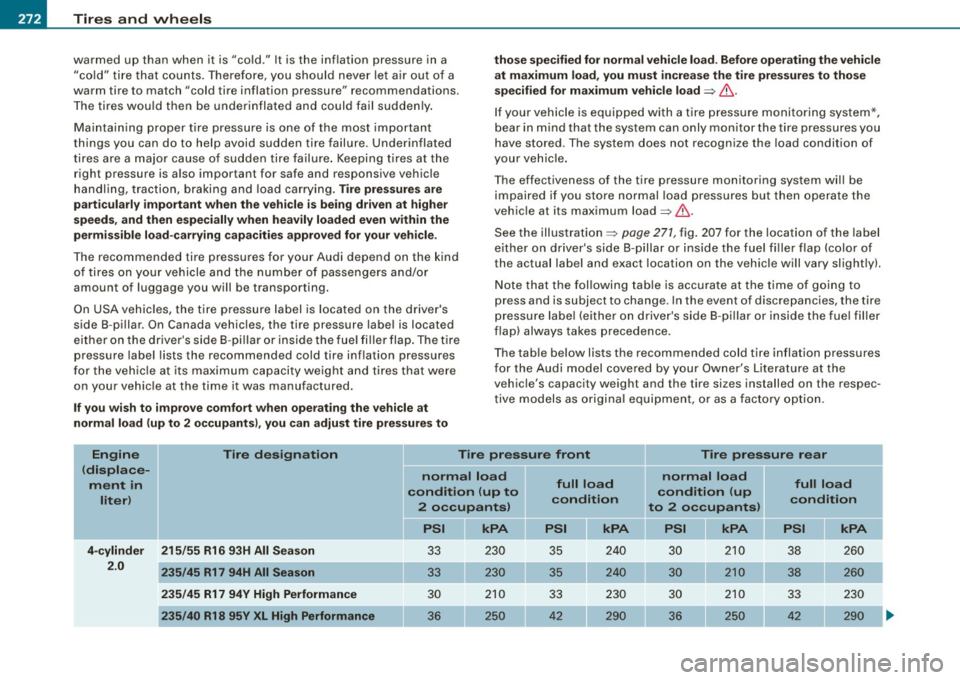
The table below lists the recommended cold tire inflation pressures
for the Audi model covered by your Owner's Literature at the
vehicle's capacity weight and the tire sizes installed on the respec
tive models as original equipment, or as a factory option.
Engine
(displace
ment in liter) Tire designation
Tire pressure front Tire pressure rear
4-cylinder
2.0 215/55 R16 93H All Season
235/45 R17 94H All Season
235/45 R17 94Y High Performance
235/40 R18 95Y XL High Performance
normal load
condition (up to
2 occupants)
PSI
33
33
30
36
kPA
230
230
210
250
full load
condition
PSI
35
35 33
42
II kPA
240
240
230
290
normal load
condition (up
to 2 occupants)
PSI
30
30
30
36
JI kPA
210
210
210
250
11 full load
condition
PSI
38
38
33
42
JI kPA
260
260
230
290
I
Page 294 of 340
11111.___W_ h_ a_ t_d_ o_ l _d _o_ n_ o_ w_ ? ______________________________________________ _
Taking out the spare wheel
- Raise the floor panel at the plastic handle.
- Securely engage the handle in the luggage compartment
seal as illustrated to keep the floor panel up.
- Unscrew the knurled retainer bolt in the wheel center
==> page 291, fig. 215. Turn it counter-clockwise.
- Take out the spare wheel.
- Disengage and lower the floor panel before you close the
luggage compartment lid again.
Storing the replaced wheel
-Place the replaced wheel inside the spare wheel well in
the luggage compartment.
- Tighten the knurled retaining screw clockwise to secure
the wheel in place.
- Disengage and lower the floor panel before you close the
luggage compartment lid again.
& WARNING
Loose items in the passenger compartment can cause serious
personal injury during hard braking or in an accident .
• Never store the spare wheel or jack and tools in the passenger
compartment.
• Always store all jacking equipment, tools, and the spare wheel
in the luggage compartment.
• Tighten the knurled retaining screw for the spare wheel
securely.
[ i] Tips
Check the inflation pressure of the spare tire periodically to keep the
tire ready for use. •
Applies to vehic les: w ith a space -saving spare wheel
Space-saving spare wheel
The compact spare wheel is only intended to be used for
a short time.
Using the space-saving spare wheel
The space -saving spare wheel is only intended for emergencies
until you can reach a repair shop. Replace it as quickly as possible
with a normal wheel.
There are some restrictions on the use of the space -saving spare
wheel
=> ,&. . The space-saving spare wheel has been developed
especially for your type of vehicle. It must not be exchanged for the
space-saving spare wheel from another type of vehicle.
Normal summer or winter tires must not be fitted on the space
saving spare wheel rim.
Snow chains
For technical reasons, the use of snow chains on the space-saving
spare wheel
not permitted .
If you do have to drive with snow chains and have a tire failure on a
front wheel, install the space-saving spare wheel in place of a rear
wheel. Install the snow chains on the rear wheel and use it to
replace the defective front wheel.
& WARNING
• After installing the space-saving spare wheel, the tire pressure
must be checked as soon as possible. The tire pressure must be
adapted to the load condition of the vehicle according to the tire .,_
Page 339 of 340
It has always been Audi's policy to continuously improve its prod
ucts. Audi, therefore, reserves the right to make changes in design
and specifications, and to make additions or improvements in its
products, without incurring any obligation to install them on prod
ucts previously manufactured.
Text , illustrations and specifications in this manual are based on the
most up -to -date information available at the time of printing.
All rights reserved. May not be reproduced or translated in whole or
in part without the written consent of AUDI AG . Specifications are
subject to change without notice. "Audi", "quattro" and
the four rings emblem are registered trade
marks of AUDI AG. "A4 Cabriolet" is trademark of AUDI AG .
Editorial deadline: 03/27/2008
c£> For the sake of the environment
Printed on environmentally friendly paper (bleached without chlo
rine, recyclable).
Printed in Germany
© 2008 AUDI AG