fuel AUDI S4 CABRIOLET 2009 Owner's Manual
[x] Cancel search | Manufacturer: AUDI, Model Year: 2009, Model line: S4 CABRIOLET, Model: AUDI S4 CABRIOLET 2009Pages: 340, PDF Size: 77.32 MB
Page 131 of 340
_______________________________________________________ T_ ra_ n_s_ m __ is_s_ io_ n ____ llJIII
- Tur n t he ignition on.
- Step on the brake pedal.
At the same time press and hold
the interlock butto n on the side of the gear selector knob
=> page 128, fig. 141 with your thumb until you have
moved the selector lever to the desi red posi tion .
Autom atic s elect or l ever l ock 53
The se lector lever is locked in the
P and N positions when the igni
tion is turned on. To move the lever from these positions the driver must depress the brake pedal. As a reminder to the driver, the
f ollow ing warning appears in the instrument c luster display when
the selector is in
P and N :
When sta tionary apply footbr ake whil e selecting gear
In addition, the symbol 53 will light up on the shift gate at the base
of the selector lever.
A time delay e lement prevents the selecto r lever from locking when
it is moved through the
N position (going from R to Dl. The locking
element will lock the selector lever if the lever is left in N (Neutral)
for more than approx imately 1 second, without the brake pedal
being pressed .
At speeds above about 3 mph (5 km/h) t he Automatic Shif t Lock is
automatically deactivated in the
N position.
Int erlock button
The lock button on the selector lever prevents the lever from be ing
accidentally shifted into certain positions . Pressing this bu tton
deactivates the selector lever lock . Depending on the direction of
the shift, the se lec tor lever locks at different posi tions. The positions
are highlighted in the illustration~
page 128, fig. 141 .
Ignition key safety int erlo ck
The key cannot be removed from the ignition un less the selector
lever is in the
P park position. When the ignitio n key is re moved, the
selector lever wil l be locked in the
P position. •
Controls and equip
ment
App lies to veh icles: with 6-speed automatic transmission
Kick-down
T he kick-down feature allows the vehicle to generate
ma ximum acceler ati on.
When you press the accelerator peda l beyond the resistance point
that is reached at ful l throttle, the transmission will select a lower
gear ratio based o n vehicle speed and engine RPM. The engine RP M
wil l be control led to produce maximum vehicle acceleration as long
as you continue to press the acce lerato r pedal beyond this resis
tance point.
& WARNING
Be care ful when using the ki ck-down feature on slippery road s.
Rapid acceleration may cause the vehicle to skid . •
App lies to vehicles: with 6-speed automatic transm iss ion
Dynamic shift program (DSP)
T he aut omatic transmission is electronically controlle d.
The transmission is se lf adapting and will auto matically se lect the
best sh ift program suited to the driving conditions and driving style.
The transmission wil l select one of the
e conomy programs when
you drive at a steady speed or a gradually changing speed without
heavy acceleration. This achieves optimum fuel efficiency, with early
upshifting and delayed downshifting.
The transmiss ion w ill automatically select the
s porty shift programs
when you drive at higher speeds, or with heavy acceleration and
frequently changing speeds . Upshifts are delayed to make full use
of engine power. Downshifting takes place at higher engine speeds
than in the economy p rog rams . _,.
Page 132 of 340
• .___T_ r_a _n_ s_ m_ is_ s_io _ n ______________________________________________________ _
The selection of the most suitable shift program is a continuous,
automatic process . The driver can a lso make the transmission
switch to a sporty program by
qu ickly pressing down the gas pedal.
This causes the transmission to shift down to a lower gear to achieve rapid acceleration, e .g. for quickly passing another vehicle.
You do not need to press the gas pedal into the kick -down range.
After the transmission has upshi fted , the original program is
selected according to your driving style.
An additiona l shift program allows the automatic transmission to
select the proper gear for uphill and downhill gradients.
This keeps the transmission from shifting up and down unneces
sari ly on hills . The transmission will shift down to a lower gear when
the driver presses the brake pedal on a downhill gradient . This
makes use of the braking effect of the engine wi thout the need to
shift down manua lly .•
Ap plies to ve hicles: wit h 6-spee d automat ic tr ans mission
Manual shift program
Using the manual shift program you can manually select
gears.
Fi g. 142 Cente r
co nso le: s hifting the
t ipt roni c® manu ally Fig.
143 Dis play :
m an ual s hift p rogram,
se lec te d g ear h igh
lig hted
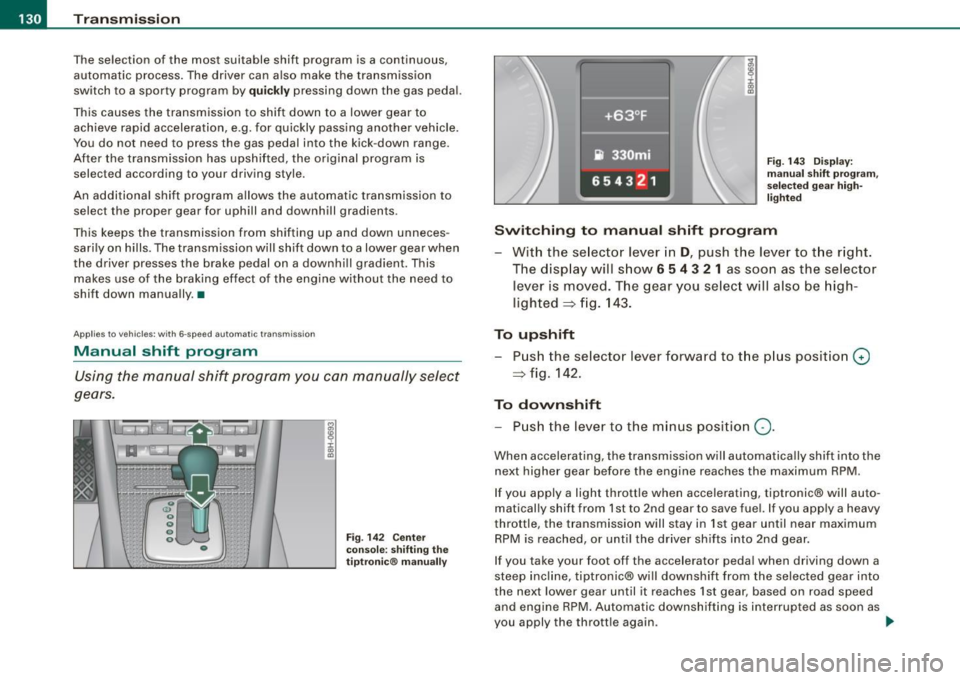
Switching to m anual shift program
With the se lector lever in D, push the lever to t he right .
The disp lay w ill s how
6 5 4 3 2 1 as soon as the selector
lever is moved. The gear you selec t will also be high
lighted => fig. 1 43.
To upshift
Push the selector lever forward to t he p lus position 0
=> fig. 142 .
To downshift
-Push th e lever to the minus position Q.
When accelerating, the transm ission will automatica lly shift into the
next higher gear before the engine reaches the maximum RPM .
I f you apply a light throttle when accelerating, tiptronic® will auto
matically shift from 1st to 2nd gear to save fuel. If you apply a heavy
throttle, the transmission will stay in 1st gear until near maximum
RPM is reached, or until the driver sh ifts into 2nd gear.
If you take your foot off the accelerator peda l when driving down a
steep inc lin e, tiptronic® will downshift from the selec ted gear into
the next lower gear until it reaches 1st gear, based on road speed
and engine RPM. Automatic downshif ting is interrup ted as soon as
you apply the thrott le again . .,_
Page 134 of 340
-Tr
ansmi ssion
.___ ______________ _
engine power is applied smoothly and comfortably , and better fuel
economy is achieved.
The transmiss ion selects the appropria te gear ra tio (upshifts and
downshiftsl automatically based on set driving programs
=> page 136.
You can a lso manually select a shift program (tiptronic®)
=> page 136 .
You should note, that the multit ronic transmission differs from a
conventional Automatic Transmission. In the multitronic transmis
sion the engine power is transferred via a link -plate chain, rather
than by a conventional torque converter. The multitronic transmis
sion greatly reduces vehicle "creep"" when at a standstil l and the
transmission is in
D Sor R. •
Ap plies to vehicles: with mult it ro nic® Contin uous ly Va ria ble Transm iss ion ( CVT)
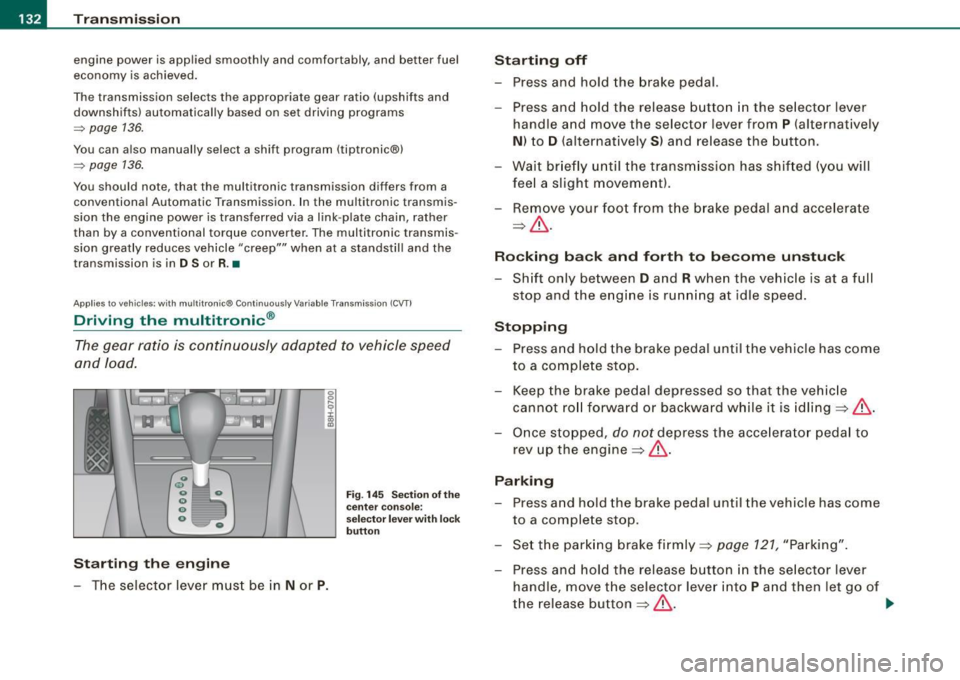
Driving the multitroni c®
The gear ratio is continuously adapted to vehicle speed
and load.
Start ing the engine
- The s ele ctor lever mus t be i n Nor P.
Fi g. 14 5 Sec tion of th e
ce nte r c on sol e:
s ele ctor leve r wit h lo ck
b utt on
St arting off
- Press and hold the brake pedal.
- Press and hold the release butto n in the se lector lever
handle and move the selector lever from
P (a lternatively
N ) to D (alternatively S) and release the button.
- Wait br iefly u ntil the transm ission has shif ted (you will
fee l a slight movem ent) .
- Rem ove your foot from the b rake p edal a nd acce lera te
=> & .
Rocking ba ck and forth to b ecom e unstu ck
- Shift only between D and R when the ve hicle is at a fu ll
stop and the eng ine is runn ing at idle speed .
Stopping
- Press a nd h old the brake pedal un til the vehicle has com e
to a comp le te stop.
- Keep the brake pedal depressed so that the vehic le
cann ot ro ll forwa rd or ba ckw ard while it is id lin g => & .
- Once stop ped,
do not depress the acce lera to r p edal to
r ev up the engine => & .
Parking
- Press and hold the brake pedal until the vehicle has come
to a complete stop .
- Set t he park ing brake firmly =>
page 121, "Parking" .
- Press and hold the release button in the se lector lever
handle, m ove the select or leve r in to
P and then let go of
the releas e button => & . .,
Page 138 of 340
• .___T_ r_a _n_ s_ m_ is_ s_io _ n ______________________________________________________ _
Applies to vehicles: with mult it ron ic® Contin uously Variable Transm iss io n (CVT )
Dynamic shift program (DSP)
The multitronic® transmission is electronically
controlled .
The transmission selects the appropriate gear ratio (upshifts and
downshiftsl automatically based on preset driving programs .
The transmission will select one of the
economy programs when
you drive at a steady speed or a gradually changing speeds without heavy acceleration. This gives best fuel efficiency, with early
upshifting and delayed downshifting .
The transmission will automatically select th e
sporty shift programs
when you drive at higher speeds, or with heavy acceleration and
fr equ ently changing speeds. Upshifts are d elay ed to make full use
of engine power. Downshifting takes place at higher engine speeds
than in the economy programs .
The selection of the most suitable shift program is a continuous,
automatic process . The driver can also make the transmission
switch to a sporty program by
quickly pressing down the gas pedal.
This causes the transmission to shift down into a lower gear ratio
a n d makes quick acceleration possible (to pass another vehicle) You
do not need to press the gas pedal into the kickdown range. After
the transmission has upshifted, the original prog ram is selected
according to your driving style .
An additional shift program allows the automatic transmission to select the prop er gear for uphill and downhill gradients .
This prevents the transmission from shifting up and down unneces
sarily on hills. The transmission
will shift down to a lower gear ratio
when the driver presses the brake pedal on a downhill gradient . This
makes use of the braking effect of the engine without the need to
shift down manually.
If you are driving in hills and mountains, the transmission will
continuously adjust the g ear ratio to the road grade . If you press the brake pedal when driving downhill, the transmission will downshift
automatically. This increases the braking effect
of the engine.
If the cruise control is on when you are trave.ling downhill, the trans
mission will automatically select a lower gear ratio in order to main
tain the set vehicle speed. This will cause the engine speed to
increase. •
Applies to vehic les: with mult it ro ni c® Continu ous ly Varia ble Trans mission (CVT )
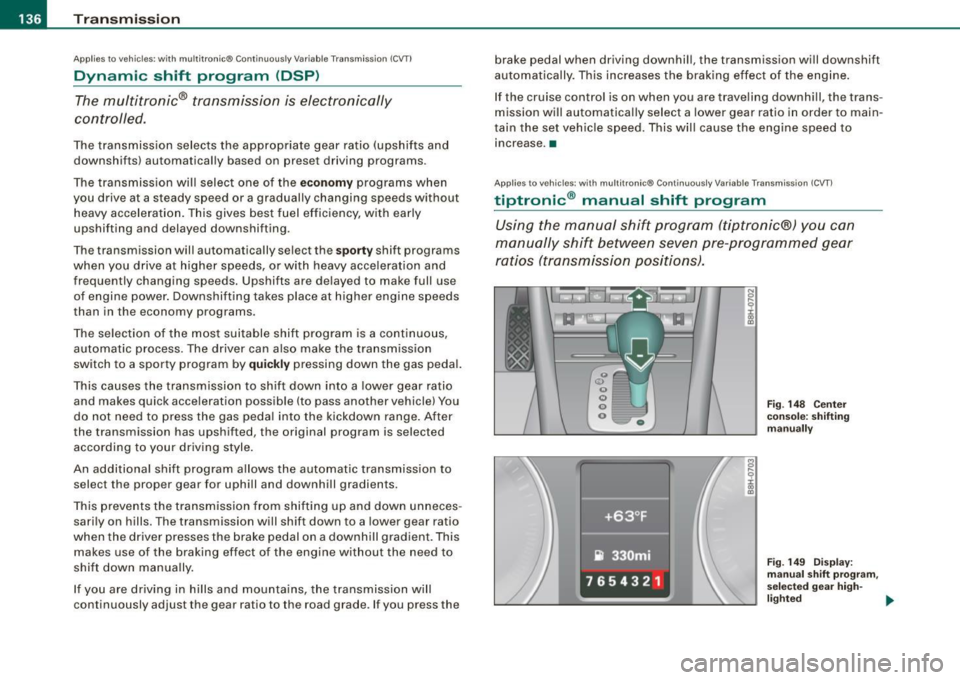
tiptronic ® manual shift program
Using the manual shift program (tiptronic®) you can
manually shift between seven pre -programmed gear
ratios (transmission positions).
I
Fig . 148 Center
console: shifting
manually
Fig. 149 Display:
manual shift program ,
selected gear high-
lighted ._
Page 139 of 340
_______________________________________________________ T_ r _a_ n_s_ m __ is_ s_ io_ n _ ___,_
Swi tching to m anual shift pro gra m
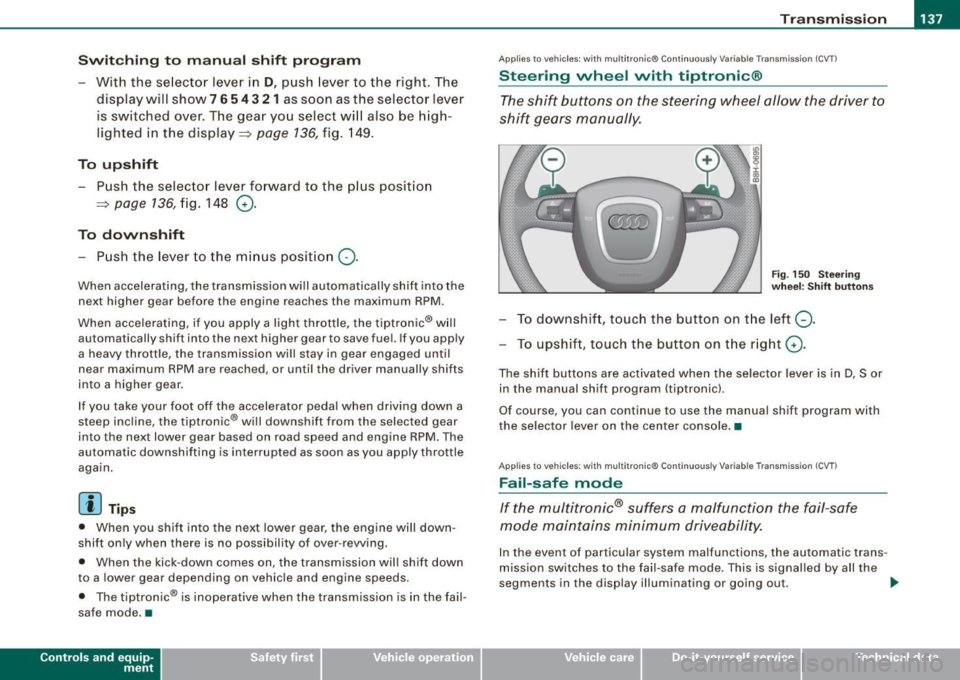
- With the selector lever in D, push lever to the right. The
display will show7
6 5 4 3 21 as soon as the selector lever
is switched over. The gear you select wi ll also be h igh
lighted in the display:::::,
page 136, fig. 149 .
To up shift
Push the selecto r lever forward to the plus position
:::::, page 136, fig. 148 G) .
To d ownshift
- Pu sh the lever to the mi nus positio n Q.
When accelerating, the transmission wi II a utomatica I ly shift into the
next higher gear before the engine reaches the maximum RPM .
When accelerating, if you apply a light throttle, the tiptronic® wil l
automatically shift into the next higher gear to save fuel. If you app ly
a heavy throttle, the transmission will stay in gear engaged until
near maximum RPM are reached, or until the driver manually shifts
into a higher gear .
If you take your foot off the accelerator peda l when driving down a
steep incline, the tiptronic ® wi ll downshift from the selected gear
into the next lower gear based on road speed and engine RPM . The
automatic downshifting is interrupted as soon as you apply throttle
again .
[ i ] Tips
• When you shift into the next lower gear, the engine will down
shift only when there is no possibility of over-revving.
• When the kick -down comes on, the transmission wi ll sh ift down
to a lower gear depending on vehicle and engine speeds.
• The tiptronic® is inoperative when the transmission is in the fai l
safe mode .•
Contro ls and eq uip
ment
Ap plies to vehicles : w it h mu ltit ron ic® Co nti nuou sly V ariable Transmi ssion ( CVT)
Steering vvheel vvith t iptronic ®
The shift buttons on the steering wheel allow the driver to
shift gears manually.
F ig. 15 0 Stee ring
w he el: S hift b utto ns
To downshift, touch the button on the left Q .
To upshift , touch the button on the r ight G) .
The shif t buttons are activated when the selector lever is in D, S or
in the manual shift program (tiptronic).
Of course, you can continue to use the manual shift program with
the selector lever on the center console. •
Applies to vehicles : wi th mu lt itro nic® Co nti nuously Var iab le Tra nsmis sion (CVT)
Fail -safe mode
If the multitronic® suffers a malfunction the fail-safe
mode maintains minimum driveability.
In the event of particular system malfunctions, the automatic trans
mission switches to the fai l-safe mode. This is signal led by all the
segments in the display illuminating or going out . _,,,
~ehicle care irechnical data
Page 221 of 340
Driving and environment
The first 1 ,000 miles (1,500 km) and afterwards
New engine
The engine needs to be run-in during the first 1,000 miles
(1,500 km).
For th e fir st 600 mil es (1 ,000 kil omet ers):
Do not use full throttle.
- Do not drive faster than 3/4 of the top speed marked on
the speedometer.
- Avoid high engine speeds .
Fr om 600 to 1 ,000 mil es (1,000 to 1 ,500
kilom ete rs ):
- Speeds can gradually be increased to t he maximum
permiss ible road or engine speed .
During and aft er br eak-in p eri od
- Do not rev the engine up to high speeds when it is cold. This applies whether the transm ission is in N (Neutral) or
1n gear.
After the br eak -in period
- Do not exceed max imum e ngine speed unde r any
circumstances.
- Upshift into the next higher gear before reaching t he red
area at the end of the tachome ter scale ~ page 12 .
Controls and equip
ment Safety first Vehicle operation
Driving
and environm ent
During the first few hours of driving, the eng ine's internal friction is
higher than later when all the moving parts have been broken in.
How well this break-in process is done depends to a cons iderable
extent on the way the vehicle is driven during the first 1,000 miles
(1,500 ki lometers).
0 Not e
Extremely high engine speeds are automatically reduced. However,
these RPM -limits were programmed for an engine we ll run-in , not a
new engine .
~ For the sake of the environment
Do not drive with unnecessarily high engine speeds -upshifting
early saves fuel , reduces noise and protects the environment.
New tires
If your v ehicle is r un ning on new tires, driv e particularly
carefu l for the first 350 miles (500 ki lometers) after fitting.
& WARNING
New tire s te nd to b e slipp ery and mu st al so be " brok en -in ". Be
su re t o reme mber thi s during th e fir st 350 m ile s (5 00 kil ome ters).
Br ake gent ly. A vo id following clo se ly behind oth er vehicle s or
ot her situ ati ons that might requi re su dd en , har d b raking.•
Vehicle care Do-it-yourself service Technical data
Page 222 of 340
___ D_ r_i v_ in_,.. g"'- a_ n_ d_ e_ n_ v_i_r _o _n_ m_ e_n_ t _______________________________________________ _
New brake pads
Remember that new brake pads do not have a full braking
effec t during the first 250 miles (400 kilometers) after they
are installed .
New brake pads have to be "burn ished in" before they have optimal
grab =>& .
During the break -in period, you shou ld avoid putting severe loads
on the brakes . Severe loads include, for examp le, sudden hard
braking, in particular at very high speeds or, for example, on moun
tain passes.
& WARNING
Ne w brake p ad s don't h ave the bes t sto pp in g po we r and mu st b e
"brok en-in " durin g the initial 100 to 1 50 m il es ( 150 to 200 kil ome
t e rs) of norm al cit y dri ving . Y o u can com pensat e for thi s by
p re ss ing the br ake p ed al more firm ly. Th is also appli es later w he n
n ew pad s a re in sta lled.
:J
Catalytic converter
It is very important that your emission control system
(catalytic converter) is functioning properly to ensure that
y o ur vehicle is running in an environmentally sound
manner.
- Always use lead-free gasoline=> page 244, "Fuel supply".
- Never run the tank down a ll the way to empty.
- Never put too much motor o il in your engine =>
page 255,
"Adding eng ine oi l 'l:::r.11
•
- Neve r try to push -or tow -s ta rt yo ur vehic le.
The catalytic converter is an efficient "clean-up" device built into the
exhaust system of the vehicle. The catalytic converter burns many
of the po llutants in the exhaust gas before they are released into the
atmosphere.
The exc lusive use of unleaded fue l is critica lly important for the l ife
of the cata lytic converter and proper functioning of the engine.
& WARNING
• Do not p ark or op erate th e veh icle in are as w here the h ot
ex hau st sys tem m ay come in co ntac t w ith dr y gr ass, brush , fuel
s pill or other mater ial which can cau se a fire .
• Do not apply a dditi ona l u nder coating or ru stpr oofing on or
n ea r the exhau st m anifold , exhau st pipe s, ca ta lytic conv ert er or
h eat shie ld s. Dur in g d riving , the sub sta nce use d fo r und ercoa ting
coul d ove rhea t and cause a fire .
0 Note
• Be aware that just one tank filling with leaded fue l wi ll already
seriously degrade the performance of the catalytic converter.
• Do not exceed the correct engine oi l level =>
page 255.
• Do not drive until the fuel tank becomes comp letely empty . The
engine cou ld misfire. Unburned fuel could also get into the exhaust
system and this could cause the catalytic conver ter to overheat .
• Do not turn off the ignition while the vehicle is moving.
• Do not con tinue to operate your vehicle under these conditions,
as otherwise fuel can reach the cata lytic converter . This cou ld result
in overheating of the converter, requiring its rep lacement .
• To assure eff icient operation of the Em ission Control System:
- Have your vehicle maintained properly and in accordance with
the service recommendations in your Warranty
& Maintenance
booklet. •
Page 223 of 340
- Lack of proper maintenance as wel l as improper use of the
vehic le wi ll impair the function of the emission control system
and could lead to damage.
'£> For the sake of the environm ent
Even when the Emission Control System is operating properly, the
exhaust gas can have a su lfur -like exhaust gas sme ll under some
operating states. This depends on the sulfur content of the fuel
being used. Using a different brand of fue l may help, or filling the
tank with lead-free super grade gasoline. •
Avoid damaging the vehicle
When you are driving on poor roads, or over curbs, steep ramps,
etc., make certain that low- lying parts such as spoilers and exhaust
system parts do not bottom out and get damaged.
This is especially true for vehicles with low -slung chassis (sports
chassis)* and fully loaded vehicles.
a
Operate your vehicle economically
and minimize pollution
General
Your personal style of driving will determine the economy
of your vehicle, as well as exhaust and noise levels.
Fuel economy, environmental impact, and wear on your engine,
brakes and tires largely depend on three factors:
• your personal driving style
• operating cond itions
• technica l limitat ions
Controls and equip
ment Safety first Vehicle operation
Driving
and environm ent
If you anticipate what you need to do next and drive economica lly,
you can easily cut your fuel consumpt ion by 10 -15 percent . This
section wil l give you some tips on how you can help the environ
ment and your pocketbook.
[ i ] Tips
The consumption est imates as published by ENV IRONMENTAL
PROTECTION AGENCY (EPA) and Transport Canada may not corre
spond to your actua l consumption on the road, which will vary
depending upon vehicle load and speed, road and weather condi
tions, trip length, etc. •
Drive smoothly and keep a lookout ahead
Vehicles use the most fuel when they ore accelerating .
-Avoid unnecessary accelerating and brak ing.
Vehicles use the most fue l when they are accelerating . If you antici
pate what is going to happen next, you wi ll need to brake less and,
thus, acce lerate less. Let the vehicle coast whenever possib le - for
examp le when you see that the next traffic light is red. •
Avoid full throttle
Driving at moderate speeds saves fuel and improves your
mileage.
-Try and keep well below your car's maximum speed.
Acce lerating gently reduces fuel consumption, engine wear, and
does not disturb the environment.
Fue l consumption, exhaust emissions and engine noise increase
disproportionately at high speeds . If you drive at approximately
three quarters of top speed, fuel consumption wil l be reduced by •
Vehicle care Do-it-yourself service Technical data
Page 224 of 340
-Dri
ving and environm ent --=---------------
one half . Never drive faster than the posted speed limit and weather
conditions permit .•
Reducing unnecessary idling
Even when your car is just idling it burns up fuel.
- Shut the eng ine off when you are not driving the vehicle.
- Do not warm up the vehicle by letting the engine run at
idle.
It makes sense to shut off the engine in traffic jams, when waiting
for trains to pass at rai lroad crossings, or at traffic lights that have
long waits on red. Turning the engine off for just 30 -40 seconds
saves more fuel than is burned s tarting the engine again .
It takes a long time for the engine to warm up fully when it is
running at idle. However, wear and noxious emissions are especially
high when the engine is warming up. So you should drive away as
soon as you star t the engine and avoid running at high rpms while
the engine is still warming up.
0 Note
Do not leave engine idling unattended after starting . If warning
lights should come on to indicate improper operation, they would
go unheeded. Extended id ling also produces heat, which could
resu lt in overheating or other damage to the veh icle or other
property .•
Regu1ar maintenance
A badly tuned engine unnecessarily wastes a lo t of fuel.
- Have your ve hicle serviced at regular intervals . By having your vehicle regularly serviced by an Audi dealer helps to
ensure that it runs properly and economical
ly . The condit ion of yo ur
vehic le not only affects its safety and abi lity to hold its va lue, it also
affects
fuel consumpt ion .
C heck your oil each time you fill your tank .
The amount of oil used is related to engine load and speed.
I t is norma l for the oil consumption of a new engine to reach its
lowest va lue after a certain mi leage has been driven.
You must drive your vehicle about 3,000 miles (5,000 kilometers) be fore you can properly assess oil consumption .
This also applies to fuel consumption and engine output .
0 Note
• Have your vehicle maintained properly and in accordance with
the service recommendations in your Warranty
& Maintenance
booklet. Lack of proper maintenance as well as improper use of the
vehic le wi ll impai r the function of the em ission control system and
cou ld lead to damage.
• Do no t alter or re move any component of the Emiss ion Contro l
System unless approved by the manufacturer.
• Do not alte r or remove any device, such as heat shields,
switches, ignition wires, valves, which are designed to protect your
vehic le's Emission Control System and other important veh icle
components. •
Fewer short trips
Fu el consumption will alw ays be rela tively high o n short
trips.
- Try to avo id d riving short dista nces wi th a cold engine. _,
Page 225 of 340
The engine and catalytic converter have to reach their optimal oper
ating temper ature
to reduce fuel consumption and noxious emis
sions effective ly.
Just after starting, a cold engine in a mid -size car only achieves a
fue l economy of 6-8 miles per gallon (30-40 1/100k m). After about a
half a mile, fuel economy climbs to 12 mpg (201/100 kml. After about
2.5 miles (4 km), the engine is at its proper operating temperature
and fuel economy has reached a normal level. So you can see that
you should avo id short tr ips whenever possib le .
The
outs ide temperat ure is also critical in this regard. Your car
consumes more fuel in the winter than in the summer. •
Controls and equip
ment Safety first Vehicle operation
Driving
and environm ent
Vehicle care Do-it-yourself service Technical data