transmission AUDI S4 CABRIOLET 2009 Owner's Manual
[x] Cancel search | Manufacturer: AUDI, Model Year: 2009, Model line: S4 CABRIOLET, Model: AUDI S4 CABRIOLET 2009Pages: 340, PDF Size: 77.32 MB
Page 140 of 340
....... _T _r_a _ n_ s_m _ i_s _s _i_o _n ______________________________________________________ _
You can continue to move the selector lever to all positions. The
manual shift program (tiptronic) is switched off in the fail -safe
mode.
You can continue to use reverse gear . But the electronic lockout for
reverse gear is turned off.
0 Note
If the transmission switches to fail-safe mode, you shou ld take the
vehicle to an authorized Audi dealership as soon as possible to have
the condition corrected. •
Page 229 of 340
![AUDI S4 CABRIOLET 2009 Owners Manual [ i ] Tip s
• Do not tow a trailer during the break-in period of your vehicle.
• If you tow a trailer, your Audi may require more frequent mainte
nance due to the ex](/img/6/57654/w960_57654-228.png "AUDI S4 CABRIOLET 2009 Owners Manual [ i ] Tip s
• Do not tow a trailer during the break-in period of your vehicle.
• If you tow a trailer, your Audi may require more frequent mainte
nance due to the ex")
[ i ] Tip s
• Do not tow a trailer during the break-in period of your vehicle.
• If you tow a trailer, your Audi may require more frequent mainte
nance due to the ex tra load=>
page 316 . •
Parking on a slope
---'--------------------
Do not park with a trailer on a slope. If it cannot be
avoided, do so only after doing the following:
Wh en p arking :
-Apply the foot brake.
- Have someone p lace chocks under both the veh ic le and
the trailer wheels .
- Wit h chocks in p lace, s low ly release t he brakes until
wheel blocks absorb t he load.
- T urn t he wheels towards the curb .
- Apply the parking brake .
- Place an automatic transmission in
P , respect ively a
manual transmission in first or reverse gear.
Wh en restarting after p arking :
- Start the e ngine .
- Shift transmiss ion into gear.
- Re lease the parking brake and slowly pull out and away
from the w heel blocks.
- Stop and have someone retr ieve t he wheel blocks.
Controls and equip
ment Safety first Vehicle operation
Tr
aile r to wing
[ i ] Tip s
If you move the selector lever of the automatic transmission to P
before applying the parking brake and before blocking the wheels,
you may have to use more force later to move the lever out of the
P
position .•
Vehicle care Do-it-yourself service Technical data
Page 244 of 340
___ C_ le_ a _ n_i_n ~g _ a_ n_ d __ p_r _o _t _e _c_ t_ i_o _n ___________________________________________ _
Safety belts
Only well-maintained safety belts work reliably when
needed.
Heavily soiled safety belts may not retract properly.
- Keep belts clean.
- For cleaning, use a mild soap and water solution. Let
belts dry thoroughly and away from direct sunlight.
- Do not allow inertia reel safety belts to retract before
they are completely dry.
- Check the condit ion of your safety belts
regularly.
& WARNING
Damaged safety belts can break in a crash .
• Anything that might damage your safety belts could mean that
you and your passengers would not be adequately protected in an
accident.
• Safety belt performance depends on correct installation. Never
remove belts from the vehicle to clean them.
• Do not use chemical cleaning agents, bleach or dyes. They have
corrosive properties which weaken the webbing.
• When cleaning your safety belts, inspect them for damage. If
you discover damage, see your Audi dealer.
• Always read and heed all WARNINGS and the information
=:> page 230. •
Engine compartment
Be especially careful when cleaning the engine compart
ment.
Always switch off the ignition before cleaning the engine :::::, &.
Plenum panel
Remove leaves from the plenum panel in front of the windshield
under the engine hood. This prevents the water drain holes from
becoming blocked, and it prevents debris from entering the vehicle
interior through the heating and ventilation ducts.
Corrosion protection
The engine compartment and transmission have been corrosion
protected at the factory.
Good anti-corrosion treatment is very important, particularly in the
winter. If the vehicle is frequently driven on salt treated roads, the
entire engine compartment and plenum panel should be thor
oughly cleaned at the end of winter and retreated to prevent salt
damage. At the same time, the underside of the vehicle should be
washed as well.
I f the engine compartment is cleaned at any time with grease
removing solutions
21 , or if you have the engine washed, the anti
corrosion treatment is almost always removed as well. It is therefore
essential to have a long-lasting corrosion protection reapplied to all
surfaces, seams, joints and components in the engine compart
ment.
& WARNING
Be aware: The engine compartment of any motor vehicle is a
potentially hazardous area.
• Before working in the engine compartment, be sure to read the
information :::::,
page 242. .,.,
21 Use only the correct cleaning solutions. Never use gasoline or diesel fuel.
Page 252 of 340
-~_C_ h_e _c _ k_ i_ n ...:::g:;..._ a_n_ d_ f_ i_ll _in ....;g:::;.._ ___________________________________________ _
Closing the engine hood
-Pull t he hood down until the pressure from the strut is
reduced.
- Let t he hood
drop down and latch in place. Do not try to
push it shut;
it may fai l to engage ~& .
& WARNING
A hood that is not completely latched could fly up and block your
view while driving.
• When you close the engine hood, check it to make sure the
safety catch has properly engaged. The hood should be flush with
the surrounding vehicle body parts.
• If you notice while driving that the hood is not secured prop
erly, stop at once and close it. •
Working in the engine compartment
Be especially careful whenever you work in the engine
compartment.
Whenever you must perform any work in the engine compartment,
for example checking and filling different fluids, there is a risk of injury, burns and accidents. To prevent personal injury always
observe the following WARNINGS. The engine compartment of any
vehicle is a hazardous area
~ 6 .
& WARNING
To help avoid injury, before you check anything under the hood :
• Turn off the engine.
• Remove the ignition key.
• Apply the parking brake.
& WARNING (continued)
• Move selector lever of automatic transmission to "P" (Park);
put manual transmission in Neutral.
• Always let the engine cool down. Hot components will burn
skin on contact.
• To reduce the risk of being burned, never open the hood if you
see or hear steam or coolant escaping from the engine compart
ment. Wait until no steam or coolant can be seen or heard before
carefully opening the hood .
• Keep children away from the engine compartment.
• Never spill fluids on hot engine components. They can cause a
fire.
• Never touch the radiator fan. The auxiliary electric fan is
temperature controlled and can switch on suddenly.
• Never open the coolant reservoir cap when the engine is still
warm. The coolant system is pressurized and hot coolant could
spray out.
• Protect your face, hands and arm from steam or hot engine
coolant by placing a thick rag over the cap when you open the
coolant reservoir.
• If work on the fuel system or the electrical system is necessary :
- Always disconnect the battery .
- Never smoke or work near heaters or open flames. Fluids in
the engine compartment could start a fire.
- Keep an approved fire extinguisher immediately available.
• To avoid electrical shock and personal injury while the engine
is running or being started, never touch :
- Ignition cables
- Other components of the high voltage electronic ignition
system.
• If you must perform a check or repair with the engine running:
~
Page 270 of 340
-~_T_ ir_e_ s_ a_ n_d _ w_ h_ e_e _l_s _________________________________________________ _
Contact a dealership if you would like to replace damaged whee l
cove rs.
& WARNING
Never loo sen the screws on rim s with threaded rim rings* -danger
of accident!
& WARNING
New tires or tires that are old , worn or damaged cannot provide
maximum control and braking abil ity .
• New tires tend to be slippery and must be broken in. To reduce
the risk of losing control , a collision and serious per sonal injurie s,
drive with special care for the first 350 miles (560 km ).
Glossary of tire and loading terminology
Accessory weight
means the co mbined we ig ht (in excess o f those standar d ite ms
which may be rep laced) of automatic transmission, power stee ring,
power b rakes, power win dows, power seats, ra dio, a nd heater, to
the extent that these items are avai lab le as factory- installed equip
m ent (w hether i nstalled or not).
Aspect ratio
means the ratio o f the he ight to t he wid th of the t ire in perce nt.
N umbers of 5 5 or lower indicate a low sidewall for improved
steer ing respo nse and bette r overall handl ing on dry pave ment.
Bead
means the part of the tire that is made of stee l wires, wrapped or
reinforced by p ly cords and that is shaped to fit the rim.
& W ARNING (continued )
• Driving with worn or damaged tires can lead to loss of control,
sudden tire failure, including a blowout and sudden deflat ion ,
crashes and serious personal injuries . Have worn or damaged tires
replaced immediately.
• Tires age even if they are not being used and can fail suddenly,
e specially at high speeds. Tires that are more than 6 years old can
only be used in an emergen cy and then with special care and at
low speed.
• Never mount used tires on your vehicle if you are not sure of
their "p revious history. " Old used tire s may have been damaged
even though the damage cannot be seen that c an lead to sudden
tire failure and lo ss of vehicle control.
• If you notice unusual vibration or if the vehicle pulls to one side
when driv ing , always stop as soon as it is safe to do so and check
the wheels and tires for damage . •
Bead separation
m eans a brea kdow n of the bond be tween compo ne nt s in the bead.
Cord
means the strands forming the plies in the tire .
Cold tire inflation pressure
means the tire pressure recommended by the vehic le manufacturer
fo r a tire of a des ig nated size tha t h as not bee n dr iven for more than
a coup le of mi les (ki lometers) at low speeds in the three hour period
b ef or e the ti re pressu re is mea sured o r adj usted. _,,
Page 292 of 340
1111...__W_ h_ a_ t_d_ o_ l _d _o_ n_ o_ vv_ ? ______________________________________________ _
What do I do now?
Trunk escape handle
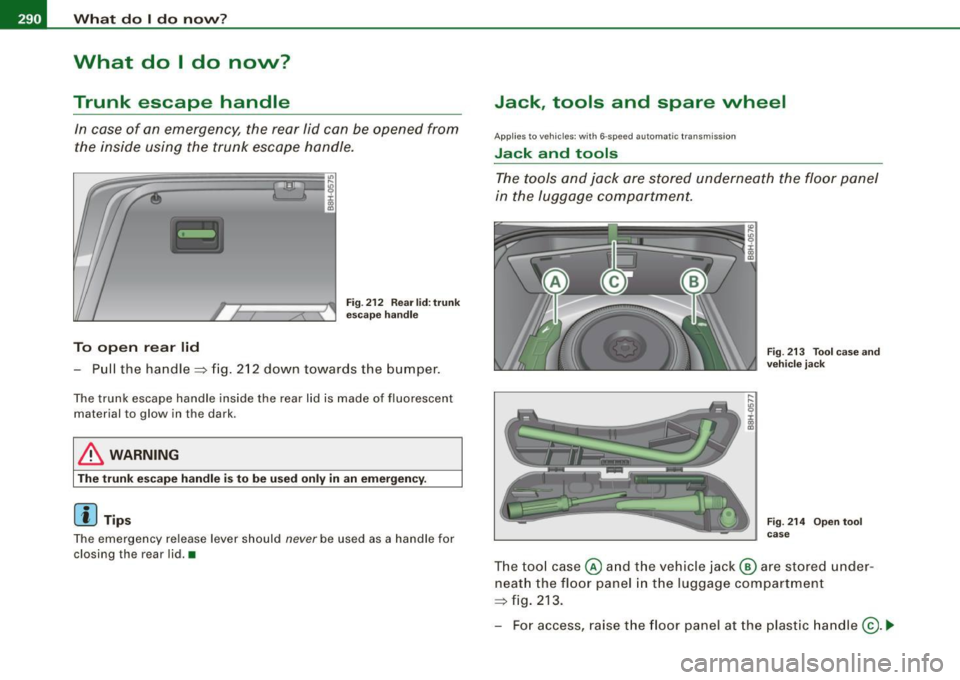
In case of an emergency, the rear lid can be opened from
the inside using the trunk escape handle.
To open rear lid
Fig. 212 Rear lid: trunk
escape handle
-Pull the handle~ fig. 212 down towards the bumper.
The trunk escape handle inside the rear lid is made of fluorescent
material to glow in the dark.
& WARNING
The trunk escape handle is to be used only in an emergency.
[ i ] Tips
The emergency release lever should never be used as a handle for
closing the rear lid. •
Jack, tools and spare wheel
Applies to vehicles: with 6 -speed automatic transmission
Jack and tools
The tools and jack are stored underneath the floor panel
in the luggage compartment.
Fig. 213 Tool case and
vehicle jack
Fig. 214 Open tool
case
The tool case @ and the vehicle jack @ are stored under
neath the floor panel in the luggage compartment
~ fig. 213.
- For access, raise the floor panel at the plastic handle
@. ~
Page 295 of 340
_____________________________________________ W_ h _a_t _ d_ o_ l _d _o _ n_o_ w_ ?_ . _ ..... 19111
•
& WARNING (continued)
pressure table - risk of accident! Use the highest tire pressure in
the table.
• Do not drive faster than 50 mph (80 km/h) - risk of accident!
• Avoid full-throttle acceleration, sharp braking, and fast
cornering - risk of accident!
• Never drive using more than one space-saving spare wheel -
risk of accident!
• Normal summer or winter tires must not be fitted on the space
saving spare wheel rim. •
Wheel change
Before changing a wheel
Follow these points for your own and your passenger's
safety when replacing a wheel.
-After you experience a tire failure, pull the car well away
from moving traffic and try to reach level ground before
you stop => & .
- All passengers should leave the car and move to a safe
location (for instance, behind the guardrail)=>& .
- Apply the parking brake firmly=>&.
- Move selector lever to position Pon an automatic trans-
mission; put manual transmission in first gear =>& .
- If you are towing a trailer: unhitch the trailer from your
vehicle.
- Take the tool case and the spare tire=>
page 290 out of
the luggage compartment.
& WARNING
You or your passengers could be injured while changing a wheel if
you do not follow these safety precautions:
• If you have a flat tire, move a safe distance off the road. Turn off
the engine, turn the emergency flasher on and use other warning devices to alert other motorists .
• Make sure that passengers wait in a safe place away from the
vehicle and well away from the roadway and traffic.
• To help prevent the vehicle from moving suddenly and possibly
slipping off the jack, always fully set the parking brake and block
the wheel diagonally opposite the wheel being changed. When one
front wheel is lifted off the ground, placing the Automatic Trans
mission in "P" (Park), or engaging a gear in a manual transmission
will
not prevent the vehicle from moving .
• Before you change a wheel, be sure the ground is level and firm.
If necessary, use a sturdy board under the jack.
• After installing the spare wheel, make sure that you remount
the flat tire/wheel in its storage area properly and tighten the
knurled retaining screw securely. •
Changing a wheel
When you change a wheel, follow the sequence described
below step-by -step and exactly in that order.
1. Remove the decorative wheel cover*. For more details
see also =>
page 294, "Decorative wheel covers" or
=>
page 295, "Wheels with cap-covered wheel bolts".
2. Loosen the wheel bolts=>
page 295.
3. Locate the proper mounting point for the jack and align
the jack below that point=>
page 296.
4. Lift the car with the jack=> page 296. _,..
Do-it-yourself service
Page 303 of 340
![AUDI S4 CABRIOLET 2009 Owners Manual _________________________________________________ F_ u_ s_ e_s _ a_n _ d_ b_ u_lb _ s ____ llll
[ i ] Tip s No . Equipm ent Amps
You are wel l adv ised to keep a supply of spare fuses in you](/img/6/57654/w960_57654-302.png "AUDI S4 CABRIOLET 2009 Owners Manual _________________________________________________ F_ u_ s_ e_s _ a_n _ d_ b_ u_lb _ s ____ llll
[ i ] Tip s No . Equipm ent Amps
You are wel l adv ised to keep a supply of spare fuses in you")
_________________________________________________ F_ u_ s_ e_s _ a_n _ d_ b_ u_lb _ s ____ llll
[ i ] Tip s No . Equipm ent Amps
You are wel l adv ised to keep a supply of spare fuses in your vehic le.
15 Instrument c luster, Navigation system 10
Fuses with the proper ampere ratings are available at your Audi 16 Garage door opener 5
dea ler. •
17 Level , tire pressure control , park assist, 10 light/rain sensor
Fuse list Automatic headlig ht range control, left 5
Fuses which con be replaced. 19 Fog lights 15
Vacant
N o. Equipm ent Amps
21 Vacant
1 Air conditioner 10
22 Doors 15
2 Footwell illumination 5 23 Vacant
3 Heated washer jets 5 Central convenience electrical system 20
Radiator fan 5 25 Heater blower 30
5
Telephone, oil level sensor, multifunction 10 Rear window defogger 30 switch, rear heated seat, shift gate
Air conditioner (air quality sensor), air pressure
27 Socket for tra iler towing (controller) 30
6 5
sensor 28 Fuel pump 20
Electronic Stabil izat ion Program (ESP), bra ke 29 Vacant
7 light switch, clutch peda l switch, steering angle 10
sensor
30 Power top control un it 30
8 Telephone 5 31
Automatic transmission, mirror dimming, diag-15 nosis socket
9 Brake booster (vacuum pump) 15 Towing assembly 15
10
Automatic headl ight beam adjustment, auto -5 33 Cigarette
lighter 20 matic headlight range control, right
34 Electrical socket 20
11
Airbag control unit, front passenge r seat recog -10 nition USA (bladder mat) 35 Luggage compartment socket 20
Diagnosis socket 10 Windshield wiper system 30
13
Steering c olumn module 10
37 Pump for windshie ld an d head light washer* 30
14
Brake lights 10
system
• Do-it-yourself service
Page 307 of 340
______________________________________________ E_ m_ e_r -=g :...e _ n_ c __a. y_ s_it _u_ a_ ti_o _ n_ s _ __,11111
& WARNING (continued)
• Before you check anything in the engine compartment, always
read and heed all WARNINGS~ page 242, "Engine compartment".
0 Note
• Applying a higher voltage booster battery will cause expensive
damage to sensitive electronic components, such as control units,
relays, radio, etc .
• There must be no electrical contact between the vehicles as
otherwise current could already start to flow as soon as the positive
(+) terminals are connected.
[ i] Tips
The discharged battery must be properly connected to the vehicle's
electrical system. •
Use of jumper cables
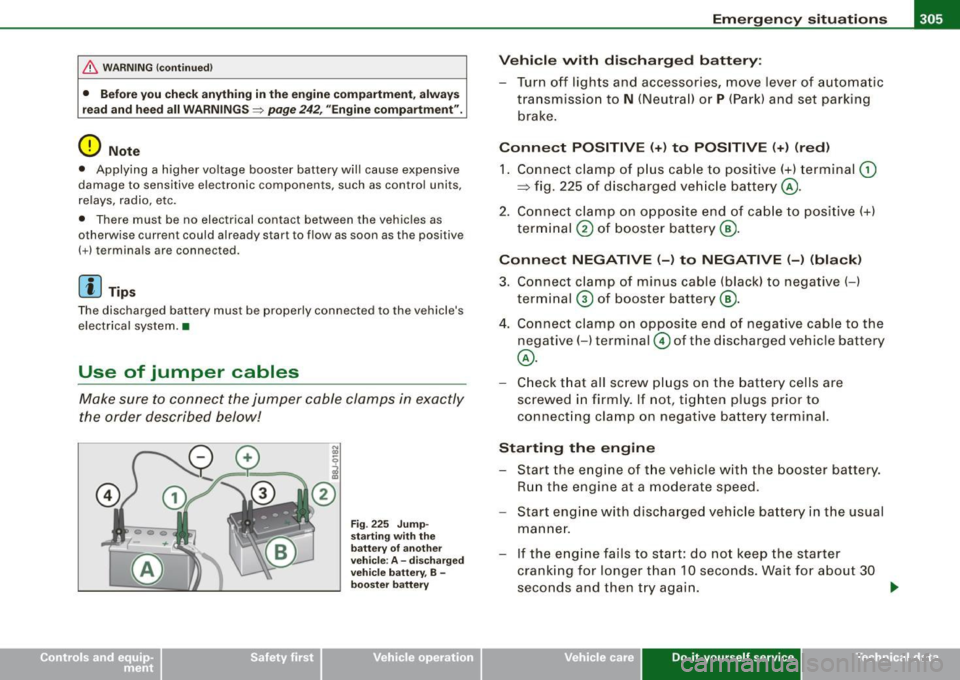
Make sure to connect the jumper cable clamps in exactly
the order described below!
Fig. 225 Jump·
starting with the
battery of another
vehicle : A -discharged
vehicle battery, B -
booster battery
Vehicle with discharged battery:
- Turn off lights and accessories, move lever of automatic
transmission to
N (Neutral) or P (Park) and set parking
brake.
Connect POSITIVE (+) to POSITIVE (+) (red)
1. Connect clamp of plus cable to positive(+) terminal G)
~ fig. 225 of discharged vehicle battery@.
2. Connect clamp on opposite end of cable to positive(+)
terminal
® of booster battery@.
Connect NEGATIVE (-) to NEGATIVE (-) (black)
3. Connect clamp of minus cable (black) to negative( -)
terminal
0 of booster battery@.
4. Connect clamp on opposite end of negative cable to the
negative( -) terminal © of the discharged vehicle battery
@.
- Check that all screw plugs on the battery cells are
screwed in firmly. If not, tighten plugs prior to
connecting clamp on negative battery terminal.
Starting the engine
- Start the engine of the vehicle with the booster battery.
Run the engine at a moderate speed.
- Start engine with discharged vehicle battery in the usual
manner.
- If the engine fails to start: do not keep the starter
cranking for longer than 10 seconds. Wait for about 30
seconds and then try again. .,,.
~ehicle care Do-it-yourse lf service Technical data
Page 308 of 340
111!1.___E_ m __ e_r -=g :...e_ n_ c-=y _ s_ i_t _u _a _t_ i_o _n_ s _______________________________________________ _
-With en gine run ning, r em ove jum per ca bles from both
v ehi cle s in exact
reve rs e o rd er.
T he battery is ve nted t o th e outs ide to preve nt gases from enter ing
the vehicle interior.
M ake s ure t hat th e jum per cla m ps are well co nnecte d with th eir
metal parts in full contact with the battery t erminals .
& WARNING
To avoid serious personal injury and damage to the vehicle , heed
all warnings and instructions of the jumper cable manufacturer. If
in doubt , call for road service .
• Jumper cables must be long enough so that the vehicles do not
touch .
• When connecting jumper cables , make sure that they cannot
get caught in any moving parts in the engine compartment .
• Before you check anything in the engine compartment, always
read and heed all WARNINGS=>
page 242, "Engine compartment ".
0 Note
Improper hook -up of jumper cables can ruin the generator.
• Always connec t POSIT IVE( +) to POS ITIVE ( +J, and NEG ATIV E (- J to
N EGAT IVE(-) te rminal.
• C heck that a ll screw plugs on the battery cel ls are screwed in
firm ly . I f not, tighten plugs prior to connec ting cla m p on nega tive
battery te rminal.
• P lease no te tha t th e procedure fo r con nec ting a ju mp er ca ble as
described above app lies specifical ly to t he case of your vehicle
b eing j ump st arted. When yo u are g iv in g a jum p start to another
veh ic le, do
not conn ect the minus(-) ca ble to the m inus( -) te rmina l
on the discha rge d battery ©=>
page 305, fig. 225. In stead , secu rely
co nnect the m inus(-) cable to e ither a m ass ive metal compone nt
that is firmly bo lted to the engine bloc k or to the engine b lock itse lf. I
f th e battery that is b ein g charged does not vent to the outside,
escapi ng battery ga s cou ld ignit e a nd ex plod e!•
Emergency towing with commercial
tow truck
General hints
Yo ur A udi requires s pecial handl in g f or t owing.
The fol lowing information i s to be used by commercial tow truck
operators who know how to operat e their equ ipment safe ly.
• Never tow your Audi, towing will cause damage to the engine
and transmission.
• Never wrap the safety chains or winch cables around the brake
lines.
• To prevent unnecessary damage , your Audi must be transported
with a car carrier (flat bed truck ).
• To load the vehicle on to the flat bed , use the towing loop found
in the vehicle tools and attach to the front or rear anchorage
=> page 3 07 and => page 307.
& WARNING
A vehicle being towed is not safe for passengers. Never allow
anyone to ride in a vehicle being towed , for any reason. •