cylinder engine AUDI S4 CABRIOLET 2009 Owners Manual
[x] Cancel search | Manufacturer: AUDI, Model Year: 2009, Model line: S4 CABRIOLET, Model: AUDI S4 CABRIOLET 2009Pages: 340, PDF Size: 77.32 MB
Page 253 of 340

_____________________________________________ C_h_ e.::...::. c.:..k .:..in ;..:.:= g:.....:.; a.:..n :....:d ::....:. f.:.:il .:.:li .:..n :.::g:!-- ----J-
& WARNING (conti nued )
-First , fully apply the parking brake , move selector lever of
automatic transmis sion to "P " (Park) ; put manual transmiss ion
in Neutral.
- Always u se extreme caut ion to prevent clothing, jewelry , or
long hair from getting caught in the radiator fan, V-belts or
other moving parts , or from conta cting hot parts. Tie back hair
before starting , and wear no cloth ing that will hang or droop
into the engine.
• Minimize exposure to emission and chemical hazards
~ & .
& WARNING
California Proposition 65 Warning :
• Engine exhaust , some of its constituents , and certa in vehicle
components contain or emit chemicals known to the State of Cali
fornia to cause cancer and birth defects and reproductive harm . In
addition , certain fluids contained in vehicles and certain produ cts
of component wear contain or emit chemicals known to the State
of California to cause cancer and birth defects or other reproduc
tive ha rm .
• Battery post s, terminals and related acces sories contain lead
and lead compounds , chemicals known to the St ate of California
to cause cancer and reproductive harms. Wash hands after
handling.
0 Note
When adding f luids, always make sure that they are poured into the
p roper container o r filler opening, otherwise se rio us damage to
vehicle systems will occur .
W For the sake of the environment
To detect lea ks i n tim e, inspect t he v ehi cle floor pa n from u nde r
neath regularly. If you see spots from oil or other vehicle fluids, have
y o ur v ehicl e inspected by an author ized Au di dea ler. •
Engine compartment
App lies to veh icles: with 2 .0 I turbo, 4-cylinder •engine
2.0 I , 4-cylinder turbo engine (200 hp )
The se are th e m ost important items that you can check .
Fig. 196 Engine comp art m ent : 2 .0 I, 4-cy lind er turbo
G) Battery ..................................... •..
0 Engine oi l fi lle r ca p ('1:::r.l ..... ... ... ....... .... .. .
© Bra ke fluid reservoir ( ) ..... ... .... ... ... ... .. . .
© Engine oil dipstick (orange) ........ .......... ... .
Vehic le care
N
N
I
261
255
2 60
25 4 ...
irechnical data
Page 254 of 340

-Ch
ecking and filling
_ _..;:::;__=----------------
©
©
0
Coolant expansion tank (.J_ J .. .. .. .. . ... .. .. .... .
Windshield/head light washer container ( O ) ..... .. .
Po wer steering re servoi r
& WARNING
Before you check anything in the engine compartment , always
read and heed all WARNINGS
=> & in "Working in the engine
c ompartment " on
page 250. •
Applies to veh icles : w ith 6 ·cy lind er engine
3.2 liter , 6-cylinder engine (255 hp)
258
266
217
Th ese a re t he most im por tan t it em s th at you c an ch eck.
F ig . 197 Engine compartment : 3.2 liter , 6- cylinder
G) Battery ... ... .. ...... .... ... .... .... .... ..... .
0 Bra ke fluid reservoir ( l ....... .. .. .. .. ...... .. .
© Engine oil fi ller cap ('t:::n) ..•. ..• ..... .•. ...• ..•..
26 1
260
255
©
©
©
0
Engine oil dipstick (orange) ...... ..... ... .... ... .
Coolant expansion tank
( -L J .. ... ... . .... ... ... .. .
W indshield/headligh t washer c ontainer (O l .. .... . .
Powe r steering rese rvoir
& WARNING
Before you check anything in the engine compartment, always
read and heed all WARNINGS
=> & in "Working in the engine
compartmen t" on
page 250. •
Engine oil
Engine oil specifications
254
258
266
2 17
The engine oil used in your Audi needs the right kind of
oil.
The engi ne in y our Audi is a sophisticated powe rp lan t tha t was built
to exacting specifications. This engine needs the right kind of
eng ine oil that meets specifications regarding quality and viscos ity
so that it can run smoothly and reliably . Choosing the right oil and
changing oil within the time and mileage interva ls printed in your
vehic le's Warranty
& Maintenance booklet matters a lot more today
than it did years ago. Audi has developed a special quality standa rd
f or e ngin e oil tha t w ill help assure that your vehicle's engine will get
the lubrication it needs for proper operation.
Modern engine lubrication has taken a quantum leap i n the last few
years. Many synthetic oils ava ilable today provide better engine
lubrication that can o utlast traditional petro leum -based oil s,
making them a smart choice for use throughout the life of your Audi.
Whether you use synthetic or petro leum -based engine oil, the oi l
tha t you use mus t conform to Audi 's oi l qual ity standard VW 502 00
to help keep your vehicle's engine running smoothly and help ._
Page 257 of 340
Checking and filling -_____________ _______::;____;;:;;____...j
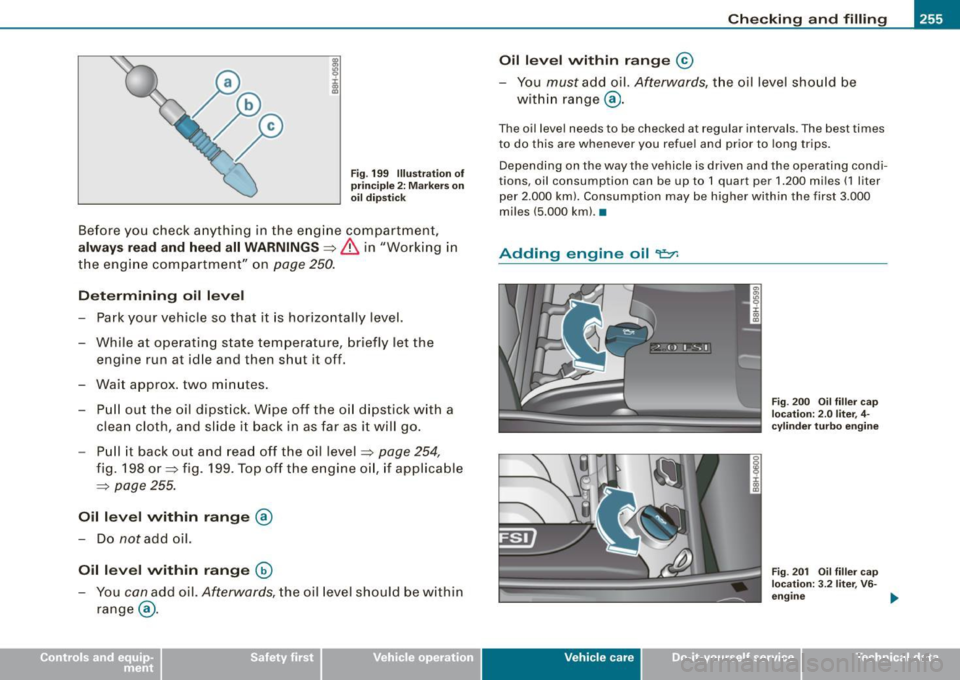
Fig. 199 Illustration of
principle 2: Markers on
oil dipstick
Before you check anything in the engine compartment,
always read and heed all WARNINGS=> & in "Working in
the engine compartment" on
page 250.
Determining oil level
Park your vehicle so that it is horizontally level.
- While at operating state temperature, briefly let the
engine run at idle and then shut it off.
- Wait approx. two minutes.
- Pull out the oil dipstick. Wipe off the oil dipstick with a
clean cloth, and slide it back in as far as it will go.
- Pull it back out and read off the oil level
=> page 254,
fig. 198 or:::> fig. 199. Top off the engine oil, if applicable
=> page 255.
Oil level within range @
- Do not add oil.
Oil level within range G)
- You con add oil. Afterwords, the oil leve l should be within
range @.
Oil level within range ©
-You must add oil. Afterwords, the oil level should be
within range @.
The oil level needs to be checked at regular intervals . The best times
to do this are whenever you refuel and prior to long trips.
Depending on the way the vehicle is driven and the operating condi
tions, oil consumption can be up to 1 quart p er 1.200 miles (1 liter
per 2.000 km). Consumption may be higher within the first 3.000
miles (5.000 km). •
Adding engine oi l 'e::1':
Vehicle care
Fig . 200 Oil filler cap
loc ation: 2.0 liter, 4-
cylinder turbo engine
Fig . 201 Oil filler cap
location: 3.2 liter , VG-
engine _,,
irechnical data
Page 274 of 340
-Tires and wheels
P'U:1-------------------
warmed up than when it is "cold." It is the inflation pressure in a
"cold" tire that counts. Therefore, you should never let air out of a
warm tire to match "cold tire inflation pressure" recommendations .
The tires would then be underinflated and could fail suddenly.
Maintaining proper tire pressure is one of the most important
things you can do to help avoid sudden tire failure. Underinflated
tires are a major cause of sudden tire failure. Keeping tires at the
right pressure is also important for safe and responsive vehicle
handling, traction, braking and load carrying.
Tire pressures are
particularly important when the vehicle is being driven at higher
speeds, and then especially when heavily loaded even within the
permissible load-carrying capacities approved for your vehicle .
The recommended tire pressures for your Audi depend on the kind
of tires on your vehicle and the number of passengers and/or
amount of luggage you will be transporting.
On USA vehicles, the tire pressure label is located on the driver's
side B-pillar . On Canada vehicles, the tire pressure label is located
either on the driver's side B-pillar or inside the fuel filler flap. The tire
pressure label lists the recommended cold tire inflation pressures
for the vehicle at its maximum capacity weight and tires that were
on your vehicle at the time it was manufactured.
If you wish to improve comfort when operating the vehicle at
normal load (up to 2 occupants), you can adjust tire pressures to
-
those specified for normal vehicle load. Before operating the vehicle
at maximum load, you must increase the tire pressures to those
specified for maximum vehicle load
=> & .
If your vehicle is equipped with a tire pressure monitoring system *,
bear in mind that the system can only monitor the tire pressures you
have stored. The system does not recognize the load condition of
your vehicle.
The effectiveness of the tire pressure monitoring system will be
impaired if you store normal load pressures but then operate the
vehicle at its maximum load=>&.
See the illustration =>
page 271, fig. 207 for the location of the label
either on driver's side B-pillar or inside the fuel filler flap (color of
the actual label and exact location on the vehicle will vary slightly).
Note that the following table is accurate at the time of going to
press and is subject to change. In the event of discrepancies, the tire
pressure label (either on driver's side B-pillar or inside the fuel filler
flap) always takes precedence .
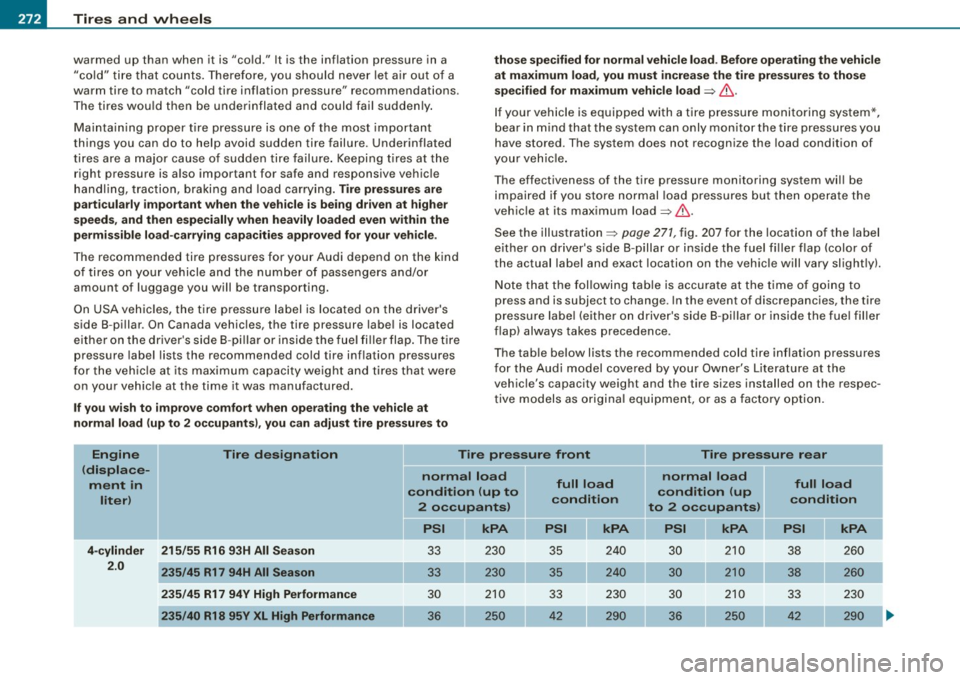
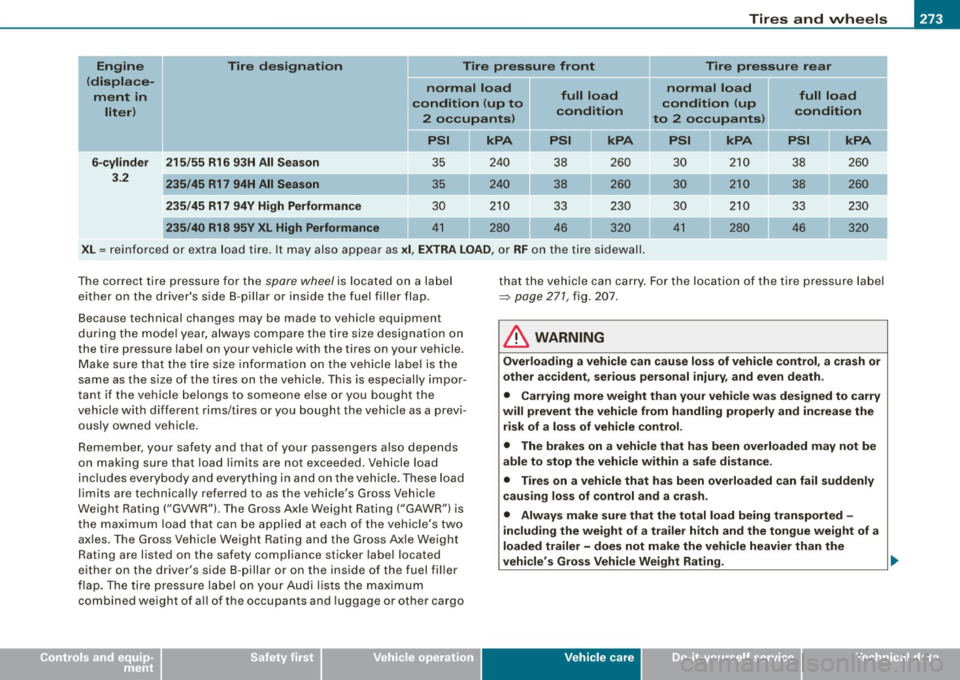
The table below lists the recommended cold tire inflation pressures
for the Audi model covered by your Owner's Literature at the
vehicle's capacity weight and the tire sizes installed on the respec
tive models as original equipment, or as a factory option.
Engine
(displace
ment in liter) Tire designation
Tire pressure front Tire pressure rear
4-cylinder
2.0 215/55 R16 93H All Season
235/45 R17 94H All Season
235/45 R17 94Y High Performance
235/40 R18 95Y XL High Performance
normal load
condition (up to
2 occupants)
PSI
33
33
30
36
kPA
230
230
210
250
full load
condition
PSI
35
35 33
42
II kPA
240
240
230
290
normal load
condition (up
to 2 occupants)
PSI
30
30
30
36
JI kPA
210
210
210
250
11 full load
condition
PSI
38
38
33
42
JI kPA
260
260
230
290
I
Page 275 of 340
Tires and wheels -
----------------
•
Engine Tire designation Tire pressure front Tire pressure rear
(displace- normal load normal load
ment in full load
full load
liter ) c
ondit ion (up to
condition c
ondition (up
condition
2 occupants ) to 2 occupants)
PSI kPA PSI kPA PSI kPA PSI kPA
6 -cylinder 215 /55 R16 93H All Season 35 240
38 260
30 2
10
38 260
3.2
235/45 R17 94H All Season 35 2
4 0
38 260 30 2
10
38 260
235/45 R17 94V High Performance 30 2 10 3 3 230 30 2 10 33 230
235 /40 R18 95V XL High Performance 41 280 46 320 41 280 4 6 320
XL= reinforced or extra load tire. It may also appear as x i, EXTRA LOAD , or RF on the tire sidewa ll.
The correct tire pressure for the
spare wheel is located on a label
either on the dr iver's side B-pilla r or i nside the fuel filler flap.
Because technical changes may be made to vehicle equipment
dur ing the mode l year, a lways co mpare the tire size designatio n on
the tire pressure label on your vehicle with the tires on your vehicle .
Make sure t hat the tire s ize informa tion o n the vehi cle labe l is the
same as the size of the tires on the vehicle . This is especially impor
t a nt if th e ve hicle belo ngs to someone else or you bough t the
vehic le with different rims/tires or you bought the vehicle as a previ
ously owned vehicle.
Re member, your safety and that of your passeng ers a ls o depends
on making sure that load limits are not exceeded. Vehicle load
inc lude s every body and everyt hin g i n and o n the vehic le . These load
limits are techn ically referred to as the vehicle's Gross Vehic le
Weight Ra tin g ("GVWR") . The Gross Axle Weig ht Ra ting ("GAWR") is
the maximum load that can be applied at each of the veh icle's two
ax les . The Gross Vehic le W eight Rating and the Gross Ax le Weight
Rating are listed on the safety compliance sticker label located
either on the driver's s ide 8 -pillar or on the inside of the fuel fi ller
fl ap. T he ti re pressure labe l on your Aud i lists the max imum
combined weight of a ll of the occupants and luggage or other cargo that the vehicle can car
ry. Fo r the l ocat io n of the tire pressure la bel
=> page 271, fig. 207.
LJ}. WARNING
Overload ing a vehicle can cause loss of vehi cle cont rol , a crash or
other ac cident , serious per sonal injury , and even death .
• Carrying more weight than your vehicle wa s designed to carry
will prevent the vehicle from handling properly and increase the
risk of a loss of vehicle control .
• The brakes on a vehicle that has been overloaded may not be
able to stop the vehi cle within a safe dist ance.
• Tires on a vehicle that has been overloaded can fail suddenly
cau sing lo ss of control and a crash .
• Always make sure that the total load being transported -
including the weight of a trailer h itch and the tongue weight of a
loaded trailer -does not make the vehicle heavier than the
vehi cle 's Gross Vehicle Weight Rating . .,,_
Vehic le care
Page 316 of 340
llftl __ D_a_ t_ a ___________________________________________________ _
Data
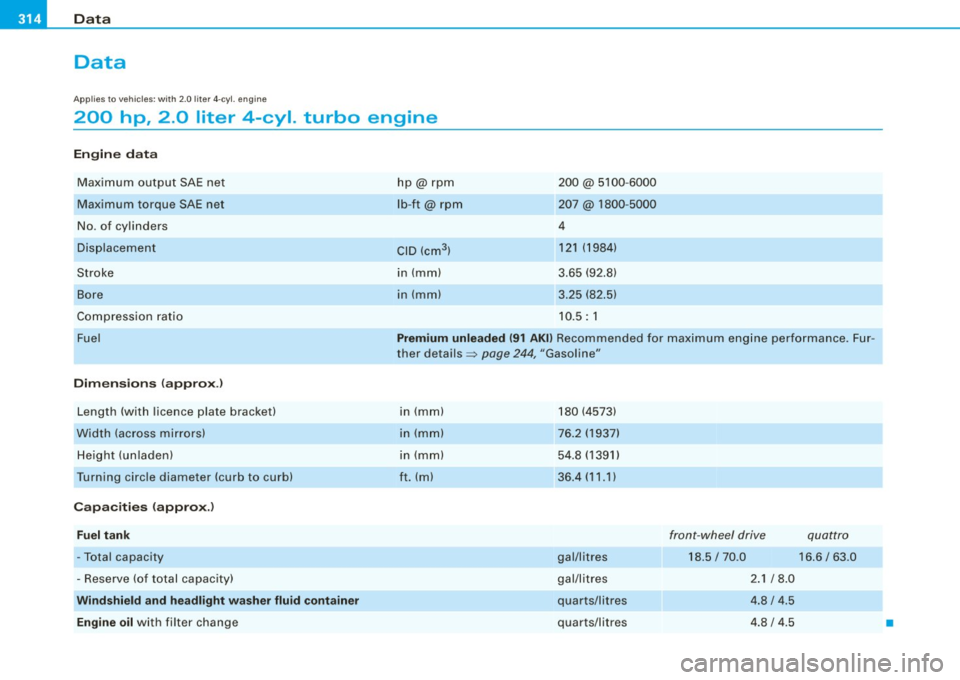
Applies to vehi cles : w ith 2.0 lite r 4-cyl. engi ne
200 hp, 2.0 liter 4-cyl. turbo engine
En gin e da ta
Maximum output SAE net
Maximum torque SAE net
No . of cylinders
Disp lacement
Stroke
Bore
Compression ratio
Fuel
Dimen sion s (a pprox.)
Length (with licence plate bracket)
Width (across mirrors) Height (unladen)
Turning circle diameter (curb to curb)
Ca paci ties (a pprox.)
Fuel ta nk
-Total capacity
- Reserve (of total capacity)
Wind shield and h eadlight washer fluid containe r
Eng ine oil
with filter change hp@rpm
lb
-ft@ rpm
CID (cm
3 )
in (mm)
in (mm)
200 @ 5100 -6000
207
@ 1800-5000
4 121 (1984)
3.65 (92.8)
3 .25 (82 .5)
10.5: 1
Premium unleaded (91 AKI! Recommended for maximum eng ine performance . Fur
ther details =:,
page 244, "Gasoline"
in (mm)
in (mm)
in (mm)
ft. (ml
180 (4573)
76.2 (1937) 54.8 (1391)
36.4 (11.1)
gal/litres
gal/litres
qua rts/1 it res
quarts/litres
front -wheel drive
18.5 / 70 .0
2.1 / 8.0
4.8
I 4.5
4.8
I 4.5
quottro
16.6 / 63_0
•
Page 329 of 340
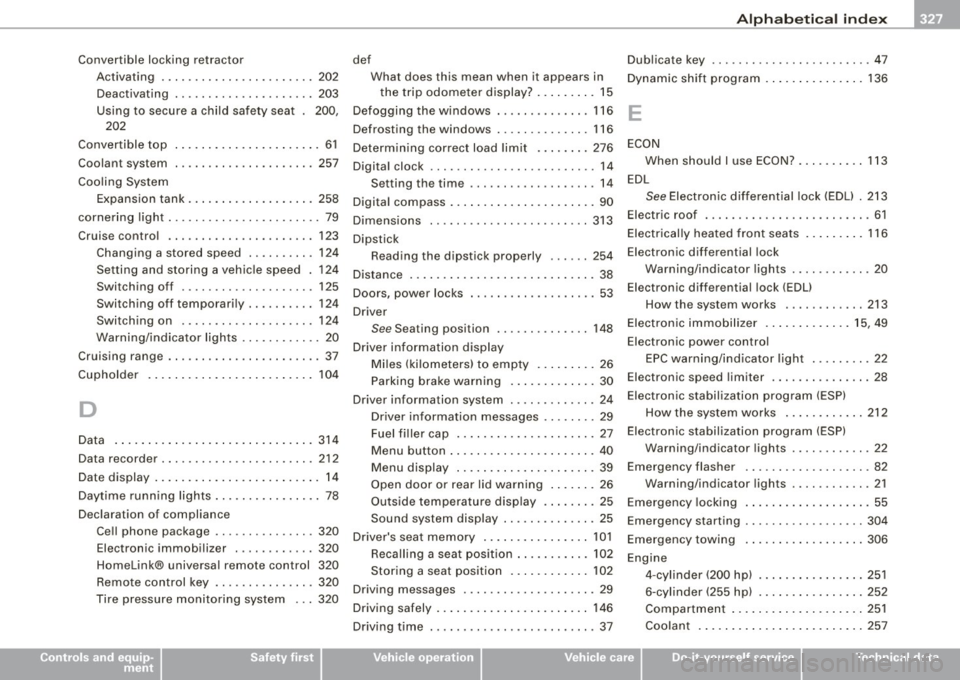
Alph ab eti ca l ind ex --------------=-----
Convertible locking retractor
Activating ...... ... .. .... ...... .. 202
Deactivating .. ... ..... ..... .. ... . 203
Using to secure a child safety seat 200 ,
202
Convertible top ........ .... .... .... .. 61
Coolant system
Cooling System 257
Expansion tank ... .... ...... .... .. 258
cornering light . .......... .. .... .... .. 79
Cruise control .. ... ... ...... ...... .. 123
Changing a stored sp eed . .... .... . 124
Setting and storing a vehicle speed . 124
Switching off .................... 125
Switching off temporari ly .. ........ 124
Switching on .... .... .... ...... .. 124
Warning/indicator lights ... ... .... .. 20
Cruising range .. .... .... .... ...... ... 37
Cupholder . ... .. ...... ..... .. .. .... 104
D
Data . .... ... . ... .. ... ... .... ..... . 314
Data recorder ... .... ...... ..... .... . 212
Date dis play . . . . . . . . . . . . . . . . . . . . . . . . . 14
Daytime running lights ... .. ... .. ... ... 78
Declaration of compliance Cell phone package .. .. .... .... ... 320
Elect ronic immobilizer . ..... .. .... 320
Homelink® universal remote con trol 320
Remote control key .. .... .... .... . 320
Tire pressure monitoring system ... 320
Controls and equip
ment Safety first
def
Dublicate key ... ...... ... .. . ... .... .. 47
What does this mean when it appears in
Dynamic shift program ....... ... ... . . 136
the trip odometer display? .. ...... . 15
Defogging the windows . ....... ..... . 116
E
Defrosting the windows .. ... ..... ... . 116
Determining correct load lim it ... .... . 276 ECON
Digi tal clock ............. .. ... ... .... 14 When should I use ECON?
... .... .. . 113
Setting the time ......... .... .... .. 14 EDL
Digital compass . ... ... . ... ... .. .... .. 90 See Electronic differential lock (EDU . 213
Dimensions ..... .... .... .... .... ... 313 Electric roof .
..... ... ..... .. .... .... . 61
Dipstick Electrically heated front seats .
.. .... .. 116
Reading the dipstick properly ...... 254 Electronic differential lock
Distance ... .... ... ... .. ... .... .... .. 38 Warning/indicator
lights ..... ... .... 20
Doors, power locks ........ ....... .... 53
Driver Electronic differ
ential lock (EDU
How the system works ...... .. .... 213
See S eating position .. ... ... ... ... 148 Electronic immobilizer ..
.. .. . .. .. .. 15, 49
Driver information dis play
Miles (kilometers) to empty .. .. ... .. 26 Electronic power control
EPC warning/indicator light ......... 22
Parking brake warning ... ... ..... .. 30 Electronic sp
eed limiter ..... .. .... .... 28
D river information sys.tern . .... ...... .. 24 Electronic stabilization program (ESP)
Driver information messages .. .... .. 29 How the system works ...
..... .. .. 212
Fuel filler cap . .. . ........ ....... .. 27 Elec
tronic stabiliza tion program (ESP)
Menu button .... . .. .. .... .... .... . 40 Warning/indicator lights
.... ...... .. 22
Menu display .... ... .... .... . ... .. 39 Emerg
ency flasher ... .... ... .. ....... 82
Open door or rear lid warning ...... . 26 Warning/indicator
lights .... ...... .. 21
Outside temperatu re disp lay ... ..... 25
Emergency locking . .... .... ... .. .. . .. 55
Sound system display .... .... .... .. 25
Emergency starting ..... ....... .. .... 304
Driver's seat memory ... .... .... ..... 101
Emergency towing . .. ... .. .. .... .... 306
Recalling a seat position .... .... ... 102
Engine
Storing a seat position ... ... .... .. 102
4-cylinder (200 hp) . ... .. .. .... .. .. 251
Driving messages ...... ........ ..... . 29
6-cylinder (255 hp) . ... .. .. .... .. .. 252
Driving safely . ... .. . ... .. .... .... ... 146
Compartment .... ... .. ...... .... . 251
Driving time . .... ...... .... ... .. .... . 37 Coolant ...
.. ... .... .... .... ..... 257
Vehicle operation Vehicle care Do-it-yourself service Technical data