air condition AUDI S4 SEDAN 2013 User Guide
[x] Cancel search | Manufacturer: AUDI, Model Year: 2013, Model line: S4 SEDAN, Model: AUDI S4 SEDAN 2013Pages: 294, PDF Size: 73.71 MB
Page 190 of 294
188 Intelligent technology
200 kilometers) of normal city driving.
You can compensate for this by pressing
the brake pedal more firmly. This also applies later when new pads are instal
led .
- You should perform braking maneuvers
for the purpose of cleaning the brake
system only if road conditions permit.
Other road users must not be put at risk -
you may cause an acc ident!
- Before descending a steep grade, reduce
speed and shift transmission into a lower
gear or lowe r driving range. Do not ride
the brakes or hold the pedal down too
long or too often. This could cause the
brakes to get hot and diminish braking
efficiency.
- Do not "ride the brakes" by resting your
foot on the pedal when you do not intend
to brake . This may cause the brakes to
overheat, premature wear and increased
stopping distance.
- Under certain climatic and operating
conditions such as passing through wa
ter, driving in heavy rain or after washing
the vehicle, the effectiveness of the
brakes can be reduced. In winter, ice can
accumulate on the brake pads, linings,
discs and drums. Carefully apply brakes
for a test. Brakes will dry and ice coat
ings will be cleaned off after a few care
ful brake applications.
- Driving for an extended period of time on
salt-covered roads without using your
brakes can also affect braking efficiency.
Clean off accumulated salt coating from
brake discs and pads with a few careful
brake applications.
- If you damage the front spoiler, or if you
install a different spoiler, be sure the air
flow to the front brakes is not obstruct
ed . Otherwise the brake system could
overheat reducing the effectiveness of
the entire brake system.
- Failure of one brake c ircuit will impair
the braking capability resulting in an in
creased stopping distance. Avoid driv ing
the vehicle and have it towed to the near- est authorized Audi dealer or
qualified
workshop.
- Never let the vehicle roll to a stop with
the engine shut off.
- If the brake booster is not working, for
example when towing your vehicle, or
because the brake booster has somehow
been damaged, the brake pedal must be
pressed considerably harder to make up
for the lack of booster assistance.
Electro-mechanical
power assist, dynamic
steering
The electro-mechanical power assist helps
the driver when steering.
Power steering adapts electronically based on
the vehicle speed .
Indicator lights and messages
• Steering defective! Do not drive vehicle!
If this indicator light turns on and stays on
and this message appears, the power steering
may have failed.
Do
not continue driving . See your authorized
Audi dealer or other qualified repair facility
for assistance.
E!"4 Dynamic steering: System fault! You can
continue driving
If the indicator light turns on and the mes
sage appears, the steering may be more diffi
cult to move or more sensitive than usual. The
steering wheel may also be at an angle when
driving straight .
Drive slowly to your authorized Audi dealer or
qualified workshop to have the malfunction
corrected .
ls!'fl Dynamic steering: initializing
If this driver message appears and the indica
tor light is flashing on the instrument panel,
dynamic steering* is being reinitialized. Once
you start the engine after this is finished, the ..,..
Page 191 of 294
steering wheel wi ll be easy to move . Re
initialization might be necessary if the steer
ing wheel was moved hard to the left and
right while the vehicle was not moving. The
d isplay goes out as soon as in itializat ion is
comp lete .
A WARNING
Have the dynamic steering* system mal
function repaired as soon as poss ible by an
authori zed A udi dealer or any qualified
workshop -risk of accident!
@ Tips
- If the . or 1;r,ij indicator light only stays
on for a short t ime, you may continue
driving.
- The dynamic steering * stability systems
are not available in t he event of a system
malfunction.
- Fo r additional informat ion on dynamic
stee ring*, re fer to
c::> page 111.
Driving with your
quattro ®
Applies to vehicles: with all-wheel drive
With oil-wheel drive, oil four wheels ore driv
en.
General information
W ith all -whee l dr ive, power is dis tributed to
a ll fo ur wheels. This happens automatica lly
depending on yo ur driving sty le and the road
conditions at the time. See also
c::> page 184 .
A center different ial d is tributes the dr iv ing
power var iably to the front and rear axle. It
wo rks together with se lective whee l to rque
contro l, which activates when driving throug h
curves
c::> page 185. With the sport d ifferen
tial*, power distribution to the rear w heels is
variable and can be adjusted with Audi drive se lect
c::> page 111 .
The all-wheel drive concept is designed for
hi gh engine power. Your vehicle is exception
ally powerful and has exce llent dr iving charac
ter ist ics both under normal d riving conditions
Int ellig ent technolog y 189
and on snow and ice . Always read and follow
safety precautions
c::> & .
Winter tires
When dr iving in t he winter, yo ur vehicle wi th
a ll -wheel drive h as an adv ant age, even w it h
regular tires. In wi nter road conditions it may
be advisable to mount winter tires (or all -sea
son tires) for improved driveability and brak
ing : these tires must be mounted on
all fou r
wheels .
See also c::> page 245, Winter tires.
Tire chains
Where tire chains a re mandatory on certain
roads, this no rma lly also app lies to veh icles
with all-wheel drive
c::> page 246 , Snow
chains .
Replacing wheels /tires
Vehicles wi th a ll-wheel drive must alw ays
have tires of the same s ize. A lso avoid tires
with different tread depths . For detai ls see
page
c::> page 241, New tires and replacing
tires and wheels.
Off-Road driving?
Your A udi does no t have enough g ro und cle ar
ance to be used as an off -road vehi cle. It is
therefore best to avoi d rough tracks and un
even te rrain as much as possib le . Also refer to
c::> page 192.
A WARNING
A lways ad just yo ur dr iv ing to road and traf
fic conditions. Do not let the extra safety
afforded by all-wheel drive tempt you into
taking extra risks .
-Al tho ugh t he all-wheel driv e is ve ry ef
fective, always remember that braking
capacity is lim ited by tire t raction. You
should t herefore not d rive a t excessive
speeds on i cy or slippery ro ad s urfa ces.
- On wet road surfa ces, be careful not to
d rive too fast bec ause the fron t whee ls
co uld begin to slide on top of the water
(aquaplani ng) . If th is should occur, yo u •
•
Page 195 of 294
A WARNING ,~ ~
After driving through water, mud, slush,
etc., the brakes may be slow to take effect
because of wet brake rotors and pads. Dry
the brakes first by braking carefully to re
store the full brak ing effect.
([) Note
Vehicle components such as the engine,
transmiss ion, suspension or electrical sys
tem can be severely damaged by driving
through wate r.
@ Tips
- Check the depth of the water before dr iv
i ng through it.
- Do not stop the veh icle, dr ive in reverse
or switch the engine off when driving
th rough water.
- Keep in mind that oncoming vehicles
may create waves that raise the water
level and make it too deep for you r vehi
cle to drive th rough safely.
- Avoid dr iving through sa lt water because
i t can ca use corrosion.
Catalytic converter
It is very important that your emission con
trol system (catalytic converter) is function
ing properly to ensure that your vehicle is run
ning in an environmentally sound manner.
11-Always use lead-free gasoline q page 210,
Fuel supply .
"'" Never run the tank down a ll the way to
empty.
11-Never put too much motor oil in your en-
gine
q page 220, ~ Adding engine oil .
11-Never try to push -or tow-start your veh icle .
The catalytic converter is an efficient "clean up" device built into the exhaust system of
the vehicle . The catalytic converter burns
many of the pollutants in the exhaust gas be
fore they are released into the atmosphere .
Drivin g and en vironm ent 193
The exclusive use of unleaded fuel is critically
important for the life of the catalytic convert
er and proper funct ion ing of the engine.
A WARNING
-
- Do not park or operate the vehicle in
areas where the hot exhaust system may
come in contact with dry grass, brush,
fuel spill or other mate rial wh ich can
cause a fir e.
- Do not apply additional undercoating or rustp roof ing on or near the exhaust
manifold, exhaust pipes, catalytic con
ve rter or heat shields. During driv ing, the
substance used for undercoating co uld
overheat and cause a fire.
(D Note
- Be aware that just one tank filling with
leaded fu el w il l already ser iously de
gra de the performance of the catalytic
c onverte r.
- Do not ex ceed t he cor rect eng ine oil level
qpage 220.
- Do not drive until the fue l tank becomes
comple tely empty. The engine co uld m is
fire . Unburned fuel could also get in to
the exhaust system and th is co uld cause
the catalytic converter to overheat .
- Do not turn off the ignition while the ve
hicle is moving.
- Do not continue to ope rate your veh icle
unde r these conditions, as otherwise fuel
can reach the catalytic converte r. T his
cou ld result in overheating of the con
verter, requir ing its replacement.
- To assure efficient operation of the Emis
sion Control System:
- H ave you r vehicle maintained prope rly
and in accorda nce w ith the serv ice rec
ommendat ions in yo ur Warranty &
M ain tenance boo klet.
- L ack of prope r maintenance as we ll as
improper use of the vehi cle w ill impair
the function of the em ission contro l
system and could lead to damage . ..,. •
•
Page 197 of 294
(D Note
Do not leave engine idling unattended af
ter starting . If warning lights should come
on to indicate improper operation, they
would go unheeded. Extended idling also
produces heat, which could result in over
heating or other damage to the vehicle or
other property .
Regular maintenance
A badly tuned engine unnecessarily wastes a
lot of fuel .
.,. Have your vehicle serv iced at regular inter-
vals .
By having your vehicle regularly serviced by an
authori zed Audi dealer helps to ensure that it
runs properly and economically . The condition
of your vehicle not only affects its safety and
ab il ity to hold its value, it also affects
fuel
consumption.
Check your oil each time you fill your tank.
The amount of oil used is related to engine
load and speed.
It is normal for the oil consumption of a new
engine to reach its lowest value after a certain
mileage has been driven.
You must drive your vehicle about 3 ,000 miles
(5,000 kilometers) before you can properly
assess oi l consumption.
This a lso applies to fuel consumption and en
g ine output .
0 Note
-Have your vehicle maintained properly
and in accordance with the service rec
ommendations in your Warranty
& Main
tenance booklet. Lack of proper mainte
nance as well as improper use of the ve
hicle will impair the function of the
emission control system and could lead
to damage.
Driving and environment 195
- Do not alter or remove any component of
the Emission Control System unless ap
proved by the manufacturer .
- Do not alter or remove any device, such
as heat shields, switches, ignition wires,
valves, which are designed to protect
your vehicle's Emission Control System and other important vehicle compo
nents .
Fewer short trips
Fuel consumption will always be rela tively
high on short trips .
.,. Try to avoid driving short distances with a
cold engine.
The engine and cata lytic converter have to
reach their opt imal
operating temperature to
reduce fuel consumpt ion and noxious emis
sions effectively .
Just after starting, a co ld engine in a mid-size
car only achieves a fuel economy of 6-8 miles
per gallon (30-40 l/100 km). After about a
half a mile, fuel economy climbs to 12 mpg
(20 l/100 km) . After about
2 .5 miles (4 km),
the engine is at its proper operat ing tempera
ture and fuel economy has reached a normal
level. So you can see that you should avoid
short trips whenever possible.
T he
outside temperature is also cr itical in th is
regard. Your car consumes more fue l in the
winter than in the summer.
•
•
Page 199 of 294
Tire pressure
When towing a trai le r, inflate the t ires of your
vehicle to the co ld tire pressure listed under
"Full load" on the label located on the driver's
side B-pillar (vis ible when the door is open).
Inflate trailer tires to trailer and tire manufac
turers' specifications.
Light s
The headlight settings should be checked with
the trailer attached before driving off. Check
to make sure both vehicle and trai ler lights
are working properly.
Safety chains
Be su re tra iler sa fety chains are properly con
nected from the trailer to the hitch on the ve
hicle. Leave enough slack in the chains to per
mit turning corners . When you install safety
chains, make sure they w ill not drag on the
road when you are driving.
The chains shou ld cross under the trai ler
tongue to prevent it from dropping in case of
separatio n from the hitch .
Driving instructions
Driving with a trailer always requires extra
core and consideration.
To obtain the best possible handling o f vehicle
and trai ler, p lease note the following:
.,. Do not tow a loaded trailer whe n your car it
self is not loaded .
.,. Be especia lly careful when passing other
vehicles .
.,. Observe speed limits .
.,. Do not drive at the maximum permissible
speed .
.,. Always apply brakes ea rly .
.,. Monitor the temperature gauge.
Weight di stribution
Towing a loaded trai ler with an empty car re
sults in a highly unstable distribution of
weight . If this cannot be avo ided, drive at very
low speeds only to avoid the risk of losing
steer ing control.
Trailer towing 197
A "balanced" rig is easier to operate and con
trol. This means that the tow vehicle should be loaded to the extent possible and permissi
ble, while keep ing the trailer as light as possi
ble under the c ircumstances. Whenever poss i
ble, transfer some cargo to the luggage com
partment of the tow vehicle while observing
tongue load requirements and vehicle loading
considerations.
Speed
The higher the speed, the more d iff icult it be
comes for the driver to control the rig . Do not
drive at the maximum permissible speed. Re
duce your speed even more if load, weather or
wind conditions are unfavorable -pa rticularly
when going downhill.
Reduce veh icle speed
immediately if the trail
er shows the slightest s ign of sway ing .
Do not
try to stop the swaying by accelerating.
Observe speed limits . In some areas, speeds
for vehicles tow ing tra ilers are lower than for
regular vehicles .
Always apply brakes early. When driving downh ill, shift into a lower gear to use the en
gine braking effect to slow the vehicle . Use of
the brakes alone can cause them to overheat
and fail.
Coolant temperature
The coolant temperature gauge ¢ page 10
must be observed carefully . If the need le
moves close to the upper end of the scale, re
duce speed immediately and/or turn off the
air conditioner.
If the coolant temperature warning light •
in the instrument cluster starts flashing, pull
off the road, stop and let the engine
idle for
about two minutes to prevent heat build -up .
A WARNING
Anyone not properly restrained in a mov
ing vehicle is at a much greater risk in an
accident . Never let anyone ride in yo ur car
who is not properly wearing the restraints
prov ided by Audi.
-
•
•
Page 201 of 294
Cleaning and protect ion
General information
Regular core preserves vehicle value.
Any automobile is exposed to industrial
fumes , corrosive road salt, etc. A well cared
for Audi can look like new many years after
purchase . Regular and correct care w ill con
tr ibute to maintaining the beauty and value of
your Aud i.
Furthermore, good care may be a condition
for substantiating a warranty claim should
corrosion damage or paint defects occur.
Your authorized Audi dealer has a variety of
dedicated vehicle-care products and can ad
vise which ones to use for cleaning the exter i
or and interior of your vehicle.
Whether you use products recommended by
Audi or other commercially available cleaning
agents, please make sure you apply them cor
rectly .
.&, WARNING
-Cleaning agents may be poisonous. Keep
them out of the reach of children.
- Heed all caution labels.
- Always read directions on the container
before using any product. Follow the di
rect ions carefully.
- Most chemical cleaners are concentrated
and have to be diluted .
- Use spot removing fluids only in well
ventilated areas.
- Do not use gasoline, kerosene, d iesel
fuel, nail polish remover or other volatile
fluids. They may be toxic, flammab le or
haza rdous in other ways. Do not wash,
wax or dry the vehicle with the ignition
on or the engine running.
- Do not clean the undersides of chassis,
fenders, wheel covers, e tc. without pro
tecting your hands and arms. You may cut yourself on sharp-edged metal parts.
Cleaning and protection 199
-Moisture and ice on brakes may impair
brak ing effic iency¢
page 187. Test the
brakes carefully each time you wash the
veh icle.
@) For the sake of the environment
Select on ly environmentally friend ly clean
i ng products . Leftover cleaning products
should not d isposed of in the household
waste.
Care of exterior
Washing
Frequent washing protects the vehicle .
The best protection against environmental i n
fluences is
frequent washing and waxing . How
often th is is required depends on:
- How much the veh icle is used
- Where the veh icle is parked (garage, in the
open under trees, etc.)
- The seasonal and weather conditions
- Environmental influences
T he longer b ird droppings, insects, tree resin,
road and indus trial gr ime, tar, soot, road salt
and other materials remain on the vehicle
body, the more lasting their destructive ef
fects will be . High temperatures caused by ex
posure to intense sun light intens ify the corro
sive effect, particularly when humid ity is high
as well.
Under certain circumstances,
weekly washing
may be necessary. Under other cond itions, a
monthly washing and waxing may be ade
quate .
After the winter, the underside of the vehicle
should be thoroughly washed, preferab ly in a
professional car wash .
.&, WARNING ,_
Always read and heed all WARNINGS and
other information¢
page 199 .
•
•
Page 208 of 294
206 Cleaning and protec tio n
Open Velcro fasteners on your clothing can
damage the seat cover. Please make sure
that Velcro fasteners are closed.
Plastic parts and instrument panel
Always use a clean cloth moistened in clear
water to clean these areas . For pers istent dirt
use an Audi approved
so lv ent-fr ee plastic
cleaner/protectant.
_& WARNING
So lvents can change the propert ies of
some plastics and make it harder for the
airbag to dep loy.
-
- Never clean the instr ument pane l or the
surface of airbag modules with cleaning
products that contain solvents.
- Products containing solvents w ill make
the surface o f this part porous.
- Serious injur ies can result if plastic pa rts
come loose when the airbag is deployed .
- Always read and heed all WARN INGS and
other information
¢page 199.
(D Note
Cleaning agents contain ing solvents will
attac k the mater ial and can change the
way it behaves.
Natural leather
Appl ies to vehicles: with natural leather
Audi makes great efforts to maintain the
properties, natural look and feel of interior
leather.
General
We offer many different types of leather on
our veh icles . Most are differe nt types of nappa
l eather, which has a smooth surface and
comes in var ious co lors .
The intensity of the color determines the v isu
al character istics and appearance .
If the sur
face of the leather has a typical natural look,
the n the leather is a nappa leat her that has been left in a relative
ly natura l condition . This
leather offers particularly good comfort and
breathes we ll. Fine veins, closed grains, insect
bites, skin fo lds, and s ubt le variations in color
rema in v is ible. These character istics demon
strate that the material is natural.
Natura l nappa leather is not covered by a co l
or finish. It is therefore more sensit ive to soil
ing and wear, which is someth ing you need to
consider if children, animals or other factors
mig ht prove to be part icularly hard o n the
l eather .
By contrast, leather types that are covered by
a colored finish layer are more durable. This has a positive effect on the leather's resist
ance to wear and soiling in da ily use . On the
othe r hand, the typica l charac teristics of natu
ral le a the r are barely o r not appa rent. Howev
er, th is does not mean that the leather itse lf
is of inferior quality.
Care and handling
Because of the exclusive nature of the types of
leather that Aud i uses and their uniq ue p rop
erties (such as sens itivity to oils, grease, soil
ing, etc.), yo u w ill need to be somewhat ca re
ful with these leathers, and a certain type of care is requi red . For example, dark clothing
mater ials can disco lor leather seats (especia l
ly if such clothing is damp and was not dyed
correct ly). Dust and dirt particles in pores,
folds, and seams can have an abrasive effect
and can damage the leather surface as well as
wea ken seams .
The leather should be cleaned regularly as needed . After hav ing been used for a relat ively
long time, your leather seats will acq uire a
rich aged fi nish. This is a character istic of nat
ur al leathe r and a s ign of true quality.
In order to maintain the value of this natural
product over the life of your veh icle, you
shou ld follow t he recomme ndat io ns be low: ..,.
Page 220 of 294
218 Check ing and filling
Modern engine lubrication has taken a quan
tum leap in the last few years. Many synthetic
oils ava ilable today provide better engine lu
brication that can outlast traditional petrole
um-based oils, making them a smart choice
for use throughout the life of your Audi .
Whether you use synthetic or petroleum
based engine oil, the oil that you use must
conform to Audi 's oil quality standard
VW 502 00 to he lp keep your vehicle's engine
running smoothly and help prevent the for
mat ion of harmfu l deposits, sometimes called
"sludge ", that ove r time can lead to expensive
repairs .
At the time of print ing , engine o ils available in
the U .S . and Canada that meet the exacting
specifications of Audi oi l standard VW 502 00
a re synthetic engine oils. This does not mean,
however, that every synthetic engine oil will
meet Audi oil standard VW 502 00. So always
be sure that you use an approved oil.
To help prevent the format ion of harmful de
posits use only oi l with the fo llowing specifi
cations printed on the oil container :
Audi oil standard VW 502 00
O il container labe ls may carry the specif ica
tion s ingly or in comb inat ion with other des ig
nations and oil qua lity standards .
Visco sity
Engine oils are graded accord ing to their vis
cosity. The proper viscosity grade oil for your
engine depends on cl imactic or seasonal con
d itions where you drive. You can use oil with a
viscosity grade of SA E SW40 across all tem
pe ratu re ranges for normal driving conditions .
However, if eng ine o il viscos ity grade SA E
SW40 is not available, you can also use viscos
ity grade SAE SW -30 or SAE OW-40 as long as
it meets Audi o il quality standard VW 502 00
specif ications .
Because engine oil that meets the Audi oil
standard may not be available everywhere
when you need it, we strongly recommend
that you always carry with you an extra quart (
li ter) of oil that exp ress ly con forms to the
VW 502 00 spec ification, in case you have to
top
off the oil while on the road.
Only if the level of the o il is at or be low the
minimum mark -and no oi l that expressly
conforms to Audi oil standard VW 502 00
specifications is available - may you top
off
with a high quality engine o il, preferab ly syn
thet ic-based, tha t mee ts ACEA A3 or API SM
specifications, but even then , only in v iscosity
grades SAE SW-40 , SAE SW-30, or SAE
OW-40. However, dur ing the entire time be
tween oil change inte rva ls , never top
off with
more than a total of 0.5 q t/ liter engine o il
t h at does not con form to Audi oi l specification
vw 502 00.
For more informa tion about eng ine oi l that
has been approved for your veh icle, please
contact e ither your authorized Aud i dealer or
Audi C ustomer Re lations at 1 (800) 822 -2834
or visit our web site at www .audiusa.com or
www.aud icanada .ca. Here you w ill also find a
current list of oils (manufacturers, brand
names e tc.) tha t conform to Audi oil s tanda rd
vw 502 00 .
Changing the engine oil
The eng ine oi l and oil fi lter must be changed
according to the mileage (kilometers) and
time intervals specified in your ve hicle's War
ranty
& Maintenance booklet. Do not exceed
these intervals -harmful deposits from old
engine oil can reduce engine performance and
can lead to expensive engine repairs .
Changi ng the oil at the recommended inter
vals is so very important because the lubricat ing proper ties of oil decrease gradually during
normal veh icle use . If you are not sure when
you have your oil changed, ask your author ized Audi Serv ice Adv isor.
Under some circumstances the engine oil
should even be changed more frequent ly .
Change oil more often if you drive mostly
short distances, operate the ve hicle in dusty
areas o r most ly unde r stop-and-go t raff ic con-
ditions, o r when you use your vehi cle where .,..
Page 236 of 294
234 Tires and wheels
Cold tire inflation pressure
Tire pressure affects the overall handling, performance and safety of a vehicle.
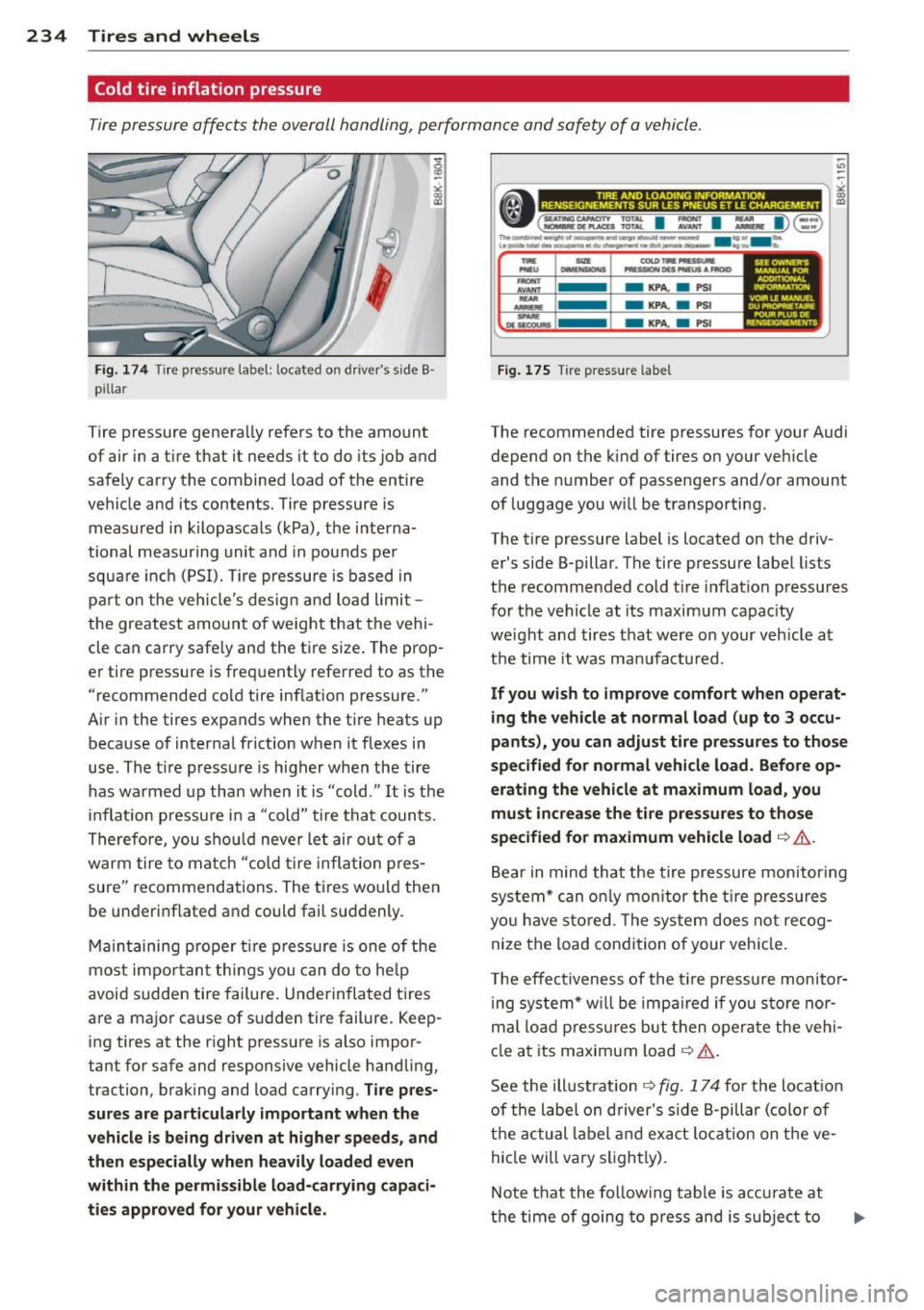
Fig. 174 Tire pressure label: located on driver's side B·
pillar
Tire pressure genera lly refers to the amount
of air i n a tire that it needs it to do its job and
safely carry the combined load of the entire
vehicle and its contents. Tire pressure is measured in kilopasca ls (kPa), the inte rna·
tional measuring unit and in pounds pe r
squa re inch ( PSI). Tire pressure is based in
pa rt o n the vehicle's desig n an d load limit
the greatest amount of weight that the vehi ·
cle can car ry safe ly and the tir e size . The prop·
er tire pressure is freq uent ly referred to as the
"recommended cold tire inflation pressure."
A ir in the tires expands when the tire heats up
because of internal frict ion when it flexes in
use . The t ire p ress ure is higher when the tire
h as warmed up than when i t is "cold ." It is the
in flat io n pressu re i n a "cold" tire that coun ts.
Th erefore, you sho uld neve r let air ou t of a
warm tire to match " co ld tir e infla tion pres
sure" recommendations . The ti res wo uld then
be un derinflated and could fail su ddenly.
M ain taining p roper t ire pr es su re is one o f the
most impo rtan t thi ngs you can do to he lp
avoid sudden tire failure. Underinfla ted ti res
a re a major ca use of s udden tire failure. Keep
ing tires at the right pressure is also impor
tant for safe and responsive vehicle handling,
traction, braking and load carrying .
Tire pres
sures are particularly important when th e
vehicle is being driven at higher speeds , and
then especially when heavily loaded even
within the permissible load -carrying capaci
tie s approved for your vehicle .
------------------.. ,;
•(=~: I : I :,.. I)@ ~
The~-----~---w-o- ....... -e.....i -·· - u ........ -.-..,.0, ... -....,.,...tot~---....... ._.,. -..
....
-..... ...........
- KPA. a PSI
- KPA.
a PSI
-KPA. a PSI
Fig. 17 5 Tire pressure la bel
SU OWNER'S MANUAl FOR AD0"10NAL l10N VOl!ILEMANU£1. DU _,...,
POUR Pl.US DE
REHSEKi.\'IEME NTS
The recommended tire pressures for your Audi
depend on the kind of tires on your ve hicle
and the numbe r of passengers and/or amount
of luggage you w il l be transporting .
The tire pressure label is located on the driv
er's si de B-pillar . T he tire pressure label lists
t h e recommended cold tir e inflat io n pressu res
for the vehicle at its maxim um capac ity
we ight and tires that were on your veh icle at
t h e time it was man ufa ctu red.
If you wish to improve comfort when operat
ing the vehicle at normal load (up to 3 occu
pants), you can adjust tire pre ssure s to tho se
specified for normal vehicle load. Before op
erating the vehicle at maximum load, you
mu st increase the tire pres sures to those
specified for maximum vehicle load
c::> .&, .
Bear in mind that the tire pressure mon itor ing
system * can o nly mo nitor the t ire pres sures
yo u have s to red. The sys tem does n ot recog
nize the load condition of your vehicle.
T he effectivene ss of the t ire p ress ure monito r
ing system* w ill be impa ired if yo u st ore nor
m al lo ad press ures but t hen opera t e the ve hi
cl e a t its ma ximum load
c::> .&. .
See the ill ustration c::> fig. 17 4 for the lo cat ion
o f the label o n driver's side B-pill ar (col or o f
t h e actu al lab el and exac t lo cat ion on the ve
hicle will vary sligh tly).
Note t hat the f ollowing ta ble is ac curate at
th e time of goi ng to press and i s sub ject to
Page 244 of 294
242 Tire s and wheels
contribution to good road ho lding and safe
handling when in good condition and properly
inflated
¢ ,& .
We recommend that all work on tires and
wheels be perfo rmed by an authorized Audi
dea ler. They are familiar with recommended
proced ures and have the necessary spec ial
too ls and spare parts as well as the proper fa
cilities for disposing of the old tires.
Authorized Audi dealers have the necessary information about technica l requ irements for
installing or changing tires and r ims.
Replacing tires and wheels
Tires should be rep laced at least in pairs and
not individually (for example both front tires
or both rear tires together).
Be sure to read and heed the information to
the tire pressure monitoring system*
¢page 248.
Always buy rep lacement radial tires that have
the same specifications as the tires approved
for your vehicle by Audi. Replacement t ires
must always have the same load rating speci
fication as the original equipment or approved
optional tires listed in the table
c:> page 234.
Aud i-approved specification tires are specially
matched to your vehicle and its load limits,
and can contribute to the important road hold
ing, driving characteristics, and safety of the
vehicle. The table
(c:> page 234) lists specifica
tions of the tires approved for the Audi mod
els covered by your Owner's Literature .
The tire pressure labe l located on driver's side
B-pillar
(c:> page 234, fig. 175) lists the speci
fications of the orig inal equipment tires in
stalled on your veh icle at the time it was man
ufactured.
Federal law requires tir e manufacturers to
place standard ized information on the s ide
wall of all tires
c:> fig. 178. This information
identifies and describes the fundamental
characterist ics, the quality grade of the tire
and also provides a tire ident ificat ion number f
or sa fety standard ce rtification and in case of
a recall.
Tire specifications
Knowledge of tire specificat ions makes it eas
ier to choose the correct tires. Radial tires
have the tire specifications marked on the
sidewa ll, for examp le:
P255 / 35 R19 96Y XL
This co nta ins the following information:
P Indicates the tir e is for passenger cars
(where app licab le)
255 Nominal tire width in mm of the tire
from sidewall edge to sidewa ll edge. In
general, the larger the number, the wider
the tire
35 Height/w idth ratio in percent (aspect ra-
t io)
R Tire construction: Radial
19 Rim diameter code (in inches)
96 Load rating code
Y Speed rating letter code
XL (or "xl", "EXTRA LOAD", or "RF" Indicates
that the tir e is a"Re inforced" or an "Extra
Load" tire
M+S (or "M/S") Indicates that the tire has
some mud and snow capability
The tires could also have the information of
direction of rotat ion
c:> page 230 .
Tire manufacturing date
The manufact uring date is also indicated on
the tire sidewall (possibly on ly on the
inner
side of the wheel) :
"DOT ... 2212 ... "means, for examp le, that
the tire was produced in the 22nd week of
2012.
Speed rating (letter code)
The speed rating letter code on the whee ls in
dicates the maximum permissible road speeds
c:> & in Winter tires on page 246.
P up to 93 mph (150 km/h)
Q up to 99 mph (158 km/h)
R up to 106 mph ( 170 km/h)