coolant AUDI S4 SEDAN 2013 User Guide
[x] Cancel search | Manufacturer: AUDI, Model Year: 2013, Model line: S4 SEDAN, Model: AUDI S4 SEDAN 2013Pages: 294, PDF Size: 73.71 MB
Page 226 of 294
224 Checking and filling
scalding from hot coolant by following
these steps.
- Turn off the eng ine and a llow it to cool
down.
- Protect your face, hands and arms from escaping flu id and steam by cover ing
the cap with a large, thick rag.
- Turn the cap slowly and very carefully
i n a counter-clockwise direction while
apply ing l ight, downwa rd p ress ure on
the top of the cap .
- To avo id being burned, do not sp ill an
tifreeze or coolant on the exhaust sys
tem or hot engine parts . Under certain
conditions, the ethylene glyco l in en
gine coolant can catch f ire .
- Antifreeze is poisonous . Always store an
tifreeze in its or iginal container and we ll
out of the reach of children .
- If you drain the coolant, it must be
caught and safely stored in a proper con
tainer clear ly marked "poison".
@ Note
- Coolant po llutes the env ironment and
could cause an engine fire . Excess coo l
ant will be forced out through the pres
sure relief valve in the cap when the en
gine becomes hot.
- If, in an emergency, on ly water can be
added, the correct ratio between water
and antifreeze
c::> page 222 must be re
stored as soon as possible .
@ For the sake of the environment
Drained coolant should not be re used. Al
ways dispose of used coolant while observ
ing all environmental regulat ions.
Radiator fan
The radiator fan switches on automatically by
itself
The radiator fan is driven by the engine via the
V-be lt . The viscous clutch regulates the speed
of the fan according to the temperature of the
coolant. An a
uxiliary electric radiator fan* switches on
and off depending on coolant temperature
and other vehicle operat ing condit ions .
After yo u sw itch the engine off, the aux iliary
f an can continue running for up to 10 minutes
- eve n wit h the ignition off. It can even switc h
on again later by itself
c::> &. , if
- t he tempe rature of the engine coo lant rises
due to the heat build -up from the engine in
the engine compartment, or
- the engine compa rtment heats up because
the vehicle is parked in i ntense sunlight.
_& WARNING
- To reduce the risk of personal in jury nev
er touch the radiator fan.
- The auxiliary electric fan is temperat ure
controlled and can sw itch on suddenly
even when the engine is not running.
- The a uxiliary radiator fan sw itches on a u
tomatically when the engine coo lant
reaches a certai n temperature and will
continue to run until the coolant temper
ature drops.
Brake fluid
Checking brake fluid level
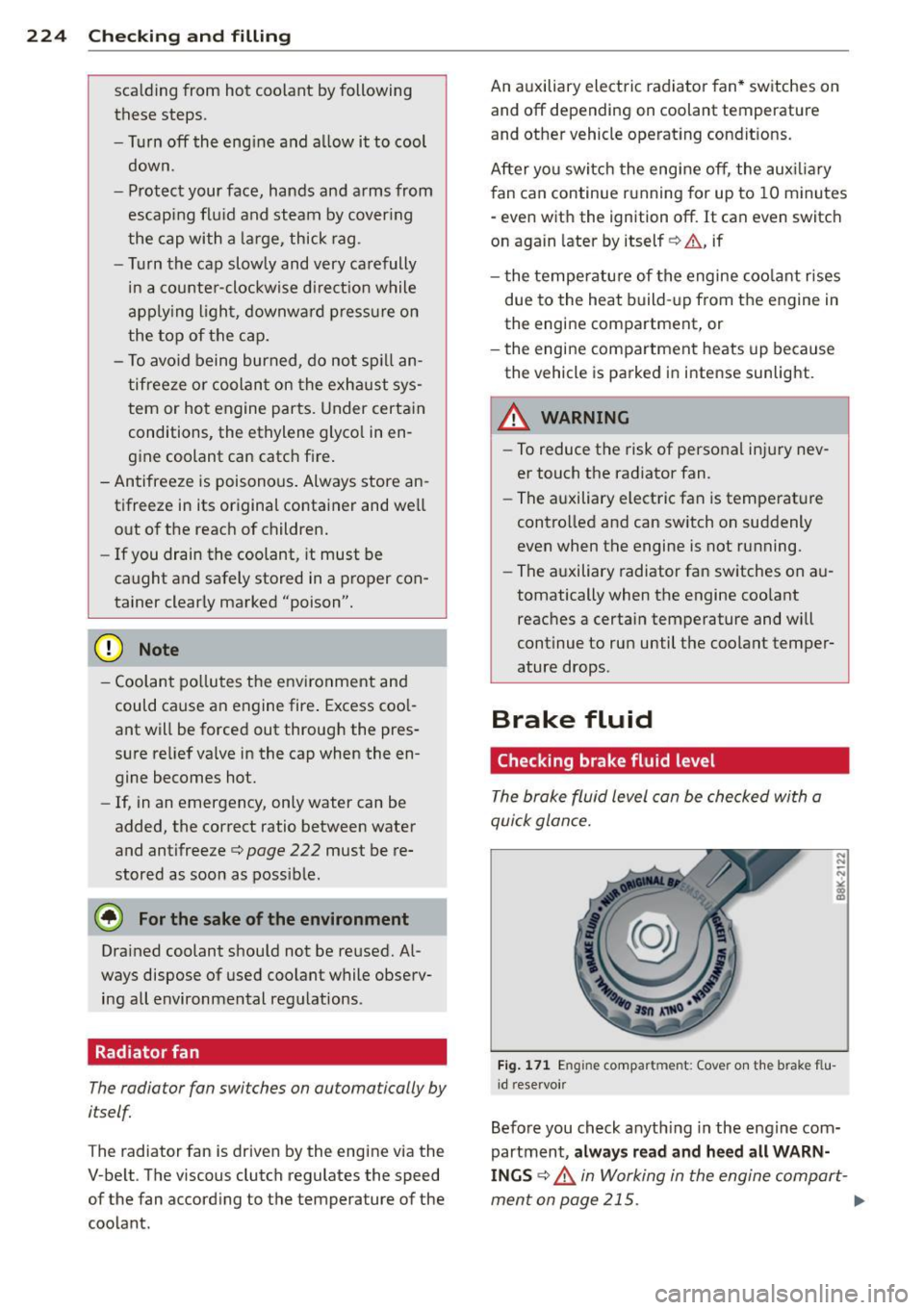
The brake fluid level can be checked with a
quick glance.
F ig . 17 1 Eng ine compartment: Cover on the brake flu
i d reservo ir
Before you check a nyth ing in the engine com
partment,
always read and h eed all WARN
INGS c::> .&. in Working in the engine compart-
ment on page 215. .,..
Page 231 of 294
(D Note
Never use a fast charger as a booster to
start the engine . This will seriously dam
age sensitive electronic components, such
as control units, relays, radio, etc ., as well
as the battery charger .
Battery replacement
The new battery must have the same specifi
cations and dimensions as the original equip
ment battery .
Intelligent energy management in your vehi
cle is responsible for d istributing the electr i
cal energy throughout your vehicle
c::>
page 190 . The intelligent energy manage
ment system w ill keep the engine battery
charged bette r then vehicles w ithout t his sys
tem. To make sure the additional electr ica l en
ergy is available once again after you have
changed the battery, we recommend that you
install batteries of the same type and manu
facture only (the same as those installed at
the time your vehicle was delivered). Specifi
cations are listed on the bat tery hous ing. Your
author ized Audi dealer must code the battery
in the energy management system to enable
you to use the energy management functions
correctly after replac ing the battery .
If it is not possible to use a battery of this
type, the new battery must have the same ca
pacity, voltage (12 volts) , amperage, con
struction and plug sea ling.
When insta lling the battery, make sure the ig
nition and all electr ical consumers are turned
off.
(D Note
Make sure the ventilation hose on the s ide
of the battery is connected , othe rwise
fumes or battery ac id can leak out .
@ For the sake of the environment
Because of the problem of proper d isposal
of a battery, we recommend your author
ized Aud i dealer change the battery for
Checkin g and fillin g 229
you. Batteries contain sul fur ic acid and
l ead and must always be disposed of prop
erly in comp liance with a ll environmental
regulations. Disposing of vehicle batter ies
i mproperly is very dangerous to the envi
ronment .
Windshield/headlight*
washer container
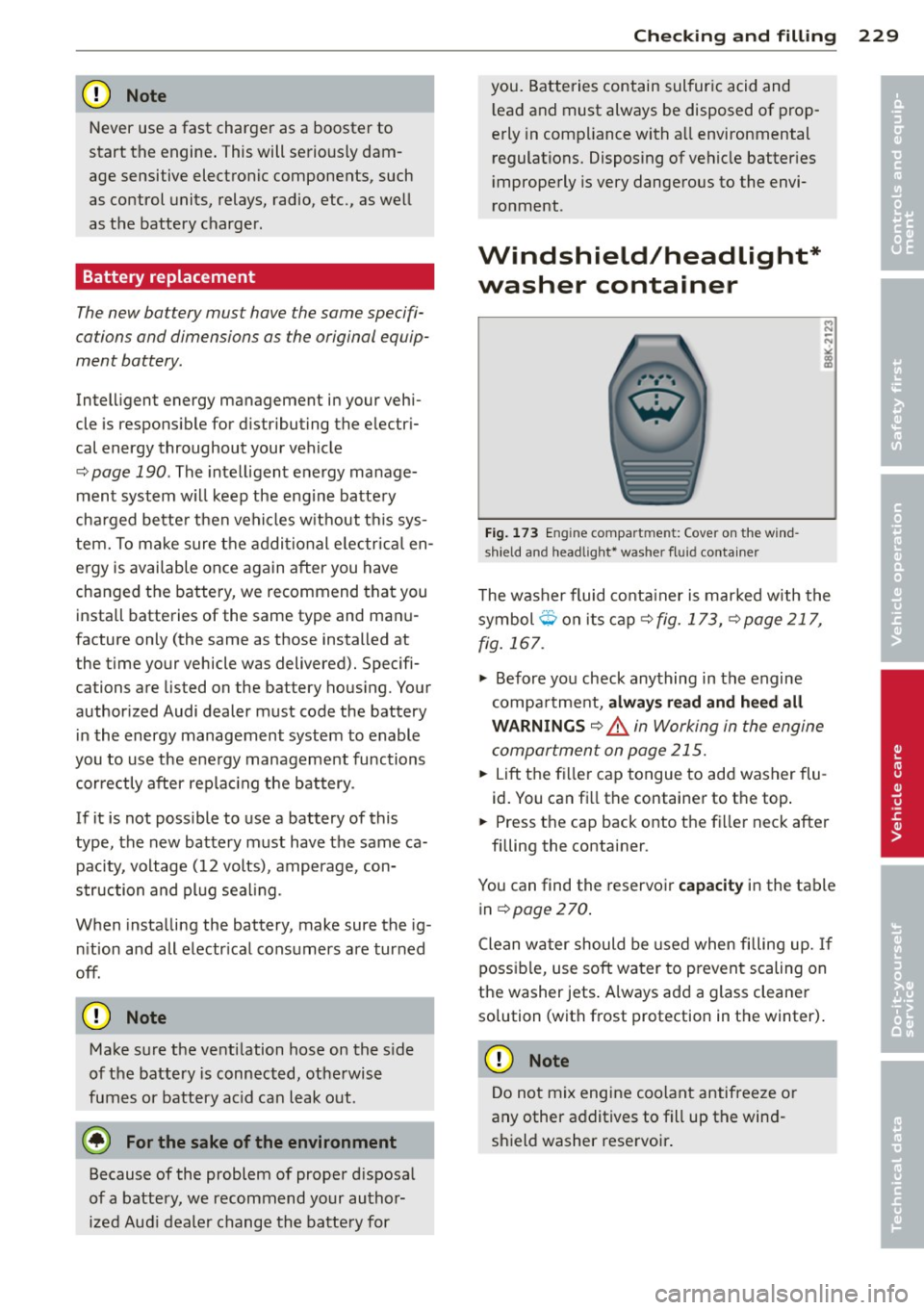
Fig. 173 En gin e compart men t: Cove r on the w ind
s hi eld an d headligh t* was her fl uid conta iner
The washer fluid container is marked w ith the
symbol
Q on its cap c::> fig. 173, c::> page 217,
fig. 167 .
.,. Before you check anything in the engine
compa rtment,
always read and heed all
WARNINGS
c::> .&. in Working in the engine
compartment on page 215.
.,. Lift the f iller cap tongue to add washer flu
id. You can fi ll the container to the top .
.. Press the cap back onto the fi ller neck after
filling the container .
You can find the reservoir
capacity in the table
in c::>
page 2 70 .
Clean water should be used when filling up. If
possib le, use soft water to prevent scaling on
the washer jets . Always add a glass cleaner
solution (with frost protection in the winter) .
(D Note
Do not mix engine coolant antifreeze or
any other additives to fill up the wind
shield washer reservoir .
•
•
Page 233 of 294
-Never mount used tires on yo ur vehicle if
you are not sure of their "previous histo
ry." Old used tires may have bee n dam
aged even though the damage cannot be
seen that can lead to sudden tire failure
and loss of vehicle control.
Glossary of tire and loading terminology
Accessory weight
means the comb ined weight (in excess of
those standard items wh ich may be rep laced)
of automati c transmission, power steering,
power br akes, power wi ndows, power sea ts,
radio, and heater, to the ex tent that these
items are avai lab le as factory -installed equip
ment (whether installed or not).
Aspect ratio
means the ratio of the height to the w idt h of
the tire in percent. Numbers of 55 or lower in
d icate a low sidewall fo r improved s teer ing re
sponse and better overall handling on dry
pavement.
Bead
means the pa rt of the t ire that is made of
s teel wires, wrapped or re inforced by ply cor ds
and that is shaped to fit the r im.
Bead separation
means a b reakdown of the bond between
components in the bead.
Cord
means the strands forming the plies in the
tire.
Cold t ir e infl ation pr essure
means the tire pressure recommended by the
vehicle manufacturer for a t ire of a designated
size that has not been dr iven for more than a
couple of miles (kilometers) at low speeds in
the three hour period before the tire pressure i s measu red or adjusted.
Tire s an d wheel s 231
-If you notice un usua l vibration or if the
veh icle pulls to one side when driv ing, a l
ways stop as soon as it is safe to do so and check the wheels and tires for dam
age.
Curb weight
mea ns the weight of a motor ve hicle w ith
standard equipment includ ing t he maximum
capa city of fuel, o il, and coolant, ai r cond i
tion ing a nd addi tional weig ht o f optiona l
equipment .
Extra load tire
means a tire design to operate at higher loads
and at higher inflation pressures than the cor
respondi ng s tanda rd tire. Extra load tires may
be identified as "X L", "xl", "EXTRA LOAD", o r
"R F" on the sidewall .
Gross Axle Weight Rating ( "GAWR ")
mea ns the load-carrying capacity of a single
axle system, measured at the tire-ground in
te rfaces.
Gross Vehicle Weight Rating ( "GVWR ")
means the maximum total loaded we ight of
t h e ve hicle.
Groo ve
means the space between two adjacent tread
ribs.
Load rating (code )
means the maximum load tha t a t ire is rated
to carry for a given inflation pressure. Yo u
may not find this information on all tires be
ca use it is not required by law.
Maximum load rating
me ans the load r ating for a tire at the maxi
mum pe rm issi ble inflat ion pressure for that
ti re .
•
•
...
Page 240 of 294
238 Tires and wheels
-If the tire pressure is too low or too high,
the tires will wear prematurely and the
vehicle will not handle well.
- If the tire is not flat and you do not have
to change a wheel immediately, drive at
reduced speed to the nearest service sta
t ion to check the tire pressure and add
air as required.
(D Note
Driving without valve stem caps can cause
damage to the tire va lves. To prevent this,
always make sure that facto ry installed
valve stem caps on all wheels are securely mounted on the valve.
@ For the sake of the environment
Underinflated tires will also increase the
fuel consumption .
Tires and vehicle load limits
There are limits to the amount of load or
weight that any vehicle and any tire can carry.
A vehicle that is overloaded w ill not handle
well and is more difficult to stop. Overloading
can not only lead to loss of vehicle control,
but can a lso damage important parts of the
vehicle and can lead to sudden tire failure, in
cluding a blowout and sudden deflation that
can cause the vehicle to crash .
Your safety and that of your passengers a lso
depends on making sure that load limits are
not exceeded. Vehicle load includes everybody
and everything in and on the vehicle . These
load limits are techn ically referred to as the
vehicle's
Gross Vehicle Weight Rating
("GVWR").
The "GVWR" includes the weight of the basic
vehicle, all factory installed accessories , a full
tank of fuel , oi l, coolant and other fluids plus
maximum load. The maximum load includes
the number of passengers that the vehicle is
intended to carry ("seating capacity") with an
assumed weight of 150 lbs . (68 kg) for each
passenger at a designated seating position
and the tota l weight of any luggage in the ve- hide.
If you tow a trai ler, the weight of the
trailer hitch and the tongue weight of the loaded trailer must be included as part of the
vehicle load.
T he
Gross Axle Weight Rating ("GAWR") is
the maximum load that can be applied at each
of the vehicle's two axles .
T he Gross Vehicle Weight Rating and the
Gross Axle Weight Rating are listed on the
safety compliance sticker label located on the
driver's side B-pillar.Your Audi has 5 seating
positions, 2 in the front and 3 in the rear for
total seating capacity of 5. Each seating posi
tion has a seat belt <=>
page 136, Safety belts .
The fact that there is an upper limit to yo ur
vehicle's Gross Vehicle Weight Rating means
that the to tal weight of wha tever is being car
ried in the vehicle ( including the weight of a
tra iler hitch and the tongue weight of the
loaded trailer) is lim ited. The more passen
gers in the vehicle or passengers who are
heavier than the standard we ights assumed
mean that less we ight can be carried as lug
gage.
T he tire pressure label on your Audi also lists
the maximum combined weight of all of the
occupants and luggage or other cargo that
the vehicle can carry. For the location of the
label <=>page234 , fig.174.
A WARNING
-Overloading a vehicle can cause loss of ve-
hicle control, a crash or other accident, se
rious personal injury, and even death.
- Carrying more we ight than your vehicle
was des igned to carry will prevent the
veh icle from handling properly and in
crease the risk of the loss of vehicle con
trol.
- The brakes on a vehicle that has been
overloaded may not be able to stop the
veh icle with in a safe distance .
- Tires on a vehicle that has been overload
ed can fail suddenly, incl uding a blowout
and sudden deflation, causing loss of
con trol and a crash .
Page 270 of 294
268 General information
General information Explanation of
technical data
Some of the technical data listed in this man
ual requires further explanation .
The technical data for your vehicle is listed in
the charts starting on
r:::> page 2 70. This sec
tion provides general information, notes and restrictions which apply to this data .
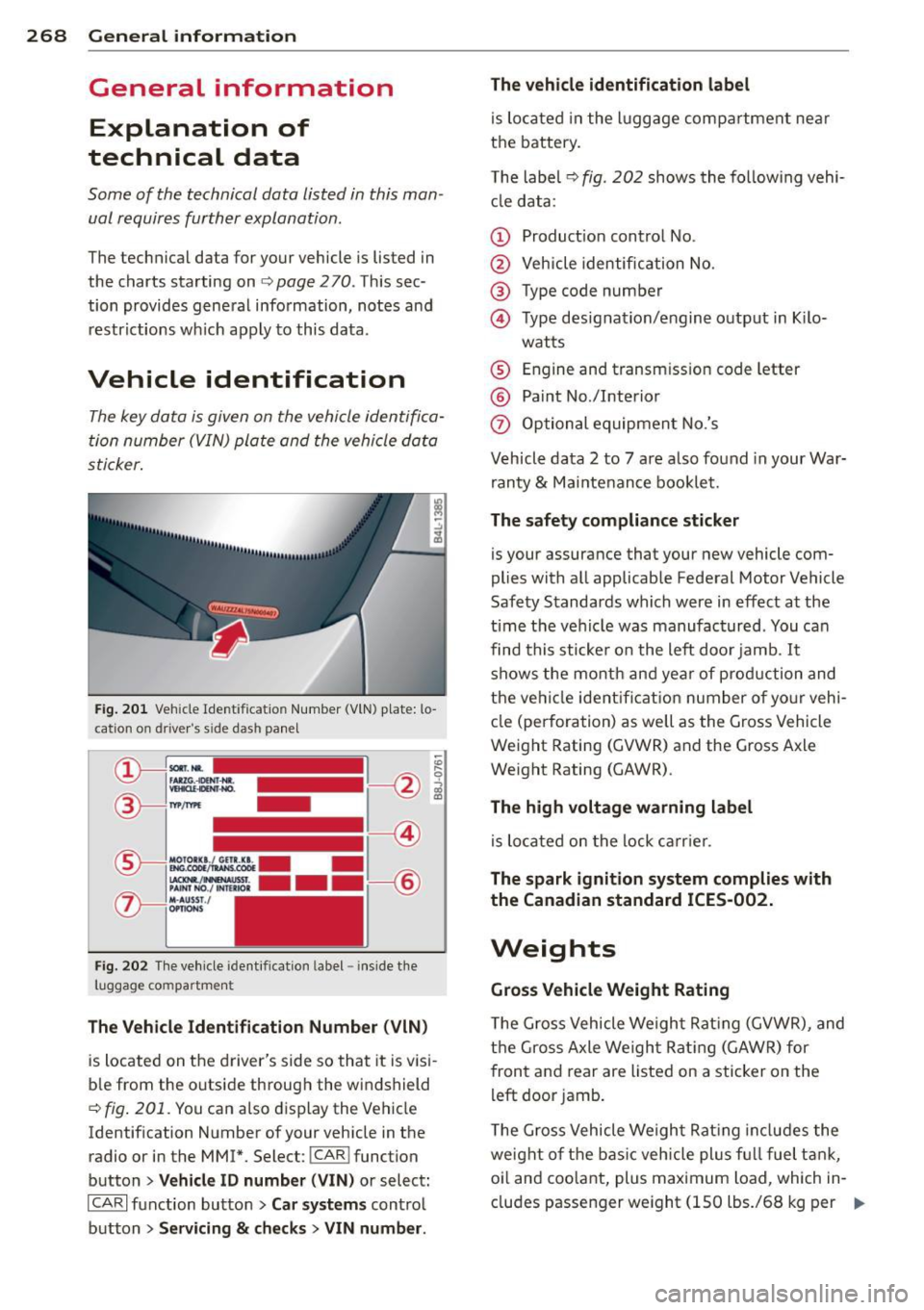
Vehicle identification
The key data is given on the vehicle identifica
tion number (VIN) plate and the vehicle data
sticker.
Fig. 201 Veh icle Ide ntific atio n Number (VlN) p late: lo
cation on driver 's sid e das h panel
Fig. 202 The vehicle identi fication label -inside the
luggage co mpa rtmen t
The Vehicle Identification Number (VIN)
is located on the driver's side so that it is visi
ble from the outside through the windshield
r:::> fig . 201 . You can also display the Vehicle
Identification Number of your vehicle in the
radio or in the MM!*. Select :
!CAR ! function
button
> Vehicle ID number (VIN) or select:
ICARI function button > Car systems control
button
> Servicing & checks > VIN number . The
vehicle identification label
is located in the luggage compartment near
the battery .
The label¢
fig. 202 shows the following vehi
cle data :
(D Production control No .
@ Vehicle identification No.
® Type code number
@ Type designation/engine output in Kilo-
watts
® Engine and transmission code letter
@ Paint No./Interior
(f) Optional equipment No.'s
Vehicle data 2 to 7 are also found in your War
ranty
& Maintenance booklet.
The safety compliance sticker
is you r assurance that your new vehicle com
plies with all applicable Federal Motor Vehicle
Safety Standards which were in effect at the
time the vehicle was manufactured . You can
find this sticker on the left door jamb.
It
shows the month and year of production and
the ve hicle ident ification number of your vehi
cle (perforation) as well as the Gross Vehicle
Weight Rating (GVWR) and the Gross Axle
Weight Rating (GAWR) .
The high voltage warning label
is located on the lock carr ier .
The spark ignition system complies with
the Canadian standard ICES-002.
Weights
Gross Vehicle Weight Rating
The Gross Vehicle Weight Rating (GVWR), and
the Gross Axle Weight Rating (GAWR) for
front and rear are Listed on a sticker on the
left door jamb.
The Gross Vehicle Weight Rating includes the
weight of the basic vehicle plus full fuel tank,
oi l and coolant, plus maximum load, wh ich in
cludes passenger weight (150 lbs./68 kg per
Ill>
Page 276 of 294
274 Con sum er Inf ormation
-Always make sure the transmission se
lector lever (automatic transmiss ion) is
in "P" (Park position) or Neutral (manual
transmission) and the park brake is firm
ly applied.
@) For the s ake of the environment
-Changing the engine settings w ill ad
versely affect emission levels. This is det
rimental to the environment and increas
es fuel consumption .
- Always observe environmental regula
tions when disposing of old engine oil,
used brake fluid, dirty engine coolant,
spent batteries or worn out tires.
- Undeployed airbag modules and preten
s ioners might be classified as Perchlo
rate Material -spec ial handling may ap
ply, see www.dtsc.ca .gov/hazardous
waste/perch lorate. When the veh icle or
parts of the restraint system including
airbag modules safety belts with preten
sioners are scrapped, all app licable laws
and regulations must be observed . Your
authorized Audi dealer is familiar with
these requirements and we recommend
that you have your dealer perform this
serv ice for you .
Additional accessories,
modifications and
parts replacement
Additional accessories and parts
replacement
Always consult on authorized Audi dealer be
fore purchasing accessories.
Your veh icle inco rporates the latest safety de
sign featu res ensuring a high standard of ac
tive and passive safety.
This safety could be compromised by non-ap
proved changes to the veh icle. For this reason ,
if pa rts have to be replaced , please observe
the following points when installing addition
a l accessories: Approved Audi accessories and genuine Audi
parts are available from authorized Audi deal
ers.
T hese dea lers a lso have the necessary facili
ties, tools and trained specialists to install the parts and acc essories proper ly .
A WARNING
-Using the wrong spare parts or using non-
approved accessories can cause damage to
the veh icle and ser ious personal injury.
- Use on ly accessories express ly approved
by Audi and genuine Audi spare parts
- These parts and accessories have been
specially designed to be used on your ve
h icle .
- Never install accessories such as tele
phone crad les or beverage ho lders on a ir
bag covers or within the airbag deploy
ment zones . Do ing so will increase the
risk of injury if a irbags are triggered in an
accident!
- Before you check anything in the engine
compa rtment, always read and heed a ll
WARNINGS
9 page 208 .
(D Note
-If items other than genu ine Audi spare
parts, add-on equipment and accessory
items are used or if repair work is not
performed accord ing to specified meth
ods, this can resu lt in seve re damage to
your vehicle's eng ine and body (such as
corrosion) and adversely affect yo ur vehi
cle's warranty .
- If emergency repairs must be performed
elsewhere, have the vehicle examined by
an authorized Audi dealer as soon as
possible .
- The manufacturer cannot be held liable
for damage wh ich occ urs due to failure
to comply with these stipu lations.
Page 279 of 294
A
Accessories . . . . . . . . . . . . . . . . . . . . 60, 274
AC (automatic climate control) ... .. .. .. 69
adaptive cruise control Vehicles with manual transmission 99
Adaptive cruise control ...... .. .. .. .. .. 97
C leaning sensors/camera ... ... .. .. . 201
Messages .. ................ ... ... 105
Request for driver intervention . . . . . . . 103
Setting the driving program .. .. .. .. . 102
Adaptive dampers .......... .. .. .. .. . 111
Adaptive light ................ ... ... . 44
Adaptive Light (defective) ......... .. .. 22
Adding Engine coolant ........... .. .. .. .. .
Engine oil .. ................ ... .. .
Windshield washer fluid ......... .. .
Additional accessories
Additives 223
220
229
274
Engine oil .. ............. .... .. .. . 220
Adjustable steering column ... ... .. .. .. 72
Adjusting Air distribution (automatic climate con-
trol) . . . . . . . . . . . . . . . . . . . . . . . . . . . . . . 70
I nstrument illumination ... .. .. .. .. .. 47
Steering column .................... 72
Temperature (automatic climate control) 70
Airbag Warning/indicator lights ... .. .. .. .. .. 20
Airbag system . . . . . . . . . . . . . . . . . 144 , 161
Advanced Airbag System ....... ... .. 148
Advanced Airbag System components . 151
Care . .. ... . .... ... ..... ..... .. ... 157
Children . .. ............. .... .. .. . 166
Child restraints ........... .. .. .. ... 167
Components (front airbags) . . . . . . . . . 151
Danger of fitting a child safety seat on
the front passenger seat . . . . . . . . . . . . 145
Disposal . .. .. ........... .. .. .. ... 157
Front airbags . . . . . . . . . . . . . . . . 148, 149
How do the front airbags work? . . . . . . 153
How many airbags does my vehicle
have? 151
How the Advanced Airbag System com-
ponents work together .... .. .. .. .. . 152
Important things to know .. .. .. .. .. . 144
Index 277
Indicator light ..... ............... 155
Monitoring . ... .... ............... 155
PASSENGER AIR BAG OFF light ....... 155
Repairs ... .. .. .. ................. 157
Safety instructions ................. 157
Side airbags ..... .. ............... 159
Side curtain airbags .. .... .. .... .... 162
Weight-sensing mat ............... 166
When must the system be inspected? . 155
all-wheel drive .. .. ................. 189
Alloy wheels .. .... .. ............... 204
All wheel drive Winter tires . .. .. .... ........... .. 245
Anti-free ze
refer to Engine coolant system ... .. .. 222
Anti-lock braking system ............ . 184
Warning/indicator lights ............ . 19
Anti-slip regulation ................. 184
Anti-theft alarm warning system ... .. .. . 32
Anti-theft systems Electronic immobilizer ............... 38
Armrest .. .. .. .. .. .. . ... ...... ... .. . 56
Ashtray ...... .. .. .................. 59
Asterisk What does it mean when something is
marked with an asterisk? . . . . . . . . . . . . . . 6
Audi braking guard
refer to braking guard . ........... .. . 97
Audi drive select . . . . . . . . . . . . . . . . . . . . 111
Adaptive dampers .. .............. . 111
Description . . . . . . . . . . . . . . . . . . . . . . . 111
Dynamic steering . .... ......... .. .. 111
Setting the driving mode ........ .. .. 112
Sport differential . .... ............. 111
Audi Service Repair Manuals and Litera-
ture 272
AU TO
Automatic climate control . . . . . . . . . . . . 70
Automatic headlights . ...... ... .. .. . 44
Auto Lock ... ... .... ................ 32
Automatic belt retractor ............. 139
Automatic car wash
refer to Washing . .. ........... .... 200
Automatic climate control Air vents . . . . . . . . . . . . . . . . . . . . . . . . . . 70
Operation . . . . . . . . . . . . . . . . . . . . . . . . . 69
Setup ........ .. .. . ............... 71
•
•
Page 281 of 294
Checking Engin e coolant leve l .... ... .. .. .. .. . 222
Chec king tire p ressure .. .... .. .. .. .. . 236
Ch ild rest ra ints
Danger of us ing ch ild restra ints in the
front seat . . . . . . . . . . . . . . . . . . . . . . . . 145
Where can I get add it ional information
about ch ild restra ints and thei r use? . . 183
Ch ild rest ra int system anchors . .. .. .. . 179
Ch ild safety . ... .... .... ... .. .. .. ... 165
Convertible locking retracto r .. .. .. .. . 17 5
Important safety instructions fo r using
child safety seats ......... .. .. .. .. . 168
Important things to know when dr iv ing
wi th chi ldren ............ .... .. .. . 165
Instal ling a child restraint us ing t he
L ATC H system ............. ... ... .. 180
M ounting and releasing the ancho rag e
h ook .... .. .. ............. .. .. ... 180
Tet he r anchors ........... .... .. .. . 18 1
Tether straps ..... .... ... .. .. .. ... 181
Ch ild safety locks
P owe r windows . ...... ... .. .. .. .. .. 40
R ear doors ................. ... .. .. 4 0
Ch ild safety seats . . . . . . . . . . . . . . . . . . . 171
Booster seats . . . . . . . . . . . . . . . . . . . . . 173
Convertible ch ild seats .... .. .. .. .. . 172
Convertibl e locking retracto r .. .. . ... . 175
D anger of using c hild restra ints in the
fron t se at . . . . . . . . . . . . . . . . . . . . . . . . 1 45
H ow do I properly ins tall a child safety
seat in my vehicle ? ..... ... .. .. .. .. . 168
Infant seats . ..... .... ... .. .. .. ... 171
Install ing .. ............. .... .. .. . 175
LATCH system . . . . . . . . . . . . . . . . . . . . . 180
Safety instructions . . . . . . . . . . . . . . . . . 168
Unused safety belts on the rear seat 170
Child seats Lower anchorages ........ .. .. .. .. . 180
C igare tte lig hter . . . . . . . . . . . . . . . . . . . . . 59
Clea ning
A lcantara ® (synthetic suede) .. .. . ... . 208
E ng ine compartment .......... ... .. 208
E xhaust tail p ipes ......... .. .. .. .. . 204
Fabr ics and fabr ic coveri ngs .. .. .. .. . 205
I ns trumen t panel ......... .. .. .. .. . 20 6
I n terior .... .. .... .... ... .. .. .. ... 205
L eather .... .. ... ..... ... .. .. .. ... 207
Inde x 279
MMI display/cont ro ls . .. ..... ... .. .. 205
P lastic and vinyl .. .. . ... .... ... .. .. 202
P last ic parts ... .. .. . .. ... .... ... .. 206
Safety be lts . .. .. ................. 208
Tr im strips .. .. .. .... ............. 202
Cleaning and protection ... .... ... .. .. 199
Cl imat e controls ... .. ................ 68
C limate control system
Automat ic recircu lation ......... .... . 71
synchronizing .. .. .... ........... .. . 71
C lock . ... .. .. .... .. . .. .. ..... ... .. . 12
Clos ing
P ower w indows .. .. . .......... .... . 40
S lid ing/ti lting s unroo f .......... .. .. . 42
S unshade ... .. .. .. .. .. ...... ... .. . 42
Clos ing/ope ning
at the lock cy linder .. .............. .. 37
by remo te control ................. . 35
with t he centra l locki ng sw itch ... .. .. . 36
with the conve nien ce key ..... ... .. .. . 36
Cold tire infla tion p ressure . .......... . 234
Coming home ... .... . ... ...... ... .. . 45
Compac t spa re tire . ............. .... 251
also refer to Spa re t ire .......... .. .. 251
Compartments . . . . . . . . . . . . . . . . . . . . . . 62
Compass in the mi rror . .. ..... ... .. .. . 52
Compliance . .. .. .. ............... .. 275
Consumer Information . . . . . . . . . . 134, 272
Contacting NHTSA .... .. ..... ... .. .. 134
Co nvenie nce key
Ind icator lights .. .. . .. ..... ... .... . 76
Star ting engi ne (S TART ENGIN E STO P
button) ... .. .. .. .... ........... .. . 75
S topping the eng ine (S TART ENG INE
STOP b utton) . . . . . . . . . . . . . . . . . . . . . . 76
Switching on ignition . ... .... ... .. .. . 75
u nlocking/locking ............. .... . 36
Convenience opening/clos ing
Convertib le child safety seats
Co nvertib le loc king retractor .....
.. .. . 41
172
Activating ... .. .. .. .. .. .. .... ... .. 177
Deact ivating . .. .. ................. 178
U sing to secure a child safety seat 1.75, 177
Coolant system . ...... .. .. ..... ... .. 222
Cooling mode (automat ic cl imate control) 69
Cooling System Expansion tank . .. .... ........... .. 222
•
•
Page 283 of 294
Engine Compartment ................ .. ... 217
Coolant .. .. ................. .. .. . 222
Hood .... .. ................. .. ... 215
Starting . . . . . . . . . . . . . . . . . . . . . . 72, 75
Starting with jumper cables .. .. . ... . 262
Stopping . . . . . . . . . . . . . . . . . . . . . . 74, 76
Engine compartment Safety instructions ........ .. .. .. .. . 215
Working the engine compartment 215
Engine coolant
Indicator light . . . . . . . . . . . . . . . . . . . . . 18
Engine coolant system ...... .. .. .. .. . 222
Adding coolant ........... .... .. .. . 223
Checking coolant leve l ..... .. .. .. .. . 222
Checking the engine coolant level .. .. . 222
Radiator fan ................ ... ... 224
Engine coolant temperature
Temperatu re gauge ....... .. .. .. .. .. 10
Engine data .. ............. .... .. ... 270
Engine hood Closing . . . . . . . . . . . . . . . . . . . . . . . . . . 215
How to release the hood ... .. .. .. .. . 215
Engine oil ... .. ........... .. .. .. ... 217
Adding .. .. ............. .... .. ... 220
Additives ... ................ ... ... 220
Changing . ................. ... ... 221
Check oil level ........... .. .. .. ... 220
Consumption ............ .... .. .. . 220
Indicator light ........... .. .. .. 17,21
Oil consumption . ............. ... .. 219
Oil grades ................ ... ... .. 217
O il level symbol ............. ... ... . 21
Pressure malfunction ...... .. .. .. .. .. 17
Sensor defective . . . . . . . . . . . . . . . . . . . . 21
Specification and viscosity . . . . . . . . . . . 217
Engine speed limitation ........ .... ... 21
Environment Break-in period ........... .... .. ... 192
Catalytic converter ........ .. .. .. .. . 193
Disposing of your vehicle battery .. .. . 229
Driving at high speeds .......... .... 194
Driving to minimize pollution and noise 194
Fuel ..... .. ................. .. ... 212
Fuel economy . ........... .. .. .. ... 194
Leaks under your vehicle ... .. .. .. .. . 215
Letting the vehicle stand and warm up. 194
Proper disposal of drained brake fluid . 225
Index 281
Proper disposal of drained engine cool-
ant ....... ... .... ............... 223
Proper disposal of drained eng ine
oil . . . . . . . . . . . . . . . . . . . . . . . . . 220, 221
Recycling used engine oil ............ 220
Roof rack . . . . . . . . . . . . . . . . . . . . . . . . . 64
Unleaded fuel .. .. .. . .. .... ........ 210
What should I do with an old battery? . 229
EPC
refer to E lectronic power control . . . . . . 20
ESC (Electronic Stabilization Control)
Warning/indicator lights ............. 19
Ethyl alcohol (Fuel) . . . . . . . . . . . . . . . . . . 211
Event Data Recorder (EDR) ............ 184
Exhaust tail pipes
Cleaning ... ..... .. ............... 204
Expansion tank .. .. .. ............... 222
Exterior lighting . .. ............... .. .
44
Exterior mirrors
Adjusting ..... .... ................ 47
Dimming ... ..... .. ................ 48
Heating ....... .... ................ 47
F
Fan
Radiator 224
Fastening Booster seats .. .. .... ......... .... 173
Convertib le child safety seats .... .. .. 172
Infant seats ..... ................. 171
Flat tire
Chang ing ... .. .... ... .......... .. 252
flexible fuel . .. .. .. .. .. ........... .. 211
Floor mats ... ... .... ............... 131
Fog lights/rear fog light(s) ............. 44
Fo lding the rear seats ............... .. 64
Foot pedals . .. .. .. .. . .............. 131
For the sake of the environment Gasoline fumes and the environment .. 212
Letting the engine warm up . . . . . . 72, 75
Refueling . .. .. .. .. ............... 212
Saving fuel by early upsh ifting ..... .. . 11
Front airbags Description . . . . . . . . . . . . . . . . . . . . . . . 148
How they work ... .. ... ....... .... . 153
Frontal collisions and the laws of physics 137
•
•
Page 284 of 294
282 Index
Front passenger's door emergency locking 3 7
Front seats Adjusting .... ............. .. .... . 128
Ch ild restra ints in the front seat ... ... 145
Fuel Addit ives . .. .......... ...... ... .. . 210
Blended gasoline .......... ... .. ... 210
Consumpt ion .......... .. .. .. .. .. .. 25
Fill er neck .... ........... .. .. .... . 212
Fu el gauge ............ .. .. .. .. .. .. 12
Gasoline ... ............ ... .. .... . 210
Gasoline additives ................ . 211
Low fuel level symbo l . . . . . . . . . . . . . . . 21
Octane rating ............ .. .. .. .. . 210
Recommendation ............. .... . 210
Refuelling .. .......... ...... ... .. . 212
Reserve .... .......... ...... ... .. .. 12
Tank capacity ............. ... .. ... 270
Tank system ........... .. .. .. .. .. .. 21
Un locki ng the f uel filler flap by hand .. 214
Fuel economy messages (eff iciency pro-
gram) ..... .. ................ ... .. .. 29
Fu el filler f lap
Unlocking the fuel filler f lap by hand .. 214
Fu ses
Assignment . . . . . . . . . . . . . 258, 259, 260
Replacing . . . . . . . . . . . . . . . . . . . . . . . . 258
G
Garage door opener (Homel ink) .. .. .. . 121
Garment hooks . . . . . . . . . . . . . . . . . . . . . . 62
Gas discharge lamps ....... ... .. .. .. . 261
Gauges Eng ine coolant temperature .. .. .. .... 10
Fu el gauge .... ........ .......... .. 12
Tachometer . . . . . . . . . . . . . . . . . . . . . . . 11
Gear recommendation ....... ... .. .. .. 28
Gearshift indicator ........... .. .... .. 27
Gearshift lever
6-speed manual transmission . . . . . . . . . 83
General illustration
I nstruments and controls . . . . . . . . . . . . . 8
Generator (warn ing/indicator lights) .... 17
Glossary of tire and load ing terminology 231
Glove compartment ............ .. .... 61
Valet park ing .. .... ...... .. .. .. .. .. 43 GPS
cont rolled clock . .. ...... .... ..... 12
Gross Vehicle Weight Rating (GVWR) ... 268
H
Headlights
Cleaning system . . . . . . . . . . . . . . . . . . . . 50
Defect ive . . . . . . . . . . . . . . . . . . . . . . . . . 21
Headlight range control ........ .... . 22
Left hand drive, right hand drive .. .. .. . 46
T ravel mode ... .. ............ ... .. . 46
Headlight washer reservoir ........ ... 229
Head restraints .... ... ....... ..... .. 130
Adjusting . . . . . . . . . . . . . . . . . . . . 57, 130
Removing/installing ........... .. .. . 57
Heated exterior mirrors . .... ...... ........ . 47
rear window . . . . . . . . . . . . . . . . . . . . . . . 70
seats . .... .... ................... . 70
windshield washer spray no zzles . . . . . . 50
Heating ... ..... .. .. ............ ... . 68
Heavy clothing and safety belts .. .. .. .. 139
High beam .. .... .. ............. .... . 45
High voltage warning label ..... .. .. .. 268
Hill descent control .. .... .... ... .. .. . 93
Homelink (remote control) ......... .. 121
Hood Open ing .. .... .. ............. .... 215
Release lever .. .. ............. .... 215
Horn .. ..... ... .. .. ... ........... ... 8
How are child restraint system anchors re-
l ated to chi ld safety . ............... . 179
How many a irbags does my vehicle have? 151
How often should I check my tire pres-
sures? ........ ... .. .............. . 237
How safety belt pretensioners work . . . . 142
Hydroplaning 241
I
Ignit ion
switching on/off . . . . . . . . . . . . . . . . . . . . 72
Ign ition key
Emergency unlock ing ........... .. .. . 35
Ignition lock .... .. .......... ........ 72
Indicator light ... ..... ...... ...... . 18
Malfunction ..... ... .......... .... . 23