seat adjustment AUDI S4 SEDAN 2013 User Guide
[x] Cancel search | Manufacturer: AUDI, Model Year: 2013, Model line: S4 SEDAN, Model: AUDI S4 SEDAN 2013Pages: 294, PDF Size: 73.71 MB
Page 172 of 294
1 70 Child Safety
range, and as far away from the airbag
as possible before installing the child
restraint.
- Always make sure that nothing pre
vents the front passenger's seat from
being moved to the rearmost position
in its fore and aft adjustment range.
- Always make sure that the backrest is
in the upright position .
- Always buckle the child safety seat firmly
in place even if a child is not sitting in it.
A loose child safety seat can fly around
during a sudden stop or in a collision.
- Always read and heed all WARNINGS
whenever using a child restrained in ave
hicle is being used
c::> page 136, Safety
belts,
c::> page 144, Airbag system and
¢ page 165, Child Safety.
.,&. WARNING
To reduce the risk of serious injury, make
sure that the
PASSENGER AIR BAG OFF
light comes on and stays on whenever a
child restraint is installed on the front pas
senger seat and the ignition is switched
on.
- Take the child restraint off the front pas
senger seat and install it properly at one of the rear seat positions if the
PASSEN
GER AIR BAG OFF
light does not stay on.
- Have the airbag system inspected by
your authorized Audi dealer immediate
ly.
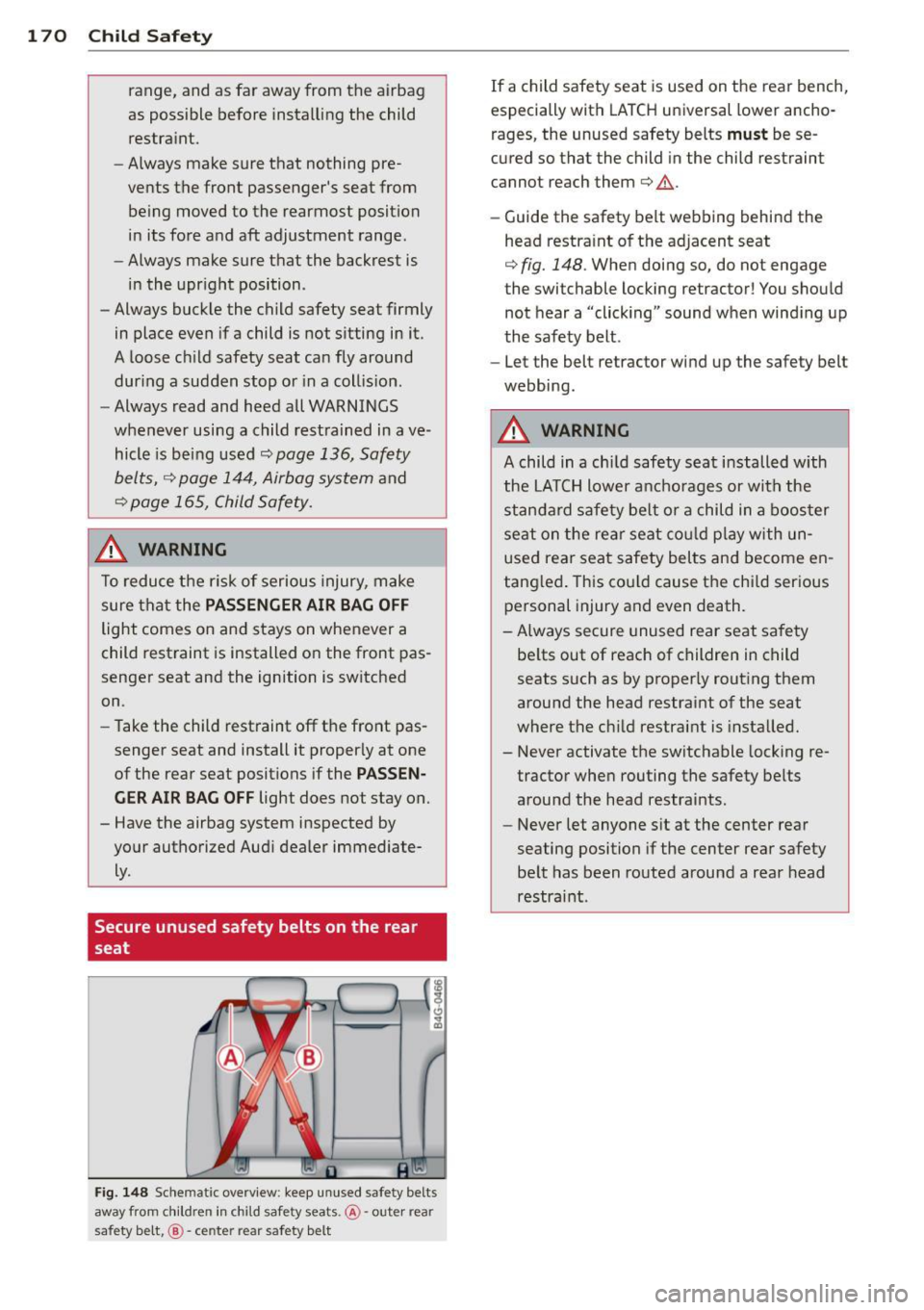
Secure unused safety belts on the rear
seat
Fig. 148 Schematic overview : keep unused safety belts
away from chil dren in child sa fety seats. @· outer rear
safety belt,
®-center rea r safety belt
.
If a child safety seat is used on the rear bench,
especially with LATCH universal lower ancho
rages, the unused safety belts
must be se
cured so that the child in the child restraint
cannot reach them
c::> &.
-Guide the safety belt webbing behind the
head restraint of the adjacent seat
c::> fig. 148 . When doing so, do not engage
the switchable locking retractor! You should not hear a "clicking" sound when winding up
the safety belt .
- Let the belt retractor wind up the safety belt
webbing.
.,&. WARNING
-A child in a child safety seat installed with
the LATCH lower anchorages or with the
standard safety belt or a child in a booster
seat on the rear seat could play with un
used rear seat safety belts and become en
tangled. This could cause the child serious
personal injury and even death.
-Always secure unused rear seat safety belts out of reach of children in child
seats such as by properly routing them
around the head restraint of the seat
where the child restraint is installed.
- Never activate the switchable locking re
tractor when routing the safety belts
around the head restraints.
- Never let anyone sit at the center rear
seating position if the center rear safety
belt has been routed around a rear head
restraint.
Page 175 of 294
to the backrest on the vehicle seat. Ad
just or remove the rear seat head restraint if it is diff icult to install the
child seat w ith the head restraint in place
¢ page 57. Install the head restraint
again immed iate ly once the child seat is
removed. Driving without head rest raints
o r with he ad restraints that are not prop
erly adjusted increases the risk of serious
or fatal neck injury dramatically.
- Always read and heed all WARNINGS
whenever using a child rest rained in ave
hicle is being used
¢page 136, Safety
belts,
¢ page 144, Airbag system and
¢ page 165, Important things to know.
A WARNING
If except ional circumstances requ ire the
use of a forward-facing child restra int on
the front passenger's seat, the ch ild's safe
ty and well-being require that the follow
ing special precautions be taken:
- Make sure the forward-fac ing seat has
been designed and certified by its manu
factur er for use on a front seat with a
passenge r fron t and side airbag.
- Always follow the manufacturer's in
st ruct ions provided with the child sa fety
sea t or infan t carrier.
- Always mov e the front passenge r seat in
to the rearmost posit ion of the passen
ger seat's fore and aft ad justment r ange,
and as far away from the airbag as possi
ble before instal ling the child restraint.
- Always make sure that noth ing prevents
the front passenger's seat from bei ng
moved to the rearmost position in its
fore and aft adjustment range .
- Always make sure the backrest is in an upright position.
- Make su re that the
PASSENGER AIR BAG
OFF
light comes on and stays on all the
time whenever the ignition is switched
on.
- If the light does not stay on, perform the
checks
¢ page 155, Monitoring the Ad
vanced Airbag System.
-
Child S afety 173
- Take the chi ld restraint
off the front pas
senger seat and install it properly at one
of the rear seat positions if the
PASSEN
GER AIR BA G OF F
light does not stay on
whenever the ignit ion is switched on.
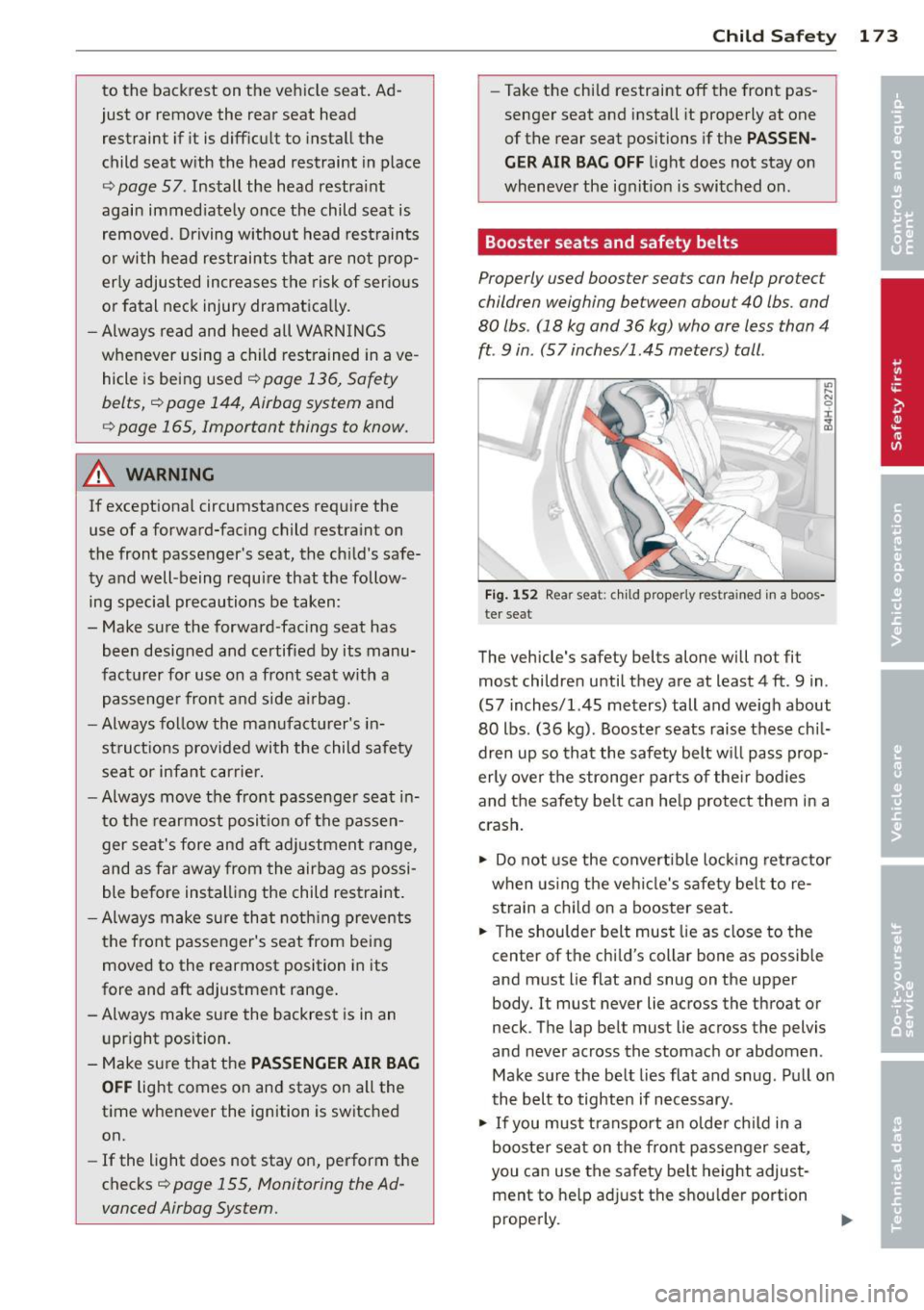
Booster seats and safety belts
Properly used booster seats con help protect
children weighing between about 40 lbs. and
80 lbs . (18 kg and 36 kg) who are less than 4
ft. 9 in . (57 inches/1 .45 meters) tall.
In .... N 0 ±
~
Fig . 152 Rear seat: ch ild properly res trained in a boos
ter seat
The vehicle's safety belts alone will not fit most children until they are at least 4
ft. 9 in .
(57 inches/1.45 me ters) tall and weigh about
80 lbs . (36 kg) . Booster seats raise these chi l
dren up so tha t the safety belt w ill pass p rop
erly over the stronger parts of the ir bodies
and the safety be lt can he lp protect them in a
crash.
.,. Do not use the conver tible locking ret ra ctor
when using the ve hicl e's s afety be lt to re
s train a ch ild on a booster seat.
... The shoulder belt must lie as close to the
center of the ch ild's collar bone as possible
and must lie flat and snug on the upper
body. It must never lie across the throat or
neck . The lap belt must lie across the pelvis
and never across the stomach or abdomen .
Make s ure the belt lies flat and snug. Pull on
th e belt to tighten if necessary.
.,. If you must transport an o lder ch ild in a
booster seat on the front passenger sea t,
you can use the safety be lt height adjust
ment to he lp ad just the shou lder portion
properly.
Page 178 of 294
176 Child Safety
-The inflating airbag will hit the child
safety seat or infant carrier with great
force and will smash the child safety seat and child against the backrest, center
armrest, door or roof.
- Always install rearward-facing child safe
ty seats or infant carriers on the rear
seat.
- Forward-facing child safety seats or in
fant carriers installed on the front pas
senger's seat may interfere with the de
ployment of the airbag and cause serious
injury to the child.
-It is safer to install a forward-facing
child safety seat on the rear seat.
- Always read and heed all WARNINGS
whenever using a child restrained in ave
hicle is being used
¢page 165. Special
precautions apply when installing a child
safety seat on the front passenger seat
¢ page 145, Child restraints on the front
seat -some important things to know.
A WARNING
-
Always take special precautions if you
must install a forward or rearward -facing
child restraint on the front passenger's
seat in exceptional situations:
- Whenever a forward or rearward-facing
child restraint is installed on the front
passenger seat, the
PASSENGER AIR
BAG OFF
light must come on and stay on
whenever the ignition is switched on.
- If the PASSENGER AIR BAG OFF light
does not come on and stay on, perform
the checks described ¢
page 155, Moni
toring the Advanced Airbag System.
- Take the child restraint off the front pas
senger seat and install it properly at one
of the rear seat positions if the
PASSEN
GER AIR BAG OFF
light does not stay on
whenever the ignition is switched on.
- Improper installation of child restraints
can reduce their effectiveness or even
prevent them from providing any protec
tion. -
An improperly installed child restraint
can interfere with the airbag as it de
ploys and seriously injure or even kill the
child .
- Always carefully follow the manufactur
er's instructions provided with the child
safety seat or carrier.
- Never place additional items on the seat
that can increase the total weight regis
tered by the weight-sensing mat and can
cause injury in a crash .
A WARNING
-Forward-facing child restraints:
- Always make sure the forward -facing
seat has been designed and certified by its manufacturer for use on a front seat
with a passenger front and side airbag.
- Never put the forward-facing child re
straint up, against or very near the in
strument panel.
- Always move the passenger seat into its
rearmost position in the seat's fore and
aft adjustment range, as far away from
the airbag as possible before installing
the forward-facing child restraint. The backrest must be adjusted to an upright
position .
-Make sure that the PASSENGER AIR BAG
OFF
light comes on and stays on all the
time whenever the ignition is switched
on .
A WARNING
-
Rearward-facing child restraints:
- A child in a rearward-facing child safety
seat installed on the front passenger
seat will be seriously injured and can be killed if the front airbag inflates -even
with an Advanced Airbag System .
- The inflating airbag will hit the child
safety seat or infant carrier with great
force and will smash the child safety seat and child against the backrest, center
armrest, door or roof.
Page 192 of 294
190 Intelligent technology
will have no warning from a sudden in
crease in engine speed as with a front
wheel drive vehicle. Always drive at speeds wh ich are suited to the road con
ditions -risk of c rash .
Energy management
Starting ability is optimized
Energy management controls the distribution
of electrical energy and thus optimizes the
availability of electrical energy for starting
the engine.
I f a vehicle with a conven tional energy system
i s not d riven for a long period of time , the bat
tery is discharged by idling c urrent consumers
(e .g. immobilizer) . In certain circumstances it
can result in there being insuffic ient energy
avai lab le to start the engine.
I ntelligent energy management in your veh i
cle hand les the distribution of electrical ener
gy . Starting abi lity is marked ly improved and
the life of the battery is extended .
B asically , energy management consists o f
battery diagno sis, idling current manage
ment
and dynami c ene rg y man agement.
Battery diagnosis
Battery d iagnosis con tinuously dete rm ines
the state of the battery. Senso rs determ ine
battery vo ltage, batte ry cur rent and battery
temperature. This determines the current
state of charge and the power of the battery.
Idling current management
I dling c urrent managemen t red uces energy
consumption while the vehicle is stand ing.
With the ignition switched off, it contro ls the
energy s upply to the various e lectrica l compo
nents . Data from battery diagnosis is consid
ered.
D epending on the battery's state of charge,
individual consumers are grad ually turned off
to prevent excess ive d ischarge of the battery
and thus ma inta in start ing cap ability .
Dynamic energy management
While the vehi cle is being driven, dynamic en
ergy management distr ibutes the energy gen
erated according to the needs of the indiv id u
al components.
It regulates consumption, so
that more electrical energy is not being used
t h an is being generated and ensures an opti
mal state of c harge for the battery.
(!) Tips
- But even ene rgy management cannot
negate the limits of physics. Consider
that the power and life of a battery are limited.
- If start ing ability is threatened, the indi
cator light(•] appears¢
page 17 .
What you should know
The highe st priori ty is given to main taining
starting capability.
T he battery is seve re ly taxed in short -d istance
driv ing, in city traff ic and during the cold time
o f year. Abundant electrical energy is re
quired, but on ly a little is generated . It is also
critical if the engi ne is not r unning and electri
ca l components are tu rned on. In this in
sta nce ene rgy is be ing consumed bu t none is
being genera ted .
It is in precisely these s ituations t hat you will
notice ene rgy management active ly regu lat
i ng t he d istribu tion of ene rgy.
Vehicle stands for an extended period
If you do not drive your vehicle over a period
of several days or weeks, e lectr ica l compo
nents a re g radually cut back or sw itched off .
T h is reduces energy consumption and ma in
ta ins s tart ing capability over a longer pe riod .
Some of the convenience func tions may not
opera te, such as the interior ligh ts or the
power seat adjustment. The convenience
functions will be available again wh en you
switch on the ignition and start the eng ine .
Page 228 of 294
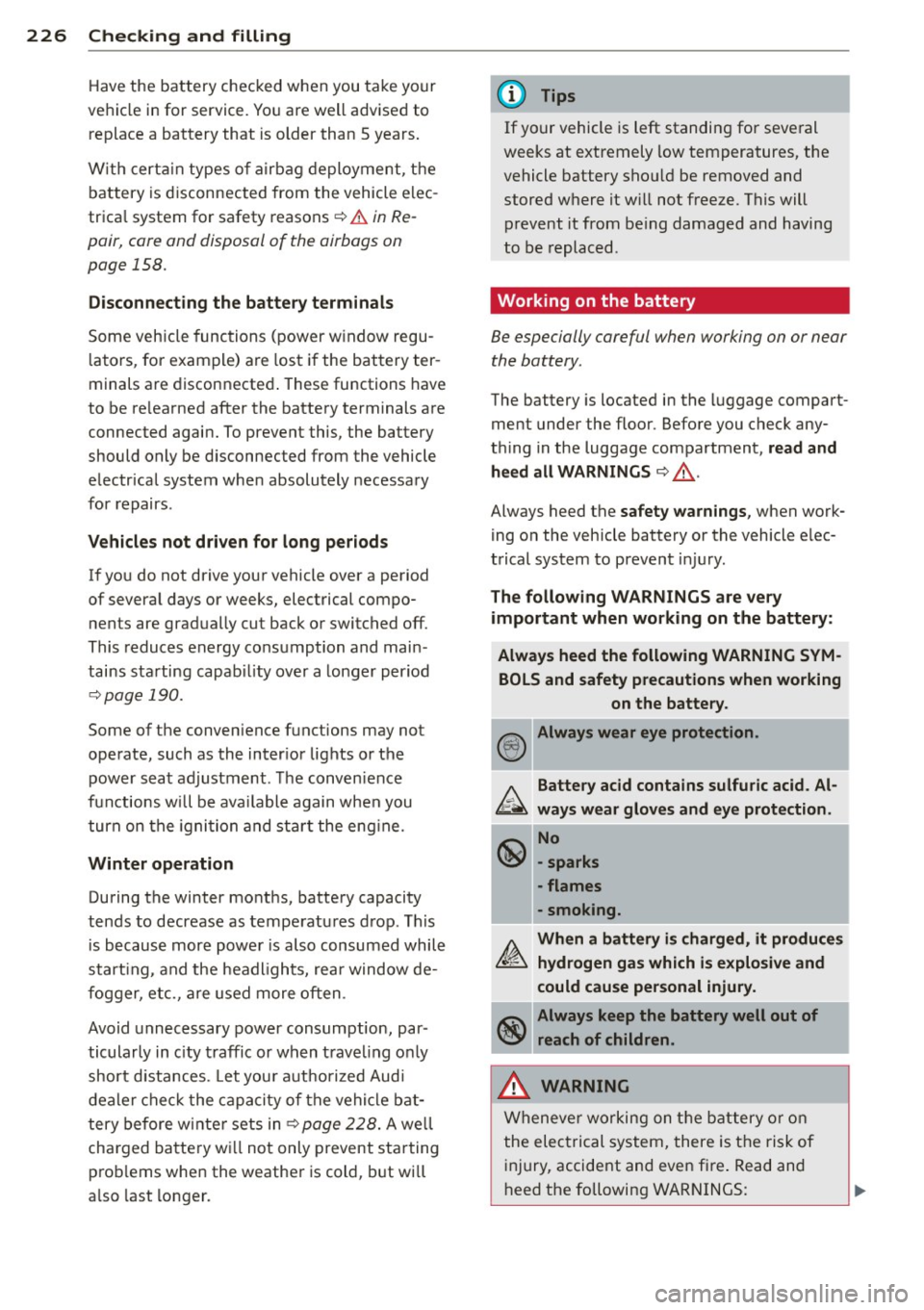
226 Check ing and filling
Have the battery checked when you take your
vehicle in for service. You are well advised to replace a battery that is older than 5 years.
W ith certa in types o f airbag deployment, the
battery is disconnected from the vehicle elec
trica l system for safety reasons¢
& in Re
pair, core and disposal of the airbags on
page 158.
Disconn ect ing the battery terminal s
Some vehicle functions (power window regu
lators, for example) are lost if the battery ter
minals are disconnected . These functions have
to be re learned after the battery terminals are
connected again. To prevent this, the battery
should only be disconnected from the vehicle
electrical system when absolutely necessary
for repairs .
Vehicles not dri ven fo r lo ng p eriod s
If you do not drive your vehicle over a period
of several days or weeks, electrical compo
nents are gradually cut back or switched off.
This reduces energy consumption and main
tains starting capabil ity over a longer period
¢ page 190.
Some of the conven ience functions may not
operate, such as the inter ior lights or the
power seat adjustment. The conven ience
functions will be ava ilable again when you
turn on the ignition and start the eng ine.
Winter operati on
During the winter months, battery capacity
tends to decrease as temperatu res drop . This
is because more power is also consumed while
start ing , and the headlights, rea r window de
fogger, etc., are used more often .
Avoid unnecessary power consumption, par
ticularly in c ity traffic or when traveling on ly
short distances. Let you r authorized Audi
dea ler check the capacity of the vehicle bat
tery before winter sets in
¢ page 228. A well
charged batte ry w ill not only prevent sta rting
prob lems when the weather is cold, but wi ll
a lso last longer.
(D Tips
If your vehicle is left standing for seve ral
weeks at extremely low temperatures, the
vehicle battery sho uld be removed and
stored where it w ill not freeze . This will
prevent it from be ing damaged and having
to be replaced .
Working on the battery
Be especially careful when working on or near
the battery.
The battery is located in the luggage compart
ment under the floor. Before you check any
t hi ng in the luggage compartment,
read and
heed all WARNINGS
¢ ,& .
Always heed the safety warnings , when work
ing on the vehicle battery or the vehicle e lec
trical system to prevent injury.
Th e follo wing WARNINGS are very
important when working on the battery :
Al ways heed the follo wing WARNING SYM
BOLS and safety prec aution s when working
on the battery .
® Always wear eye protection .
,0,. Battery acid contains sulfuric acid . Al
~ way s wear glov es and ey e prot ectio n.
~ No
\!SI -sparks
-flames
-smoking.
A Wh en a battery is charged , it produ ce s
~ hydro gen gas which is e xplosi ve and
c o uld cau se pe rson al injur y.
~ Always keep the battery well out of
'if!:11 reach of children .
_& WARNING
Whenever working on the battery or on
the electrical system, there is the risk of
injury, accident and even fire . Read and
heed the following WARNINGS:
-
Page 287 of 294
-----------------------------~I~ n~d~ e~x 285
Parking system (rear, with rea r view cam
era) Park ing mode 1 ......... ... .. .. .. . 1 18
Park ing mode 2 .......... .... .. ... 119
Safety precautions ........ .. .. .. .. . 116
Sw itching on/off .............. .... 117
Sw itching rear view camera on/off ... . 120
Parts rep lacement . ..... ... .. .. .. .. . 274
P ass-t hrough . . . . . . . . . . . . . . . . . . . . . . . . 66
PASSENGER AIR BAG OFF light . . . . . . . . 155
P assive safety system .... ... .. .. .. .. . 126
P eda ls .. .. ... ...... ............. .. 13 1
Phys ica l pr inc iples of a frontal coll is ion . 137
P olishing .. .. ............. .. .. .. .. . 20 1
Pollutant filter (automatic AC system) . .. 68
Powe r
seat adjustment . . . . . . . . . . . . . . . . . . . . 56
P ower locking sys tem ....... .. .. .. .. .. 3 2
E mergency locking . . . . . . . . . . . . . . . . . . 3 7
Power windows ... .... ... .. .. .. .... 41
Rear lid .... .... .. .... ... .. .. .. .... 39
Selective unlock feat ure ... .. .. .. .. .. 37
Sett ings . .. ............. .... .. .... 37
Sliding/tilting sunroof ..... .. .. .. .. .. 41
P owe r steering
refer to Electro-mechanical power as
sist
. .. ... . .... ............. .. .. .
Powe r window 188
Conven ien ce opening/ closing . .. .. .. .. 41
Powe r windows ......... ...... .... ... 40
C hi ld safety locks ............ .... ... 40
M alf unct io ns ............ .... .. .. .. 42
Pregnant women Special cons iderations when weari ng a
safety belt . . . . . . . . . . . . . . . . . . . . . . . 141
Proper occupa nt seating positions .. .. . 127
P rope r safe ty belt pos it ion ... .. .. .. .. . 14 0
Proper seat ing pos ition
Front passenger . ............. ... .. 128
Occupa nts ..... ........... ... ... .. 127
Rear passengers ............... .... 129
Q
Quartz clock ............... ... ... ... 12
quattro ®
refer to all-whee l dr ive
189 Question
What happens to unbe lted occupants? 137
Why safety belts? . . . . . . . . . . . . . . . . . 136
R
Radiator fan 224
Rain/ light sensor
H ead ligh ts .. .. .. ................. . 44
Inte rmit ten t (w indshie ld w ipers) . .. .. . SO
Senso r defec tive . . . . . . . . . . . . . . . . . . . . 22
Read ing lights . .. .... ... ....... ...... 47
Rear door su n shade . .. ... .... ... .. .. . 49
Rea r fog lights .. .. ................. . 44
Rear lid
Emergency re lease .. .............. .. 39
E scape handle ... .. . .. .. .. ... ... .. . 40
Open ing and closing ... ..... ... .... . 39
Rear light
Defective . . . . . . . . . . . . . . . . . . . . . . . . . 21
Rea r view came ra
118
119
Pa
rking mode 1
Parking mode 2
Rea r view m irror
· · · · · .. ......... .. .. . 48
Rear window heat ing 70
Rear window sun shade .. ..... ... .. .. . 49
Recircu lation mode (automat ic cl imat e
control) . . . . . . . . . . . . . . . . . . . . . . . . . . . . 69
Refuel ling .. .. .. .. ................. 212
Re lease lever for hood
Remote control 215
Homel in k ... .. .. ................. 121
Remote contro l key. . . . . . . . . . . . . . . . . . . 33
Pe rsonalizing .. .. .. . .. .. ..... ... .. . 33
unlocking/locking .. .............. .. 35
Remote rear lid re lease .. ..... ... .. .. . 39
Repair ma nuals .. .. ... ............ .. 272
Repairs Airbag system ... .. . .. .. .. ... ... .. 157
Rep lacement key .... . .. ..... ... .. .. . 33
Rep lac ing
Windsh ie ld wiper b lades ........ ..... 51
Rep lacing bu lbs . .. ................. 261
Rep lacing tires and wheels ..... ... .. . .
Repo rting Saf ety Defects ............ .
Reset button
. ... .. .. . ...............
Retr actor ... .. .. .. .. .. ........... ..
242
134
12
139
•
•
Page 288 of 294
286 Index
Reverse gear S tronic transmission . ... .. .. ... ... .. 90
R ight hand d rive ........... .... .... .. 46
R ims
Cast alloy .. ... . ...... ... .. .. .. .. . 204
Roof rac k . . . . . . . . . . . . . . . . . . . . . . . . . . . 63
Roof load . . . . . . . . . . . . . . . . . . . . . . . . . 64
Roof weight . . . . . . . . . . . . . . . . . . . . . . . 64
s
SA FE ..... .. ... .. ..... ... .. .. .... .. 12
Safe driving hab its ...... ... .. .. .. .. . 126
Safety belt position . . . . . . . . . . . . . . . . . 140
Safety belt he ight adjustment .. .... . 142
Safety belts worn by pregnant women . 141
Safety belt pretensioner ... .. .. .. .... . 142
Service and disposal . . . . . . . . . . . . . . . 143
Safety belts .... ........... .. .. .... . 139
C leaning . .. ............. .... .. .. . 208
D anger to passengers who do not wea r a
safety be lt . . . . . . . . . . . . . . . . . . . . . . . 13 7
Fastening .... ........... .. .. .... . 139
Height adjustment ........ .. .. .. .. . 142
Improperly worn . . . . . . . . . . . . . . . . . . 142
Not worn .. .................. .... 137
Safety belt position ........ ... .. .. . 140
Safety instructions . . . . . . . . . . . . . . . . . 139
Secur ing c hild safety sea ts . .. .. .. ... 175
Speci al consider ations fo r pregnant
women . ... .. .. ...... ... .. .. .... . 141
Unfasten ing . .. .. ..... ... .. .. .... . 141
Warning/ indicato r light . ... .. .. .. .. . 136
Warn ing light . ........... .. .. .... .. 17
WhyYOU M USTwearthem . .. .. .. ... 136
Worn properly ............. .. .... . 138
Safety belt warning light . ... .. .. .... . 13 6
Safety compliance st icker . ...... .. .. . 268
Safety equipment ............ .. .... . 126
Safety fe atures for o ccup ant restra int and
p rotec tion ... ... .. ..... ... .. .. .... . 12 6
Safety guidel ines
Seats .. .. .. ........ ..... .. ........ S4
Safety instructions Eng ine compartment ...... .. .. .. .. . 215
for side curtain a irbags .. .. .. .. .. .. . 164
for us ing chi ld safety seats ..... .. ... 168 f
o r using sa fe ty belts . .. ..... ... .. .. 139
Monito ring the Advanced Airbag Sys-
tem . ... .. .. .. .. .. ... .. ..... ... .. 157
Seat adjustment He ad restra ints .. ............. .... 130
Seat belts
refer to Safety belts ............... . 136
Seat heating ...... ............. .... . 70
Se ating c apac ity . .. ... .......... .. .. 136
Seating pos ition
D rive r ... ... .. .. .. ... ... ... .. .. .. 127
Front passeng er .. .......... ...... . 128
How to ad just the fron t seats .. .. .. .. 1 28
Incor re ct sea t position .......... .. .. 130
Occ upan ts ..... .. ... .. ..... ... .. .. 12 7
Rear passengers . .... .. ..... .... . .. 129
Seat memory . . . . . . . . . . . . . . . . . . . . . . . 58
Seats Adjusting . . . . . . . . . . . . . . . . . . . . . 5S, 56
Driver's seat . . . . . . . . . . . . . . . . . . . . . . . 54
Folding ....... .. .. ... ....... ... .. . 64
Front passenger's seat . . . . . . . . . . . . . . . 5S
Head restra ints .. ... .......... .. .. . 57
N umber of sea ts . ............. .. .. 136
Sa fe ty g uid elines ................ .. . 54
Se lective unlock feature . . . . . . . . . . . . . . . 3 7
Se lector lever ..... .. ... ..... ... .. .. . 8S
Emergency re lease . . . . . . . . . . . . . . 89, 9S
Se lector lever d isp lay . ........... .. .. . 90
Se lector lever emergency release ...... . 9S
Se rvice and disposa l
Safety be lt pretensioner . . . . . . . . . . . . 143
Se rv ice interv al d is play . . . . . . . . . . . . . . . . 29
SET button . . . . . . . . . . . . . . . . . . . . . . . . . 11
S hi ft indicato r (efficiency program) ... .. . 28
S ide a irbags
Des cription ...... ............. .... 159
How they wor k ... ............. .... 161
s ide ass ist
Adjus ting the b rightness . ........... 109
Senso r range .. .. ................ . 108
S ide assist
Activati ng and deactivating .... .. .. .. 109
Cleaning sensors .... .. .. ... ..... .. 201
Desc ription .. .. .. .......... ... ... . 107