change wheel AUDI S5 COUPE 2016 User Guide
[x] Cancel search | Manufacturer: AUDI, Model Year: 2016, Model line: S5 COUPE, Model: AUDI S5 COUPE 2016Pages: 264, PDF Size: 66.92 MB
Page 185 of 264
Trailer mode notes
Important to know
Your vehicle handles different ly when tow ing a
trailer because of the additional weight and d if
ferent weight distr ibution. Safety, perfo rmance
and economy will greatly depend on how careful
ly you load your trailer and operate your rig .
Before you actually tow your trailer, practice
turning, stopping and backing up in an area away
from traffic. Keep practicing until you have be
come completely familiar with the way your vehi
cle-trailer combination behaves and responds.
Backing up is difficult and requires pract ice.
Backing up with a trailer generally requires steer
ing action opposite to that when backing up your
vehicle without a trailer.
Maintain a greater distance between your vehicle
and the one in front of you. You will need more
room to stop. To compensate for the trailer, you
will need a larger than normal turning radius.
When pass ing, remember that you cannot accel
erate as fast as you normally would because of
the added load. Make sure you have enough room
to pass. After passing, allow plenty of room for
your trai ler before changing lanes again.
Avoid jerky starts, sharp turns or rapid lane
changes.
(D Tips
- Do not tow a trailer during the break-in peri
od of your vehicle.
- If you tow a trailer, your Audi may require
more frequent maintenance due to the ex
tra load
c::> page 244.
Parking on a slope
Do not pork on a slope with a trailer. If it cannot
be avoided, do so only ofter doing the following:
When parking:
;::; .. Apply the foot brake.
0 ~ .. Have someone place chocks under both the ve-
~ hicle and the trailer wheels. Lil ,...., v:, ,....,
Trailer mode
.. With chocks in place, slowly release the brakes
until the wheel chocks absorb the load.
.. Turn the wheels towards the curb .
.. Apply the parking brake.
.. Place an automatic transmission* in P, respec
tively a manual transmission in first or reverse
gear .
When restarting after parking:
.. App ly the foot brake.
.. Start the engine .
.. Move the selector lever to D/S, respectively a
manual transmission in first gear .
.. Release the parking brake and slowly pull out
and away from the wheel chocks.
.. Stop and have someone retrieve the wheel
chocks.
(D Tips
If you move the selector leve r of the automat
ic transmission* to P before applying the
parking brake and before blocking the wheels,
you may have to use more force later to move
the lever out of the P position.
183
Page 212 of 264
Wheels
"XL" "xl" "EXTRA LOAD" or "RF" I I I
on the sidewall.
Rim
means a metal support for a tire
or a tire and tube assembly upon
which the tire beads are seated.
Rim diameter
means nominal diameter of the
bead seat . If you change your
wheel size, you w ill have to p ur
chase new tires to match the new rim diameter .
Rim size designation
means rim diameter and width.
Rim width
means nomina l distance between
rim flanges.
S idewall
means that portion of a tire be
tween the tread and bead .
Speed rating (letter code)
means the speed at which a tire is
designed to be driven for extend
ed periods of time. The rat ings
range from 93 mph (150 km/h)
to 186 mph (298 km/h)
¢ table
on page 206 .
You may not find
this information on all tires be
cause it is not requ ired by law.
2 10
The speed rating letter code,
where applicable, is molded on
the tire sidewall and ind icates the
maximum permissible road
speeds
¢ .&. in Winter tires on
page 220.
Tire pressure monitoring system*
means a system that detects
when one or mo re of a vehicle's
tires are underinflated and illum i
na tes a low tire pressure warning
te lltale .
Tread
means that portion of a tire that
comes into contact w ith the road .
Tread separation
means pulling away o f the tread
from the t ire carcass .
Treadwear indicators (TWI)
means the projections within the
principal grooves designed to give
a visua l indication of the deg rees
of wear of the tread. Se e
¢ page 214, Treadwear indicator
for more information on measur-
ing tire wear. .,.
Page 218 of 264
Wheels
the risk of an accident. Read and follow the important safe
ty precautions in r=:> page 217,
Tires and vehicle load limits.
-The tire must flex more if the tire pressure is too low or if
the vehicle speed or load are
too high. This heats the tire up
too much. This increases the
risk of an accident because it
can cause the tire to burst and
result in loss of vehicle con
trol.
- Incorrect tire pressure in
creases tire wear and has a
negative effect on driving and
Tire pressure table
Please note that the information
contained in the following table
was correct at the time of print
ing, and the information is sub
ject to change. If there are differ ences between this information
and the tire pressures specified
on the label on the driver's side 8-pillar, always follow the specifica
t ion on the 8-pillar label
r=:> page215, fig.169.
216
braking behavior, which in
creases the risk of an accident.
(D Note
Replace lost valve caps to re
duce the risk of damage to the
tire valves.
@ For the sake of the environment
Tire pressure that is too low in
creases fuel consumption.
(D Tips
Audi recommends using the
tire pressure specified for a normal load
r=:> page 216 or for
a full load when the vehicle is
part ially loaded .
Make sure that the tire designa
tion on your tire matches the des ignation on the tire pressure label
and the tire pressure table.
The following table lists recom mended tire pressures in cold
tires according to the load and the size of the tires installed.
Page 225 of 264
.... N
0 Ico ....
them to the proper pressure. Driving on a signifi
cantly under-inflated tire causes the tire to over
heat and can lead to t ire failure. Under-inflation
a lso reduces fuel efficiency and tire tread life,
and may affect the vehicle 's handling and stop
p ing ability .
Please note that the TPMS is not a substitute for
proper tire maintenance, and it is the driver's re
sponsib ility to ma intain correct tire pressure,
even if under-inflation has not reached the level
to tr igger illum inat ion of the TPMS low tire p res
sure telltale.
Your veh icle has also bee n eq uipped w ith a TPMS
malfunct ion indicator to indicate when the sys
tem is not operat ing properly . The TPMS ma l
function ind icator is combined w ith the low tire
p ressure tellta le. Whe n the system detects a
malfunct ion, the te lltale will flash fo r approx i
mately one mi nute and then remain continuo usly
illuminated. This sequence will continue upon
subseq uent veh icle start-ups as long as the ma l
function ex ists .
When t he malfunction indicator is ill uminated,
the system may not be ab le to detect or signal
l ow tire press ure as intended. TPMS ma lf u nctions
may occur for a var iety of reasons, including the
installation of replacement or alternate t ires or
wheels on the vehicle that prevent the TPMS
from functioning properly . Always c heck the
TPMS malfunction telltale afte r rep lacing one o r
mo re t ires o r whee ls on your ve hicl e to e nsur e
th at t he replacement or al tern ate tir es and
wheels a llow the TPMS to con tinue to function
p roperly .
Wheel s
If the Tire Pressure Monitoring System
indicator appears
Applies to vehicles: with tire pressure monitor ing system
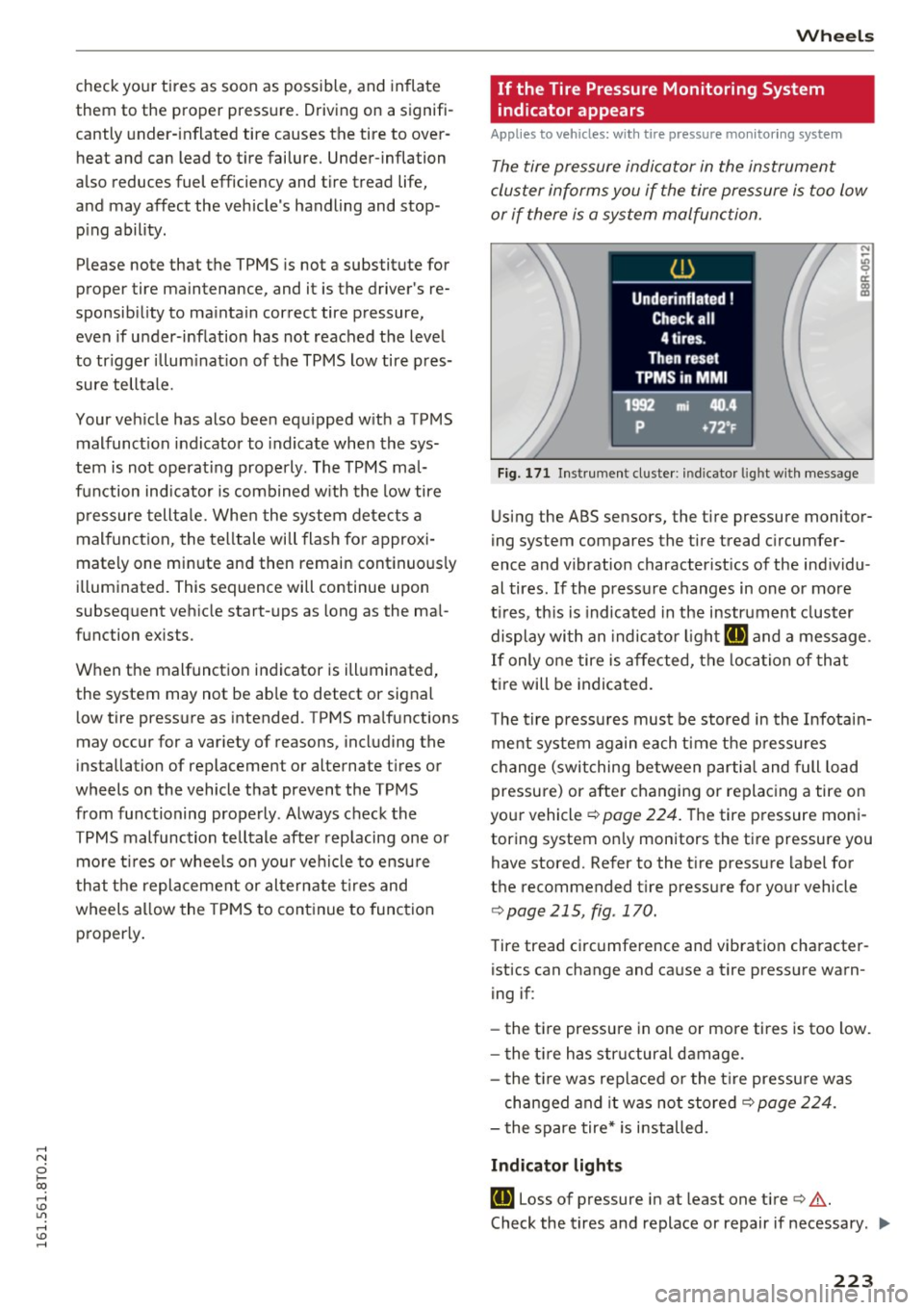
The tire pressure indicator in th e instrument
cluster informs you if the tire pressure is too low
or if there is a sys tem malfunction.
Fi g. 17 1 Instrumen t cl uster: indicator lig ht w ith mess age
U sing the ABS sensors, the t ire pressure monito r
ing system compares the tire tread c ircumfer
ence and v ibration characterist ics of the ind iv idu
al tires. If the press ure changes in one or more
t ir es, th is is indicated in the instrument cluster
display with an indica to r li ght
HE and a message.
If only one tire is affected, the loc ation of tha t
t ir e will be indicated.
T he t ire press ures mus t be stored in the Infota in
me nt system again each time t he pr essures
c h ange (switching between parti al and full load
pressure) or afte r changing or replac ing a tire on
yo ur vehicle ¢
page 224 . The tire p ressure moni
toring system on ly monitors the tire pressure you
have stored. Re fer to the t ire pressure label for
the recommended t ire pressure for yo ur vehicle
r=> page 215, fig . 170.
T ire tread c irc umference and vibration character
istics can change and ca use a tire press ure warn
ing if :
- the tire pressure in one or more tires is too low.
- t he t ire h as str uctural damage.
- t he t ire w as re pla ce d or the t ire pressu re was
ch anged and it was no t stored ¢
page 224 .
- the spare tire* is i nstalled .
Indicator lights
HE Loss of pressure in at least one tire¢.& .
Check the tires and replace or repair if necessary .
IJJ,,
223
Page 226 of 264
Wheels
Check/correc t the p ress ures o f all four tires and
store the pressure again in the Infotainment sys
tem
¢ page 224.
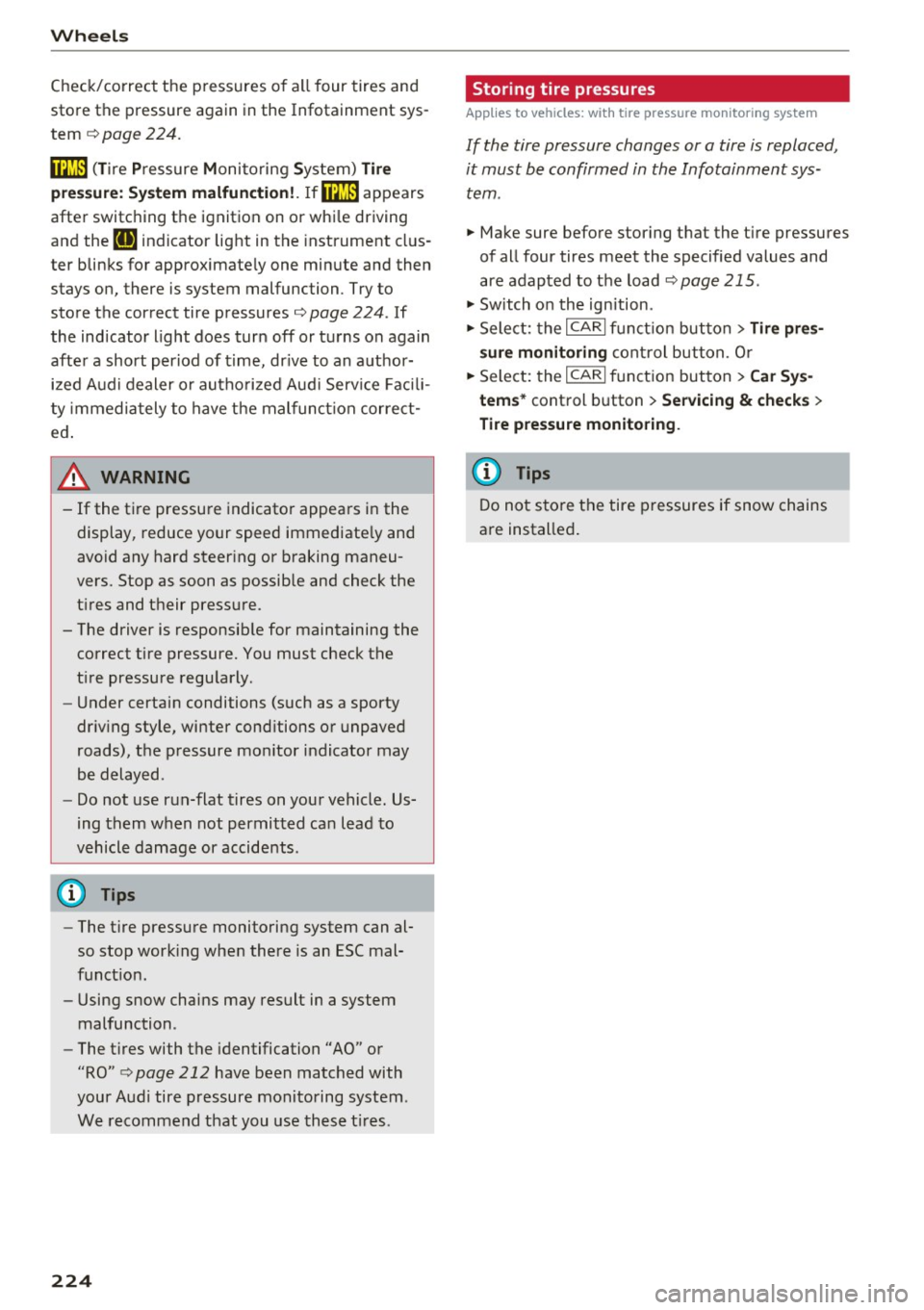
mm (Ti re Pressure Moni to ring System) Tire
pressure: S ystem malfunction !.
Ifm:im appears
after switc hing the ignition on or whi le driving
and the
RI] i ndicator light in the instrument cl us
ter blinks for approximate ly one minute and then
stays on, there is system malfunction. Try to
store the correct tire pressures¢
page 224 . If
the ind icator light does tur n off or turns on again
after a short period of t ime, dr ive to an a uthor
ized Audi dealer o r autho rized Aud i Service Faci li
ty immedia tely to have the malfunct ion corre ct
ed .
A WARNING
- If the ti re pressu re indicator appears in the
display, reduce your speed immediate ly and
avoid any hard steering or braking maneu
vers. Stop as soon as possib le and check the
t ires and t heir pressure.
- The driver is responsib le for maintaining the
correct tire pressure. You must check the
t ire pressure regu larly .
- Under certain conditions (such as a sporty
dr iv ing style, winter cond itions or unpaved
roads), the pressure mon itor indicator may
be delayed.
- Do not use run-flat tires on your vehicle. Us
ing them when not permitted can lead to
vehicle damage or accidents.
(D Tips
- The t ire pressure monitoring system can al
so stop work ing when there is an ESC mal
funct ion.
- Using snow chains may result in a system
malfunction.
- The t ires with the identification "AO" or
"RO" ¢
page 212 have been matched with
your Audi tire pressure monitoring system .
We recommend that you use these t ires.
224
· Storing tire pressures
Applies to vehicles: with tire pressure mo nitoring system
If the tire pressure changes or a tire is replaced,
it must be confirmed in the Infotainment sys
tem .
.,. Make sure before stor ing that the t ire pressures
of all four tires meet the specified values and
are adapted to the load
¢ page 215.
.,. Sw itch on the ign ition .
.,. Sele ct: the
I CARI fu nct ion button > Tire pres·
s ure monitoring
cont rol button. O r
.,. Select: the
I CAR I fun ct ion but ton > Car Sys
tem s*
control b utton > Serv icing & checks >
Tire pressure mon itoring .
(D Tips
Do not store the tire pressures if snow chains
are installed .
Page 229 of 264
.... N
0 Ico ....
place away from the vehicle and well away
from the road and traffic.
- To help prevent the vehicle from moving
suddenly and possibly slipping off the jack,
always fully set the parking brake and block
the wheel diagonally opposite the wheel be
ing changed with the folding chocks or oth
er objects. When one front wheel is lifted
off the g round, plac ing the Automatic
T ransmission in "P" (Park) will
not prevent
the vehicle from moving .
- Before you change a wheel, be su re t he
ground is level and firm. If necessary, use a
stu rdy board under the jack.
- Always sto re the veh icle tool k it, the jac k*
and the replaced tire in the luggage com
partment ¢
page 118 .
(1) Note
If you are cha nging the whee l on a steep in
cline, use a rock or similar objec t to block the
opposi te whee l to prevent the veh icle from
moving.
@ Tips
Obey all laws .
Changing a wheel
When you change a wheel, follow the sequence
described below step-by-step and in exactly that
order.
1. Remove the deco rative wheel cover * or the
whe el bolt cap s*. For more deta ils see also
¢ page 228, Decorative wheel covers or
¢ page 228, Wh eels with wh eel bolt caps.
2. Loosen the wheel bol ts ¢ page 228.
3 . Locate the proper mounting point for the
jack and align the jack below that point
¢ page 229.
4. Lift the car with the jack¢ page 229.
5 . Remove the
whe el with the flat tir e and then
insta ll the
s pare tire ¢ page 230 .
6. Tighten all wheel bo lts lightly.
7 .
Low er th e ve hicle w it h the ja ck .
Em ergenc y ass is tanc e
8. Use the wheel bolt wrench and firmly tighten
all wheel bo lts in a crisscross pattern
¢ page 228.
9. Replace the deco rati ve w heel co ver* or the
wheel bolt caps* .
A WARNING
Always read and follow all WARNINGS and in
fo rmation
¢ .&. in Raising the vehicle on
page229and ¢page 231.
After changing a wheel
A wheel change is not complete without the do
ing the following .
.,. Always store the vehicle too l kit, the jack*, and
the replaced tire in the luggage compartment
¢ page 118 .
.,. Check the tire pres sure of the spare tire as soon
as poss ible.
.,. As soon as poss ib le, have the
tigh tening tor
qu es
on a ll wheel bolts checked with a torque
w rench. The correct tightening torque is
90 ft
lbs.
(120 Nm) .
.,. Hav e the flat tire
repl aced as soon as possible .
(D Tips
-If you notice that the wheel bo lts are co r
roded and difficult to turn while changing a
tire, they shou ld be replaced before you
check the tightening torque.
- Drive at reduced speed unti l yo u have the
tightening torques checked.
227
Page 231 of 264
,-1 N
0 1-CX)
,-1 I.Cl U"I
,-1 I.Cl ......
-If a whee l bolt is very tight, you may find it
easier to loosen by carefully pushing down
on the end of the wheel bo lt wrench with
one foot only. As you do so, hold on to the
car to keep your balance and take care not
to slip.
Raising the vehicle
The vehicle must be li~ed with the jack first be
fore the wheel can be removed .
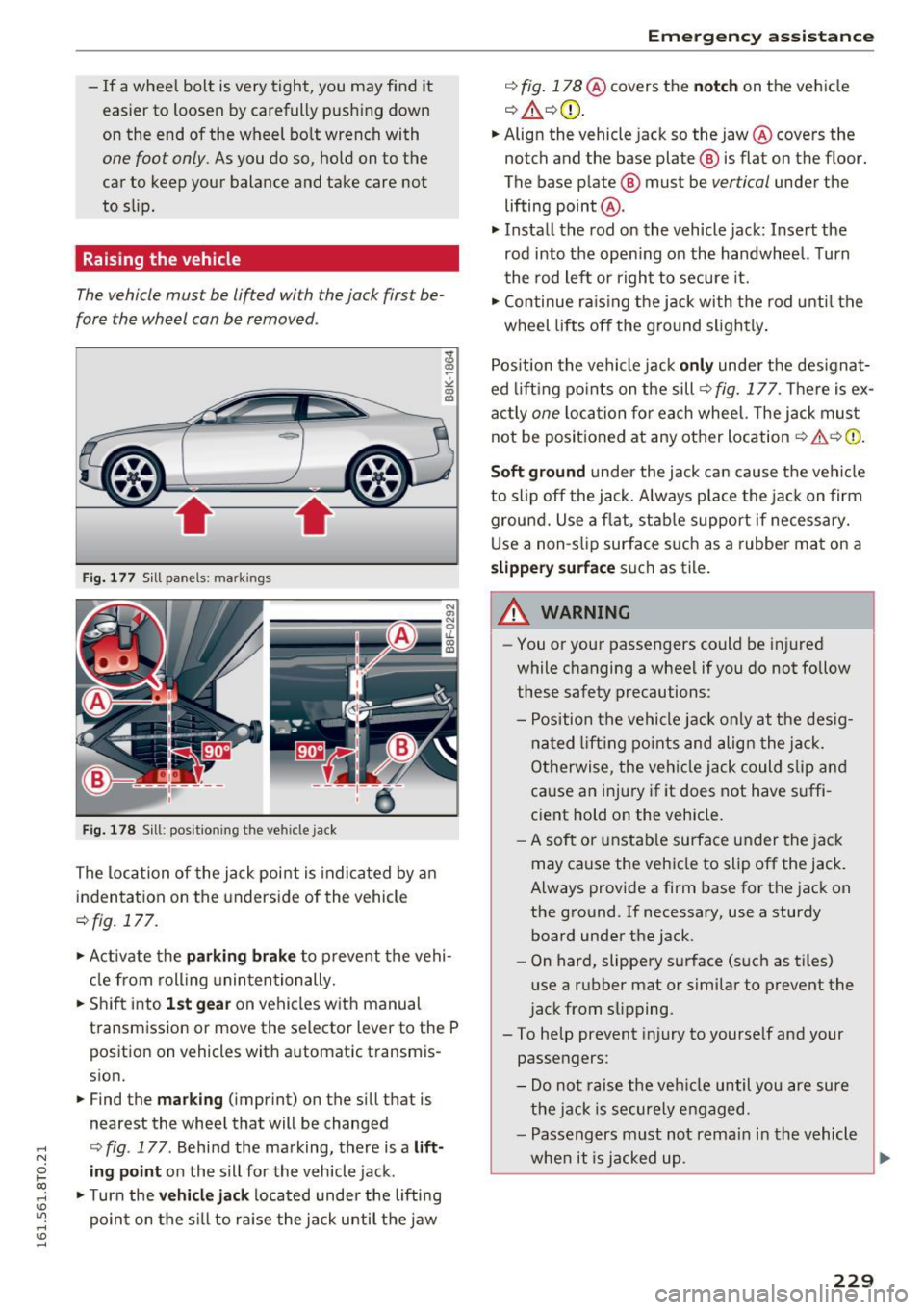
Fig. 177 Sill pane ls: mark ing s
Fig. 178 Sill: po sit ion in g the ve hicle jack
The location of the jack point is indicated by an
indentation on the underside of the vehicle
~ fig . 177 .
.,. Activate the parkin g brak e to prevent the vehi
cl e from roll ing unintentionally.
.,. Shift into
1st g ear on vehicles with manual
t ransm ission or
move the selector lever to the P
position on v ehicles with automatic transmis
sion.
.,. Find the
ma rki ng (imprint) on the sill that is
nearest the wheel that will be changed
~ fig . 177 . Behind the marking, there is a lift
ing point
on the sill for the vehicle jack .
.,. Turn the
vehi cle jack located under the lifting
po in t on the s ill to ra ise the jack until the jaw
Em ergen cy a ssis tanc e
~ fig. 178 @covers the notch on the ve hicle
~ A ~0 .
.,. Align the vehicle jack so the jaw@ covers the
notch and the base pla te ® is flat on the floor.
The base p late ® must be
vertical under the
lifting point @.
.,. Install the rod on the vehicle jack: Insert the
rod into the open ing o n the handwheel. Turn
the rod left or righ t to secu re it.
.,. Continue ra is ing the jack wi th the rod unti l the
wheel lifts off the ground slight ly .
Pos ition the vehicle jack
only unde r the des ignat
ed lift ing po ints on the sill
c:!> fig. 177 . There is ex
act ly
one l oca tion for each wheel. The jack must
not be positioned at any other location
c:!> &,. c:!>(D .
Soft ground under the jack ca n cause t he vehicle
to slip off the jack. A lways p lace the ja ck on firm
ground. Use a f lat, stab le support if necessary.
Use a non-s lip surface s uch as a rubbe r mat on a
slipper y surfa ce such as tile .
A WARNING
-
-You o r your passengers could be in jured
while changing a wheel if you do not follow
these safety precautions :
- Position the vehicle jack only at the des ig
na ted lift ing po ints and alig n the jack.
Otherwise, the veh icle jack could slip and
cause an injury if it does not have suffi
cient hold on the vehicle.
- A soft or unstab le surface under the jac k
may cause the vehicle to slip off the jack.
Always provide a firm base for the jack on
the ground. If necessary, use a sturdy board under the jack .
- On hard, slippery surface (s uch as tiles)
use a rubber mat or similar to prevent the
j ack from slipping.
- To help prevent in jury to yourse lf and your
passengers:
- Do not raise the ve hicle until you are sure
the jack is securely engaged.
- Passengers must not remai n in the vehicle
whe n it is jacked up .
~
229
Page 233 of 264
.... N
0 I-co ....
screwdriver handle to loosen or tighten the
wheel bolts.
Tires with unidirectional tread design
Tires with unidirectional tread design must be
mounted with their tread pattern pointed in the
right direction.
Using a spare tire with a tread pattern
intended for use in a specific direction
When using a spare tire with a tread pattern in
tended for use in a specific direction, please note
the following:
- The direction of rotation is marked by an
arrow
on the side of the tire.
-If the spare tire has to be installed in the incor
rect direction, use the spare tire only tempora
rily since the tire w ill not be ab le to achieve its
opt imum performance character istics with re
gard to aquaplaning, noise and wear.
- We recommend that you pay particular atten
t ion to this fact during wet weather and that
you adjust your speed to match road condi
t ions.
- Replace the f lat t ire with a new one and have it
installed on your vehicle as soon as possible to
restore the hand ling advantages of a unidirec
t iona l tire.
Notes on wheel changing
Pl ease read the informat ion ~page 212, New
tires or wheels
if you are going to use a spare tire
which is different from the tires on your vehicle.
After you change a tire :
-Check the tire pressure on the spare immedi
ately after installation.
- Have the wheel bolt tightening torque
checked with a torque wrench as soon as pos
sible by your authorized Audi dealer or quali
fied workshop.
- With steel and alloy wheel rims, the wheel
bolts are correctly tightened at a torque of 90
ft lbs . (120 Nm) .
Emergency assistance
-If you notice that the wheel bolts are corroded
and difficult to turn while changing a tire,
they should be replaced before you check the
tightening torque.
- Replace the flat tire with a new one and have
it installed on your vehicle as soon as possi
ble. Remount the wheel cover.
Until then , drive with extra care and at reduced
speeds.
A WARNING
-
- If you are going to equip your vehicle with
tires or rims which differ from those which
were factory installed, then be sure to read
the information
¢ page 212, New tires or
wheels.
- Always make sure the damaged wheel or
even a flat tire and the jack and tool kit are
proper ly secured in the luggage compart
ment and are not loose in the passenger
compa rtment .
- In an accident or sudden maneuver they
could fly forward, injuring anyone in the ve
hicle.
- Always store damaged wheel, jack and tools
securely in the luggage compartment. Oth
erwise, in an acc ident or sudden maneuver
they could fly forward, causing injury to pas
sengers in the veh icle.
(D Note
Do not use commerc ially available tire seal
ants. Otherwise, the electr ical components of
the tire press ure monitoring system * will no
l onger work properly and the sensor for the
tire pressure monitoring system* wi ll have to
be replaced by qualified workshop.
231
Page 255 of 264
.... N
0 Ico ....
Headlights
Clean ing system . . . . . . . . . . . . . . . . . . . . . . 50
Defective . . . . . . . . . . . . . . . . . . . . . . . . . . . 21
Headlight range control . . . . . . . . . . . . . . . 21
Left hand dr ive, right hand dr ive . . . . . . . . . 46
T rave l mode . . . . . . . . . . . . . . . . . . . . . . . . . 46
Headlight washer reservoir . . . . . . . . . . . . . 204
H ead restra ints ..................... .. 115
Ad justing .. .. ............... . 57, 58 , 115
Removing/ins tall ing . . . . . . . . . . . . . . . . . . 58
H eated
exterior m irro rs . . . . . . . . . . . . . . . . . . . . . . 47
rear w indow ........................ . 70
seats . . . . . . . . . . . . . . . . . . . . . . . . . . . . . . . 70
windsh ie ld washer spray no zzl es . . . . . . . . 50
H eating . . . . . . . . . . . . . . . . . . . . . . . . . . . . . . 68
Heavy clothing and safety belts . . . . . . . . . . 123
H igh bea m . . . . . . . . . . . . . . . . . . . . . . . . . . . . 45
High voltage warn ing label . . . . . . . . . . . . . 241
H ill descent contro l . . . . . . . . . . . . . . . . . . . . 86
H ome link (garage door ope ner) . . . . . . . . . . 41
Hood
Opening . . . . . . . . . . . . . . . . . . . . . . . . . . . 191
Re lease lever . . . . . . . . . . . . . . . . . . . . . . . 191
H orn . . . . . . . . . . . . . . . . . . . . . . . . . . . . . . . . . 8
H ow are child restra int system anchors re lat-
ed to ch ild safety . . . . . . . . . . . . . . . . . . . . . 164
How many airbags does my vehicle have? . . 135
H ow sa fe ty belt pretens io ners wor k 127
I
Ignition
sw itch ing o n/off . . . . . . . . . . . . . . . . . . . . . 72
Ignition key Emergency un lock ing . . . . . . . . . . . . . . . . . . 34
Ignition lock . . . . . . . . . . . . . . . . . . . . . . . . . . 72
Indicator light . . . . . . . . . . . . . . . . . . . . . . . 18
Malfunct io n . . . . . . . . . . . . . . . . . . . . . . . . . 22
I mba lance (wheels) . . . . . . . . . . . . . . . . . . . 2 13
Immobilizer . . . . . . . . . . . . . . . . . . . . . . . . . . 12
Important things to do before driving . . . . 112
I m properly wo rn s afe ty be lts . . . . . . . . . . . 126
Index
Indicator lights . . . . . . . . . . . . . . . . . . . . . . . . 13
Airbag system . . . . . . . . . . . . . . . . . . . . . . 139
Dynam ic steering . . . . . . . . . . . . . . . . . . . . 174
PASSENGER AIR BAG OFF . . . . . . . . . . . . . 139
also refer to Warning/ indicator lights . . . . 13
Infan t seats . . . . . . . . . . . . . . . . . . . . . . . . . 156
Inflation press ure (t ires) . . . . . . . . . . . . . . . 215
Installing the upper tether strap on the an
chorage . . . . . . . . . . . . . . . . . . . . . . . . . . . . . 167
Instruments . . . . . . . . . . . . . . . . . . . . . . . . . . 10
Adjusting the lighting . . . . . . . . . . . . . . . . . 47
Instruments and contro ls
Genera l ill ust ra tion . . . . . . . . . . . . . . . . . . . . 8
Interior lights
Front . . . . . . . . . . . . . . . . . . . . . . . . . . . . . . . 47
Rear . . . . . . . . . . . . . . . . . . . . . . . . . . . . . . . 47
Intermittent (windshie ld wipers) . . . . . . . . . 50
J
Jump -starting 236
Jumper cables . . . . . . . . . . . . . . . . . . . . . . . . 237
K
Key....... ... .. .. .. .... ...... ... .. .. . 32
Battery replacement . . . . . . . . . . . . . . . . . . 33
Check lig ht . . . . . . . . . . . . . . . . . . . . . . . . . . 33
E mergency key . . . . . . . . . . . . . . . . . . . . 32 , 74
Ig nitio n/eng ine on/off . . . . . . . . . . . . . . . . 72
K ey repla cement . . . . . . . . . . . . . . . . . . . . . 32
Mechanica l key . . . . . . . . . . . . . . . . . . . . 32 , 33
remov ing . . . . . . . . . . . . . . . . . . . . . . . . . . . 74
u nlocking/locking . . . . . . . . . . . . . . . . . 34, 36
Ki ck -dow n
t ipt ronic . . . . . . . . . . . . . . . . . . . . . . . . . . . . 87
K nee a irbags . . . . . . . . . . . . . . . . . . . . . . . . . 143
Description . . . . . . . . . . . . . . . . . . . . . . . . . 143
How they wor k . . . . . . . . . . . . . . . . . . . . . . 144
Impo rtant s afety i nstr uctions . . . . . . . . . . 145
L
La ne Change Assistant
refer to side assis t . . . . . . . . . . . . . . . . . . . . 98
LATCH . . . . . . . . . . . . . . . . . . . . . . . . . . . . . . 164
Description . . . . . . . . . . . . . . . . . . . . . . . . . 165
Installing a child rest raint . . . . . . . . . . . . . 165
253