door lock AUDI S5 COUPE 2016 Owner's Manual
[x] Cancel search | Manufacturer: AUDI, Model Year: 2016, Model line: S5 COUPE, Model: AUDI S5 COUPE 2016Pages: 264, PDF Size: 66.92 MB
Page 78 of 264
Driving
oil pressure must first build up in the hy
draulic valve adjusters. This is normal and not a cause for concern.
- If you leave the vehicle with the ignition
switched on, the ignition will switch off af
ter a certain period of time. Please note that
electrical equipment such as exterior lights
will switch off as well when that happens .
Switching engine off
Applies to veh icles: w ith conven ience key
" Bring your vehicle to a complete stop .
" Automatic transmission: Move the selector lev
er to the P or N position.
"Press the
I STA RT ENG INE S TOPI button
~ page 75, fig. 79.
Steering lock
The steering locks when you turn the engine off
using the
I START E NGINE STOP ! button and
open the driver's door. The locked steering helps
prevent vehicle theft.
Emergency off
If necessary, the engine can be switched off with
the selector lever in the R or D/S positions . The
engine stops if you press and hold the
I STAR T ENGIN E STOPI button at speeds below
6 mph (10 km/h) and press the brake pedal.
A WARNING
-Never turn off the engine before the vehicle
has come to a complete stop. The full func
tion of the brake booster and the power
steering is not guaranteed. You must use
more force to turn or brake if necessary. Be
cause you cannot steer and brake as you
usually would, this could lead to crashes
and serious injuries.
- For safety reasons, you should always park
your vehicle with the selector lever in P.
Otherwise, the vehicle could inadvertently
roll away .
- The radiator fan can continue to run for up
to 10 minutes even after you have turned
off the engine and removed the ignition key.
The radiator fan can also turn on again if the
76
engine coolant heats up because of intense
sunlight or heat build-up in the engine com
partment.
- Always take the key with you whenever you
leave your vehicle . Otherwise, the engine
could be started or electrical equipment
such as the power windows could be operat
ed. This can lead to serious injury.
(D Note
If the engine has been under heavy load for
an extended period, heat builds up in the en
gine compartment after the engine is switch
ed off - there is a risk of damaging the engine .
Allow the engine to run at idle for about two
minutes before switching it off.
Driver messages
Ignition is on
This message appears and a warning tone sounds
if you open the driver's door when the ignition is
switched on .
No key identified
This message appears when the
I STAR T ENGINE ST OP ! button is pressed if there
is no master key inside the vehicle or if the sys
tem does not recogni ze it. For example, the mas
ter key cannot be recognized if it is covered by an
object (e .g . aluminum brief case) which
screens
the radio signal. Electronic devices such as cell
phones can also interfere with the radio signal.
Press brake pedal to start engine
This message appears if you do not press the
brake pedal to start the engine in a vehicle with
an automatic transmission.
Press clutch pedal to start engine
This message appears if you do not press the
clutch pedal to start the engine in a vehicle with
a manual transmission.
Shift to N or P to start engine
This message appears when attempting to start
the engine if the selector lever for the automatic
transmission is not in the P or N position . The .,_
Page 79 of 264
..... N
0 1-CX)
engine can only be star ted with the se lector in
these positions .
!I Is the key in the v ehicle?
This message appears if the master key is re
moved from the vehicle with the engine run ning .
If the maste r key is no longer in the veh icle, you
cannot swi tch on the ignition after stopping the
engine and yo u also cannot start the engine
again. Moreover, you cannot lock the vehicle
from the outside with the key .
Shift to P otherwise vehicle can roll away . Door s
do not lo ck if l ever i s not in
P.
This message appears fo r safety reasons a long
with a warning signal. It appears if the selec to r
l eve r fo r th e automatic transmission is not in the
P posit ion when switching off the ignition . M ove
the selector leve r to the P position, otherwise the
ve hicle is not secured against rolling away. You
also cannot lock the vehicle using the locking button* on the door handle or using the remote
key.
Con venien ce key d efectiv e! Use ignition lo ck
This message appea rs if the engine mus t be
s t arted or stopped us ing t he igni tion key and no t
the
! START ENGINE STOPI button .
Electromechanical
parking brake
Operation
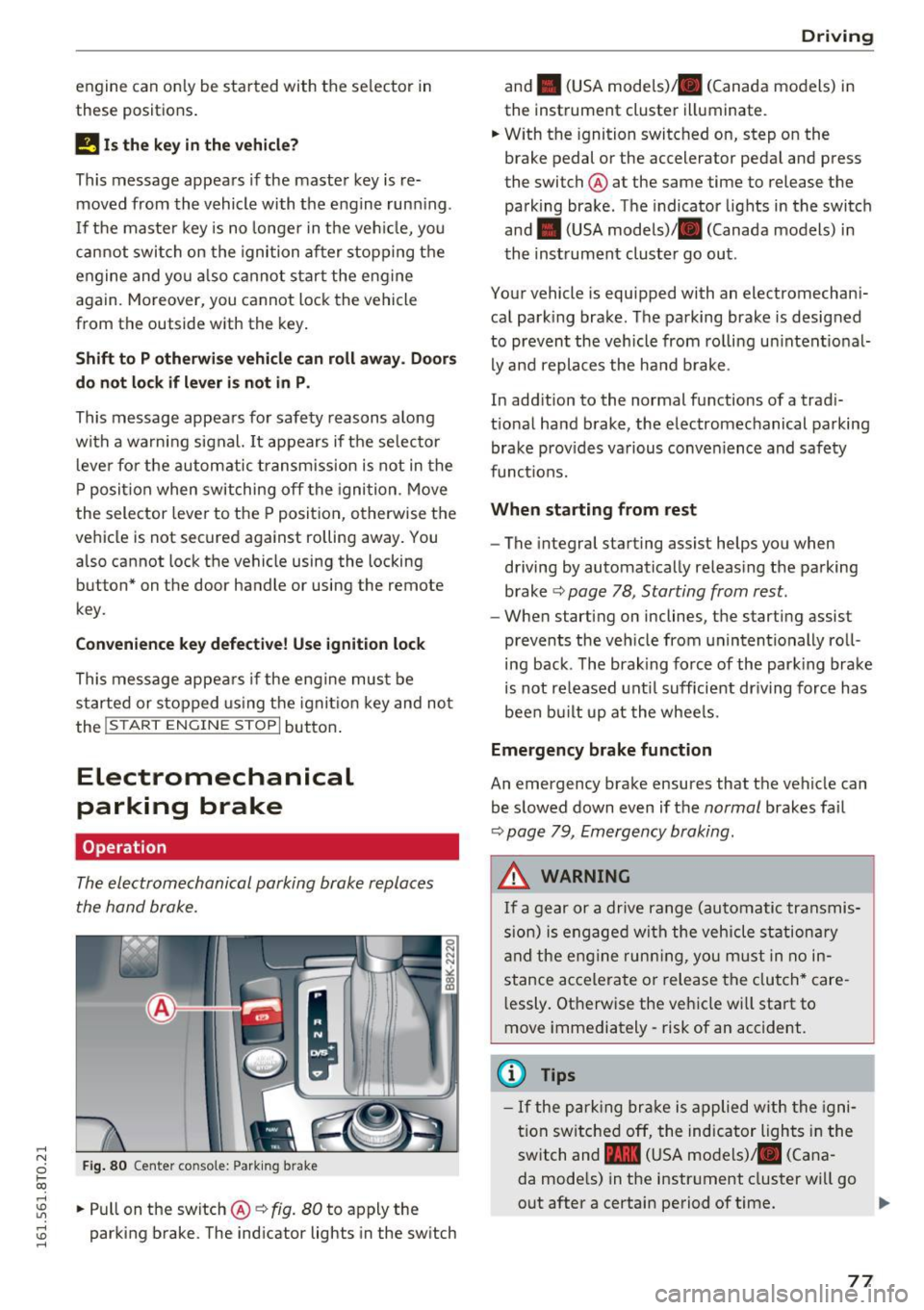
The electromechanical parking brake replaces
the hand brake.
Fig . 8 0 Center co nsole: Park ing b rake
rl
~ .. Pull on the switch@~ fig. 80 to apply the
~ parking brake. The ind icator lights in the sw itch ......
D rivi ng
and . (USA mode ls)/ . (Canada models) in
the instrument cluster illuminate.
.. W ith the ignition switc hed on, step on the
brake pedal or the accelerator pedal and press
the switch @ at the same time to release the
parking brake . The indicator lights in the switch
and . (USA models)/ . (Canada models) in
the instrument cluster go out .
Your vehicle is equipped with an electromechani
cal park ing brake. The parking brake is designed
to prevent the vehicle from rolling un intent ional
ly and replaces the ha nd b rake .
In add ition to the normal functions of a trad i
t ional ha nd brake, the electromechanical parking
brake prov ides va rious conven ience and safety
funct ions.
When starting from rest
- The integral starting assist helps you when
driving by automatically releas ing the parking
brake ~
page 78 , Starting from rest.
- When start ing on inclines, the starting assist
prevents the veh icle from unintentionally roll
ing back . T he brak ing force of the park ing brake
is not re leased unt il sufficient dr iving force has
been bu ilt up at the whee ls.
Emergency brake function
An emergency brake ensures that the veh icle can
be slowed down even if the
normal brakes fa il
~ page 79, Emergency braking .
A WARNING
If a gear or a drive range (automatic transmis
s ion) is engaged wi th the vehicle stationa ry
a nd the engine runn ing, you must in no in
stance acce lera te or release the clutch* care
l essly. Otherwise the vehicle wi ll sta rt to
move immediately- risk of an accident.
(1) Tips
- If the pa rk ing br ake is a pplied with the igni
tion swi tche d off, the indicator lights i n the
switch and -(USA models) . (Cana
da mode ls) in the instr ument cluster wi ll go
out after a certain period of time.
77
Page 80 of 264
Driving
- Occasional noises when the parking brake is
applied and released are normal and are not
a cause for concern.
- When the vehicle is parked, the parking
brake goes through a self-test cycle at regu
lar intervals. Any associated noises are nor
mal.
Parking
.,. Press the brake pedal to stop the vehicle .
.,. Pull the switch @¢
page 77, fig. 80 to set the
parking brake .
.,. Automatic transmission: Move the selector lev-
er to P.
.. Turn the engine off¢.&, .
.. Manual transmission: Shift into 1st gear.
.. When on inclines or declines, turn the steering
wheel so that the vehicle will roll into the curb
if it begins to move.
A WARNING
-
-When you leave your vehicle -even if only
briefly -always remove the ignition key. This
applies particularly when children remain in
the vehicle. Otherwise the children could
start the engine, release the parking brake
or operate electrical equipment (e.g. power
windows). There is the risk of an accident.
- When the vehicle is locked, no one -particu
larly not children should remain in the vehi
cle. Locked doors make it more difficult for
emergency workers to get into the vehicle -
putting lives at risk.
Starting from rest
The starting assist function ensures that the
parking broke is released automatically upon
starting .
Stopping and applying parking brake
.. Pull the switch @¢ page 77, fig. 80 to apply
the parking brake.
78
Starting and automatically releasing the parking brake
.. When you start to drive as usual, the parking
brake is automatically released and your vehicle
begins to move.
When stopping at a traffic signal or stopping in city traffic on vehicles with an automatic trans
mission, the parking brake can be applied. The
vehicle does not have to be held with the foot brake. The parking brake eliminates the tendency
to creep with a drive range engaged . As soon as
you drive off as usual, the parking brake is re leased automatically and the vehicle starts to
move .
Starting on slopes
When starting on inclines, the starting assist pre
vents the vehicle from unintentionally rolling back. The braking force of the parking brake is
not released until sufficient driving force has
been built up at the wheels.
(D Tips
For safety reasons, the parking brake is re
leased automatically only when the driver's
safety belt is engaged in the buckle.
Starting off with a trailer
To prevent rolling back unintentionally on an in
cline, do the following:
.. Keep the switch @¢ page 77, fig. 80 pulled
and depress the accelerator. The parking brake
stays applied and prevents the vehicle from
rolling backward.
.,. You can release the switch @once you are sure
that you are developing enough driving force at
the wheels by depressing the accelerator.
Depending on the weight of the rig (vehicle and
trailer) and the severity of the incline, you may
roll backwards as you start. You can prevent roll
ing backwards by holding the parking brake
switch @pulled out and accelerating -just as
you would when starting on a hill with a conven
tional hand brake .
Page 87 of 264
.... N
0 I-co ....
~ Remove your foot from the brake pedal and ac
ce lerate .
Stopp ing tempo raril y
~ Keep the veh icle stat ionary using t he b raking
peda l, for example at traffic lights.
~ Do not press the accelerator pedal when doing
this.
~ To prevent the vehicle from rolling when you
start driving, set the park ing brake when stop
ping on steep inclines¢&, .
~ The parking brake w ill release automatically
and the vehicle w ill start moving once you press
the accelerator pedal.
Stopping /parking
If the selector lever is not in the P position when
you open the driver's door, the vehicle could roll. The message
Tran smission: Car may roll! Shift
to park! appears.
~ Press and hold the brake pedal unt il the vehicle
has come to a complete stop .
~ Apply the parking brake ¢ page 78, Parking .
~ Select the P selector leve r pos ition ¢ ,&.
Stopp ing on an incline
~ Always press the brake pedal to hold the vehi
cle in place and prevent it from "rolling back"
¢ &, . Do
not try to prevent the vehicle from
"ro lling back " when a gear is engaged by in
c reasing the engi ne speed ¢0 .
Starting on an incline
~ Activate the parking brake .
~ With the driving gear selected, press the accel
erator peda l carefully. The parking brake will
re lease automatically if your seat belt is fas
tened .
Unde r certain c ircumstances, such as dr iv ing in
the mountains, it may be useful to switch tempo rari ly to the manua l shift program in orde r to ad
just t he gears to the d rivi ng conditions by hand
¢ page 86.
On slopes, activate the parking brake first and
then move the selector lever to the P pos it ion.
Autom atic tran sm iss ion
This prevents too m uch stress from being placed
on the locking mechanism .
A WARNING ,-
-The vehicle can also ro ll when the eng ine is
stopped.
- Unintended vehicle movement can ca use se
rio us injury .
- Never leave your vehicle with the engine
r u nning while in gear. If you must leave
your veh icle when the engine is running, ac
tivate the pa rking brake and move the selec
tor lever to P .
- Power is still transmitted to the wheels
when the engine is runn ing at idle . To pre
vent the vehicle from "creepi ng", you must
keep your foot on the b rake when the en
g ine is r un ning and the selector lever is in D/
Sor R or "ti ptroni c" mode is selected.
- D o not press the acce le rator peda l when
cha nging t he se lecto r lever position while
t he vehicle is sta tionary and the engine is
r u nning .
- Never s hift into R or P wh ile driving.
- Before d riving down a s teep slope, reduce
your speed a nd s hift into a lowe r gear w it h
" t i pt ronic".
- Do not ride the brakes or press the brake
pedal too often o r too long when dr iv ing
down a hill. Const ant brak ing c auses t he
brakes to overheat and s ubstant ially re
duces bra king performance, increases brak
ing distance or causes comp lete fai lure of
the brake system.
- To prevent the vehicle from rol ling bac k
when stopp ing on inclines, always hold it in
p lace with the brake peda l or park ing brake.
- Never hold the vehicle on an incline with a
slipping clutch. The clutch opens a utomati
cally when it becomes too hot from the
overload. An ind icator lamp@] illuminates
a nd a driver message appears
¢ page 87
when the clu tch is over loaded .
- If the engine must rema in running, never
have any d riving position engaged when
checking unde r the hood . Make s ure these
lecto r lever has se cu rely engage d and is
lo ck ed in P with the par kin g b rake set
85
Page 120 of 264
Driving safety
Storing cargo correctly
Loading the luggage compartment
All Luggage and other objects must be properly
stowed and secured in the Luggage compart
ment.
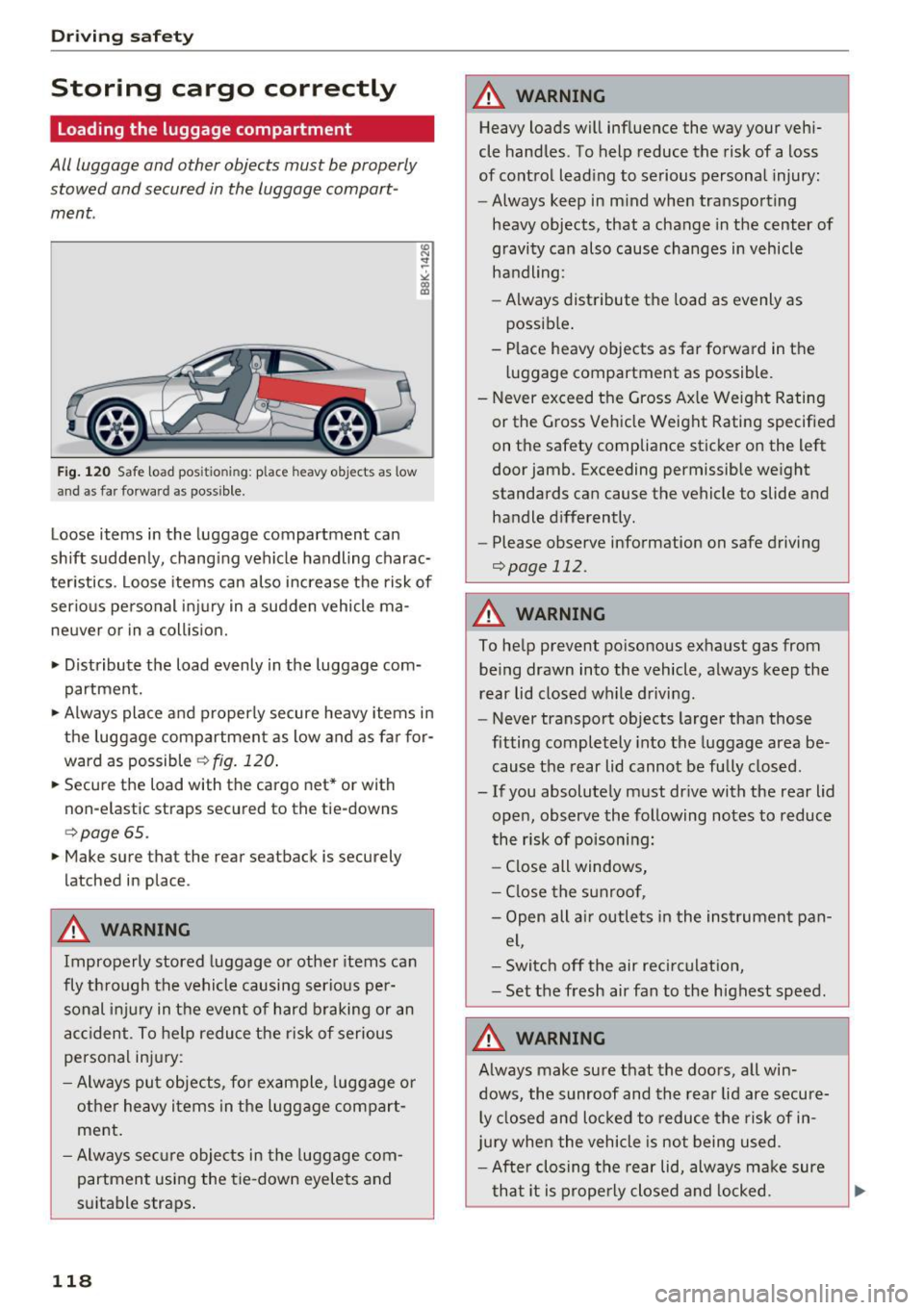
Fig. 120 Safe load positio ning: place heavy objects as low
and as far forwar d as possible.
Loose items in the luggage compartment can
shift suddenly, changing vehicle handling charac
teristics . Loose items can also increase the risk of
serious personal injury in a sudden vehicle ma
neuver or in a collision.
• Distribute the load evenly in the luggage com
partment.
• Always place and properly secure heavy items in
the luggage compartment as low and as far for
ward as possible
¢ fig. 120.
• Secure the load with the cargo net* or with
non-elastic straps secured to the tie-downs
c>page 65.
• Make sure that the rear seatback is securely
latched in place .
A WARNING
Improperly stored luggage or other items can
fly through the vehicle causing serious per
sonal injury in the event of hard braking or an
accident. To help reduce the risk of serious
personal injury :
- Always put objects, for example, luggage or
other heavy items in the luggage compart
ment.
- Always secure objects in the luggage com
partment using the tie-down eyelets and
suitable straps.
118
A WARNING
Heavy loads will influence the way your vehi
cle handles. To help reduce the risk of a loss
of control leading to serious personal injury:
- Always keep in mind when transporting
heavy objects, that a change in the center of
gravity can also cause changes in vehicle
handling:
- Always distribute the load as evenly as
possible.
- Place heavy objects as far forward in the
luggage compartment as possible.
- Never exceed the Gross Axle Weight Rating or the Gross Vehicle Weight Rating specified
on the safety compliance sticker on the left
door jamb. Exceeding permissible weight
standards can cause the vehicle to slide and
handle differently.
- Please observe information on safe driving
c> page 112.
A WARNING
To help prevent poisonous exhaust gas from
being drawn into the vehicle, always keep the
rear lid closed while driving.
- Never transport objects larger than those
fitting completely into the luggage area be
cause the rear lid cannot be fully closed.
- If you absolutely must drive with the rear lid
open, observe the following notes to reduce
the risk of poisoning:
- Close all windows,
- Close the sunroof,
- Open all air outlets in the instrument pan-
el,
- Switch off the air recirculation,
- Set the fresh air fan to the highest speed.
A WARNING
-
Always make sure that the doors, all win
dows, the sunroof and the rear lid are secure
ly closed and locked to reduce the risk of in
jury when the vehicle is not being used.
- After closing the rear lid, always make sure
that it is properly closed and locked. .,..
Page 159 of 264
,-1 N
0 1-CX)
,-1 I.Cl U"I
,-1 I.Cl ......
The airbag on the passenger side makes the front
seat a potentially dangerous p lace for a child to
ride . The front seat is not the safest place for a
child in a forward-facing chi ld seat. It is a very
dangerous place for an infant or a larger child in
a rearward -facing seat .
& WARNING
Not using a ch ild safety seat, using the w rong
child safety seat or improper ly installing a
child restra int increases the r isk of se rious
personal in jury and death in a crash.
- Never install rearward-fac ing c hild safety
seats or infant car riers on the fron t passen
ger seat -even wit h an Advanced A irbag Sys
tem . A child w ill be seriously injured and can
be k illed when the inflat ing airbag hits the
child safety seat or infant carrier with great
force and smashes the child safety seat and child against the backrest, center armrest,
door or roof ¢
page 130, Child restraints on
the front seat -some important things to
know .
-Always install rearward-fac ing ch ild safety
seats or infant car riers on the rear seat .
- Never install a rearward-facing chi ld re
straint in the forward -facing direction . Such
restra ints are designed for the special needs
of infants and ve ry small ch ild ren and can
not protect them prope rly if the seat is for
wa rd -facing.
- If you must install a rearward fac ing ch ild
sa fety seat on t he front p asse nger seat be
ca use of exceptiona l circumstances and the
PASSENGER AIR BAG OFF light does not
come on and stay o n, immediate ly install
the rearward-facing child safety seat in a rear seat ing pos ition and have the airbag
system inspected by your authorized Audi
dealer .
- Always read and heed all WARNINGS when
ever using a child restra ined in a veh icle is
being used¢
page 121, Safety belts,
¢ page 129, Airbag system and
¢ page 151, Important information.
Child sa fety
Convertible child safety seats
Properly used convertible child safety seats can
help protect toddlers and children over age one who weigh between 20 and 40 lbs. (9 and 18 kg)
in a crash.
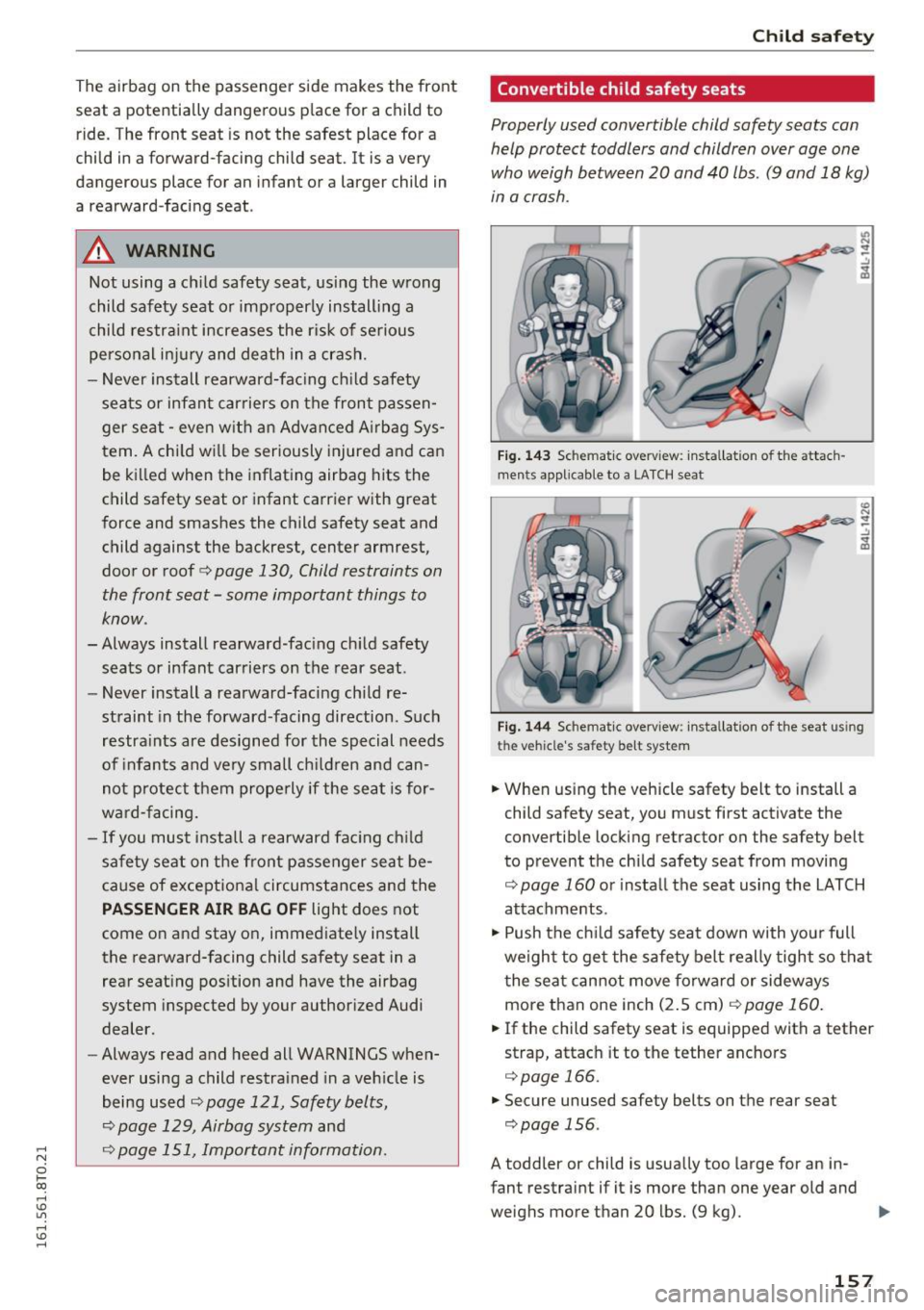
F ig . 14 3 Schem atic overv ie w: installat ion o f the attac h
men ts applicable to a LA TCH sea t
Fig. 144 Schemat ic overv iew : insta llat ion of the seat usin g
t he ve hicle 's sa fety b elt syst em
.. W hen using the vehicle safe ty belt to install a
child safety seat, you must first activate the
convertib le locking retractor on the safety belt
to prevent t he chi ld safety seat from moving
¢
page 160 or install the seat using the LATCH
attachments .
.. Push the ch ild safety seat down with yo ur full
we ight to ge t the safety belt really tight so that
t he seat can not move forward or sideways
more than one inch (2 .5 cm) ¢
page 160 .
.. If the child safety seat is equ ipped with a tether
strap, attac h it to the tether anchors
¢ page 166 .
.. Secure unused safety belts on the rear seat
¢page 156.
A toddler or child is usua lly too large fo r an in
fant restraint if it is more th an one year old and
weighs more than 20 lbs. (9 kg). ..,
157
Page 163 of 264
.... N
0 I-co ....
Improperly installed child safety seats in
crease the risk of serious personal injury and
death in a collision.
- Always make sure that the safety belt re
tractor is locked when installing a child
safety seat. An unlocked safety belt retrac
tor cannot hold the child safety seat in place
during no rma l driving or in a crash.
- Always buckle the child safety seat firmly in
place even if a child is not sitting in it. A
loose child safety seat can fly around d uring
a sudden stop or in a collision .
- If the backrest is not securely latched, the
child and the child restrain t will be thrown
forward together with the backrest and will strike parts of the vehicle interior. The ch ild
can be seriously injured or killed.
- Never install rearward -facing child safety
seats or infant carriers on the front passen ger seat. A child will be seriously injured and
can be killed when the passenger airbag in
flates.
- The inflating a irbag will hit the child safety
seat or infant carrier with great force and
will smash the ch ild safety seat and child
against the backrest, center armrest, door or roof .
- Always install rearward-fac ing ch ild safety
seats or infant carriers on the rear seat .
- Forward-fac ing ch ild safety seats or infant
carriers installed on the front passenger's
seat may inte rfere with the deployment of
the a irbag and cause serious injury to the
c hild.
- It is safe r to install a forward-fac ing ch ild
safety seat on the rear seat.
- Always read and heed all WARNINGS when
ever using a child restrained in a veh icle is
being used
¢page 151. Specia l pre caut ions
apply when installing a child safety seat on
the front passenger seat¢
page 130, Child
restraints on the front seat -some impor
tant things to know.
Ch ild safety
A WARNING
Always take special precautions if you must
i nstall a forward or rearward-facing child re
stra int on the front passenger's seat in excep
tional s ituations:
- Whenever a forward or rearward-fac ing
child restraint is installed on the front pas
senger seat, the
PASSENGER AIR BAG OFF
lig ht must come on and stay on w henever
the ignition is switched on.
- If the PASSENGER AIR BAG OFF li ght does
not come on and stay on, perform the
checks desc ribed¢
page 139, Monitoring
the Advanced Airbag System.
- Take the child restr aint off t he front passen
ger seat and install it properly at one of the
rear seat positions if the
PASSENGER AIR
BAG OFF
light does not stay on whenever
the ignition is switched on.
- Improper installation of child restraints can
reduce their effectiveness or even prevent
them from providing any protect ion.
- An imprope rly installed child restraint can
interfere with the airbag as it deploys and
serious ly injure or even kill the chi ld.
- Always care fully follow the manufacturer's
instr uctions provided with the child safety
seat or carr ier.
- Never p lace add itiona l items on the seat
that can increase the total weight registered
by the weight-sensing mat and can cause in
jury in a crash.
A WARNING
-Forward-facing child restra ints:
- Always make sure the forward-facing seat
has been des igned and certified by its man
ufacturer for use on a front seat with a pas
senger front and side airbag .
- Never put the forward-facing child restraint up, against or very nea r the instrument pan
el.
- Always move the passenger seat into its
rearmost posit ion in the seat's fore and aft
-
161
Page 164 of 264
Child safet y
adjustment range, as far away from the air
bag as possib le before insta lling the for
ward-facing child restra int. The backrest
must be adjusted to an upright posit ion.
- Make sure that the
PASSEN GER AIR BAG
OFF
light comes on and stays on all the time
whenever the ignition is switched on .
A WARNING
Rearward-facing child restraints:
- A ch ild in a rearward-facing child safety seat
installed on the front passenger seat will be
seriously injured and can be killed if the
front airbag inflates - even with an Ad
vanced Airbag System.
- The inflating a irbag w ill hit the child safety
seat or infant carrier wi th great force and
will smash the chi ld safety seat a nd child
against the backrest, cen ter armrest, door
or roof.
- Always be especially careful if you must in
sta ll a rearward facing child safety seat on
the front passenger seat in exceptional cir
cumstances .
- A tight tether strap on a rearward-fac ing
child restraint attached to the front passen
ger seat can put too much pressu re on the
weight-mat in the seat and register a heavi er we ight in the Advanced Airbag System.
The heav ier we ight registered can make the
system work as though an adult were on the
seat and deploy the Advanced Airbag when it m ust be s uppressed causi ng serio us or
even fatal injury to the child.
- Make s ure that the
PASSENGER AIR BAG
OFF
light comes on and stays on all the time
whenever the ignition is switched on.
- If the
PASSENGER AIR BAG OFF light does
not come on and stay on , immediately in
sta ll the rearward-facing child safety seat in
a rear seating position and have the a irbag
system inspected by your authorized Audi
dealer .
162
· Activating the convertible locking retractor
Use the convertible locking retractor to secure a
child restraint.
Always heed the ch ild safety seat manufacturer's
i nstruct ions when installing a child restra int in
your vehicle . To activate the convertible locking
retractor:
.. Place the child restraint on a seat, preferably
on the rear seat.
.. Slowly pull the belt
all th e w ay out .
.. Route it around or through the child restra int
be lt path
~ ,&. .
.. Push the ch ild safety sea t down wi th yo ur full
weigh t to get the safety belt really tight.
.. Insert the be lt tong ue into the b uck le for that
seating position .
.. Guide the safety be lt back into the retracto r un
til the belt lies flat and sn ug on the ch ild safety
seat.
.. You should hear a "cl icking" noise as the belt
w inds back into the inertia reel. Test the con
vert ible lock ing retractor by pull ing on the belt.
You shou ld no lo nge r be able to pull the belt
out of the retracto r. T he convertib le locking re
tractor is now activa ted.
.. Make sure that the red release button is facing
away from the chi ld restraint so that it can be
unbuckled quickly .
.. Pull on the belt to make sure the safety belt is
properly t ight and fastened so that the seat
cannot move forward or s ideways more than
one inch (2 .5 cm) .
A WARNING
Using the wrong ch ild restraint or an improp
e rly installed child restra int can ca use serious
personal injury or death in a crash.
- Always make sure that the safety be lt re
tr actor is locked when installing a ch ild
safety seat . An unlocked safety be lt retrac
tor cannot hold the ch ild safety seat in place
during normal driving or in a crash.
- Always buckle the child safety seat firmly in
place even if a chi ld is not sitting in it. A
loose child safety seat can fly around during
a sudden stop or in a crash.
Page 191 of 264
.... N
0 Ico ....
er flap is automatically unlocked or locked. Re
fue l the vehicle with the ignit ion turned
off.
T a king the fuel cap off
.,. Turn off the ignition.
.,. Press the left side of the fue l filler flap to open
it
c:> fig . 154 -arrow -.
.,. Unscrew fue l cap counter -clockwise and hang it
on the fue l filler flap
c:> fig. 155.
Refuelling proc edure
.,. Inse rt the fue l nozzle from the gasoline pump
into the fuel filler neck as far as it will go .
.,. Se lect a medium refuelling rate so that the
nozzle switches off automatically when the
tank is full.
Putting the fuel cap back on
.,. After filling yo ur tank, tw ist the f uel cap clock-
wise as far as it wi ll go .
.,. Close the fuel filler flap.
To avoid fuel spill ing o r evaporating from the f uel
tank always close fuel cap proper ly and com
pletely.
A WARNING
Improper refueling or handling of fuel can
cause fire, explosion and severe b urns.
-
- Fuel is highly flammable an d can cause se
vere burns and other injur ies .
- Failure to shut the engine off wh ile refuel
ing and/or to insert the pump nozz le fully
into the fuel filler neck could ca use fue l to
spray out of filler neck or to ove rflow. Fuel
spray and overflowing fue l can cause a fire.
- Never use a cellular telephone wh ile refuel
ing. The electromagnetic radiation can
cause spa rks that can ignite f uel vapors and
cause a fire.
- Never get back into your vehicle while refu
eling. If in except ional circumstances you
must get back in your vehicle while refuel
ing, make certain that you close the door
and touch meta l to discha rge static ele ctric
ity befo re touching the filler noz zle ag ain.
Fuel and R efueling
Stat ic elect ricity can cause sparks that can
ignite fue l vapors released during refueling.
- Never smo ke or have an open flame any
where in or near your vehicle when ref ueling
or filling a portable fuel container .
- For your safety, we strongly recommend
that you do not trave l with a po rtable fuel
container in your veh icle. The container, fu ll
or empty may leak and co uld cause a fire,
especially in a crash.
- If, under except ional circumstances, you
m ust transport a portable fuel container,
p lease observe the following:
- Never fill a portab le fue l conta iner while it
is anywhere in or on the vehicle (for exam
ple, in the l uggage compa rtment, o r on
the trunk). Static electricity can build up
while filling and can ignite fuel vapors caus ing a f ire .
-Always place a portab le fue l conta iner on
the ground before fi lling .
-A lways keep the f iller nozzle comp lete ly
inside the portable container before and
during f il li ng.
- If filling a portable co nta iner made of
metal, the filler nozz le must always be in
contact with the container . This will he lp
prevent stat ic elec trici ty from discharging
and ca use a fire.
- Never spill fue l inside the vehicle o r lug
gage compartment. F uel vapors a re highly
flammable.
- Always observe loca l and state/prov incial
l aws rega rding the use, storage a nd trans
po rtation of fuel contai ners.
- Make ce rtain the f uel con tainer mee ts i n
dust ry sta ndards (A NSI/ AS TM F852 -86).
(D Note
If any fuel has sp illed onto the car, it should
be removed immed iately to p revent damage
to the pa int.
@) For the sake of the environment
As soon as the correctly operated nozzle
switches off automatically for the first time,
189
Page 192 of 264
Fuel and Refueling
the tank is full . Do not try to add more fuel
because fuel may spill out. In addition, the
expansion space in the fuel tank will be filled -
causing the fuel to overflow when it becomes
warm and pollute the environment.
(D Tips
- Running your engine while refuelling may
cause vapors to escape or even cause fuel to
sp ill out of the tank. This would then shut
off the fuel nozzle before the tank is full.
- Do not refuel your vehicle with the ignition
turned on. The fuel gauge may otherwise
not indicate the correct fuel level after refu
elling .
- The fuel filler flap of your vehicle is not
l ocked when you lock the veh icle from the
inside .
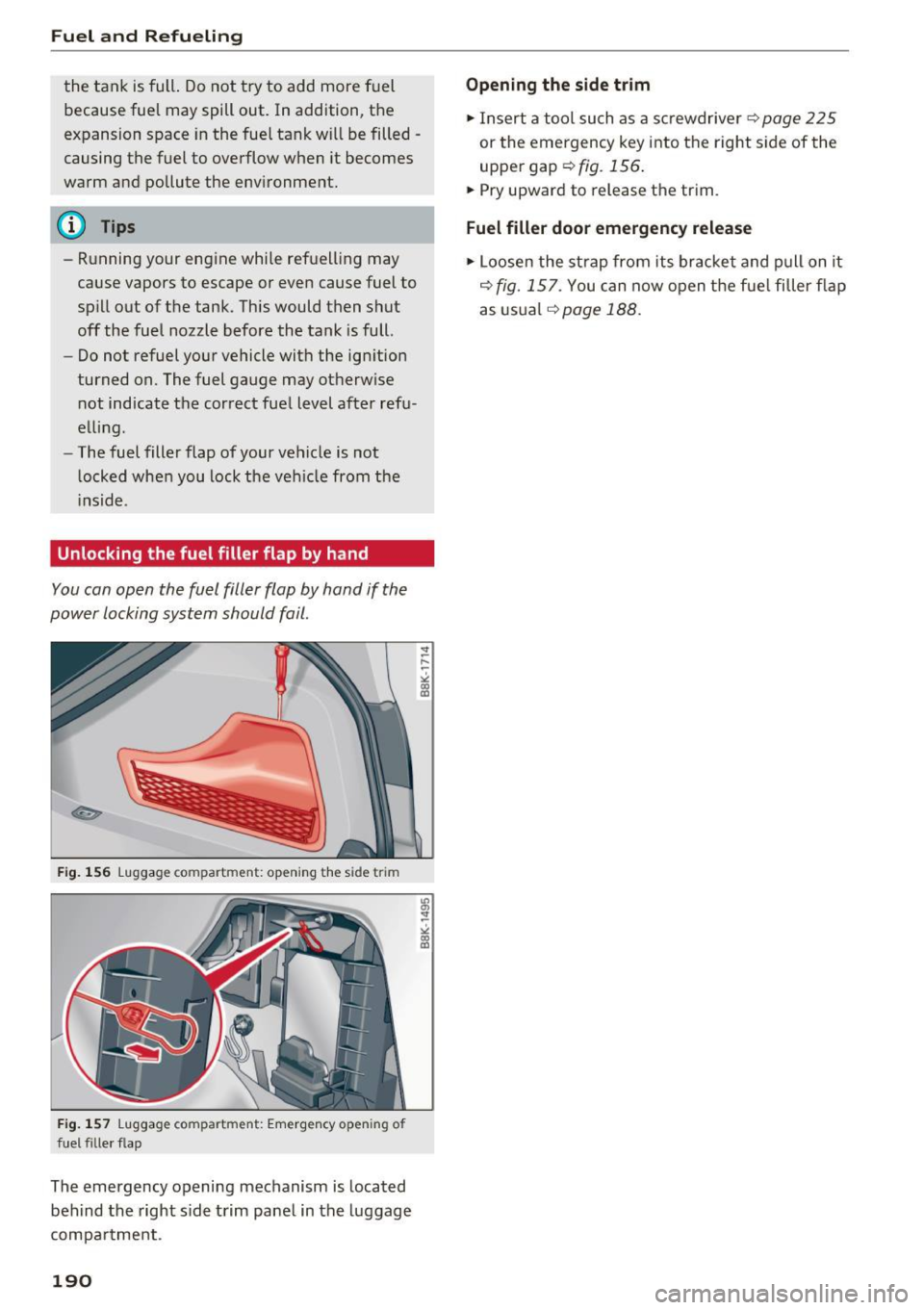
Unlocking the fuel filler flap by hand
You con open the fuel filler flop by hand if the
power locking system should fail.
F ig. 156 luggage compartment: opening the side trim
F ig. 157 luggag e compartment: Emergency opening of
fuel filler flap
The emergency opening mechanism is located
behind the right side trim panel in the luggage
compa rtment.
190
"' a, st
-
" co
"'
Opening the side trim
.,. Insert a tool such as a screwdriver¢ page 225
or the eme rgency key into the right side of the
upper gap¢
fig. 156.
.,. Pry upward to release the trim.
Fuel filler door emergency release
.,. Loosen the st rap from its bracket and pull on it
¢
fig. 157. You can now open the fue l filler f lap
as usual
¢page 188.