engine AUDI S5 COUPE 2016 Repair Manual
[x] Cancel search | Manufacturer: AUDI, Model Year: 2016, Model line: S5 COUPE, Model: AUDI S5 COUPE 2016Pages: 264, PDF Size: 66.92 MB
Page 199 of 264
.... N
0 Ico ....
er's glycol-basedcoo lant additive Gl3 antifreeze
with anticorrosion additives (50% for USA mod
e ls; 60% for Canadian models). This m ixture
both assures the necessary frost protection and
protects metal components in the engine's cool
ing system from corrosion and scaling.
It also
raises the boiling point of the coolant .
Do not reduce the concentration of the coolant in
the summer by adding plain water.
Th e propor
tion of coolant addit ive must be at l eas t 50° /4
but not more th an 60 %
to maintain antifreeze
p rotection and cooling efficiency. If the coolant
frost protec tion is too low, the coolant co uld
freeze and damage the vehicle heating and en
gine cooling system.
F or yea r-round driving, antifreeze is added at the
factory for temperatures down to:
- -31 °F (- 35 °C) USA
- -40 °F ( - 40 °C) Canada.
If you must add coolant, use a mixture of water
and coolant addit ive. Mixing the coolant additive
with distilled water is recommended.
A WARNING
Before you check anything in the engine com
partment, always read and heed all WARN
INGS
Q &. in Working in the engine compart
ment on page 191.
(D Note
- Before winter sets in, have the coolant
checked to see if the coolant additive in your
vehicle is sufficient to meet the climate con
dit ions. This is especially important if you
li ve in a reg ion where the w inte r is ext reme
l y co ld. If ne cessary, in cre ase the proport io n
of coo lant add itive to 60%.
- When addi ng coolant addit ive to you r cool
i ng system, remember:
- We recommend using only coolant addi
tive Gl2++ or Gl3 for your ve hicle. T his
coolant additive is available at authorized
Audi dea lers. Othe r types of antifreeze can
significant ly reduce cor ros ion p rotection .
Check ing and Filling
The resulting co rrosion can cause a loss of
coolant and serious engine damage.
- Do not add any type of radiator lea k sealant
to your vehicle's engine coolant. Adding ra
diator repair fluid may adversely affect the
function and performance of your cooling
system and could resu lt in damage not cov
ered by your New Veh icle Limited Warranty.
Checking the engine coolant level
The engine coolant level can be checked with a
quick glance.
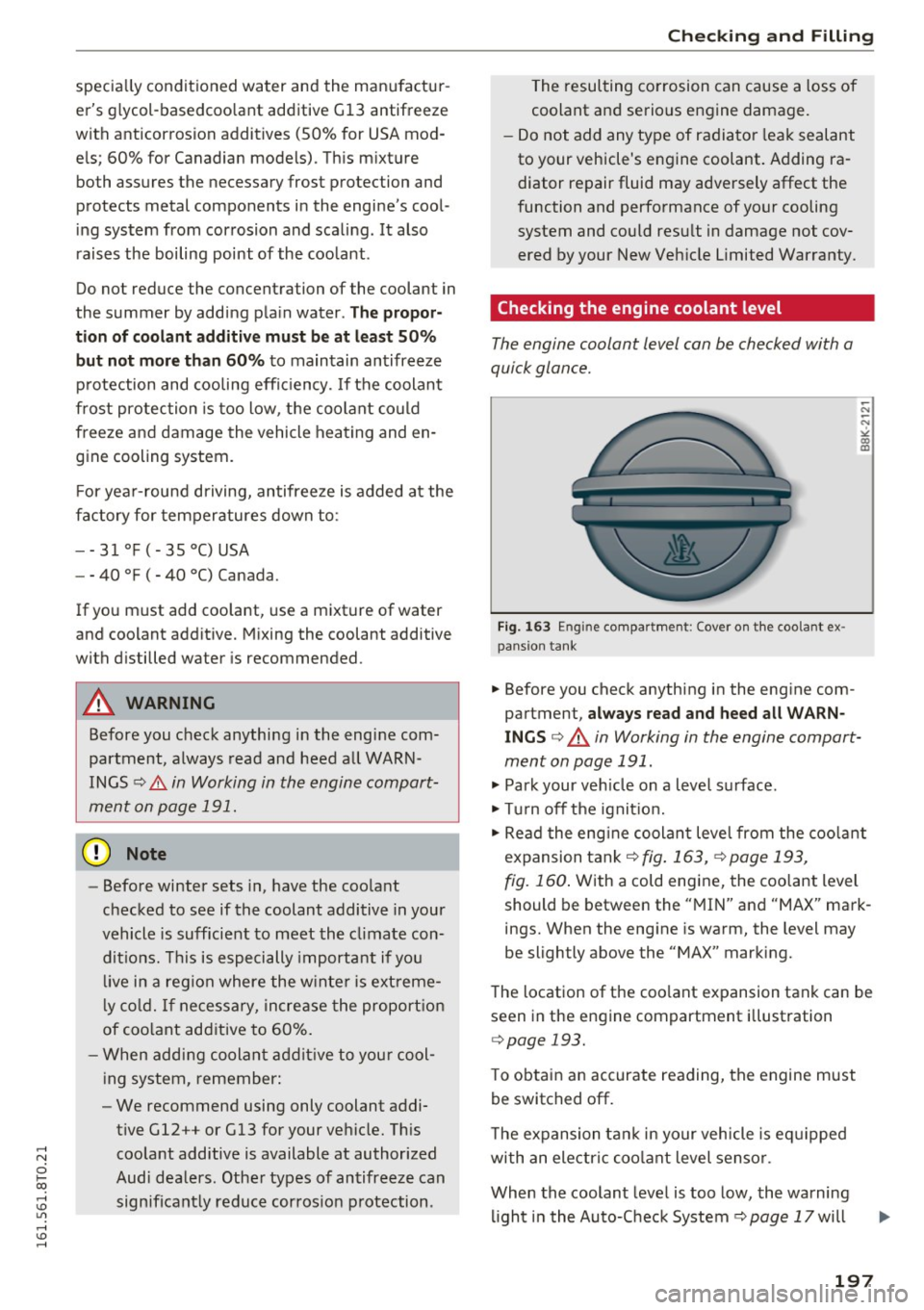
F ig. 163 Engine compa rtment: Cover on the coolant ex
pans ion tank
.. Before you check anything in the engine com
partment,
al ways read and heed all WARN
INGS
q ..&. in Working in the engine compart
ment on page 191.
.. Park your ve hicle on a leve l sur face .
.. Tu rn off the ignit io n .
.. Read the eng ine coolan t level from the coo la nt
expansion tank
qfig . 163, Qpage 193,
fig. 160 .
With a cold engine, the coolant level
should be between the " MIN" and "MAX" mark
ings. When the engine is warm, the level may
be slightly above the "MAX" marking.
The location of the coolant expansion tank can be
seen in the engine compartment illustration
qpage 193.
To obtain an accurate reading, the engine must
be switched off.
T he expansion ta nk in your veh icle is eq uipped
with an electric coo lant level senso r.
When the coolant leve l is too low, the warning
light i n the Auto-Check System
Q page 17 will
197
Page 200 of 264
Check ing and F illing
blink until you add coolant and the level has been
restored to normal. Even though there is an e lec
tr ic coolant level sensor, we still recommend you
check the coo lant level from time to time.
Coolant los s
Coolant loss may indicate a l e ak in the cooling
system. In the event of coolant loss, the cooling
syst em should be insp ected immediately by your
authorized Audi dealer. It is not enough merely
to add coolant.
I n a
s e aled system, losses can occur only if the
boiling point of the coo lant is exceeded as a re
sult of overheating.
A WARNING
The cooling system is under pressure and can get very hot. Reduce the risk of scalding from
hot coolant by following these steps.
- Turn off the eng ine and allow it to cool
down .
- Protect your face, hands and arms from es
caping fluid and steam by covering the cap
with a large, thick rag.
- Turn the cap slowly and very carefully in a
counter-clockwise direction wh ile apply ing
l ight, downward pressure on the top of the
cap .
- To avo id being burned, do not sp ill anti
freeze or coolant on the exhaust system or
hot eng ine parts . Under certain conditions,
the ethy lene g lycol i n engine coolant can
catch fire.
{Q) Note
Do not add any type of radiator leak seala nt
to your veh icle's engine coolant . Adding radia
to r repa ir fluid may adversely affec t the func
tion and performance of yo ur cooling system
and could result in damage not covered by
your New Vehicle Limited Warranty.
Adding coolant
Be very careful when adding engine coolant.
Before you check anyth ing in the eng ine compart
ment,
a lwa ys re ad an d heed all WARNINGS
198
¢ A in Working in the engine compartment on
page 191.
Requireme nt: The re must be a res idual amount
of coo lant in the expans ion tank
~CD-
.,,. Turn off the engine .
.,,. Let the engine cool down.
.,,. Place a thick rag over the coolan t expa nsion
tank ¢page 197, fig. 163 and
carefull y turn
the cap counter-clockwise ¢.&_ .
.,,. Add coo lant mixed in the correct ratio
~ page 196, Coolant up to the MAX marking.
.,,. Make sure that the fluid level remains stab le.
Add more coolant if necessary .
.,,. Twist the cap on aga in tightly.
Replacement engine coolant must conform to ex
act specifications ¢ page 196, Coolan t.
We recommend using only coo lant additive
G l2 +
+ , Gl3
or in an emergency Gl2+. Do not use a
different additive . In an emergency use plain wa
ter unt il you can get the correct addit ive and can
restore the correct rat io. Th is should be done as
soon as possible.
If you have lost a considerable amount of cool
ant, then you should add cold antifreeze and cold
water only when the engine is cold.
Always use new engine coo lant when refilling .
Do not fi ll coolant above the "MAX " mark. Excess
coolant will be forced out th rough the pressure
relief valve in the cap when the engine becomes
hot.
A WARNING
- The cooling system is under pressure and can get very hot. Reduce the risk of scalding
from hot coolant by following these steps.
- Turn off the engine and a llow it to cool
down.
- Protect your face, hands and arms from
escaping fluid and steam by covering the
cap with a large, thick rag.
- Turn the cap s low ly and very ca refully in a
counter-clo ckwise direction wh ile app ly ing
li ght, downward pressure on the top o f
the cap.
~
Page 201 of 264
,-1 N
0 1-CX)
,-1 I.Cl U"I
,-1 I.Cl ......
-To avoid being burned, do not spill anti
freeze or coolant on the exhaust system or hot engine parts. Under certain condi
tions, the ethylene glycol in engine cool ant can catch fire.
- Antifreeze is poisonous. Always store anti
freeze in its original container and well out
of the reach of children.
- If you drain the coolant, it must be caught
and safely stored in a proper container
clearly marked "poison".
(D Note
-Do not add coolant if the expansion tank is
empty . Air could enter the cooling system
and damage the engine.
If this is the case,
do not continue driving. Seek professional
assistance.
- Coolant pollutes the environment and could
cause an engine fire. Excess coolant will be
forced out through the pressure relief valve
in the cap when the engine becomes hot.
-If, in an emergency, only water can be add
ed, the correct ratio between water and an
tifreeze c::>
page 196 must be restored as
soon as possible.
@) For the sake of the environment
Drained coolant should not be reused. Always
dispose of used coolant while observing all
environmental regulations.
Radiator fan
The radiator fan switches on automatically by it
self.
The radiator fan is driven by the engine via the V
belt . The viscous clutch regulates the speed of
the fan according to the temperature of the cool
ant.
An auxiliary electric radiator fan* switches on and
off depending on coolant temperature and other
vehicle operating conditions.
After you switch the engine off, the auxiliary fan
can continue running for up to 10 minutes -even
Checking and Filling
with the ignition off. It can even switch on again
later by itself c::>
&, if
- the temperature of the engine coolant rises due
to the heat build-up from the engine in the en
gine compartment, or
- the engine compartment heats up because the
vehicle is parked in intense sunlight.
A WARNING
-To reduce the risk of personal injury never
touch the radiator fan.
- The auxiliary electric fan is temperature
controlled and can switch on suddenly even
when the engine is not running.
- The auxiliary radiator fan switches on auto
matically when the engine coolant reaches a
certain temperature and will continue to run
until the coolant temperature drops.
Brake fluid
Checking brake fluid level
The broke fluid level con be checked with o quick
glance .
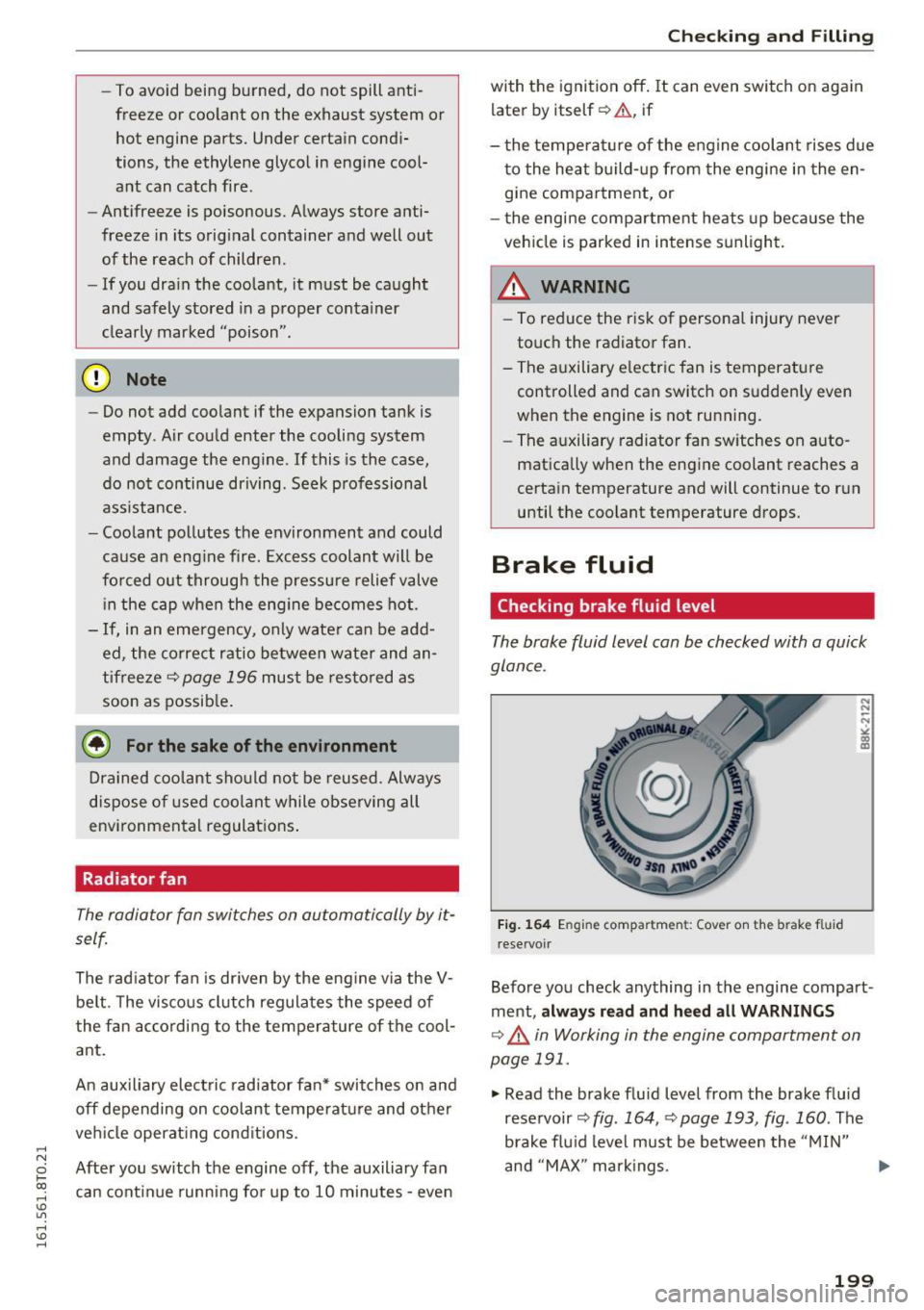
Fig. 164 Engine compartmen t: Cover on the brake flui d
re servoir
Before you check anything in the engine compart
ment,
always read and heed all WARNINGS
c::> _.& in Working in the engine comportment on
page 191.
.,. Read the brake fluid level from the brake fluid
reservoir c::>fig.164,
c::>poge 193, fig .160 . The
brake fluid level must be between the "MIN"
and "MAX" markings.
199
Page 202 of 264
Check ing and F illing
The brake fluid rese rvoir is located at the rear
partition of the engine compartment on the l eft
side
c!,> pag e 193 .
The fl uid level may drop slightly after some time
due to the automatic adjustment of the brake
pads . This is not cause for alarm.
If th e b rake fl uid level fa lls considerably be low
the "M IN" mark, the b rake warning/ind icator
lig ht ( U.S. mode ls :
1111 , Canadian models:. )
will come on
c!,> page 15 . Do not contin ue to oper
ate the vehicle . T he comp lete brake system
should be thoroughly checked by an authori zed
Aud i dealer or qualified workshop and the cause
corrected . If the brake flu id level is too low, the
b rake warning/indicator light will i llum inate.
Contact a n author ized Audi dealer
immediately .
{D) Tips
The brake fluid reservoir is located under
neath the cover .
Changing brake fluid
Have the brake fluid changed by an experienced
technician .
Brake fluid absorbs mo isture from the air. If the
water content in the b rake fluid is too high, cor
rosion in the brake system may resu lt afte r ape
riod of t ime. The boiling poi nt of the brake flu id
will also decrease cons iderably and decrease
b raking perfo rman ce.
Therefore, the brake fluid must be changed
every
two year s.
Always use new brake fluid wh ic h con
forms to Fede ral Motor Veh icle Standard "FMVSS
1 16 DO T 4".
The brake fluid reservoir can be diff icult to reach,
therefore, we recommend that yo u have the
brake fl uid changed by yo ur autho rized
Audi
dealer .
Your dealer has t he corre ct tools, t he
right brake fluid and the know-how to do this for
you.
A WARNING
- Brake fluid is poisonous. It must be stored
only in the closed orig inal container out of
the reach of chi ldren!
200
- Bra ke fa ilure ca n result from old or inapp ro
priate brake fluid . Observe these precau
tions:
- Use only brake fluid t hat meets SA E speci
fi ca ti on
J 170 3 and con forms to Federa l
Motor Ve hicle Standard 116 . Always check
wi th yo ur autho rized Audi dea le r to make
s ur e yo u are using the correct brake fluid .
The correct type of brake flu id is also ind i
cated on the b rake fluid reservo ir .
- The brake fluid m ust be new . Heavy use of
the brakes can cause a vapo r lock if the
brake fluid is left in the system too long .
This can se riously affect the efficiency of
the b rakes as well as your safety . This
could resu lt in an accident .
(D Note
Brake fluid will damage the paint of your veh i
cle.
@ For the sake of the environment
Because of the problem o f proper d isposa l o f
brake fluid as well as the spec ial too ls re
q ui red a nd the necessary expertise, we rec
omme nd that you have the bra ke f luid
changed by yo ur autho rized Aud i dea le r.
Battery
, General information
U nder normal operating condit ions, the battery
i n your Audi does not need any maintenance.
With
high outside temperatures or long daily
drives we recommend that you have the elect ro
lyte level c hecked by an au thorized Aud i dealer o r
qualified workshop. The electro lyte level shou ld
a lso be che cked each time the battery is c ha rged
c:!,> page 202.
Have the batte ry chec ked when you take yo ur ve
hicle in for service. You are we ll adv ised to re
pla ce a battery tha t is older than 5 yea rs.
With certain types of airbag deployment, t he
batte ry is d iscon nected from the ve hicle electri
ca l system for safety reasons
c!,> .&. in Repair, care
and disposal of the airbags on page 1 42. .,.
Page 203 of 264
.... N
0 I-co ....
Some vehicle func tion s (p ower w indow reg ula
tors, for example) are lost i f th e battery termi
na ls are d isconnected. These functions have to be
relearned afte r the battery termina ls are con
nected aga in. To prevent th is, the batte ry shou ld
only be disconnected from the vehicle e lectr ica l
system w hen abso lute ly necessary for repairs.
Vehicles not driven for long periods
If yo u do not drive you r vehicle over a period of
seve ral days or weeks, e lectrical components a re
g radually c ut back or sw itched off. This reduces
e nergy consumption and ma inta ins starting ca
pability over a longer pe riod
c:> page 175 .
Some of the conven ience f unctions may not ope r
ate, s uch as the inte rior lights or the power seat
ad justment. The convenience functions will be
ava ila ble aga in whe n you tu rn o n the ignition and
start the engine .
Winter operation
During the winter months, battery capacity tends
to dec rease as temperatu res dr op. This is be
cause more power is also consumed wh ile start
in g, and the head lights , rear wi ndow defogge r,
etc., are used more of ten .
Avoid un necessa ry power consumption, part icu
l arly in city traffic or when t rave ling on ly short
d ista nces . Let your authorized Audi dealer check
the capaci ty of the vehicle battery be fore w inte r
sets in
r=;, pag e 202. A well cha rged batt ery w ill
n o t onl y preven t st arti ng p roble ms w hen the
wea ther is cold, but will also last l on ger .
(D Tips
If your v ehicle is left stand ing fo r se ve ral
wee ks at extre mely low tem per at ures, the ve
hicle b attery sh ould be re moved and stor ed
w here it will not free ze . Th is will preve nt i t
from being dama ged and hav ing to be re
placed .
Checking and Filling
Working on the battery
Be especially careful when working on or near
the battery.
The battery is located in the luggage compart
ment under the floor. Befo re you check anything
i n the luggage compart ment ,
read and heed all
WARNINGS
c:> &_ .
Always heed the safety warnings , when working
o n the veh icle batte ry or t he ve hicle elec trical
system to prevent in jury .
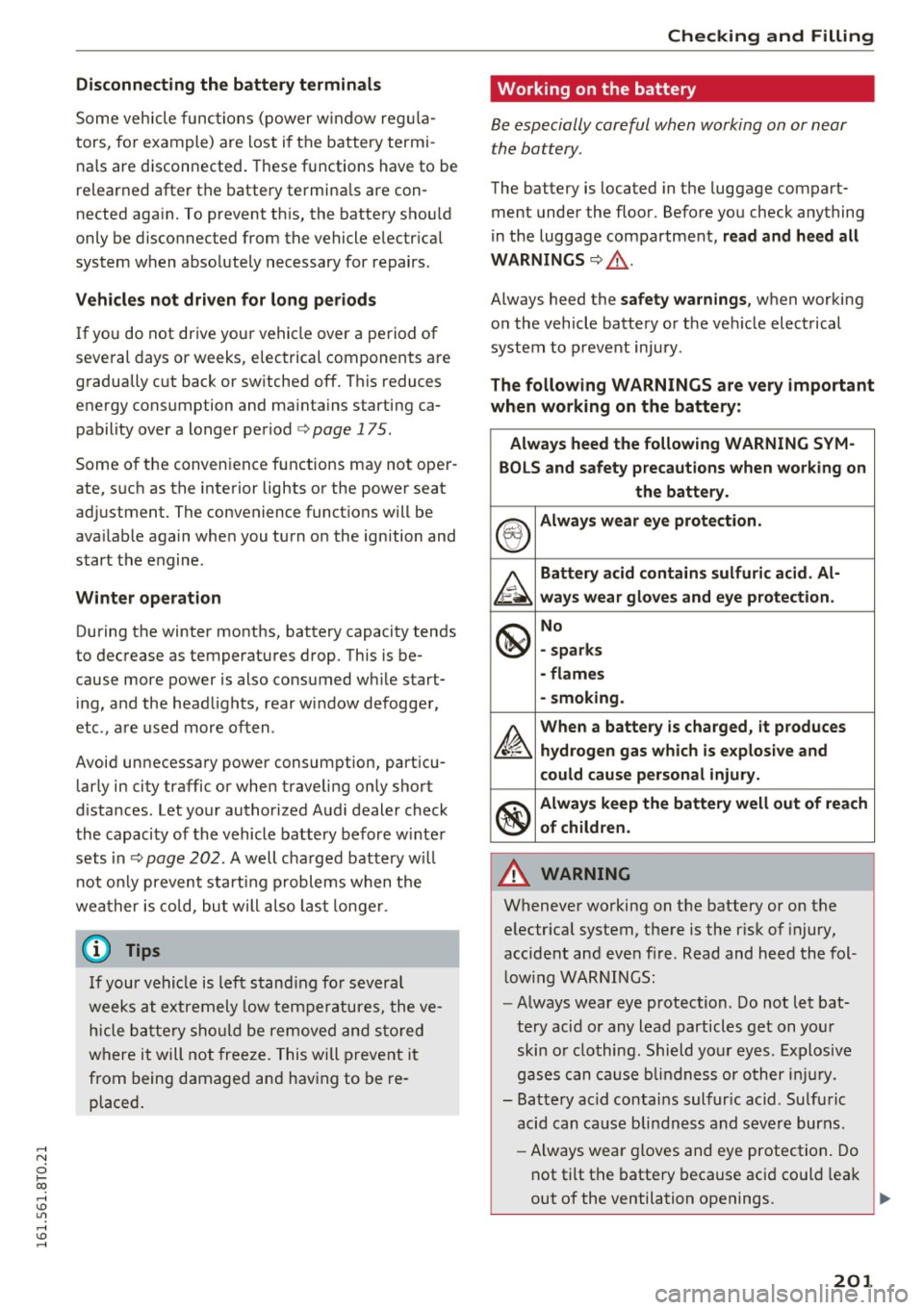
The following WARNINGS are very important
when working on the battery :
Always heed the following WARNING SYM-
BOLS and safety precautions when wo rking on
the battery.
®
Always wear eye protection.
A
Battery acid contains sulfuric acid. Al-
ways wear gloves and eye protection.
@
No
- sparks
- flames
- smoking.
~
When a battery is charged , it produces
hydrogen gas which is explosive and
could cause personal injury.
®
Always keep the battery well out of reach
of children.
A WARNING .....__ -
Wheneve r working on t he battery or on the
e lectr ica l system, the re is the r isk of injury,
accide nt a nd eve n fire. Read and he ed the fol
l ow ing W AR NIN GS:
- Always wear eye protection. Do not let bat
tery acid or any l ead particles ge t on you r
skin o r clothing. Shield yo ur eyes. E xplosiv e
g ases can ca use b lindne ss or other in jury.
- Ba tte ry acid contai ns sulfur ic acid. Sulfu ric
acid can ca use blindness and s evere burns.
- Always wea r gloves and eye protection . Do
n ot tilt t he batte ry because aci d could lea k
out of the ventilation openings. ""
201
Page 204 of 264
Checking and Filling
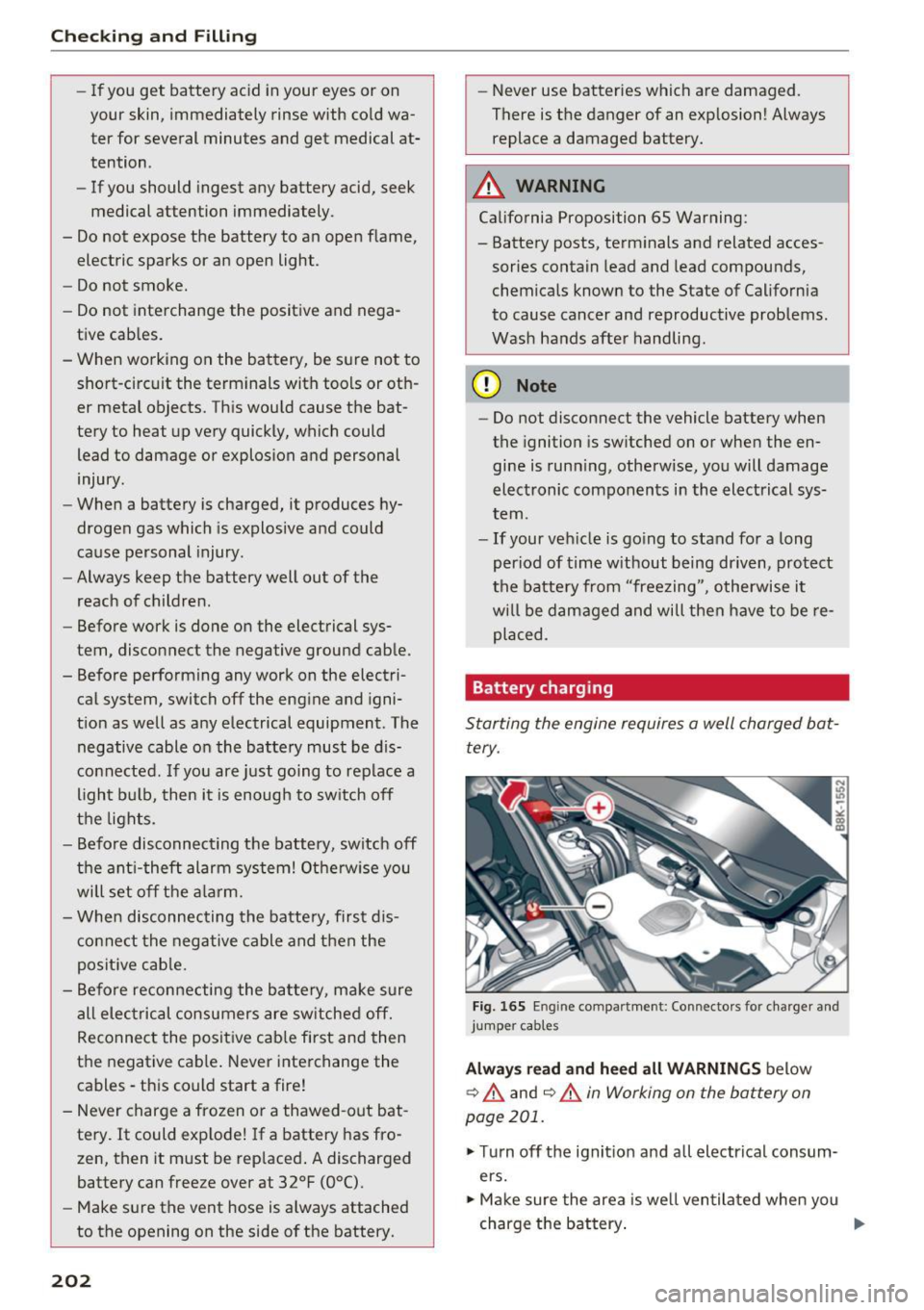
-If you get batt ery acid in your eyes or on
your skin, immediately rinse with cold wa
ter for several minutes and get medical at
tention .
- If you should ingest any battery acid, seek
medical attention immediately.
- Do not expose the battery to an open flame, electric sparks or an open light .
- Do not smoke.
- Do not interchange the positive and nega-
tive cables.
- When working on the battery, be sure not to short-circuit the terminals with tools or oth
er metal objects. This would cause the bat
tery to heat up very quickly, which could lead to damage or explosion and personal
injury.
- When a battery is charged, it produces hy
drogen gas which is explosive and could
cause personal injury.
- Always keep the battery well out of the
reach of children.
- Before work is done on the electrical sys
tem, disconnect the nega tive ground cable .
- Before performing any work on the electri cal system, switch off the engine and igni
tion as well as any electrical equipment. The negative cable on the battery must be dis
connected. If you are just going to replace a
light bulb, then it is enough to switch off
the lights.
- Before disconnecting the battery, sw itch off
the anti-theft alarm system! Otherwise you
will set off the alarm.
- When disconnecting the battery, first dis
connect the negative cable and then the
positive cable.
- Before reconnecting the battery, make sure
all electrical consumers are switched off.
Reconnect the positive cable first and then
the negative cable. Never interchange the
cabl es - this could start a fire!
- Never charge a frozen or a thawed-out bat
tery . It could explode! If a battery has fro
zen, then it must be replaced. A discharged
battery can freeze over at 32°F (0°C).
- Make sure the vent hose is always attached
to the opening on the side of the battery.
202
- Never use batteries which are damaged .
There is the danger of an explosion! Always
replace a damaged battery.
A WARNING
California Proposition 65 Warning:
- Battery posts, terminals and related acces
sories contain lead and lead compounds,
chemicals known to the State of California
to cause cancer and reproductive problems.
Wash hands after handling .
(D Note
- Do not disconnect the vehicle battery when
the ignition is switched on or when the en
gine is running, otherwise, you will damage
electronic components in the electrical sys
tem .
-If your vehicle is going to stand for a long
period of time without being driven, protect
the battery from "freezing" , otherwise it
will be damaged and will then have to be re
placed.
Battery charging
Starting the engine requires a well charged bat tery .
Fig. 165 En g in e compar tment : Co nnectors for charger and
jumper cab les
Always read and heed all WARNINGS below
9 A and ¢ A in Working on the battery on
page 201.
.,. Turn off the ignition and all electrical consum
ers.
.,. Make sure the area is well ventilated when you
charge the battery.
Iii>-
Page 205 of 264
.... N
0 Ico ....
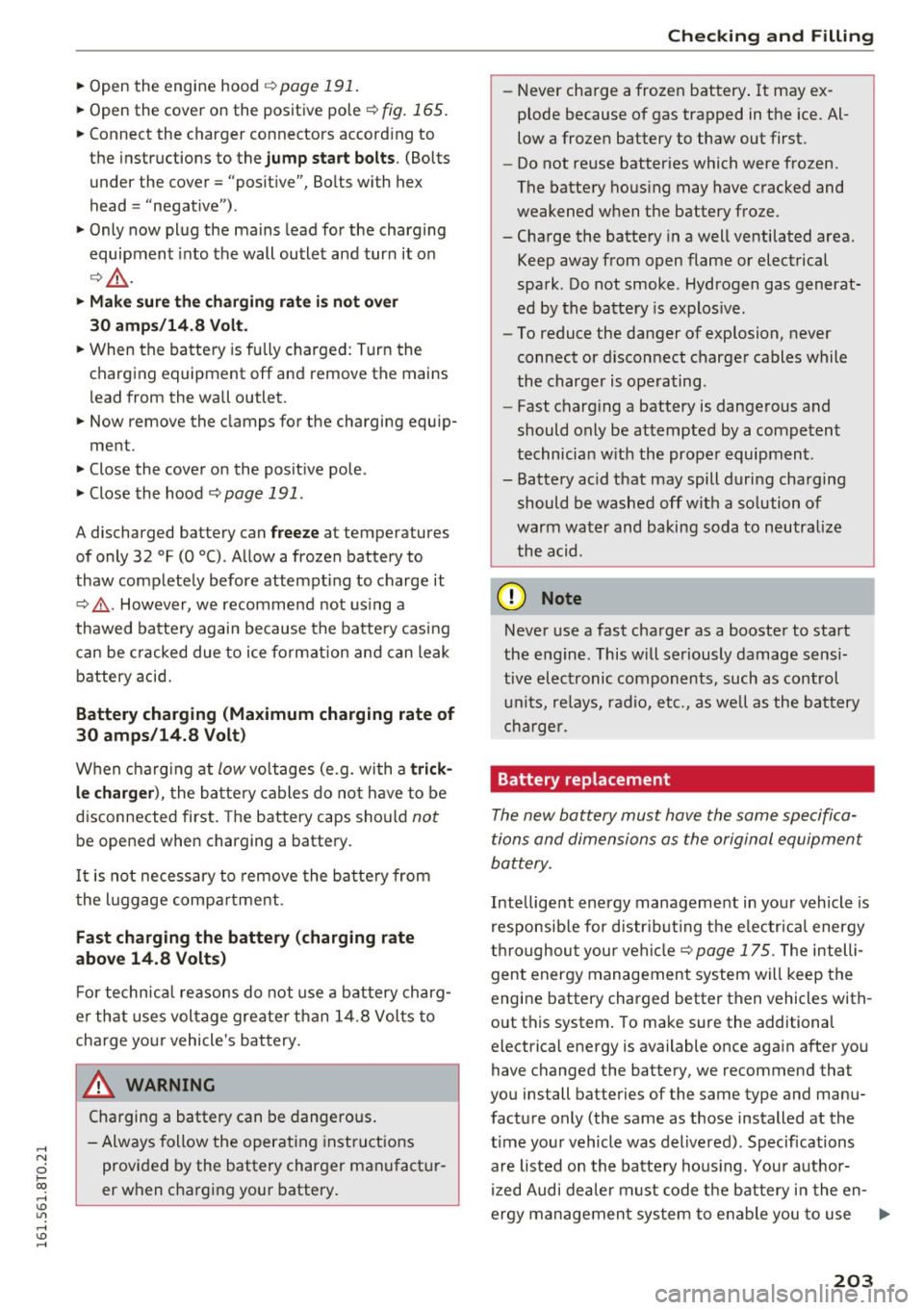
~ Open the cover on the positive pole ~ fig. 165.
~ Connect the charger connectors accord ing to
the instructions to the
jump start bolts. (Bolts
under the cover= "positive", Bo lts with hex
head = "negative") .
~ Only now plug the mains lead for the charging
equipment into the wall outlet and turn it on
~ & -
~ Make sure the charging rate is not over
30 amps/14.8 Volt.
~ When the battery is fully charged: Turn the
charging equipment off and remove the mains
lead from the wall outlet.
~ Now remove the clamps for the charging equip-
ment.
~ Close the cover on the posit ive pole .
~ Close the hood ~ page 191.
A discharged battery can freeze at temperatures
of only 32 °F (0 °C) . Allow a frozen battery to
thaw completely before attempt ing to charge it
~ & . However, we recommend not using a
thawed batte ry again because the battery casing
can be cracked due to ice formation and can leak
battery acid.
Battery charging (Maximum charging rate of
30 amps/14.8 Volt)
When charging at low voltages (e .g . with a trick
le charger),
the battery cables do not have to be
disconnected first. The battery caps should
not
be opened when charging a battery.
It is not necessary to remove the battery from
the luggage compartme nt.
Fast charging the battery (charging rate
above 14.8 Volts)
Fo r techn ical reasons do not use a battery charg
e r that uses voltage greate r than 14.8 Volts to
charge your vehicle 's battery.
A WARNING
Charging a battery can be dangerous.
- Always follow the operating instructions
provided by the battery charger manufactur
er when charging your battery .
Checking and Filling
-Never charge a frozen battery . It may ex
plode because of gas trapped in the ice. Al
low a frozen battery to thaw out first.
- Do not reuse batteries which were frozen.
The battery housing may have cracked and
weakened when the battery froze.
- Charge the battery in a well ventilated area.
Keep away from open flame or electrical
spark. Do not smoke . Hydrogen gas generat
ed by the battery is explosive.
- To reduce the danger of explosion, never
connect or disconnect charger cables while
the charger is operating .
- Fast charg ing a battery is dangerous and
should only be attempted by a competent
technician with the proper equipment.
- Battery acid that may spill during charging should be washed off w ith a solution of
warm water and baking soda to neutralize
the acid .
@ Note
Never use a fast charger as a booster to start
the engine . This will seriously damage sensi
tive electronic components, such as control
units, relays, radio, etc., as well as the battery
cha rge r.
Battery replacement
The new battery must have the same specifica
tions and dimensions as the original equipment
battery.
Intelligent energy management in your vehicle is
r esponsib le for distr ibut ing the electrical energy
throughout your vehicle ~
page 175. The intelli
gent energy management system will keep the
engine battery charged better then vehicles with
out this system. To make sure the additional
electrical energy is available once again after you
have changed the battery, we recommend that
you install batteries of the same type and manu
facture only (the same as those installed at the
t ime your vehicle was delivered) . Specifications
are listed on the battery housing . Your author
ized Audi dealer must code the battery in the en-
ergy managemen t system to enable you to use
ll>
203
Page 206 of 264
Checking and Filling
the energy m anag ement functions correctly after
replacing the battery.
I f it is not poss ible to use a battery of th is type,
the new battery must have the same capacity,
voltage (12 -volts), amperage, construction and
p lug sealing .
When insta lling the batte ry, make sure the igni
tion and all elec trical consumers are turned off.
CD Note
Ma ke sure the ventilation hose on the side of
t he batte ry is connected, othe rw ise f umes or
bat tery acid can lea k out.
@ For the sake of the environment
Because of the prob lem of proper dispo sal of
a ba tte ry, we recommen d your author ized
Audi de aler change the battery fo r you . Bat
teries contain su lf u ric acid and lea d and must
always be disposed of properly in compliance
w ith all environmental regu lations. D ispos ing
of vehicle batteries improperly is very danger
ous to the env ironment.
Windshield/headlight*
washer container
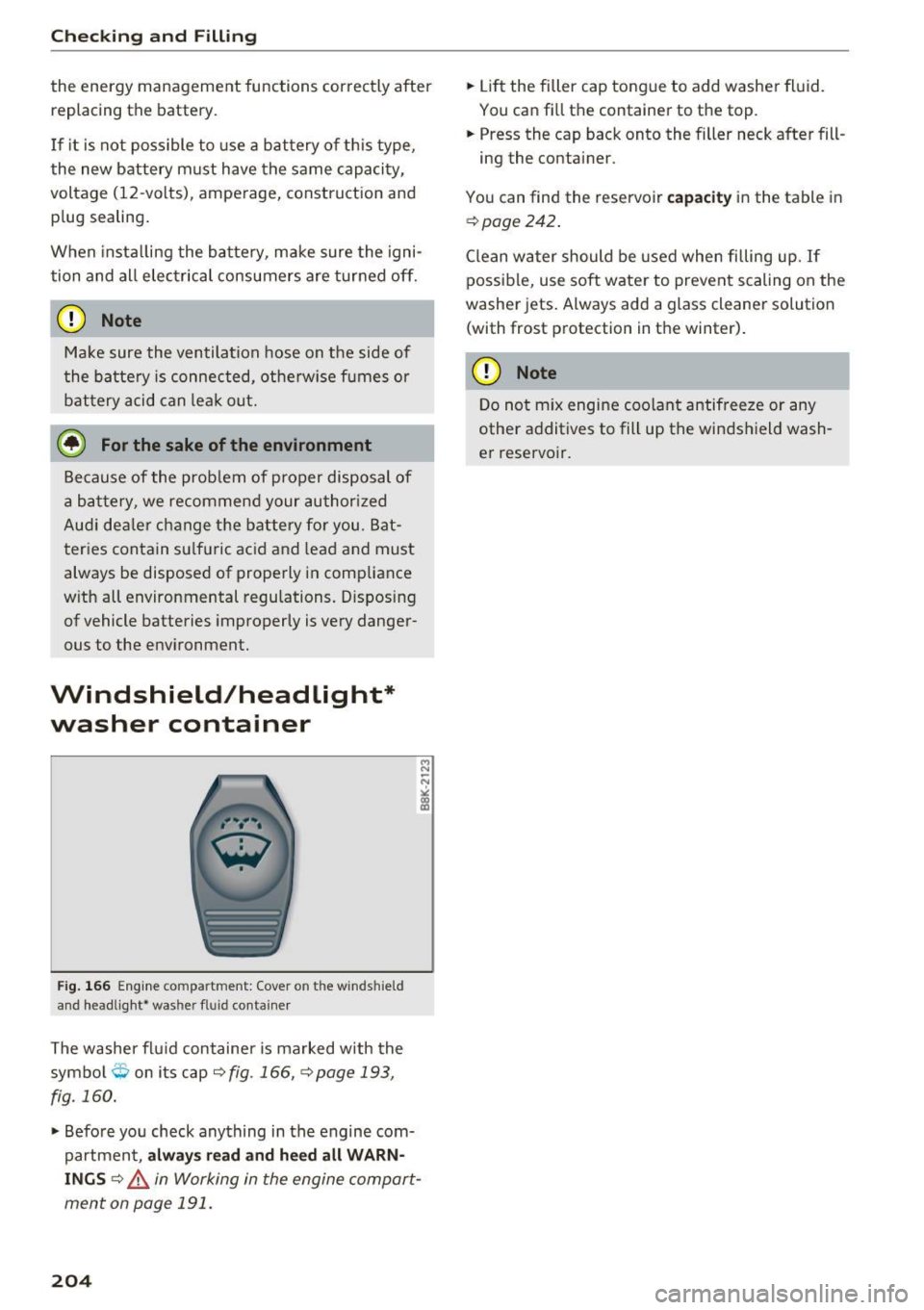
F ig. 16 6 Engine co mpar tment : Cove r o n th e w ind shie ld
and head lig ht ' was her fluid conta iner
The washer fl uid containe r is m arked with the
symbo l
O on its cap ~ fig. 166 , ¢ page 193 ,
fig . 160 .
.,. Befo re yo u check anything in the engine com
partment,
alway s read and heed all WARN
INGS ¢,& in Working in the engine compor t
ment on page 191.
204
.,. Lift the filler cap tongue to add washe r fl uid.
You ca n fill the conta iner to the top.
.,. Press the cap back onto the filler neck after fill -
ing the container .
You can find the reservoir
capacit y in the table in
~ page 242.
Clean water should be used when filling up . If
possib le , use soft wate r to prevent scaling on the
washer jets. Always add a glass cleaner solution
(with frost p rotection in the winter) .
CD Note
Do not mix engine coolant antifreeze or any
other additives to fill up the winds hield wash
er reservoir.
Page 219 of 264
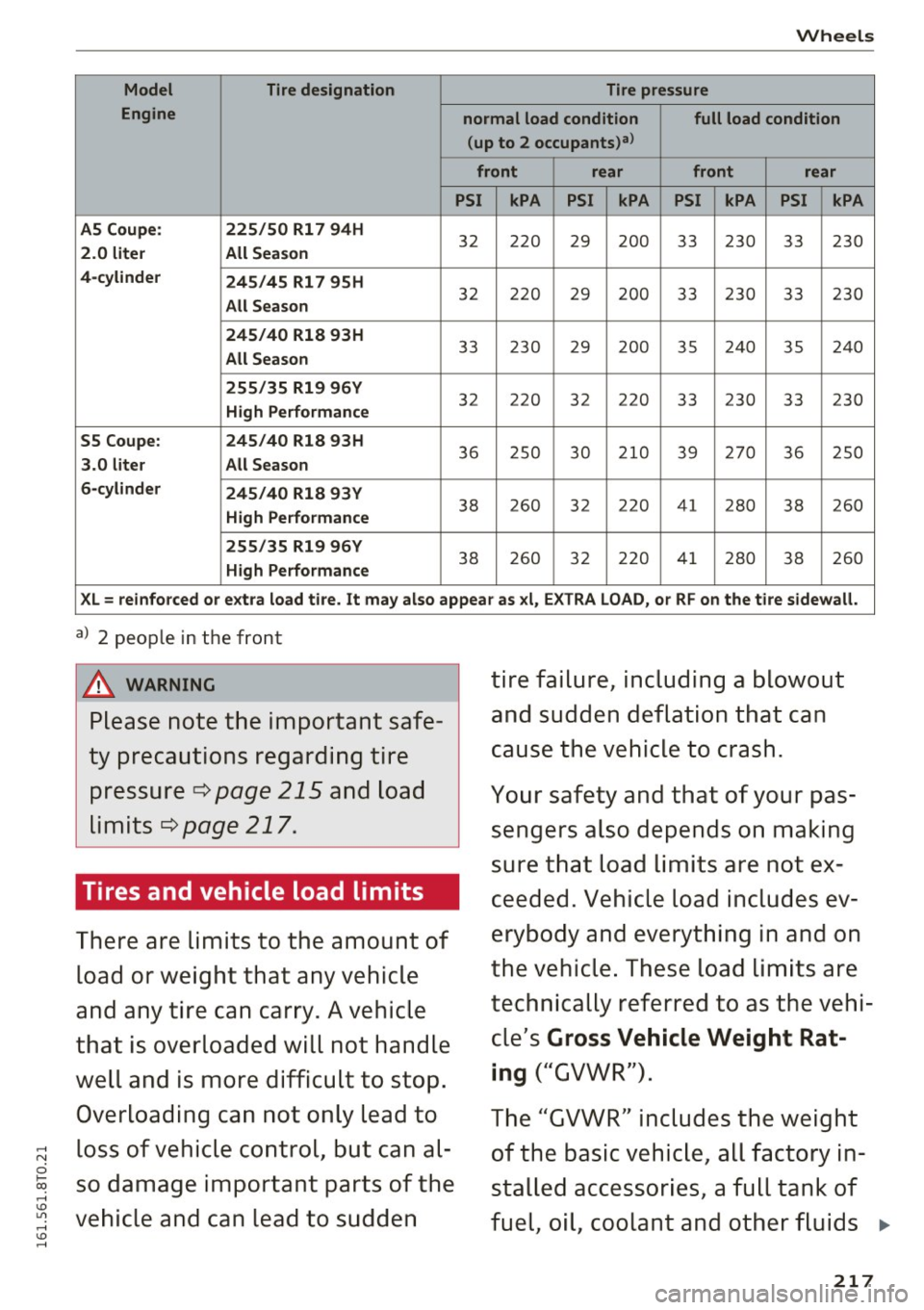
.... N
0 Ico ....
Model Tire designation Tire pressure
Engine normal load condition full load condition
(up to 2 occupants)a)
front rear front rear
PSI kPA PSI kPA PSI kPA PSI kPA
AS Coupe: 225/50 Rl
7 94H
32 220 29 200 33 230 33 230 2.0 liter All Season
4-cylinder 245/45 Rl
7 95H
All Season
32 220 29 200 33 230 33 230
245/40 Rl8 93H 33 230 29 200 35 240 35 240
All Season
255/35 Rl9 96Y
3 2 22 0 32 22 0 33 230 33 230 High Performance
55 Coupe: 245/40 Rl8 93H
36
250 30 210 39 270 36 250 3.0 liter All Season
6-cylinder
245/40 Rl8 93Y
High Performance
38 2
60 3 2 22 0 41 280
38 2
60
255/35 Rl9 96Y
38 260 32 220 41
280 38 260 High Performance
XL= reinforced or extra load tire. It may also appear as xl, EXTRA LOAD, or RF on the tire sidewall.
a) 2 people in the front
_& WARNING
Please note the important safe
ty precautions regarding tire pressure
¢page 215 and load
limits¢
page 217.
Tires and vehicle load limits
There are limits to the amount of
load or weight that any vehicle
and any tire can carry. A vehicle
that is overloaded will not handle
well and is more difficult to stop.
Overloading can not only lead to
loss of vehicle control, but can al
so damage important parts of the
vehicle and can lead to sudden tire failure, including a blowout
and sudden deflation that can
cause the vehicle to crash.
Your safety and that of your pas
sengers also depends on making
sure that load limits are not ex
ceeded. Vehicle load includes ev
erybody and everything in and on
the vehicle. These load limits are
technically referred to as the vehi cle's
Gross Vehicle Weight Rat
ing
("GVWR").
The "GVWR" includes the weight
of the basic vehicle, all factory in
stalled accessories, a full tank of
fuel, oil, coolant and other fluids ..,
217
Page 227 of 264
,-1 N
0 1-CX)
,-1 I.Cl U"I
,-1 I.Cl ......
Emergency assistance
Vehicle tool kit
The tools ore stored underneath the floor panel
in the luggage comportment.
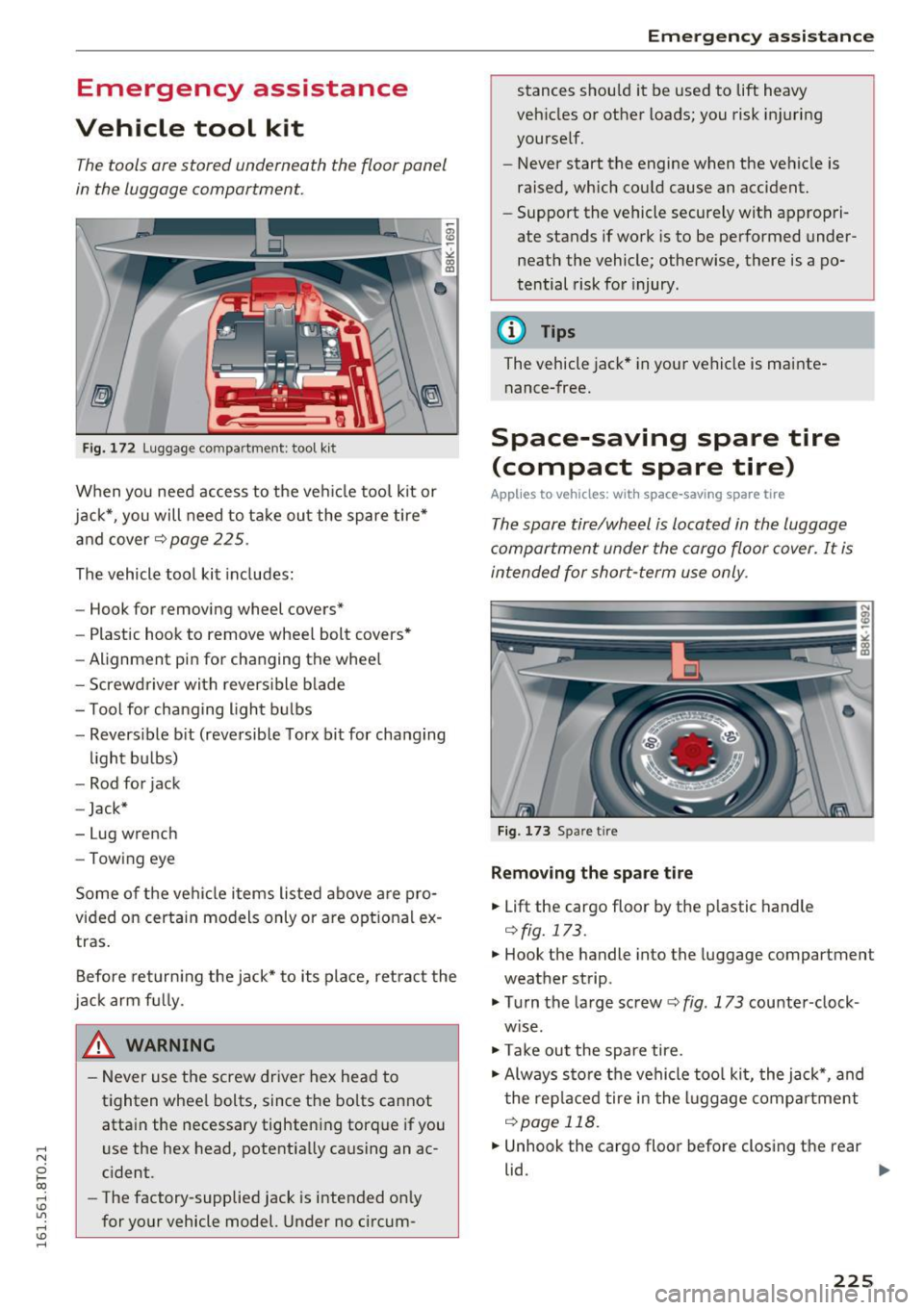
Fig. 172 Luggage compartment: tool ki t
When you need access to the veh icle tool kit or
jack*, you will need to take out the spare tire*
and cover
qpoge 225.
The vehicle tool kit includes:
- Hook for removing wheel covers*
- Plastic hook to remove wheel bolt covers*
- Alignment pin for changing the wheel
- Screwdriver with reversible blade
- T ool for changing l ight bulbs
- Revers ible b it (reversible Torx bit for changing
li ght bulbs)
- Rod for jack
- Jack*
- Lug wrench
- Towing eye
Some of the vehicle items listed above are pro
vided on certa in models only or are optional ex
tras.
Before return ing the jack* to its place, retract the
jack arm f ully.
_& WARNING
-Never use the screw driver hex head to
tighten wheel bolts, since the bo lts cannot
attain the necessary tightening torque if you
use the hex head, potentially causing an ac
c ident.
- The factory-supplied jack is intended on ly
for your vehicle model. Under no circum-
Emergency assistance
stances s hou ld it be used to lift heavy
vehicles or other loads; you risk injuring
yourself.
- Never start the engine when the vehicle is
raised, which could cause an accident.
- Support the vehicle securely with appropri
ate stands if work is to be performed under
neath the vehicle; otherwise, there is a po
tential risk for injury .
(D Tips
The vehicle jack* in your vehicle is mainte
nance-free.
Space-saving spare tire (compact spare tire)
Applies to veh icles: w ith space-sav ing spare t ire
The spore tire/wheel is located in the luggage
comportment under the cargo floor cover . It is
intended for short-term use only .
Fig. 173 Spare tir e
Removing the spare tire
.. Lift the cargo floor by the p lastic handl e
qfig. 173.
.. Hook the handle into the lugg age compartment
weather strip .
.,. Turn the large screw
qfig. 173 counter-clock
w ise.
.. Take out the spare tire .
.. Always store the vehicle tool kit, the jack *, and
t he replaced tire in the luggage compartment
qpoge 118.
.. Unhook the cargo floor before closing the rear
lid . ...
225