warning light AUDI S5 COUPE 2016 Manual PDF
[x] Cancel search | Manufacturer: AUDI, Model Year: 2016, Model line: S5 COUPE, Model: AUDI S5 COUPE 2016Pages: 264, PDF Size: 66.92 MB
Page 174 of 264
Intelligent Technology
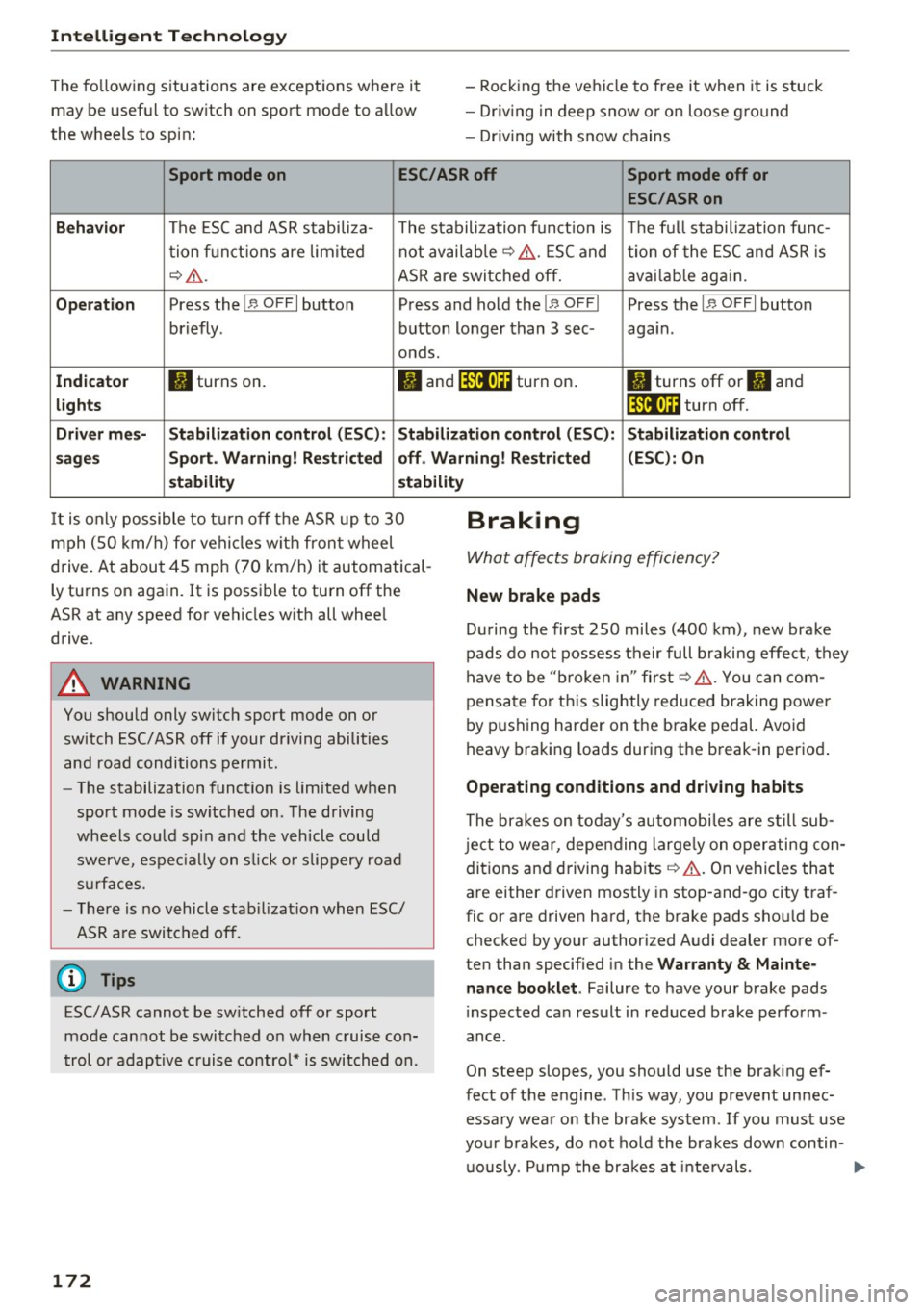
The fo llowing s ituations are exceptions where it
may be useful to switch on sport mod e to a llow
the wheels to sp in : -
Rock ing the vehicle to free it when it is stuck
- Dr iv ing in deep snow or o n loose g ro und
- Dr iving with snow chains
Sport mode on ESC/ASR off Sport mode off or
ESC/ASRon
Beha vior
The ESC and ASR stabiliza- The stabilization funct ion is The f ull stabilization fun c-
t ion f un ct ions are lim ited not availab
le ¢ ,&. . ESC and
tion of the ESC and ASR is
¢ .&. .
ASR are switched off. ava ilab le aga in.
Op era tion Press the I 1> OFF I button Press and hold the !1> O FFI Press the I,, OFF I button
briefly . button longer than 3 sec- again.
onds .
In dicato r II turns on.
• and lf'lii•li~ turn on . II turns off or II and
light s lf'lii•l~~ turn off.
Driv er m es- Stabilization contr ol (E S C): Stabilization control (ESC ): Stabilization control
s age s Sport. Warning! Restri cted off . Warning ! Re stri cted (ESC
): On
s t a bilit y stabilit y
It is only possible to t urn off the ASR up to 30
mph (SO km/h) fo r vehicles w ith front wheel
d rive. At about 45 mph (70 km/h) it automatical
ly tu rns on again. It is possible to turn off the
ASR at any speed for vehicles w ith all whee l
drive .
A WARNING
You should only switch sport mode on or
switch ESC/ASR off if your driving abilities
and road conditions permit .
-
-The stabilization function is limited when
sport mode is sw itched on . The driving
wheels co uld spi n and the vehicle could
swerve , espec ia lly on s lick o r slippery road
s ur faces.
- The re is no vehicle stab ilizat ion when ESC/
ASR a re switched off.
(D Tips
ESC/ASR cannot be sw itched off or sport
mode cannot be switched on when cruise co n
t rol or adaptive cruise control* is switched on .
172
Braking
What affects braking efficiency?
New brake pads
D ur ing the first 250 miles (400 km) , new brake
pads do not possess their full b raking effe ct, they
have to be "b roken in" first ¢,&. . You can com
pensa te for th is slightly reduced b raking power
by p ushing harder on the brake pedal. Avo id
heavy braking loads dur ing the break-in period .
Operating conditions and driving habits
The brakes on today's automobi les are s till sub
je ct to wear, depending large ly on operating con
dit ions and driving habits ¢.&. . On vehi cles that
a re either driven mostly i n stop-and-go city traf
fic or are drive n hard, the b rake pads sho uld be
checked by your authorized A udi dealer more of
ten than specified in the
Wa rrant y & Mainte
nance book let .
Failure to have your brake pads
i nspected can result in reduced brake perform
ance .
On steep slopes, you should use the brak ing ef
fect of the engine . Th is way, you prevent unnec
essary wear on the brake system . If you must use
your brakes, do not ho ld the bra kes down contin
u ously. P ump the bra kes at inte rvals.
Page 176 of 264
Intelligent Technology
Clean off accumulated salt coating from
brake discs and pads with a few caref ul
brake app lications.
- If you damage the front spoiler, or if yo u in
stall a d ifferent spoiler, be sure the air flow
to the front brakes is not obstructed. Other
wise the brake system could overheat reduc
ing the effectiveness of the entire b rake sys
tem.
- Failure of one brake c ircuit will impair the
bra king capability res ult in g in an increased
stopp ing distance. Avoid driving the vehicle
and h ave i t towe d to the ne arest author ized
Audi dealer or quali fied workshop.
- Never let the vehicle roll to a s to p wi th the
eng ine shut off.
- I f the bra ke booste r is not wor kin g, the
bra ke pe dal m ust be presse d considerably
harder to make up for the lac k of b oos ter
assistance .
Electro-mechanical
power assist, dynamic
steering
The electro-mechanical power assist helps the
driver when steering.
Power steering adapts electronically based on
the vehicle speed .
Indicator lights and mess ages
• Steering defective! Do not dri ve vehicle!
If thi s ind icator light tu rns on and stays o n and
this message appears, t he power steering may
have fa iled.
D o
not conti nue d riving. See yo ur autho riz ed
Aud i dea ler o r a q ua lified repair facility fo r assis
tance.
l;r-ij Dynamic steering : Sy stem fault! You can
c ontinue driving
If t he i ndicator lig ht t urns on and the message
appears, the steering may be more difficult to
move or mo re sens it ive than usual. The steer ing
wheel may also be a t an an gle when dr iv ing
s tra ight .
174
Drive slowly to your a uth orized Audi dea ler or
qualified workshop to have the malfunction cor
r ected.
'I-ij Dynamic steering: initializing
If this d rive r message appea rs and t he in dicator
li ght is flashing on the instr ume nt pa nel, dynam
ic steer ing * is being re ini tiali zed. After s tarting
the e ngine, t he s teer ing whee l w ill move sligh tly.
Re -initializa tion might be necessary if the steer
ing whee l was moved hard to the left and right
whi le the vehicle was not moving . T he d isp lay
goes out as soon as initiali zation is comp lete.
A WARNING
-
H ave the dynamic steering* system malfunc-
tion repaired as soon as poss ible by an au
thor ized Audi dealer or qualified workshop -
risk of acc ident!
@ Tips
- If the . or 'I-ij indicator light only stays on
for a sho rt time, you may cont inue driving.
- The dynamic steerin g* stab ility systems a re
not ava ilable in the event of a system mal
function .
- For add itiona l information on dynamic
steeri ng*, refer to
<=> page 102.
Driving with your
quattro
Applies to vehicles: with all-whee l dr ive
With all-wheel drive, all four wheels are driven.
General informat ion
With a ll-w heel d rive, power is distri buted to a ll
fo ur wheels. This happens automat ica lly depend
i ng on your d riving style a nd the roa d conditions
at the t ime . See also
c> page 170.
A center d ifferen tial d istr ibu tes the dr iving powe r
variab ly to the front and rear ax le.
It works to
gether w it h select ive whee l torque contro l, w hich
ac tiv ates w hen d rivi ng thro ugh curves
<=> page 171. With the spo rt different ial *, power
distribution to the rear wheels is variable and can
be adjusted with drive select<::>
page 102. .,.
Page 183 of 264
.... N
0 Ico ....
General information
Your Audi was designed primarily for passenger
transportation .
If you plan to tow a trailer, please remember that
the additional load will affect durability, econo my and performance.
T railer towing not only places more stress on the
vehicle, it also calls for more concentration from
the driver.
For this reason, always follow the operating and
driving instructions provided and use common
sense.
Technical requirements
Trailer hitch
Use a weight-carrying hitch conforming to the
gross trailer weight. The hitch must be suitable
for your vehicle and trailer and must be mounted
securely on the vehicle's chassis at a technically
sound
location . Use only a trailer hitch with a re
movable ball mount . Always check with the trail
er hitch manufacturer to make sure that you are
using the correct hitch.
Do not use a bumper hitch.
The hitch must be installed in such a way that it
does not interfere with the impact -absorbing
bumper system . No modifications should be
made to the vehicle exhaust and brake systems .
From time to time, check that all hitch mounting
bo lts remain securely fastened.
When you are not towing a trailer,
remove the
tra iler hitch ball mount . This prevents the hitch
from causing damage should your vehicle be
struck from beh ind ¢
,&. .
Trailer brakes
If your trailer is equipped with a braking system,
check to be sure that it conforms to all regula
tions .
Trailer mode
The trailer hydraulic brake system must not be
directly connected to the vehicle's hydraulic
brake system ¢.&. .
Safety chains
Always use safety chains between your vehicle
and the trailer.
Trailer lights
T ra iler lights must meet all regulations . Be sure
to check with your author ized Audi dealer for cor
rect wiring, switches, and relays.
Mirrors
If you are unable to see the traffic behind you us
ing the regular outside mirrors, then you
must in
stall extended mirrors. It is important that you
always have clear vision to the rear.
,8. WARNING
-If a trailer has electrical brakes please note
that these brakes are not activated by the
factory-fitted control unit -risk of accident!
- After removing the trailer hitch, do not store it in your vehicle. In case of sudden
braking, the hitch could fly forward and in
jure you or your passengers.
Operating instructions
Maximum trailer weight
A trailer for your vehicle is limited to a typical
class 1 or class 2 trailer.
Trailer load distribution
Be sure the load in the trailer is held securely in
place to prevent it from shifting forward, back
ward or sideways.
Never allow a passenger to ride in a trailer¢.&.
in Driving instructions on page 182.
Engine cooling system
Towing a trailer makes the engine work harder . It
is important that the cooling system's perform
ance is up to the additional load . Make sure that
the cooling system has enough fluid. .,..
181
Page 184 of 264

Trailer mode
Tire pressure
When towing a trailer, inflate the tires of you r
veh icle to the cold tire pressure listed under "Fu ll
load" on the label located on the driver's side B
pillar (visib le when the door is open) . Inflate
trai ler tires to trailer and tire manufacturers'
specifications.
Lights
The headlight settings should be checked with
the trailer attached before driving off. Check to
make sure both vehicle and trailer lights are
working properly .
Safety chains
Be sur e trailer safety chains are properly connect
ed from the trai ler to the hitch on the vehicle .
Leave enough slack in the chains to permit turn
ing corners . When you install safety chains, make
sure they w ill not drag on the road when you are
driving.
The chains shou ld cross under the trailer tongue
to prevent it from dropping in case of separation
from the hitch.
Driving instructions
Driving with a trailer always requires extra care
and consideration.
To obtain the best possible handling of vehicle
and trailer, please note the fo llowing :
.. Do not tow a loaded trailer when your car itself
is not load ed .
.. Be especia lly carefu l when passing other
vehicles .
.. Observe speed limits.
.. Do not drive at the maximum permissible
speed .
.. Always apply brakes early.
.. Monitor the temperature gauge .
Weight distribution
Towing a loaded trailer with an empty car resu lts
in a high ly unstable distribution of weight. If this
cannot be avo ided, drive at very low speeds only
to avoid the risk of losing steering control.
182
A "balanced" rig is easier to operate and control.
This means that the tow vehicle shou ld be loaded
to the extent possible and permissib le, wh ile
keeping the trailer as light as poss ible under the
c ir cumstances . Whenever possible, transfer
some cargo to the luggage compartment of the
tow veh icle while observing tongue load require
ments and vehicle load ing considerations .
Speed
The higher the speed, the more difficult it be
comes for the driver to control the r ig. Do not
drive at the maximum permissible speed. Reduce
your speed even more if load, weather or wind
cond it ion s are unfavorab le -particularly when
go ing downh ill.
Reduce vehicle speed
immediately if the trailer
shows the slightest sign of sway ing .
Do not try
to stop the swaying by accelerating.
Observe speed limits. In some areas, speeds for
vehicles towing tra ilers are lower than for regular
vehicles.
Always apply brakes early. When driving down
hill, shift into a lower gear to use the engine
braking effect to slow the vehicle . Use of the
brakes alone can cause them to overheat and fail.
Coolant tempe rature
The coolant temperature gauge c::> page 10 must
be observed carefully.
If the needle moves close
to the upper end of the scale, reduce speed im
med iately and/or turn off the a ir cond itioner .
If the coolant temperature warning light . in
the instrument cluster starts flashing, pull off
the road, stop and let the engine
idle for about
two m inutes to prevent heat build-up .
A WARNING
Anyone not properly restrained in a moving
vehicle is at a much greater risk in an acci
dent. Never let anyone ride in your car who is
not properly wearing the restraints provided
by Audi.
-
Page 186 of 264
Care and cleaning
Care and cleaning
General information
Regular, proper care helps to maintain your vehi
cle's value.
It can also be a requirement when
submitting warranty claims for corrosion damage
and paint defects on the body.
The necessary care products can be obtained
from your authorized Audi dealer . Read and fol
low the instructions for use on the packaging.
A WARNING
-Using cleaning and care products incorrectly
can be dangerous to your health.
-Always store cleaning and care products out of reach of children to reduce the risk of poi
soning .
@ For the sake of the environment
-Preferably use environmentally-friendly
products when buying cleaning agents.
- Do not dispose of leftover cleaning and care
products with household trash.
Car washes
The longer that deposits remain on the vehicle,
the more the surface may be damaged. High
temperatures such as those caused by sunlight
increase the damaging effect.
Before washing, rinse
off heavy deposits with
plenty of water.
Stubborn deposits such as bird droppings or tree
sap are best removed with plenty of water and a
microfiber cloth.
Also , wash the underside of your vehicle once
road sa lt stops being used for the season.
Pressure washers
When washing your vehicles with a pressure
washer, always follow the operating instructions
provided with the pressure washer. This is espe
cially important in regard to the pressure and
spraying distance . Do not aim the spray directly
at seals on side windows, doors, the hood, the
luggage compartment lid or the sunroof* or at
184 tires,
rubber hoses, insulating material, sensors*
or ca mer a lenses*. Keep a distance of at least
40.64 cm (40 cm).
Do not remove snow and ice with a pressure
washer.
Never use rotary nozzles or high pressure noz
zles.
The water temperature must not be above 140 °F
(60
°() .
Automatic car washes
Spray off the vehicle before washing.
Make sure that the windows and roof* are closed
and the windshield wipers are
off . Follow instruc
tions from the car wash operator, especially if
there are accessories attached to your vehicle.
If possible, use car washes that do not have
brushes.
Washing by hand
Clean the vehicle starting from the top and work
ing down using a soft sponge or cleaning brush.
Use solvent-free cleaning products.
Washing vehicles with matte finish paint by
hand
To avoid damaging the paint when washing, first
remove dust and large particles from your vehi
cle. Insects, grease spots and fingerprints are
best removed with a special cleaner for matte
finish paint .
Apply the product using a microfiber cloth. To
avoid damaging the paint surface, do not use too
much pressure.
Rinse the vehicle thoroughly with water. Then
clean using a neutral shampoo and a soft micro
fiber cloth .
Rinse the vehicle thoroughly again and let it air
dry. Remove any water residue using a sham my.
A WARNING
-
- Only wash the vehicle when the ignition is
off and follow the instructions from the car
Page 193 of 264
,-1 N
0 1-CX)
,-1 I.Cl U"I
,-1 I.Cl ......
Checking and Filling Hood
Releasing and opening the engine hood
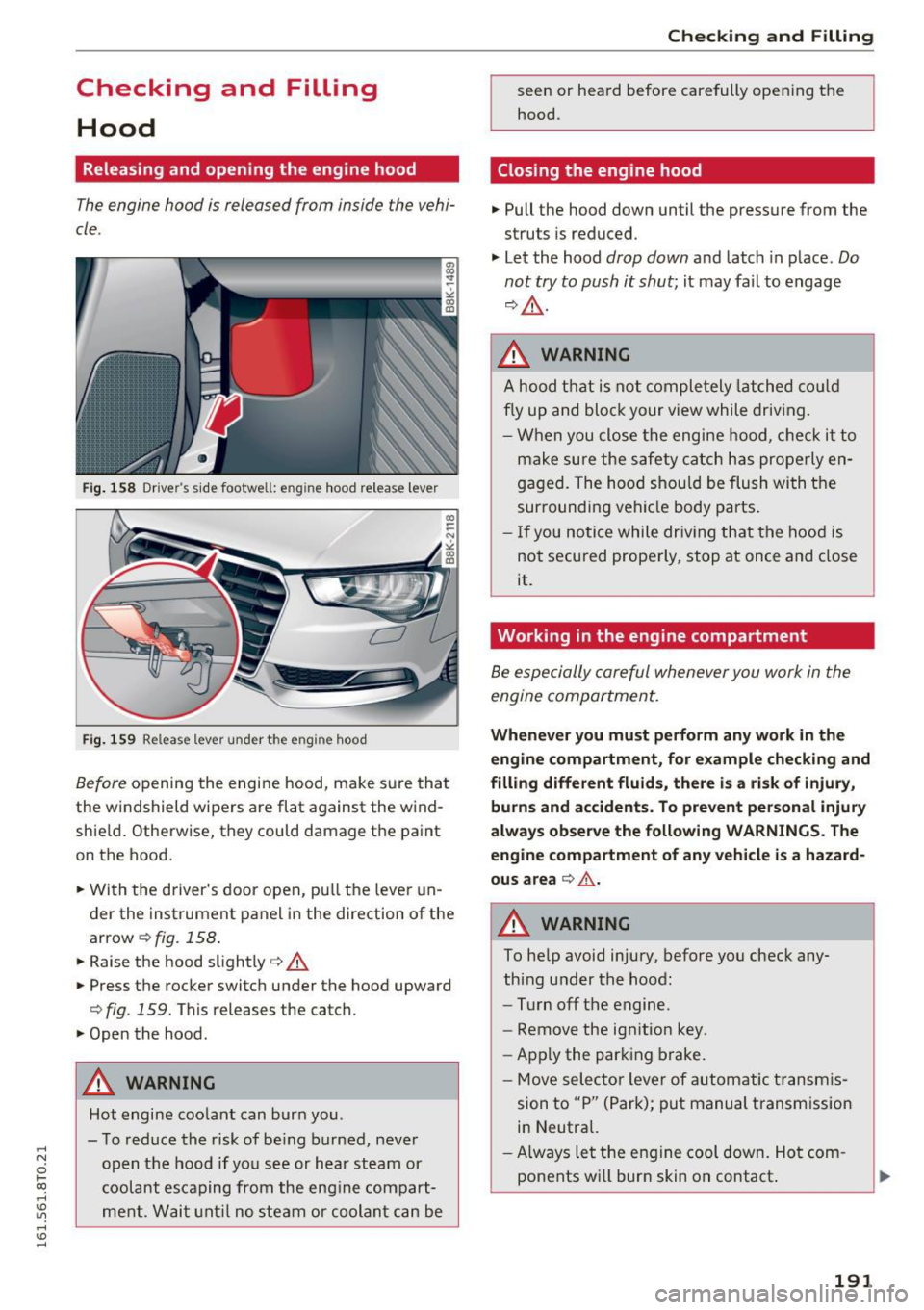
The engine hood is released from inside the vehi
cle.
Fig. 158 Driver's side footwell: engine hood re lea se lever
Fig. 159 Release lever under the engine hood
Before opening the engine hood, make sure that
the windshield wipers are flat against the wind
shield. Otherwise, they could damage the paint
on the hood.
.. With the driver's door open, pull the lever un
der the instrument panel in the direction of the
arrow
¢ fig. 158.
.. Raise the hood slightly¢&.
.. Press the rocker switch under the hood upward
¢fig . 159. This releases the catch.
.. Open the hood.
A WARNING
Hot engine coolant can burn you.
- To reduce the risk of being burned, never
open the hood if you see or hear steam or
coolant escaping from the engine compart
ment. Wait until no steam or coolant can be
Checking and Filling
seen or heard before carefully opening the
hood.
Closing the engine hood
.. Pull the hood down until the pressure from the
struts is reduced .
.,. Le t the hood
drop down and latch in place. Do
not try to push it shut;
it may fail to engage
¢&, .
A WARNING
A hood that is not completely latched could
fly up and block your view while driving.
- When you close the engine hood, check it to
make sure the safety catch has properly en
gaged. The hood should be flush with the
surrounding vehicle body parts.
- If you notice while driving that the hood is
not secured properly, stop at once and close
it.
Working in the engine compartment
Be especially careful whenever you work in the
engine compartment.
-
Whenever you must perform any work in the
engine compartment, for example checking and
filling different fluids, there is a risk of injury, burns and accidents. To prevent personal injury
always observe the following WARNINGS. The
engine compartment of any vehicle is a hazard
ous area
¢ .&. .
A WARNING
-~
To help avoid injury, before you check any
thing under the hood:
- Turn off the engine.
- Remove the ignition key .
- Apply the parking brake.
- Move selector lever of automatic transmis-
sion to "P" (Park); put manual transmission
in Neutral.
-Always let the engine cool down. Hot com
ponents will burn skin on contact.
191
Page 195 of 264
,-1 N
0 1-CX)
,-1 I.Cl U"I
,-1 I.Cl ......
Checking and Filling
Engine compartment
Engine compartment
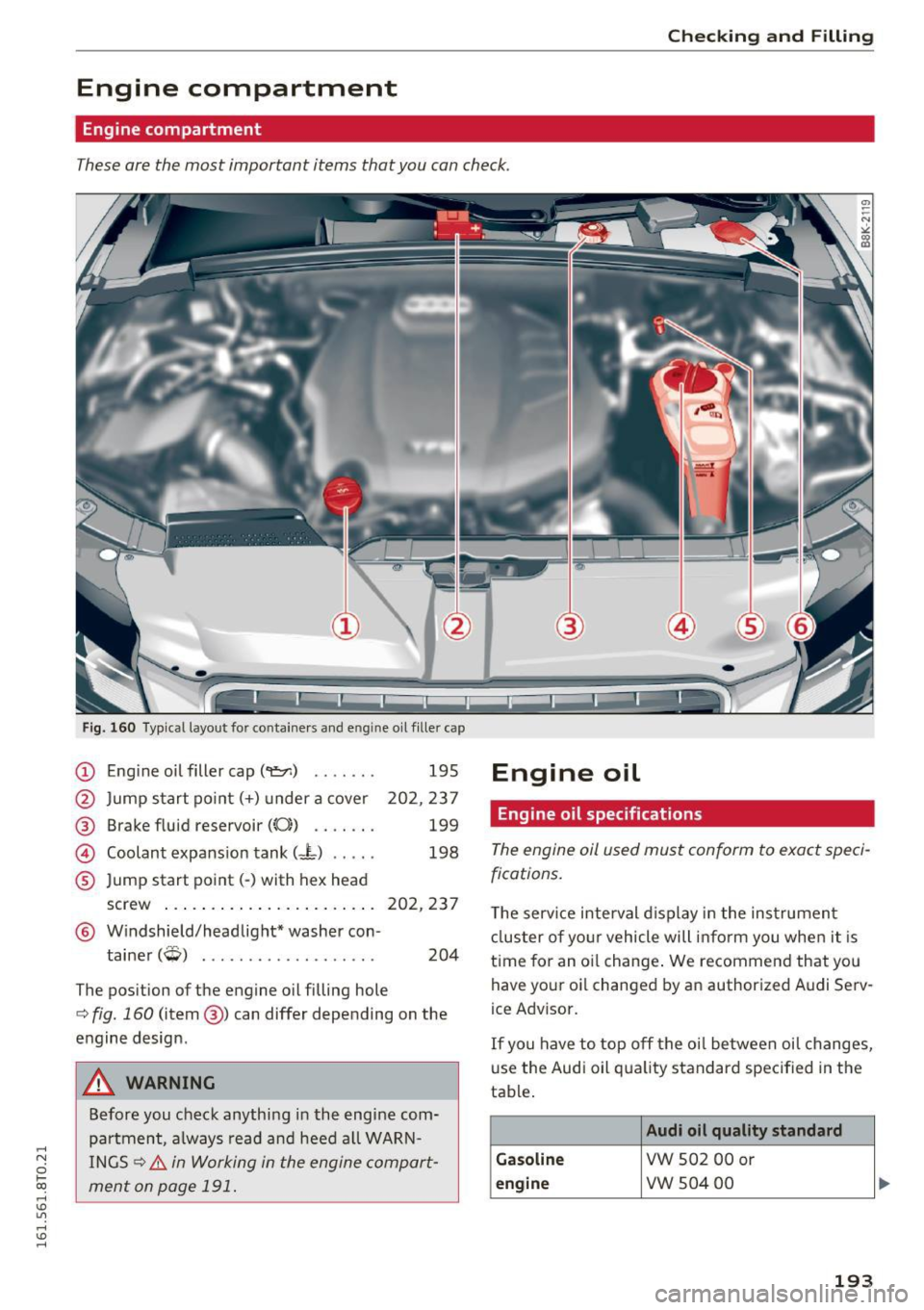
These are the most important items that you can check.
Fig. 160 Typical layout for containers and e ngin e oil fille r cap
(D Eng ine o il filler cap (
@ Brake fluid reservoir
((0) ...... .
@ Coolant expansion tank (- L) .... .
® Jump start point( -) with hex head
195
202,237
199
198
screw . . . . . . . . . . . . . . . . . . . . . . . 202, 237
@ Windshield/headlight* washer con-
tainer
(W) . . . . . . . . . . . . . . . . . . . 204
The position of the engine oil filling hole
c:> fig. 160 (item @) can differ depending on the
engine design .
A WARNING
Before you check anything in the engine com
partment, always read and heed all WARN
INGS
c:> &. in Working in the engine compart
ment on page 191.
Engine oil
Engine oil specifications
The engine oil used must conform to exact speci
fications.
T he serv ice interval display in the instrument
cluster of your vehicle will inform you when it is
time for an oi l change . We recommend that you
have your oi l changed by an authorized Audi Serv
ice Advisor.
If you have to top off the oil between oil changes,
use the Audi oil quality standard specified in the
table .
Audi oil quality standard
Gasoline
VW 502 00 or
engine vw 504 00
193
Page 196 of 264
Check ing and F illing
Using the proper engine oil is impo rtant for the
functionality and service life of the engine. Your engine was facto ry-filled with a h igh-quality oi l
which can usually be used throughout the entire
year.
@) Note
Your Limited New Vehicle War ranty does not
cover damage or malfunctions due to failure
to follow recommended maintenance and use
requirements as set forth in the Audi Owner's
Manual and Warran ty
& Maintenance booklet.
- Use only a high quality eng ine oil t hat ex-
p ressly complies with the Audi oil qua lity
standard specified for your vehicle's engine .
Using a ny o ther oil can cause serious engine
d am age.
- D o not mix any lubricants o r other addit ives
i nto the engine oil. Doing so ca n cause en
g ine damage.
(D Tips
I f you need to add oil and there is none availa
ble t hat meets the Audi o il quality standard
your eng ine requi res , you m ay ad d a tot al of
no more than 0.5 qu art /li ter o f a h igh-quality
"synthe tic"oil that meets t he following speci
fications.
- Vehicles w it h gasoline eng ine: AC EA A3 o r
API SM with a viscosity grade of SAE 0W-30,
SAE SW -30 or SAE SW-40.
- Fo r more information about en gine o il that
has been approve d for your ve hicle, please
contact eithe r you r a uthorized Aud i dea ler
or A udi C ustome r Relat ions at
1 (800) 822-2834 or visit our web site at
www .audiusa .com or www.aud icanada .ca .
Engine oil consumption
The engine in your vehicle depends on an ade
quate amoun t of oil to lubricate and cool all of
its moving parts .
In order to provide effective lubr ication and coo l
ing of in ternal engine components, all internal
combustion eng ines consume a certain amou nt
of oil. Oil co nsumption varies from engine to en
g ine and may change significant ly over the life of
194
th e engine. Typically, engines w ith a specified
break-in period (see
r=:> poge 177) consume more
o il dur ing the b reak-in per iod than they consume
after oil consumption has stabili zed .
U nder normal cond itions, the rate of oil con
sumption depends on the q ua lity and viscosity of
the oil, the RPM (revo lutions per m inute) at
which the engine is operated, the ambient tem perature and road condit ions. Further factors are
the amo unt of o il di lution from water condensa
t ion or fuel residue a nd the oxidation level of the
o il. As any engine is subject to wea r as mileage
builds up, the o il cons umption may increase ove r
t i me unt il repla ce m ent of wo rn components m ay
be come necessary .
With a ll these va riab les coming into p lay, no
sta ndard rate of o il cons umption can be estab
li sh ed or spec ified . T he re is no alte rn ative to reg
ul ar and frequen t checking of the oi l level, see
Note .
If the yellow engine oi l leve l wa rning symbo l Ill
in the instrument clus ter lights up , you sho uld
c h eck t he o il level as soon as possible
r=:> page 195 . Top off the oi l at your ea rliest con
venience
r=:> poge 195.
A WARNING
Before you check anyth ing in the engine com
partment, always read and heed all WARN
INGS
r=:> .&. in Working in the engine compart
ment on page 191.
@ Note
D riving wit h an insuffic ient oil level is like ly to
cause severe damage to the eng ine.
(D Tips
- The oil pressure warning display. is not
an indicator of the oil level. Do not rely on
it . Instead, check the oil level in your en
gine at regular intervals, preferably each
time you refuel, and always before going
on a long trip .
-If you have the impress io n your e ngine con
sumes excessive amou nts of oil, we recom-
mend th at yo u consult an authori zed A udi .,.
Page 199 of 264
.... N
0 Ico ....
er's glycol-basedcoo lant additive Gl3 antifreeze
with anticorrosion additives (50% for USA mod
e ls; 60% for Canadian models). This m ixture
both assures the necessary frost protection and
protects metal components in the engine's cool
ing system from corrosion and scaling.
It also
raises the boiling point of the coolant .
Do not reduce the concentration of the coolant in
the summer by adding plain water.
Th e propor
tion of coolant addit ive must be at l eas t 50° /4
but not more th an 60 %
to maintain antifreeze
p rotection and cooling efficiency. If the coolant
frost protec tion is too low, the coolant co uld
freeze and damage the vehicle heating and en
gine cooling system.
F or yea r-round driving, antifreeze is added at the
factory for temperatures down to:
- -31 °F (- 35 °C) USA
- -40 °F ( - 40 °C) Canada.
If you must add coolant, use a mixture of water
and coolant addit ive. Mixing the coolant additive
with distilled water is recommended.
A WARNING
Before you check anything in the engine com
partment, always read and heed all WARN
INGS
Q &. in Working in the engine compart
ment on page 191.
(D Note
- Before winter sets in, have the coolant
checked to see if the coolant additive in your
vehicle is sufficient to meet the climate con
dit ions. This is especially important if you
li ve in a reg ion where the w inte r is ext reme
l y co ld. If ne cessary, in cre ase the proport io n
of coo lant add itive to 60%.
- When addi ng coolant addit ive to you r cool
i ng system, remember:
- We recommend using only coolant addi
tive Gl2++ or Gl3 for your ve hicle. T his
coolant additive is available at authorized
Audi dea lers. Othe r types of antifreeze can
significant ly reduce cor ros ion p rotection .
Check ing and Filling
The resulting co rrosion can cause a loss of
coolant and serious engine damage.
- Do not add any type of radiator lea k sealant
to your vehicle's engine coolant. Adding ra
diator repair fluid may adversely affect the
function and performance of your cooling
system and could resu lt in damage not cov
ered by your New Veh icle Limited Warranty.
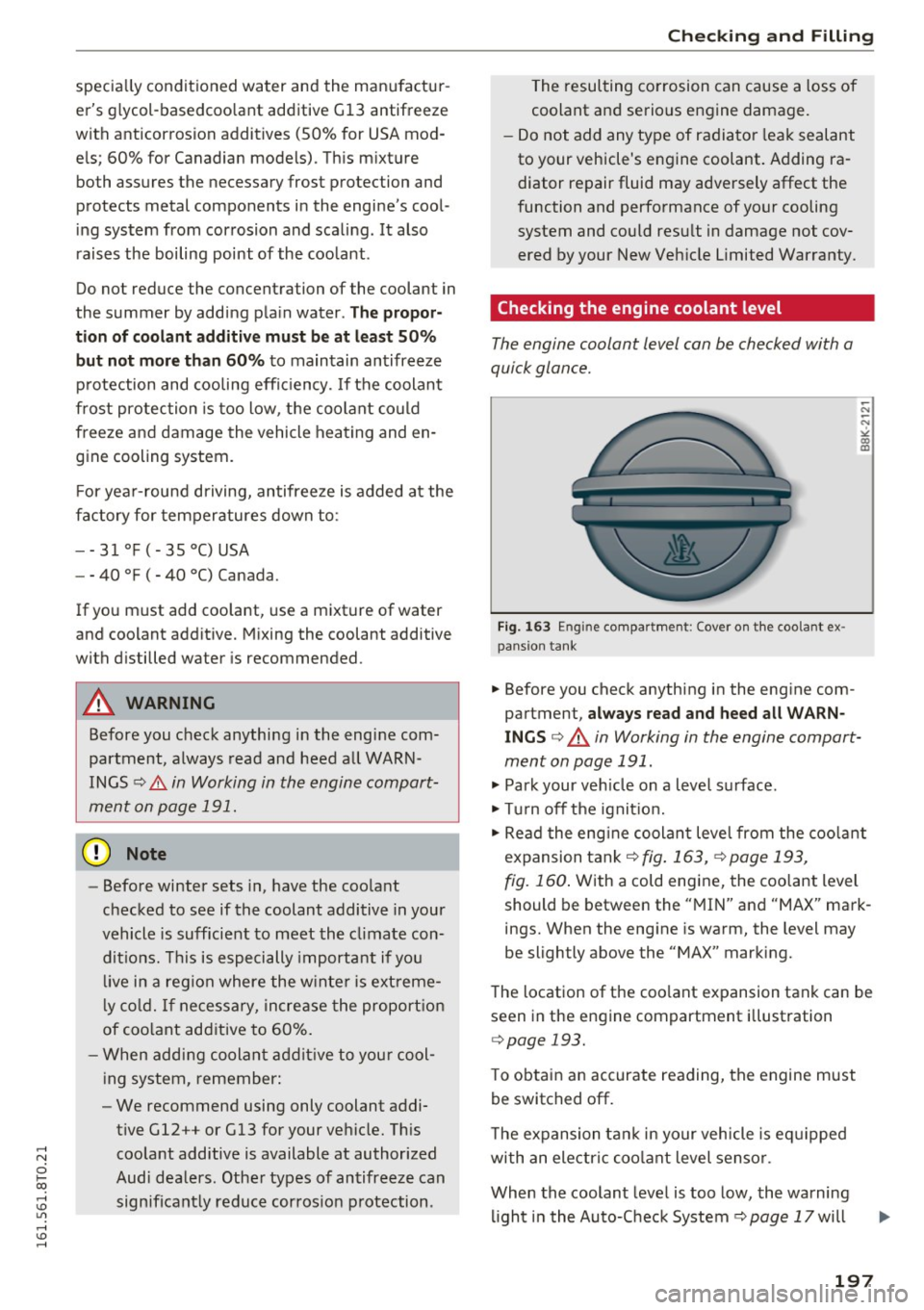
Checking the engine coolant level
The engine coolant level can be checked with a
quick glance.
F ig. 163 Engine compa rtment: Cover on the coolant ex
pans ion tank
.. Before you check anything in the engine com
partment,
al ways read and heed all WARN
INGS
q ..&. in Working in the engine compart
ment on page 191.
.. Park your ve hicle on a leve l sur face .
.. Tu rn off the ignit io n .
.. Read the eng ine coolan t level from the coo la nt
expansion tank
qfig . 163, Qpage 193,
fig. 160 .
With a cold engine, the coolant level
should be between the " MIN" and "MAX" mark
ings. When the engine is warm, the level may
be slightly above the "MAX" marking.
The location of the coolant expansion tank can be
seen in the engine compartment illustration
qpage 193.
To obtain an accurate reading, the engine must
be switched off.
T he expansion ta nk in your veh icle is eq uipped
with an electric coo lant level senso r.
When the coolant leve l is too low, the warning
light i n the Auto-Check System
Q page 17 will
197
Page 201 of 264
,-1 N
0 1-CX)
,-1 I.Cl U"I
,-1 I.Cl ......
-To avoid being burned, do not spill anti
freeze or coolant on the exhaust system or hot engine parts. Under certain condi
tions, the ethylene glycol in engine cool ant can catch fire.
- Antifreeze is poisonous. Always store anti
freeze in its original container and well out
of the reach of children.
- If you drain the coolant, it must be caught
and safely stored in a proper container
clearly marked "poison".
(D Note
-Do not add coolant if the expansion tank is
empty . Air could enter the cooling system
and damage the engine.
If this is the case,
do not continue driving. Seek professional
assistance.
- Coolant pollutes the environment and could
cause an engine fire. Excess coolant will be
forced out through the pressure relief valve
in the cap when the engine becomes hot.
-If, in an emergency, only water can be add
ed, the correct ratio between water and an
tifreeze c::>
page 196 must be restored as
soon as possible.
@) For the sake of the environment
Drained coolant should not be reused. Always
dispose of used coolant while observing all
environmental regulations.
Radiator fan
The radiator fan switches on automatically by it
self.
The radiator fan is driven by the engine via the V
belt . The viscous clutch regulates the speed of
the fan according to the temperature of the cool
ant.
An auxiliary electric radiator fan* switches on and
off depending on coolant temperature and other
vehicle operating conditions.
After you switch the engine off, the auxiliary fan
can continue running for up to 10 minutes -even
Checking and Filling
with the ignition off. It can even switch on again
later by itself c::>
&, if
- the temperature of the engine coolant rises due
to the heat build-up from the engine in the en
gine compartment, or
- the engine compartment heats up because the
vehicle is parked in intense sunlight.
A WARNING
-To reduce the risk of personal injury never
touch the radiator fan.
- The auxiliary electric fan is temperature
controlled and can switch on suddenly even
when the engine is not running.
- The auxiliary radiator fan switches on auto
matically when the engine coolant reaches a
certain temperature and will continue to run
until the coolant temperature drops.
Brake fluid
Checking brake fluid level
The broke fluid level con be checked with o quick
glance .
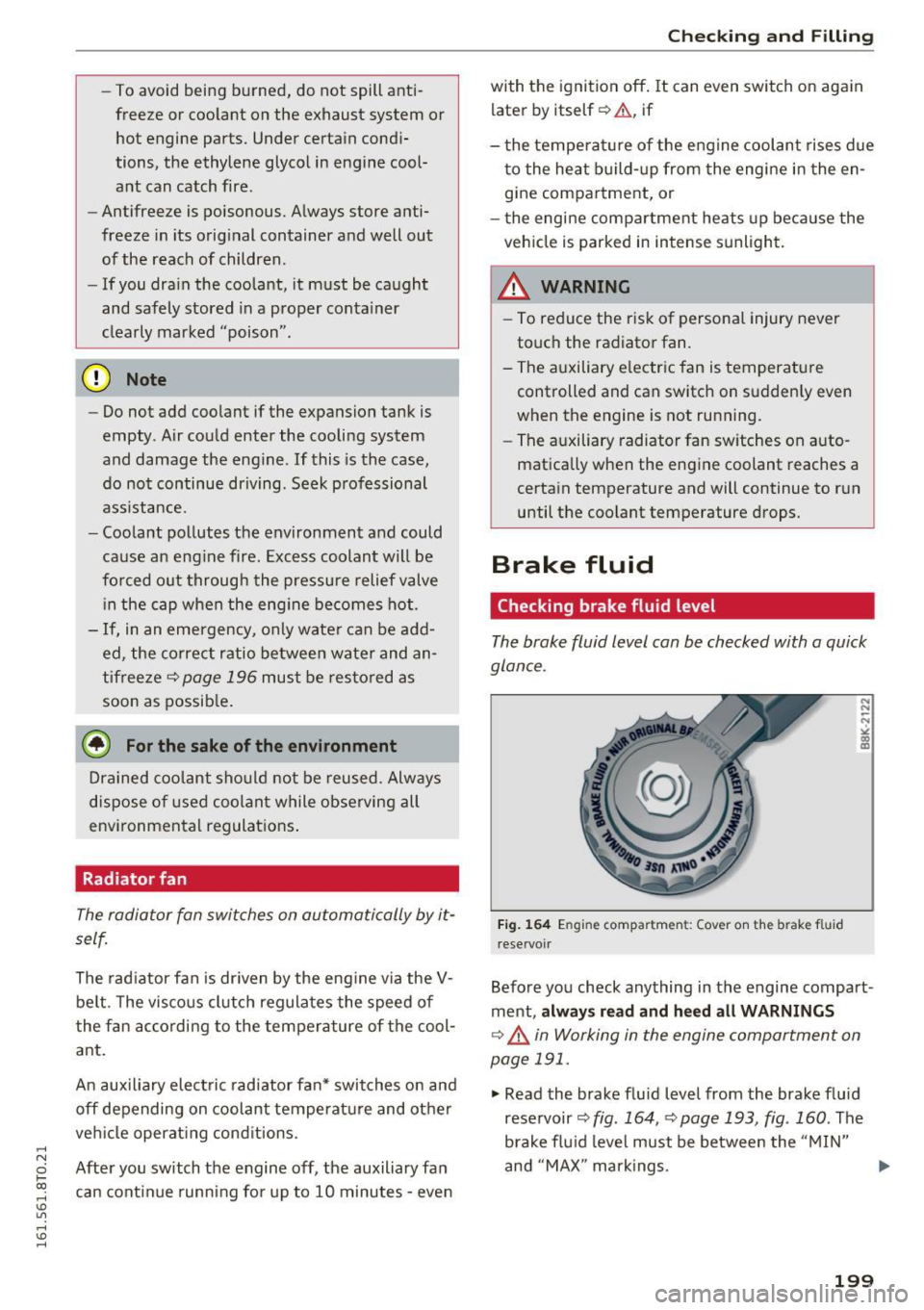
Fig. 164 Engine compartmen t: Cover on the brake flui d
re servoir
Before you check anything in the engine compart
ment,
always read and heed all WARNINGS
c::> _.& in Working in the engine comportment on
page 191.
.,. Read the brake fluid level from the brake fluid
reservoir c::>fig.164,
c::>poge 193, fig .160 . The
brake fluid level must be between the "MIN"
and "MAX" markings.
199