warning light AUDI S6 2008 Owners Manual
[x] Cancel search | Manufacturer: AUDI, Model Year: 2008, Model line: S6, Model: AUDI S6 2008Pages: 390, PDF Size: 88.42 MB
Page 306 of 390
___ C_h_ e_ c_k _in --== g'-- a_n _d_ f_il _li _n ..:::g:::..- ___________________________________________ _
le as t 50% b ut not mor e th an 60 % to maintain antifreeze protection
and cooling efficiency . If the coo lant frost protection is too low, the
coo lant could freeze and damage the vehicle heating and engine
cooling system.
For year -round driving, antifreeze is added at the factory for temper
atures down to:
• -31 °F ( -35 °C) USA
• -40 °F ( -40 °C) Canada.
You can m ix the
Gl 2 + coolant additive with other add itives (for
example
Gl 1 or Gl 2). A lways check with your authorized Audi
dea ler .
& WARNING
Before you check anyt hing in the engine comp artment , alw ays
re ad and heed all WARNINGS ~
& in "Working in the eng ine
co mpar tm ent " o n
pag e 297.
0 Note
• Before win ter sets in, have the coolant checked to see if the
coolant additive in your vehicle is sufficient to meet the climate
conditions. This is especia lly important if you live in a region where
the winter is extremely cold. I f necessary, increase the proportion of
coo lant additive to 60%.
• When adding coolant additive to your coo ling system,
remember:
-We recommend using only coolant additive
Gl 2+ (check the
label) for your vehicle. This coolant addit ive is available at autho
rized Audi dealers. Other types of antifreeze can significantly
reduce corrosion protect ion . T he resulting corrosion can cause a
loss of coolant and serious engine damage.
• Do not add any type of radiator leak sealant to your vehicle's
engine coolant. Adding radiator repair fluid may adversely affect the function and performance of your cooling system and cou
ld result
in damage not c overed by your New Vehicle Limited Warranty. •
Checking the engine coolant level
The engine coolant level can be checked with a quick
glance.
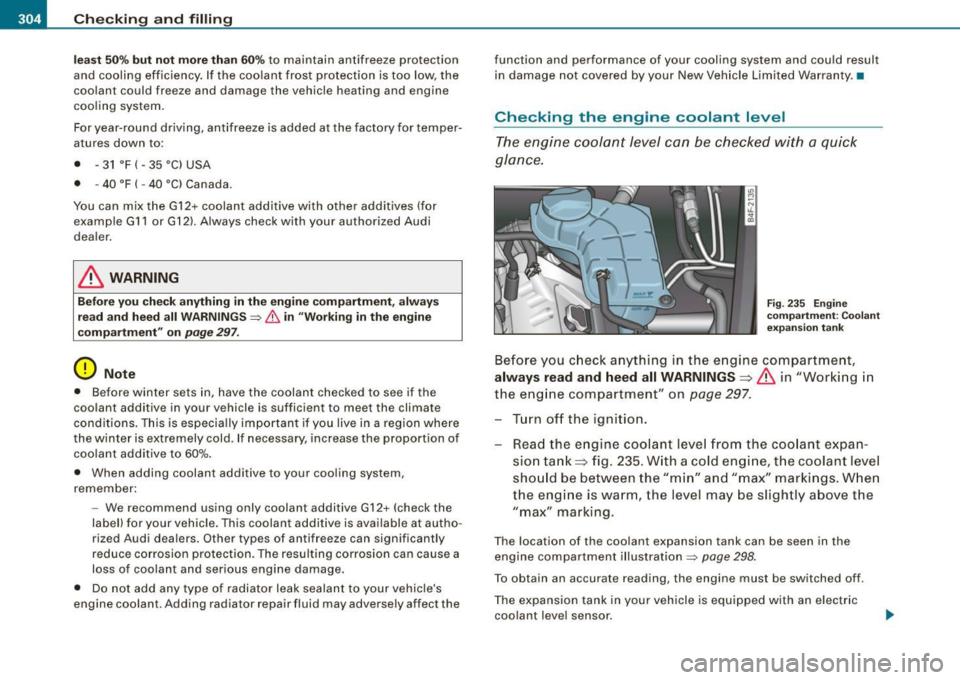
F ig . 235 Eng ine
c o mpartm ent : Cool ant
ex pa nsion tank
Before you check anything in the engine compartment,
always read and heed all WARNINGS~
& in "Working in
the e ngin e compa rtment" on
page 297 .
Turn off the ignition.
Re ad the en gine coo lant leve l from the coo lant exp an
sio n ta n k~ fig. 235. With a cold eng ine, the coolan t leve l
sho uld be between the "m in" and "max" markings. W hen
t h e eng ine is warm, the level may be s lightly abov e the
"max" marking .
The location of the coolant expansion tank can be seen in the
engine compartment illustration~
page 298.
To obtain an accurate reading, the engine must be switched off .
T he expansion tank in your vehicle is equipped with an e lectric
coo lant leve l sensor.
Page 307 of 390
_____________________________________________ C_h_ e_ c_k _in ~ g_ a_n _d_ f_il _li _n ~g __ _
•
When the coolant level is too low , the warning light in the Auto
Check System =>
page 33will blink un til you add coo lant and the
level has been restored to normal. Even though there is an electric
coolant leve l sensor, we still recommend you check the coo lant level
from time to time .
Coola nt lo ss
Coolant loss may indicate a leak in the cooling system . In the event
of coolant loss, the coo ling sys tem should be inspected immedi
ately by your authorized Audi dealer . It is not enough merely to add
coolant.
In a
s ealed system, losses can occur only if the boiling po int of the
coolant is exceeded as a result of overheating.
0 Note
Do not add any type of radiator leak sea lant to your vehicle's engine
coolant . Adding radiator repair fluid may adversely affect the func
tion and performance of your cooling system and could resu lt in
damage not covered by your New Vehic le Limited War ranty .•
Adding coolant
Be very careful when adding engine coolant.
Before you check anything in the engine compartment,
always read and heed all WARNINGS => & in "Working in
the engine compartment" on
page 297 .
- Tu rn off the engine .
- L et the engine coo l dow n.
- Place a t hick rag over the coolant expansion tank
=> page 304, fig . 235 and carefully tw ist t he cap counter
cloc kw ise
=> & .
- Add coolant. - Twist the cap
on agai n
tightly.
Replacement engine coolant must conform to exact specifications
=>
page 303, "Coolant". If in an emergency coolant additive G12 + is
not avai lable, do
not use a different additive . Use p lain water
instead until you can get the correct additive and can restore the
correct ratio . This should be do ne as soon as possible.
If you have lost a considerable amount of coolant, then you should
add cold antifreeze and cold water only when the engine is cold .
Always use
new engine coolant when refilling .
Do not fil l coolant above the "MAX" mark. Excess coolant will be
forced out through the pressure relief va lve in the cap when the
engine becomes ho t.
& WARNING
• The cooling system is under pressure and can get ver y hot.
Redu ce the risk of sc alding from hot coolan t by follow ing the se
s tep s.
- Turn off th e en gine and allo w it to cool down .
- Protect your fa ce , ha nd s and arm s from e sc a pi ng fluid and
s tea m by cov ering the c ap with a large , thick rag.
- Tur n the cap slo wly an d very ca refully in a counter -clockw is e
dire ction whil e applying light , downward pres sure on the top
o f the cap.
- To av oid bei ng burn ed , do n ot spill antifree ze or cool ant on
the e xhau st sy stem or h ot e ngi ne part s. Under cert ain co ndi
tion s, the ethylen e gl ycol in engin e co olant c an c atch fire .
• Antifr eeze is po iso nous. Alwa ys store antifree ze in its or igin al
c ontainer and well out of the reach of c hildren .
• If you dra in t he coola nt, it mu st b e ca ught and sa fel y stor ed in
a prop er container clearly mark ed "poi son ".
~
Vehicle care I t •
Page 308 of 390
•---=C:.:h..:. e=-= c..:.k :..:.in :..:.:= g:.....= a..:.n :.:d::....:. f.:.:il .:.:li ..:.n :..::g~ --------------------------------------------
0 Not e
• Coolant pollutes the environment and cou ld cause an engine
fire. Excess coolant will be forced out through the pressure relief
valve in the cap when the engine becomes hot.
• If, in an emergency, only water can be added, the correct ratio
between water and antifreeze ~
page 303 must be restored as soon
as possible .
ci> For the sake of the environment
Dra ined coolant should not be reused . Always dispose of used
coolant whi le observing all environmental regulations. •
Radiator fan
The radiator fan switches on automatically by itself.
The rad iator fan is driven by the eng ine v ia the V-be lt . The v iscous
clutch regulates the speed of the fan according to the tempera ture
of the coo lant .
An auxiliary electric radiator fan * swi tches on and off depending on
coo lant temperature and other vehicle operating conditions.
After you switch the engine off, the auxiliary fan can continue running for up to 10 minut es -even with th e igni tion o ff. It can even
switch o n again later by itself~ & , if
• the temperature of the engine coo lant rises due to the heat
bui ld -up from the engine in the engine compartment, o r
• the engine compartment heats up because the vehic le is parked
in intense sun light.
& WARNING
• To reduce the ri sk of per sonal injury never tou ch the radiator
f a n.
& W AR N ING (continu ed )
• The auxiliary e le ctri c fan i s temperature controlled and can
s w itch on suddenly even when the engine is not running .
• The auxiliary radiator fan swit ches on automatically when the
engine coolant reache s a ce rtain temperature and will con tinue to
run until the coolant t emperatur e drop s. •
Brake fluid
Checking brake fluid level
Th e brake fluid level c an be checked with a quick glance.
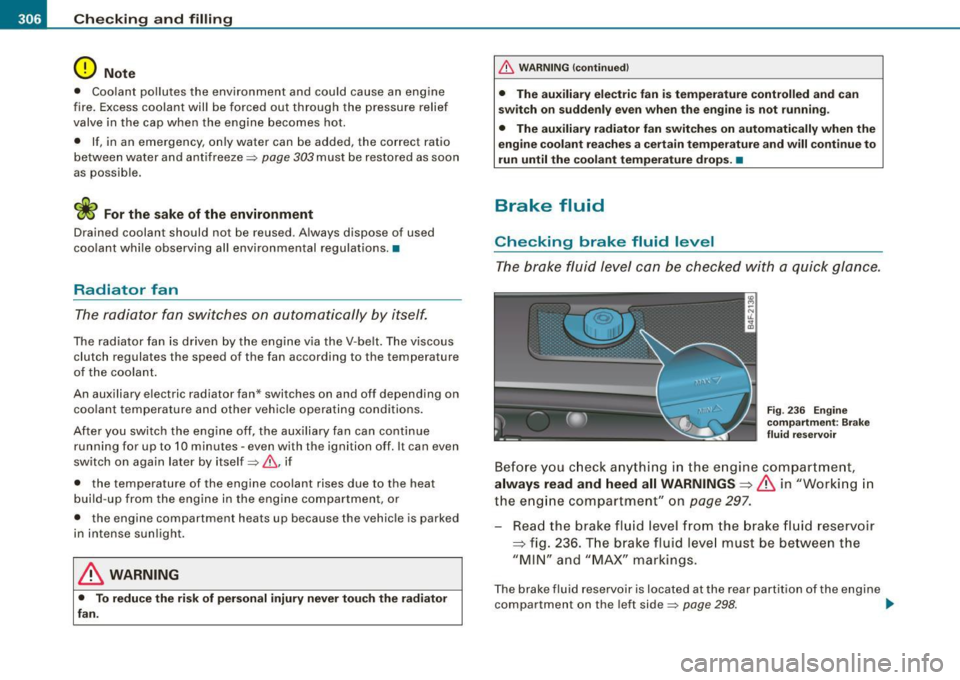
Fig . 23 6 En gin e
co mp art m ent : B ra ke
fl uid re servoir
Befo re yo u c heck anything in th e en gin e compar tme nt,
always read and heed all WARNINGS~ & in "Working in
the eng ine compartment" on
page 297 .
Rea d the brake fl uid level from the bra ke fluid reservoir
~ fig . 236. T he b rake fluid leve l must be betwee n the
" M IN " and "MAX" markings.
The brake fluid reservoir is located at the rear parti tion of the engine
compartment on the left side~
page 298. .,_
Page 309 of 390
___________________________________________ C_ h_e _c_ k_ i_n _g _ a_n _d_ f_il _li _n _g __ lll
•
T he fluid level may drop slightly after some time due to the auto
m atic adjustment of the brake pads. This is not cause for alarm .
If the brake fluid level fal ls
considerably below the "MIN" mark , the
brake warning/indicator light (U.S. models :
BRAKE, Canadian models:
{(j))) will come on~ page 23 and ~ page 32. Do not continue to
operate the vehic le. The complete brake system should be thor
oughly checked by an authorized Audi dealer or other qua lified
facili ty and the cause corrected . If the brake fluid level is too low, the
brake warning/indicator l ight will illuminate. Contact an au thorized
Audi dea ler
immediate ly .•
Changing brake fluid
Have the brake fl uid changed by an experienced techni
ci an.
Brake fluid absorbs moisture from the air. If the water content in the
brake fluid is too h igh, corrosion in the brake system may result
after a period of time. The boiling point of the brake fluid will also
decrease considerab ly and decrease braking performance .
Therefore , the brake fluid must be changed
e v ery tw o year s. Always
use new brake fluid which conforms to Federal Motor Vehic le Stan
dard "FMVSS 116 DOT 4".
T he brake fluid res ervoir can b e difficult to reach, th erefore, we
recommend that you have the brake fluid changed by your autho
rized
Audi de aler . Your dealer has the correct tools, the right brake
fl uid and the know -how to do t his fo r you .
& WARNING
• Brake fluid is poi sonous . It mu st be stored onl y in the clo sed
o riginal cont ainer out of the rea ch of children!
• Brake failure c an re sult from old or inappropri ate br ake flu id .
Obs erv e the se pre caution s:
& WAR N IN G (c ontinued )
-Use only brake fluid that meet s SAE specification J 1703 and
c onfo rm s to Feder al Moto r Vehicle St andard 116 . Al wa ys check
w ith your authori zed Audi dealer to make sure you are u sin g
the corre ct b rake flu id. The cor rect type of br ake fluid is als o
indic ated on the brake fl uid reservoir .
- The brake fluid mus t be ne w. Heav y use of th e brake s can
ca use a vapor lock if the bra ke fluid i s left in the sy stem too
long . Thi s can seriou sly affect the efficiency of the brake s as
w ell as your s afety . This could r esult in an a ccident .
0 Note
Brake fluid will damage the paint of your vehicle .
the special too ls required and the necessary expertise, we recom
mend that you have the brake fluid changed by your authori zed Audi
dea ler .•
Battery
General information
Und er n ormal operating conditions, the battery in your Audi does
not need any maintenance. With
high outside temperatures or long
daily drives we recommend that you have the electrolyte level
checked by a se rvice facility . The e lectrolyte level should a lso be
checked each time the battery is charged~
page 310 .
Have the batte ry checked when you take your vehic le in for service.
You are well advised to replace a battery that is o lder than 5 years . _,,
Vehicle care I t •
Page 310 of 390
lffl __ C _h_ e_ c_k _in --== g'-- a_n _d_ f_il _li _n ..:::g:::..- ___________________________________________ _
With certain types of airbag deployment, the battery is discon
nected from the vehicle electrical system for safety reasons=>&. in
"Repair, care and disposal of the airbags" on
page 226.
Di sc o nnect ing the b attery t ermin als
Some vehic le functions (power window regulators, for example) are
lost if the battery terminals are disconnected. These func tions have
to be relearned after the battery terminals are connected again . To
prevent this, the battery should only be disconnected from the
vehic le electrical system when absolute ly necessary for repairs.
V ehicle s not driven for long period s
If you do not drive your vehicle over a period of several days or
weeks, electrical components are gradually cut back or switched off .
This reduces energy consumption and maintains starting capability
over a longer period =>
page 265.
Take into consideration that when you un lock your vehicle, some
convenience functions, such as the master key remote function or
power seat adjustment, may not be available. The convenience
functions will be availab le again when you turn on the ignition and
start the engine .
Winter oper ation
During the w inter months, battery capacity tends to decrease as
temperatures drop. This is because more power is also consumed
while s tarti ng, an d the headlights, rear wi ndow defogger, etc ., are
used more often.
Avoid unnecessary p ow er consumption, particularly in ci ty traffic or
when trave ling only short distances. Let your authorized Audi dea ler
check the capacity of the vehicle battery before winter sets in
=> page 310. A we ll charged battery wil l not on ly prevent starting
problems when the weather is cold, but wi ll also last longer.
[ i J Tips
If your vehicle is left standing for severa l weeks at extremely low
t empera tures, the vehicle ba ttery should be r emoved and stored where it will not freeze
. This will prevent it from being damaged and
having to be replaced .•
Working on the battery
B e espec ially caref ul when working on or near the battery.
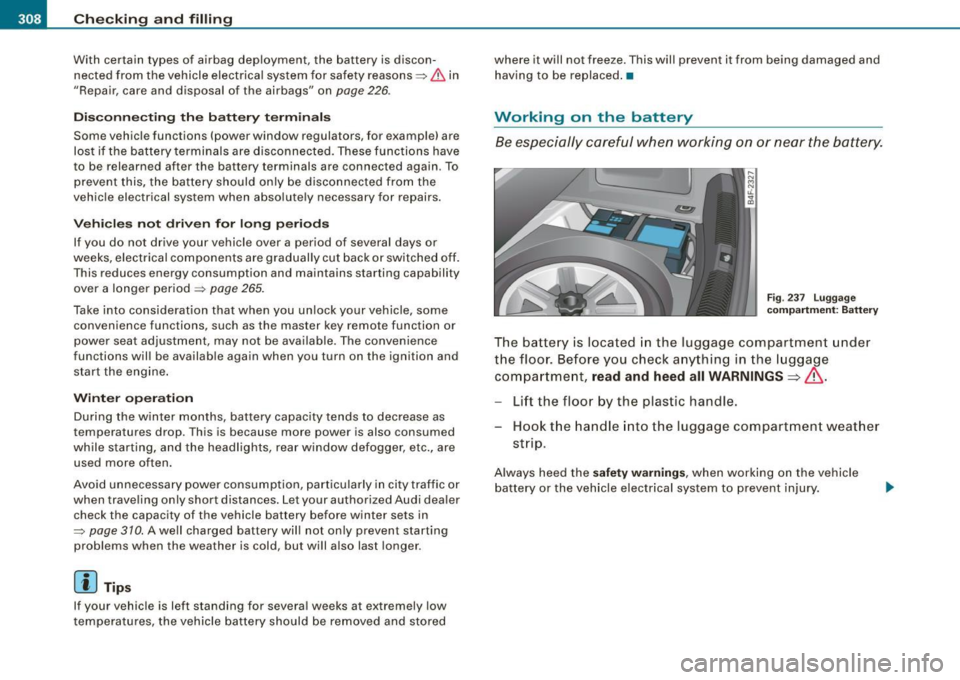
Fi g. 23 7 Lugg age
compartm ent : B attery
The battery is located in the luggage compartment under
the floor. Before you check a nything in the l uggage
com partme nt,
read and heed all WARNINGS=>& .
-Lift the floor by the plastic handle.
Hook t he hand le in to the luggage compartment weather
st rip.
Always heed the safety warnings , when working on the vehicle
ba ttery or the vehicle e lectrical system to prevent injury.
Page 311 of 390
Checking and filling 111111
---------------------------=----
•
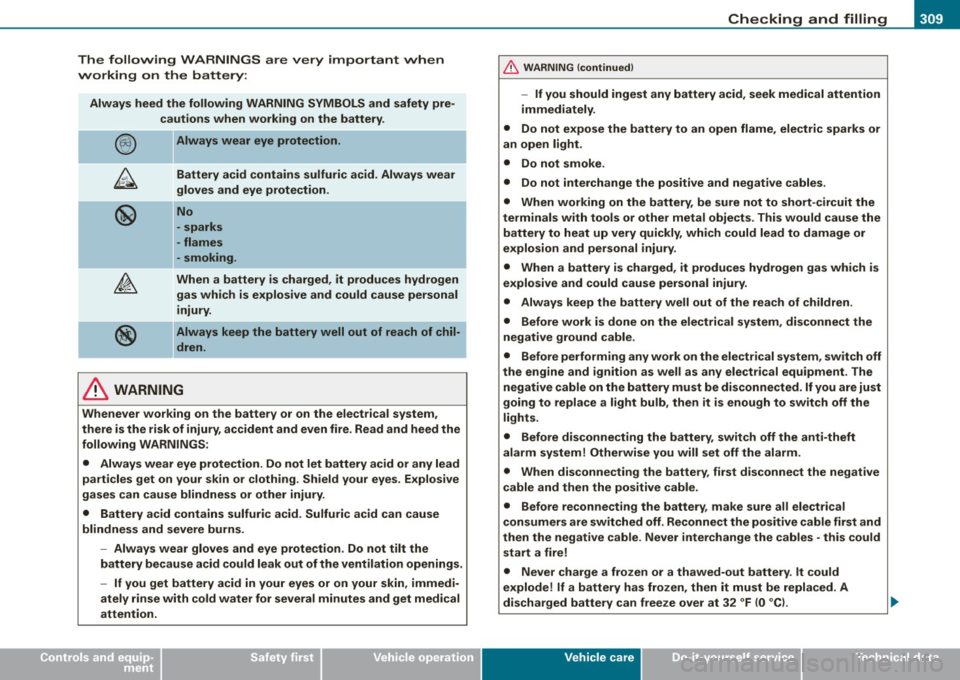
The following WARNINGS are very important when
working on the battery:
Always heed the following WARNING SYMBOLS and safety pre
cautions when working on the battery .
Always wear eye protection.
Battery acid contains sulfuric acid. Always wear
gloves and eye protection.
No
- sparks
- flames
- smoking.
When a battery is charged, it produces hydrogen
gas which is explosive and could cause personal
injury.
Always keep the battery well out of reach of chil
dren.
& WARNING
Whenever working on the battery or on the electrical system,
there is the risk of injury, accident and even fire. Read and heed the
following WARNINGS:
• Always wear eye protection. Do not let battery acid or any lead
particles get on your skin or clothing. Shield your eyes. Explosive
gases can cause blindness or other injury.
• Battery acid contains sulfuric acid. Sulfuric acid can cause
blindness and severe burns.
- Always wear gloves and eye protection. Do not tilt the
battery because acid could leak out of the ventilation openings.
- If you get battery acid in your eyes or on your skin, immedi
ately rinse with cold water for several minutes and get medical
attention.
& WARNING (continued)
-If you should ingest any battery acid, seek medical attention
immediately.
• Do not expose the battery to an open flame, electric sparks or
an open light.
• Do not smoke.
• Do not interchange the positive and negative cables .
• When working on the battery, be sure not to short -circuit the
terminals with tools or other metal objects. This would cause the battery to heat up very quickly, which could lead to damage or
explosion and personal injury.
• When a battery is charged, it produces hydrogen gas which is
explosive and could cause personal injury.
• Always keep the battery well out of the reach of children.
• Before work is done on the electrical system, disconnect the
negative ground cable.
• Before performing any work on the electrical system, switch off
the engine and ignition as well as any electrical equipment. The
negative cable on the battery must be disconnected.
If you are just
going to replace a light bulb, then it is enough to switch off the
lights.
• Before disconnecting the battery, switch off the anti-theft
alarm system! Otherwise you will set off the alarm.
• When disconnecting the battery, first disconnect the negative
cable and then the positive cable.
• Before reconnecting the battery, make sure all electrical
consumers are switched off. Reconnect the positive cable first and
then the negative cable . Never interchange the cables - this could
start a fire!
• Never charge a frozen or a thawed-out battery. It could
explode! If a battery has frozen, then it must be replaced. A
discharged battery can freeze over at 32 °F (0 °CI. .,,_
Vehicle care
I t •
Page 312 of 390
___ C_h_ e_ c_k _in --== g'-- a_n _d_ f_il _li _n ..:::g:::..- ___________________________________________ _
& WARNING (continued)
• Make sure the vent hose is always attached to the opening on
the side of the battery.
• Never use batteries which are damaged. There is the danger of
an explosion! Always replace a damaged battery.
& WARNING
California Proposition 65 Warning:
• Battery posts, terminals and related accessories contain lead
and lead compounds, chemicals known to the State of California
to cause cancer and reproductive problems. Wash hands after handling.
0 Note
• Do not disconnect the vehicle battery when the ignition is
switched on or when the engine is running, otherwise, you will
damage electronic components in the electrical system .
• When working on the engine, protect the battery housing from
ultraviolet (UV) rays by not parking the vehicle in direct sunlight .
• If your vehicle is going to stand for a long period of time without
being driven , protect the battery from "freezing", otherwise it will
be damaged and will then have to be replaced. •
Battery charging
Starting the engine requires a well charged battery.
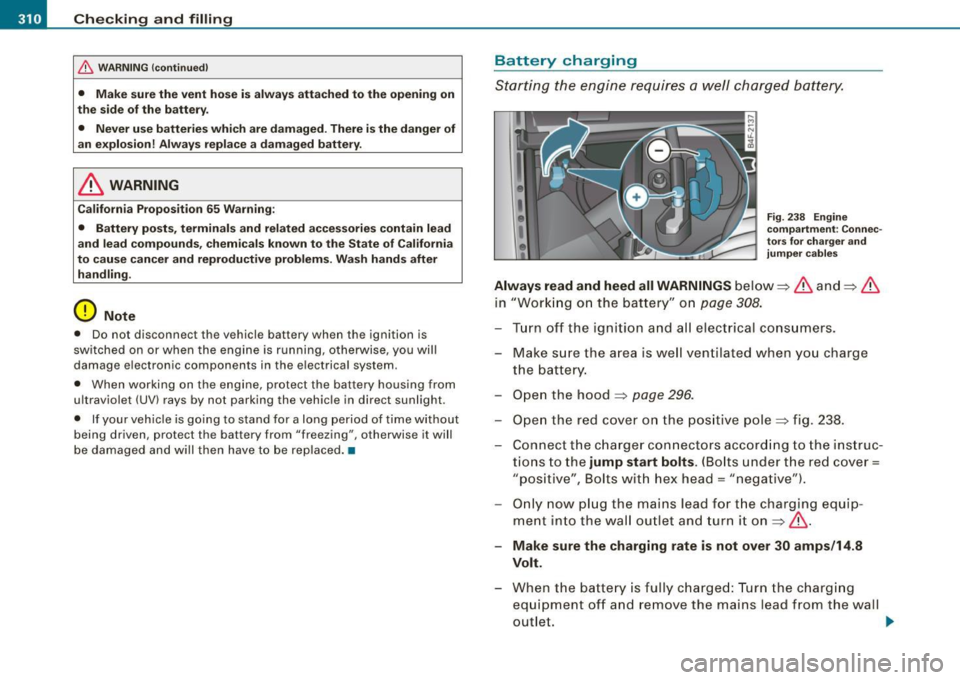
Fig. 238 Engine
compartment : Connec
tors for charger and
jumper cables
Always read and heed all WARNINGS below=> & and=> &
in "Working on the battery" on page 308.
-Turn off the ignition and all electrical consumers.
- Make sure the area is well ventilated when you charge
the battery.
- Open the hood =>
page 296.
-Open the red cover on the positive pole=> fig. 238.
- Connect the charger connectors according to the instruc-
tions to the
jump start bolts. (Bolts under the red cover=
"positive", Bolts with hex head= "negative").
- Only now plug the mains lead for the charging equip
ment into the wall outlet and turn it on =>
&-
- Make sure the charging rate is not over 30 amps/14.8
Volt.
- When the battery is fully charged: Turn the charging
equipment off and remove the mains lead from the wall
outlet. .,_
Page 314 of 390
-Ch
ecking and filling
---=---------------
0 Not e
Make sure the ventilation hose on the side of the battery is
connected, otherwise fumes or battery acid can leak out.
mend your authorized Audi dea ler change the battery for you .
Batteri es contain sulfuric acid and lead and must always be
disposed of properly in compliance with all environmental regula
tions . Disposing of v ehicle batteries improperly is very dang erous to
t he environment. •
Windshield/headlight washer
container
Using plain water is not adequate for filling the wind
shield washer system and the headlight washer system .
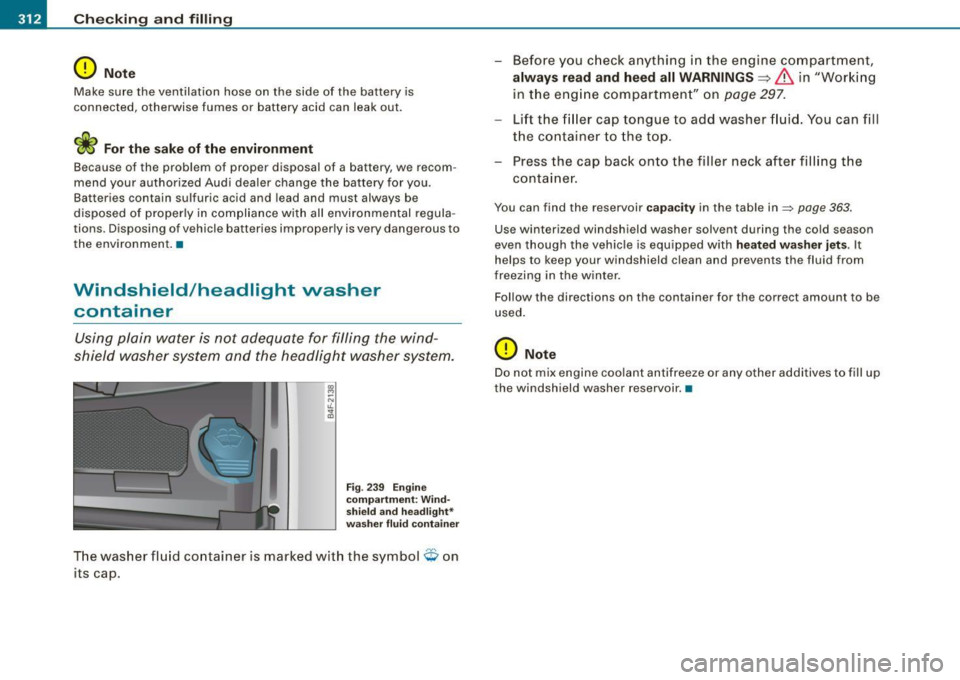
Fig. 239 E ngine
c omp artm ent : Wi nd
s h iel d and he adlight*
was her fluid c ont ain er
The washer fluid container is marked with the symbol O on
i ts cap. -
Before y ou c heck anything in the engine compartment,
a lway s read and heed all WARNINGS~ & in "Working
in t he eng ine compartment" on
page 297.
- Lift the filler cap tongue to add washer fluid . You can fill
the cont ainer to the top.
- Press the cap bac k on to the f iller neck after filling t he
container .
You can find the reservoir capacity in the tab le in~ page 363.
Use winterized windshield washer solvent during the co ld season
even though the vehic le is equ ipped with
he ated wa sher jets . It
helps to keep your windshield clean and prevents the fluid from
freezing in the winter .
Follow the directions on the container for the correct amount to be
used .
0 Note
Do not mix engine coo lant antifreeze or any other additives to fill up
the windshield washer reservoir. •
Page 322 of 390
-~_T_ ir_e_ s_ a_ n_d _ w_ h_ e_e _l_s _________________________________________________ _
possible to see whether the radial tires used today are underinflated
just by looking at them.
Therefore, be sure to check tire pressures at least once a month and
always before going on a long trip. Make sure to take the number of
people and the amount of luggage into account when adjusting tire
pressure for a trip -even one that you would not consider to be
"long." See=>
page 321, "Tires and vehicle load limits" for more
important information.
Always use an accurate tire pressure gauge when checking and
adjusting inflation pressures . Check all of the tires and be sure not
to forget the spare tire. If the pressure in any tire is too high when
the tire is "cold," let air out of the tire slowly with the edge of the tire
gauge and keep checking the pressure until you reach the pressure
that is correct for the load (passengers and luggage) and kind of
driving you plan to do.
If the pressure in any tire is too low, note the difference between the
pressure in the cold tire and the pressure you need and add the air
that you need to reach the correct pressure for the vehicle load
(passengers and luggage) for the tires on your vehicle as listed on
the on your vehicle and in this manual and the kind of driving you
plan to do.
Never exceed the maximum inflation pressure listed on the tire
sidewall for any reason.
Remember that the vehicle manufacturer, not the tire manufacturer,
determines the correct tire pressure for the tires on your vehicle.
It is important to check the tire pressure when the tires are cold.
• Read the required tire pressure from the tire pressure label. On
USA vehicles, the tire pressure label is located on the driver's side
8-pillar . On Canada vehicles, the tire pressure label is located either
on the driver's side 8-pillar or inside the fuel filler flap.
• Turn the valve stem cap counter-clockwise to remove it from the
tire valve.
• Place the air pressure gauge on the valve. • The
tire pressures should only be checked and adjusted when
the tires are cold. The slightly raised pressures of warm tires must
not be reduced .
• Adjust the tire pressure to the load you are carrying.
• Reinstall the valve stem cap on the valve.
When should I check the tire pressure?
The correct tire pressure is especially important at high speeds. The
pressure should therefore be checked at least once a month and
always before starting a journey. Do not forget to check the tire pres
sure for the spare wheel =>
page 337.
When should I adjust the tire pressures?
Adjust the tire pressure to the load you are carrying. After changing
a wheel
or replacing wheels you have to adjust the tire pressures on
all wheels. In addition, you must then initialize the new tire pres
sures in the tire pressure monitoring system=>
page 42.
& WARNING
Incorrect tire pressures and/or underinflation can lead sudden tire
failure, loss of control, collision, serious personal injury or even
death.
• When the warning symbol I appears in the instrument
cluster, stop and inspect the tires.
• Incorrect tire pressure and/or underinflation can cause
increased tire wear and can affect the handling of the vehicle and
stopping ability .
• Incorrect tire pressures and/or underinflation can also lead to
sudden tire failure, including a blowout and sudden deflation,
causing loss of vehicle control.
• The driver is responsible for the correct tire pressures for all
tires on the vehicle. The applicable pressure values are located on a sticker on the driver's side 8-pillar or on the inside of the fuel
filler flap. .,_
Page 341 of 390
-------------------------------------------~W~h~a~t~d~o~l ~d~o~n~o~w~ ?::__fflll
•
& WARNING (continued)
front wheel is lifted off the ground, placing the Automatic Trans
mission in "P" {Park) will
not prevent the vehicle from moving.
• Before you change a wheel, be sure the ground is level and firm.
If necessary, use a sturdy board under the jack.
• After installing the spare wheel, make sure that you replace the
flat tire/wheel in its storage area properly and tighten the knurled
retaining screw securely. •
Changing a wheel
When you change a wheel, follow the sequence described
below step-by-step and in exactly that order.
1. Activate the vehicle jack mode (only vehicles with Adap
tive Air Suspension)~
page 184.
2. Remove the decorative wheel cover*. For more details
see also ~
page 340, "Decorative wheel covers" or
~ page 340, "Wheels with wheel bolt caps".
3. Loosen the
wheel bolts~ page 341.
4. Locate the proper mounting point for the jack and align
the jack below that point~
page 341.
5. Lift the car with the jack ~ page 341.
6. Remove the wheel with the flat tire and then install the
spare
~ page 343.
7. Tighten all wheel bolts lightly.
8.
Lower the vehicle with the jack.
9. Use the wheel bolt wrench and
firmly tighten all wheel
bolts~
page 341 .
10. Replace the decorative wheel cover*.
11. Deactivate the vehicle jack mode (only vehicles with
Adaptive Air Suspension)~
page 184.
& WARNING
Always read and follow all WARNINGS and information => & in
uRaising the vehicle" on
page 341 and=> page 344. •
After changing a wheel
A wheel change is not complete without the doing the
following.
- Store and secure the wheel you replaced in the spare
wheel well.
- Replace the tools and the jack in their proper location.
- Check the tire pressure on the spare wheel immediately
after mounting it.
- As soon as possible, have the
tightening torques on all
wheel bolts checked with a torque wrench. The correct
tightening torque is 90 ft lb (120 Nm).
- Have the flat tire
replaced as soon as possible.
[ i] Tips
• If you notice that the wheel bolts are corroded and difficult to
turn while changing a tire, they should be replaced before you check
the tightening torque.
• Drive at reduced speed until you have the tightening torques
checked .•
Do-it -yourself service