check oil AUDI S6 2008 User Guide
[x] Cancel search | Manufacturer: AUDI, Model Year: 2008, Model line: S6, Model: AUDI S6 2008Pages: 390, PDF Size: 88.42 MB
Page 303 of 390
_______________________________________________ C_ h_e_ c_ k_in --= g'--- a_n _d_ f_i _ ll _in _ g=- ____. •
0 Note
Driving with an insufficient oil level is likely to cause severe damage
to the engine.
[ i] Tips
• The oil pressure warning display~ is not an indicator of the oil
level. Do not rely on it. Instead, check the oil level in your engine at
regular intervals, preferably each time you refuel, and always before
going on a long trip.
• If you have the impression your engine consumes excessive
amounts of oil, we recommend that you consult your Audi dealer to
have the cause of your concern properly diagnosed. Keep in mind
that the accurate measurement of oil consumption requires great
care and may take some time . Your Audi dealer has instructions
about how to measure oil consumption accurately. •
Checking the engine oil level
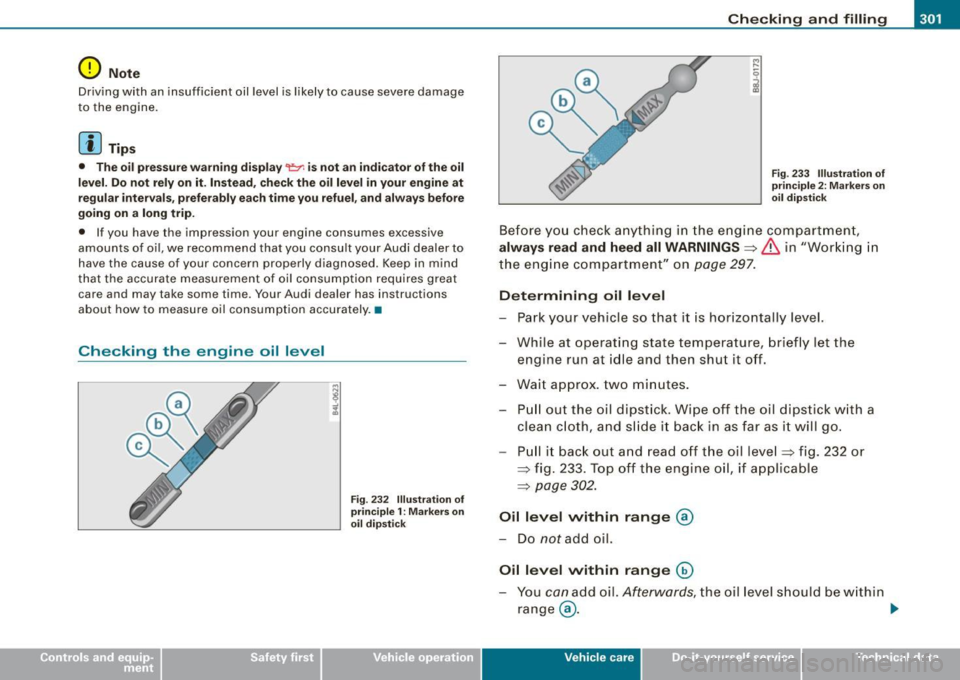
Fig. 232 Illustration of
principle 1: Markers on
oil dipstick Fig
. 233 Illustration of
principle 2: Markers on
oil dipstick
Before you check anything in the engine compartment,
always read and heed all WARNINGS=> & in "Working in
the engine compartment" on
page 297.
Determining oil level
-Park your vehicle so that it is horizontally level.
- While at operating state temperature, briefly let the
engine run at idle and then shut it off.
- Wait approx. two minutes.
- Pull out the oil dipstick. Wipe off the oil dipstick with a
clean cloth, and slide it back in as far as it will go.
Pull it back out and read off the oil level=> fig. 232 or
=> fig. 233. Top off the engine oil, if applicable
=>
page 302.
Oil level within range @
- Do not add oil.
Oil level within range @
-You can add oil. Afterwards, the oil level should be within
range @. _,,,
Vehicle care I I irechnical data
Page 304 of 390
___ C_h_ e_ c_k _in --=:: g;__ a_n _d_ f_il _li _n ..:g:a.- ___________________________________________ _
Oil level within range
©
- You must add oil. Afterwards, the oil level should be
within range@.
The oil level needs to be checked at regular intervals. The best times
to do this are whenever you refuel and prior to long tr ips. •
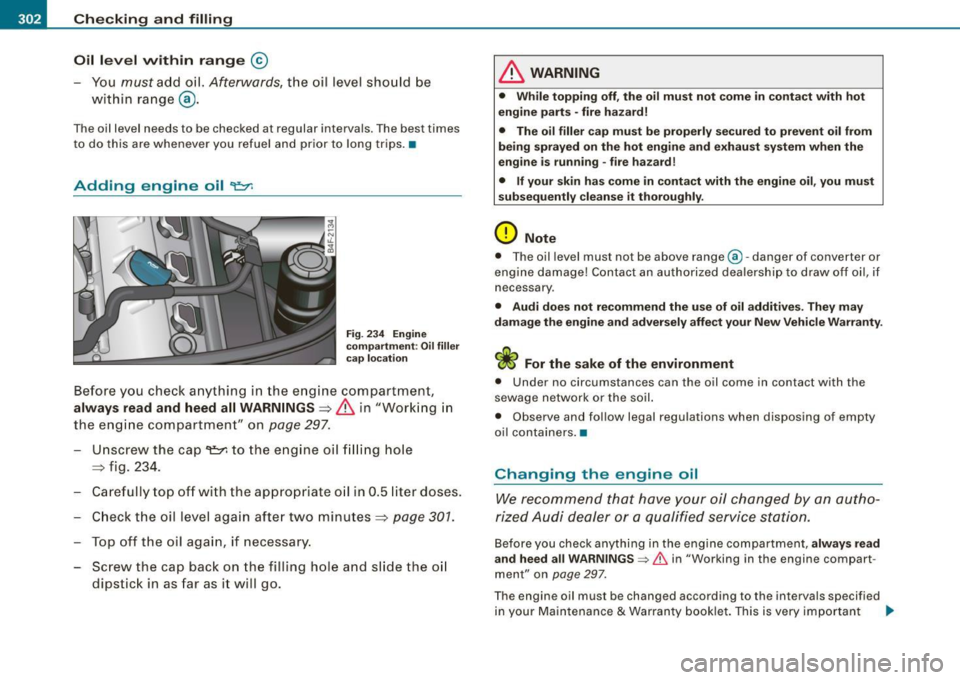
Adding engine oil 'l:::1':
Fig. 234 Engine
compartment: Oil filler
cap locat ion
Before you check anything in the engine compartment,
always read and heed all WARNINGS~ & in "Working in
the engine compartment" on
page 297.
Unscrew the cap
Carefully top off with the appropriate o il in 0.5 liter doses.
- Check the oil level again after two minutes ~
page 301.
Top off the oil again, if necessary.
Screw the cap back on the filling hole and slide the o il
dipstick in as far as it will go.
& WARNING
• While topping off, the oil must not come in contact with hot
engine parts -fire hazard!
• The oil filler cap must be properly secured to prevent oil from
being sprayed on the hot engine and exhaust system when the
engine is running -fire hazard!
• If your skin has come in contact with the engine oil , you must
subsequently cleanse it thoroughly.
0 Note
• T he oil level must not be above range @- danger of converter or
engine damage! Contact an au thorized dealership to draw off oil, if
necessary .
• Audi does not recommend the use of oil additives. They may
damage the engine and adversely affect your New Vehicle Warranty.
sewage network or the soil.
• Observe and follow legal regulations when disposing of empty
oi l containers .•
Changing the engine oil
We recommend that have your oil changed by an autho
rized Audi dealer or a qualified service station .
Before you check anything in the engine compartment, always read
and heed all WARNINGS ~
& in "Working in the engine compart
ment" on
page 297.
The engine oil must be changed according to the intervals specified
in your Maintenance
& Warranty booklet. This is very important ...
Page 307 of 390
_____________________________________________ C_h_ e_ c_k _in ~ g_ a_n _d_ f_il _li _n ~g __ _
•
When the coolant level is too low , the warning light in the Auto
Check System =>
page 33will blink un til you add coo lant and the
level has been restored to normal. Even though there is an electric
coolant leve l sensor, we still recommend you check the coo lant level
from time to time .
Coola nt lo ss
Coolant loss may indicate a leak in the cooling system . In the event
of coolant loss, the coo ling sys tem should be inspected immedi
ately by your authorized Audi dealer . It is not enough merely to add
coolant.
In a
s ealed system, losses can occur only if the boiling po int of the
coolant is exceeded as a result of overheating.
0 Note
Do not add any type of radiator leak sea lant to your vehicle's engine
coolant . Adding radiator repair fluid may adversely affect the func
tion and performance of your cooling system and could resu lt in
damage not covered by your New Vehic le Limited War ranty .•
Adding coolant
Be very careful when adding engine coolant.
Before you check anything in the engine compartment,
always read and heed all WARNINGS => & in "Working in
the engine compartment" on
page 297 .
- Tu rn off the engine .
- L et the engine coo l dow n.
- Place a t hick rag over the coolant expansion tank
=> page 304, fig . 235 and carefully tw ist t he cap counter
cloc kw ise
=> & .
- Add coolant. - Twist the cap
on agai n
tightly.
Replacement engine coolant must conform to exact specifications
=>
page 303, "Coolant". If in an emergency coolant additive G12 + is
not avai lable, do
not use a different additive . Use p lain water
instead until you can get the correct additive and can restore the
correct ratio . This should be do ne as soon as possible.
If you have lost a considerable amount of coolant, then you should
add cold antifreeze and cold water only when the engine is cold .
Always use
new engine coolant when refilling .
Do not fil l coolant above the "MAX" mark. Excess coolant will be
forced out through the pressure relief va lve in the cap when the
engine becomes ho t.
& WARNING
• The cooling system is under pressure and can get ver y hot.
Redu ce the risk of sc alding from hot coolan t by follow ing the se
s tep s.
- Turn off th e en gine and allo w it to cool down .
- Protect your fa ce , ha nd s and arm s from e sc a pi ng fluid and
s tea m by cov ering the c ap with a large , thick rag.
- Tur n the cap slo wly an d very ca refully in a counter -clockw is e
dire ction whil e applying light , downward pres sure on the top
o f the cap.
- To av oid bei ng burn ed , do n ot spill antifree ze or cool ant on
the e xhau st sy stem or h ot e ngi ne part s. Under cert ain co ndi
tion s, the ethylen e gl ycol in engin e co olant c an c atch fire .
• Antifr eeze is po iso nous. Alwa ys store antifree ze in its or igin al
c ontainer and well out of the reach of c hildren .
• If you dra in t he coola nt, it mu st b e ca ught and sa fel y stor ed in
a prop er container clearly mark ed "poi son ".
~
Vehicle care I t •
Page 309 of 390
___________________________________________ C_ h_e _c_ k_ i_n _g _ a_n _d_ f_il _li _n _g __ lll
•
T he fluid level may drop slightly after some time due to the auto
m atic adjustment of the brake pads. This is not cause for alarm .
If the brake fluid level fal ls
considerably below the "MIN" mark , the
brake warning/indicator light (U.S. models :
BRAKE, Canadian models:
{(j))) will come on~ page 23 and ~ page 32. Do not continue to
operate the vehic le. The complete brake system should be thor
oughly checked by an authorized Audi dealer or other qua lified
facili ty and the cause corrected . If the brake fluid level is too low, the
brake warning/indicator l ight will illuminate. Contact an au thorized
Audi dea ler
immediate ly .•
Changing brake fluid
Have the brake fl uid changed by an experienced techni
ci an.
Brake fluid absorbs moisture from the air. If the water content in the
brake fluid is too h igh, corrosion in the brake system may result
after a period of time. The boiling point of the brake fluid will also
decrease considerab ly and decrease braking performance .
Therefore , the brake fluid must be changed
e v ery tw o year s. Always
use new brake fluid which conforms to Federal Motor Vehic le Stan
dard "FMVSS 116 DOT 4".
T he brake fluid res ervoir can b e difficult to reach, th erefore, we
recommend that you have the brake fluid changed by your autho
rized
Audi de aler . Your dealer has the correct tools, the right brake
fl uid and the know -how to do t his fo r you .
& WARNING
• Brake fluid is poi sonous . It mu st be stored onl y in the clo sed
o riginal cont ainer out of the rea ch of children!
• Brake failure c an re sult from old or inappropri ate br ake flu id .
Obs erv e the se pre caution s:
& WAR N IN G (c ontinued )
-Use only brake fluid that meet s SAE specification J 1703 and
c onfo rm s to Feder al Moto r Vehicle St andard 116 . Al wa ys check
w ith your authori zed Audi dealer to make sure you are u sin g
the corre ct b rake flu id. The cor rect type of br ake fluid is als o
indic ated on the brake fl uid reservoir .
- The brake fluid mus t be ne w. Heav y use of th e brake s can
ca use a vapor lock if the bra ke fluid i s left in the sy stem too
long . Thi s can seriou sly affect the efficiency of the brake s as
w ell as your s afety . This could r esult in an a ccident .
0 Note
Brake fluid will damage the paint of your vehicle .
the special too ls required and the necessary expertise, we recom
mend that you have the brake fluid changed by your authori zed Audi
dea ler .•
Battery
General information
Und er n ormal operating conditions, the battery in your Audi does
not need any maintenance. With
high outside temperatures or long
daily drives we recommend that you have the electrolyte level
checked by a se rvice facility . The e lectrolyte level should a lso be
checked each time the battery is charged~
page 310 .
Have the batte ry checked when you take your vehic le in for service.
You are well advised to replace a battery that is o lder than 5 years . _,,
Vehicle care I t •
Page 315 of 390
Tires a nd wh eels -
----------------
•
Tires and wheels
Tires
General notes
Tires may be the least appreciated and most abused parts
of a motor vehicle.
Tires may be the least appreciated and most abused parts of a
motor vehicle. Tires are, however, one of the most important parts
of a vehicle, particularly considering the comparative ly sma ll patch
of rubber on each tire that assures that all- important contact
between you, your vehicle and the road .
Maintaining the correct tire pressure, making sure that your vehicle
and its tires do not have to carry more weight than they can safely
handle, avoiding damage from road hazards and regu lar ly
inspecting tires for damage inc luding cuts , slashes irregular wear
and overa ll condition are the most important things that you can do
to help avoid sudden tire failure including tread separation and
b lowouts .
Avoiding dama ge
If you have to drive over a curb or similar obstacle, drive very slow ly
and as close as possible at a right angle to the curb.
A lways keep chemica ls includ ing grease, oil, gasoline and brake
f luid off the tires.
I nspec t the tires regularly for damage (cuts, cracks or blis ters, etc.l.
Remove any foreign bodies embedded in the treads.
Storing tires
Mark tires when you remove them to indicate the direction of rota
tion . This ensu res you to be ab le to mount them correctly when you
reinstal l them. When removed, the wheels or tires shou
ld be stored in a coo l, dry
and preferably dark place.
St ore t ires in a vertical posit ion if they a re not mounted on rims, in
a horizontal position if they are mounted on rims.
New tire s
New tires have to be broken in~&.
The tread dep th of new tires may va ry, according to the type and
make of tire and the tread pattern.
Hidden d ama ge
Damage to tires and rims is often not readily visible. If you notice
unusua l vibration or the vehicle pul ls to one side, this may indicate
that one of the tires has been damaged . The tires must be checked
immed iately by an authorized Audi dealer or qualified workshop .
Unidire ction al tir es
A unidirectio nal tire can be iden tif ied by arrows on the s idewa ll, that
point in the direction the tire is designed to rotate. You must follow
the specified direction of ro tation . This is necessary so that these
tires can deve lop their optimum characteristics regarding grip, road
noise, wear and hydroplaning resistance . For more information
~ page 344.
in. WARNING
Ne w tire s or tire s that are old , worn or damaged cann ot pro vide
m aximum cont rol and braking ability.
• New tire s tend to be slippe ry and m ust be broken in . To redu ce
the risk of losing control, a colli sion and seriou s per sonal injurie s,
drive with speci al care for t he fi rst 350 m ile s ( 560 km l.
• Driving with worn or damaged t ire s can lead to lo ss of co ntrol ,
s udd en tire failure , in clu ding a blowout a nd sudden deflation , .,,_
Vehicle care
I t •
Page 316 of 390
-~_T_ ir_e_ s_ a_ n_d _ w_ h_ e_e _l_s _________________________________________________ _
& WARNING (continued)
crashes and serious personal injuries . Have worn or damaged tires
replaced immediately.
• Tires age even if they are not being used and can fail suddenly,
especially at high speeds. Tires that are more than 6 years old can
only be used in an emergency and then with special care and at
low speed.
Glossary of tire and loading terminology
Accessory weight
means the combined weight (in excess of those standard items
which may be replaced) of automatic transmission, power steering,
power brakes, power windows, power seats, radio, and heater, to
the extent that these items are available as factory-installed equip
ment (whether installed or not).
Aspect ratio means the ratio of the height to the width of the tire in percent.
Numb ers of 55 or lower indicate a low sidewall for improved
steering response and better overall handling on dry pavement.
Bead
means the part of the tire that is made of steel wires, wrapped or reinforced by ply cords and that is shaped to fit the rim.
Bead separation means a breakdown of the bond between components in the bead.
Cord
means the strands forming the plies in the tire.
& WARNING (continued)
• Never mount used tires on your vehicle if you are not sure of
their "previous history." Old used tires may have been damaged
even though the damage cannot be seen that can lead to sudden
tire failure and loss of vehicle control.
• If you notice unusual vibration or if the vehicle pulls to one side
when driving, always stop as soon as it is safe to do so and check
the wheels and tires for damage . •
Cold tire inflation pressure
means the tire pressure recommended by the vehicle manufacturer
for a tire of a designated size that has not been driven for more than
a couple of miles (kilometers) at low speeds in the three hour period
before the tire pressure is measured or adjusted .
Curb weight means the weight of a motor vehicle with standard equipment
including the maximum capacity of fuel, oil, and coolant, air condi
tioning and additional weight of optional equipment.
Extra load tire
means a tire designed to operate at higher loads and at higher infla
tion pressures than the corresponding standard tire . Extra load tires
my be identified as "XL",
"xi", "EXTRA LOAD", or "RF" on the side
wall.
Gross Axle Weight Rating ("GAWR")
means the load-carrying capacity of a single axle system, measured
at the tire -ground interfaces .
Gross Vehicle Weight Rating ("GVWR"l
means the maximum total loaded weight of the vehicle.
Page 326 of 390
--~_T_ ir_e_ s_ a_ n_d _ w_ h_ e_e _l_s _________________________________________________ _
Tire pressure
Incorrect tire pressure causes premature wear and can cause
sudden tire blow-out. For this reason, tire pressure must be checked
at least once a month~
page 319.
Driving style
Driving fast around curves, heavy acceleration and hard braking
increase tire wear.
Rotating tires for more even wear
For all four tires on your vehicle to have the same service life, we
recommend that the front and rear tires are rotated according to the
tire manufacturer's suggested tire rotation intervals. Please remember the following:
• Tire rotation intervals may differ from the vehicle service inter
vals outlined in your Maintenance and Warranty Booklet.
• The longer one tire is used in one location on the vehicle, the
more it wears at certain points; therefore, we recommend that you
follow the tire manufacturer's suggested tire rotation intervals.
• Vehicles with front-wheel drive experience more tread wear on
the front wheels compared to all-wheel drive (quattro®l .
• Please rotate tires as shown ~
page 323, fig. 243.
• Extra care must be taken when rotating direction -specific tires
~ page 344.
Wheel balancing
The wheels on new vehicles are balanced. However, various situa
tions during everyday driving can cause them to become unbal
anced, resulting in vibrations you can usually feel through the
steering wheel.
Unbalanced wheels must be rebalanced to avoid excessive wear on
steering, suspension and tires. A wheel must also be rebalanced
when a new tire is installed.
Incorrect wheel alignment
Incorrect wheel alignment can cause excessive tire wear, impairing
the safety of the vehicle. If tires show excessive wear, have the
wheel alignment checked by an authorized Audi dealer or qualified
workshop.
All Wheel Drive
Vehicles with quattro® must always have tires of the same size, construction and tread type. For details see~
page 264.
& WARNING
Sudden tire failure can lead to loss of control, a crash and serious
personal injury!
• Never drive a vehicle when the tread on any tire is worn down
to the wear indicators.
• Worn tires are a safety hazard, they do not grip well on wet
roads and increase your risk of "hydroplaning" and loss of control.
• Always keep chemicals that can cause tire damage, such as
grease, oil, gasoline and brake fluid away from tires.
• Tires age even if they are not being used and can fail suddenly,
especially at high speeds. Tires that are more than 6 years old can
only be used in an emergency and then with special care and at
lower speeds.
• Never mount used tires on your vehicle if you are not sure of
their "previous history." Old used tires may have been damaged
even though the damage cannot be seen that can lead to sudden
tire failure and loss of vehicle control. •
Page 333 of 390
Tires and wheels -________________ w-.
•
Remove wheel center covers and trim discs before putting snow
chains on you r veh icle =>
(D. For sa fety reasons c ove r cap s m ust
then be fitted over the wheel bo lts . These are avai lable from autho
r ized Aud i deale rs.
& WARNING
Using the wrong snow chains for your vehicle or in stalling them
incorrectly can increase the risk of loss of control leading to
serious personal injury.
• Snow ch ains are available in different sizes . Always make sure
to follow the instructions provided by the snow chain manufac
turer .
• When driving with snow chains never drive faster than the
speed permitted for your specific snow chains .
• Always observe local regulations .
0 Note
• Remove sn ow chai ns b efore d rivin g on roads not cove red w ith
snow to avoid damaging tires and wearing the snow chains down
u n n ecessa r i ly.
• Snow chains , which come into d irect contact with t he whee l rim,
ca n scratc h or da mage it. T herefore, ma ke sur e tha t th e snow chains
are suitably covered.
• I f the Adaptive Air Suspensio n* shou ld malfunction, do no t
mount or use snow chains because the vehicle will be extremely
l o w. I f yo u do drive w ith snow c hai ns o n w hi le t he ve hicle is a t thi s
level, the snow cha ins might severe ly damage the wheelhouse and
ot her parts o f the vehicle.
[ i ] Tips
W her e sn ow c hai ns are manda tory on certa in roa ds, t his no rm ally
a lso app lies to vehic les with Al l Wheel Drive. •
Wheel bolts
Wheel bo lts must alw ays be t ig hte ned to the correct
to rq ue .
The design of wheel bo lts is matched to the factory instal led rims. If
d iffere nt rim s are fitted, the corr ect w heel bo lts w it h t he rig ht le ngth
and correctly shaped bolt heads must be used. This ensures that
w he els are fitted securely and that the brake sys tem func tions
correctly.
I n certa in c ircums ta nces, you may not use wheel bo lts from
a
different vehicle -even if it is the same model=> page 368.
& WARNING
Improperly tightened or maintained wheel bolts can become loose
causing loss of control , a collision and serious personal injury .
• Always keep the wheel bolts and the threads in the wheel hubs
clean so the wheel bolts can turn easily and be properly tightened.
• Never grease or oil the wheel bolts and the threads in the wheel
hubs. They can become loose while driving if greased or oiled,
even if tightened to the specified torque .
• Only use wheel bolts that belong to the rim being installed .
• Never use different wheels bolts on your vehicle.
• Always maintain the correct tightening torque for the wheel
bolts to reduce the risk of a wheel loss.
If the tightening torque of
the wheel bolts is too low , they can loosen and come out when the
vehicle is moving . If the tightening torque is too high, the wheel
bolts and threads can be damaged and the wheel can become
loose .
0 Note
The specified torque for the wheel bolts is 9 0 ft lb (120 Nm) with a
to lera nce of± 7,4 ft lb(± 10 Nm). Torque whee l b o lt s d ia go nally.
Af ter changing a wheel, the torque must be checked as soon as .,_
Vehicle care I t •
Page 359 of 390
________________________________________________ E _m_ e_r.:g :;,. e_ n_c ...: y:.- s_ i_ t _u _a_ t_ i_ o _ n_ s __ lll
•
& WARNING
• To reduce the risk of serious injury and vehicle damage.
-Always lift the vehicle only at the special workshop hoist and
floor jack lift points illustrated
=> page 356, fig. 267 and
=> page 356, fig. 268.
- Failure to lift the vehicle at these points could cause the
vehicle to tilt or fall from a lift if there is a change in vehicle
weight distribution and balance. This might happen, for
example, when heavy components such as the engine block or
transmission are removed.
• When removing heavy components like these, anchor vehicle
to hoist or add corresponding weights to maintain the center of
gravity. Otherwise, the vehicle might tilt or slip off the hoist,
causing serious personal injury.
0 Note
• Be aware of the following points before lifting the vehicle:
- The vehicle should never be lifted or jacked up from under
neath the engine oil pan, the transmission housing, the front or
rear axle or the body side members . This could lead to serious
damage.
- To avoid damage to the underbody or chassis frame, a rubber
pad must be inserted between the floor jack and the lift points.
- Before driving over a workshop hoist, check that the vehicle
weight does not exceed the permissible lifting capacity of the hoist .
- Before driving over a workshop hoist, ensure that there is
sufficient clearance between the hoist and low parts of the
vehicle. •
Do-it-yourself service
Page 378 of 390
llffl __ A_l.:,. p _h_ a_ b_e _t _ic _ a_l _in _ d_e _x ____________________________________________ _
Driver seat
See Seating position . . . . . . . . . . . . . . 194
Driver's seat . . . . . . . . . . . . . . . . . . . . . . . . 88
Driver's seat memory . . . . . . . . . . . . . . . . . 91
Activating remote control key .. ... .. 92
Recalling a seat posit ion ...... .... . 91
Storing a seat position . ........ .... 91
Driving messages ...... .... .... .... .. 30
Driving safely .... .... .... ...... .... 192
Driving time . ...... .. .... .... .... .... 40
Dup licate key ........... .... ... .... .. 48
DVD player for navigation system . . . . . . 99
Dynamic shift program .............. 163
E
Easy entry feature 124
Electric seat adjustment
S ee Power seat . . . . . . . . . . . . . . . . . . . 88
Electromechanica l parking brake
Emergency braking .. ...... ...... . 131
Malfunction ...... .... .... ....... 131
Operation . . . . . . . . . . . . . . . . . . . . . . . 129
Parking . . . . . . . . . . . . . . . . . . . . . . . . . 130
Rel easing and app lying .... ... .... 129
Starting off with a trailer ... ..... .. 131
Warning /indicator ligh ts ... .... .... 23
Electronic differential lock (EDU
How the system works . . . . . . . . . . . . 259
Warning /indicator lights ....... .... 22
Electronic immobilizer . ... .... .. . .. 15, 51
Electronic power contro l
(EPC) warning/indicator light ...... .. 19 Electronic stabili
zation program (ESP)
How the system works . ...... ..... 258
Wa rning/indicator lights ......... .. 19
Emergency braking . . . . . . . . . . . . . . . . . 131
Emergency closing Power sunroof ......... .... ... . 68, 69
Emergency flasher . . . . . . . . . . . . . . . . . . . 73
Wa rning/indicator lights ..... ...... 20
Emergency locking of doors ....... ... . 57
Emergency starting .. ... .... .... .... 351
Emergency towing ..... .... .... ... .. 354
Energy management ... .. .... .... ... 265
Battery power . . . . . . . . . . . . . . . . . . . 266
Driver notification 266
Engine Compartment . .... .... .... .... .. 298
Coolant ......................... 303
Hood ... .. .... .... .... .... .... .. 296
Starting ...... ........ .... .. 124, 125
Starting with jumper cables .. ..... 351
Stopping ........................ 126
Engine compartment Safety instructions .... ...... ..... 297
Working the engine compartment .. 297
Engine coolant system ........ .... ... 303
Adding coolan t ..... ........ .... . 305
Checking coo lant level .. ....... ... 304
Check ing the engine coolant level .. 304
Malfunction ......... .... .. .. .... . 33
Radiator fan ...... .. .. .... .... ... 306
Engine coolant temper .ature
Temperature gauge ...... ...... ... 13
Engine data .. ... ... .. .... .... ...... 363 Engine hood
Clos ing ... .... ... ... ... .. .... ... 297
How to release the hood . . . . . . . . . . 296
Engine oi l ..... ... .... .... .. .. ..... . 299
Adding ... .... .... .... .... ... ... 302
Additiv es .. ...... ..... .. .. .... ... 302
Changing . ....... .... ... .. ...... 302
Checking the engine oil level . .... .. 301
Indications and conditions requiring extra
checking .. ...... .... .......... 301
Oil consumption ... .... .... .... .. 300
Oil grades . ...... ... ... .... ..... . 299
Recommended oil che ck in tervals .. 301
Specif ication and viscosity .. .. .. ... 299
Engine oil leve l ... .... .... .. .. ..... .. 37
Engine oil pressure Malfunction .. .. .. .... .... .... .... 34
Eng ine oi l sensor defective .... .... .... 37
Environment Break -in period ........ ..... ..... 267
Catalytic converter .... .... ..... .. 268
Disposing of your vehicle battery .. . 311
Driving a t high speeds ............ 269
Driv ing to minimize pollution and noise .
269
Fuel .... .. .... .... .............. 293
Fuel economy ...... .... .. .. .... .. 269
Leaks under your vehicle ....... ... 297
Letting the vehicle stand and warm up ..
270
Proper disposal of drained brake fluid 307
P roper disposal o f drained engine
coo lant ..... .. .. .... .... ....... 305