instrument panel AUDI S6 2008 User Guide
[x] Cancel search | Manufacturer: AUDI, Model Year: 2008, Model line: S6, Model: AUDI S6 2008Pages: 390, PDF Size: 88.42 MB
Page 214 of 390
-Airbag s yste m Ptrf _______________ _
Airbag system
Important things to know
Importance of wearing safety belts and
sitting properly
Airbags are only supplemental restraints. For airbags to
do their job, occupants must always properly wear their
safety belts and be in a proper seating position.
For your safe ty a nd the safety of your passengers, before
driving o ff, a lways:
- Adjust the driver's seat and steering wheel properly
~ page 194,
-Adjust the front passenger's seat properly~ page 88,
- Wear safety belts properly~ page 205,
-Always properly use the proper child restraint to pro tect
children~
page 234 .
In a col lision airbags must inflate within the blink of an eye and with
considerable force. The supplemental airbags can cause injuries if
the driver or the front seat passenger is not seated properly. There
fore in order to help the airbag to do its job, it is important, both as
a driver and as a passenger to sit properly at a ll times.
By keep ing room between your body and the steering wheel and the
front of the passenger compartment, the airbag can inflate fu lly and
comp letely and prov ide supplementa l protection in certain frontal
collisions =>
page 194, "Proper occupant seating positions". For
detai ls on the operation of the seat adjustment controls=>
page 88.
It's especially important that children are properly restrained
=>
page 234 .
There is a lot that the driver and the passengers can and must do to
help the individual safety features installed in your Audi work
together as a system.
P roper seating position is important so that the front airbag on the
driver side can do its job. I f you have a physical impairment or
condition that prevents you from sitting properly on the driver seat
with the safety belt properly fastened and reaching the pedals, o r if
you have concerns with regard to the function or operation of the
Advanced Airbag System, p lease contact your authorized Audi
dea ler or qua lif ied workshop, or call Audi Customer CARE at 1-800-
822 -2834 for possib le modifications to your vehicle.
When the airbag system deploys, a gas generator wi ll fill the
airbags, break open the padded covers, and inflate between the
steering wheel and the driver and be tween the instrument panel
and the front passenger. The airbags wil l deflate immediate ly after
deployment so that the front occupants can see through the wind
shield again without interruption .
A ll of this takes p lace in the b link of an eye, so fast that many people
don't even rea lize that the airbags have dep loyed . The airbags also
inflate with a great deal of force and nothing should be in their way
when they dep loy. Fron t airbags in combination wi th properly worn
safety belts slow down and limit the occupant's forward movement.
T ogether they help to prevent the driver and front seat passenger
from hitting parts of the inside the vehicle while reducing the forces act ing on the occupant during the crash . In this way they he lp to
reduce the r isk of injury to the head and upper body in the crash.
Airbags do not protect the arms or the lower parts of the body .
Both front airbags will not in flate in al l fro ntal col lisions . The trig
gering of the airbag system depends on the vehic le decelerat ion
r ate caused by the colli sion and registe red by the electronic contro l
unit. If this rate is below the reference value programmed into the
cont rol unit, the airbags w ill not be t riggered, even though the car
may be bad ly damaged as a result of the collision. Vehicle damage, .,,,.
Page 215 of 390
Airbag syst em -----------------=~-
repair costs or even the lack of vehicle damage is not necessari ly an
indication of whether an airbag should inflate or not.
It is not possible to define a range of vehicle speeds that will cover
every possible kind and ang le of impact that wil l always trigger the
airbags, since the circumstances wil l vary considerab ly between
one collision and another. Important factors include, for example,
the nature (hard or so ft) of the object which the car hits, the angle
of impact, vehicle speed, etc. The front airbags wi ll also not inflate
in side or rear co llisions, or in roll -overs .
Al way s rem ember : Airbags wi ll deploy only once, and on ly in certain
kinds of coll isions . Your safety belts are always there to offer protec
tion in those situat ions in wh ich airbags are not supposed to deploy,
or when they have already deployed; for example, when your vehic le
strikes or is struck by another a fter the first coll ision.
T his is just one of the reasons why an airbag is a supplementary
restraint and is not a substitute for a sa fety be lt. The airbag system
works most effectively when used with the safety be lts. Therefore ,
a lways prope rly wea r your safety belt s =>
page 202 .
& WARNING
Sitting too clo se to the steering wheel or in strument panel will
de crease the effect ivene ss of the airbags and will incr ease the risk
of personal injury in a collision.
• Never sit closer than 10 in ches (25 cm) to the steering wheel or
in strument panel.
• If you c annot sit more than 10 in ches (25 cm ) from the steering
wheel , inve stiga te whether adaptive equipment may be available
to held you reach the pedal s and in crease your se ating dist ance
from the steering wheel.
• If you are unrestra ined , leaning forward , sittin g side ways or out
of position in any way , your risk of injury i s much higher .
• You will also receive serious injur ies and could even be killed if
you are up again st the airba g or too clo se to it when it infl ates -
ev en with an Advanced Airbag .
Controls and equip ment Safety first
Vehicle operation
& WAR N IN G ( continued )
• To reduce the ri sk of injury when an airbag inflate s, alw ays
wear safety belt s prope rly~
page 20 6, "S afet y belt s".
• Always make certain that ch ildren age 12 or younger alway s
ride in the rear seat. If children are not p rope rly re str ained , they
may be severely injured or killed when an airbag inflate s.
• Never let children ride unre str ained or impr operly rest rained in
the vehicl e. Adju st the front seat s properly .
• Never ride with the b ackrest r eclined .
• Alway s sit a s far as possible from the steering wheel or the
instrument panel ~
pag e 194.
• Alway s sit upright with your back again st the backre st of your
seat .
• Ne ver pla ce your feet on the instrument panel or on the seat .
Always keep both feet on the floor in front of the seat to help
prevent seriou s injurie s to the leg s and hips if the airbag inflate s.
• Nev er r ecline th e front passenger 's seat to transpo rt obje cts .
Item s can al so mo ve into the area of the side a irbag or the front
airbag during braking or in a sudden m aneuver . Obje cts near the
a irbags can become pro je ctile s and cau se injury when an airbag
inflates .
& WARNING
Airbags that have deployed in a crash must be repla ced.
• U se only original equipment airbags approved by Audi and
in stalled by a trained technician who ha s the neces sary tool s and
diagnostic equipment to properly r epla ce any airb ag in your
vehicle and as sure sy stem effectivenes s in a crash .
• Never perm it salvag ed or re cy cled airb ag s to be i nstall ed in
your vehicle. •
Vehicle care Do-it-yourself service Technical data
Page 216 of 390
llffl __ A_ ir_ b_ a-g _ s_y _s_ t_ e_ m _________________________________________________ _
Child restraints on the front seat - some
important things to know
-Be sure to read the important information and head the
WARNINGS for important details about ch ildren and
Advanced Airbags~
page 234.
Even though your vehic le is equipped with an Advanced Airbag
System, make certain that a ll children, especia lly those 12 years and
younger , always ride in the back seat proper ly restrained for their
age and size . The airbag on the passenger side makes the front seat
a potentia lly dangerous place for a child to ride. The front seat is not
the safest place for a chi ld in a forward -facing child safety seat. It
can be a very dangerous place for an infant or a child in a rearward
facing seat.
The Advanced Ai rbag System in your vehicle has been certified to
comply with the Requirements of United States Federal Motor
Vehicle Safety Standard 208 as applicable at the time your vehicle
was manufactured.
The Standard requires the front airbag on the passenger side to be
turned off ("suppressed") if a chi ld up to about one year of age
restrained in one of the rear-facing or forward-facing infant res traints listed in Federa l Motor Vehicle Safety Standard 208 with
which the Advanced Airbag System in your vehicle was cert ified has
been insta lled on the front passenger seat. For a listing of the child
restraints that were used to certify compliance with the US Safety
Standard =>
page 236.
The PASS ENGER AIR B AG OFF light in the instrument panel tells you
when the front Advanced Airbag on the passenger side has been
t urned off by the electronic control unit.
Each time you turn on the ignition , the
PASSEN GER AIR BA G OFF
light will come on for a few seconds and:
• will stay on if the front passenger seat is not occupied, •
will stay on if there is a small child or child restraint on the front
passenger seat,
• will go off if the front passenger seat is occupied by an adult as
registered by the weight-sensing mat=>
page 223, "Monitoring the
Advanced Airbag System" .
The
P AS SENGER AIR BAG OFF light comes on when the control unit
detects a tota l weight on the front passenger seat that requires the
front airbag to be turned off.
If the total weight on the front passenger seat is more than that of
a typica l 1 year -old child but less than the weight of a small adult,
the front airbag on the passenger side can deploy (the
PA SSE NGER
A IR BA G OFF
light does not come on). If the P ASSE NGER AIR B AG
O FF
light does not come on, the front airbag on the passenger s ide
has not been turned off by the electronic control unit and can
deploy if the control unit senses an impact that meets the condi
tions stored in its memory.
F o r e xample , th e a ir b ag m ay dep loy if:
• a small ch ild that is heavier than a typical 1 year -o ld child is on
the front passenger seat (regardless of whether the child is in one
of the child safety seats listed
=> page 236), or
• a child who has outgrown chi ld restraints is on the front
passenger seat.
If the front passenger airbag is turned off, the
PASSEN GER AIR BA G
OFF
light comes on in the instrument cluster and stays on.
The fron t airbag on the passenger side may
not deploy (the
PA SS ENGER AIR BA G OFF light does not illuminate and stay lit) even
if a small adult or teenager, or a passenger who is no t sitting upright
with their back against a non -reclined backrest with their feet on the
vehic le floor in front of the seat is on the front passenger seat
=> page 194, "Proper seating position for the driver".
If the front passenger airbag deploys, the Federal Standard requires
the airbag to meet the "low risk" deployment criteria to reduce the risk of injury through interact ion with the airbag. "Low risk" d eploy
ment occu rs in those crashes that take place at lower decelerations .,.
Page 217 of 390
Airbag system -----------------=~-rm-I
as defined in the electronic control unit~ page 224, "PASSENGER
AIR BAG OFF l igh t" .
A lways remember, a chi ld safety seat or infant carrier insta lled on
the front seat may be struck and knocked out of position by the
rap id ly i nfl ating pass eng er's ai rbag in a frontal co llision . The airba g
co uld greatly reduce the effectiveness of the chi ld restraint and
even s erio usly in jure the chi ld du ring infl ation.
F or this reason, and because the bac k seat is the safest place for
c h ildr en -w he n prop erly res trained a cc or ding to th eir age an d size
- w e stro ngly recomm end that c hildren a lwa ys s it in th e back seat
~ page 234, "C hil d Safe ty" .
& WARNING
A child in a rearward -facing child safety seat installed on the front
passenger seat will be seriously injured and can be killed if the
front airbag inflates - even with an Advanced Airbag System.
• The inflating ai rbag will hit the child safety seat o r infant
carrier with great force and will smash the child safety seat and
child against the ba ckrest , center arm rest , door or roof.
• Always install rear-facing child safety seats on the rear seat.
• If you must install a rearward facing child safety seat on the
front pa ssenger seat because of exceptional circumstances and
the PASSENGER AIR BAG OFF light does not come on and stay on,
immediately install the rear-facing child safety seat in a rear
seating position and have the airbag system inspected by your
Audi dealer .
• Forward-facing child safety seats installed on the front
pa ssenger's seat may interfere with the deployment of the airbag
and cause serious personal injury to the child .
& WARNING
If, in exceptional circumstances , you must install a forward-facing
child restraint on the front passenger's seat:
Controls and equip ment Safety first
Vehicle operation
& WARNING (continued)
• Always make sure the forward-facing seat has been designed
and certified by its manufacturer for use on a front seat with a
passenger front and side airbag .
• Never put the forward-facing child restraint up against or very
near the instrument panel .
• Always move the passenger seat into its rearmost position in
the seat's fore and aft adjustment range, as far away from the
airbag as possible before installing the forward-facing child
restraint. The backrest must be adjusted to an upright position .
• Make sure that the PASSENGER AIR BAG OFF light comes on
and stays on all the time whenever the ignition is switched on.
& WARNING
To reduce the risk of serious injury , make sure that the PASSENGER
AIR BAG OFF light
will be displayed whenever a child restraint is
installed on the front passenger seat and the ignition is switched
on.
• If the PASSENGER AIR BAG OFF light does not stay on , perform
the checks described
~ page 223 , "Monitoring the Advanced
Airbag System" .
• Take the child restraint off the front passenger seat and install
it properly at one of the rear seat positions if the PASSENGER AIR
BAG OFF light does not stay on .
• Have the airbag system inspected by your Audi dealer immedi
ately .
• Always carefully follow instructions from child restraint manu
facturers when installing child restraints .
& WARNING
If, in exceptional circumstances, you must install a forward or
rearward-facing child restraint on the front passenger's seat :
Vehicle care Do-it-yourself service Technical data
Page 219 of 390
__________________________________________________ A_ i_ r _b _a...; g::- s_ y=--- s_t _e _m __ fflllll
& WA RN ING (co ntinued)
• Airb ag work mo st effectively when u sed with prope rly worn
s afety belts.
• Therefore , alwa ys wear your safety be lt s and make sure that
ev erybod y i n yo ur vehi cle is properly re str ained.
& WARNING
A pe rson on the front pa ssen ger s eat , e spe cially inf ants and small
c hildren , w ill re ceive s eriou s injurie s and can ev en be killed by
being too cl ose to the airbag whe n it infl ates .
• Although the Advan ced Airba g System in your vehicle i s
de signed t o tu rn off the front p assenger airb ag i f a n inf ant or a
s mall child i s on the front pa ssenger seat , nobod y can absolut ely
gu ara nt ee that deployment under these spe cial con ditio ns is
impo ssible in all conc eivable situations that m ay happen during
the useful l ife of your vehic le.
• The Adv anced Airbag Sy stem will deploy in a ccordance with
the "lo w risk" opti on u nder th e U.S. Feder al Stand ard if a child t hat
i s heavier than th e typi cal on e-year old child i s on the front
p asse nger seat and the other conditi ons for airb ag dep loym ent
are met.
• Acc ident stat istics have shown that children are gener ally s afe r
in the rear seat ar ea than in the front seating po sit ion .
• Fo r their o wn safet y, all children , espe cially 12 yea rs and
younger , should always r ide in the back properly restrained for
their age and siz e. •
Advanced front airbag system
Your vehicle is equipped with a front Advanced Airbag System in
compliance with United States Federal Motor Veh icle Sa fety Stan
dard 208 as applicab le at the time your vehicle was manufactured.
Controls and equip ment Safety first Vehicle operation The front Advanced Airbag System supplements the safety belts to
provide additional protection for the driver's and front passenger's
heads and upper bodies in fronta l crashes. The airbags inflate only
in frontal impacts when the vehic le dece leration is high enough.
The front Advanced Airbag System for the front seat occupants is not a substitute for your safety belts. Rather, it is part of the overa ll
occupant restraint system in your vehicle. A lways remember that
the airbag system can only help to protect you, if you are sitting
upright, wear ing your safety belt and wearing it properly . This is why
you and your passengers must a lways be properly restrained, not
just because the law requires you to be .
The Advanced A irbag System in your vehicle has been certified to
meet the " low risk" requirements for 3 and 6 year-o ld children on the
passenger side and very small adults on the driver side. The low risk
deployment criteria are intended to he lp reduce the risk of injury
through interact ion wi th the front a irbag that can occur, for
examp le, by being too close to the steering whee l and instrument
panel when the airbag inflates.
In addition, the system has been certified to comply with the
"suppression" requirements of the Safety Standard, to turn off the
front airbag for infants 12 months old and younger who are restrained on the front passenger seat in child restraints that are
listed in the Standard:::::,
page 236, "Child restraints and Advanced
Airbags".
"Suppression" requires the front ai rbag on the passenger side to be
turned off if:
• a child up to about one year of age is restrained on the front
passenger seat in one of the rear-facing or forward -facing infant
restraints listed in Federal Motor Vehicle Safety Standard 208 with
wh ich the Advanced Airbag System in your vehicle was certif ied. For
a listing of the child restraints that were used to certify your
vehicle's compliance with the US Safety Standard:::::,
page 236,
• weight less than a threshold leve l stored in the control unit is
detec ted on the front passenger sea t. .._
Vehicle care Do-it-yourself service Technical data
Page 221 of 390
__________________________________________________ A_ i_ r _b _a...; g::- s_ y=--- s_t _e _m __ fllll
& W ARNING (continued )
• If you must in stall a rearward facing child safety seat on the
front passenger seat because of exceptional circumstances and
the PASSENGER AIR BAG OFF light does not come on and stay on ,
immediately install the rear -facing child safety seat in a rear
seating position and have the airbag system inspected by your
Audi dealer .
& WARNING
If, in exceptional circumstance s, you must install a forward-facing
c hild restraint on the front passenger's seat:
• Always make sure the forward -facing seat has been designed
and certified by its manufacturer for use on a front seat with a
passenger front and side airbag .
• Never put the forward -facing child restraint up against or very
near the instrument panel.
• Always move the passenger seat into its rearmost position in
the seat's fore and aft adjustment range , as far away from the
airbag as possible , before installing the forward -facing child
restraint. The backrest must be adjusted to an upright position.
• Make sure that the PASSENGER AIR BAG OFF light comes on
and stays on all the time whenever the ignition is switched on .•
Advanced Airbag System components
T he front passenger seat in your vehicle has a lot of very important
p ar ts of th e A dva nced Air b ag System in it. T hese pa rts inc lu d e the
weight -sensing mat, sensors , w iring, brackets, and more. The func
t ion o f the sys te m in the fr ont passenge r sea t is c hecked by th e e le c
tronic contro l unit when the i gnition is on. The control unit monitors
th e Adva nced Ai rbag Syst em an d t urns t he air b ag in dicat or ligh t on
when a malfunction in the system components is detected. T he
function of the airbag indicator light is described in greater detail
Controls and equip ment Safety first Vehicle operation below
. B ecause the front passenger seat conta ins important par ts
o f th e Adva nced Ai rbag Sys te m , yo u m ust take care to prev ent it
from be ing damaged. Damage to the seat may pr event the
Advanced Air bag for the fr ont pas senge r sea t fr om doing i ts job i n
a cras h.
The front Advanced Airbag System consists of the
following :
• Crash sens ors in th e fro nt of th e vehi cle that meas ure vehic le
acce leration/dece leration to provide information to the Advanced
A irb ag System ab out the seve rity of the c rash .
• An electron ic control unit, with integrat ed crash sensors for front
and si de i mpac ts . T he co ntr ol unit "de cides" w heth er to f ir e th e
front airbags based on th e information received from the crash
se nsors . The con trol unit also "deci des" w hethe r the safet y belt
pretensioners should be activated.
• A dua l- st age A dvan ced Airb ag with gas ge nerato r for t he drive r
inside the steer ing wheel hub .
• A du al- s tage A dvanced Air bag a nd gas gene ra tor insid e the
instrument panel fo r the front passenger.
• A w eigh t-s e nsin g mat und er the u phols ter y padding of th e fron t
passenger seat cushion that measures the total weight on the seat.
Th e in form atio n r egis tered i s sen t co nti nuousl y to th e e lectr oni c
control unit to regu late dep loyment of th e fro nt Advanced Airbag o n
t he pas se nge r sid e.
• An airbag monito ring system and indicator light in the instru
m ent c luste r::::>
p age 22 3.
• T he PASSENGER AIR BAG OFF light comes on and stays on in the
ce nter of the i nstrume nt p anel ::::>
pa ge 224, fi g. 206 a nd tells y ou
when the front Advanced Airbag on the passenger side has been
tu rne d off .
• A sensor be low the safety belt latch for the front seat passenger
to mea sure the t ensio n on t he sa fet y b elt. The ten sion o n the safet y
belt and the weight registe red by t he weight -sensing mat help the
cont ro l un it "deci de" whe ther t he fro nt air bag fo r the front _,.
Vehicle care Do-it-yourself service Technical data
Page 224 of 390
-L~A:::..:,: ir:....: b:!..::: a~g L.:: s:1y :...:s::..: t~ e:.: m:...:...:.. ________________________________________________ _
or the lower parts of the body. Front airbags only supp lement the
th ree p oint safe ty belts in som e front al co llis ions in which the
vehic le dece leration is h igh enou gh to deploy the a irba gs.
Front airbags will not deploy:
• if the ignition is switched off when a crash occurs,
• i n sid e collis io ns,
• i n rea r- e nd collisi ons ,
• in ro llovers,
• when th e c ras h de celerat io n measur ed by the a irba g system is
less than the minimum threshold needed for a irbag deployment as
r egi stere d by th e ele ctro nic con trol uni t.
The front passenger airbag will also not deploy :
• when th e fr ont pass enger seat is no t occupi ed,
• when the weight on the front passenger seat a s sensed by the
A dvanced A irbag Syste m indica tes tha t the fr ont air bag o n the
passenger side has to be turned off by the e lectronic cont rol unit
(t he PASSENGER AIR BAG OFF li gh t comes o n and s tays o nl.
& WARNING
Sitting in the wrong position can increase the risk of serious injury
in crashes .
• To reduce the risk of injury when the airbags inflate , the driver
and passengers must always sit in an upright position , must not
lean against or place any part of their body too close to the area
where the airbags are located.
• Occupants who are unbelted , out of position or too close to the
airbag can be seriously injured by an airbag as it unfolds with
great force in the blink of an eye=> page
214.
& WARNING
A child in a rearward-facing child safety seat installed on the front
passenger seat will be seriously injured and can be killed if the
front airbag inflates -even with an Advanced Airbag System .
• The inflating airbag will hit the child safety seat or infant
carrier with great force and will smash the child safety seat and
child against the backrest, center arm rest, door or roof.
• Always install rear-facing child safety seats on the rear seat.
• If you must install a rearward facing child safety seat on the
front passenger seat because of exceptional circumstances and
the PASSENGER AIR BAG OFF light does not come on and stay on, i mmediately install the rear-facing child safety seat in a rear
seating position and have the airbag system inspected by your
Audi dealer .
& WARNING
Objects between you and the airbag will increase the risk of injury
in a crash by interfering with the way the airbag unfolds or by
being pushed into you as the a irbag inflates .
• Never hold things in your hands or on your lap when the vehicle
is in use.
• Never transport items on or in the area of the front passenger
seat. Objects could move into the area of the front airbags during
braking or other sudden maneuver and become dangerous projec
tiles that can cause serious personal injury if the airbags inflate .
• Never place or attach accessories or other objects (such as
cupholders, telephone brackets , large, heavy or bulky objects) on
the doors , over or near the area marked "AIRBAG" on the steering
wheel , instrument panel , seat backrests or between those areas
and yourself . These objects could cause injury in a crash , espe
cially when the airbags inflate .
• Never recline the front passenger's seat to transport object s.
Items can also move into the area of the side airbag or the front ..,
Page 227 of 390
Airbag syst em -----------------=~-
the weight -sensing mat to measure more weight than is actually on
the seat .
If th e PA SSENGER AIR BAG OFF light still d oes not come on and does
not stay on continuously (when the ignition is switched on),
• t ake the child restraint off the front passenger seat and install it
properly at one of the rear seat positions. Have the airbag system
inspected by your Audi dealer immediately.
• move the child to a rear seat position and make sure that the
child is proper ly restrained in a child restraint that is appropria te for
its size and age .
The
P AS SENGER AIR BAG OFF light shou ld NOT come on when the
ignition is on and an adult is sitting in a proper seating posi tion on
the front passenger seat . If the
PASSENGER AIR BAG OF F light
comes on and stays on or flashes for about 5 seconds whi le driving,
under these circumstances, make sure that :
• the adu lt on the front passenger seat is properly seated on the
center of the seat cushion w ith his or her back up against the back
res t and the backrest is not reclined => page 794, "Proper occupant
sea ting positions" ,
• the adult is not taking weight of f the sea t by holding on to the
passenger assist handle above the front passenger door or
supporting thei r we ight on the armrest,
• the safety belt is being proper ly worn and that there is not a lot
of slack in the safety belt webbing,
• accessory seat covers or cushions or other things that may cause
an incorrect reading or impression on the weight -sensing mat
under the upho lstery of the seat have been removed from the front
passenger sea t,
• a safety belt extender has not been left in the safety be lt latch for
t he front passenger seat .
In addition to the
PA SS ENGER AIR BAG OFF light in the center of the
instrument panel, the message
PASSENGER AIR BAG O FF o r
PAS SEN GER AIR BA G ON wi ll briefly appear in the instrument c luster
Controls and equip
ment Safety first Vehicle operation
display. This is to inform the driver of the current front passenger
a
irbag status .•
Important safety instructions on monitoring
the Advanced Airbag System
& WARNING
An airbag sy stem that is not functioning properly cannot provide
supplemental protection in a front al cra sh .
• If the airb ag ind icator li ght come s on , it me ans that there may
be something wrong with the Advanced Ai rbag S ystem. It is
po ssible that the airbag will inflate when it is not suppo sed to , or
w ill not infl ate w hen it should .
• Have the airb ag system inspe cted immediatel y by you r Audi
dealer.
& WARNING
If the front airb ag infl ate s, a child without a child re straint , in a
rear ward -fa cing child safet y se at or i n a forwa rd-fa cing child
r e str aint that has not been properly installed will be seriously
inj ured and can be killed .
• Even though your vehicle i s equipped with an Adv anced Airbag
Sy stem , m ake cert ain that all children , e speci ally 1 2 year s and
younger , alway s ride on the bac k seat prope rly re strain ed for their
a ge and siz e .
• Alway s install forward or rear -facin g child safety seats on the
re ar seat - even with an Ad vanced Airb ag System .
• If you must in stall a rearwa rd -fa cing child safety seat on the
fron t pa sse nger seat be cau se of exc eptional circu mstan ce s a nd
the PASSENGER AIR BAG OFF light doe s not appe ar and st ay o n,
immedi atel y insta ll the rear -f ac ing child safet y seat in a re ar ..,
Vehicle care Do-it-yourself service Technical data
Page 228 of 390
___ A_ ir_ b_ a-g _ s_y _s_ t_ e_ m _________________________________________________ _
& WARN ING (continued )
seating posit ion and have the airb ag system inspe cted by your
Audi dealer .
• A t ight tether or other strap on a rearward-fa cing child restr aint
att ached to the front pas senger se at can put too much pres sure
on the weight-sensing mat in the seat and reg ister more weight
than is actually on the seat. The heavier weight registered can
m ake the system work as though an adult were on the seat and
deploy the Advanced Airbag when it must be suppressed cau sing
ser ious or even fatal injury to the child .
• If, in exceptional circumstance s, you mu st in stall a forward
f a cing child restraint on the front passenger seat , always move the
seat into its rearmost position in the seat's fore and aft adjust
ment range , as far away from the airbag as po ssible . The ba ckrest
must be adjusted to an upright position. Make sure that the
PASSENGER AIR BAG OFF light comes on and stay s on all the time
whenever the ignition is switched on .
& WARNING
• If the PASSENGER AIR BAG OFF light does not go out when an
adult is sitting on the front passenger seat after tak ing the step s
described above, make sure the adult i s properly seated and
restrained at one of the rear seating posit ions .
• Have the airbag system inspected by your Audi dealer before
transport ing anyone on the front passenger seat .
[ i ] Tips
If the weight -sensing mat in the front passenger seat detects an
e m pty seat , the front a irbag on the passenge r side wil l be tur ned
off, and PASSENGER AIR BAG OFF will stay on.•
Repair, care and disposal of the airbags
P arts of the airbag system are installed at many different p laces on
you r Aud i. Insta ll ing, r emoving, servic ing or repa iring a pa rt in an
area of the vehicle can damage a part of an airbag system and
p revent that sys tem from working pr operly in a c ollisi on.
There are some important things you have to know to ma ke sure
t h at the effective ness of the system will not be impai red and that
discarded co mponents do not cause injury or po llute the env iro n
ment .
& WARNING
Improper care , servicing and repair procedures can increase the
risk of personal injury and death by pre venting an airbag from
deploying when needed or deploying an airbag unexpectedly:
• Never cover , obstruct , or change the steering wheel horn pad
or airbag cover or the instrument panel or modify them in any way .
• Never attach any objects such as cupholders or telephone
mountings to the surfaces covering the airbag units .
• For cleaning the horn pad or instrument panel , use only a soft,
dry cloth or one moistened with plain water. Solvents or cleaner s
c ould damage the airbag cover or change the stiffness or strength
of the material so that the airbag cannot deploy and protect prop
erly .
• Never repair , adju st, or change any parts of the airbag sy stem .
• All work on the steering wheel , instrument panel , front seats or
electrical system (including the installation of audio equipment ,
cellular telephones and CB radios , etc .I must be performed by a
qualified technician who has the training and special equipment
necessary .
• For any work on the airbag system, we strongly recommend
that you see your author ized Audi dealer or qual ified workshop .
• Never modify the front bumper or parts of the vehicle body .
Page 234 of 390
lfflJ_.....:::A::.::..:. ir..:b ::..:a::. 9:2...: s:::L y..::s :.:t ..::e :.:m.:..:... ________________________________________________ _
angle of impact, since the circumstances will vary considerably
between one collision and another . Important factors include, for
example, the nature (hard or soft) of the impacting object, the angle
of impact, vehicle speed, etc.:::,
page 232, "How side curtain airbags
work".
Aside from their normal safety function, safety belts work to help
keep the driver or front passenger in position in the event of a colli
sion so that the side curtain airbags can provide protection.
The airbag system is not a substitute for your safety belt. Rather, it
is part of the overa ll occupant restraint system in your vehicle.
Always remember that the airbag system can only help to protect
you if you are wearing your safety belt and wearing it properly. This
is another reason why you should always wear your safety belts, not
just because the law requires you to do so:::,
page 202, "General
notes".
It is important to remember that while the side curtain airbag
system is designed to help reduce the likelihood of serious injuries,
other injuries, for example, swelling, bruising, and minor abrasions
can a lso be associated with these airbags. Remember too, these
airbags will deploy only once and only in certain kinds of accidents
- your safety belts are always there to offer protection .
The side curtain airbag system basically consists of:
• The electronic control module and external side impact sensors
• The side curtain airbags above the front and rear side windows
• The airbag indicator light in the instrument panel
The airbag system is monitored electronically to make certain it is
functioning properly at all times. Each time you turn on the ignition,
th e airbag system indicator light will come on for a few seconds
(self diagnostics).
The side curtain airbag is not activated:
• if the ignition is turned off,
• in side collisions when the acceleration measured by the sensor
is too low, •
in front -end collisions,
• in rear-end collisions,
• in ro llovers.
& WARNING
• Safety belts and the airbag system will only provide protection
when occupants are in the proper seating position :::,
page 87,
"General recommendations".
• If the airbag indicator light comes on when the vehicle is being
used , have the system inspected immediately by your authorized
Audi dealer. The side curtain airbag may not work properly even
when the vehicle acceleration in a side collision is high enough to
activate the airbag.
::i
How side curtain airbags work
Side curta in airbags can work together with side airbags
to help reduce the risk of head and upper torso injuries for
occupants who are properly restrained.
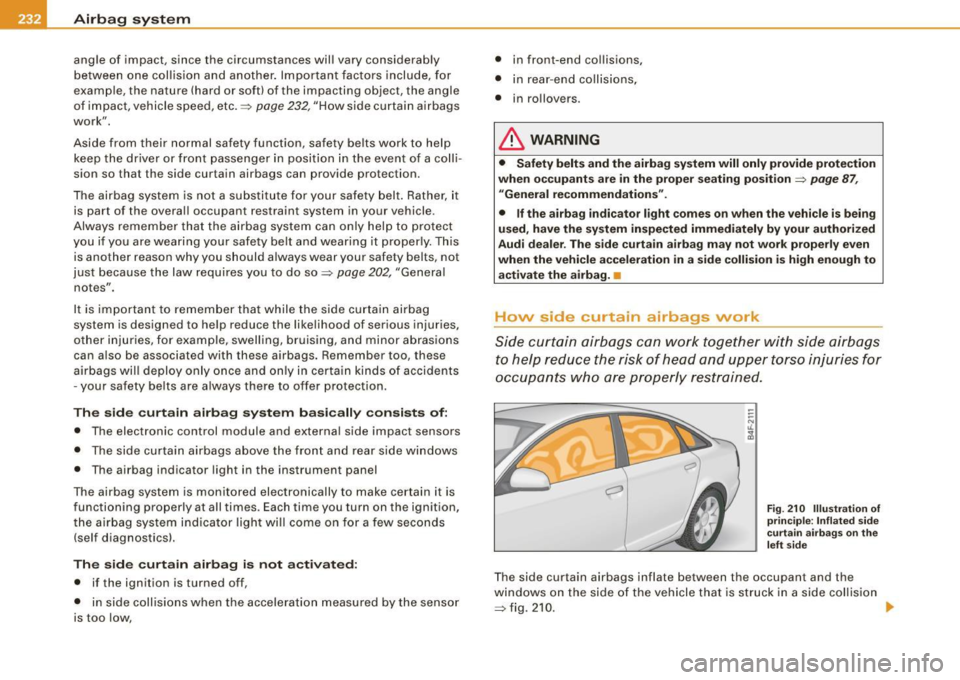
Fig. 210 Illustration of
principle : Inflated side
curtain airbags on the
left side
The side curtain airbags inflate between the occupant and the
windows
on the side of the vehicle that is struck in a side collision
:::, fig. 210.
~