weight AUDI S6 2008 User Guide
[x] Cancel search | Manufacturer: AUDI, Model Year: 2008, Model line: S6, Model: AUDI S6 2008Pages: 390, PDF Size: 88.42 MB
Page 205 of 390
- Make sure that your passengers also buckle up and prop
erly wear their safety belts.
- Protect children with a child restraint system appropriate
for the size and age.
The warning light 4,-in the instrument cluster lights up when the
ignition is switched on as a reminder to fasten the safety belts . In
addition , you will hear a warning tone .
After the ignition is switched on, the warning light in the instrument cluster will always come on for about 6 seconds and if the driver has
not fastened the safety belt , a warning tone will also sound for
about 6 seconds. As soon as the driver has fastened the safety belt,
the warning tone will stop and the warning ligh t will go out .
If the driver or front seat passenger have not buckled -up within
about 10 seconds after the warning tone has stopped and the
vehicle is moving faster than about 15 mph, the warning tone will
sound again for about 6 seconds and then stop for 24 seconds and
then repeat this reminder sequence for a maximum of 2 minutes . At
speeds below 5 mph, the warning tone will not sound.
Fasten your safety belt and make sure that your passengers also
properly put on their safety belts.
& WARNING
• Safety belts are the single most effective means available to
reduce the risk of serious injury and death in automobile acci
dents. For your protection and that of your passengers, always
correctly wear safety belts when the vehicle is moving.
• Failure to pay attention to the warning light that come on,
could lead to personal injury. •
Safety first
Safety belts
Why safety belts?
Frontal collisions and the law of physics
Frontal crashes create very strong forces for people riding
in vehicles.
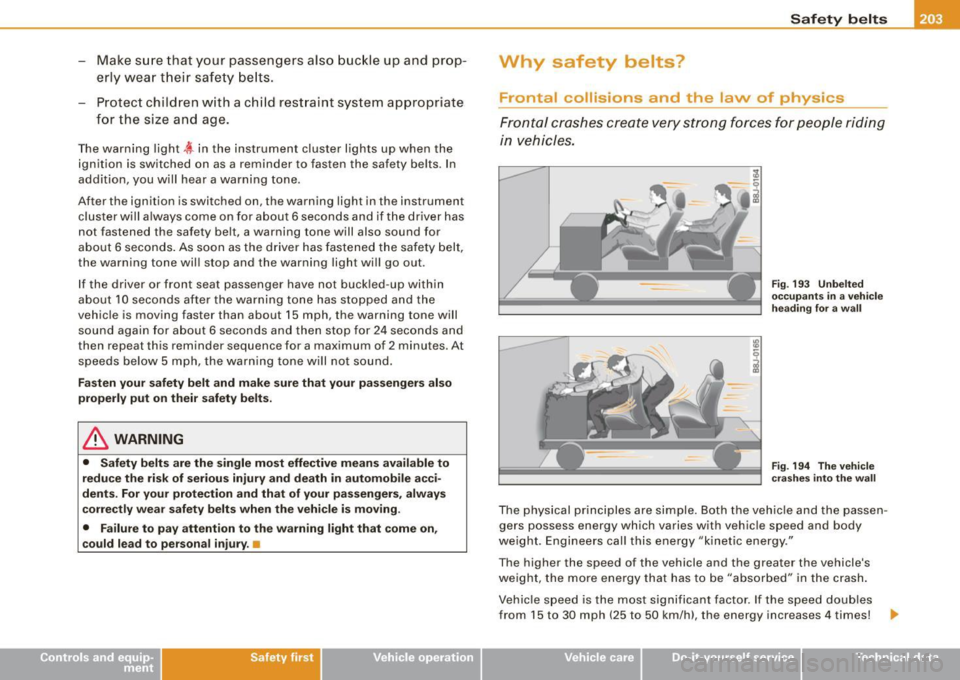
Fig . 193 Unbelted
occupants in a vehicle
heading for a wall
Fig. 194 The vehicle
crashes into the wall
The physical principles are simple. Both the vehicle and the passen
gers possess energy which varies with vehicle speed and body
weight . Engineers call this energy "kinetic energy."
The higher the speed of the vehicle and the greater the vehicle's
weight, the more energy that has to be "absorbed" in the crash.
Vehicle speed is the most significant factor . If the speed doubles
from 15 to 30 mph (25 to 50 km/h) , the energy increases 4 times!
~
Vehicle care I I Technical data
Page 216 of 390
llffl __ A_ ir_ b_ a-g _ s_y _s_ t_ e_ m _________________________________________________ _
Child restraints on the front seat - some
important things to know
-Be sure to read the important information and head the
WARNINGS for important details about ch ildren and
Advanced Airbags~
page 234.
Even though your vehic le is equipped with an Advanced Airbag
System, make certain that a ll children, especia lly those 12 years and
younger , always ride in the back seat proper ly restrained for their
age and size . The airbag on the passenger side makes the front seat
a potentia lly dangerous place for a child to ride. The front seat is not
the safest place for a chi ld in a forward -facing child safety seat. It
can be a very dangerous place for an infant or a child in a rearward
facing seat.
The Advanced Ai rbag System in your vehicle has been certified to
comply with the Requirements of United States Federal Motor
Vehicle Safety Standard 208 as applicable at the time your vehicle
was manufactured.
The Standard requires the front airbag on the passenger side to be
turned off ("suppressed") if a chi ld up to about one year of age
restrained in one of the rear-facing or forward-facing infant res traints listed in Federa l Motor Vehicle Safety Standard 208 with
which the Advanced Airbag System in your vehicle was cert ified has
been insta lled on the front passenger seat. For a listing of the child
restraints that were used to certify compliance with the US Safety
Standard =>
page 236.
The PASS ENGER AIR B AG OFF light in the instrument panel tells you
when the front Advanced Airbag on the passenger side has been
t urned off by the electronic control unit.
Each time you turn on the ignition , the
PASSEN GER AIR BA G OFF
light will come on for a few seconds and:
• will stay on if the front passenger seat is not occupied, •
will stay on if there is a small child or child restraint on the front
passenger seat,
• will go off if the front passenger seat is occupied by an adult as
registered by the weight-sensing mat=>
page 223, "Monitoring the
Advanced Airbag System" .
The
P AS SENGER AIR BAG OFF light comes on when the control unit
detects a tota l weight on the front passenger seat that requires the
front airbag to be turned off.
If the total weight on the front passenger seat is more than that of
a typica l 1 year -old child but less than the weight of a small adult,
the front airbag on the passenger side can deploy (the
PA SSE NGER
A IR BA G OFF
light does not come on). If the P ASSE NGER AIR B AG
O FF
light does not come on, the front airbag on the passenger s ide
has not been turned off by the electronic control unit and can
deploy if the control unit senses an impact that meets the condi
tions stored in its memory.
F o r e xample , th e a ir b ag m ay dep loy if:
• a small ch ild that is heavier than a typical 1 year -o ld child is on
the front passenger seat (regardless of whether the child is in one
of the child safety seats listed
=> page 236), or
• a child who has outgrown chi ld restraints is on the front
passenger seat.
If the front passenger airbag is turned off, the
PASSEN GER AIR BA G
OFF
light comes on in the instrument cluster and stays on.
The fron t airbag on the passenger side may
not deploy (the
PA SS ENGER AIR BA G OFF light does not illuminate and stay lit) even
if a small adult or teenager, or a passenger who is no t sitting upright
with their back against a non -reclined backrest with their feet on the
vehic le floor in front of the seat is on the front passenger seat
=> page 194, "Proper seating position for the driver".
If the front passenger airbag deploys, the Federal Standard requires
the airbag to meet the "low risk" deployment criteria to reduce the risk of injury through interact ion with the airbag. "Low risk" d eploy
ment occu rs in those crashes that take place at lower decelerations .,.
Page 218 of 390
___ A_ ir_b _a_ g;:::;_ s--:.. y_s _t _e _m _________________________________________________ _
& WARNING (con tinued )
• Improper in stallation of child re straints can reduce their effec
tiveness or even prevent them from p roviding any protection .
• An improperly installed child re straint can interfere with the
airbag as it deploys and seriously injure or even kill the child -
even with a n Advanced Airbag System .
• Always carefully follow the manufa cturer's instruction s
provided with the child safety seat or carrier .
• Never pl ace additional items on the seat that can in crease the
total weight regi stered by the weight -sensing mat and can cause
injury in a crash .
u
Front airbags
Description of front airbags
The air bag system c an pr ovi de su ppleme ntal pr otecti on
t o prop erl y re stra ined fr ont se at occu pant s.
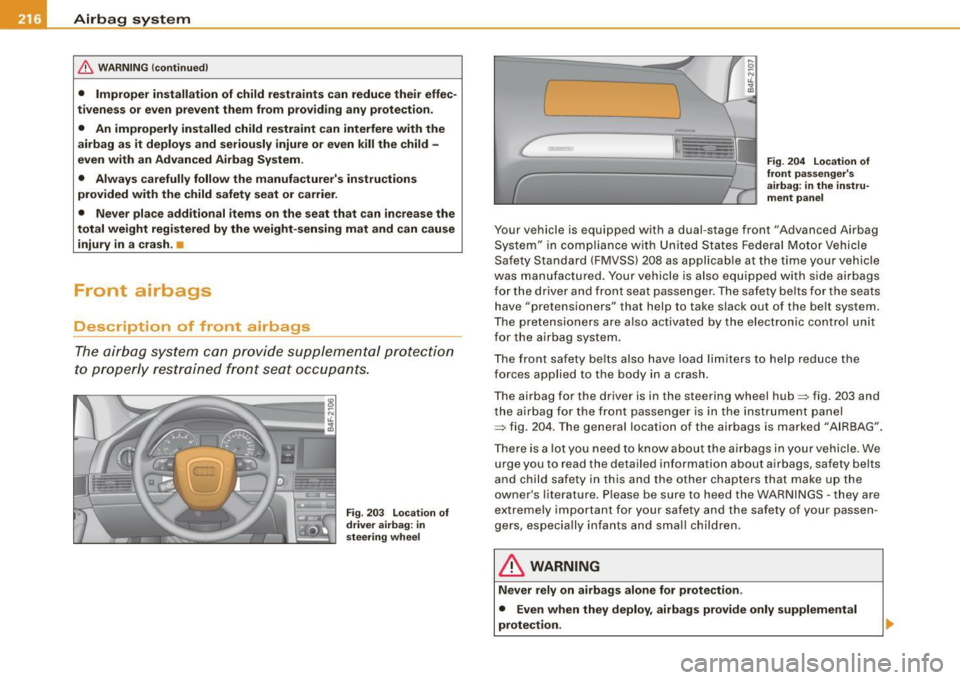
Fig . 203 Location of
driver airbag: in
s teering wheel
(
Fig . 204 Locat ion of
front pa ssenger' s
airbag : in the in stru
ment pa nel
Your vehicle is equipped with a dual -stage front "Advanced Airbag
Sys tem" in com pliance w ith United Sta tes Fede ral Mo tor Vehicle
Safety Standard (F MVSS) 208 as applicab le at the time your v ehicle
was man ufactured. Yo ur vehicle is also equipped w ith side air bags
f o r th e dr iver and fro nt seat passen ger. T he sa fety be lts fo r the seats
have "pretensioners" that help to take slack out of the be lt system.
T he pre tensio ners are a lso activated by the electronic co ntro l un it
for the airbag system.
T he fron t safety be lts als o have load li m ite rs to hel p red uce the
forces applied to the body in a crash.
T he airbag for the driver is in the steering wheel hub=:, fig. 20 3 and
t h e ai rbag for t he front passeng er is in the inst rument pane l
=:, fig. 204. The genera l location of the ai rbags is marked "A IRBAG".
There is a lo t you need to know ab out the airbags in y our vehicle. We
urge you to read the detailed information about airbags, safety belts
and chil d safety in this a nd th e other cha pters t hat make up the
owner's l iterature. Please be sure to heed the WAR NINGS -th ey are
extremely important for your safety and the safety of your passen
gers, especia lly infants and sma ll children .
& WARNING
Never rely on airbags alone for prote ction .
• Even when they deploy, airbag s provide only supplemental
protection .
Page 219 of 390
__________________________________________________ A_ i_ r _b _a...; g::- s_ y=--- s_t _e _m __ fflllll
& WA RN ING (co ntinued)
• Airb ag work mo st effectively when u sed with prope rly worn
s afety belts.
• Therefore , alwa ys wear your safety be lt s and make sure that
ev erybod y i n yo ur vehi cle is properly re str ained.
& WARNING
A pe rson on the front pa ssen ger s eat , e spe cially inf ants and small
c hildren , w ill re ceive s eriou s injurie s and can ev en be killed by
being too cl ose to the airbag whe n it infl ates .
• Although the Advan ced Airba g System in your vehicle i s
de signed t o tu rn off the front p assenger airb ag i f a n inf ant or a
s mall child i s on the front pa ssenger seat , nobod y can absolut ely
gu ara nt ee that deployment under these spe cial con ditio ns is
impo ssible in all conc eivable situations that m ay happen during
the useful l ife of your vehic le.
• The Adv anced Airbag Sy stem will deploy in a ccordance with
the "lo w risk" opti on u nder th e U.S. Feder al Stand ard if a child t hat
i s heavier than th e typi cal on e-year old child i s on the front
p asse nger seat and the other conditi ons for airb ag dep loym ent
are met.
• Acc ident stat istics have shown that children are gener ally s afe r
in the rear seat ar ea than in the front seating po sit ion .
• Fo r their o wn safet y, all children , espe cially 12 yea rs and
younger , should always r ide in the back properly restrained for
their age and siz e. •
Advanced front airbag system
Your vehicle is equipped with a front Advanced Airbag System in
compliance with United States Federal Motor Veh icle Sa fety Stan
dard 208 as applicab le at the time your vehicle was manufactured.
Controls and equip ment Safety first Vehicle operation The front Advanced Airbag System supplements the safety belts to
provide additional protection for the driver's and front passenger's
heads and upper bodies in fronta l crashes. The airbags inflate only
in frontal impacts when the vehic le dece leration is high enough.
The front Advanced Airbag System for the front seat occupants is not a substitute for your safety belts. Rather, it is part of the overa ll
occupant restraint system in your vehicle. A lways remember that
the airbag system can only help to protect you, if you are sitting
upright, wear ing your safety belt and wearing it properly . This is why
you and your passengers must a lways be properly restrained, not
just because the law requires you to be .
The Advanced A irbag System in your vehicle has been certified to
meet the " low risk" requirements for 3 and 6 year-o ld children on the
passenger side and very small adults on the driver side. The low risk
deployment criteria are intended to he lp reduce the risk of injury
through interact ion wi th the front a irbag that can occur, for
examp le, by being too close to the steering whee l and instrument
panel when the airbag inflates.
In addition, the system has been certified to comply with the
"suppression" requirements of the Safety Standard, to turn off the
front airbag for infants 12 months old and younger who are restrained on the front passenger seat in child restraints that are
listed in the Standard:::::,
page 236, "Child restraints and Advanced
Airbags".
"Suppression" requires the front ai rbag on the passenger side to be
turned off if:
• a child up to about one year of age is restrained on the front
passenger seat in one of the rear-facing or forward -facing infant
restraints listed in Federal Motor Vehicle Safety Standard 208 with
wh ich the Advanced Airbag System in your vehicle was certif ied. For
a listing of the child restraints that were used to certify your
vehicle's compliance with the US Safety Standard:::::,
page 236,
• weight less than a threshold leve l stored in the control unit is
detec ted on the front passenger sea t. .._
Vehicle care Do-it-yourself service Technical data
Page 220 of 390
___ A_ ir_ b_ a-g _ s_y _s_ t_ e_ m _________________________________________________ _
When a person is detected on the front passenger seat, weighing
m ore tha n the to tal weigh t of a c hild that is ab out 1 year old
restra ined in one of the rear -fac ing or forward -facing infant
r es traints (listed in Fede ra l M oto r Vehicle Safe ty S ta ndard
208 with
which the Advanced Airba g System in your ve hic le was certified),
the fro nt airbag on the pas se nge r si de may o r may not dep loy .
The
PASSENGER AIR BAG OFF li gh t com es o n when the elect ro ni c
contro l unit detects a total weight on the front passenger seat that
requ ires th e front ai rbag to be tur ned off. If th e
PASSENGER AIR BAG
OFF
light does not come on, the front airbag on the passenger side
h as not been tu rned off by the c ontrol unit and can depl oy if the
control unit senses an impact that meets the conditions stored in its memo ry .
If t he to tal we ight on the fro nt passen ge r seat is more t han t hat of
a typical
1 year -old, but less than the weight of a small adult, the
fro nt a irba g on t he passen ger side may dep loy (the
PASSENGER AIR
BAG OFF
li ght does not come onl.
For example, the airbag may deploy if:
• a small ch ild that is heav ie r th a n a typ ical 1 yea r-old ch ild is o n
the front passenger seat (regardless of whether the child is in one
o f th e ch ild sa fety seats listed=>
page 236),
• a ch ild wh o ha s ou tg rown chi ld re strain ts is on the fron t
passen ger seat.
If the front passenge r airbag is turned off, the
PASSENGER AIR BAG
OFF
lig ht in the ce nter of t he inst rument panel wi ll co me on a nd stay
on.
The fron t airb ag o n the passenger side may
not deploy (the
PASSENGER AIR BAG OFF lig ht does not i llu m ina te and s ta y lit) i f:
• a small adu lt or teenager is on the front passenger seat
• a passenger who is no t sitt ing up rig ht with the ir back aga inst a
non -reclined bac krest with their feet on the vehicle f loor in front of
t h e seat is on th e fro nt pass enger se at.
If the front passenger airbag deploys, the Federa l Standard requires
t he a irbag to m eet th e "low ri sk" deploy ment criter ia to he lp reduce the risk of injury through interaction with the airbag. "
Low risk"
d eployme nt occ urs in those cras hes that ta ke place a t lower de ce l
e rations as defined in the electron ic contro l unit .=:>
page 223
Always remember : Even though your vehicle is equipped with
A dva nced Air bags , th e sa fes t place fo r chi ldren is properly
r estra ined on the back seat. Please be sure to read the important
i nf orm atio n in t he sect ions t hat follow and b e sur e to hee d all of the
WARN INGS.
& WARNING
To reduce the risk of injury when an airbag inflates, always wear
safety belts properly.
• If you are unrestrained, leaning forward , sitting sideways or out
of posit ion in any way, your risk of injury is much higher.
• You will also receive serious injuries and could even be killed if
you are up against the airbag or too close to it when it inflates -
even with an Advanced Airbag=:>
page 212.
& WARNING
A child in a rearward -facing child safety seat installed on the front
passenger seat will be seriously injured and can be killed if the
front airbag inflates -even with an Advanced Airbag System .
• Although the Advanced Airbag System in your vehicle is
de signed to turn off the front airbag when a rearward -facing child
restraint has been installed on the front passenger seat , nobody
can absolutely guarantee that deployment is impossible in all
conceivable situations that may happen dur ing the useful life of
your vehicle.
• The inflating airbag will hit the child safety seat or infant
carrier with great force and will smash the child safety seat and
c hild against the backrest , center arm rest , door , or roof .
• Always install rearward -facing child restraints in the back seat . ..,.
Page 221 of 390
__________________________________________________ A_ i_ r _b _a...; g::- s_ y=--- s_t _e _m __ fllll
& W ARNING (continued )
• If you must in stall a rearward facing child safety seat on the
front passenger seat because of exceptional circumstances and
the PASSENGER AIR BAG OFF light does not come on and stay on ,
immediately install the rear -facing child safety seat in a rear
seating position and have the airbag system inspected by your
Audi dealer .
& WARNING
If, in exceptional circumstance s, you must install a forward-facing
c hild restraint on the front passenger's seat:
• Always make sure the forward -facing seat has been designed
and certified by its manufacturer for use on a front seat with a
passenger front and side airbag .
• Never put the forward -facing child restraint up against or very
near the instrument panel.
• Always move the passenger seat into its rearmost position in
the seat's fore and aft adjustment range , as far away from the
airbag as possible , before installing the forward -facing child
restraint. The backrest must be adjusted to an upright position.
• Make sure that the PASSENGER AIR BAG OFF light comes on
and stays on all the time whenever the ignition is switched on .•
Advanced Airbag System components
T he front passenger seat in your vehicle has a lot of very important
p ar ts of th e A dva nced Air b ag System in it. T hese pa rts inc lu d e the
weight -sensing mat, sensors , w iring, brackets, and more. The func
t ion o f the sys te m in the fr ont passenge r sea t is c hecked by th e e le c
tronic contro l unit when the i gnition is on. The control unit monitors
th e Adva nced Ai rbag Syst em an d t urns t he air b ag in dicat or ligh t on
when a malfunction in the system components is detected. T he
function of the airbag indicator light is described in greater detail
Controls and equip ment Safety first Vehicle operation below
. B ecause the front passenger seat conta ins important par ts
o f th e Adva nced Ai rbag Sys te m , yo u m ust take care to prev ent it
from be ing damaged. Damage to the seat may pr event the
Advanced Air bag for the fr ont pas senge r sea t fr om doing i ts job i n
a cras h.
The front Advanced Airbag System consists of the
following :
• Crash sens ors in th e fro nt of th e vehi cle that meas ure vehic le
acce leration/dece leration to provide information to the Advanced
A irb ag System ab out the seve rity of the c rash .
• An electron ic control unit, with integrat ed crash sensors for front
and si de i mpac ts . T he co ntr ol unit "de cides" w heth er to f ir e th e
front airbags based on th e information received from the crash
se nsors . The con trol unit also "deci des" w hethe r the safet y belt
pretensioners should be activated.
• A dua l- st age A dvan ced Airb ag with gas ge nerato r for t he drive r
inside the steer ing wheel hub .
• A du al- s tage A dvanced Air bag a nd gas gene ra tor insid e the
instrument panel fo r the front passenger.
• A w eigh t-s e nsin g mat und er the u phols ter y padding of th e fron t
passenger seat cushion that measures the total weight on the seat.
Th e in form atio n r egis tered i s sen t co nti nuousl y to th e e lectr oni c
control unit to regu late dep loyment of th e fro nt Advanced Airbag o n
t he pas se nge r sid e.
• An airbag monito ring system and indicator light in the instru
m ent c luste r::::>
p age 22 3.
• T he PASSENGER AIR BAG OFF light comes on and stays on in the
ce nter of the i nstrume nt p anel ::::>
pa ge 224, fi g. 206 a nd tells y ou
when the front Advanced Airbag on the passenger side has been
tu rne d off .
• A sensor be low the safety belt latch for the front seat passenger
to mea sure the t ensio n on t he sa fet y b elt. The ten sion o n the safet y
belt and the weight registe red by t he weight -sensing mat help the
cont ro l un it "deci de" whe ther t he fro nt air bag fo r the front _,.
Vehicle care Do-it-yourself service Technical data
Page 222 of 390
___ A_ i_r _b _a _ g~ s_ y_ s_t _e _m ___________________________________________________ _
passenger seat shou ld b e turned off or not=> pa ge 214, "Child
res train ts on the fron t seat - so m e impor tant thi ngs to kno w".
• A sensor in the safety belt latch for the driver and fo r the front
s e at pass enger that s enses w hether th at sa fet y belt is la tc hed or not
and transmits this information to the el ectron ic control unit .
& WARNING
Damage to the front passenger seat can prevent the front airbag
from working properly .
• Improper repair or disassembly of the front passenger and
driver seat will prevent the Advanced Airbag System from func
tioning properly .
• Repairs to the front passenger seat must be performed by qual
ified and properly trained workshop personnel.
• Never remove the front passenger or driver seat from the
vehicle.
• Never remove the upholstery from the front passenger seat .
• Never disassemble or remove parts from the seat or disconnect
wires from it .
• Never carry sharp objects in your pockets or place them on the
seat .
If the weight-sensing mat in the passenger seat is punctured
it cannot work properly.
• Never carry things on your lap or carry objects on the
passenger seat. Such items can increase the weight registered by
the weight-sens ing mat and send the wrong information to the
airbag control unit .
• Never store items under the front passenger seat . Parts of the
Advanced Airbag System under the passenger seat could be damaged , preventing them and the airbag system from working
properly.
• Never place seat covers or replacement upholstery that have
not been specifically approved by Audi on the front seats.
& WARNING (continued)
• Seat covers can prevent the Advanced Airbag System from
recognizing child restraints or occupants on the front passenger
seat and prevent the side airbag in the seat backrest from
deploying properly .
• Never use cushions, pillows, blankets or similar items on the
front passenger seat . The additional padding will prevent the
weight-sensing mat in the seat from accurately registering the
child restraint or person on the seat and prevent the Advanced
Airbag System from functioning properly.
• If you must use a child restraint on the front passenger seat
and the child restraint manufacturer's instructions require the use
of a towel , foam cushion or something else to properly position
the child restraint, make certain that the PASSENGER AIR BAG OFF
light comes on and stays on whenever the child restraint is
i nstalled on the front passenger seat .
• If the PASSENGER AIR BAG OFF light does not come on and stay
on, immediately install child restraint in a rear seating position
and have the airbag system inspected by your Audi dealer. •
How the Advanced Airbag System
components work together
T he front Advanced Airbag System and the si de airba gs supplement
t h e protection offered by the fro nt three -point safety be lt s with
pretensioners and load limiters a nd t he adjustab le head restraints
to help reduce the risk of in jury in a wide range of accident and
cras h situati ons. Be s ure to read the im por tant i nformation about
safety and heed the WAR NINGS in this chapter.
Depl oyment of the Adva nced A irbag Sy stem and the acti vat ion of
th e safety be lt pr etensioners dep ends on the decele ration
m easu re d by the crash se nso rs and regi stered by the e lec troni c
control unit . Crash s eve rity depends on speed and dec eleration as
~
Page 223 of 390
well as the mass and stiffness of the vehicle or object involved in the crash.
When the electronic control unit registers a low severity crash and
the safety belt is being used, the airbag wi ll not deploy . If the safety
belt is not being used, the first stage deploys, followed by the
second stage after a much later time in the crash sequence.
If the electronic control unit registers a crash of medium severity,
the first stage of the airbag deploys followed by the second stage at
a much later t ime in the crash sequence · regardless of whe ther the
safety belt is being used or not. In higher severity crashes as regis
tered by the e lectronic contro l unit, both the fi rst and second stages
deploy almost at the same time.
On the passenger side, regardless of safety belt use, the airbag will
be turned off if the weight on the passenger seat is less than the
amount programmed in the electronic control unit. The front airbag
on the passenger side wi ll a lso be turned off if one of the child
safety seats that has been certified under Federal Motor Vehicle
Safety Standard 208 has been recogn ized on the seat . The
PAS SEN GER A IR BAG OFF light comes on and stays on to tell you
when the front Advanced Airbag on the passenger side has been
turned off~
page 214, "Child restraints on the front seat - some
important things to know".
& WARNING
T o re duc e the ri sk of injury wh en an airb ag infla te s, a lw ay s wear
sa fet y belt s pr operl y.
• If you are unr estra ined , leanin g forw ard , s it tin g s idew ays or out
o f positi on i n a ny w ay, y ou r ris k of in jur y is much hig her.
• Yo u w ill al so rec eive seriou s injurie s and could even be kill ed if
y ou are up a gain st th e airbag or too close to it when it infl ates -
e ve n with an A dvanced Airbag~
page 212. •
Safety first
Airb ag sy ste m
More important things to know about front
airbags
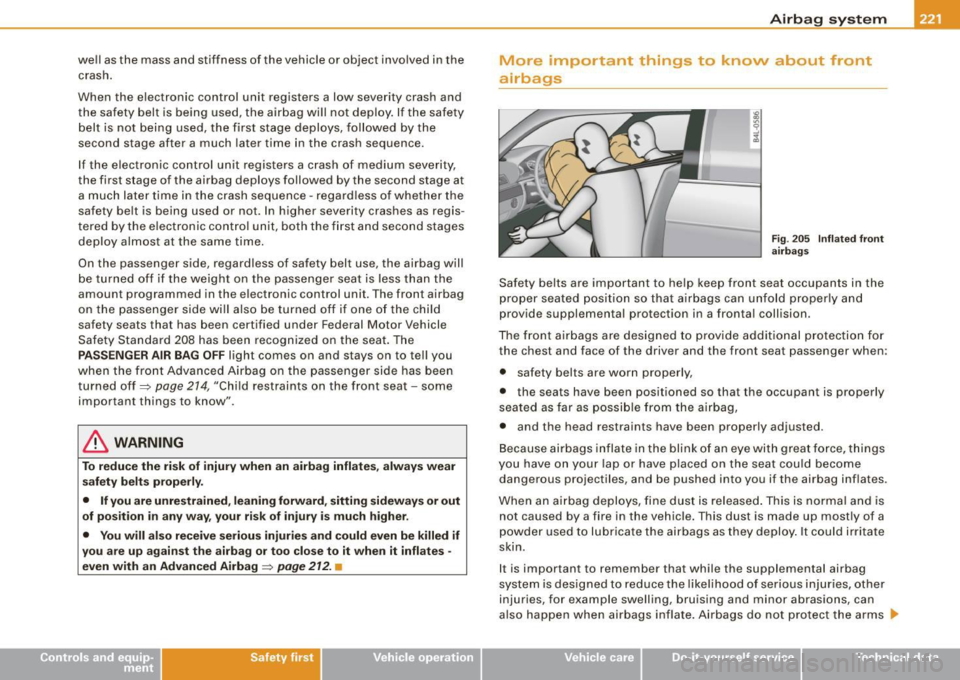
F ig . 205 In fl at ed front
airb ags
Safety belts are important to he lp keep front seat occupants in the
proper seated position so tha t airbags can unfold proper ly and
provide supplemental protection in a fronta l collision.
The fron t airbags are designed to provide addit ional protection for
the chest and face of the driver and the front seat passenger when:
• safety belts are worn properly,
• the seats have been positioned so that the occupant is properly
seated as far as possib le from the airbag,
• and the head restraints have been properly adjusted .
Because airbags inflate in the blink of an eye with great force , things
you have on your lap or have p laced on the seat cou ld become
dangerous projectiles, and be pushed into you if the airbag inflates .
When an airbag deploys, fine dust is released . This is norma l and is
not caused by a fire in the vehicle. This dust is made up mostly of a
powder used to lubricate the airbags as they d eploy . It could irritate
skin.
It is important to remember that while the supplemental airbag
system is designed to reduce the likelihood of serious injuries, other
injuries, for example swelling, bruising and minor abrasions, can
a lso happen when airbags inflate. Airbags do not pro tect the arms •
Vehicle care I I irechnical data
Page 224 of 390
-L~A:::..:,: ir:....: b:!..::: a~g L.:: s:1y :...:s::..: t~ e:.: m:...:...:.. ________________________________________________ _
or the lower parts of the body. Front airbags only supp lement the
th ree p oint safe ty belts in som e front al co llis ions in which the
vehic le dece leration is h igh enou gh to deploy the a irba gs.
Front airbags will not deploy:
• if the ignition is switched off when a crash occurs,
• i n sid e collis io ns,
• i n rea r- e nd collisi ons ,
• in ro llovers,
• when th e c ras h de celerat io n measur ed by the a irba g system is
less than the minimum threshold needed for a irbag deployment as
r egi stere d by th e ele ctro nic con trol uni t.
The front passenger airbag will also not deploy :
• when th e fr ont pass enger seat is no t occupi ed,
• when the weight on the front passenger seat a s sensed by the
A dvanced A irbag Syste m indica tes tha t the fr ont air bag o n the
passenger side has to be turned off by the e lectronic cont rol unit
(t he PASSENGER AIR BAG OFF li gh t comes o n and s tays o nl.
& WARNING
Sitting in the wrong position can increase the risk of serious injury
in crashes .
• To reduce the risk of injury when the airbags inflate , the driver
and passengers must always sit in an upright position , must not
lean against or place any part of their body too close to the area
where the airbags are located.
• Occupants who are unbelted , out of position or too close to the
airbag can be seriously injured by an airbag as it unfolds with
great force in the blink of an eye=> page
214.
& WARNING
A child in a rearward-facing child safety seat installed on the front
passenger seat will be seriously injured and can be killed if the
front airbag inflates -even with an Advanced Airbag System .
• The inflating airbag will hit the child safety seat or infant
carrier with great force and will smash the child safety seat and
child against the backrest, center arm rest, door or roof.
• Always install rear-facing child safety seats on the rear seat.
• If you must install a rearward facing child safety seat on the
front passenger seat because of exceptional circumstances and
the PASSENGER AIR BAG OFF light does not come on and stay on, i mmediately install the rear-facing child safety seat in a rear
seating position and have the airbag system inspected by your
Audi dealer .
& WARNING
Objects between you and the airbag will increase the risk of injury
in a crash by interfering with the way the airbag unfolds or by
being pushed into you as the a irbag inflates .
• Never hold things in your hands or on your lap when the vehicle
is in use.
• Never transport items on or in the area of the front passenger
seat. Objects could move into the area of the front airbags during
braking or other sudden maneuver and become dangerous projec
tiles that can cause serious personal injury if the airbags inflate .
• Never place or attach accessories or other objects (such as
cupholders, telephone brackets , large, heavy or bulky objects) on
the doors , over or near the area marked "AIRBAG" on the steering
wheel , instrument panel , seat backrests or between those areas
and yourself . These objects could cause injury in a crash , espe
cially when the airbags inflate .
• Never recline the front passenger's seat to transport object s.
Items can also move into the area of the side airbag or the front ..,
Page 226 of 390
llffll,___A_ ir_ b_ a.::g <-- s--
Iii
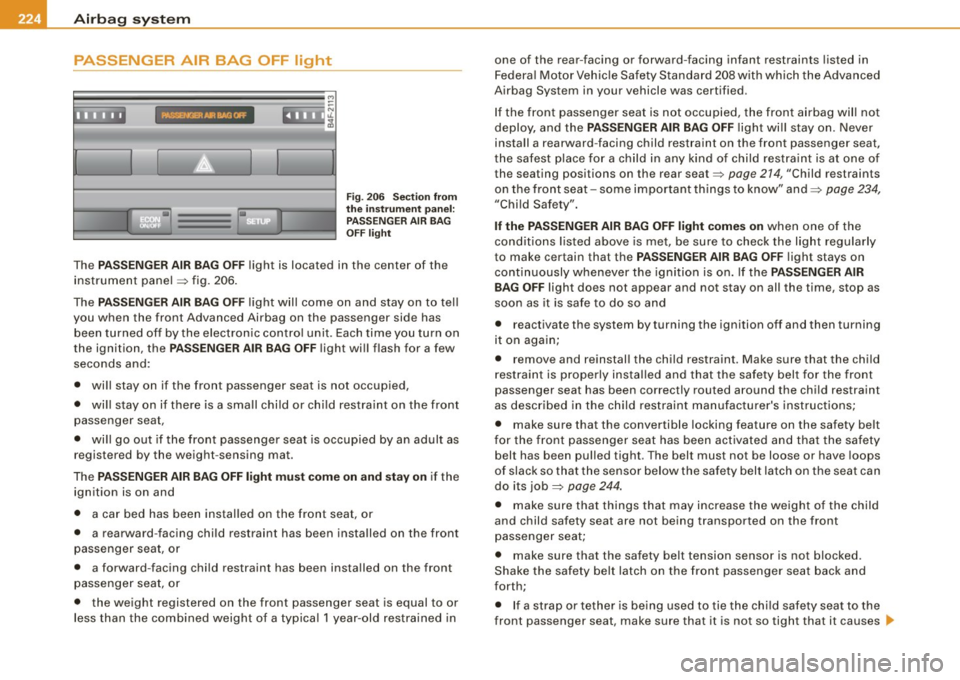
Fig . 206 Sec tio n fr om
th e i nstrument pan el:
PAS SENGER AIR BAG
OFF light
The PASSENGER AIR BAG OFF light is located in the center of the
instrument pane l => fig. 206 .
The
PASSENGER AIR BAG OFF light will come on and stay on to tel l
you when the front Advanced Airbag on the passenger side has
been turned off by the electronic contro l unit . Each time you turn on
the ignition, the
PAS SENGER AIR BAG OFF light wi ll flash for a few
seconds and :
• will stay on if the front passenger seat is not occupied,
• will stay on if there is a small chi ld or chi ld restraint on the front
passenger seat ,
• will go out if the front passenger seat is occupied by an adult as
registered by the weight -sensing mat .
The
PASSENGER AIR BAG OFF light must come on and stay on if the
ignition is on and
• a car bed has been installed on the front seat, or
• a rearward-facing child restraint has been installed on the front
passenger seat, or
• a forward-facing child restraint has been insta lled on the front
passenger seat, or
• the weight registered on the front passenger seat is equal to or
less than the combined weight of a typical 1 year-old restrained in one of the rear
-facing or forward-facing infant restraints listed in
Federa l Motor Vehicle Safety Standard 208 with which the Advanced
Airbag System in your vehicle was certified .
I f the front passenger seat is not occupied, the front airbag wil l not
deploy, and the
PASSENGER AIR BAG OFF li ght wi ll stay on. Never
install a rearward -facing child restraint on the front passenger seat,
the safest place for a child in any kind of child restraint is at one o f
the seating posi tions on the rear seat=>
page 214, "Child restraints
o n the front seat -some important things to know" and=>
page 234,
"Chi ld Safety".
If the PASSENGER AIR BAG OFF light comes on when one of the
conditions listed above is met , be sure to check the light regularly
to make certain that the
PASSENGER AIR BAG OFF light stays on
continuously whenever the ignition is on. If the
PASSENGER AIR
BAG OFF
light does not appear and not stay on all the time, stop as
soon as it is safe to do so and
• reactivate the system by turning the ignition off and then turning
it on again;
• remove and reinstal l the child restraint. Make sure that the child
restraint is properly insta lled and that the safety belt for the front
passenger seat has been correctly routed around the child restraint
as described in the child restraint manufacturer's instructions;
• make sure that the convertible locking feature on the safety belt
for the front passenger seat has been activated and that the safety
belt has been pulled tight . The belt must not be loose or have loops
of slack so that the sensor below the safety belt latch on the seat can
do its job =>
page 244.
• make sure that things that may increase the weight of the child
and child safety seat are not being transported on the front
passenger seat;
• make sure that the safety belt tension sensor is not blocked .
Shake the safety belt latch on the front passenger seat back and
forth;
• If a strap or tether is being used to tie the child safety seat to the
front passenger seat, make sure that it is not so tight that it causes -.,