roof AUDI S6 2008 Owner's Manual
[x] Cancel search | Manufacturer: AUDI, Model Year: 2008, Model line: S6, Model: AUDI S6 2008Pages: 390, PDF Size: 88.42 MB
Page 240 of 390
___ C_h_ i_ ld _ S_ a_ f_ e_ t_y ____________________________________________ _
& WARNING
Not using a child safety seat, using the wrong child safety seat or
improperly installing a child restraint increases the risk of serious
personal injury and death.
• All vehicle occupants and especially children must always be
restrained properly whenever riding in a vehicle .
- An unrestrained or improperly restrained child can be injured or killed by being thrown against the inside of the vehicle or by
being ejected from it during a sudden maneuver or impact.
- An unrestrained or improperly restrained child is at much
greater risk of injury or death by being struck by an inflating
airbag.
• Commercially available child safety seats are required to
comply with U.S . Federal Motor Vehicle Safety Standard (FMVSSI
213 (in Canada CMVSS 2131.
-When buying a child restraint , select one that fits your child
and the vehicle.
- Only use child restraint systems that fully contact the flat
portion of the seat cushion . The child restraint must not tip or
lean to either side . Audi does not recommend using child safety
seats that rest on legs or tube-like frames. They do not provide
adequate contact with the seat .
- Always heed all legal requirements pertaining to the installa
tion and use of child safety seats and carefully follow the
instructions provided by the manufacturer of the seat you are
using .
• Never allow children under 57 inches (1 .5 meters) to wear a
normal safety belt. They must always be restrained by a proper
child restraint system. Otherwise, they could sustain injuries to
the abdomen and neck areas during sudden braking maneuvers or
accidents.
• Never let more than one child occupy a child safety seat .
& WARNING (continued)
• Never let babies or older children ride in a vehicle while sitting
on the lap of another passenger.
- Holding a child in your arms is never a substitute for a child
restraint system .
- The strongest person could not hold the child with the forces
that exist in an accident. The child will strike the interior of the
vehicle and can also be struck by the passenger.
- The child and the passenger can also injure each another in
an accident.
• Never install rear-facing child safety seats or infant carriers on
the front passenger seat . A child will be seriously injured and can
be killed when the passenger airbag inflates - even with an
Advanced Airbag System .
• The inflating airbag will hit the child safety seat or infant
carrier with great force and will smash the child safety seat and
child against the backrest , center arm rest, door or roof .
• Always install rear -facing child safety seats or infant carriers on
the rear seat.
• Forward -facing child safety seats installed on the front
passenger's seat can interfere with the airbag when it inflates and
cause serious injury to the child . Always install forward -facing
child safety seats on the rear seat .
• If exceptional circumstances require the use of a forward
facing child restraint on the front passenger's seat , the child's
safety and well -being require that the following special precau
tions be taken:
- Make sure the forward -facing seat has been designed and
certified by its manufacturer for use on a front seat with a
passenger front and side airbag .
- Always carefully follow the manufacturer's instructions
provided with the child safety seat or carrier .
Page 247 of 390
_______________________________________________ C_h _ i_ld _ S_ a_ f_ e_ t..,:c y __ lftlll
& WARNING (continued )
• If the backrest is not securely latched, the child and the child
restraint will be thrown forward together with the backrest and
will strike parts of the vehicle interior . The child can be seriously
injured or killed .
• Never install rear-facing child safety seats or infant carriers on
the front passenger seat. A child will be seriously injured and can be killed when the passenger airbag inflates .
• The inflating airbag will hit the child safety seat or infant
carrier with great force and will smash the child safety seat and
child against the backrest , center arm rest , door or roof.
• Always install rear-facing child safety seats or infant carriers on
the rear seat.
• Forward-facing child safety seats or infant carriers installed on
the front passenger's seat may interfere with the deployment of
the airbag and cause serious injury to the child .
• It is safer to install a forward -fac ing child safety seat on the rear
seat.
• Always read and heed all WARNINGS whenever using a child
restrained in a vehicle is being used
=> page 234 . Special precau
tions apply when installing a child safety seat on the front
passenger seat
=> page 214 , "Child restraints on the front seat -
some important things to know ".
& WARNING
Always take special precautions if you must install a forward or
rearward-facing child restraint on the front passenger's seat in
exceptional situations:
• Whenever a forward or rearward -facing child restraint is
installed on the front passenger seat, the PASSENGER AIR BAG
OFF light must come on and stay on whenever the ignition is
switched on .
Controls and equip ment Safety first
Vehicle operation
& WARNING (continued )
• If the PASSENGER AIR BAG OFF light does not come on and stay
on, perform the checks described
=> page 223, ''Monitoring the
Advanced Airbag System ".
• Take the child restraint off the front passenger seat and install
it properly at one of the rear seat positions if the PASSENGER AIR
BAG OFF light does not stay on whenever the ignition is switched
on .
• Improper installation of child restraints can reduce their effec
tiveness or even prevent them from providing any protection.
• An improperly installed child restraint can interfere with the
airbag as it deploys and seriously injure or even kill the child.
• Always carefully follow the manufacturer's instructions
provided with the child safety seat or carrier.
• Never place additional items on the seat that can increase the
total weight registered by the weight-sensing mat and can cause injury in a crash.
& WARNING
Forward-facing child restraints:
• Always make sure the forward -facing seat has been designed
and certified by its manufacturer for use on a front seat with a
passenger front and side airbag.
• Never put the forward-facing child restraint up, against or very
near the instrument panel .
• Always move the passenger seat into its rearmost position in
the seat's fore and aft adjustment range , as far away from the
airbag as possible before installing the forward-facing child
restraint . The backrest must be adjusted to an upright position .
• Make sure that the PASSENGER
AIR BAG OFF light comes on
and stays on all the time whenever the ignition is switched on . .,,,_
Vehicle care Do-it-yourself service Technical data
Page 248 of 390
•L-----=C::..: h:...:..:..:. il-= d ~S=-= a~fe =-=- ty!.._ _____________________________________________ _
& WARNING
Rearward-facing child restraints:
• A child in a rearward-facing child safety seat installed on the
front passenger seat will be seriously injured and can be killed if
the front airbag inflates -even with an Advanced Airbag System.
• The inflating airbag will hit the child safety seat or infant
carrier with great force and will smash the child safety seat and
child against the backrest, center arm rest, door or roof.
• Always be especially careful if you must install a rearward
facing child safety seat on the front passenger seat in exceptional
circumstances.
• A tight tether strap on a rearward-facing child restraint
attached to the front passenger seat can put too much pressure
on the weight-mat in the seat and register a heavier weight in the
Advanced Airbag System. The heavier weight registered can make
the system work as though an adult were on the seat and deploy
the Advanced Airbag when it must be suppressed causing serious or even fatal injury to the child.
• Make sure that the PASSENGER AIR BAG OFF light comes on
and stays on all the time whenever the ignition is switched on.
• If the PASSENGER AIR BAG OFF light does not come on and stay
on, immediately install the rear-facing child safety seat in a rear
seating position and have the airbag system inspected by your
Audi dealer. •
Activating the convertible locking retractor
Use the convertible locking retractor to secure a child
restraint.
Always heed the child safety seat manufacturer's instruc
tions when installing a ch ild restraint in your vehicle. To
activate the convertible locking retractor: -
Place the child restraint on a seat, preferably on the rear
seat.
- Slowly pull the belt
all the way out.
-Route it around or through the child restraint belt path
=>& .
- Push the child safety seat down with your full weight to
get the safety belt really tight.
- Insert the belt tongue into the buckle for that seating
position.
- Guide the safety belt back into the retractor until the belt
lies flat and snug on the child safety seat.
- You should hear a "clicking" noise as the belt winds back
into the inertia reel. Test the convertible locking retractor
by pulling on the belt. You should no longer be able to
pull the belt out of the retractor. The convertible locking
retractor is now activated.
- Make sure that the red release button is facing away from
the child restraint so that it can be unbuckled quickly.
- Pull on the belt to make sure the safety belt is properly
tight and fastened so that the seat cannot move forward
or sideways more than one inch (2.5 cm).
& WARNING
Using the wrong child restraint or an improperly installed child
restraint can cause serious personal injury or death in a crash.
• Always make sure that the safety belt retractor is locked when
installing a child safety seat. An unlocked safety belt retractor
cannot hold the child safety seat in place during normal driving or
in a crash.
~
Page 270 of 390
___ D_ r_iv _ in_... g"'- a_ n_ d_ e_ n_ v_i_r _o _n_ m_ e_n_ t _______________________________________________ _
New brake pads
--
Remember that new brake pads do not have a full braking
effect during the first 250 miles (400 kilometers) after they
are installed .
New brake pads have to be "burnished in" before they have optimal
grab =>& .
During the break -in period, you should avoid putting severe loads
on the brakes . Severe loads include, for examp le, sudden hard
braking, in particular at very high speeds or, for example, on moun
tain passes.
& WARNING
New brake pads don't have the best stopping power and must be
"broken-in" during the initial 100 to 150 miles (150 to 200 kilome
ters) of normal city driving. You can compensate for this by
pressing the brake pedal more firmly . This also applies later when
new pads are installed.
:J
Catalytic converter
It is very important that your emission control system
(catalytic converter) is functioning properly to ensure that
your vehicle is running in an environmentally sound
manner.
- Always use lead-free gasoline:=> page 291, "Fuel supply".
- Never run the tank down all the way to empty.
- Never put too much motor oil in your engine ==>
page 302,
"Adding engine oil 't=:;r\11
•
Never try to push- or tow-start your vehicle.
The catalytic converter is an efficient "clean-up" device built into the
exhaust system of the vehicle. The catalytic converter burns many
of the po llutants in the exhaust gas before they are released into the
atmosphere.
The exclusive use of unleaded fuel is critically important for the life
of the catalytic converter and proper functioning of the engine.
& WARNING
• Do not park or operate the vehicle in areas where the hot
exhaust system may come in contact with dry grass, brush, fuel
spill or other material which can cause a fire .
• Do not apply additional undercoating or rustproofing on or
near the exhaust manifold, exhaust pipes, catalytic converter or
heat shields. During driving, the substance used for undercoating
could overheat and cause a fire .
0 Note
• Be aware that just one tank filling with leaded fuel will alr eady
seriously degrade the performance of the catalytic converter.
• Do not exceed the correct engine oil level=>
page 302.
• Do not drive until the fuel tank becomes completely empty. The
engine could misfire. Unburned fuel could also get into the exhaust
system and this could cause the catalytic converter to overheat.
• Do not turn off the ignition while the vehicle is moving.
• Do not continue to operate your vehicle under these conditions,
as otherwise fuel can reach the catalytic converter. This could result
in overheating of the converter, requiring its replacement .
• To assure efficient operation of the Emission Control System:
- Have your vehicle maintained properly and in accordance with
the service recommendations in your Maintenance
& Warranty
booklet. •
Page 281 of 390
_____________________________________________ C_ l_ e _a_ n_ in_ g_a _ n_d_ p_ r_ o_ t _e_ c_t _io _ n __ lJ!II
•
Under certain circumstances, weekly washing may be necessary.
Under other conditions , a monthly washing and waxing may be
adequate .
After the winter, the
underside of the vehicle should be thoroughly
washed, preferably in a professional car wash.
& WARNING
Always read and heed all WARNINGS and other information
~ page 278. •
Automatic car wash
The vehicle can be washed in almost any modern auto
matic car wash.
The vehicle paint is so durable that the vehicle can normally be
washed without problems in an automatic car wash . However, the
effect on the paint depends to a large extent on the design of the
facility, the filtering of the wash water , the type of wash and care
material, etc. If the paint has a dull appearance after going through
the car wash or is scratched , bring this to the attention of the oper
ator immediately . If necessary, use a different car wash .
Before going through a car wash, be sure to take the usual precau
tions such as closing the windows and power roof . Factory installed
antennas must not be removed.
If you have installed additional accessories on the vehicle - such as
spoilers, roof rack, etc. -it is best to ask the car wash operator if
these should be removed.
& WARNING
Always read and heed all WARNINGS and other information
~ page 278. •
Washing the vehicle by hand
A lot of water is needed when washing a vehicle by hand.
-Before you start washing, make sure you have read and
understood the WARNINGS =:>
& in "General informa
tion" on
page 278.
-First soak all dried dirt until it is soft, then rinse it off.
- As you clean your vehicle, start with the roof and work
your way down to the bottom, using a sponge, a sponge glove or a clean brush.
- Rinse the sponge or the sponge glove often, flushing it
clean each time.
- Use special car shampoo only for very persistent dirt.
- Rinse the car thoroughly with water.
- Use a chamois leather to gently w ipe the exterior dry.
Use a separate sponge for cleaning the wheels , door sills and other
regions exposed to road dirt. In this way, you will not scratch the
paint with coarse particles imbedded in the sponge the next time
you wash the car.
& WARNING
• Do not clean the underside of the chassis, fenders, wheel
covers, or other hard to reach parts without protecting your hands
and arms. You may cut yourself on sharp-edged metal parts.
• Always read and heed all WARNINGS and other information
~ page 278. _..
Vehicle care I t •
Page 286 of 390
llffll __ C_ le_ a _ n_i_n ~g _ a_ n_ d __ p_r _o _t _e _c_ t_ i_o _n ___________________________________________ _
brake dust is also corrosive. If left on for too long, brake dust can
cause pitting.
Use on ly specia l
acid-free cleaners formulated for a lloy r ims . Safe
products are available at your Audi dealer. Never leave the cleaner
on the ri ms longer than specified on the label. If not rinsed of f
promptly, the acid contained in some c leaners can attack the
threads o n the wheel bo lts .
Never use abrasive or metal po lishing c leaning agents. If the protec
tive coating has been chipped, e.g . by kicked up road dirt, touch i t
up as soon as poss ible .
& WARNING
• Moisture and i ce on b rake s may affe ct b raking effi cien cy
~ page 261 , "General information ". Te st the brake s carefully ea ch
t ime you wa sh the vehi cle .
• Always read and heed all WARNINGS and other information
~ pag e 278. •
Body cavity sealing
The body cavity sealing does not nee d to be checked .
All body cavities which could be affected by corrosion have been
t horoughly pr otected a t the factory .
This sealing does not require any inspection or additional treat
ment . If any wax should seep out of the cavity when the ambient
temperature is high, it can be removed with a plastic scraper and a suitable solvent .
& WARNING
Solvents can be dangerous.
• Ben zine is fla mmab le and to xic . If you use be nzine fo r removing
the wax , keep sparks, f lame and lighted cigarettes away . Never
& W ARN ING (continued )
dump benz ine on the ground , into open streams or down sewage
dra in s.
• Be sure to observe all safety and env ironmental regulat ions .
Follow all in struction s on the cont ainer .
• Alway s read and heed all WARNINGS and other inform ation
~ page 278 .•
Chassis
Have the u nderc oating c hecked for dama ge from tim e to
time.
T he lower body shell of your Audi is also thoroughly protected
aga inst corrosion .
Any damage to the undercoat ing caused by road hazards shou ld be
repaired promptly.
& WARNING
Too much undercoating in the wrong place s can cau se a fire .
• Do not app ly addition al undercoating or rustproofing on or
near the exhaust manifold, exhau st pipe s, catalytic converter or
he at shield s. While dr iving , the sub stance used for underco ating
could overhe at and cau se a fire .
• Alwa ys read and heed all WARNINGS and other info rm ation
=> page278 .•
Page 317 of 390
Tires a nd wh eels -
----------------
•
Groove
means the space between two adjacent tread ribs.
Load ra ting (code)
means the maximum load that a tire is rated to carry for a given
inflation pressure. You may not find this information on all tires
because it is not required by law.
M ax im um l oad ra tin g
means the load rating for a tire at the maximum permissib le infla
tion pressure for that tire.
Ma ximum l oaded v ehi cle weigh t
means the sum of:
(a) Curb weight
(b) Accessory weight
(c) Vehic le capacity weight, and
(ct) Production options weight
M ax im um (p er mi ssibl e) infl ati on pr essur e
means the maximum cold inflation pressure to wh ich a tire may be
inflated. Also ca lled "maximum inflation pressure."
Normal occ upa nt wei ght
means 150 lbs. (68 kilograms) times the number of occupants
seated in the vehicle up to the to tal seating capacity of your vehicle.
O ccupant di stributi on
means distribution of occupants in a vehicle .
Outer di am eter
means the overall diameter of an inflated new tire.
O ve rall wi dth
means the linear distance between the exteriors of the sidewa lls of
an inflated tire, includ ing elevations due to labeling, decorations, or
protective bands or ribs.
Pl y
means a layer of rubber -coated para lle l cords.
P rodu ction opt io ns wei ght
means the combined weight of those installed regular production
options weighing over 5 lbs . (2.3 kg) in excess of those standard
i t ems wh ich they replace, not previously considered in curb weigh t
or accessory weight, including heavy duty brakes, ride levelers, roof
rack, heavy duty battery, and specia l trim .
Radi al p ly tire
means a pneumatic tire in which the ply cords that extend to the
beads are laid at substantially 90 degrees to the centerline of the
tread .
Reco mm ended infl ati on pr essu re
see => page 314, "Cold tire inflation pressure".
Rein force d tir e
means a tire designed to operate at higher loads and at higher infla
tion pressures than the corresponding standard tire. Reinforced
t ires my be identified as "XL", "xi", "EXTRA LOAD", or "RF" on the
sidewall.
R im
means a metal support for a tire or a tire and tube assembly upon
wh ich the t ire beads are seated.
Rim di amet er
means nominal diameter of the bead seat. If you change your whee l
size, you wi ll have to purchase new tires to match the new rim diam
eter .
Rim siz e de sig nation
means rim diameter and width.
Rim wid th
means nominal distance between rim flanges.
Vehicle care I t •
Page 347 of 390
_________________________________________________ F_ u_ s_ e_s _ a_n _d_ b_ u _ lb_ s _ __.1111
Fuses and bulbs
Fuses
Replacing a fuse
A problem in the electrical system may be caused by a
blown fuse.
Fig . 256 Ins trumen t
pa nel left: Face c over
F ig . 257 I nst rume nt
pa nel left: Co ntent
F ac e cover
- Locate the fuse which belongs to the component which
failed.
- Switch off the ignition and the e lectr ica l component
affected. - Carefully p
ry t he face cover off the instr umen t pane l
using the ignition key or a screwdriver~ fig. 256.
- Rem ove the plastic clip @ from i ts retainer in the face
cove r~ fig. 257, p lace i t over the questionable fuse and
remove the fuse.
- Replace a blown fuse (recognizable by the melted metal
str ip inside) wi th a f use of the
same amperage.
The individual circuits are protected by fuses. T he fuse panels with
the fuses are located on the left and right front faces of the instru
ment pane l behind a cover and in the right storage area in the
luggage compartment.
There is a plastic clip @ in the cover on the lef t side of the instru
ment pane l, which can be used to remove the fuses . The crank © is
used for emergency operation of the power roof*. You will also find
a label on both covers in the instrument panel with the fuse layout
© for the corresponding fuse panel.
& WARNING
Nev er r eplac e a fuse with one that ha s a high er amperag e rati ng.
• A fu se w ith a to o high ampe rage co uld d amag e the ele ctr ical
pa rt a nd cau se a fire .
0 Note
• On no account should fuses be repaired (e .g. patched up wi th tin
foil or wire) as this may cause serious damage elsewhere in the e lec
trica l circuit o r cause fire.
• If a fuse blows repeatedly, do not keep replacing it. Instead , have
the cause of the repea ted short circuit or overload located and fixed.
ti>
Vehicle care Do-it-yourself service Technical data
Page 349 of 390
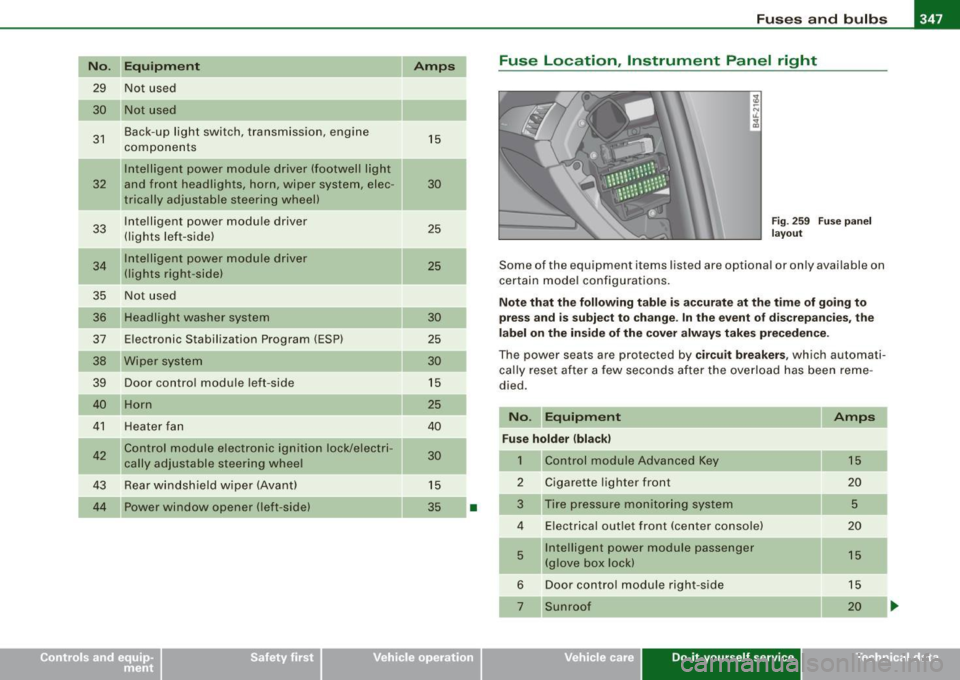
_______________________________________________ F_ u_ s...:....... e...;.s _ a_ n_d :.:.....:.: b:...: u:...: l:.:.: b :...:s:...___,J
No . Equipm ent
29 Not used
30 Not used
31 Back-up light swi
tch, transmission , engine
components
Intelligent power mo dule driver (footwell l ight
32 and front headlights , horn, wiper system, elec
tr ically adjusta ble steering wheel)
33 I
ntelligent power modu le driver
(lights left -side)
---,--
34
35
36
37
38
39 I
nte lligent power modu le driver
(lights right -side)
Not used
Headlight washer system
E lectronic Stabilization Program (ESP)
Wip er system
Door control module left -side
Horn
41 Heater fan
42 Control module electronic ignition lock/electri
cally adjustable steering wheel
43 Rear windsh iel d wiper (Avant)
4 4 Power window opener (left-side)
Amps
15
30
25
25
30 25
30
15
25
40
30
15
35
-
•
Fuse Location , Instrument Panel right
Fig . 2 59 F use p an el
la yo ut
Some of the equipm ent items lis ted are op tional or on ly available on
certain m ode l configu rations.
Note that the following table is ac curate at the time of g oing to
press and is subject t o change . In the ev ent of d iscrepan cies , th e
l a b el on t he in side of the cover alw ay s take s prec eden ce.
Th e power seats are pr otected by circuit breaker s, which automa ti
ca lly reset after a few seconds a fter the ove rload has been reme
died .
No. Equipment Amps
Fu se holder (bla ck )
1 Control module Advanced Key 15
2 Cigarette
lighter front
20
3 Tire pressure moni tor ing system
5
4 E lectrica l outlet front (center conso le) 20
5 Intellige
nt power module passenger
15
(glove box lock)
6 Door control module right -side 15
Sunroof 20
Vehicle care Do-it-yourself service irechnical data
Page 363 of 390
_________________________________________________ G_ e_ n_ e_r _a _l_ i_n _f_o _ r_ m_ a_ t _i _o _ n __ lllll
v e hic le identificatio n number of your vehic le (p erforation) as well as
th e G ro ss V ehic le We ight Rat ing (GVWR) an d the Gro ss A xle We ig ht
R ating (GAWRl .
The high voltage warning label is located on the lock carrier.
The spark ignition system meets all requirements of the Canadian Interference -Ca using Equipment Regulations . •
Displaying Vehicle Identification
Number in the MMI
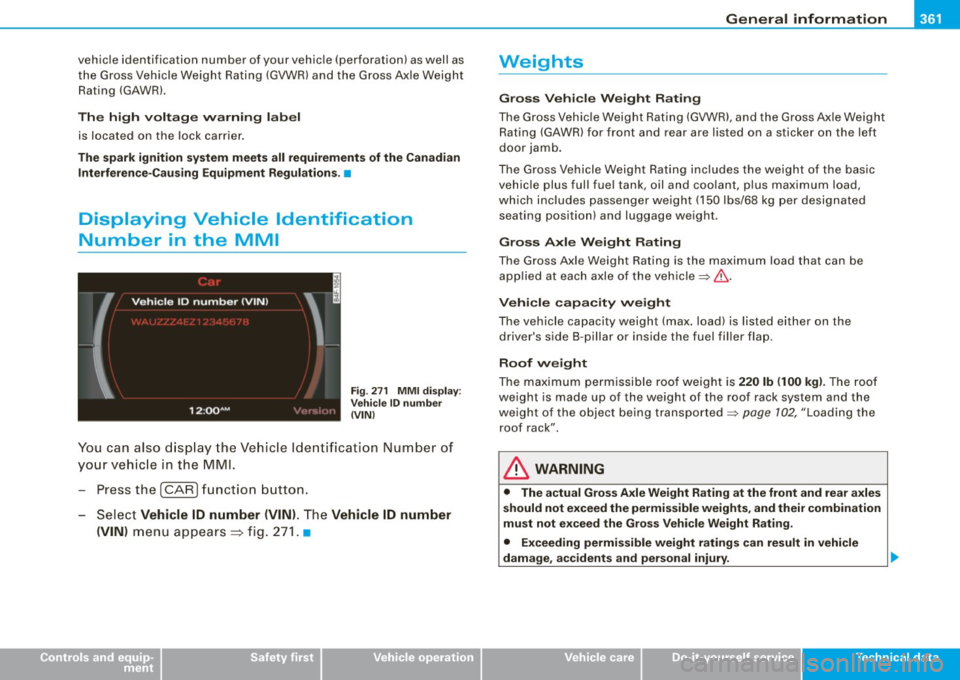
Fig . 2 7 1 MMI display :
Vehicle ID number
( VIN )
You c an also disp lay the Ve hic le I dentification Num be r of
y o ur vehi cle in t he MM I.
- Press the
I C A R I funct io n bu tton.
- Se lect
Vehicle ID number (VIN). T he Vehicle ID number
(VIN)
me nu a ppear s :::::;, fig . 271 . •
Controls and equip
ment Safety first Vehicle operation
Weights
Gross Vehicle Weight Rating
The G ross Ve hicle We ight Rating (GVWR), a nd the Gross A xle Weight
R ating (GAW R) for front and rear are l isted on a stic ker on the left
doo r jamb .
T he G ross Ve hicle We igh t R ating includes t he weight o f the bas ic
vehic le plus full fue l tank , oil and coo lant, p lus maximum load,
w hi ch includes passe nger we ight (1 50 lbs/68 kg per des ignat ed
seat ing position) and luggage weight .
Gross Axle Weight Rating
The Gross Axle Weight Rating is the maximum load that can be
ap plied at each axl e of the vehicle~ &.
Vehicle capacity weight
The vehic le capacity weig ht (max. load) is list ed e ither on the
driver's side B -pillar or ins ide the fuel fi ller flap.
Roof weight
The maxi mum pe rm is s ible roof we ig ht i s 220 lb (100 kg ). The ro of
we ight is made up of th e wei ght of t he roof rack system and the
we igh t of t he o bjec t being tra nspo rted ~ page
102, "Lo ading the
roo f rack".
& WARNING
• The actual Gross Axle Weight Rating at the front and rear axles
should not exceed the permissible weights , and their combination
must not exceed the Gross Vehicle Weight Rating.
• Exceeding permissible weight ratings can result in vehicle
damage , accidents and personal injury .
Vehicle care Do-it-yourself service Tec hn ica l da ta