steering wheel AUDI S6 2008 Owner's Manual
[x] Cancel search | Manufacturer: AUDI, Model Year: 2008, Model line: S6, Model: AUDI S6 2008Pages: 390, PDF Size: 88.42 MB
Page 206 of 390
__ .....::S-=a ::..;f _:e :..:t :.!..y _ b::.....:: e..:..lt :.:s::..._ _____________________________________________ _
Because the passengers of this vehicle are not using safety belts
~ page 203, fig. 193, they will keep moving at the same speed the
vehicle was moving just before the crash, until something stops
them -here, the wall~
page 203, fig. 194.
The same principles apply to people sitting in a vehicle that is involved in a frontal collision. Even at city speeds of 20 to 30 mph
(30 to 50 km/h), the forces acting on the body can reach one ton
(2,000 lbs. or 1,000 kg) or more. At greater speeds, these forces are
even higher.
People who do not use safety belts are also not attached to their
vehicle. In a frontal collision they will also keep moving forward at
the speed their vehicle was travelling just before the crash. Of course, the laws of physics don't just apply to frontal collisions, they
determine what happens in all kinds of accidents and collisions. •
What happens to occupants not wearing
safety be lts?
In crashes unbelted occupants cannot stop themselves
from flying forward and being injured or killed. Always
wear your safety belts!
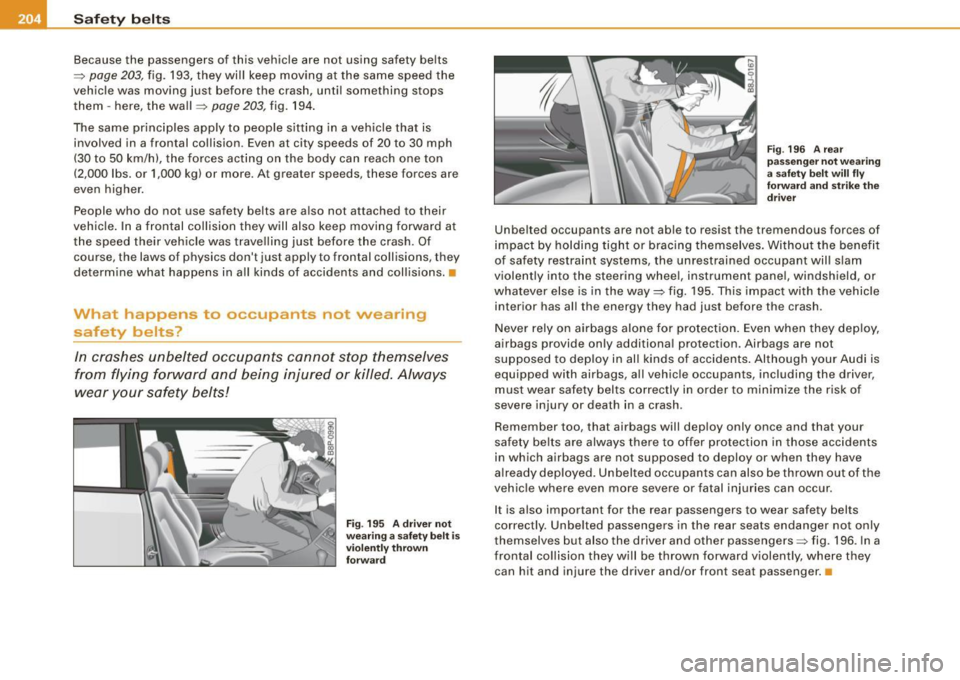
Fig . 195 A driver not
wearing a safe ty belt is
violently thrown
forward Fig. 196
A rear
passenger not wearing
a safety belt will fly
forward and strike the
driver
Unbelted occupants are not able to resist the tremendous forces of
impact by holding tight or bracing themselves. Without the benefit
of safety restraint systems, the unrestrained occupant will slam
violently into the steering wheel, instrument panel, windshield, or
whatever else is in the way~ fig. 195. This impact with the vehicle
interior has all the energy they had just before the crash.
Never rely on airbags alone for protection. Even when they dep loy,
airbags provide only additional protection. Airbags are not
supposed to deploy in all kinds of accidents . Although your Audi is
equipped with airbags, all vehicle occupants, including the driver,
must wear safety belts correctly in order to minimize the risk of
severe injury or death in a crash .
Remember too, that airbags will deploy only once and that your
safety belts are always there to offer protection in those accidents
in which airbags are not supposed to deploy or when they have
a lready deployed. Unbelted occupants can also be thrown out of the
vehicle where even more severe or fatal injuries can occur.
It is also important for the rear passengers to wear safety belts
correctly . Unbelted passengers in the rear seats endanger not only
themselves but also the driver and other passengers~ fig. 196. In a
frontal collision they will be thrown forward violently, where they
can hit and injure the driver and/or front seat passenger. •
Page 214 of 390
-Airbag s yste m Ptrf _______________ _
Airbag system
Important things to know
Importance of wearing safety belts and
sitting properly
Airbags are only supplemental restraints. For airbags to
do their job, occupants must always properly wear their
safety belts and be in a proper seating position.
For your safe ty a nd the safety of your passengers, before
driving o ff, a lways:
- Adjust the driver's seat and steering wheel properly
~ page 194,
-Adjust the front passenger's seat properly~ page 88,
- Wear safety belts properly~ page 205,
-Always properly use the proper child restraint to pro tect
children~
page 234 .
In a col lision airbags must inflate within the blink of an eye and with
considerable force. The supplemental airbags can cause injuries if
the driver or the front seat passenger is not seated properly. There
fore in order to help the airbag to do its job, it is important, both as
a driver and as a passenger to sit properly at a ll times.
By keep ing room between your body and the steering wheel and the
front of the passenger compartment, the airbag can inflate fu lly and
comp letely and prov ide supplementa l protection in certain frontal
collisions =>
page 194, "Proper occupant seating positions". For
detai ls on the operation of the seat adjustment controls=>
page 88.
It's especially important that children are properly restrained
=>
page 234 .
There is a lot that the driver and the passengers can and must do to
help the individual safety features installed in your Audi work
together as a system.
P roper seating position is important so that the front airbag on the
driver side can do its job. I f you have a physical impairment or
condition that prevents you from sitting properly on the driver seat
with the safety belt properly fastened and reaching the pedals, o r if
you have concerns with regard to the function or operation of the
Advanced Airbag System, p lease contact your authorized Audi
dea ler or qua lif ied workshop, or call Audi Customer CARE at 1-800-
822 -2834 for possib le modifications to your vehicle.
When the airbag system deploys, a gas generator wi ll fill the
airbags, break open the padded covers, and inflate between the
steering wheel and the driver and be tween the instrument panel
and the front passenger. The airbags wil l deflate immediate ly after
deployment so that the front occupants can see through the wind
shield again without interruption .
A ll of this takes p lace in the b link of an eye, so fast that many people
don't even rea lize that the airbags have dep loyed . The airbags also
inflate with a great deal of force and nothing should be in their way
when they dep loy. Fron t airbags in combination wi th properly worn
safety belts slow down and limit the occupant's forward movement.
T ogether they help to prevent the driver and front seat passenger
from hitting parts of the inside the vehicle while reducing the forces act ing on the occupant during the crash . In this way they he lp to
reduce the r isk of injury to the head and upper body in the crash.
Airbags do not protect the arms or the lower parts of the body .
Both front airbags will not in flate in al l fro ntal col lisions . The trig
gering of the airbag system depends on the vehic le decelerat ion
r ate caused by the colli sion and registe red by the electronic contro l
unit. If this rate is below the reference value programmed into the
cont rol unit, the airbags w ill not be t riggered, even though the car
may be bad ly damaged as a result of the collision. Vehicle damage, .,,,.
Page 215 of 390
Airbag syst em -----------------=~-
repair costs or even the lack of vehicle damage is not necessari ly an
indication of whether an airbag should inflate or not.
It is not possible to define a range of vehicle speeds that will cover
every possible kind and ang le of impact that wil l always trigger the
airbags, since the circumstances wil l vary considerab ly between
one collision and another. Important factors include, for example,
the nature (hard or so ft) of the object which the car hits, the angle
of impact, vehicle speed, etc. The front airbags wi ll also not inflate
in side or rear co llisions, or in roll -overs .
Al way s rem ember : Airbags wi ll deploy only once, and on ly in certain
kinds of coll isions . Your safety belts are always there to offer protec
tion in those situat ions in wh ich airbags are not supposed to deploy,
or when they have already deployed; for example, when your vehic le
strikes or is struck by another a fter the first coll ision.
T his is just one of the reasons why an airbag is a supplementary
restraint and is not a substitute for a sa fety be lt. The airbag system
works most effectively when used with the safety be lts. Therefore ,
a lways prope rly wea r your safety belt s =>
page 202 .
& WARNING
Sitting too clo se to the steering wheel or in strument panel will
de crease the effect ivene ss of the airbags and will incr ease the risk
of personal injury in a collision.
• Never sit closer than 10 in ches (25 cm) to the steering wheel or
in strument panel.
• If you c annot sit more than 10 in ches (25 cm ) from the steering
wheel , inve stiga te whether adaptive equipment may be available
to held you reach the pedal s and in crease your se ating dist ance
from the steering wheel.
• If you are unrestra ined , leaning forward , sittin g side ways or out
of position in any way , your risk of injury i s much higher .
• You will also receive serious injur ies and could even be killed if
you are up again st the airba g or too clo se to it when it infl ates -
ev en with an Advanced Airbag .
Controls and equip ment Safety first
Vehicle operation
& WAR N IN G ( continued )
• To reduce the ri sk of injury when an airbag inflate s, alw ays
wear safety belt s prope rly~
page 20 6, "S afet y belt s".
• Always make certain that ch ildren age 12 or younger alway s
ride in the rear seat. If children are not p rope rly re str ained , they
may be severely injured or killed when an airbag inflate s.
• Never let children ride unre str ained or impr operly rest rained in
the vehicl e. Adju st the front seat s properly .
• Never ride with the b ackrest r eclined .
• Alway s sit a s far as possible from the steering wheel or the
instrument panel ~
pag e 194.
• Alway s sit upright with your back again st the backre st of your
seat .
• Ne ver pla ce your feet on the instrument panel or on the seat .
Always keep both feet on the floor in front of the seat to help
prevent seriou s injurie s to the leg s and hips if the airbag inflate s.
• Nev er r ecline th e front passenger 's seat to transpo rt obje cts .
Item s can al so mo ve into the area of the side a irbag or the front
airbag during braking or in a sudden m aneuver . Obje cts near the
a irbags can become pro je ctile s and cau se injury when an airbag
inflates .
& WARNING
Airbags that have deployed in a crash must be repla ced.
• U se only original equipment airbags approved by Audi and
in stalled by a trained technician who ha s the neces sary tool s and
diagnostic equipment to properly r epla ce any airb ag in your
vehicle and as sure sy stem effectivenes s in a crash .
• Never perm it salvag ed or re cy cled airb ag s to be i nstall ed in
your vehicle. •
Vehicle care Do-it-yourself service Technical data
Page 218 of 390
___ A_ ir_b _a_ g;:::;_ s--:.. y_s _t _e _m _________________________________________________ _
& WARNING (con tinued )
• Improper in stallation of child re straints can reduce their effec
tiveness or even prevent them from p roviding any protection .
• An improperly installed child re straint can interfere with the
airbag as it deploys and seriously injure or even kill the child -
even with a n Advanced Airbag System .
• Always carefully follow the manufa cturer's instruction s
provided with the child safety seat or carrier .
• Never pl ace additional items on the seat that can in crease the
total weight regi stered by the weight -sensing mat and can cause
injury in a crash .
u
Front airbags
Description of front airbags
The air bag system c an pr ovi de su ppleme ntal pr otecti on
t o prop erl y re stra ined fr ont se at occu pant s.
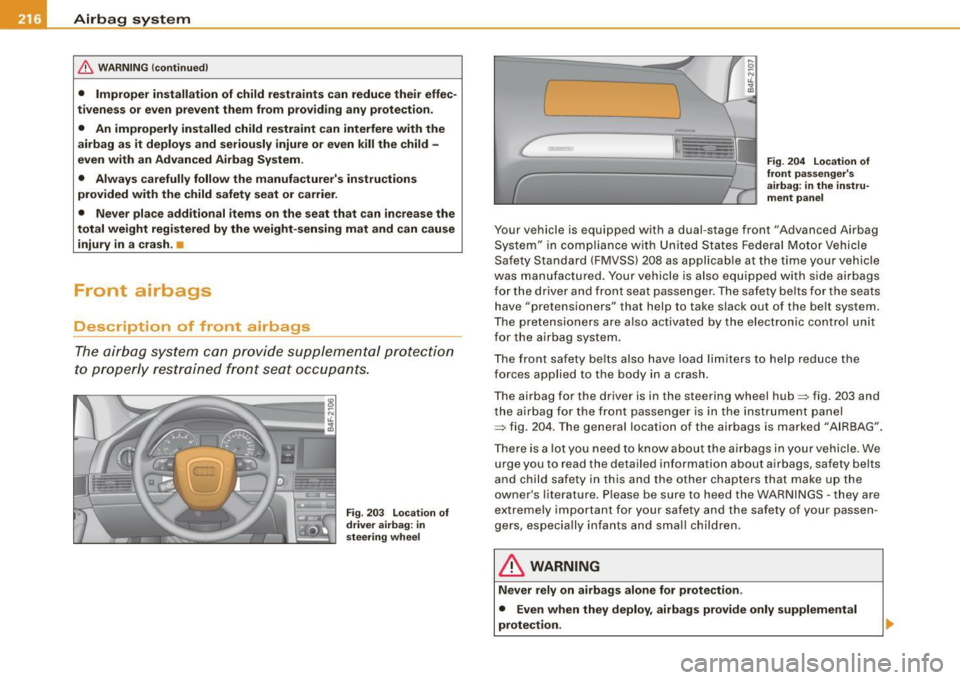
Fig . 203 Location of
driver airbag: in
s teering wheel
(
Fig . 204 Locat ion of
front pa ssenger' s
airbag : in the in stru
ment pa nel
Your vehicle is equipped with a dual -stage front "Advanced Airbag
Sys tem" in com pliance w ith United Sta tes Fede ral Mo tor Vehicle
Safety Standard (F MVSS) 208 as applicab le at the time your v ehicle
was man ufactured. Yo ur vehicle is also equipped w ith side air bags
f o r th e dr iver and fro nt seat passen ger. T he sa fety be lts fo r the seats
have "pretensioners" that help to take slack out of the be lt system.
T he pre tensio ners are a lso activated by the electronic co ntro l un it
for the airbag system.
T he fron t safety be lts als o have load li m ite rs to hel p red uce the
forces applied to the body in a crash.
T he airbag for the driver is in the steering wheel hub=:, fig. 20 3 and
t h e ai rbag for t he front passeng er is in the inst rument pane l
=:, fig. 204. The genera l location of the ai rbags is marked "A IRBAG".
There is a lo t you need to know ab out the airbags in y our vehicle. We
urge you to read the detailed information about airbags, safety belts
and chil d safety in this a nd th e other cha pters t hat make up the
owner's l iterature. Please be sure to heed the WAR NINGS -th ey are
extremely important for your safety and the safety of your passen
gers, especia lly infants and sma ll children .
& WARNING
Never rely on airbags alone for prote ction .
• Even when they deploy, airbag s provide only supplemental
protection .
Page 224 of 390
-L~A:::..:,: ir:....: b:!..::: a~g L.:: s:1y :...:s::..: t~ e:.: m:...:...:.. ________________________________________________ _
or the lower parts of the body. Front airbags only supp lement the
th ree p oint safe ty belts in som e front al co llis ions in which the
vehic le dece leration is h igh enou gh to deploy the a irba gs.
Front airbags will not deploy:
• if the ignition is switched off when a crash occurs,
• i n sid e collis io ns,
• i n rea r- e nd collisi ons ,
• in ro llovers,
• when th e c ras h de celerat io n measur ed by the a irba g system is
less than the minimum threshold needed for a irbag deployment as
r egi stere d by th e ele ctro nic con trol uni t.
The front passenger airbag will also not deploy :
• when th e fr ont pass enger seat is no t occupi ed,
• when the weight on the front passenger seat a s sensed by the
A dvanced A irbag Syste m indica tes tha t the fr ont air bag o n the
passenger side has to be turned off by the e lectronic cont rol unit
(t he PASSENGER AIR BAG OFF li gh t comes o n and s tays o nl.
& WARNING
Sitting in the wrong position can increase the risk of serious injury
in crashes .
• To reduce the risk of injury when the airbags inflate , the driver
and passengers must always sit in an upright position , must not
lean against or place any part of their body too close to the area
where the airbags are located.
• Occupants who are unbelted , out of position or too close to the
airbag can be seriously injured by an airbag as it unfolds with
great force in the blink of an eye=> page
214.
& WARNING
A child in a rearward-facing child safety seat installed on the front
passenger seat will be seriously injured and can be killed if the
front airbag inflates -even with an Advanced Airbag System .
• The inflating airbag will hit the child safety seat or infant
carrier with great force and will smash the child safety seat and
child against the backrest, center arm rest, door or roof.
• Always install rear-facing child safety seats on the rear seat.
• If you must install a rearward facing child safety seat on the
front passenger seat because of exceptional circumstances and
the PASSENGER AIR BAG OFF light does not come on and stay on, i mmediately install the rear-facing child safety seat in a rear
seating position and have the airbag system inspected by your
Audi dealer .
& WARNING
Objects between you and the airbag will increase the risk of injury
in a crash by interfering with the way the airbag unfolds or by
being pushed into you as the a irbag inflates .
• Never hold things in your hands or on your lap when the vehicle
is in use.
• Never transport items on or in the area of the front passenger
seat. Objects could move into the area of the front airbags during
braking or other sudden maneuver and become dangerous projec
tiles that can cause serious personal injury if the airbags inflate .
• Never place or attach accessories or other objects (such as
cupholders, telephone brackets , large, heavy or bulky objects) on
the doors , over or near the area marked "AIRBAG" on the steering
wheel , instrument panel , seat backrests or between those areas
and yourself . These objects could cause injury in a crash , espe
cially when the airbags inflate .
• Never recline the front passenger's seat to transport object s.
Items can also move into the area of the side airbag or the front ..,
Page 228 of 390
___ A_ ir_ b_ a-g _ s_y _s_ t_ e_ m _________________________________________________ _
& WARN ING (continued )
seating posit ion and have the airb ag system inspe cted by your
Audi dealer .
• A t ight tether or other strap on a rearward-fa cing child restr aint
att ached to the front pas senger se at can put too much pres sure
on the weight-sensing mat in the seat and reg ister more weight
than is actually on the seat. The heavier weight registered can
m ake the system work as though an adult were on the seat and
deploy the Advanced Airbag when it must be suppressed cau sing
ser ious or even fatal injury to the child .
• If, in exceptional circumstance s, you mu st in stall a forward
f a cing child restraint on the front passenger seat , always move the
seat into its rearmost position in the seat's fore and aft adjust
ment range , as far away from the airbag as po ssible . The ba ckrest
must be adjusted to an upright position. Make sure that the
PASSENGER AIR BAG OFF light comes on and stay s on all the time
whenever the ignition is switched on .
& WARNING
• If the PASSENGER AIR BAG OFF light does not go out when an
adult is sitting on the front passenger seat after tak ing the step s
described above, make sure the adult i s properly seated and
restrained at one of the rear seating posit ions .
• Have the airbag system inspected by your Audi dealer before
transport ing anyone on the front passenger seat .
[ i ] Tips
If the weight -sensing mat in the front passenger seat detects an
e m pty seat , the front a irbag on the passenge r side wil l be tur ned
off, and PASSENGER AIR BAG OFF will stay on.•
Repair, care and disposal of the airbags
P arts of the airbag system are installed at many different p laces on
you r Aud i. Insta ll ing, r emoving, servic ing or repa iring a pa rt in an
area of the vehicle can damage a part of an airbag system and
p revent that sys tem from working pr operly in a c ollisi on.
There are some important things you have to know to ma ke sure
t h at the effective ness of the system will not be impai red and that
discarded co mponents do not cause injury or po llute the env iro n
ment .
& WARNING
Improper care , servicing and repair procedures can increase the
risk of personal injury and death by pre venting an airbag from
deploying when needed or deploying an airbag unexpectedly:
• Never cover , obstruct , or change the steering wheel horn pad
or airbag cover or the instrument panel or modify them in any way .
• Never attach any objects such as cupholders or telephone
mountings to the surfaces covering the airbag units .
• For cleaning the horn pad or instrument panel , use only a soft,
dry cloth or one moistened with plain water. Solvents or cleaner s
c ould damage the airbag cover or change the stiffness or strength
of the material so that the airbag cannot deploy and protect prop
erly .
• Never repair , adju st, or change any parts of the airbag sy stem .
• All work on the steering wheel , instrument panel , front seats or
electrical system (including the installation of audio equipment ,
cellular telephones and CB radios , etc .I must be performed by a
qualified technician who has the training and special equipment
necessary .
• For any work on the airbag system, we strongly recommend
that you see your author ized Audi dealer or qual ified workshop .
• Never modify the front bumper or parts of the vehicle body .
Page 237 of 390
Child Safety -
--------------------''---
& WARNIN G (continu ed )
• Always install rear-facing child safety seat s on the rear seat.
• If you mu st in stall a re arw ard fa cing child safety sea t on the
front pa ssenger seat in exceptional cir cum stances and the
PASSENGER AIR BAG OFF light doe s not come on and stay on,
immediate ly in sta ll the re ar-facing child safety seat in a rear
s eating po sition and h ave the airbag sy stem inspected immedi
atel y by your Audi dea ler .
& WARNING
If, in exceptional circum stance s, you mu st install a forward -facing
c hild re st raint on the fro nt p ass enger's seat :
• Alway s make sure the forward -facing seat has been de signed
and cert ified by it s manufa cturer f or use on a front se at with a
p assenger front and side airbag .
• Always follow the manufacturer's instructions provided with
the child safety seat or carrier.
• Always mov e the passenger sea t into it s rea rmo st p osition in
the seat' s fore and aft adju stment r ange , as far away from the
airb ag as possible before in stalling the ch ild r estr aint . The b ack
r es t must be adju sted to an upr ight po sition.
• Alway s ma ke sure th at the PASSENGER AIR BAG OFF l ight
c ome s on and stay s on all the time whenever the ignition is
s witched on. •
Advanced front airbag system and children
Your vehicle is equipped with a dual -stage front "Advanced Airbag
System" in comp liance with United States Federal Motor Vehicle
Safety Standard ( FMVSS) 208 as applicab le at the time your vehic le
was manufactured.
Controls and equip ment Safety first Vehicle operation
The Advanced Airbag system in your vehicle has been certified to
meet the " low -risk" requirements for 3 and 6 year -old children on
the passenger side and small adu lts on the driver side. The low risk
deployment crite ria are intended to reduce the risk of injury th rough
interaction with the airbag that can occur, for example, by being too
close to the steering wheel and instrument panel when the airbag
inf lates . In addit ion, the system has been cert ified to comply with
the "suppression" requirements of the Safety Standard, to turn off
the front airbag for infants up to 12 months who are restrained on
the front passenger seat in child restraints that are listed in the
Standard.
Even though your vehic le is equipped with an Advanced Airbag
system, all children, especially those 12 years and younger, should
a lways ride in the back seat properly restrained for their age and
s ize . The airbag on the passenger side makes the front seat a poten
tia lly dangerous p lace for a chi ld to ride. The front seat is not the
safest p lace for a child in a forward -facing child safety seat. It can be
a very dangerous place for an infant or a larger child in a rearward
facing seat. •
Advanced Airbags and the weight-sensing
mat in the front seat
The Advanced Airbag System in your vehicle detects the presence
of an infant or child in a chi ld restraint on the front passenger seat
using the weight -sensing mat in the seat cushion and the sensor
below the safety belt latch on the front passenger seat that
measures the tension on the safety be lt .
The weight -sensing mat measures t otal weight of the child and the
child safety seat and a chi ld blanket on the front passenger seat. The
we ight o n the front passenger seat is related to the design of the
child restraint and its "footprint" , the size and shape of the bottom
of the child restraint as it sits on the seat. The weight of a child
restraint and its "footprint" vary for different kinds of child
~
Vehicle care Do-it-yourself service Technical data
Page 261 of 390
The direction in which the driver wishes to travel is determined with
t he aid of the steering angle and vehicle speed and is continua lly
compared with the actual behavior of the vehicle. If the two do not
match, for example, when the vehic le starts hydrop laning on a wet
road, ESP will automatically brake the appropriate whee l to correct
the prob lem.
The vehicle is then stab ilized by the forces acting on the whee l
during braking. If the vehicle is
oversteering (rear tends to skid out
of the turn), the brakes are mainly app lied on the wheel that is on
the outside of the curve. In the case of a vehicle that is
understeering
(tendency to sl ide out of the curve), the brakes are applied at the
rear wheel that is on the inside of the curve . An acoustic signal indi
cates when ESP brake application cuts in
~ & .
The system operates across the entire speed range in combination
with the ABS system
~ page 262 . If the Anti -Lock Brake System
(ABS) malfunctions, the ESP wi ll be out of action as well.
Ac tivat ing
When you turn on the eng ine, ESP will automatically be activated
and will perform a se lf -test . As soon as the test is comp leted, the
system is in norma l operating mode.
You can activate a deactivated ESP or deactivated ESP/ASR if required by pressing the~
page 258, fig. 225 button . When they are
activated, the message
E S P/AS R on appears briefly in the display.
D eactiv ating
The ESP should normally be activated al l the time . If necessary, you
can deactivate An ti- Slip Regulation (ASR) or the E lectronic Stabiliza
tion Program (ESP) by pressing the button~
page 258, fig. 225.
• Dea ct ivat ing A SR: Tap the button . In certain exceptional situa
tions (e.g. driving with t ire chains) , the Anti-Sl ip Regulation (ASR)
can be deactivated ~
page 260. The message ASR off appears in the
display as we ll.
• Dea ctiv at ing E SP/ASR Press the button for more than 3 seconds.
With the ESP/ASR deactivated, the ESP check light comes on, see
Controls and equip
ment Safety first Vehicle operation
In
te llig ent tec hn olo gy
~ page 19 . The message ES P sw itched off appears in the disp lay as
we ll.
& WARNING
The Electroni c Stabili zation Program i s never thele ss subject to the
la ws o f physics . It is p articularl y import ant t o pay a ttent ion t o th is
f a ct on wet and slippery road s. It is ther efore important tha t y ou
a lw ays a dapt your dr iving to the c ondit ion of th e ro ad and t raffi c
c ondition s. Do n ot allow the inc rea sed safety pro vided b y th e Elec
tr on ic S ta bili zatio n Pr ogram sys tem to lull you in to acc epting
add iti onal safet y risk s. C
Electronic differential tock (EDL)
The electronic differential lock monitors the rotational
speed of the drive wheels.
Gener al note s
The electronic differential lock (EDU helps the car to start moving,
accelerate and c limb a gradient on surfaces providing poor or
almost no grip . Without EDL, this would be difficult, if not impos
sib le .
How th e sys te m wo rk s
The EDL operates automatical ly . It monitors the rotational speed of
the drive wheels on an axle with the he lp of the ABS sensors
~ page 262 . If a noticeable difference in rotational speed between
the drive wheels on one axle is detected (e.g. on slippery ground
on
one side),
the spinning wheel is braked, thereby transferring power
to the other drive wheel or whee ls (a ll -whee l drive) . Th is is done up
to a speed of about 60 mph ( 100 km/h). Noises from the brake
system signal that wheel spin is being control led .
Dr iving off
When driving off , always be sure to keep road conditions in mind as
you accelerate. If one drive wheel spins because it is on a surface
Iii>
•
Vehicle care Do-it-yourself service Technical data
Page 265 of 390
& WARNING
Although the ABS is very effective, always remember that braking
capability is limited by tire traction. Always adjust your driving
speed according to the road and traffic conditions. Do not let the
extra safety afforded by the ABS tempt you into taking extra risks.
The ABS cannot overcome the laws of physics.
[ i] Tips
• If ABS is not functioning properly, a warning light will come on .
See
=> page 22.
• If a fault occurs in the ABS , the EDL is also not functioning. This
is indicated by the ABS warning light. •
Brake assistant
The brake assistant is designed to achieve the optimum
braking effect.
The brake assistant helps to increase the effective braking power
and thus to achieve a shorter stopping distance . If the driver
presses the brake pedal very quickly, the brake assistant automati
cally boosts the braking force to the maximum level, up to the point
where the anti-lock brake function (ABS) intervenes to stop the
wheels from locking. You should then keep the brake pedal pressed
until the vehicle has braked to the required speed. The brake assis
tant switches itself off as soon as you release the brake pedal.
The brake assistant will not be operative if there is a malfunction in
the ABS.
In vehicles with Adaptive Cruise Control* (ACC), the distance to the
vehicle ahead is continuously calculated using a radar sensor,
within the limits of the system=>
page 135. If the radar system
detects a short distance to the vehicle ahead, the brake system
exerts a small braking force to reduce the brake response time in
Controls and equip
ment Safety first Vehicle operation
Intelligent technology
case of braking. In this way, the brake application can be quickened
and
the stopping distance reduced.
& WARNING
Please remember that the accident risk always increases if you
drive too fast, especially in corners or on a slippery road, or if you
follow the vehicle ahead of you too closely. Increased risk of an accident cannot be compensated for even by the brake assistant,
so always maintain a safe speed.
n
Servotronic® -advanced power
steering system
The power steering systems uses the power of the
running engine to allow precise steering with little effort.
The advanced Servotronic ® power steering system senses the road
speed and electronically adjusts power assistance to provide
comfortable and safe steering response exactly matched to the
vehicle speed.
Power steering will not work if the engine is off. As a result, the
steering wheel will be hard to turn.
The power steering fluid level is checked during the scheduled
maintenance services.
0 Note
If there is an electronic malfunction, servotronic will still function
like a conventional power steering system, providing a constant
steering support force that is no longer proportionate to the vehicle
speed. This is most noticeable when turning the steering wheel at
low speeds (for example when parking), -more effort will be
required than usual.
II-
Vehicle care Do-it-yourself service Technical data
Page 266 of 390
___ ln_ t _e_ ll-'"ig ...,_ e_ n_t _t_ e_ c_ h _ n_o _ l_o _,.g= y,_ __________________________________________ _
• Be aware of the different than usual steering response and
adj ust you r steer ing for ce accordingly.
• Have the problem checked and set right by an Audi dealer as
s o on as possible .
[ i ] Tip s
• When th e engine is running, never hold the steering whee l
turned all the way to the right or to the left for longer than 15 seconds. The power steering pump will overheat the hydrau lic
fluid if you keep ho lding the steering wheel turned all the way. This
is like ly to damage the power steering system.
• If the power steering system should fail entirely, or if the engine
is not running (for example, while being towed), you wil l still be able
to steer the vehicle . However,
considerably more effort will be
required to do so.
• If the power steering system should have a leak, or is not func
tioni ng properly, contact your authorized Audi dealer immediately.
• The power steering system requires a specially formulated
hydraulic fluid . The power steering reservoir is the one located most
forward on the left side of the engine compartment~
page 298. The
correct fluid level in the reservoir is important for proper func
tioning of the power steering.
App lies to vehic les: with A ll Wheel Dr ive
Dr iving with your quattro®
With All Wheel Drive, all four wheels are driven.
Gen era l i nfo rm ati on
With All Wheel Drive, power is d istr ibuted to all four whee ls. Th is
happens automatica lly depending on your driving style and the
road conditions at the time. See also ~
page 259, "Electronic differ
entia l lock (EDU".
Wint er tir es
When driving in the winte r, your vehicle with All Wheel Drive has an
advantage, even with regular tires. In winter road conditions it may
be advisable to mount winter tires (or all -season tires) for improved
driveability and braking: these tires must be mounted on
a ll fou r
wh eel s.
See also ~ page 329, "Winter tires".
Tire chains
Where tire chains are mandatory on certain roads, this normally
a lso app lies to veh icles with A ll Wheel Drive~
page 330, "Snow
chains".
R epl acing w hee ls/t ires
Vehicles with All Wheel Drive must always have tires of the same
size. Also avoid tires with different tread depths . For details see
page ~
page 325, "New tires and replacing tires and wheels" .
Off-R oa d dri ving?
Your Audi does no t have enough ground c learance to be used as an
off -road vehic le. It is therefore best to avoid rough tracks and
uneven terrain as much as possible . Also refer to~
page 269.
& WARNING
Always a djust yo ur driving to r oad and traffi c condition s. Do not
let the e xtr a s afet y affor ded b y All Whee l Dri ve tempt you into
taking extr a risks.
• Although the All Wheel Dr ive i s very effe ct ive , a lwa ys
r e member that braking capacity i s limited b y tire trac tion. You
s hould therefore not d riv e at e xcess iv e speed s on icy or slipp ery
road surfaces .
• On we t road surf aces, be care fu l no t to d riv e t oo fas t beca use
the front whe els could b egin to slid e on top of the w ater (aqu a
planing ). If t his sho uld occ ur, you will h ave no warn ing from a
s udden incr ease in engine sp eed a s with a front -wh eel drive
v ehicl e. Alwa ys dri ve at spee d s w hic h are s uited to th e road condi
tion s - risk of cra sh.
;:i