instrument panel AUDI S6 2009 Owner's Manual
[x] Cancel search | Manufacturer: AUDI, Model Year: 2009, Model line: S6, Model: AUDI S6 2009Pages: 398, PDF Size: 43 MB
Page 231 of 398
__________________________________________________ A_ i_ r _b _a...; g::- s_ y=--- s_t _e _m __ fllll
& W ARNING (continued )
seating position and have the airbag system inspected by your
Audi dealer .
• A tight tether or other str ap on a rearward-fac ing child restr aint
attached to the front pas senger seat can put too much pressure
on the weight-sensing mat in the seat and reg ister more weight
than i s actually on the seat. The heavier weight registered can
make the system work as though an adult were on the seat and
deploy the Advanced Airbag when it must be suppressed causing
s erious or even fatal injury to the child .
• If, in exceptional circumstance s, you mu st in stall a forward
fac ing child restra int on the front passenger seat , always move the
seat into its rearmost position in the seat 's fore and aft ad just
ment range , as far away from the airbag a s possible . The backrest
must be adjusted to an upright position . Make sure that the
PASSENGER AIR BAG OFF light comes on and stay s on all the time
whenever the ignition is switched on .
& WARNING
• If the PASSENGER AIR BAG OFF light does not go out when an
adult is sitting on the front passenger seat after taking the steps
described above, make sure the adult is properly seated and
restrained at one of the rear seating positions .
• Have the airbag system inspected by your Audi dealer before
transporting anyone on the front passenger seat .
[ i ] Tips
If the weight -sensing mat in the front passenger seat detects an
e mp ty seat, the fro nt air b ag on the pa ssenge r sid e will be t urned
off, and the PASSENGER AIR BAG OFF l ight will stay on .
a
Controls and equip
ment Safety first
Vehicle operation
Repair, care and disposal of the airbags
Parts of the airbag system are insta lled at many different places on
your Au di. In sta ll in g, re moving, ser vic in g or re pair in g a part in an
area of the vehicle can damage a part of an a irbag system and
pre ven t that system fro m wo rki ng p rope rly in a co llision .
There are some important things you have to know to make sure
that the effectiveness of the system will not be impai red an d that
d iscarded components do not cause inju ry or po llute t he e nv iron
ment .
& WARNING
Improper care , servicing and repair procedures can increase the
risk of personal injury and death by preventing an airbag from
deploying when needed or deploying an airbag unexpectedly:
• Never cover , obstruct , or change the steering wheel horn pad
or airbag cover or the instrument panel or modify them in any way .
• Never attach any objects such as cupholders or telephone
mountings to the surfaces covering the airbag units.
• For cleaning the horn pad or instrument panel, use only a soft ,
dry cloth or one moi stened with plain water . Solvents or cleaners
c ould damage the airbag cover or change the stiffness or strength
of the material so that the airbag cannot deploy and protect prop
erly .
• Never repair , adjust , or change any parts of the airbag system.
• All work on the steering wheel , instrument panel , front seats or
electrical system (including the installation of audio equipment ,
c ellular telephones and CB radios , etc .I must be performed by a
qualified technician who has the training and special equipment
necessary .
• For any work on the airbag system , we strongly recommend
that you see your authorized Audi dealer or qualified workshop .
• Never modify the front bumper or parts of the vehicle body .
Vehicle care Do-it-yourself service Technical data
Page 237 of 398
angle of impact, s inc e the ci rcumstanc es w ill vary considerably
bet ween one collisi on and another. Important factors include, for
example, the na ture (hard or soft) of the impacting object, the ang le
of impact, vehicle speed, etc.~
page 235, "How side curtain ai rbags
work".
Aside from their norma l safety function, safety be lts work to help
keep the driver or front passenger in position in the event of a col li
sion so tha t the side curtain airbags can provide protection .
The airbag system is not a substitute for your safety belt. Rather, it
is part of the overa ll occupant restraint system in your vehicle .
Always remembe r that the airbag sy stem can only help to protect
you if you are wea ring your safety belt and wearing it proper ly. This
is another reason why you should a lways wear your safety belts, not
just because the law requires you to do so~
page 205, "General
notes".
I t is important to remember tha t while the side curtain airbag
system is designed to help reduce the likelihood of serious injuries,
other in jur ies, for examp le, swelling, bruising, and minor abrasions
can a lso be associated with these airbags upon dep loyment.
Remember too, these airbags will dep loy only once and only in
certa in kinds o f accidents -your safety belts are always there to
offer protection.
T he side curtain airbag s ystem basi cally consists of :
• T he electronic control module and external side impac t sensors
• T he side curtain airbags above the front and rear side windows
• The airbag indicator light in the instrument panel
T he airbag system is monitored electronically to make certain i t is
functioning prope rly at a ll times. Each time you turn on the ignition,
the airbag system indicator light will come on for a few seconds
(self diagnos tics).
The side curtain airbag is not a cti vated :
• if the ignition is tur ned off,
Safety first
Airb ag sy ste m
• in side collisions when the acceleration measured by the sensor
is too low,
• in front -end collisions,
• in rear -end co llisions,
• in ro llovers .
& WARNING
• Safety belt s and the airbag system will only provide protection
when o ccupant s are in the proper seating position
~ page 80 ,
"General r ecommendation s".
• If the airbag indicator light comes on when the vehic le is being
used , have the sy stem inspected immediately by your authori zed
Audi deale r. The side curtain airbag may not work properly even
when the vehicle a cceleration in a side colli sion i s high enough to
a c tivate the a irbag . •
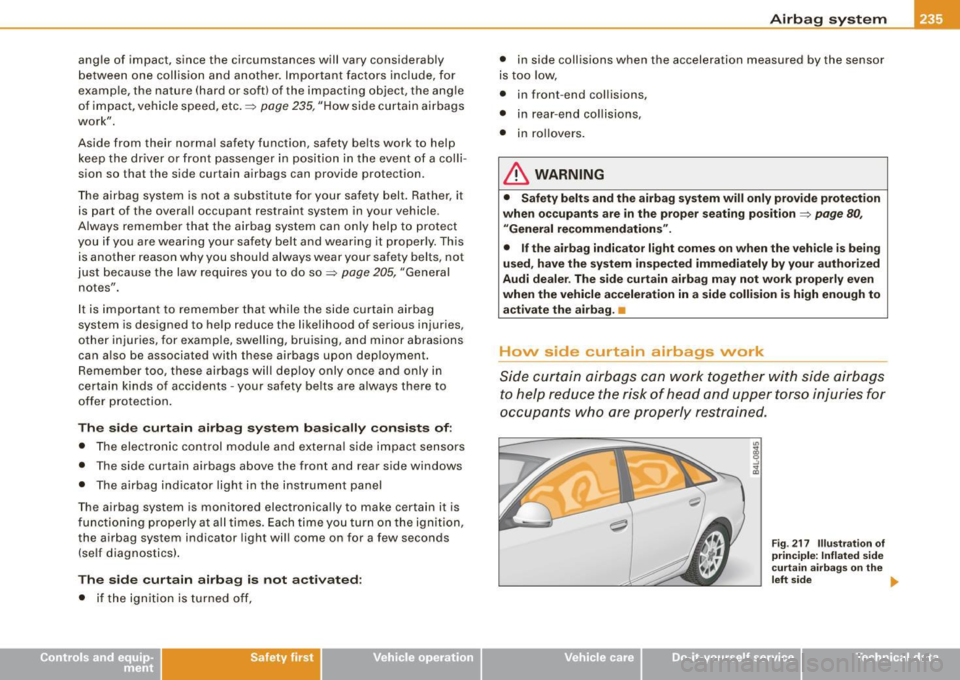
How side curtain airbags work
S ide cu rtain airbags can work together with si de airb ags
to hel p redu ce the risk of he ad and upper t ors o injuries for
occupants who are properly restrained.
Vehicle care I I
F ig. 217 Illustra tio n of
prin cipl e: Infla ted side
c urta in a irbag s on the
lef t si de ..
irechnical data
Page 241 of 398
-------------------------------------------~C:::.'. h~ i~ ld :::.....:: S~ a~ f~e ~t .!.y __ l!ftlll
& WA RNIN G (continu ed )
• Always install rear-facing child safety seat s on the rear seat.
• If you mu st in stall a re arw ard fa cing child safety sea t on the
front pa ssenger seat in exceptional cir cum stances and the
PASSENGER AIR BAG OFF light doe s not come on and stay on,
immediate ly in sta ll the re ar-facing child safety seat in a rear
s eating po sition and h ave the airbag sy stem inspected immedi
atel y by your Audi dea ler .
& WARNING
If, in exceptional circum stance s, you mu st install a forward -facing
c hild re st raint on the fro nt p ass enger's seat :
• Alway s make sure the forward -facing seat has been de signed
and cert ified by it s manufa cturer f or use on a front se at with a
p assenger front and side airbag .
• Always follow the manufacturer's instructions provided with
the child safety seat or carrier.
• Always mov e the passenger sea t into it s rea rmo st p osition in
the seat' s fore and aft adju stment r ange , as far away from the
airb ag as possible before in stalling the ch ild r estr aint . The b ack
r es t must be adju sted to an upr ight po sition.
• Alway s ma ke sure th at the PASSENGER AIR BAG OFF l ight
c ome s on and stay s on all the time whenever the ignition is
s witched on. •
Advanced front airbag system and children
Your vehicle is equipped with an "Advanced Airbag System" in
compliance with United States Federal Motor Veh icle Sa fety Stan
dard ( FMVSS) 208 as applicable at the time your vehicle was manu
f actured .
Controls and equip ment Safety first Vehicle operation The Advanced Airbag system in your vehicle has been certified to
meet the " low -risk" requirements for 3 and 6 year -old children on
the passenger side and small adu lts on the driver side. The low risk
deployment crite ria are intended to reduce the risk of injury th rough
interaction with the airbag that can occur, for example, by being too
close to the steering wheel and instrument panel when the airbag
inf lates . In addit ion, the system has been cert ified to comply with
the "suppression" requirements of the Safety Standard, to turn off
the front airbag for infants up to 12 months who are restrained on
the front passenger seat in child restraints that are listed in the
Standard.
Even though your vehic le is equipped with an Advanced Airbag
system, all children, especially those 12 years and younger, should
a lways ride in the back seat properly restrained for their age and
s ize . The airbag on the passenger side makes the front seat a poten
tia lly dangerous p lace for a chi ld to ride. The front seat is not the
safest p lace for a child in a forward -facing child safety seat. It can be
a very dangerous place for an infant or a larger child in a rearward
facing seat. •
Advanced Airbags and the weight-sensing
mat in the front seat
The Advanced Airbag System in your vehicle detects the presence
of an infant or child in a chi ld restraint on the front passenger seat
using the weight -sensing mat in the seat cushion and the sensor
below the safety belt latch on the front passenger seat that
measures the tension on the safety be lt .
The weight -sensing mat measures t otal weight of the child and the
child safety seat and a chi ld blanket on the front passenger seat. The
we ight o n the front passenger seat is related to the design of the
child restraint and its "footprint" , the size and shape of the bottom
of the child restraint as it sits on the seat. The weight of a child
restraint and its "footprint" vary for different kinds of child
~
Vehicle care Do-it-yourself service Technical data
Page 251 of 398
_______________________________________________ C_h _ i_ld _ S_ a_ f_ e_ t..,:c y __ ffllll
& WARNING (continued )
• If the backrest is not securely latched, the child and the child
restraint will be thrown forward together with the backrest and
will strike parts of the vehicle interior . The child can be seriously
injured or killed .
• Never install rear-facing child safety seats or infant carriers on
the front passenger seat. A child will be seriously injured and can be killed when the passenger airbag inflates .
• The inflating airbag will hit the child safety seat or infant
carrier with great force and will smash the child safety seat and
child against the backrest , center arm rest , door or roof.
• Always install rear-facing child safety seats or infant carriers on
the rear seat.
• Forward-facing child safety seats or infant carriers installed on
the front passenger's seat may interfere with the deployment of
the airbag and cause serious injury to the child .
• It is safer to install a forward -fac ing child safety seat on the rear
seat.
• Always read and heed all WARNINGS whenever using a child
restrained in a vehicle is being used =>
page 238. Special precau
tions apply when installing a child safety seat on the front
passenger seat=>
page 217 , "Child restraints on the front seat -
some important things to know ".
& WARNING
Always take special precautions if you must install a forward or
rearward-facing child restraint on the front passenger's seat in
exceptional situations:
• Whenever a forward or rearward -facing child restraint is
installed on the front passenger seat, the PASSENGER AIR BAG
OFF light must come on and stay on whenever the ignition is
switched on .
Controls and equip ment Safety first
Vehicle operation
& WARNING (continued )
• If the PASSENGER AIR BAG OFF light does not come on and stay
on, perform the checks described =>
page 226, ''Monitoring the
Advanced Airbag System ".
• Take the child restraint off the front passenger seat and install
it properly at one of the rear seat positions if the PASSENGER AIR
BAG OFF light does not stay on whenever the ignition is switched
on .
• Improper installation of child restraints can reduce their effec
tiveness or even prevent them from providing any protection.
• An improperly installed child restraint can interfere with the
airbag as it deploys and seriously injure or even kill the child.
• Always carefully follow the manufacturer's instructions
provided with the child safety seat or carrier.
• Never place additional items on the seat that can increase the
total weight registered by the weight-sensing mat and can cause injury in a crash.
& WARNING
Forward-facing child restraints:
• Always make sure the forward -facing seat has been designed
and certified by its manufacturer for use on a front seat with a
passenger front and side airbag.
• Never put the forward-facing child restraint up, against or very
near the instrument panel .
• Always move the passenger seat into its rearmost position in
the seat's fore and aft adjustment range , as far away from the
airbag as possible before installing the forward-facing child
restraint . The backrest must be adjusted to an upright position .
• Make sure that the PASSENGER
AIR BAG OFF light comes on
and stays on all the time whenever the ignition is switched on . .,,,_
Vehicle care Do-it-yourself service Technical data
Page 292 of 398
___ C_ le_ a _ n_i_n ~g _ a_ n_ d __ p_r _o _t _e _c_ t_ i_o _n ___________________________________________ _
wards, use copious amounts of clean water to remove the
rema ining detergen t. App ly the wa ter w ith a damp cloth or sponge
and pat the fabric dry with an absorbent, dry c loth.
Stains from choco late or makeup should have detergent paste (e.g .
ox -ga ll soap) rubbed into them. A fterwards, remove the soap w it h
water (damp sponge).
A lcoh ol can be us ed t o t rea t sta ins fro m grease, oil, lipstick o r a ba ll
point pen. Melted grease or dye must be patted off using absorbent
ma te ri al. It may be neces sary to retreat the a reas w ith de tergent
paste and water .
In the case of genera l soiling of the upho lstery and cover material,
we recommend h ir ing a specialis t that has the equ ip m ent to c lea n
the seat covers and other fabric surfaces by shampooing and spray
e xt rac tion.
& WARNING
Always read and heed all WARNINGS and the information
~ page 282 .
[ i] Tips
Open Ve lcro fasteners on your clothing can damage the seat cover.
Please make sure that Velcro fas tene rs a re c losed .•
Plastic parts and instrument panel
A lways use a clean cloth mo iste ned in cl ear wa ter to clean these
areas . For persistent dirt use an Audi approved
solvent-free plastic
cleaner/ protectant.
in. WARNING
Solvents can change the properties of some plastics and make it
harder for the airbag to deploy.
& WARNING (continued )
• Never clean the instrument panel or the surface of airbag
modules with cleaning products that contain solvents .
• Products containing solvents will make the surface of this part
porou s.
• Serious injuries can result if plastic parts come loose when the
airbag is deployed .
• Alway s read and heed all WARNINGS and other information
~ page 282.
0 Note
Cleaning agents containing so lvents wil l attack the material and can
c hange t he way it behave s.•
App lies to vehicles: with natu ra l l eathe r
Natural leather
Aud i mak es gr eat effo rts to main ta in the p roperties ,
n atu ra l look an d fee l of interior le athe r.
General
We offe r ma ny diff erent typ es of leather on our v ehicles . M ost ar e
different types of nappa leather, which has a smooth surface and
comes in va rious co lors .
T he intens ity o f the color de termi nes t he visua l character ist ics a nd
appearance. If the surface of the leather has a typica l natural look,
th en the leathe r is a nappa leather t hat has bee n l eft in a re lat ive ly
natural condition. This leather offers particu lar ly good comfort and
b reathes well. Fi ne vei ns, closed g ra ins, ins ect bit es, ski n folds, a nd
subt le variations in color remain visib le. These character istics
dem onstrate tha t the mate rial is natural.
Natura l nappa leather is not covered by a color finis h. It is therefo re
more sens itive to so iling and wea r, which is something you need to ...
Page 302 of 398
___ C_ h_ e_c _ k_ i_ n ...;:g:- a_ n_ d_ f_ il _li _n ...::g ::.- _____________________________________________ _
Checking and filling
Engine hood
Releasing the engine hood
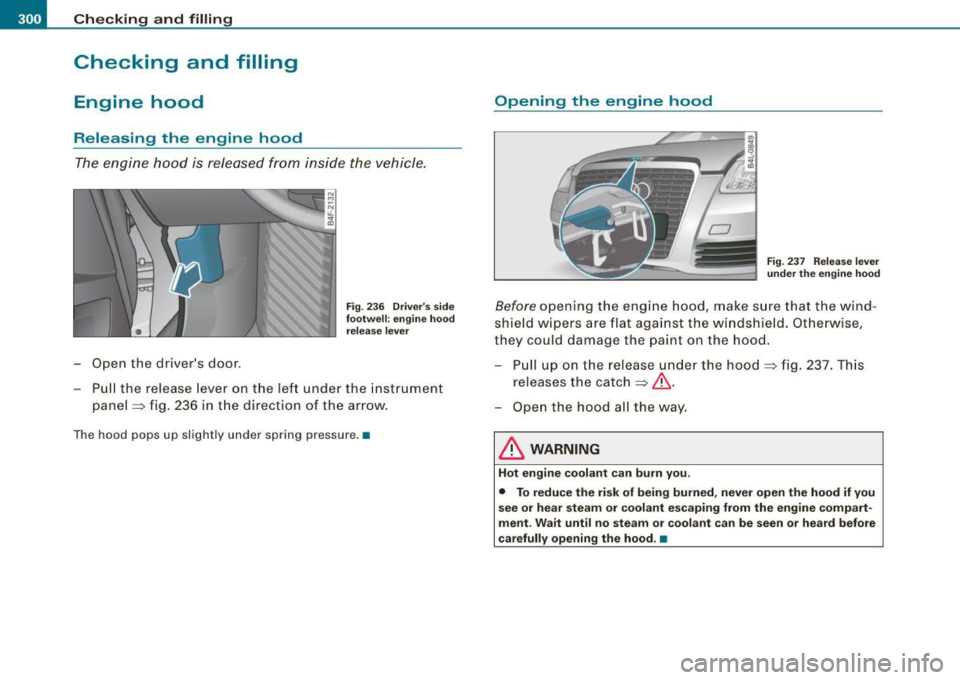
The engine hood is released from inside the vehicle.
-Open the driver's door .
Fig. 236 Driver's side
footwell: engine hood
release lever
-Pull the release lever on the left under the instrument
panel
~ fig. 236 in the direct ion of the arrow.
The hood pops up sl ightly under spring pressure. •
Opening the engine hood
Fig. 237 Release lever
under the engine hood
Before opening the engine hood, make sure that the w ind
shield wipers are flat against the windshield. Otherwise,
they could damage the paint on the hood.
Pull up on the release under the hood
~ fig. 237. This
releases the catch
~ /n. .
- Open the hood all the way.
& WARNING
Hot engine coolant can burn you.
• To reduce the risk of being burned, never open the hood if you
see or hear steam or coolant escaping from the engine compart
ment . Wait until no steam or coolant can be seen or heard before
carefully opening the hood. •
Page 353 of 398
Fuses and bul bs -
------------------
Fuses and bulbs
Fuses
Replacing a fuse
A problem in the electrical system may be caused by a
blown fuse.
Fig . 2 65 Instru ment
pa nel left: Face c over
F ig . 266 I nst ru me nt
pa nel left: Co ntent
F ac e cover
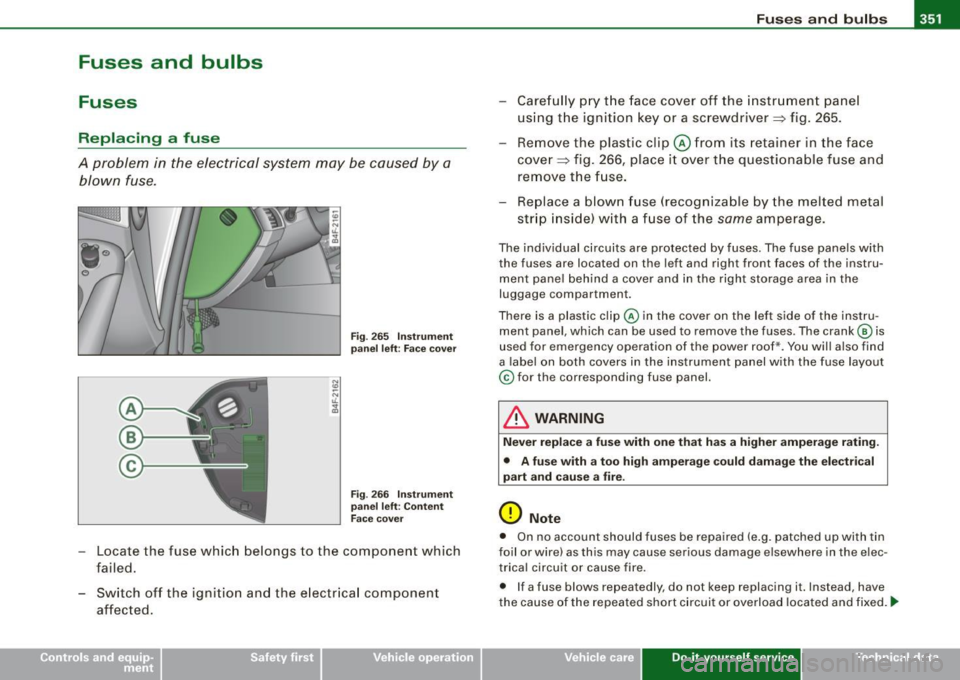
- Locate the fuse which belongs to the component which
failed.
- Switch off the ignition and the e lectr ica l component
affected. - Care
fully p ry t he face cover off the instr umen t pane l
using the ignition key or a screwdriver~ fig. 265.
- Rem ove the plastic clip @ from i ts retainer in the face
cove r~ fig. 266, place i t over the questionable fuse and
remove the fuse.
- Replace a blow n fuse (recogniza ble by the melted metal
str ip inside) wi th a f use of the
same amperage.
The individual circuits are protected by fuses. T he fuse panels with
the fuses are located on the left and right front faces of the instru
ment pane l behind a cover and in the right storage area in the
luggage compartment.
There is a plastic clip @ in the cover on the lef t side of the instru
ment pane l, which can be used to remove the fuses. The crank © is
used for emergency operation of the power roof*. You will also find
a label on both covers in the instrument panel with the fuse layout
© for the corresponding fuse panel.
& WARNING
Nev er replac e a fuse with on e that ha s a high er amperag e rating .
• A fu se w ith a t oo high ampe rage could damage the ele ctr ical
pa rt a nd cause a fire .
0 Note
• On no account should fuses be repaired (e .g. patched up wi th tin
foil or wire) as this may cause serious damage elsewhere in the e lec
trica l circuit o r cause fire.
• I f a fuse blows repeatedly, do not keep replacing it. Instead, have
the cause of the repea ted short circuit or overload located and fixed.
ti>
Vehicle care Do-it-yourself service Technical data
Page 354 of 398
-Fuses and bulbs Pffl..._ _____________________ _
[ i J Tip s
You are wel l advised to keep a supply of spare fuses in your vehicle .
Fuses with the proper ampere ratings are availab le at your Audi
dea ler. •
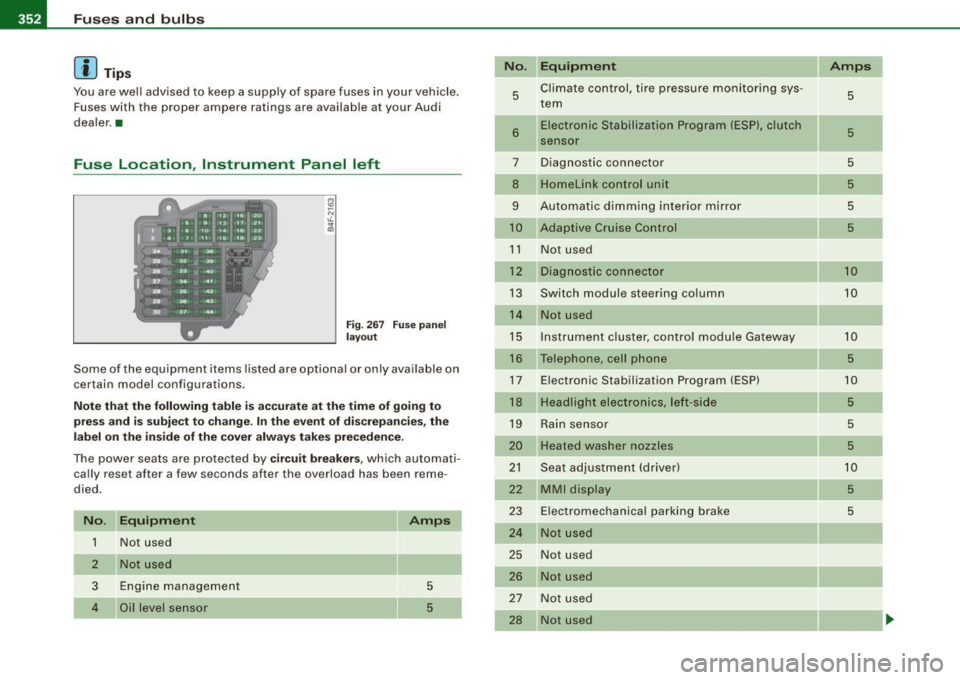
Fuse Location , Instrument Panel left
Fig . 267 Fuse pa nel
l ayo ut
Some of the equipment items listed are optional or only ava ilable on
certain model configurations .
Note th at t he fo llo wi ng t able i s acc urat e at th e time of goin g to
pr ess and is subject t o ch ang e. In th e eve nt of d iscrep ancie s, th e
labe l on th e in side of th e cover always ta kes prece de nce .
The power seats are protected by cir cuit br eaker s, which automati
cally reset after a few seconds after the overload has been reme
died.
N o. Equipm ent
1 Not used
2
3
4
Not used
Engine management
Oil level sensor Amps
5
5
No
.
5
6
..
7
8
9
10
1 1
12
13
14
15
16
17
18
19
20
21
22
23
24
25
26
27
28
Equipm ent
Climate cont rol , tire pressure monitoring sys
tem
Electronic Stabilization Program (ESP), clutch
sensor
Diagnostic connector
Homelink control unit
Automa tic dimming interior mirror
Adaptive Cruise Control
Not used
Diagnostic connector
Switch modu le steering column
Not used
I nstrument c luster, control module Ga teway
Telephone, cell phone E lectronic Stabilization Program (ESP)
Headlight electronics, left -side
Rain sensor
Heated washer nozzles
Seat adjustment (driver)
MMI display
E lectromechanica l parking brake
Not used
Not used
Not used
N ot used
Not used Amps
5
5
5
5
5
5
10
10
10
5
10
5
5
5
10
5
5
-
Page 355 of 398
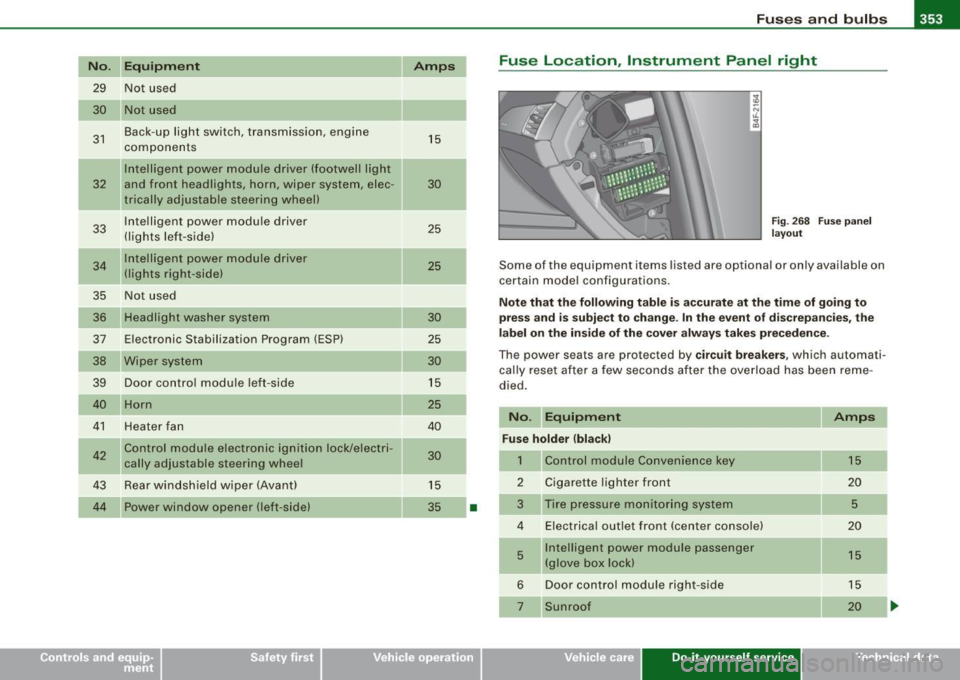
Fuses and bul bs -_____________ -----=----.;....:..::.:....:.::;______J
No. Equipm ent
29 Not used
30 Not used
31 Back-up light switch, transmission, engine
components
Intelligent power mo dule driver (footwell l ight
32 and front headlights, horn, wiper system, elec
trically adjusta ble steering wheel)
33 Intelligent power modu le driver
(lights left-side)
---,--
34
35
36
37
38
39
I nte lligent power module driver
(lights right-side)
Not used
Headlight washer system
E lectronic Stabilization Program (ESP)
Wip er system
Door control module left -side
Horn
41 Heater fan
42 Control module electronic ignition lock/electri
cally adjustable steering wheel
43 Rear windsh iel d wiper (Avant)
44 Power window opener (left-side) Amps
15
30
25
25
30 25
30
15
25
40
30
15
35
-
•
Fuse Location , Instrument Panel right
Fig. 2 68 F use pan el
la yo ut
Some of the equipment items listed are optional or on ly available on
certain model configu rations.
Note that the following table is ac curate at the time of g oing to
press and is subject t o change . In the eve nt of d iscrepan cies , th e
l a b el on t he in side of the cover alw ay s take s prec eden ce.
The power seats are protected by cir cuit breaker s, which automati
ca lly reset after a few seconds a fter the ove rload has been reme
died.
No . Equipment Amps
Fu se holder (bla ck )
1 Control module Convenience key 15
2
Cigarette lighter front 20
3
Tire pressure moni tor ing system 5
4 E lectrica l outlet front (center conso le) 20
5
Intelligent power module passenger 15 (glove box lock)
6 Door control module right -side 15
Sunroof 20
Vehicle care Do-it-yourself service irechnical data