airbag AUDI S6 2009 Repair Manual
[x] Cancel search | Manufacturer: AUDI, Model Year: 2009, Model line: S6, Model: AUDI S6 2009Pages: 398, PDF Size: 43 MB
Page 260 of 398
___ C_h_ i_ld _ S_ a_ f_ e_ t-= y'------------------------------------------------
& W ARNING (continued )
• Never secure or attach any luggage or other items to the LATCH
lower anchorages or to the tether anchors.
• If a tether or other strap is used to attach a child restraint to the
front passenger seat, make sure that it is not so tight, that it
causes the weight-sensing mat to measure more weight than is
actually on the seat .
• The heavier weight registered can make the system work as
though an adult were on the seat and deploy the Advanced Airbag
when it must be suppressed causing serious or even fatal injury to
the child .•
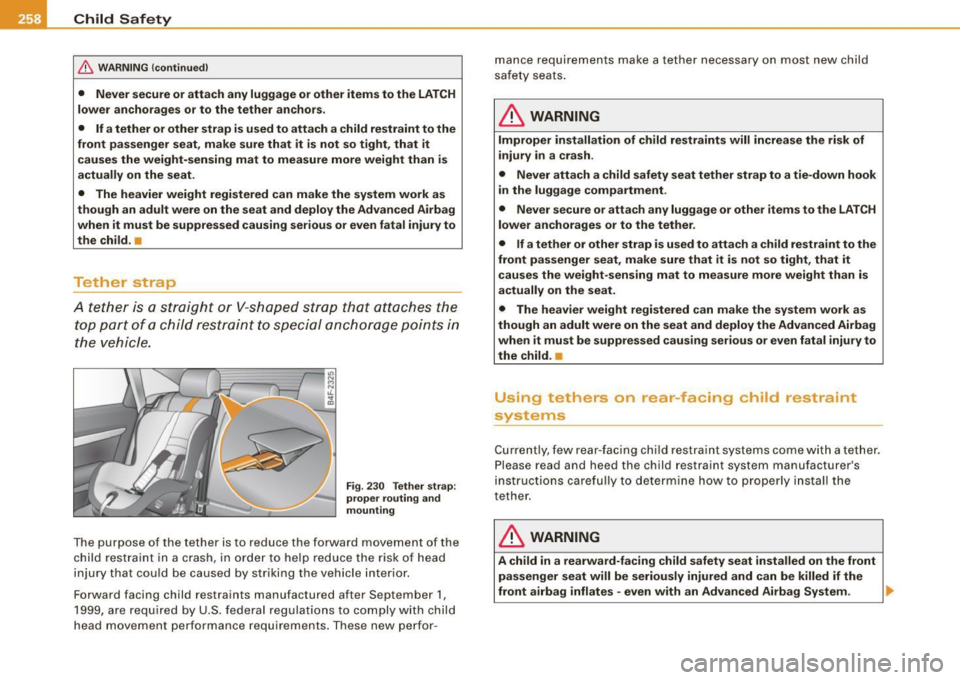
T et her strap
A tether is a stra ig h t or V-shape d strap that atta ches the
top part of a ch ild restraint to sp ecial anchorage po ints in
th e v ehicl e.
Fig . 230 Tether strap :
prope r routing and
mounting
T he purpose of the tether is to reduce the forward movement of t he
ch ild res trai nt in a cras h, in or der t o help re duce t he risk o f head
injury that cou ld b e caused by str ikin g th e vehicl e interior.
Forward facing child rest raint s manufactured after Septe mber 1,
19 99, are require d b y U.S . f edera l reg ulatio ns to comp ly with c hild
head movement performance requirements . These new pe rfor- mance requirements ma
ke a tether necessary on most new child
sa fe ty seats .
& WARNING
Improper installation of child restraints will increase the risk of
injury in a crash .
• Never attach a child safety seat tether strap to a tie -down hook
in the luggage compartment .
• Never secure or attach any luggage or other items to the LATCH
lower anchorages or to the tether.
• If a tether or other strap is used to attach a child restraint to the
front passenger seat , make sure that it is not so tight , that it
causes the weight-sensing mat to measure more weight than is
actually on the seat.
• The heavier weight registered can make the system work as
though an adult were on the seat and deploy the Advanced Airbag
when it must be suppressed causing serious or even fatal injury to
the child .•
Us ing tethe rs on rear.facing chi ld restra int
systems
C ur rently , few r ear-faci ng child re stra int s ystems co me with a tether.
P lease read and heed the ch ild restra int system manufactur er's
i n str uct ions care full y to d ete rmin e ho w to prop erly i nsta ll th e
tether.
& WARNING
A child in a rearward-facing child safety seat installed on the front
passenger seat will be seriously injured and can be killed if the
front airbag inflates -even w ith an Advanced Airbag System . ._
Page 261 of 398
& WARNING !continued)
• The inflating airbag will hit the child safety seat or infant
carrier with great force and will smash the child safety seat and
child against the backrest, center arm rest, or door .
• A tight tether or other strap on a rearward-facing child restraint
attached to the front passenger seat can put too much pressure
on the weight -mat in the seat and register a heavier weight in the
Advanced Airbag System. The heavier weight registered can make
the system work as though an adult were on the seat and deploy
the Advanced Airbag when it must be suppressed causing serious
or even fatal injury to the child.
• If you must install a rearward facing child safety seat on the
front passenger seat because of exceptional circumstances and
the PASSENGER AIR BAG OFF light does not come on and stay on,
immediately install the rear-facing child safety seat in a rear
seating position and have the airbag system inspected by your
Audi dealer. •
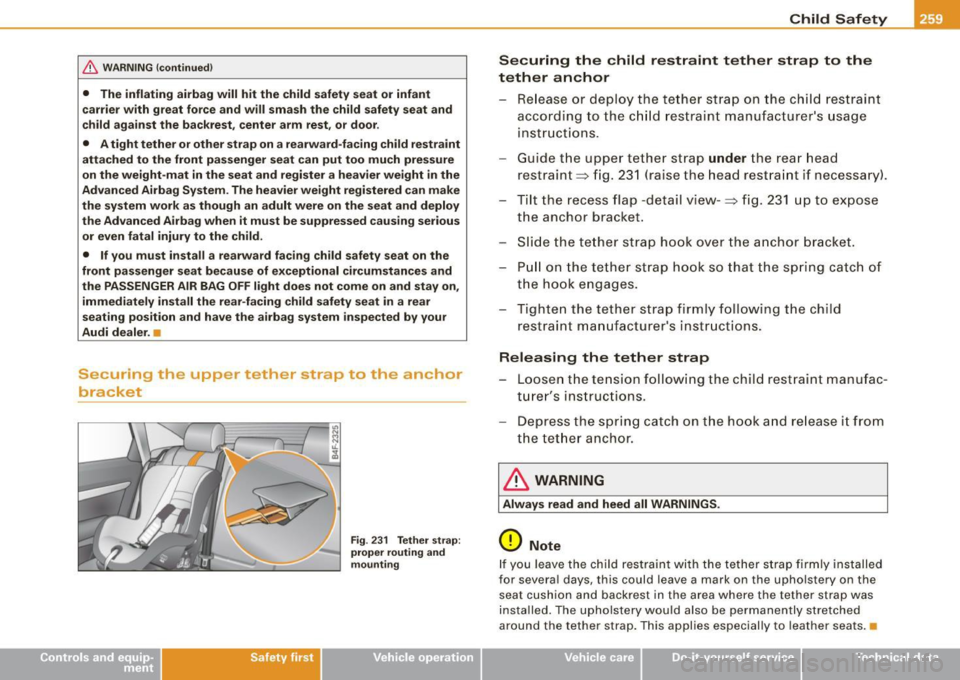
Securing the upper tether strap to the anchor
bracket
Safety first
Fig. 231 Tether strap:
proper routing and
mounting
Child Safety
Securing the child restraint tether strap to the
tether anchor
- Release or deploy the tether strap on the child restraint
according to the child restraint manufacturer's usage
instructions.
Guide the upper tether strap
under the rear head
restraint ~ fig. 231 (raise the head restraint if necessary) .
- Tilt the recess flap -detail view-:::;, fig. 231 up to expose
the anchor bracket .
- Slide the tether strap hook over the anchor bracket.
- Pull on the tether strap hook so that the spring catch of
the hook engages.
- Tighten the tether strap f irmly following the child
restraint manufacturer's instructions.
Releasing the tether strap
- Loosen the tension following the child restraint manufac
turer's instructions.
- Depress the spring catch on the hook and release it from
the tether anchor.
& WARNING
Always read and heed all WARNINGS.
0 Note
If you leave the child restraint with the tether strap firmly installed
for several days, this could leave a mark on the upholstery on the seat cushion and backrest in the area where the tether strap was
installed. The upholstery would also be permanently stretched
around the tether strap. This applies especially to leather seats.•
•
Vehicle care I I irechnical data
Page 264 of 398
___ ln_ t _e_ ll-'"ig ...,_ e_ n_t _t_ e_ c_ h _ n_o _ l_o _,.g= y,_ __________________________________________ _
Intelligent technology
Notice about data recorded by
vehicle control modu les
Your vehicle is not equipped with an Event Data Recorder (EDR),
installed by some manufacturers for the express purpose of
capturing data for retrieval after an accident or crash event . EDR's
are sometimes called "crash recorders" .
Some state laws restrict the retrieva l or downloading of data stored
by EDR's that were insta lled in a vehicle for the express purpose of
retrieving data after an accident or crash event without the owner's
consent.
Although your vehicle is not equipped with an EDR, it is equipped
with a number of electronic control modules for various vehicle systems such as, for example, engine function, emission control, as
well as for the airbags and safety belts.
These electronic control modules also record vehicle-related data during norma l vehicle operation for diagnost ic and repair purposes .
The recording capacity of the electronic control modules is limited
to data (no sound is recorded) and only a small amount of data is
actually recorded over a very limited period of time and stored when
a system fault or other condition is sensed by a control unit. Some
of the data then stored may relate to vehicle speed, direction, braking as well as restraint system use and performance in the
event of a crash or other condition . Stored data can only be read and
down loaded with special equipment .•
Electron ic Stabilizat ion Program (ESP)
General =nformation
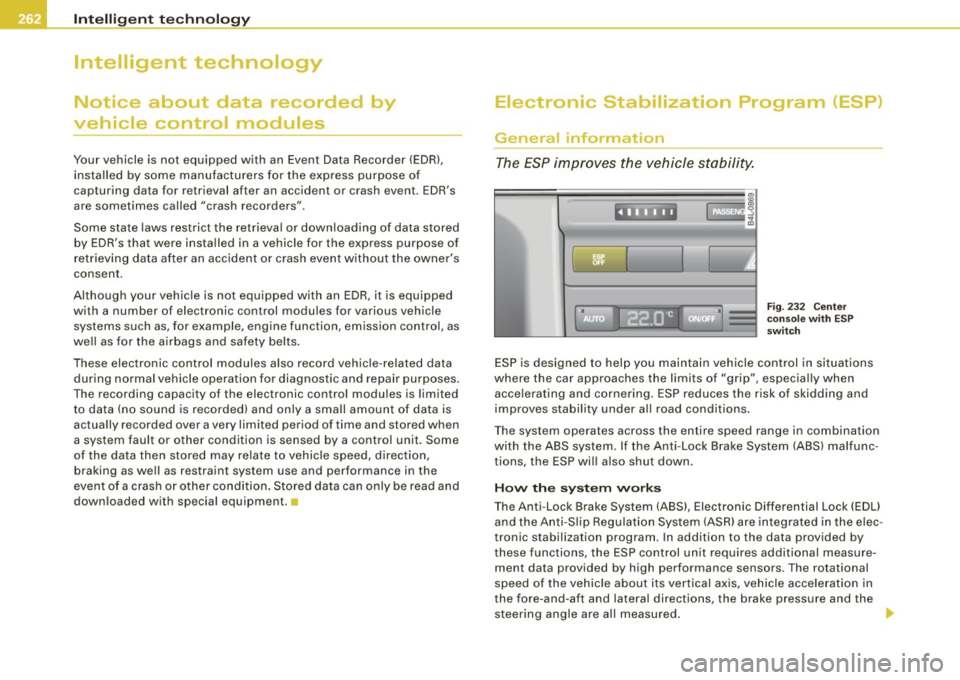
The ESP improves the vehicle stability.
(
Fi g. 232 C ente r
co nso le w it h ES P
swi tch
ESP is designed to he lp you maintain vehic le control in situations
where the car approaches the limits of "grip", especia lly when
accelerating and cornering. ESP reduces the risk of skidding and
improves stabil ity under all road conditions .
T he system operates across the entire speed range in combination
with the ABS system. If the Anti-Lock Brake System (ABS) malfunc
tions, the ESP wil l also shut down .
How th e sys te m w ork s
The Anti -Lock Brake System (ABS) , Electronic Differential Lock (EDU
and the Anti-Slip Regulation System (ASR) are integrated in the e lec
tronic stabi lization program . In addition to the data provided by
these functions, the ESP control unit requires additional measure ment data provided by high performance sensors . The rotational
speed of the vehic le about its vertical axis, vehicle acce leration in
the fore-and-aft and lateral directions, the brake pressure and the steering angle are al l measured .
Page 292 of 398
___ C_ le_ a _ n_i_n ~g _ a_ n_ d __ p_r _o _t _e _c_ t_ i_o _n ___________________________________________ _
wards, use copious amounts of clean water to remove the
rema ining detergen t. App ly the wa ter w ith a damp cloth or sponge
and pat the fabric dry with an absorbent, dry c loth.
Stains from choco late or makeup should have detergent paste (e.g .
ox -ga ll soap) rubbed into them. A fterwards, remove the soap w it h
water (damp sponge).
A lcoh ol can be us ed t o t rea t sta ins fro m grease, oil, lipstick o r a ba ll
point pen. Melted grease or dye must be patted off using absorbent
ma te ri al. It may be neces sary to retreat the a reas w ith de tergent
paste and water .
In the case of genera l soiling of the upho lstery and cover material,
we recommend h ir ing a specialis t that has the equ ip m ent to c lea n
the seat covers and other fabric surfaces by shampooing and spray
e xt rac tion.
& WARNING
Always read and heed all WARNINGS and the information
~ page 282 .
[ i] Tips
Open Ve lcro fasteners on your clothing can damage the seat cover.
Please make sure that Velcro fas tene rs a re c losed .•
Plastic parts and instrument panel
A lways use a clean cloth mo iste ned in cl ear wa ter to clean these
areas . For persistent dirt use an Audi approved
solvent-free plastic
cleaner/ protectant.
in. WARNING
Solvents can change the properties of some plastics and make it
harder for the airbag to deploy.
& WARNING (continued )
• Never clean the instrument panel or the surface of airbag
modules with cleaning products that contain solvents .
• Products containing solvents will make the surface of this part
porou s.
• Serious injuries can result if plastic parts come loose when the
airbag is deployed .
• Alway s read and heed all WARNINGS and other information
~ page 282.
0 Note
Cleaning agents containing so lvents wil l attack the material and can
c hange t he way it behave s.•
App lies to vehicles: with natu ra l l eathe r
Natural leather
Aud i mak es gr eat effo rts to main ta in the p roperties ,
n atu ra l look an d fee l of interior le athe r.
General
We offe r ma ny diff erent typ es of leather on our v ehicles . M ost ar e
different types of nappa leather, which has a smooth surface and
comes in va rious co lors .
T he intens ity o f the color de termi nes t he visua l character ist ics a nd
appearance. If the surface of the leather has a typica l natural look,
th en the leathe r is a nappa leather t hat has bee n l eft in a re lat ive ly
natural condition. This leather offers particu lar ly good comfort and
b reathes well. Fi ne vei ns, closed g ra ins, ins ect bit es, ski n folds, a nd
subt le variations in color remain visib le. These character istics
dem onstrate tha t the mate rial is natural.
Natura l nappa leather is not covered by a color finis h. It is therefo re
more sens itive to so iling and wea r, which is something you need to ...
Page 314 of 398
-Checking
and filling
---=---------------
checked by a service facility . The electrolyte level should also be
checked each time the battery is charged
~ page 314.
Have the battery checked when you take your vehicle in for service.
You are well advised to replace a battery that is older than 5 years.
With certain types of airbag deployment, the battery is discon nected from the vehicle electrical system for safety reasons~
& in
"Repair, care and disposal of the airbags" on
page 229.
Disconnecting the battery terminals
Some vehicle functions (power window regulators, for example) are
lost if the battery terminals are disconnected . These functions have
to be relearned after the battery terminals are connected again . To
prevent this, the battery should only be disconnected from the
vehicle electrical system when absolutely necessary for repairs.
Vehicles not driven for long periods
If you do not drive your vehicle over a period of several days or
weeks, electrical components are gradually cut back or switched off.
This reduces energy consumption and maintains starting capability
over a longer period
~ page 269.
Take into consideration that when you unlock your vehicle, some
convenience functions , such as the master key remote function or
power seat adjustment, may not be available. The convenience
functions will be available again when you turn on the ignition and
start the engine.
Winter operation
During the winter months, battery capacity tends to decrease as
temperatures drop . This is because more power is also consumed
while starting, and the headlights, rear window defogger, etc., are
used more often.
Avoid unnecessary power consumption, particularly in city traffic or
when traveling only short distances. Let your authorized Audi dealer
check the capacity of the vehicle battery before winter sets in
~ page 314. A well charged battery will not only prevent starting
problems when the weather is cold , but will also last longer .
[ i] Tips
If your vehicle is left standing for several weeks at extremely low
temperatures, the vehicle battery should be removed and stored
where it will not freeze. This will prevent it from being damaged and
having to be replaced. •
Working on the battery
Be especially careful when working on or near the battery.
Fig. 244 Luggage
compartment : Battery
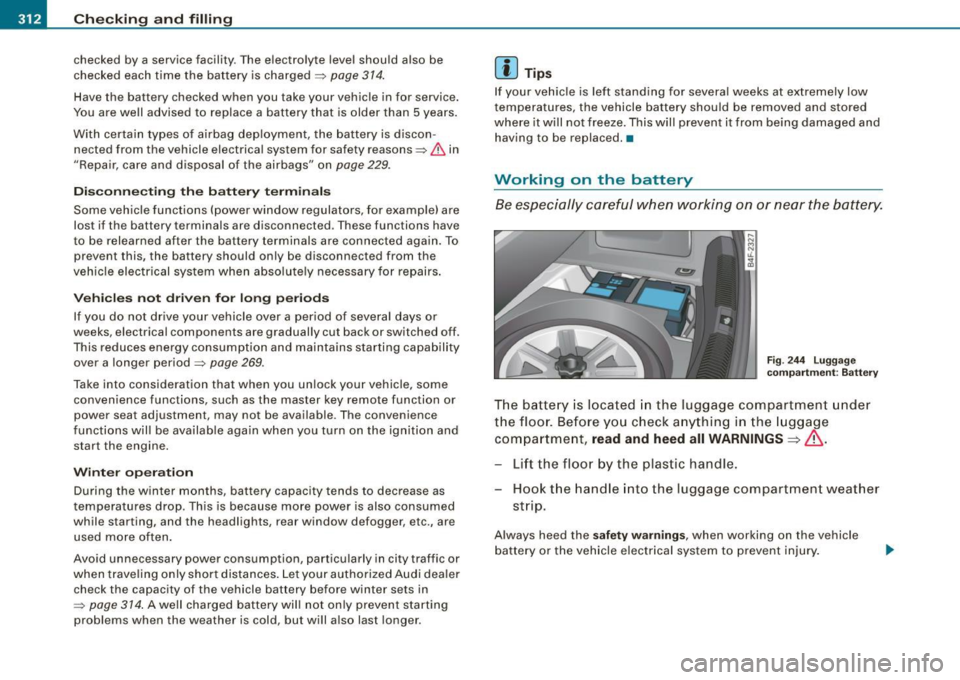
The battery is located in the luggage compartment under
the floor. Before you check anything in the luggage
compartment,
read and heed all WARNINGS=>& .
Lift the floor by the plastic handle.
Hook the handle into the luggage compartment weather
strip.
Always heed the safety warnings, when working on the vehicle
battery or the vehicle electrical system to prevent injury.
Page 356 of 398
IIJII Fuses and bulbs ..._ ____ .;__...;_;,;_ _______________________________ _
No. Equipment
8 A/C controls
9 Heated seats, front
10 MMI
11 Seat adjustment (passenger)
12 Communication
Fuse holder (brown)
1
2
3
4
5
6
7
8
9
10
11
12
Electric fuel pump
Adaptive Air Suspension Lane assist
Audi side assist
Adaptive Air Suspension Shift gate automatic transmission/clutch
switch
Acoustic Parking System Control module Gateway
Automatic headlight range control (auxiliary driving lights), headlight electronics, right-side
Airbag
Heated rear seats
Telephone Amps
10
30
7,5
10
5
20/30
15
10
5
5
5
-
5
5
5
5
5
5
•
Fuse Location, Luggage Compartment right
Fig. 269 Fuse panel
layout
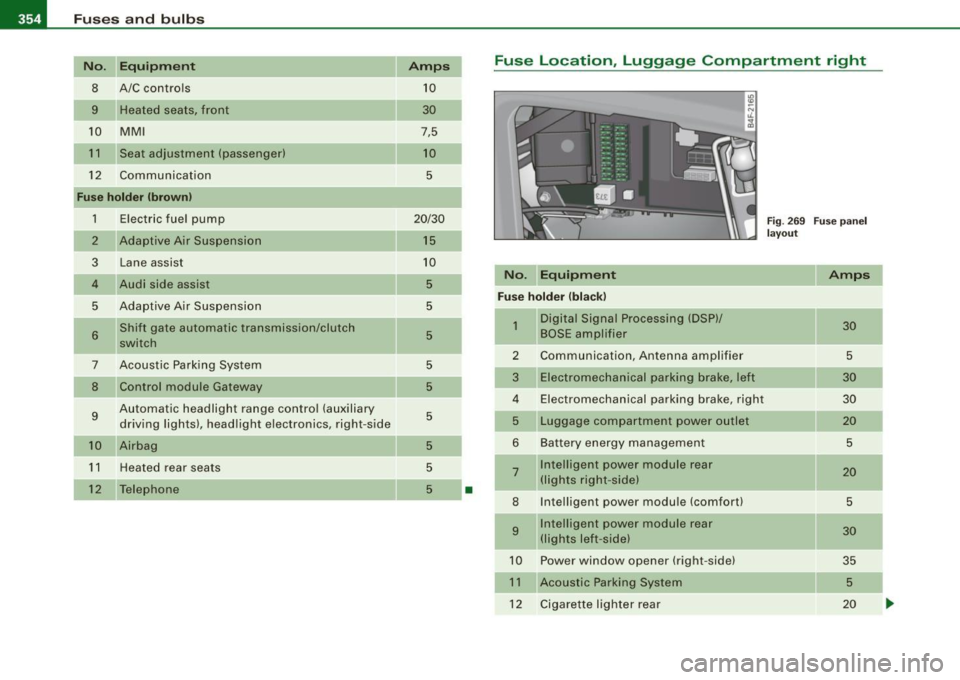
No. Equipment Amps
Fuse holder (black)
-
1 Digital Signal Processing (DSP)/ 30 BOSE ampl ifier
2 Communication, Antenna amplifier 5
3
Electromechanical parking brake, left 30
4 Electromechanical parking brake, right 30
5
Luggage compartment power outlet 20
6 Battery energy management 5
7 Intelligent power module rear 20 (lights right -side)
8 Intelligent power module (comfort) 5
9 Intelligent power module rear 30 (lights left -side)
10 Powe r window opener (right-side) 35
11
Acoustic Parking System 5
12 Cigarette lighter rear 20
Page 376 of 398
___ C_ o_n_ s_ u_m _ e_ r_ ln_ f_o _r_m _ a_ t_ i_o _n ______________________________________________ _
& WARN ING (continued )
• The engine compartment of any motor vehicle is a potentially
hazardous area . Never rea ch into the area around or to uch the
radiator fan . It is temperature controlled and can sw itch on
suddenly -even when the engine is off and the ignition key has
been removed . The radiator fan switches on automatically when
the coolant reaches a certain temperature and will continue to run until the coolant tempe rature drops .
• Always remove the ignition key before anyone gets under the
vehi cle .
• Always support your vehicle with safety stands if it is neces
sary to work underneath the vehicle . The jack suppl ied with the
vehicle is not adequate for this purpose and could collap se
causing serious personal injury .
• If you must work underneath the vehicle with the wheels on
the ground, always make sure the veh icle is on level ground , that
the wheels are always securely blocked and that the engine
cannot be sta rted .
• Always make sure the tr ansmission selector lever (automatic
transmission) is in "P" (Park position ) and the p ark brake is firmly
applied.
W For the sake of the environment
• Cha ng ing the e ngin e sett ings will a dverse ly aff ect em iss ion
levels. This is detrimenta l to the environment and increases fuel
co nsump tion .
• Always observe environmenta l regu lations when disposing of
o ld eng ine oil, u sed bra ke flu id, d irty eng ine coo la nt, spent batter ies
or worn out tires.
• Undeployed airbag modul es and pretensioners might be classi
fied as Perchlorate Material -specia l handling may apply, see
www .d tsc.ca .gov/ hazardouswaste/pe rc h lora te . W hen t he vehicle or
parts of the restraint s ystem including airbag modules safety be lts
with pre tensio ners are sc ra p pe d, a ll ap pl ica ble laws and reg ula- tions must be observed. Your authorized Audi dea
ler is familiar with
t hese requi reme nts and we reco mmend th at you h ave your dealer
perform th is serv ice for you. •
Additional accessories,
modifications and parts replacement
Additional accessories and parts
replacement
A lways consult an author ized Audi dea ler before
pur chasin g access orie s.
Y our vehicle incorporates the latest safety design featu res ensuring
a hi gh standa rd of active a nd passive sa fety .
T his saf ety could be com promised by non -approved changes to th e
vehic le . Fo r thi s reason, i f parts have to be replaced, p lease obse rve
th e fo llow ing po ints wh en insta lling add it io na l acc essories:
Approved Audi accessories and genuine Audi parts are avai lable
from autho rized Audi dea lers .
T hese dealers also have the necessary faci lities, tools and trained
spec ia lists to ins tal l the part s and accessorie s prope rly.
& WARNING
Using the wrong spare parts or using non -approved accessories
can cause serious personal injury.
• Use only accessorie s expressly approved by Audi and genuine
Audi spare parts
• These parts and accessories have been specially designed to
be used on your vehicle .
• Never install accessories such as telephone cradles or
beverage holders on airbag covers or within the airbag deploy-
Page 382 of 398
-Alphabetical index
---=--------------------------------
A
A . ccessones . . . . . . . . . . . . . . . . . . . . . . . . 374
Adapter for cupholder . . . . . . . . . . . . . . . . 95
Adaptive Air Suspension .. .... ... .... 184
Automatic mode . . . . . . . . . . . . . . . . . 185
Description . . . . . . . . . . . . . . . . . . . . . 184
Dynamic mode . . . . . . . . . . . . . . . . . . 185
Jacking mode when changing a flat tire .
186
Lift mode . . . . . . . . . . . . . . . . . . . . . . . 185
Setting the driving modes .. .... ... 185
Standard mode . . . . . . . . . . . . . . . . . . 185
Trailer towing mode ... .... .... ... 186
Warning/indicator lights ........... 20
Adaptive Cruise Control . . . . . . . . . . . . . . 127
Changing speed .. ........... .... 131
D. . f . river in ormat1on . . . . . . . . . . . . . . . 135
Driver interven tion prompt ........ 138
Driving in traffic ...... .... ...... . 128
Driving program ...... .... .... ... 139
Error messages . . . . . . . . . . . . . . . . . . 137
Open road . . . . . . . . . . . . . . . . . . . . . . 128
Override 128
Request for driver to assume control 128
Save speed . . . . . . . . . . . . . . . . . . . . . . 130
Setting distance . . . . . . . . . . . . . . . . . 133
Setting time interval .. .. ....... ... 133
Settings . . . . . . . . . . . . . . . . . . . . . . . . 139
Specia l driving situations .. .. .. ... 140
Status messages . . . . . . . . . . . . . . . . . 137
Switching on and off .. .... .... ... 130
System limits ...... .... .......... 140
Temporarily turning off ... ..... ... 132
warning/indicator lights .... ..... .. 135
Adaptive Light . . . . . . . . . . . . . . . . . . . . . . . 66
defective ......................... 36
Adding
Engine coolant ................ ...
309
Engine oil ... .. ...... ....... ..... 306
Windshield washer fluid .. ...... ... 316
Additional accessories .... .... .... ... 374
Additives
Engine oil
Adjusting
. .. .. ..... .. .... .... ... 306
Instrument cluster i llumination ...... 16
Steering column electrically .. ... .. 115
Steering column manually ......... 114
How many airbags does my vehicle have?
222
How the Advanced Airbag System compo -
nents work together . . . . . . . . . . . . .
223
Important things to know ... .... ... 215
Indicator light .... .... ........... 226
Monitoring .... .... .... ...... .... 226
PASSENGER AIR BAG OFF light ..... 227
Repairs ..... .. .... .... .......... 229
Safety instructions .. ...... .... ... 228
Side airbags . .... .... ............ 231
Side curtain airbags .. ....... .. ... 234
Weight -sensing mat .... ... .... ... 239
When must the system be inspected? . ..
226
All Wheel Drive ... .... .... .. . .... .. . 268
Ad' . f Justing ront seats .. .... .... .... ... 80 All h 1 oy w ee s ....................... 287
Air conditioning
See Climate controls ... ...... ... . .
102
Airbag
Warning/indicator lights ..... ......
18
Airbag system . ... .... ........ .. 215, 232
Advanced Airbag System .......... 219
Advanced Airbag System components ..
222
Care ...... .... .... .... .... .... .. 229
Child restraints .................. 240
Children .. .... ..... .. .... .... ... 239
Components (front airbags) .. ... ... 222
Danger of fitting a child safety seat on the
front passenger seat . .... .... ...
217
Disposal . . . . . . . . . . . . . . . . . . . . . . . . 229
Front airbags ....... .... ... .. 219,220
How do the front aiirbags work? .... 224
All- whee l drive
Winter tires
A lternator
333
Malfunction ......... ... .. .... .... 30
Anti -freeze
See Engine coolant system ...... ..
307
Anti-glare inside day-night mirror .... .. 75
Anti -lock brake system
How the ABS system works . .... ...
266
Warning/indicator lights ...... ... ... 21
Anti -Slip Regulation System (ASR)
How the system works . . . . . . . . . . . .
264
Anti-theft systems
Anti -theft alarm system .. ...... ....
54
Electronic immobilizer ............. 44
Tilt sensors ....................... 55
Page 387 of 398
______________________________________________ A_ l.:.. p _h_ a_ b_e _t_i c_ a _ l _in _ d_e _ x __ _
Environment
Break -in period ... ... . .. .. ..... ... 271
Catalytic converter .... ...... ...... 272
Dispos ing of your vehic le battery ... 315
Driving at high speeds .... .... ... . 273
Dr iving to minimi ze pollution and noise .
273
Fuel ............................ 297
Fuel economy .... .... .... ....... . 273
Leaks under your vehicle ... .. ... .. 301
Letting the vehicle stand and warm up .
274
Proper disposal of drained brake fluid 311
Proper disposal of drained engine coolant ........................ 309
Proper disposa l of drained engine oil 306
Recycling used engine oi l .. .. .. .... 306
Un leaded fuel .................... 295
What should I do with an old battery?
315
EPC
See E lectronic power control ........ 18
ESP
See E lectronic stabi lizat ion p rogram
(ESP) ... ..... ...... .... ..... .... 18
Event Data Recorder (EDR) . ...... .... . 262
Expansion tank ... ... .... ..... .. .... 308
Exterior lighting in the mirror housing ... 66
E yeglasses compartment .... .... .... . 100
Controls and equip
ment Safety first
F
Fan
Radiator .... .... .... .... ...... .. 310
Fastening eyelets .................... 90
Flat tire
Changing .... .... .... .... .... ... 344
Floor mats ......................... 200
Fog lights ...... .... .... ...... ... .. .. 65
Fo lding master key with remote contro l . 41
Foot pedals ........................ 200
For the sake of the e nvi ro nmen t
Gaso line fu mes and the environment 297
Letting your eng ine warm up ...... . 1 17
Reducing engine noise by ear ly
upshif ting ....................... 12
Re fuel ing ..... ... .... .... .... .... 297
Savi ng fuel by early upshifti ng .. .... 12
Using the rear window de fogger ... . 108
Front airbags Description .... ..... .. .... .... ... 219
How they work .... .... .... ....... 224
Front arm rest adjusting . .... ..... .. .... .... .... . 88
Storage compartment .............. 88
Front ashtray .... .... .... .... .... ... . 96
Front fog lights . .... .... .... .... ..... 65
F ront seats .. ............ .... ....... . 80
Adjusting ....................... 197
Child restraints in the front seat .... 217
F ronta l coll isions and the laws of physics
206 Fuel
Additives .. .... .... ... .... .... ... 295
Blended gasoline ...... .... .... ... 295
Consumption ........... .... ...... 38
Fi ller neck .... .... .... ... .... .... 296
Fuel gauge . ...... .... ... .... .... . 14
Gas oline ...... .... ... .... .... ... 295
Gaso li n e additives ..... ... .... .... 296
Low fuel level ..... .... ... .... .. 14, 3 4
Octane rating .. ...... .... .... .... 295
Recommendation .. .... ... .... .... 295
Refuelling .... .... .... ... .... .... 297
Reserve ... .... ... .... ... ... ...... 14
Tank capacity ..... ... .... ...... .. 369
Un locking the fue l filler flap by hand 299
Fuse ar rangement . ....... ... .... .... 35 1
G
Ga rage door opener (Homelink®) ..... . 188
Gas discharge lamps ... ... .... ... ... . 355
Gauges Engine coolant temperature .... ..... 12
Fuel gauge ... ... ....... . .... ..... 14
Speedometer . .... .... ... .... ..... 14
Tachometer ....................... 13
Tr ip odometer .. ....... .... .... .... 14
General illustration Instruments and controls . .... .... .. 11
G lossary of tire a nd loading termi nology . . .
318
G love compartment ... .. .... .... ..... 99
cd change r ... .... .... .... .... .... 99
Valet key function .... .... .... ... .. 44
Vehicle operation Vehicle care Do-it-yourself service Technical data
Page 388 of 398
llffl __ A_l.:,. p _h_ a_ b_e _t _ic _ a_l _in _ d_e _x ____________________________________________ _
Glove compartment -emergency unlocking .
100
Gross Vehic le Weight Rating (GVWRl ... 367
H
Head restraints . . . . . . . . . . . . . . . . . . . . . 199
Adjusting . .... .... ....... ...... . 199
Front seats . . . . . . . . . . . . . . . . . . . . . . . 86
Insta llation and remova l .... ....... 87
Rear seats . . . . . . . . . . . . . . . . . . . . . . . 87
Headlight washer reservoir ........... 316
Headlights . . . . . . . . . . . . . . . . . . . . . . . . . . 63
Adaptive Light .... .... .... ...... .. 66
Defective . . . . . . . . . . . . . . . . . . . . . . . . 25
Front fog lights . . . . . . . . . . . . . . . . . . . 65
Headlight range control defective .. . 35
Switching off ..................... 63
Switching on . .................. .. 63
Washer system . . . . . . . . . . . . . . . . . . . 73
Xenon headlights . ...... ... .. .... . 63
Heat ed outside mirrors . . . . . . . . . . . . . . . 76
Heated seats
Front ............. .... ........ .. 110
Rear ..................... ...... 110
Heated steering wheel . . . . . . . . . . . . . . . 111
Heat ed washer jets
Wiper and washer system . . . . . . . . . . 71
Heavy clothing and safety belts .. .... . 208
High beam . . . . . . . . . . . . . . . . . . . . . . . 63, 67
Warning/indicator lights ........... 20
High voltage warning label . ........ .. 366
Homelink® universal remote control .. 188 Hood
Opening 300 Interior
lights ..... ... . .... .. . .. .. .... 68
Rear .. ..... ....... .... ... .... . 68, 69
Release lever .. ...... .... ..... ... 300 Intermittent wiping
Horn .. ...... ............ ....... .... 11
How many a irbags does my vehicle have? ..
222
How often should I check my tire pressures?
324
How safety belt pretensioners work .... 213
Hydroplaning .... .... .... .... ...... 328
I
Ignition key ........................ 116
Ignition lock .. .... .... .... .... .... .. 116
Malfunction .. .... ...... .... ... 33, 36
Ignition lock posit ions .......... ..... 116
Immobilizer ......................... 14
Important things to do before driving .. 195
Improperly worn safety be lts ......... 213
Indicator lights ...... ....... ....... .. 16
Airbag system ............... 226, 227
PASSENGER AIR BAG OFF ......... 227
Infant seats .......... .... ....... ... 243
How do I properly install an infant seat in my veh icle? ........ .... ... .. ... 243
Safety instructions ............... 243
Inside rear view mirror . ............. .. 75
Installing child safety seats
Safety belts . . . . . . . . . . . . . . . . . . . . . 248
Instrument cluster illumination . ... .... 16
Instruments and controls . . . . . . . . . . . . . 12
General illustration ................ 11 Rain sensor
... .... .... ...... .... . 71
J
Jack 342
Jumper cables ...................... 358
Jump-starting 357
K
Key ................................ 41
Battery replacement ............... 43
Coded settings ................... 102
Convenience opening and closing of windows .. ........ ......... .... 57
Emergency key ............ .... .... 41
Key replacement . . . . . . . . . . . . . . . . . . 41
Mast er key ................. ...... 41
Valet key .. ............ ...... ... .. 41
Key coded settings
Climate controls . . . . . . . . . . . . . . . . . 102
Key less entry remote control ... ........ 42
Kick -down
multitronic® ... .... .... ... .... ... 165
tiptronic® ............ ........ ... 158
L
Lane assist
Activating and deactivating 143
Description . . . . . . . . . . . . . . . . . . . . . . 143