oil type AUDI S6 2009 Owners Manual
[x] Cancel search | Manufacturer: AUDI, Model Year: 2009, Model line: S6, Model: AUDI S6 2009Pages: 398, PDF Size: 43 MB
Page 15 of 398
Warning light in the instrument cluster -L
When the _L warning light in the instrument cluster starts to flash,
this can mean one of two things: either the coolant
temperature is
too high, or the coolant
level is too low=> page 31.
If the needle is well in the upper area of the gauge, the coolant
temperature is too high. Stop the vehicle, switch the engine off and
allow the engine to cool. If the warning light comes on again after
driving a short distance, contact an authorized dealer.
& WARNING
• Always observe the warning in => page 293, "Engine compart
ment", before opening the hood and checking the engine coolant
level.
• Never open the engine hood if you see or hear steam, or if you
see engine coolant dripping from the engine compartment . You
could burn yourself. Let the engine cool off first so that you cannot
hear or see any steam or engine coolant.
0 Note
• Mount ing additional lights or accessories in front of the air inlets
reduces the cooling effect of the radiator. At high outside tempera
tures or high engine load, the engine could overheat .
• The front spoiler has been designed to properly distribute the
cooling air when the vehicle is moving. If the spoiler is damaged,
this could reduce the cooling effect and the engine could then over
heat. Ask your authorized Audi dealer for assistance. •
Tachometer (engine rev counter)
The tachometer indicates the engine RPM (revolutions per
minutes).
Th e tachometer 0 => page 12, fig. 2 is the left of the two large clock
type displays.
Controls and equip
ment
Instruments and warning/indicator lights
The engine turns at a speed 1,000 times the single digit in the
display, e.g. if the needle is pointing at the "2" the engine is turning
at
2,000 RPM.
If engine RPM drops below
1,500, you should downshift to the next
lower gear. The red area at the end of the scale indicates maximum
permissible engine RPM after the break -in period. Before reaching
this area, move the selector lever to position "D (Drivel" or ease your
foot off the accelerator pedal.
0 Note
The tachometer needle should not move into the red range. If it
does, then only for a very short period of time. You could damage
your engine by driving at high RPM.
'£> For the sake of the environment
Upshifting early saves fuel and reduces engine noise .•
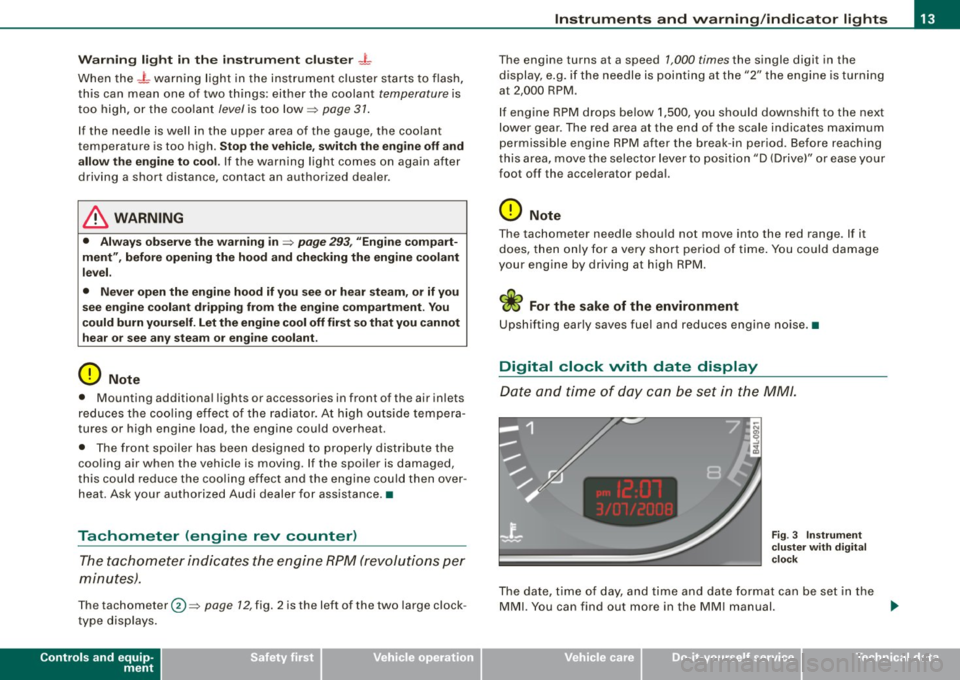
Digital clock with date display
Dote and time of day con be set in the MM/.
Fig . 3 Instrument
cluster with digital
clock
The date, time of day, and time and date format can be set in the
MMI. You can find out more in the MMI manual. .,_
I • •
Page 285 of 398
_____________________________________________ C_ l_ e _a_ n_ in_ g_a _ n_d_ p_ r_ o_ t _e_ c_t _io _ n __ l"III
•
Under certain circumstances, weekly washing may be necessary.
Under other conditions , a monthly washing and waxing may be
adequate .
After the winter, the
underside of the vehicle should be thoroughly
washed, preferably in a professional car wash.
& WARNING
Always read and heed all WARNINGS and other information
~ page 282. •
Automatic car wash
The vehicle can be washed in almost any modern auto
matic car wash.
The vehicle paint is so durable that the vehicle can normally be
washed without problems in an automatic car wash . However, the
effect on the paint depends to a large extent on the design of the
facility, the filtering of the wash water , the type of wash and care
material, etc. If the paint has a dull appearance after going through
the car wash or is scratched , bring this to the attention of the oper
ator immediately . If necessary, use a different car wash .
Before going through a car wash, be sure to take the usual precau
tions such as closing the windows and power roof . Factory installed
antennas must not be removed.
If you have installed additional accessories on the vehicle - such as
spoilers, roof rack, etc. -it is best to ask the car wash operator if
these should be removed.
& WARNING
Always read and heed all WARNINGS and other information
~ page 282. •
Washing the vehicle by hand
A lot of water is needed when washing a vehicle by hand.
-Before you start washing, make sure you have read and
understood the WARNINGS =:>
& in "General informa
tion" on
page 282.
-First soak all dried dirt until it is soft, then rinse it off.
- As you clean your vehicle, start with the roof and work
your way down to the bottom, using a sponge, a sponge glove or a clean brush.
- Rinse the sponge or the sponge glove often, flushing it
clean each time.
- Use special car shampoo only for very persistent dirt.
- Rinse the car thoroughly with water.
- Use a chamois leather to gently w ipe the exterior dry.
Use a separate sponge for cleaning the wheels , door sills and other
regions exposed to road dirt. In this way, you will not scratch the
paint with coarse particles imbedded in the sponge the next time
you wash the car.
& WARNING
• Do not clean the underside of the chassis, fenders, wheel
covers, or other hard to reach parts without protecting your hands
and arms. You may cut yourself on sharp-edged metal parts.
• Always read and heed all WARNINGS and other information
~ page282. _..
Vehicle care
I t •
Page 292 of 398
___ C_ le_ a _ n_i_n ~g _ a_ n_ d __ p_r _o _t _e _c_ t_ i_o _n ___________________________________________ _
wards, use copious amounts of clean water to remove the
rema ining detergen t. App ly the wa ter w ith a damp cloth or sponge
and pat the fabric dry with an absorbent, dry c loth.
Stains from choco late or makeup should have detergent paste (e.g .
ox -ga ll soap) rubbed into them. A fterwards, remove the soap w it h
water (damp sponge).
A lcoh ol can be us ed t o t rea t sta ins fro m grease, oil, lipstick o r a ba ll
point pen. Melted grease or dye must be patted off using absorbent
ma te ri al. It may be neces sary to retreat the a reas w ith de tergent
paste and water .
In the case of genera l soiling of the upho lstery and cover material,
we recommend h ir ing a specialis t that has the equ ip m ent to c lea n
the seat covers and other fabric surfaces by shampooing and spray
e xt rac tion.
& WARNING
Always read and heed all WARNINGS and the information
~ page 282 .
[ i] Tips
Open Ve lcro fasteners on your clothing can damage the seat cover.
Please make sure that Velcro fas tene rs a re c losed .•
Plastic parts and instrument panel
A lways use a clean cloth mo iste ned in cl ear wa ter to clean these
areas . For persistent dirt use an Audi approved
solvent-free plastic
cleaner/ protectant.
in. WARNING
Solvents can change the properties of some plastics and make it
harder for the airbag to deploy.
& WARNING (continued )
• Never clean the instrument panel or the surface of airbag
modules with cleaning products that contain solvents .
• Products containing solvents will make the surface of this part
porou s.
• Serious injuries can result if plastic parts come loose when the
airbag is deployed .
• Alway s read and heed all WARNINGS and other information
~ page 282.
0 Note
Cleaning agents containing so lvents wil l attack the material and can
c hange t he way it behave s.•
App lies to vehicles: with natu ra l l eathe r
Natural leather
Aud i mak es gr eat effo rts to main ta in the p roperties ,
n atu ra l look an d fee l of interior le athe r.
General
We offe r ma ny diff erent typ es of leather on our v ehicles . M ost ar e
different types of nappa leather, which has a smooth surface and
comes in va rious co lors .
T he intens ity o f the color de termi nes t he visua l character ist ics a nd
appearance. If the surface of the leather has a typica l natural look,
th en the leathe r is a nappa leather t hat has bee n l eft in a re lat ive ly
natural condition. This leather offers particu lar ly good comfort and
b reathes well. Fi ne vei ns, closed g ra ins, ins ect bit es, ski n folds, a nd
subt le variations in color remain visib le. These character istics
dem onstrate tha t the mate rial is natural.
Natura l nappa leather is not covered by a color finis h. It is therefo re
more sens itive to so iling and wea r, which is something you need to ...
Page 293 of 398
_____________________________________________ C_ l_ e _a_ n_ in_ g_a _ n_d_ p_ r_ o_ t _e_ c_t _io _ n __ _
•
consider if children, anima ls or other factors m ight prove to be
partic ularly hard on the leather.
By contrast, leather types that are covered by a colored finish layer
are more durable. This has a positive effect on the leather 's resis
tance to wear and soiling in da ily use. On the ot her hand, the typica l
characteristics of natural leather are barely or not apparent.
However, this does not mean that the leather itself is of inferior
quality .
Care and h andling
Because of the exclusive nature of the types of leather that Audi
uses and their unique properties (such as sensitivity to oils, grease,
soiling, etc.l, you will need to be somewhat careful with these
lea thers, and a cer tain type of care is requ ired . For example, dark
clothing materials can discolor leather seats (especial ly if such
clothing is damp and was not dyed correctly). Dust and dirt par ticles
in pores , folds, and seams can have an abrasive effect and can
damage the leather surface as well as weaken seams .
The leather shou ld be c leaned regularly as needed . After having
been used for a relatively long time , your leather seats will acquire
a rich aged finish . This is a characteristic of natural leather and a
sign of true qua lity.
I n order to maintain the value of this natural p roduc t over the life of
your vehic le, you should fo llow the recommendations below :
0 Note
• To keep your leather from b leaching out, do not allow it to be
exposed to bright sun light for long per iods of time . If you have to
leave the vehicle parked outside for long periods, cover the leather
to protect it from direct exposure to sunlight.
• Sharp ob jects on c lothing, such as zippers, rivets or sharp pieces
on belts can leave permanent scratches or sc rape marks on the
surface of t he leather.
[ i ] Tip s
• After each time you clean the leathe r and at regular intervals, use
a leather preservative creme that contains UV -blockers and that
works into the leather . This creme wil l nour ish and moisturize the
leather, helping it to breathe and stay supple . It a lso helps to build
up a protect ive coating on the sur face .
• Clean the leather every 2 -3 months, and c lean any areas that get
soiled.
• Remove fresh marks made by ballpoint pens, ink, lipstick, shoe
polish, etc . as soon as possible .
• Preserve the co lor of the leather as needed by using a special
colored leather care creme to touch up areas of uneven co lor. •
App lies to ve hic les : w ith n atura l le at he r
Cleaning and caring for leather upholstery
and trim
Natural leather requires special care and atten tion .
Normal cleaning
Clean so iled areas wi th a slightly mo is tened cot to n or
woole n cloth.
More stubborn dirt
- More stub born dirt can be removed using a cloth satu
rated wi th a mild soap solut io n (2 tab lespoons mild
liq uid soap) .
- Neve r allow the soap solution to sa turate the leathe r, and
make certain that no water soaks i nto the seams .
Wipe off the soap solution with a soft, dry cloth. .,,
Vehicle care I t •
Page 310 of 398
lffl __ C _h_ e_ c_k _in --== g'-- a_n _d_ f_il _li _n ..:::g:::..- ___________________________________________ _
models; 60% for Canadian models). This mixture both assures the
necessary frost protection and protects metal components in the
engine's cooling system from corrosion and scaling. It also raises
the boiling point of the coolant.
Do not reduce the concentration of the coolant in the summer by
adding plain water.
Th e pro port io n of coo la nt additi ve mu st be at
lea st 50 % but n ot mor e th an 60 %
to maintai n ant ifreeze protection
and cooling efficiency. If the coolant frost protection is too low , the
coolant could free ze and damage the veh icle heating and engine
cooling system .
For year-round driving , antifreeze is added at the factory for temper
atures down to:
• -31 °F ( -35 °c1 usA
• - 40 °F ( - 40 °C) Canada.
You can mix the
Gl 2+ + coolant additive with other additives (G12+
or G12). Always check w ith your authorized Audi dealer.
& WARNING
B efo re you che ck anyt hing in th e eng ine compartmen t, alway s
re ad a nd he ed all WARN ING S~
& in " Working in the engine
c ompar tm ent " on
page 30 1.
0 Not e
• Before winter sets in, have the coolant checked to see if the
coo lant additive in your vehicle is sufficient to meet the climate
conditions. This is especia lly important if you live in a region where
the winter is extremely cold . If necessary, increase the proportion of
coolant additive to 60%.
• When adding coolan t additive to your coo ling system,
remember:
-We recommend using only coolant additive
G12+ + (check the
label) for your vehicle. This coolant additive is avai lable at autho
riz ed Audi dealers. Other types of antifreeze can significantly reduce corrosion protection. The resulting corrosion can cause a
loss of coolant and serious engine damage.
• Do not add any type of radiator leak sealant to your vehicle's
engine coolan t. Adding radiator repair fluid may adversely affect the
function and performance of your cooling system and could result
in damage not covered by your New Vehicle Limited Warranty. •
Checking the engine coolant level
The engine coolant level can be checked with a quick
glance.
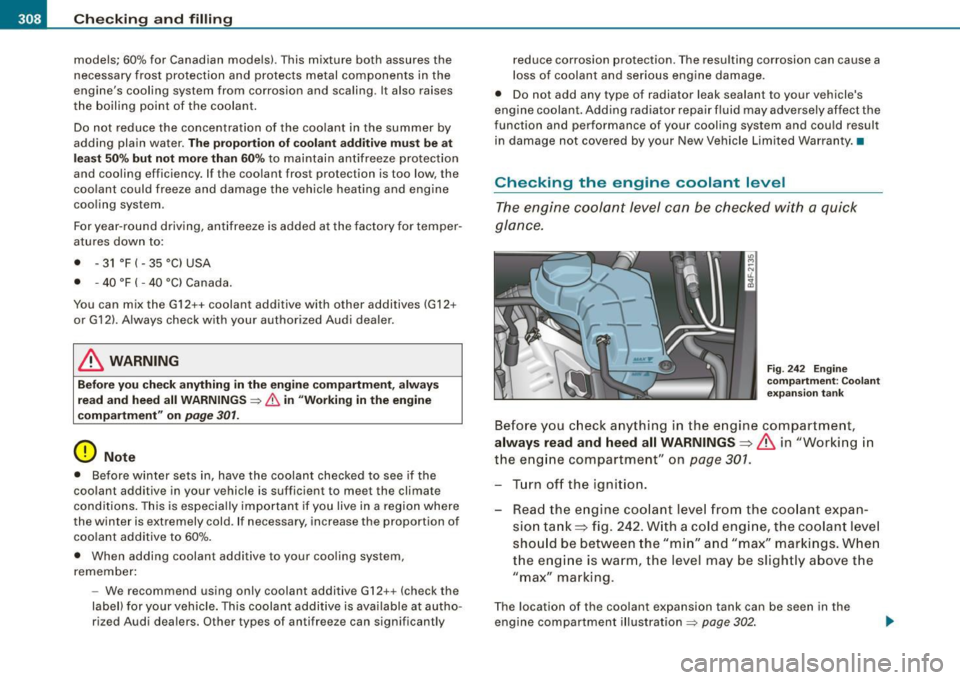
F ig . 2 42 E ngin e
com partm ent : Cool ant
ex pans io n tank
Before you check anything in the engine compartment,
alw ays read and h eed all WARNINGS ~ & in "Working in
the eng ine compartment" on page 301.
- Turn off the ignition.
- Read the e ngine coo lant level from the coo lant expan -
sion tank~ fig. 242. With a cold engi ne, the coolant level
sho uld be between the "min" and "max" markings. W hen
the engine is warm, the level may be slightly above the
"max" marking .
The location of the coolant expansion tank can be seen in the
engine compartment illustration~
page 302.
Page 311 of 398
_____________________________________________ C_h_ e_ c_k _in ~ g_ a_n _d_ f_il _li _n ~g __ lfflll
•
T o obtain an accurate reading, the engine must be switched off .
The expansion tank in your vehic le is equipped with an e lectric
coolant level sensor.
When the coolant level is too low, the warning light in the Auto
Check System ~
page 37 will blink until you add coo lant and the
level has been restored to normal. Even though there is an electric
coolant level sensor, we still recommend you check the coo lant level
from time to time .
Coolant loss
Coolant loss may indicate a leak in the cooling system. In the event
of coolant loss, the cooling system should be inspected immedi
ately by your authorized Audi dealer . It is not enough merely to add
coo la nt.
In a sealed system, losses can occur only if the boiling point of the
coolant is exceeded as a result of overheating .
0 Note
Do not add any type of radiator leak sealant to your vehicle's engine
coolant . Adding radiator repair fluid may adversely affect the func
tion and performance of your cooling system and could result in
damage not covered by your New Vehicle Limited Warranty. •
Adding coolant
Be very careful when adding engine coolant.
Before you check anything in the engine compartment,
always read and heed all WARNINGS~ & in "Working in
the engine compartment" on
page 301.
- Turn off the engine.
- Let the engine cool down. Place
a thick rag over the coolant expansion tank
~ page 308, fig. 242 and carefully twist the cap counter
clockwise ~& .
Add coolant.
- Twist the cap on again
tightly .
Replacement engine coolant must conform to exact specifications
~ page 307, "Coolant". Even in an emergency, if coolant additive
G12++ , G12 + or G12 is not availab le, do not use a different additive .
Use plain water instead until you can get the correct add itive and
can restore the correct ratio. This shou ld be done as soon as
possible.
If you have lost a considerab le amount of coolant, then you should
add cold antifreeze and cold water only when the engine is cold .
A lw ays use
new engine coolant when refilling.
Do not fill coolant above the "MAX" mark. Excess coolant will be
forced out through the pressure relief valve in the cap when the
eng ine becomes hot.
& WARNING
• The cooling system is under pressure and can get very hot.
Reduce the risk of scalding from hot coolant by following these
steps.
-Turn off the engine and allow it to cool down .
- Protect your face , hands and arms from escaping fluid and
steam by covering the cap with a large , thick rag.
- Turn the cap slowly and very carefully in a counter-clockwise
direction while applying light , downward pressure on the top
of the cap.
- To avoid being burned, do not spill antifreeze or coolant on
the exhaust system or hot engine parts. Under certain condi-
tions , the ethylene glycol in engine coolant can catch fire . ...
Vehicle care
I t •
Page 319 of 398
________________________________________________ T_ i _r_e _s_ a_n_ d_ w_ h_ e_e _ l_s __ lllll
•
Tires and wheels
Tires
General notes
Tires may be the least appreciated and most abused parts
of a motor vehicle.
Tires may be the least appreciated and most abused parts of a
motor vehicle. Tires are, however, one of the most important parts
of a vehicle, particularly considering the comparative ly sma ll patch
of rubber on each tire that assures that all- important contact
between you, your vehicle and the road .
Maintaining the correct tire pressure, making sure that your vehicle
and its tires do not have to carry more weight than they can safely
handle, avoiding damage from road hazards and regu lar ly
inspecting tires for damage inc luding cuts , slashes irregular wear
and overa ll condition are the most important things that you can do
to help avoid sudden tire failure including tread separation and
b lowouts .
Avoiding dama ge
If you have to drive over a curb or similar obstacle, drive very slow ly
and as close as possible at a right angle to the curb.
A lways keep chemica ls includ ing grease, oil, gasoline and brake
f luid off the tires.
I nspec t the tires regularly for damage (cuts, cracks or blis ters, etc.l.
Remove any foreign bodies embedded in the treads.
Storing tires
Mark tires when you remove them to indicate the direction of rota
tion . This ensu res you to be ab le to mount them correctly when you
reinstal l them. When removed, the wheels or tires shou
ld be stored in a coo l, dry
and preferably dark place.
St ore t ires in a vertical posit ion if they a re not mounted on rims, in
a horizontal position if they are mounted on rims.
New tire s
New tires have to be broken in~&.
The tread dep th of new tires may va ry, according to the type and
make of tire and the tread pattern.
Hidden d ama ge
Damage to tires and rims is often not readily visible. If you notice
unusua l vibration or the vehicle pul ls to one side, this may indicate
that one of the tires has been damaged . The tires must be checked
immed iately by an authorized Audi dealer or qualified workshop .
Unidire ction al tir es
A unidirectio nal tire can be iden tif ied by arrows on the s idewa ll, that
point in the direction the tire is designed to rotate. You must follow
the specified direction of ro tation . This is necessary so that these
tires can deve lop their optimum characteristics regarding grip, road
noise, wear and hydroplaning resistance . For more information
~ page 349.
in. WARNING
Ne w tire s or tire s that are old , worn or damaged cann ot pro vide
m aximum cont rol and braking ability.
• New tire s tend to be slippe ry and m ust be broken in . To redu ce
the risk of losing control, a colli sion and seriou s per sonal injurie s,
drive with speci al care for t he fi rst 350 m ile s ( 560 km l.
• Driving with worn or damaged t ire s can lead to lo ss of co ntrol ,
s udd en tire failure , in clu ding a blowout a nd sudden deflation , .,,_
Vehicle care
I t •
Page 370 of 398
___ G_ e_n_ e_ r_ a _l _i_n _f _o _ r_ m_ a_ t_ i_ o _ n ________________________________________________ _
0 Note
• The vehicle capacity weight figures apply when the load is
distributed evenly in the vehicle (passengers and luggage). When
transporting a heavy load in the luggage compartment, carry the
load as near to the rear axle as possible so that the vehicle's
handling is not impaired.
• Do not exceed the maximum permissible axle loads or the
maximum gross vehic le weight. Always remember that the vehic le's
handling will be affected by the extra load. Therefore, adjust your
speed accordingly .
• Always observe local regulations. •
Dimensions
The specifications refer to the basic model. Differences may occur
depending on the mode l type and options ordered, for example, tire
sizes.
0 Note
When driving up steep ramps, on rough roads, over curbs, etc. it is
important to remember that some parts of your vehicle, such as
spoilers or exhaust system components, may be close to the
ground. Be careful not to damage them. •