service AUDI S6 2010 Owners Manual
[x] Cancel search | Manufacturer: AUDI, Model Year: 2010, Model line: S6, Model: AUDI S6 2010Pages: 368, PDF Size: 86.82 MB
Page 283 of 368
_____________________________________________ C_h _ e_ c_ k_in --= g'-- a_n _d_ f_i _ll _i_n -=g ::;__ ____.1111
0 Note
Driv ing with an insufficient oil level is likely to cause severe damage
to the engine .
[ i ] Tips
• The oil pressure warning display~ is not an indicator of the oil
level. Do not rely on it. Instead , check the oil level in your engine at
regular intervals, preferably each time you refuel, and always
before going on a long trip .
• If you have the impression your engine consumes excessive
amounts of oil, we recommend that you consult your Audi dealer to
have the cause of you r concern properly diagnosed. Keep in mind that
the accurate measurement of oil consumpt ion requires great care
and may take some time . Your Audi dealer has instructions about how
to measure oil consumption accurately .•
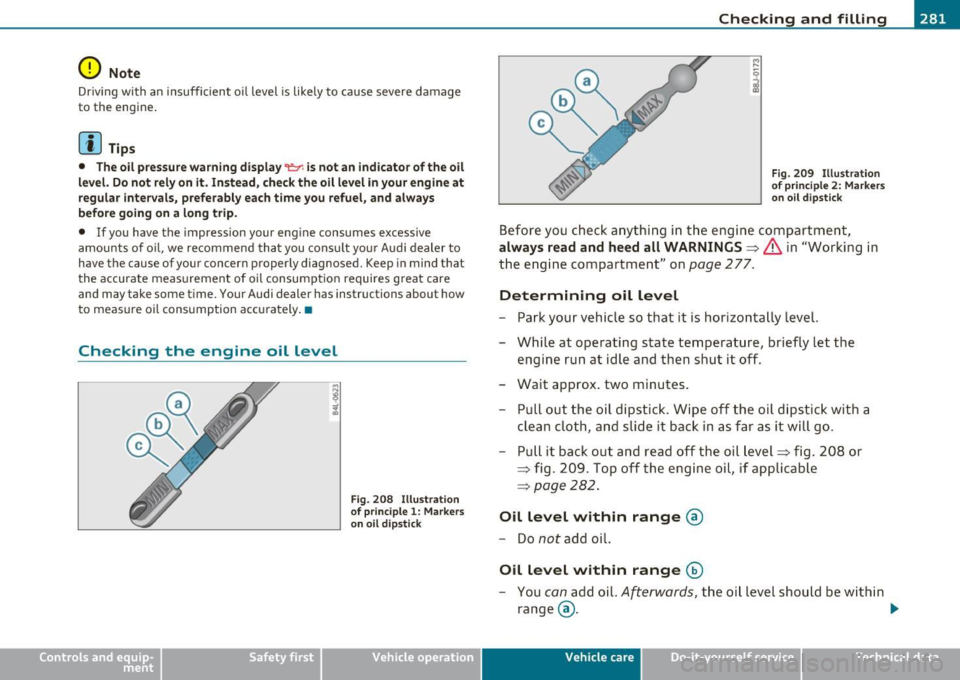
Checking the engine oil level
Fig. 208 Ill ustra tion
o f principle 1: Markers
on oil dipstick
Vehicle OP-eration
Fig. 209 Illustrat ion
of prin ciple 2: Markers
on oil dipst ic k
Before you check anything in the engine compartment,
always read and heed all WARNINGS => & in "Working in
the engine compartment" on
page 2 77.
Determining oil level
-Park your vehicle so that it is horizontally level.
- While at operating state temperature, briefly let the
engine run at idle and then shut it off.
- Wait approx. two minutes.
Pull out the oil dipstick. Wipe off the oil dipstick with a
clean cloth, and slide it back in as far as it will go .
- Pull it back out and read off the oil level ::::> fig. 208 or
~ fig. 209. Top off the engine oil, if applicable
~ page 282 .
Oil Level within range @
-Do not add oil.
Oil Level within range ®
-You can add oil. Afterwards, the oil level should be within
range @. _,,,
Vehicle care Do-it-yourselt service iTechnical data
Page 285 of 368
___________________________________________ C_ h_e _c _k_ i_n ~g_ a_n_ d_ f_ i_ll _i_n _g __ _
Changing the engine oil
We recommend that have your oil changed by an autho
ri ze d Audi dealer or a qualified service station.
Before you check anything in the engine compartment, alway s read
and heed all WARNINGS:::::,
& in "Working in t he eng ine compart
ment" on page 277.
T he eng ine oil mus t be changed acco rding to the intervals specifie d in
your Warranty
& Maintenance book let . This is very important because
the lub ricating properties of oil diminish gradually during norma l
vehicle use .
Under some circumstances the eng ine o il sho uld be changed more
frequently. Ch ange oi l more ofte n if you drive mos tly short distan ces,
operate the vehicle in dusty areas or under predominant ly stop-and
go tr affic condi tions , or have yo ur vehicl e where temperat ures rem ain
below freezing for extended per iods.
Detergent a dditives in the o il w ill make fres h oil look dark after the
eng ine has been ru nning for a s hort ti me. Th is is normal an d is not a
reason to change the oil mo re often than recommended.
B eca u se of the proble m of pr oper di sp o sal, along w ith the s pe cial
too ls and necessary expertise required , we strong ly recommend that
yo u have your o il changed by an a uth o rized
Audi dealer o r a qua lified
service stat io n.
If you choose to change your oil yourself , please note the following
i m po rtan t informatio n:
& WARNING
To reduce the risk of personal injury if you must change the engine
oil in your vehicle your self:
• Wear eye protection.
• To reduce the risk of burns from hot engine oil, let the engine
cool down to the touch.
Safety first
& WARNING (co ntinued )
• When removing the oil drain plug with your fingers , stay as far
away as possible. Always keep your forearm parallel to the ground
to help prevent hot oil from running down your arm .
• Drain the oil into a container designed for this purpose, one
large enough to hold at least the total amount of oil in your
engine .
• Engine oil is poisonous. Keep it well out of the reach of chil
dren.
• Continuous contact with used engine oil is harmful to your
skin. Always protect your sk in by washing oil off thoroughly with
soap and w ater.
(D Note
N ever m ix o il additives w it h your engine oil. These a dditives can
damage your engine and adversely affect your Audi L imited New
Vehicle Warranty .
For the sake of the environment
• Before changing yo ur oil, first ma ke sure you know w he re you ca n
pro pe rly dispose of the use d oil.
• Always dispose of used eng ine oil prope rly . D o not dum p it on
garden soi l, wooded a reas, into open st reams or down sewag e drains .
• Recy cl e used en gine o il by taking it to a use d eng ine oil collection
facili ty in your area, or contac t a serv ice stat io n.•
Vehicle care Technical data
Page 289 of 368
___________________________________________ C_ h _ e_c _k _ i_n -=g .._ a_n _ d_ f_i _ll _i _ n -=g '--- ........ 11'1
Brake fluid
Checking brake fluid level
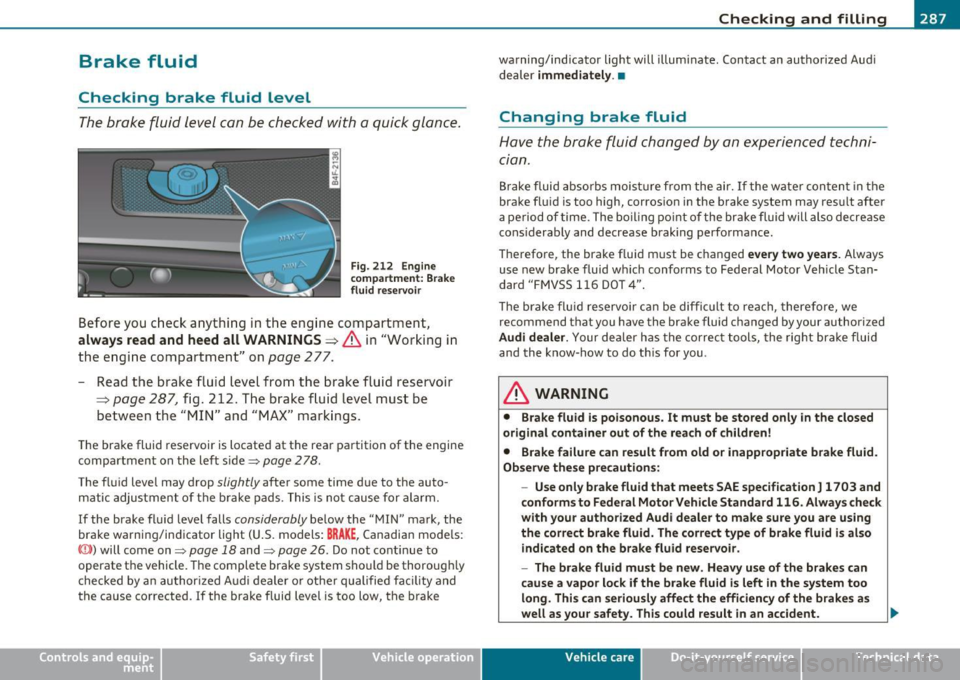
The b rake f lu id l eve l can be checke d wit h a qui ck g lanc e.
Fig . 212 E ngine
compartment : Br ake
fluid re se rv o ir
Before you c heck a nythi ng in the eng ine compartment ,
always read and heed all WARNINGS~ & in "Working in
the e ngi ne comp art ment" on
page 27 7.
- Read t he bra ke flu id level from the bra ke fluid reservoir
~ page 287, fig . 212. The brake flu id level must be
between the " MIN" and " MAX" mar kings.
The brake fluid reservoir is locate d at the rear pa rtition of the engine
compartmen t on the left s ide=>
page 278 .
The f luid leve l may drop slightly after some time d ue to the auto
m atic a dju stment of t he b rake pads. This i s not c ause for ala rm.
If the brake flu id level falls
considerably be low the "M IN" mark, the
brake warni ng/ind icator light ( U.S. models :
BRAKE, Canadia n mo dels:
(0) ) will come on=> page 18 and=> page 26. Do not continue to
operate t he vehicle. The complete brake system sho uld be thoroug hly
chec ked by an au thor ized A ud i d eale r or othe r qualified fac ility and
the cause corrected.
If the brake fluid level is too low, the brake
Vehicle OP-eration
warning/ind icator light will illum inate . Contact an au thoriz ed Aud i
de aler
immediately .•
Changing brake fluid
H av e the b rake fluid chang ed by an expe rie nc ed t echni
CJ an.
B ra ke flui d absorb s moi stur e from the air. If the wa te r co nten t in t he
brake fl uid is too high, corros ion in the b rake system may res ult after
a pe riod of time. The boili ng po int of the brak e flu id will als o decrea se
co nsiderab ly and decrease brak ing perfo rmance.
Th erefore, the brake f lui d m ust be c hanged
every two years . Always
use new brake fluid w hich conforms to Fede ral Motor Veh icle Stan
dard "F MVSS 1 16 DOT 4" .
Th e br ake f luid reserv oir can be diffi cult to rea ch, there fore, we
recommend that you have the brake fluid changed by your authori zed
Audi dealer . Your deal er h as th e correc t tools, the rig ht bra ke flui d
and the know-how to do th is for you.
& WARNING
• Brake fluid is poisonous. It must be stored only in the closed
original container out of the rea ch of children!
• Brake
failure can result from old or inappropriate brake fluid .
Observe these precaution s:
- Use only b rake fluid that meets SAE specification
J 1703 and
conforms to Federa l Motor Vehicle Standard 116. Always check
with your authorized Audi dealer to make sure you are using
the correct brake fluid. The corre ct type of brake fluid is also
indicated on the brake fluid rese rvoir.
- The brake fluid must be new . Heavy use of the brakes can
c ause a vapor lo ck if the brake fluid is left in the system too
long . Thi s can seriously affect the efficiency of the brakes as
well as your safety. This could result in an accident .
~
Vehicle care Do-it-yourselt service Technical data
Page 290 of 368
-L~C~ h~ e~c ~k :..!_i ~ n ~g ~ a~n ~d~ f~il ~l~in ~ g[_ ________________________________________ _
0 Note
Brake fluid will damage the paint of your vehicle.
the special tools required and the necessary expertise, we recom
mend that you have the brake fluid changed by your authorized Audi
dealer. •
Battery
General information
Under normal operating condit ions, the battery in your Aud i does not
need any maintenance. With
high outside temperatures or long daily
drives we recommend that you have the electrolyte level checked by
a service facility. The electrolyte level should also be checked each
time the battery is charged~
page 290.
Have the battery checked when you take your vehicle in for service.
You are well advised to replace a battery that is older than 5 years.
With certain types of a irbag deployment, the battery is disconnected
from the vehicle electrical system for safety reasons=>
& in "Repair,
care and disposal of the airbags" on
page 209.
Disconnecting the battery terminals
Some vehicle functions (power window regulators, for example) are
lost if the battery terminals are disconnected. These functions have
to be relearned after the battery terminals are connected aga in. To
prevent this, the battery should only be disconnected from the
vehicle electrical system when absolutely necessary for repairs.
Vehicles not driven for long periods
If you do not drive your veh icle over a period of severa l days or weeks,
electrical components are gradually cut back or switched off. This
reduces energy consumption and maintains starting capability over a
longer period~
page 247.
Take into consideration that when you unlock your vehicle, some
convenience functions, such as the master key remote function or
power seat adjustment, may not be available. The convenience func
tions will be available again when you turn on the ign ition and start
the engine.
Winter operation
During the winter months, battery capacity tends to decrease as
temperatures drop. This is because more power is also consumed
while starting, and the headlights, rear window defogger, etc., are used more often .
Avoid unnecessary power consumpt ion, particu larly in city traffic or
when traveling only short distances. Let your authorized Audi dealer
check the capacity of the vehicle battery before w inter sets in
=> page 290. A well charged battery will not only prevent starting
problems when the weather is cold, but will also last longe r.
(I] Tips
If your veh icle is left standing for several weeks at extreme ly low
temperatures, the vehicle battery should be removed and stored
where it will not freeze. This will prevent it from being damaged and
having to be replaced.•
Page 291 of 368
___________________________________________ C_ h _ e_c _k _ i_n -=g .._ a_n _ d_ f_i _ll _i _ n -=g '-- ........
Working on the battery
Be es peciall y careful when wor kin g on or near the
ba ttery .
Fig. 213 Luggage
compartment : Battery
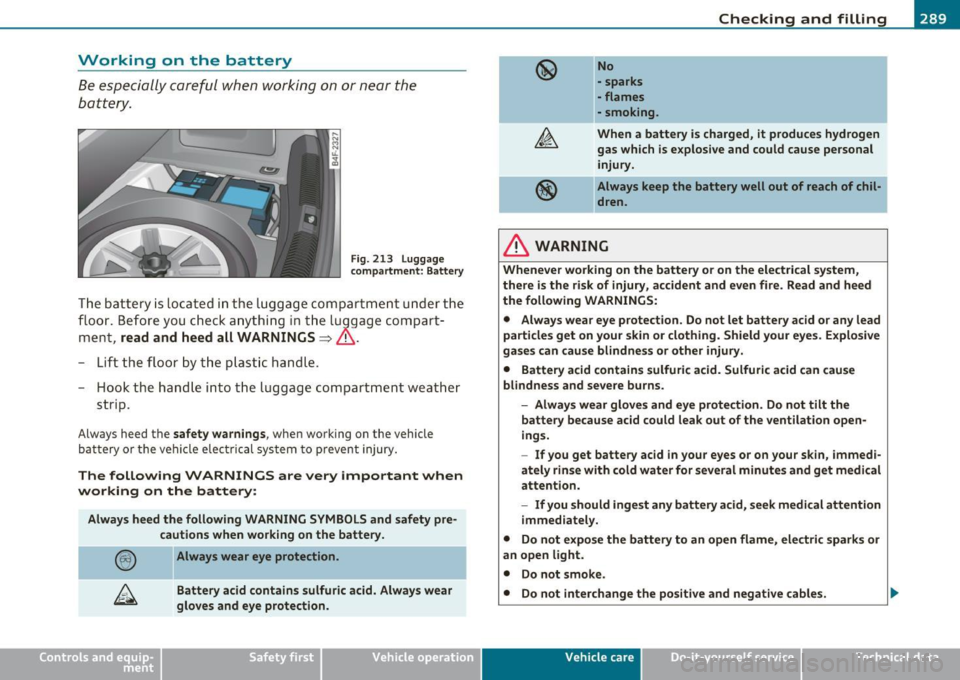
T he b atte ry is loc ated in th e lugg age co mpartmen t under the
flo or. Before you check an ything i n the lu~ga ge compart
m ent , read and heed all WARNINGS~
&-
- Li ft the fl oor by the plastic handle .
- Hook the ha nd le i nto the lugga ge com partm ent weat her
s tri p.
Always heed the safety warnings, when working on the veh icle
b att ery o r the vehi cle elec trical sys te m t o pr even t injury .
The following WARNINGS are very important when
working on the battery:
Always heed the following WARNING SYMBOLS and safety pre cautions when working on the battery.
®
Always wear eye protection.
Battery acid contains sulfuric acid. Always wear
gloves and eye protection. I
Vehicle OP-eration
No
- sparks
- flames
- smoking .
When a battery is charged, it produces hydrogen
gas which is explosive and could cause personal
injury.
Always keep the battery well out of reach of chil
dren.
& WARNING
Whenever working on the battery or on the electrical system,
there is the risk of injury, accident and even fire . Read and heed
the following WARNINGS:
• Always wear eye protection. Do not let battery acid or any lead
particle s get on your skin or clothing. Shield your eyes. Explosive
gases can cause blindness or other injury.
• Battery acid contains sulfuric acid . Sulfuric acid can cause
blindness and severe burns .
- Always wear gloves and eye protection. Do not tilt the battery because acid could leak out of the ventilation open
ings.
- If you get battery acid in your eyes or on your skin, immedi
ately rinse with cold water for several minutes and get medical
attent ion.
- If you should ingest any battery acid, seek medical attention
immediately.
• Do not expose the battery to an open flame, electric sparks or
an open light. • Do not smoke.
• Do not interchange the positive and negative cable s.
Vehicle care Do-it-yourselt service iTechnical data
Page 299 of 368
________________________________________________ T_ i_ re _ s_ a_ n_d_ w_ h_ e_ e_l _s _ ....... ffl
Occupant loading and distribution for vehicle normal load for various designated seat ing capacities
Designated seating capacity, num- Vehicle normal load, number of Occupant distribution in a nor
mally loaded vehicle
ber
of occupants occupants
5 3 2 in front, 1 in back seat
Co ld tire inf lation pressure
Tire pr essur e affects the overall handling, performance and safety of a vehicle .
Fig. 216 Tire pressure
label : lo cated o n
dr iver 's sid e B·pillar
Tire pressure generally refers to t he amo unt of a ir i n a tire tha t it
needs it to do its job and safe ly carry the comb ined load of t he entire
vehicle and its contents . Tire p ressure is measured in kilopasca ls
(kPa), the inte rnationa l measur ing unit and in poun ds per squar e in ch
(PSI). Tire press ure is based in part on the ve hicle 's design and load
limit -the greatest a mount of weight that the vehi cle can c arry safe ly
and the tire s ize. The proper tire pressure is frequently refer red to as
the "re commen ded cold t ire inflation p ressure. " Air in t he tires
expands when the tire heats up because of internal friction when it
flexes in use. T he tire press ure is hig her w hen the tir e h as warme d up
than whe n it is "cold." It is the inflation pressure in a "cold" tire that
c o unts. The refo re, you sho uld never let air o ut of a warm t ire to
match "cold ti re inflation pressure " recommendations . The t ires
wou ld then be under in flated and could fail s uddenly.
------------------.. ,::
.(
... TINGc.worv TOTAA. I """" I .... I)(··-) :& NOMBAE DE P\.ACES TOTAi. 4VANT ARAIERE _,, rt-.oomblNd-...glllolOCCIUPll"Matlll~liio.Mn ~a:.u•d •"'M _ .. Uooldt IOUol -~ Ill du dltH-gt11'Nffl N dolt j._11, cibtl-loo !IQ lb.
TIRE SClE COI.O TIN! PMSSUAE PN(U DIMfN 5'0NS NW:S.St()N OU PNEUS A fflOIO
""""
SUOWN'EA'S MANUAl F
INFORMATION
VOIR U MANUEL DU PROJl'RIETAIRE
POUR PLUS OE
RENS£1Gf\1£MENTS Fig . 217 Tire pre ssur e
label
Ma intain ing prope r tire pressure is one o f the most importa nt things
you can do to he lp avoid sudde n tir e fa il u re . Under inflated tires are a
majo r ca use of sudden tire fa ilure . Keeping t ires at the rig ht pressure
is a lso important for safe and responsive vehicl e ha nd ling , traction,
braki ng an d load ca rryi ng.
Tire pressures are particularly impo rtant
when the vehicle is being driven at higher speed s, and then espe·
cially when heav ily loaded even within the permissible load ·
carrying capacities approved for your vehicle .
The recommended tire pressures for your Audi depend on the kind of
t ires on your vehicle and the num be r of passengers and/or amou nt o f
luggage you will be tra nspo rt ing .
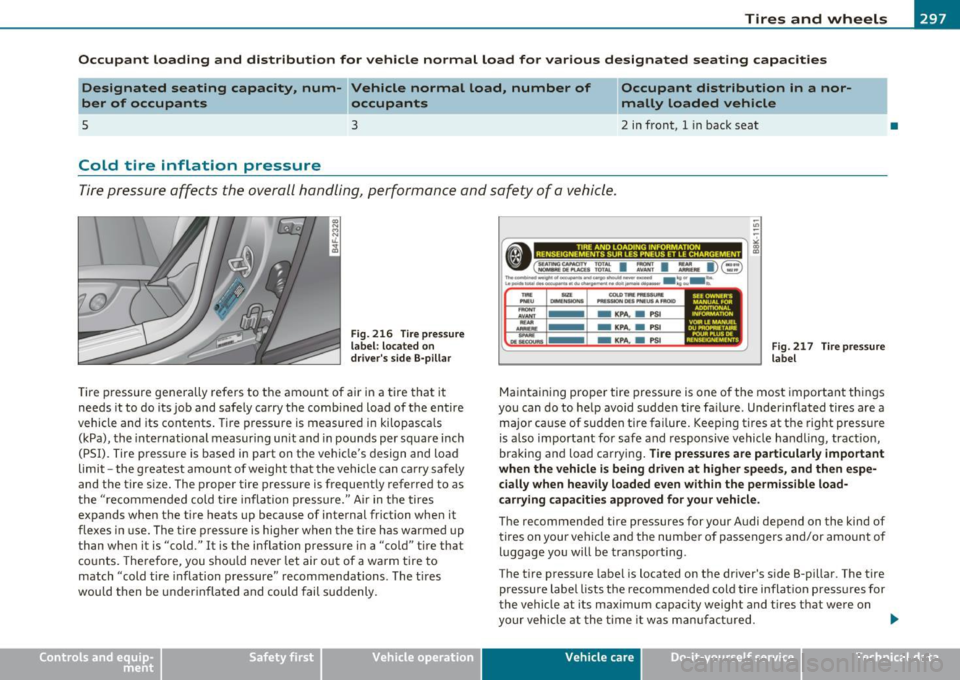
The t ire pressure labe l is located on t he dr iver's side B-pilla r. The tire
pressure labe l lists th e recommended cold tire inflat ion p ress ures for
the vehicle at its maximum capacity weight and t ires t hat were on
•
your vehicle at the time it was manu fact ured. _,,,
Vehicle OP-eration Vehicle care Do-it-yourselt service iTechnical data
Page 303 of 368

__________________________________________________ T_i_ r _e _s_ a_ n_ d_ w_ h_e_ e _ l_s __ _
• Adjust the tire press ure to the load you are ca rry ing .
• Reins tall the valve s te m ca p on the v alve .
When should I check the tire pressure?
The cor rect tire p ress ure is especially importa nt a t hi gh s peeds . The
pressu re s ho ul d therefore be c hecked at least once a month and
always befor e sta rt ing a jou rney . Do not fo rget to ch eck the tire pr es
sure for the spare wheel=>
page 317.
When should I adjust the tire pressures?
Adjust t he tire pressure to the loa d you are ca rry ing . After chan ging a
w hee l or replac ing w heels yo u hav e to adjust the t ire press ures on all
w heels. I n add it io n, you m ust then store th e new t ire pressures in the
t ire press ure moni toring system *=>
page 31 4.
& WARNING
Incorrect tire pressures and /or underinflation can lead sudden tire
failure , loss of control , collision , serious personal injury or even
death .
• When the warning symbol appears in the instrument
cluster, stop and inspect the tires. • Incorrect tire pressure and/or underinflation can cause
increased tire
wear and can affect the handling of the vehicle and
stopping ability.
• Incorrect tire pressures and /or underinflation can also lead to
sudden tire failure , including a blowout and sudden deflation ,
causing loss of vehicle control.
• The driver is responsible for the correct tire pressures for all
tires on the vehicle. The applicable pressure values are located on
a sticker on the driver 's side 8-pillar.
• Only when all tires on the vehicle are filled to the correct pres
sure, the tire pressure monitoring system* can work correctly .
• The use of incorrect tire pressure values can lead to accidents or
other damage . Therefore it is e ssential that the driver observe the
Safety first
& WARNING (co ntinued )
specified tire pressure values for the tires and the correct pres
sures for the function of the tire pres sure monitoring system*.
• Always inflate tires to the recommended and correct tire pres
sure before driving off.
• Driving with underinflated tires bend more , letting them get
too hot re sulting in tread separation, sudden tire failure and loss
of control.
• Excessive speed and /overloading can cause heat build-up,
sudden tire failure and loss of control.
• If the tire pressure is too low or too high, the tires will wear
prematurely and the vehicle will not handle well.
• If the tire is not flat and you do not have to change a wheel
immediately, drive at reduced speed to the nearest service station
to check the tire pressure and add air as required .
0 Note
Driv ing witho ut valve stem caps can cause damage to the t ir e valves.
T o preven t this, a lways make sure th at fa ct o ry insta lled va lve stem
caps on all wheels are s ecure ly m ou nted on t he v alve .
<£> For the sake of the environment
Under infla ted ti res will also increase t he fue l cons umption .•
Tires and vehicle load limits
Th ere a re limits to the amo unt of load or weight that a ny vehicle and
any tire can ca rry . A veh icle t hat is overloaded w ill not handle well and
is mo re diffic ult to s top . Ove rloading can no t only lead to loss of
vehicle contro l, but can also damage important parts o f the ve hicle
a nd can le ad t o sud de n tir e fa ilure, incl uding a blowout and su dden
deflation t hat can cause the vehicle to crash . .,_
Vehicle care Technical data
Page 306 of 368
lffll __ T_ i_ r _e _s_ a_n_ d_ w_ h_ e_e_ l_ s _______________________________________________ _
Tire service Life
The servi ce life of tires depends on a lot of different
things including proper installation and balancing,
correct tir e pressure and driving style.
l 1.. ______ Jj
Tread Wear Indicator (TWI)
Fig. 2 18 Tire tread:
t rea d w ear in di cato rs
(TW I)
Fig . 21 9 R otati ng
tires f or m ore e ven
w ea r
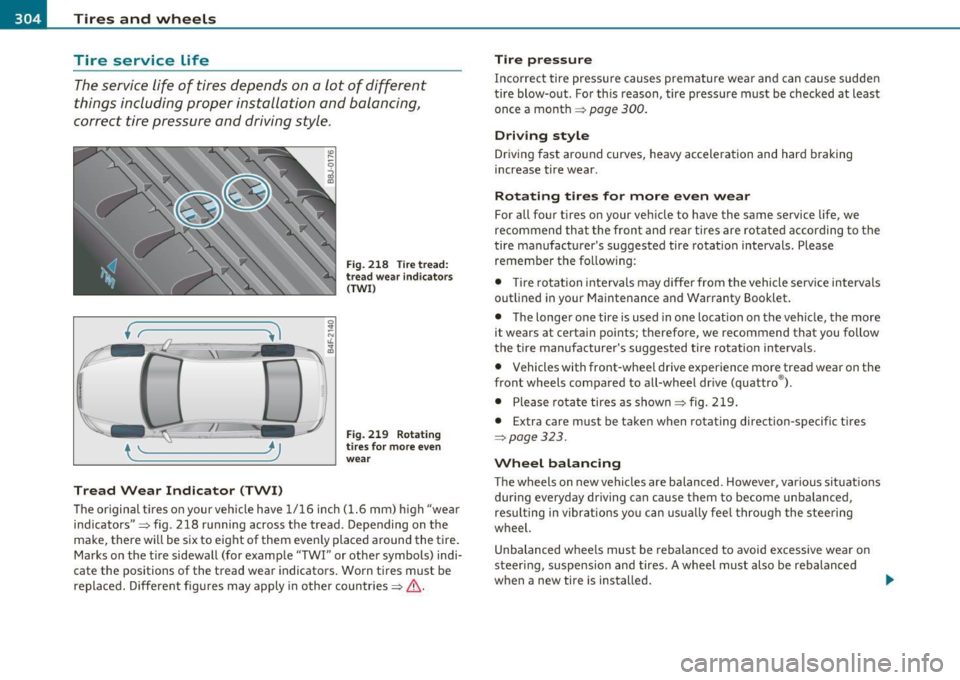
The original t ires o n your veh icle have 1/16 inch ( 1.6 mm) h igh "wear
ind icators"~ fig. 218 running across the tread . Depending on the
ma ke, there w ill be six to eight of them even Ly placed around the ti re.
Marks on the t ire sidewall (for examp le "TWI " or other symbols) indi
cate the positions of the tread wea r indicators . Worn t ires must be
replaced. Differe nt figu res may apply in other countries ~ & .
Tire pressure
Incorrect tire pressure causes premature wea r and can cause sudden
tire blow-o ut. Fo r th is reason, tire pressu re must be checked at least
once a month~
page 300.
Driv ing style
Driving fast aro und curves, heavy acceleration and hard b raking
increase tire wear .
Rotating tires for more even wear
For all four tires o n your ve hicle to have the same se rvice life, we
recommend that the fron t and rear t ires are rot ated according to the
tire manufact urer's suggested tire rotat ion intervals . Please
remember the fo llow ing :
• Tir e ro tat ion inte rvals may d iffe r from the vehicle serv ice intervals
out lined in your Maintenance and Warranty Booklet .
• The longer one tire is used in one locat ion on the vehicle, the more
it wears at certain points; therefore, we recommend that you follow
the t ire manufacture r's sugges ted tire rotation interva ls .
• Vehicles with front-whee l drive experience more tread wea r on the
front wheels compa red to a ll-wheel dr ive (quattro ®).
• Please ro ta te tires as shown~ fig. 219 .
• Extra care must be taken when rotating direction -specific t ires
~ page 323 .
Wheel balancing
The wheels on new vehicles are balanced. However, var ious si tuatio ns
dur ing everyday driving can cause them to become unbalanced,
resu lting in v ibr ations yo u can us ua lly fee l throug h the stee rin g
w heel.
Unbalanced whee ls mus t be rebalanced to avoid excessive wea r on
steeri ng, suspension and tires . A wheel must also be rebalanced
when a new tire is installed.
~
Page 307 of 368

________________________________________________ T_ i_ re _ s_ a_ n_d_ w_ h_ e_ e_l _s _ ........
Incorrect wheel alignment
In correct whee l al ignme nt can ca use excessive tir e wea r, impairing
th e sa fety o f the vehicl e. If t ires show excessive w ear, hav e the w heel
alignment checked by a n authorized A udi dea ler or qualifie d work
shop.
All Wheel Drive
Vehicles wi th quattro® must always have tires of the same size ,
con st ruct ion an d tread type . For details see~
page 246.
& WARNING
Sudden tire failure can lead to los s of control, a cra sh and serious
personal injury!
• Never drive a vehicle when the tread on any tire is worn down
to the wear indicators.
• Worn tires are a safety hazard, they do not grip well on wet
roads and increase your risk of "hydroplaning" and loss of control.
• Always keep chemicals that can cause t ire damage, such as
grease , oil, gasoline and brake fluid away from tires.
• Tires age even if they are not being used and can fail suddenly,
especially at high speeds. Tires that are more than 6 years old can
only be used in an emergency and then with special care and at
lower speeds.
• Never mount used tires on your vehicle if you are not sure of
their "previous history. " Old used tires may have been damaged
even though the damage cannot be seen that can lead to sudden
tire failu re and loss of vehicle control. •
Vehicle OP-eration
New tires and replacing tires and whee ls
N ew t ires an d w hee ls have to be brok en in .
Fig. 220 Tire specificat ion codes on th e sidewall of a tire
No.
©
®
®
©
©
©
Description
Passenger car tire (where applicable)
Nom inal wid th of ti re in mil limeters
Ratio of hei9ht to width (aspect ratio)
Radial
jj Rim diameter code
L oa d index and speed rating
Vehicle care Do-it-yourselt service iTechnical data
Page 311 of 368

________________________________________________ T_i_re _ s_ a _ n_d_ w_ h_ e_ e_l_s __ _
For example: Tread wear 200, Traction AA, Temperature A.
All passenger car tires must conform to Federal Safety Requirements
in addition to these grades.
Tread wear
The tread wear grade is a comparative rating based on the wear rate
of the tire when tested under controlled conditions on a specified
government test course .
For example, a tire graded 150 would wear one and one half (1 1/2)
times as well on the government course as a tire graded 100.
The relative performance of tires depends upon the actual conditions
of their use, however, and may depart significantly from the norm
due to variations in driving habits, service practices and differences in
road characteristics and climate.
Traction
The traction grades, from highest to lowest, are AA, A, Band C. Those
grades represent the tire's ability to stop on wet pavement as
measured under controlled conditions on specified government test
surfaces of asphalt and concrete . A tire marked C may have poor trac
tion performance ~& .
Temperature
The temperature grades are A (the highest), B, and C, representing
the tire's resistance to the generation of heat and its ability to dissi
pate heat when tested under controlled conditions on a specified
indoor laboratory test wheel.
Sustained high temperature can cause the material of the tire to
degenerate and reduce tire life, and excessive temperature can lead
to sudden tire failure~&.
The grade C corresponds to a level of performance which all
passenger car tires must meet under the Federal Motor Vehicle
Safety Standard No. 109 . Grades Band A represent higher levels of
performance on the laboratory test wheel than the minimum
required by law .
Safety first
& WARNING
The traction grade assigned to this tire is based on straight-ahead
braking traction tests, and does not include acceleration,
cornering, hydroplaning or peak traction characteristics.
& WARNING
The temperature grade for this tire is established for a tire that is
properly inflated and not overloaded. Excessive speed, underinfla
tion, or excessive loading, either separately or in combination, can
cause heat buildup and possible tire failure. •
Winter tires
Winter tires can improve vehicle handling on snow and
ice . At temperatures below 45 °F (7 °C) we recommend
changing to winter tires.
In some heavy snow areas, local governments may require true
winter or "snow" tires, those with
very deeply cut tread. These tires
should only be used in pairs and be installed on all four wheels. Make
sure you purchase snow tires that are the same size and construction
type as the other tires on your vehicle.
If your vehicle is equipped with all-wheel drive*, this will improve
traction during winter driving,
even with the standard tires. However,
we strongly recommend that you always equip all four wheels on your
vehicle with correctly fitted winter tires or all-season tires, when
winter road conditions are expected. This also improves the vehicle's
braking performance and reduces stopping distances.
Summer tires provide less grip on ice and snow .
Winter tires (snow tires) must always be fitted on all four wheels .
Ask your authorized Audi dealer or qualified workshop for permitted
winter tire sizes. Use only radial winter tires. ..,_
Vehicle care Technical data