door lock AUDI S6 2010 Owner's Guide
[x] Cancel search | Manufacturer: AUDI, Model Year: 2010, Model line: S6, Model: AUDI S6 2010Pages: 368, PDF Size: 86.82 MB
Page 226 of 368
Ill Child Safety __ .,.___ ____________ _
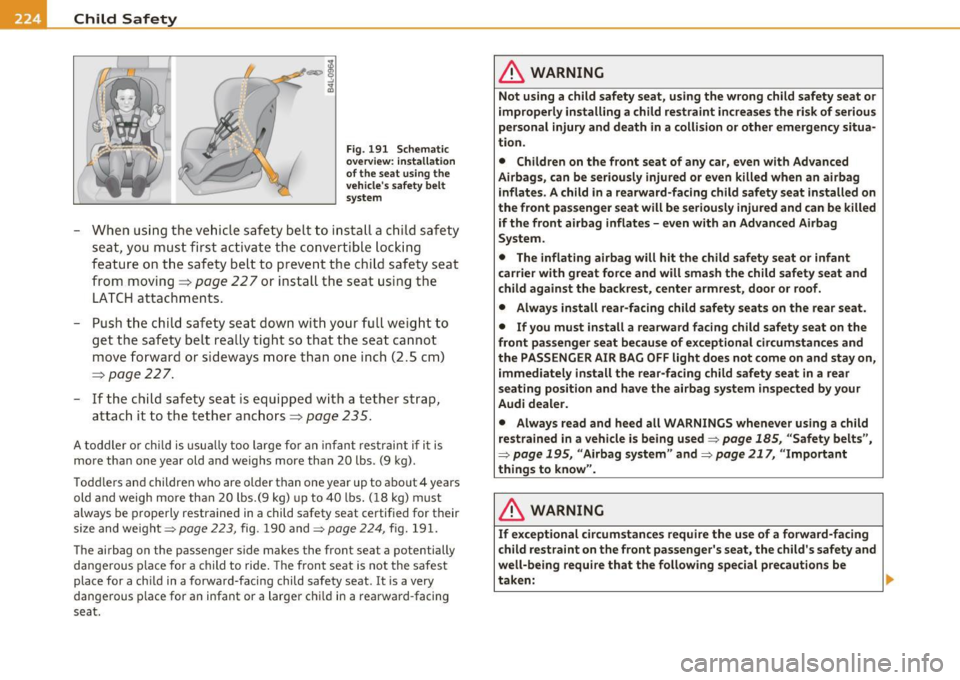
Fig. 191 Schematic
overview: installation
of the seat using the
vehicle's safety belt
system
- When using the vehicle safety belt to install a child safety
seat, you must first activate the convertible locking
feature on the safety belt to prevent the child safety seat
from moving~
page 227 or install the seat using the
LATCH attachments.
- Push the child safety seat down with your full weight to get the safety belt really tight so that the seat cannot
move forward or sideways more than one inch
(2.5 cm)
=>
page 227.
- If the child safety seat is equipped with a tether strap, attach it to the tether anchors=>
page 235.
A toddler or child is usually too large for an infant restraint if it is
more than one year old and weighs more than 20 lbs . (9 kg) .
Toddlers and children who are older than one year up to about 4 years old and weigh more than 20 lbs .(9 kg) up to 40 lbs. (18 kg) must
always be properly restrained in a child safety seat certified for their
size and weight~
page 223, fig. 190 and~ page 224, fig. 191.
The airbag on the passenger side makes the front seat a poten tially
dangerous place for a child to ride. The front seat is not the safest
place for a child in a forward-facing child safety seat . It is a very
dangerous place for an infant or a larger child in a rearward-facing
seat .
& WARNING
Not using a child safety seat, using the wrong child safety seat or
improperly installing a child restraint increases the risk of serious
personal injury and death in a collision or other emergency situa
tion.
• Children on the front seat of any car, even with Advanced
Airbags, can be seriously injured or even killed when an airbag
inflates. A child in a rearward-facing child safety seat installed on
the front passenger seat will be seriously injured and can be killed
if the front airbag inflates -even with an Advanced Airbag
System.
• The inflating airbag will hit the child safety seat or infant
carrier with great force and will smash the child safety seat and
child against the backrest, center armrest, door or roof.
• Always install rear-facing child safety seats on the rear seat.
• If you must install a rearward facing child safety seat on the
front passenger seat because of exceptional circumstances and
the PASSENGER AIR BAG OFF light does not come on and stay on,
immediately install the rear-facing child safety seat in a rear
seating position and have the airbag system inspected by your
Audi dealer.
• Always read and heed all WARNINGS whenever using a child
restrained
in a vehicle is being used~ page 185, "Safety belts",
~ page 195, "Airbag system" and~ page 217, "Important
things to know".
& WARNING
If exceptional circumstances require the use of a forward-facing
child restraint on the front passenger's seat, the child's safety and
well-being require that the following special precautions be
taken:
11'-
Page 231 of 368

_____________________________________________ C _h_i_ld _ S_ a_ f_ e_ t ... Y'--- __
& WARNING
Rearward-facing child restraints:
• A child in a rearward-facing child safety seat installed on the
front passenger seat will be seriously injured and can be killed if
the front airbag inflates -even with an Advanced Airbag System.
• The inflating airbag will hit the child safety seat or infant
carrier with great force and will smash the child safety seat and
child against the backrest, center armrest, door or roof.
• Always be especially careful if you must install a rearward
facing child safety seat on the front passenger seat in exceptional
circumstances.
• A tight tether strap on a rearward-facing child restraint
attached to the front passenger seat can put too much pressure on
the weight-mat in the seat and register a heavier weight in the
Advanced Airbag System. The heavier weight registered can make
the system work as though an adult were on the seat and deploy
the Advanced Airbag when it must be suppressed causing serious
or even fatal injury to the child.
• Make sure that the PASSENGER AIR BAG OFF light comes on
and stays on all the time whenever the ignition is switched on.
• If the PASSENGER AIR BAG OFF light does not come on and
stay on, immediately install the rear-facing child safety seat in a
rear seating position and have the airbag system inspected by
your Audi dealer. •
Activating the convertible Locking retractor
Use the convertible locking retractor to secure a child
restraint.
Always heed the child safety seat manufacturer's instruc
tions when installing a child restraint in your vehicle. To acti
vate the convertible locking retractor:
Controls and equip
ment Safety first Vehicle operation
-
Place the child restraint on a seat, preferably on the rear
seat.
- Slowly pull the belt
all the way out.
- Route it around or through the child restraint belt path
=>& .
- Push the child safety seat down with your full weight to
get the safety belt really tight.
- Insert the belt tongue into the buckle for that seating
position.
- Guide the safety belt back into the retractor until the belt
lies flat and snug on the child safety seat.
- You should hear a "clicking" noise as the belt winds back
i nto the inertia reel. Test the convertible locking retractor
by pulling on the belt. You should no longer be able to pull
the belt out of the retractor. The convertible locking
retractor is now activated.
- Make sure that the red release button is facing away from
the child restraint so that it can be unbuckled quickly.
- Pull on the belt to make sure the safety belt is properly
tight and fastened so that the seat cannot
move forward
or sideways more than one inch (2.S cm).
& WARNING
Using the wrong child restraint or an improperly installed child
restraint can cause serious personal injury or death in a crash.
• Always make sure that the safety belt retractor is locked when
installing a child safety seat. An unlocked safety belt retractor
cannot hold the child safety seat in place during normal driving or
in a crash. ._
Vehicle care Do-it-yourself service Technical data
Page 262 of 368
-~_C_ le_ a_n_ i_ n_ g=- a_ n_d___. p_ ro_ t_e _c_ t_ i_o _n ___________________________________________ _
0 Note
• Never try to remove dirt, mud or dust if the surface of the vehicle
is dry. Never use a dry cloth or sponge, since this could scratch your
vehicle's paint or windows.
• Never wash your car in bright sunlight . Drops of water act as
magnifying lenses and may damage your pa int.
• When you wash your car in the winter: if you rinse your vehicle with
a hose, be careful not to a im the stream of water d irectly at locks, or
at door or hatch openings -they can freeze shut.
• Never use sponges designed to remove insects, or any kitchen
scouring sponges or similar products. They can damage your paint
fin ish .
• Never use a dry cloth or sponge to clean the headlights . Only use
wet cloths or sponges to prevent scratches . It is best to use soapy
water.
For the sake of the environment
In the interest of the environment, the vehicle should on ly be washed
in special wash bays. •
Washing your vehicle with a power washer
Cleaning the exterior of your car with a high-pressure
power washer is safe as long as you observe a few simple
rules .
-Before using the power washer, make sure you have read
and unders tood the WARNINGS ~
& in "General infor
mation" on
page 258.
- Always follow the operating instructions for the power
washer. -
Make sure that the jet on the spray hose produces a "fan
shaped spray".
- Do
not hold the spray nozzle too close to soft materials.
When cleaning the vehicle with a power washer always follow the
operating instructions. This applies particularly to the
operating
pressure
and the spraying distance. Maintain a sufficient distance to
soft materials such as rubber hoses and sound/vibration deadening
materials (particularly on the underside of the engine hood). Do not
use a jet which sprays water in a
direct stream or one that has a
rotating jet.
Water temperature should not exceed 140
°F (60 °() .
& WARNING
Never wash tires with a jet that sprays water in a direct stream.
This could cause invisible damage to the tires and weaken them,
even if the spray is from a relatively long distance and for a short
time. Damaged and weakened tires can fail and cause accidents
and personal injury .
0 Note
To avoid damaging your vehicle, always make sure that there is suffi
cient distance between the spray head and soft materials like rubber
hoses , plastic parts and sound-deadening mater ials. Never aim the
spray head at the same point for a long time. This a lso applies to
cleaning headlights and painted bumpers. Remember: the closer the
nozzle is to the surface of the material, the greater the stress on the
material. •
Page 267 of 368
____________________________________________ C_l_e _a_ n_ in--= g=-- a_n_ d_ p ,__r_o _t_ e_ c_ t _ io_ n __ _
Your authorized Audi dealer can provide cleaning products that have
bee n tested and approved for your veh icle. •
Care of interior
MMI display
- Clean the MMI display with a soft clean cloth and an LCD
cleaner .
The MMI display can be cleaned with a professionally available "LCD
cleaner". The cloth should be slightly dampened with the cleaning
fluid to clean the d isp lay .
0 Not e
To avoid scratching the MMI display, you should never clean it dry. •
MMI control console
- First clean the MMI control console with a brush to
remove dust from the housing.
- Then wipe the MMI control console with a clean, soft,
slightly damp cloth.
T he MM I control console sho uld be cleaned w ith a brush first so that
no dirt is trapped between the buttons and the housing. We recom
mend g iving the MMI contro l conso le a final w ipe with a cloth mois t
ened w ith water and dish washing detergent.
0 Note
To prevent damage, make sure that no fluid ever gets into the MMI
control console .•
Safety first
Aluminum trim
Use only neut ral-pH products to remove spots and deposits from
al uminum surfaces. Ch rome care prod ucts and al kaline cleaners w ill
attack aluminum surfaces and can damage them over t ime .
& WARNING
Alw ay s re ad and heed all WARNING S and other information
~ page 258 . •
Fabrics and fabric coverings
Fabrics and fabr ic coverings (e .g . seats, door trim panels, etc.) should
be clean ed at regular interva ls with a vacuum cl eaner . T his removes
surfa ce di rt pa rt icl es which co uld become embedded in the fabr ic
through use . Steam cleaners should not be used, because the steam
tends to push the d irt deeper into the f abric and lock it there.
Norm al clean ing
Genera lly, we recommend using a soft sponge or a li nt-free
microfiber cloth to the clean fabric. Brushes should on ly be used for
ca rpets and floor mats , since other fab ric surfaces could be ha rmed
by brushes.
No rma l sur face sta ins can be cleaned us ing a commercially avai lab le
foam cleaner. Spread the foam on the surface of the fabr ic with a soft
sponge and work it in gently . Do not saturate the fabric. Then pat the
foam dry using absorbent , dry cloths (e .g. microfiber cloth) and
vacuum it after it has dried comp letely.
Clean ing stains
Sta ins caused by beverages (e .g. coffee, fruit juice, etc.) can be
treated with a mild detergent solut ion. Apply the detergent solut ion
with a sponge . In the case of stubborn stains, a detergent paste can
be applied directly to the stai n and worked into the fabric . After
wards, use copious amo unts of clean water to remove the remaining .,.
Vehicle care Technical data
Page 275 of 368
In order to fill the tank properly while protecting the environment,
please follow this refueling procedure carefully.
& WARNING
Under normal operating conditions, never carry additional fuel
containers in your car. Gas canisters and other containers used to
transport fuel can be dangerous. Such containers, full or empty,
may leak and could cause a fire in a collision. If you must transport
fuel to use for your lawn mower, snow blower, etc., be very careful
and always observe local and state laws regarding the use, trans
portation and storage of such fuel containers. Make certain the
container meets industry standards (ANSI /ASTM F852 -86).
0 Note
Never drive your vehicle until the fuel tank is completely empty . The
irregular supply of fuel can cause misfiring. Gasoline could enter the
exhaust system and damage the catalytic converter. •
Refuelling
The fuel filler flap is unlocked from a button in the
driver's door.
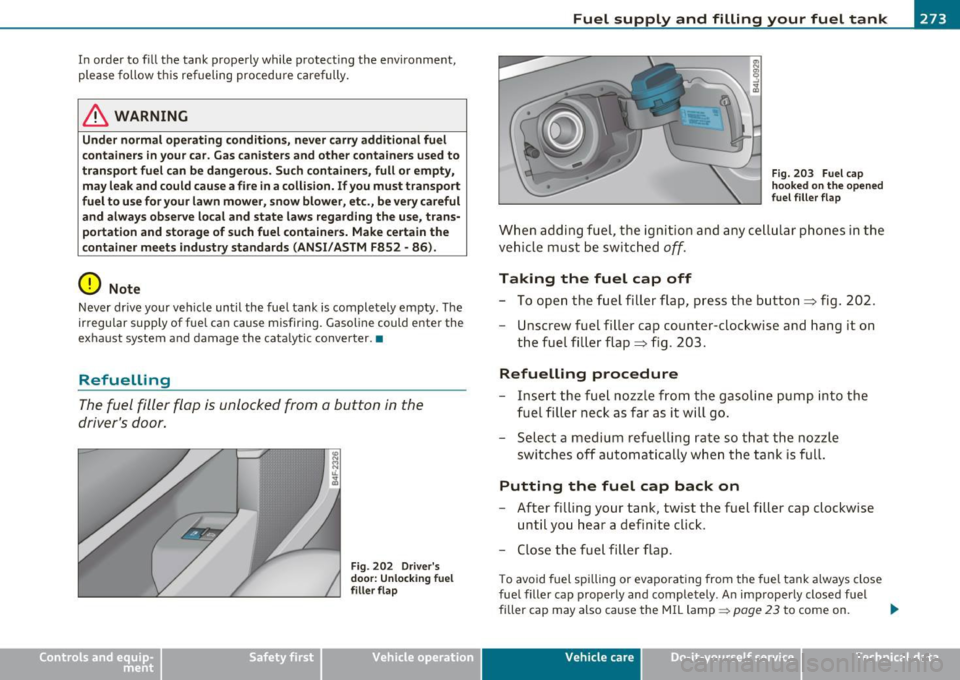
Fig . 202 Driver's
door: Unlock ing fuel
filler flap
Vehicle OP-eration
Fuel supply and filling your fuel tank
Fig. 203 Fuel cap
hooked on the opened
f uel filler flap
When adding fuel , the ignition and any cellular phones in the
vehicle must be switched
off.
Taking the fuel cap off
- To open the fuel filler flap, press the button~ fig. 202.
- Unscrew fuel filler cap counter-clockwise and hang it on
the fuel filler flap~ fig . 203.
Refuelling procedure
- Insert the fue l nozzle from the gasoline pump into the
fuel filler neck as far as it will go.
- Select a medium refuelling rate so that the nozzle
switches off automatically when the tank is full.
Putting the fuel cap back on
- After filling your tank, twist the fuel filler cap clockwise
until you hear a definite click .
- Close the fuel filler flap.
To avo id fuel spi lling or evaporating from the fuel tank always close
fuel filler cap properly and completely . An improperly closed fuel
filler cap may also cause the MIL lamp~
page 23 to come on. ._.
Vehicle care Do-it-yourselt service iTechnical data
Page 329 of 368

______________________________________________ F _u_s _e_ s_ a_ n_ d _ b _u_l_b _ s _ ___.9I
No. Equipment
29 Not used
30 Not used
31 Back-up
light switch, transmission, engine com-
ponents
Intelligent power module driver (footwell light
32 and front headlights, horn, wiper system, elec-
trically adjustable steering wheel)
-
33 Intelligent power module dr
iver
(lights left-side)
34 Intelligent power module driver
(lights right-side)
35 Not used
36 Headlight
washer system
37 Electronic Stabilization Program (ESP)
38 Wiper system
39 Door control module
left-side
Horn
41 Heater fan
42 Control module electronic ignition lock/electri-
cally adjustable steering wheel
43 Rear
windshie ld wiper (Avant)
44 Power window opener (left-side)
Amps
15
30
25
25
30
25
30 15
25
40
30
15
-
-
35 •
Vehicle OP-eration
Fuse Location, Instrument Panel right
Fig. 236 Fuse panel
l ayou t
Some of the equipment items listed are optional or only available on
certain model configurations.
Note that the following table is accurate at the time of going to
press and is subject to change. In the event of discrepancies, the
label on the inside of the cover always takes precedence.
The power seats are protected by circuit breakers , which automati
cally reset afte r a few seconds after the overload has been remedied.
No. Equipment Amps
Fuse holder (black)
1 Control module Convenience
key
15
2 Cigarette lighter front 20
3 Tire pressure monitoring system
5
4 Electrical outlet front (center console)
20
-
5 Intelligent power module passenger
15
(glove box lock)
6 Door control module right-s ide
15
Sunroof 20
A/C controls 10
Vehicle care Do-it-yourself service iTechnical data
Page 354 of 368
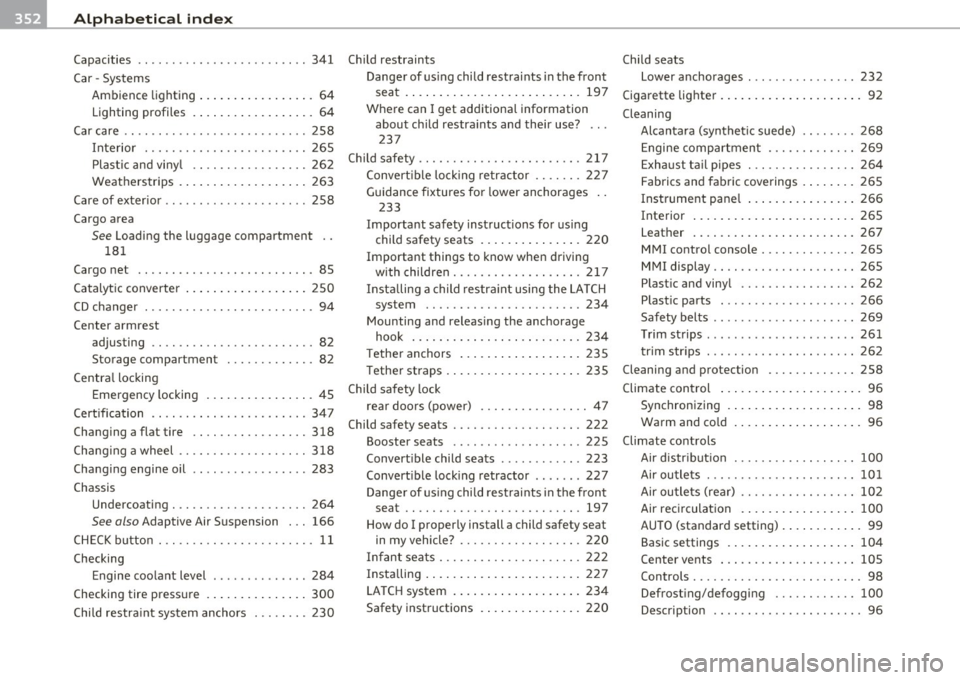
-Alphabetical inde x lffi'f ___,__ ______________ _
Capacities .... ..................... 341
Car -Systems
Ambience lighting ... .............. 64
Lighting profiles . ................. 64
Car care .. .. .. ..................... 2S8
Interior ..... ............. .... .. 265
Plastic and vinyl .. .. .. .. ......... 262
Weatherstrips ................ ... 263
Care of exterior .. .... .. .. ..... ... ... 258
Cargo area
See Loading the luggage compartment ..
181
Cargo net .. .. ...... .... .. .. .. ..... . 85
Catalytic converter .................. 250
CD changer ............ .... .. .... ... 94
Center armrest adjusting .. .... .. .. .... .......... 82
Storage compartment ... .......... 82
Centra l locking
Emergency locking ............ .... 45
Cert ification .... ...... .... ......... 347
Changing a flat tire .. .. .. .. ......... 318
Changing a wheel ........... ...... .. 318
Changing engine oil .. .. ... ....... .. . 283
Chassis Undercoating . ................. .. 264
See also Adaptive Air Suspension . .. 166
CHECK button . .. .. ........ .......... 11
Checking Engine coolant level . ........... .. 284
Checking tire pressure ............ ... 300
Child restra int system anchors . ... .... 230 Child restraints
Danger of us ing child restraints in the front
seat . ... ............... .. ... .. 197
Where can I get additional information
about child restraints and their use? .. .
237
Child safety ....... ...... ... . .. .. .. . 217
Convert ible locking retractor .... .. . 227
Guidance fixtures for lower anchorages
233
Important safety instructions for using
child safety seats ......... ... .. . 220
Important things to know when driving with children ............ .. .. .. . 217
Installing a child restraint using the LATCH
system .................. ..... 234
Mounting and releasing the anchorage
hook .............. .... ....... 234
Tether anchors ...... ... .. .. .... . 235
Tether straps .............. ... .. . 23S
Child safety lock rear doors (power) ........ .. .. .. .. 47
Child safety seats ............ .. ..... 222
Booster seats .... .. .. .. .. .. .. .. . 225
Convertible child seats .......... .. 223
Convertible lock ing retractor ....... 227
Danger of us ing child restraints in the front
seat .. .... .. ........... .. .. .. . 197
How do I properly install a child safety seat in my vehicle? ........... .. .. .. . 220
In fant seats .............. .. .... . 222
Insta lling ...... .... .. .. .. ....... 227
LATCH system ....... ..... ....... 234
Safety instructions . ... .... ....... 220 Child seats
Lower anchorages . ...... ........ . 232
Cigarette lighter ................... .. 92
Cleaning Alcantara (synthetic suede) .. .. .. .. 268
Engine compartment .......... ... 269
Exhaust tail pipes . .. .. .. ......... 264
Fabrics and fabric coverings . ....... 265
Instrument pane l ... ............. 266
Interior ............. .... ..... .. 265
Leather ....... ... ... ... ..... ... 267
MMI control console .............. 265
MMI display .. .... .. ......... .... 265
Plastic and vinyl .. .. ............. 262
Plastic parts ... .. .. .......... ... 266
Safety belts .............. ... .. .. 269
Trim strips ..................... . 261
tr im strips . .. ................. .. 262
Cleaning and protection ....... .. .. .. 258
Climate control . . . . . . . . . . . . . . . . . . . . . 96
Synchronizing . ................. .. 98
Warm and cold ....... ... .. .. .. ... 96
Climate controls Air distr ibut ion ...... ...... ...... 100
Air outlets . .. ....... ...... .. .. .. 101
Air outlets (rear) ................. 102
Air recirculation . ... ............. 100
AUTO (standard setting) ............ 99 Basic settings ............ ... .. .. 104
Center vents . ............... .... lOS
Controls . . . . . . . . . . . . . . . . . . . . . . . . . 98
Defrosting/defogging ............ 100
Description .. .. ... ...... ..... .. .. 96
Page 355 of 368

Alphabetical index -________________ fWI
Energy management ...... .. .. ..... 96
Fan .................... ... ... .. 100
Heated seats, front .............. . 103
Key coded setting ........ ...... ... 96
Recirculation mode (automatic) .. ... 104
Recommended sett ings ............ 96
Residual heat ..................... 99
Setting the temperature ............ 99
Switching air cooling on/off .... ... .. 99
Synchronization . ... .............. lOS
Turning on and off ....... ...... .. .. 99
Using climate control economically .. 102
Clock ................ .... .. .... .... . 9
Closing Power sunroof ... .. ... ... .. .. . .... S4
Coat hooks ........... ..... .... ... ... 9S
Cold ti re inflation pressure ..... .. ..... 297
Compass mirror ........ ...... .. .... .. 73
Compliance . ... ................ .... 347
Consumer Information . . . . . . . . . . 183, 344
Contacting NH TSA .... .............. 183
Continuously Variable Transmission (CVT)
See multit ronic ® ................. 152
Convenience key .................... . 47
Dr iver messages ....... ... .. .. ... . 112
Locking vehicle ...... ....... .. .... . 49
START button ............. .. ... .. 110
Starting engine .. ............. .. . 110
S TOP button ............ .. .. .... . 111
Switching eng ine off .............. 111
Switching on ignition ......... .. ... 110
Unlocking vehicle ................ .. 48
Convertible child safety seats ..... .... 223
Controls and equip
ment Safety first
Convert
ible lock ing retractor
Activating ............... .. ...... 229
Deactivating ..................... 230
Us ing to secure a chi ld safety seat .. 227,
229
Coolant system ..................... 284
Cooling System Expans ion tank ..... .. .. ... .... .. 284
Cruise control Changing speed ..... ... .......... 117
Presetting your speed ... .......... 117
Switching off . .. ................. 117
Switching on .................. .. 116
Warning/indicator lights ........ .. . 16
See also Adaptive Cruise Control .... 119
Cruising range ... ................ .... 34
(upholder .... ............. .. .. . 89,90
D
Damp ing
See Adaptive A ir Suspens ion ...... .. 166
Data . .... ....................... .. 341
Data record er .. . .... .. ... .......... 240
Date display ......................... . 9
Daytime running lights . . . . . . . . . . . . 58, 59
Declaration of compl ia nee
Adaptive Cruise Contro l ... ......... 347
Audi side assist .. .. . .. ...... .. ... 347
Cell phone package . .............. 347
Convenience key .... .. .. .. .. ..... 347
E lectronic immobilizer ............ 347 Homelink
® universal remote control . 347
Remote control key .. ....... ... ... 34 7
def What does this mean when it appears in
the trip odometer disp lay? .. .. ..... 10
Defective light bulb warn ing ......... .. 21
Defrosting/defogging the windows .. .. . 100
Defrosting/defogging w indows ........ 101
Determining correct load limit ....... .. 302
Digital clock . ........ ................ 9
Digital compass ..................... 73
Digital speedometer .................. 21
Dimensions ............ ... .. .. ..... 339
Dipstick Reading the dipstick properly ....... 281
Distance control system
See Adaptive Cruise Control ... .. .. . 119
Doors Power ch ild safety lock .. ....... .... 47
Driver information system ............. 19
Digital speedometer ............... 21
Driver information messages ........ 24
Open door or rear lid warning . ....... 21
Outs ide temperature display ........ 20
Sound system disp lay .............. 20
Driver seat
See Seating position .............. 176
Driver's seat ... .... .. .... ........... 76
Driver's seat memory ................. 79
Activating remote control key ....... 80
Recalling a seat pos it ion . ... ..... ... 79
Storing a seat position .. ....... .... 79
Vehicle operation Vehicle care Do-it-yourself service Technical data
Page 356 of 368

-Alphabetical inde x ------',.__ ___________________________________ _
Driv ing messages ...... ...... .. .. .. .. 24
Dr iv ing safely . . . . . . . . . . . . . . . . . . . . . . 1 7 4
Dr iving through water ... ... ... .. .. .. 250
Dr iv ing time .. ............ .......... 34
Duplica te key . .... .... .. .. .. ........ 3 7
Dust fi lter
Climate controls .. .. .. .... .. .. . ... 96
DVD player for navigation system . .. . .. . 86
Dynam ic shift program ............ .. 156
E
Easy entry feature . .. .. .. .. .... ..... 108
Electric seat adjustment
See Power seat ................... 76
Electromechanical parking brake Emergency braking . ... .. .. .... .. . 11 5
Ma lf u nct ion . . . . . . . . . . . . . . . . . . . . . 115
Operation . . . . . . . . . . . . . . . . . . . . . . 113
Park ing .................... .. .. 114
Releasing and app ly ing ... .. ... .. .. 113
Starting off w ith a t railer ......... . 115
Wa rning/ind icator lights . .. .... .. .. 17
Electronic differential lock (EDL) How the system works ... ......... 241
Warning/ind icator lights . .......... 17
Electroni c immobili ze r ... .... .. .. .. .. . 40
Electronic powe r control
(EPC) war ning/ indicato r light .. .. ... . 14
E lectronic speed limiter ........ .... .. . 23
Ele ctro nic s tabiliza tion p rogram ( ESP)
How t he system wor ks ... ......... 2 40
W arning/ind icator lights . .......... 14 Emergency braking
..... .. .. .. .. .. .. 115
Emergency closing Power su nroof ... ... .. .. . ... ... 55, 56
Eme rgency flasher ................ ... 61
Wa rning/ind icator l ights . .. .. .. .. .. 15
Emergency locking of doors . .. .. .. .. .. 45
E mergency sta rt ing .... ..... ... .. .. . 331
Emergency towing .................. 334
Energy management ................ 247
Battery power .. .. .. .. .. .... ..... 248
Dr iver not ification ............... . 248
Engine Compartment . ... .. .. .. .. .. .. ... 2 78
Coolant .. ... .. .. .. .. .... .. .. .. . 284
Hood . ... .. .. .. .... ... .. .. .. .. . 276
Starting ....... .. .. ........ . 108, 109
Starting with jumpe r cab les . .. .... . 331
Stopping ...... .............. ... 110
E ngine compa rtment
Sa fety instructions . .... ... .. .. .. . 277
Working the eng ine compartment .. 277
En gine coolant system ........ .. .. .. . 28 4
Add ing coolant ................. . 285
C hecking coo la nt level . ..... .. .. .. 28 4
Checking the engine coo lant level . .. 284
Ma lfu nction ... .. ..... ..... .... .. . 27
Radiator fan ....... .. ... . .. .. ... 286
E ngine coo lant tempe rature
T emperat ure gauge ............. .. . 8
Engine data ....... ...... .... .. ..... 341
Engine hood Closing .... ..... ..... .... .. .. .. . 2 77
How to re lease the hood ..... .. ... . 2 76 Engine oil
.. ... .... ... .. . ... ... .. .. 279
Add ing .............. .... ... .. .. 282
Add itives .................. .... . 282
Changing .. ..... .......... .. .. .. 283
Checking the engine oil leve l ..... .. 281
Indi cat io ns and conditions requiring extr a
check ing . .. .. .. .. ............. 281
Oil consumption .... ............. 280
Oil grades . .. .. .... ..... ....... . 279
Recommended oil check intervals ... 281
Specification and viscosity ..... .. .. 279
Engine oil leve l .... .. .. ............. . 31
E ngine oil p ress ure
Mal fu nct ion .. .. .. .. .... .......... 28
Engine oil sensor defect ive . ...... ... .. 31
Engine speed limitation ....... ... .. .. . 32
E nvironmen t
Bre ak-in per iod ...... ...... .. .. .. 249
Ca taly tic converte r .. .... ......... 250
Disposing o f you r vehi cle bat tery .... 292
Driving at hig h speeds ..... ... . ... 252
Driving to minimize poll ution and noise . .
2 51
Fuel .. .. .... ....... ...... .... .. 273
F ue l economy .. .. .. ....... .. .. .. 251
Leaks unde r yo ur vehicle ... .. .. .. . 2 77
Lett ing the vehicle stand and warm up .. .
252
Proper disposa l of dra ined brake fluid 287
Prope r disposal of dra ined engine coo la nt
285
Proper disposal of drained engine oil 282, 283
Recy cling used e ng ine o il .......... 282
Page 357 of 368

Alphabetical index -________________ fNi'II
Unleaded fuel .... .... ... .. .. . .. . 271
What should I do with an old battery? ...
292
EPC
See E lectronic power control ........ 14
ESP
See Electronic stabilizat ion program (ESP)
14
Event Data Recorder (EDR) ............ 240
Exhaust tail pipes
Cleaning ................ .... .... 264
Expansion tank ..................... 284
Ex terior lighting in the mirror housing ... 61
Eyeglass es compa rtment .............. 9S
F
Fan
Radiator ............... .. .. .. .. . 286
Fastening Booster seats .................... 225
Convertible child safety seats .. ..... 223
Infant seats .............. .... .. . 222
Fastening eyelets .................... 84
Flat tire Changing . .. ........... ...... .. . 318
Floor mats ......................... 180
Fog lights ................. ........ . 60
Folding master key with remote control .. 3 7
Foot pedals .. .. ... ........ .. .. .. .. . 180
For the sake of the environment
Gasoline fumes and the environment 273
Letting your engine warm up ...... . 109
Controls and equip
ment Safety first
Reducing engine noise
by early upshifting
8
Refueling . .. ..... .. .. .. ......... 273
Saving fuel by early upshifting ........ 8
Using the rear window defogger ..... 101
Front airbags Descript ion . ...... .. .. .. .. ....... 199
How they work ................. .. 204
Front ashtray ........................ 91
Front fog lights .. ................. .. . 60
Front seats ... .. ..... ...... ...... .. . 75
Adjusting .. .. .. ........ ......... 177
Chi ld restraints in the front seat . ... 197
Fro nta l collisions and the laws of physics 186
Fuel Additives .... .. .... .. .. ......... 271
Blended gasoline ................. 271
Consumption ............ .... .. .. . 34
Filler neck ....................... 272
Fuel gauge ...... ............. .... 10
Gasoline ..................... ... 271
Gasoline additives ................ 272
Low fuel leve l . . . . . . . . . . . . . . . . . 10, 30
Octane rating . .. ................. 271
Recommendation . ......... .... .. 271
Refuelling ....... .... .. .. ....... 273
Reserve .................. ... .. .. . 10
T ank capacity .................... 341
Unlocking the fuel filler flap by hand . 275
Fuse arrangement ................. .. 325
G
Garage door opener (Homelink ®) .. .. .. 169 Gas d
ischarge lamps .. ... .... ... .... . 329
Gauges Engine coolant temperature .......... 8
Fuel gauge ... ... .. ............... 10
Speedometer ..................... 10
Tachometer . .... .. ... ............. 9
Trip odometer ............ ...... .. 10
General illustration Instrum ents and contro ls ............ 7
Glossary of tire and loading terminology 294
Glove compartment . .. .... .... .. ..... 94
cd changer .. .... .. .... ........... 94
emergency unlocking .............. 94
Valet key function ................. 40
Gross Vehicle Weight Rating (GVWR) ... 339
H
Head restraints ..................... 179
Adjusting ............... ... ... .. 179
Front seats ........ ............... 81
Rear seats .. .. .. .. ............... 81
Headlight washer reservoir ... ........ 292
Headlights ......................... . 58
Adaptive Light .............. ...... 61
Defective . .. .. .. .. ... ............ 21
Front fog lights ................... 60
Headl ight range control defective .. .. 31
Switching off ............ ... .. .. .. 58
Switching on ............ ...... ... 58
Washer system ... ................ 67
Xenon headlights ... ... ... ......... 58
Heated outside mirrors ............... 71
Vehicle operation Vehicle care Do-it-yourself service Technical data