fuel AUDI S6 2010 Owner's Guide
[x] Cancel search | Manufacturer: AUDI, Model Year: 2010, Model line: S6, Model: AUDI S6 2010Pages: 368, PDF Size: 86.82 MB
Page 275 of 368
In order to fill the tank properly while protecting the environment,
please follow this refueling procedure carefully.
& WARNING
Under normal operating conditions, never carry additional fuel
containers in your car. Gas canisters and other containers used to
transport fuel can be dangerous. Such containers, full or empty,
may leak and could cause a fire in a collision. If you must transport
fuel to use for your lawn mower, snow blower, etc., be very careful
and always observe local and state laws regarding the use, trans
portation and storage of such fuel containers. Make certain the
container meets industry standards (ANSI /ASTM F852 -86).
0 Note
Never drive your vehicle until the fuel tank is completely empty . The
irregular supply of fuel can cause misfiring. Gasoline could enter the
exhaust system and damage the catalytic converter. •
Refuelling
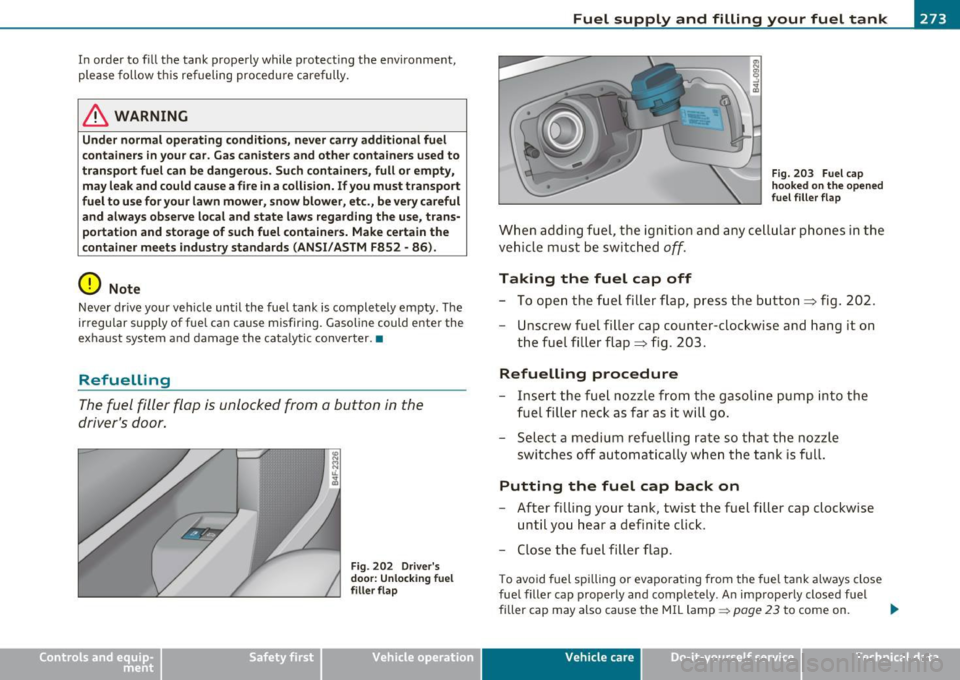
The fuel filler flap is unlocked from a button in the
driver's door.
Fig . 202 Driver's
door: Unlock ing fuel
filler flap
Vehicle OP-eration
Fuel supply and filling your fuel tank
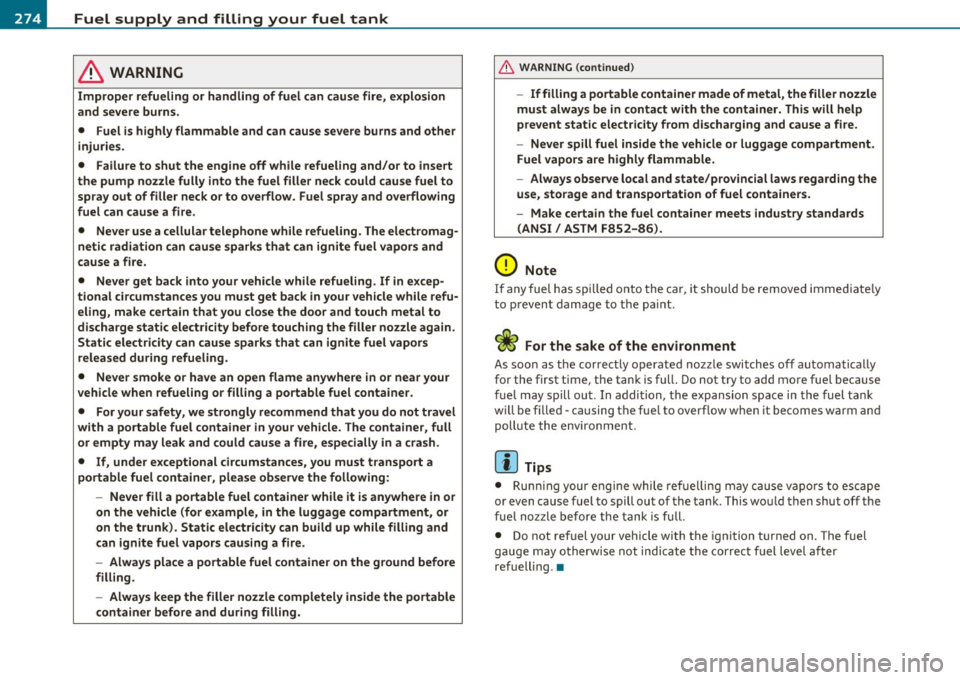
Fig. 203 Fuel cap
hooked on the opened
f uel filler flap
When adding fuel , the ignition and any cellular phones in the
vehicle must be switched
off.
Taking the fuel cap off
- To open the fuel filler flap, press the button~ fig. 202.
- Unscrew fuel filler cap counter-clockwise and hang it on
the fuel filler flap~ fig . 203.
Refuelling procedure
- Insert the fue l nozzle from the gasoline pump into the
fuel filler neck as far as it will go.
- Select a medium refuelling rate so that the nozzle
switches off automatically when the tank is full.
Putting the fuel cap back on
- After filling your tank, twist the fuel filler cap clockwise
until you hear a definite click .
- Close the fuel filler flap.
To avo id fuel spi lling or evaporating from the fuel tank always close
fuel filler cap properly and completely . An improperly closed fuel
filler cap may also cause the MIL lamp~
page 23 to come on. ._.
Vehicle care Do-it-yourselt service iTechnical data
Page 276 of 368
Fuel supply and filling your fuel tank
in. WARNING
Improper refu eling or handling of fuel can cause fire , explosion
and sev ere burns .
• Fuel is highly flammable and can cause seve re burns and other
injuries .
• Failure to shut the engine off while refueling and /or to inse rt
the pump nozzle fully into the fuel fill er n eck could cau se fuel to
spray out of filler neck or to overflow. Fuel sp ray and overflowing
fue l can cau se a fire.
• Never u se a cellula r telephone while refueling. The electromag
netic radiation can cau se spark s that can ign ite fuel vapor s and
cause a fire.
• Never get back into your vehicle while refue ling . If in ex cep
tional circumstances you must get back in your veh icle while refu
eling , make certain that you clo se th e door and touch metal to
discharge static electricity before touching the filler nozzle again .
Static electricity can cause sparks that can ignite fuel vapors
released during refueling.
• N ever smoke or have an open flame anywhere in or near your
vehicle when refueling or filling a portable fuel containe r.
• For your safety, we strongly recommend that you do not travel
with a portable fuel container in your vehicle. The containe r, full
or empty may leak and could cau se a fire, especially in a crash .
• If, under except ional circumstances , you must t ranspo rt a
portable fuel container, please ob serve the following:
- Never fill a portable fuel container while it is anywhere in or
on the vehicle (for example, in the luggage compartment, or
on the trunk ). Static electricity can bu ild up while filling and
can ignite fuel vapors causing a fire .
- Alway s place a portable fuel container on the ground before
fill ing.
- Alway s keep the filler nozzle completely inside the portable
container before and during fill ing.
& WARNING (c on tinued )
-If filling a portable container made of metal , the filler nozzle
must alway s be in contact with the container. This will help
prevent static electricity from dis charging and cause a fire .
- Never spill fuel inside the vehicle or luggage compartment .
Fuel vapor s are highly flammable.
- Always observe local and state /provincial laws regarding the
use , storage and transportation of fuel containers .
-Make certain the fuel container meets industry standards
(ANSI / ASTM F852-86).
0 Note
If any fuel has spilled onto the ca r, it should be remove d immed iate ly
t o prevent damage to t he pa int.
For the sake of the environment
As soo n as t he correct ly operated nozz le switches off automatically
for the first time, the tank is full. Do not try to add more fue l because
fue l may spill out . In addition, the expansion s pace in the fuel tank
w ill b e filled -causing the fue l to overflow when it becomes warm an d
poll ute the e nvironment .
(I] Tips
• Runn ing your e ngine while ref uellin g may cause vapo rs to escape
or even cause fuel to spill out of the tank . This wou ld then shut off the
fue l nozzle before the tank is f ull.
• Do not refuel your vehicle with the ignition turned on. The fuel
gauge may o therwise not ind icate the correc t fu el leve l after
refuell ing .•
Page 277 of 368
Unlocking the fuel filler flap by hand
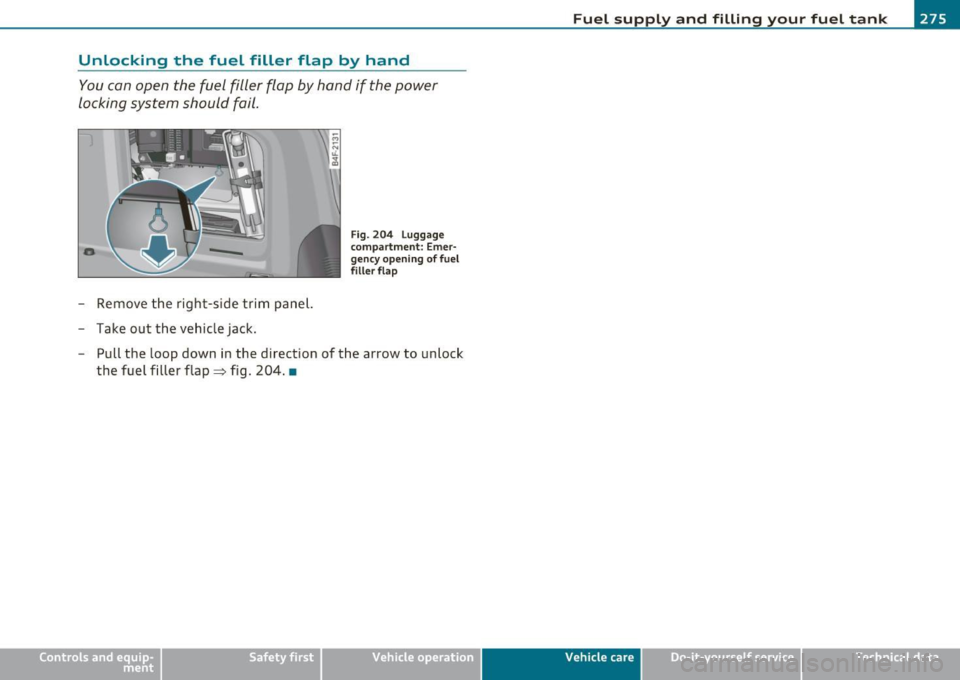
You can open the fuel filler flap by hand if the power
locking system should fail .
-Remove the right-side trim panel.
- Take out the vehicle jack.
Fi g. 20 4 L uggage
compar tment: Emer ·
gency open ing o f fue l
f iller flap
- Pull the loop down in the direction of the arrow to unlock
the fuel filler flap~ fig. 204. •
Vehicle OP-eration
Fu el supp ly and filling your fuel t ank
Vehicle care Do-it-yourselt service iTechnical data
Page 279 of 368

___________________________________________ C..:...._ h:....:e :....:c:..:. k.::..: i..:.. n .:..:g:!:....:: a....:. n..:.. d~ f:....:. i.:..ll :.:.i:....:n :.:g !....- _,n
Closing the engine hood
- Pull the hood down until the pressure from the struts is
reduced.
- Let the hood
drop down and latch in place. Do not try to
push it shut;
it may fail to engage=:> &.
& WARNING
A hood that is not completely latched could fly up and block your
view while driving.
• When you close the engine hood, check it to make sure the
safety catch has properly engaged. The hood should be flush with
the surrounding vehicle body parts.
• If you notice while driving that the hood is not secured prop
erly, stop at once and close it. •
Working in the engine compartment
Be especially careful whenever you work in the engine
compartment.
Whenever you must perform any work in the engine compartment,
for example checking and filling different fluids, there is a risk of injury, burns and accidents. To prevent personal injury always
observe the following WARNINGS. The engine compartment of any
vehicle is a hazardous area=>& .
& WARNING
To help avoid injury, before you check anything under the hood:
• Turn off the engine.
• Remove the ignition key.
• Apply the parking brake.
Safety first
& WARNING (continued)
• Move selector lever to "P" (Park).
• Always let the engine cool down. Hot components will burn
skin on contact.
• To reduce the risk of being burned, never open the hood if you
see or hear steam or coolant escaping from the engine compart
ment. Wait until no steam or coolant can be seen or heard before
carefully opening the hood.
• Keep children away from the engine compartment.
• Never spill fluids on hot engine components. They can cause a
fire. • Never touch the radiator fan. The auxiliary electric fan is
temperature controlled and can switch on suddenly.
• Never open the coolant reservoir cap when the engine is still
warm. The coolant system is pressurized and hot coolant could
spray out.
• Protect your face, hands and arm from steam or hot engine
coolant by placing a thick rag over the cap when you open the
coolant reservoir.
• If work on the fuel system or the electrical system is necessary:
- Always disconnect the battery.
- Never smoke or work near heaters or open flames. Fluids in
the engine compartment could start a fire.
- Keep an approved fire extinguisher immediately available.
• To avoid electrical shock and personal injury while the engine is
running or being started, never touch:
-Ignition cables
- Other components of the high voltage electronic ignition
system.
• If you must perform a check or repair with the engine running:
- First, fully apply the parking brake, move selector lever to
"P" (Park). .,
Vehicle care Technical data
Page 282 of 368
___ C_ h_e _c_ k_ i_ n _ g_ a_ n _ d_ f_il _l _in ____ g ___________________________________________ _
Changing the engine oil
The engine oil and oil fi lter must be changed according to the mileage
(kilometers) and t ime intervals specified in your vehicle 's Warranty
&
Maintenance booklet . Do not exceed these interva ls -harmful
deposits from o ld engine oil can reduce engine performance and can
lead to expensive engine repairs .
Changing the oil at the recommended intervals is so very impo rtant
because the lubricating properties of o il decrease gradually during
normal vehicle use. If you are not sure when you have your oil
changed, ask your author ized Audi Service Adv isor .
Under some circumstances the engine oil should even be changed
mo re frequently. Change oil more often if you drive mostly short
distances, operate the vehicle in dusty areas or mostly under stop
and-go traffic conditions, or when you use your vehicle where temper
atures stay be low freezing point for long periods.
Detergent addit ives in the oi l wi ll make fresh oil look dark after the
engine has been running for a short t ime. This is normal and is not a
reason to change the oil more often than recommended .
Damage or malfunctions due to lack of maintenance
It is essential that you change your oil at the recommended intervals
using only engine oi l that complies with Audi oil standard
VW 502 00. Your Limited New Vehicle War ranty does not cover
damage or malfunctions due to fai lure to follow recommended main
tenance and use requirements as set forth in the Audi Owner 's
Manual and Warranty
& Maintenance booklet. Your dealer will have
to deny warranty coverage unless you present to the dealer proof in
the form of Serv ice or Repair Orders that all scheduled maintenance
was performed in a time ly manner. •
Engine oil consumption
The engine in your vehicle depends on an adequate
amount of oil to lubricate and cool all of its moving parts.
In order to provide effective lubrication and cooling of internal
eng ine components, all inte rnal combustion engines consume a
certain amount of oil. Oil consumption varies from engine to engine
and may change sign ifican tly over the lif e of the engine. Typically,
engines with a specified break- in period (see~
page 249) consume
more oil during the break-in period than they consume after oil
consumption has stab ilized .
Under normal conditions, the rate of oil consumption depends on the
quality and viscosity of the oil, the RPM (revolutions per minute) at
which the engine is operated, the ambient temperature and road
conditions. Further factors are the amount of oil dilution from water
condensation or fuel residue and the ox idation level of the oil. As any
eng ine is subject to wear as mileage builds up, the oil consumption
may increase over time until replacement of worn components may
become necessary.
With all these variab les coming into play, no standard rate of oil
consumption can be established or specified . There is no alternative
to regular and frequent checking of the oil level , see
Note .
If the yellow engine oil leve l warning symbol in the instrument
cl uster lights up, you should chec k the oil level as soon as possible
with the oil dipstick~ page 281. Top off the oil at your earliest
convenience ~
page 282.
& WARNING
Before you check anything in the engine compartment, always
read and heed all WARNINGS~
& in "Working in the engine
compartment" on
page 277.
Page 283 of 368
_____________________________________________ C_h _ e_ c_ k_in --= g'-- a_n _d_ f_i _ll _i_n -=g ::;__ ____.1111
0 Note
Driv ing with an insufficient oil level is likely to cause severe damage
to the engine .
[ i ] Tips
• The oil pressure warning display~ is not an indicator of the oil
level. Do not rely on it. Instead , check the oil level in your engine at
regular intervals, preferably each time you refuel, and always
before going on a long trip .
• If you have the impression your engine consumes excessive
amounts of oil, we recommend that you consult your Audi dealer to
have the cause of you r concern properly diagnosed. Keep in mind that
the accurate measurement of oil consumpt ion requires great care
and may take some time . Your Audi dealer has instructions about how
to measure oil consumption accurately .•
Checking the engine oil level
Fig. 208 Ill ustra tion
o f principle 1: Markers
on oil dipstick
Vehicle OP-eration
Fig. 209 Illustrat ion
of prin ciple 2: Markers
on oil dipst ic k
Before you check anything in the engine compartment,
always read and heed all WARNINGS => & in "Working in
the engine compartment" on
page 2 77.
Determining oil level
-Park your vehicle so that it is horizontally level.
- While at operating state temperature, briefly let the
engine run at idle and then shut it off.
- Wait approx. two minutes.
Pull out the oil dipstick. Wipe off the oil dipstick with a
clean cloth, and slide it back in as far as it will go .
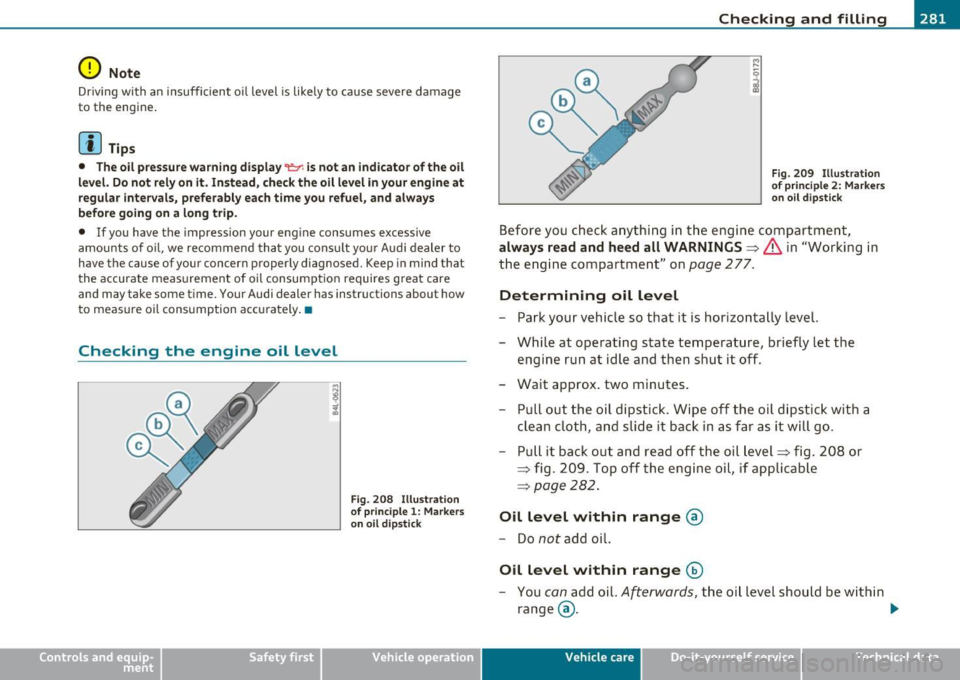
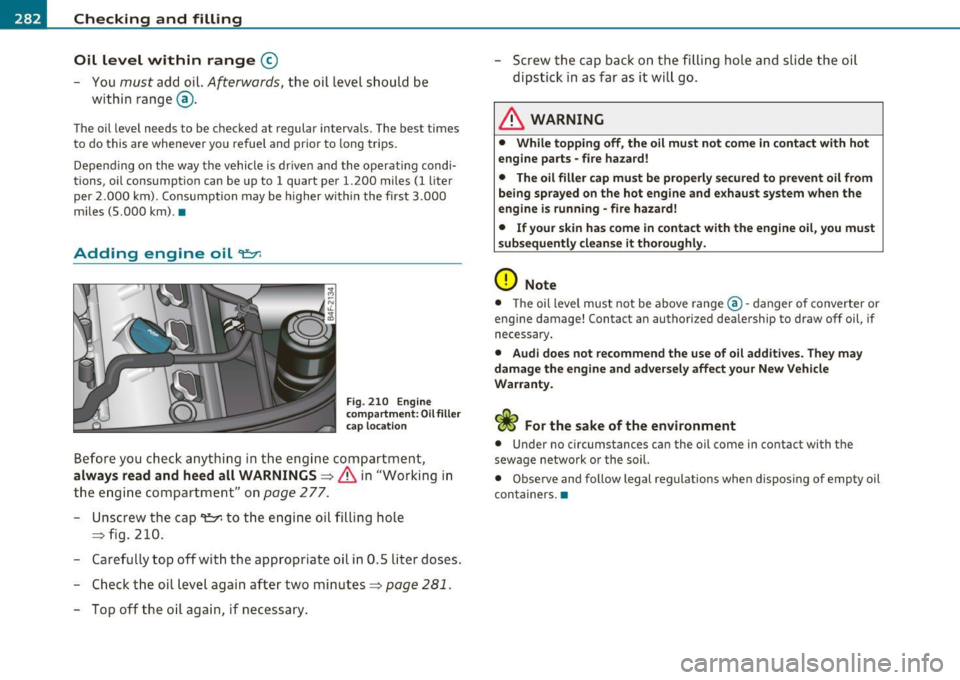
- Pull it back out and read off the oil level ::::> fig. 208 or
~ fig. 209. Top off the engine oil, if applicable
~ page 282 .
Oil Level within range @
-Do not add oil.
Oil Level within range ®
-You can add oil. Afterwards, the oil level should be within
range @. _,,,
Vehicle care Do-it-yourselt service iTechnical data
Page 284 of 368
___ C_h_ e_c_ k_i_n -=g :a,__ a_n_ d_ f_ i_ l _li _n _,g;._ __________________________________________ _
Oil level within range
©
- You must add oil. Afterwards, the oil level should be
within range@.
The oil level needs to be checked at regular intervals. The best times
to do this are whenever you refuel and prior to long trips.
Depending on the way the vehicle is driven and the operating condi
tions, oil consumption can be up to 1 quart per 1.200 miles
(l liter
per 2.000 km). Consumption may be higher within the first 3.000
miles (5.000 km) .•
Adding engine oil 9=::11
Fig . 210 Engine
compa rtment: Oil filler
cap locatio n
Before you check anything in the engine compartment,
always read and heed all WARNINGS =>
& in "Working in
the engine compartment" on
page 277.
- Unscrew the cap
210 .
-Carefully top off with the appropriate oil in 0.5 liter doses.
- Check the oil level again after two minutes=>
page 281.
-Top off the oil again, if necessary . -
Screw the cap back on the filling hole and slide the oil
dipstick in as far as it will go.
& WARNING
• While topping off, the oil must not come in contact with hot
engine parts -fire hazard!
• The oil filler cap must be properly secured to prevent oil from
being sprayed on the hot engine and ex haust system when the
engine is running -fire hazard!
• If your skin has come in contact with the engine oil, you must
subsequently cleanse it thoroughly.
0 Note
• The oil level must not be above range@- danger of converter or
engine damage! Contact an authorized dealership to draw off oil, if
necessary .
• Audi does not recommend the use of oil additives. They may
damage the engine and adversely affect your New Vehicle
Warranty.
sewage network o r the soil.
• Observe and follow legal regulations when disposing of empty oil
containers. •
Page 312 of 368

llft!l,.___T_ ir_e_ s _ a_ n _ d_ w_ h_e_ e_ ls _______________________________________________ _
Winter tires lose their effectiveness when the tread is worn down to
a d epth o f 0. 157 inch ( 4 mm).
Only drive w it h w inte r tir es under w inte r co nd it io ns. S u mmer t ires
hand le better w hen there is no s now or ice on t he roads a nd the
t em pe ra ture i s above 4 5
°F (7 ° ( ).
If you have a flat tire, see notes on spare wheel~ page 305.
Please always remember that winter tires may have a lower speed
rating than t he t ires or iginally installed on yo ur ve hicle at the time it
was ma nufact ured . Please see~
page 307, "Speed rat ing ( letter
c ode)" fo r a listing of the speed rating le tte r codes a nd t he maximu m
speed at which the tires can be dr ive n.
Th e spee d rat ing le tt er code( ~
page 296) i s on the side w all of the
t ire~
page 305 .
& WARNING
Winter tires have maximum speed limits that may be lower than
your vehicle's maximum speed. Always know the maximum speed
before driving off. Never drive faster than the speed permitted for
your specific winter tires . This will cause damage to the tire s
leading to an accident and serious personal injury to you and your
passengers.
& WARNING
Driving faster than the maximum speed for which the winter tires
on your vehicle were des igned can cause ti re failure includ ing a
blowout and sudden deflation, lo ss of control, crashes and serious
personal injuries . Have worn or damaged tires replaced immedi
ately.
• Winter t ires have maximum speed rat ing that may be lower
than your vehicle's maximum speed .
• Never drive faster than the speed for which the winter or other
tires installed on your vehicle are rated.
& WARNING
Always adjust your driving to the road and traffic conditions.
Never let the good acceleration of the winter tires and all-wheel
drive tempt you into taking extra risks. Always remember :
• When braking , an all-wheel drive vehicle handles in the same
way as a front drive vehicle .
• Drive carefully and reduce your speed on icy and slippery roads,
even winter tires cannot help under black ice conditions.
do not wear as quickly and reduce fuel consum ption .•
Snow chains
Snow chains may be fit te d on ly to the fr ont w heels, and only to
certain t ire sizes . Ask yo ur aut horized Audi dealer on which tire sizes
snow chains can be used .
If you are go ing to use snow c ha ins, then you must insta ll th em on t he
front wheels at least .
Th e sn ow chain s mus t have low-pr ofile li nks and m ust no t be th icker
than 0 .53 inc h (13.5 mm), including the lock.
R emove wheel cente r covers an d trim discs before putti ng snow
chains on your vehicle~
0. For safety reaso ns cove r caps m ust the n
be fitted over the whee l bo lts. These are availab le from a utho rized
Audi dealers.
& WARNING
Using the wrong snow chains for your veh icle or installing them
incorrectly can increase the risk of loss of control leading to
serious personal injury .
~
Page 330 of 368
.,.,___F_ u_ s_e _ s_ a_n_ d_ b_u _ l_ b_ s _______________________________________________ _
No. Equipment Amps
9 Heated seats, front 30
10 MMI
7,5
11 Seat adjustment (passenger) 10
12 Communication 5
Fuse holder (brown)
1 Electric fuel pump 20/30
2 Adaptive Air Suspension
15
3 Lane assist 10
4 Audi side assist
5
5 Adaptive Air Suspension 5
6 Shift gate automatic transmission/clutch switch 5
7 Parking System 5
8 Control module Gateway 5
9
Automatic headlight range control (auxiliary 5
driving lights), headlight electronics, right-side
10 Airbag 5
11 Heated rear seats 5
12 Telephone
5 •
Fuse Location, Luggage Compartment
right
Fig. 237 Fuse panel
layout
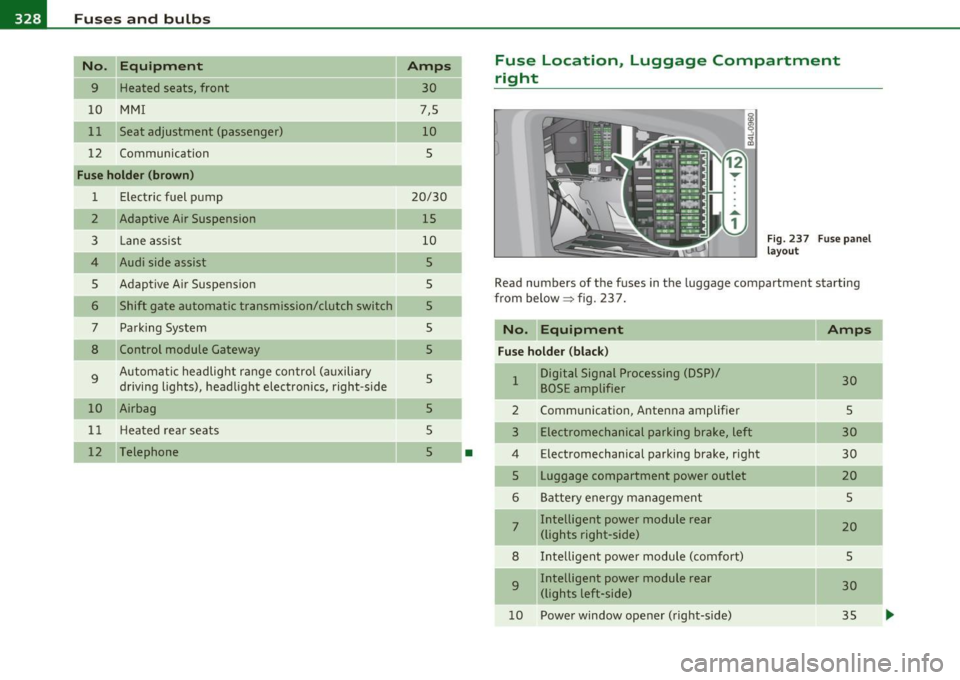
Read numbers of the fuses in the luggage compartment starting
from below :::::> fig. 23 7.
No. Equipment
Amps
Fuse holder (black)
1 Digital Signal Processing (DSP)/ 30 BOSE amplifier
2 Communication, Antenna amplifier 5
3 Electromechanical parking brake, left 30
4 Electromechanical parking brake, right
30
5 Luggage compartment power outlet
20
6 Battery energy management 5
7 Intelligent power module rear
20 (lights right-side)
8 Intelligent power module (comfort)
5
9 Intelligent power module rear
30
(lights left-side)
10 Power window opener (right-side)
35
-
-
-
...
Page 344 of 368
___ D_ a_t _a _____________________________________________________ _
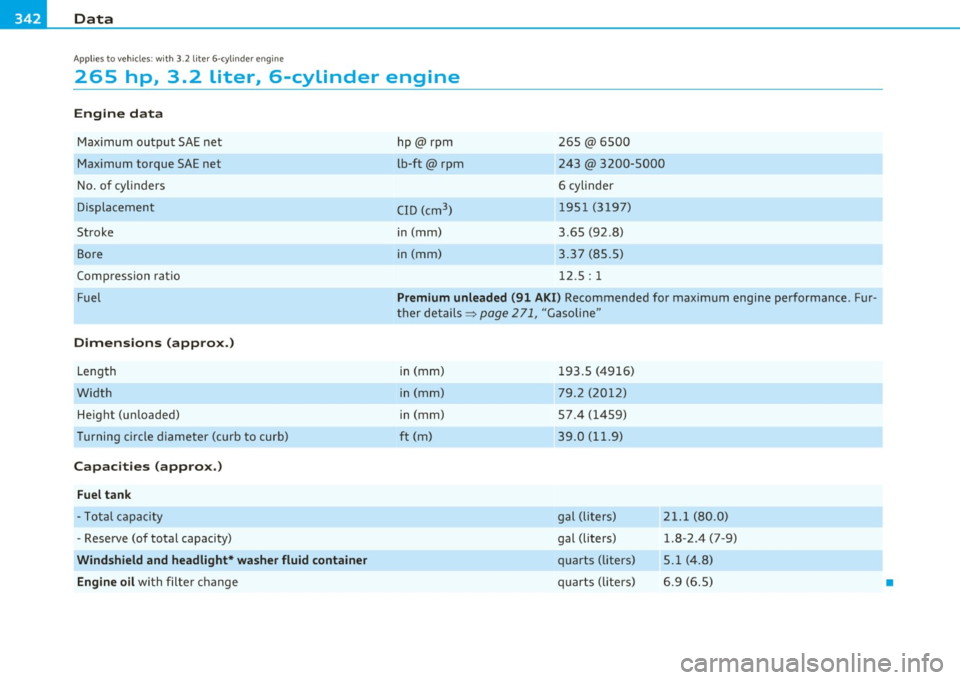
Applies to vehicles : w ith 3.2 lite r 6 -cylin der engine
265 hp, 3.2 Liter, 6-cylinder engine
Engine dat a
Max imum output SAE net
Max imum torque SAE net
No . of cylinders
Displacement
Stroke
Bore
Comp ression ratio
F uel
Dimen sions (appro x.)
Length
Width Height (unloaded)
Turn ing circle diameter (curb to curb)
Capacities (appro x.)
Fuel t ank
- Total capac ity
- Reserve (of total capacity)
Wind shield and headlight* was her flu id c ontainer
Engin e oil
with filter change hp@rpm
lb-
ft@ rpm
CID (cm
3 )
in (mm)
in (mm) 265 @6500
243 @ 3200-5000
6 cylinder
195 1 (3 197)
3 .65 (92 .8)
3 .37 (85.5)
12 .5: 1
Premium un leaded (91 A KI) Recommended fo r maximum engine performance . Fur
ther details =>
page 271, "Gasoline"
in (mm)
in (mm)
in (mm)
ft (m) 193.5 (4916)
79.2 (2012)
57.4 (1459)
39 .0 (11.9)
gal (liters)
gal (liters)
quarts (lite rs)
quarts ( liters) 21.1 (80
.0)
1. 8-2 .4 (7 -9)
5.1 (4 .8)
6.9 (6.5)
•