ground clearance AUDI S6 2010 Owners Manual
[x] Cancel search | Manufacturer: AUDI, Model Year: 2010, Model line: S6, Model: AUDI S6 2010Pages: 368, PDF Size: 86.82 MB
Page 18 of 368
Instruments and warning/indicator lights
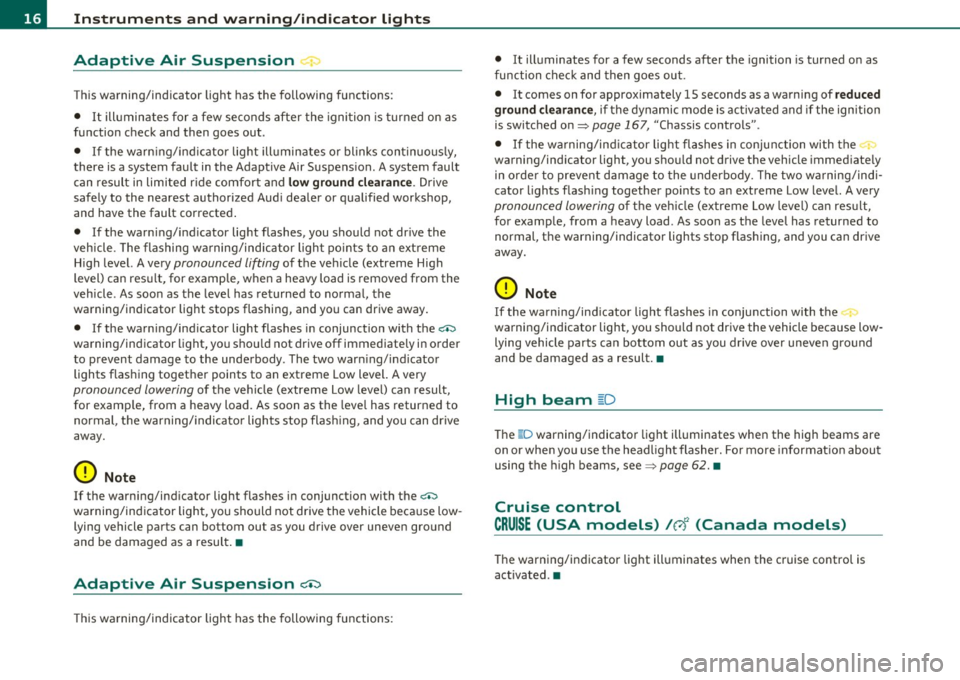
Adaptive Air Suspension
~
This warning/indicator light has the following functions :
• It illuminates for a few seconds after the ignition is turned on as
function check and then goes out .
• If the warn ing/ind icator light illuminates or blinks continuously,
there is a system fault in the Adaptive Air Suspension . A system fault
can result in limited r ide comfort and
low ground clearance. Drive
safely to the nearest authorized Audi dealer or qualified workshop,
and have the fault corrected .
• If the warning/indicator light flashes, you should not drive the
vehicle . The flashing warning/indicator light points to an extreme
High level. A very
pronounced lifting of the vehicle (extreme High
level) can resu lt, for example, when a heavy load is removed from the
vehicle . As soon as the level has returned to normal, the
warning/indicator light stops flashing, and you can drive away.
• If the warning/ind icator light flashes in conjunction with the
a,
warning/ indicator light, you shou ld not drive off immediately in order
to prevent damage to the underbody . The two warn ing/indicator
lights flashing together points to an extreme Low level. A
very
pronounced lowering of the vehicle (extreme Low level) can result,
for examp le, from a heavy load. As soon as the leve l has returned to
normal , the warning/ indicator lights stop flash ing, and you can drive
away.
0 Note
If the warning/indicator light flashes in conjunction with the a,
warning/indicator light, you should not drive the vehicle because low
lying vehicle parts can bottom ou t as you drive over uneven ground
and be damaged as a result.•
Adaptive Air Suspension c.:)
This wa rning/indicator light has the following functions: •
It illuminates for a few seconds after the ignition is turned on as
function check and then goes out.
• It comes on for approximately 15 seconds as a warning of
reduced
ground clearance,
if the dynamic mode is activated and if the ignition
is switched on =>
page 167, "Chassis controls" .
• If the warning/indicator light flashes in conjunction with the
warning/indicator light, you shou ld not drive the vehicle immediately
in orde r to prevent damage to the underbody. The two wa rning/indi
cator lights flashing together points to an extreme Low level. A very
pronounced lowering of the veh icle (extreme Low leve l) can result,
for example, from a heavy load . As soon as the level has returned to
normal, the warning/indicator lights stop flashing, and you can drive
away.
0 Note
If the wa rning/ind icator light flashes in conjunction with the
warning/indicator light, you should not drive the vehicle because low
lying vehicle parts can bottom out as you drive over uneven ground
and be damaged as a result. •
High beam ~D
The ~D warning/indicator light illuminates when the high beams are
on or whe n you use the headlight flasher. For more information about
using the high beams, see=>
page 62. •
Cruise control
CRUISE (USA models) /(lJ1 (Canada models)
The warning/indicator light illuminates when the cruise control is
activated .•
Page 135 of 368

Adaptive Cruise Control IJI ____________ ___,__ __ ____.
Vehicles moving up ahead but offset in the lane cannot be detected
by ACC until they are in sensor range.•
Appli es to vehi cles : wit h Adap tive Cru ise Cont rol
Lane changes by other vehicles
Fig. 122 A vehicle
changes lanes
Vehicles that cut into your lane a short distance in front of you cannot
be detected by ACC until they are in sensor range. •
Appli es to vehi cles : wit h Adap tive Cru ise Cont rol
Vehicles that are difficult to detect
Con tro ls a nd e quip
m en t
Fig.123 Two-wheeled
vehicle driving ahead
Vehicle OP-eration
Some vehicles moving up ahead in your lane of travel are difficult to
detect, for example two-wheeled vehicles, vehicles with high ground
clearance, loads sticking out the back . Vehicles like this are often
detected late or in some situations not at all. •
App lies to ve hicle s: w ith Ad aptive Crui se Contro l
Stationary vehicles
Fig. 124 Turning and
stationary vehicle
Fig. 125 Sheering out
and stationary vehicle
If a vehicle that has been detected by ACC exits the highway or sheers
out into the neighboring travel lane, and there is a stationary vehicle
ahead of that vehicle, ACC will not detect or react to that stationary
vehicle~ fig. 124 and~ fig. 125 . •
Vehicle care Do-it-yourselt service iTechnical data
Page 168 of 368
lffll.___A_ d_ a_,_ p_t _i_ v _e _ A_i_ r_ S_ u_ s ... p,_ e_n_ s_ io_ n __________________________________________ _
Adaptive Air Suspension
Adaptive Air Suspension and
Damping
Ap plies to veh icles: w ith Ad aptive Ai r Suspens ion
Description
Adaptive Air Suspension and damping can be regula ted
and they adapt automatically to a request from the
driver and the driving situation at the time .
Adaptive Air Suspension is an e lectron ically controlled springing and
damping system . This chass is system makes it eas ie r on the driver by
adapting to the particular situation th rough impe rceptible contro l
processes .
The
Adaptive Air Suspension component regu lates ground clearance
depending on ve hicl e speed, load cond ition and driver input .
W hen the system is in a utomatic mode, accelerat ing to a speed above
a predete rm ined limit will make the vehicle lower itsel f. On t he othe r
hand, driv ing more slowly res ults in the vehicle ra is ing again at
specific speeds.
Th e
damping component provides individua l control of the damping
forces. For example, with damp ing characterist ics set to provide
greater com fort, damp ing is se t somewhat harder for a br ief period
only as required, for example, whe n going around a curve or over
rough road sur faces as we ll as when braking .
Settings
Adaptive Air Suspension prov ides the drive r wi th t he opportu nity to
set the chass is characterist ics also to their individual preference.
W ith the driving modes
Comfort, Automatic an d Dynamic the dr ive r
has three chassis sett ings available, ranging from comfort to sporty.
In addit ion,
Lift p rovides a fourth mode which can be selecting fo r
dr iving over poor stretches of road =>
page 167, "Chass is controls" . The modes are set
in MM I =>
page 167.
& WARNING
The height of the parked vehicle can change due to temperature
fluctuation s or changes in load .
0 Note
• Whenever you park yo ur vehicle, always make sure there is
adeq uate clearance above and below the ve hicle . T he heig ht of the
parked vehicle can change as the res ult of temperature fluctuations,
changes in load condition and changes in the dr iv ing mode (ground
clearance).
• If the veh icle is be ing transported (e .g. by tow truck, train, ship,
etc.) , mount the tie-down cha ins/cables over the r unning s urface
(c ircumfere nce) of the tir es. Never sec ure the ve hicle by the ax le, the
suspension struts or the front or rea r tow line eye. For technical
reaso ns, the p ressure in t he suspension st ru ts m ay change dur ing the
transport, w hic h could result in the vehicle no longer being secured
pro perly .
• To prevent damage to the vehicle underbody, remember that your
veh icle is no t an off-roa d veh icle, even in the "lift" mo de. Th e ground
clearance is insufficient for this type of operation.
• If you are go ing to tow a trai ler, you mus t activate the trai ler ope r
ation mode =>
page 168.
[ i ] Tips
Before you raising your vehicle us ing the veh icle jack (for example,
w hen c hanging a flat tire) you must acti va te the j ack ing mode
=>page 168 . •
Page 169 of 368
__________________________________________ A _d_ a __,_ p_t_ i_v _e _ A_i_ r _ S_ u_s __,_p _ e_ n_s _ i_ o _n _ __.fflll
A pplie s to veh icles : with Ad aptive Air Su spen sion
Chassis controls
Four different driving modes can be set by the driver.
The automatic control processes are speed- and time-dependent. For
example, it is not possible to raise the suspension to the lift mode
above certain speeds.
Level adjustment
Automatic
Comfort
Dynam ic
Lift
Automatic Ground clearance
about 4
. 7 -4.1 inches
(120 -105 mm)
about 4. 7 inches (120 mm)
about 4.1 inches (105 mm)
about 5.3 inches (135 mm)
Select the automatic mode if you prefer suspens ion and damping
sett ings emphasizing comfort .
• Lowering : When a speed of about 75 mph (120 km/h) is exceeded
for more than 30 seconds, the vehicle is automatically lowered by
about 0 .6 inch (15 mm) to the dynamic level which is more suitable
for highway speeds. Road holding is optimized as a result of the lower
center of gravity and fuel consumption is reduced as a result of
reduced wind resistance.
• Raising: The vehicle is automatically raised again if the speed falls
below about 44 mph (70 km/h) for a period of 2 minutes. The veh icle
is raised immediately when speed falls below about 22 mph (35
km/h).
Comfort
Select the comfort mode if you desire a suspension setting with a
special emphasis on comfort. In the standard mode there is
no
lowering of the suspension. Even at high speeds, the vehicle stays at
the same level. Damping characteristics with a decided emphasis on
comfort are se lected in this mode .
Contro ls a nd e quip
m en t Vehicle
OP-eration
Dynamic
Select the dynamic mode if you prefer a sporty suspension setting . In
this mode, the vehicle is lowered while it is st ill stationary and sporty
damping characteristics are se lected. The wa rning light
cw in the
instrument cluster will come on for a few seconds just to remind you
of the reduced ground clearance.
If you switch off the engine wh ile the vehicle is in the dynamic mode
and then switch on the ignition once again, the
cw warning light will
also come on again for a few seconds as a reminder.
Lift
Select the lift mode when you have to travel over poor sections of
road (e.g. trails) . In the lift mode, the vehicle is raised by 0.6 inch (15
mm) compared to normal level w hile it is still stationary and damping
characteristics are adjusted to emphasize comfort.
Th e lift mode can be activated only at speeds below 50 mph (80
km/h) . When a speed of about 62 mph (100 km/h) is exceeded, the
system automatically leaves lift mode and the mode set previously
(standard, automatic, dynamic) is activated again.•
App lies to veh icles: w ith Adaptive Air Suspens ion
Setting the driving modes
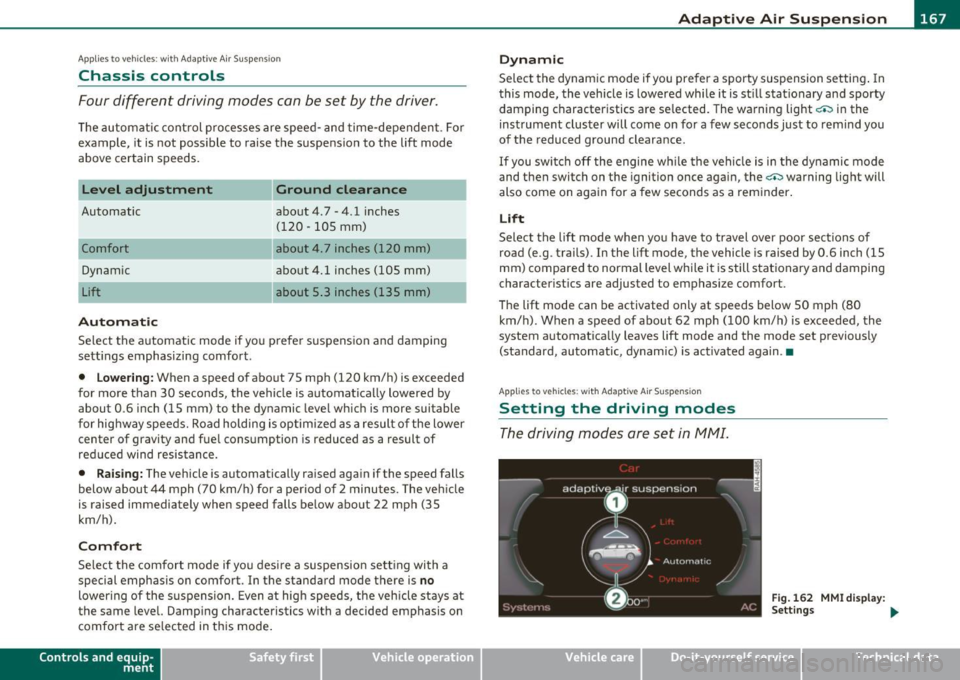
The driving modes are set in fv1fv1I.
Fig. 162 MMI display :
Settings ...
Vehicle care Do-it-yourselt service iTechnical data
Page 248 of 368

Intelligent technologyL ______________________________________ _
steering support force that is no longer proportionate to the vehicle
speed. This is most noticeable when turning the steering wheel at low
speeds (for example when parking), - more effort will be required
than usual.
• Be aware of the different than usual steering response and adjust
your steering force accordingly.
• Have the prob lem checked and set right by an Audi dealer as soon
as possible.
[ i ] Tips
• When the engine is running, never hold the steering wheel turned
all the way to the right or to the left for longer than 15 seconds . The
power steering pump will overheat the hydraul ic fluid if you keep
holding the steering wheel turned all the way . This is likely to damage
the power steering system.
• If the power steering system should fail entirely, or if the engine
is not running (for examp le, while be ing towed), you will still be able
to steer the vehicle. However,
considerably more effort will be
required to do so.
• If the power steering system should have a leak, or is not func
tioning properly, contact your authorized Audi dealer immediately.
• The power steering system requires a specially formulated
hydra ulic fluid. The power steering reservoir is the one located most
forward on the left side of the engine compartment=>
page 2 78 . The
correct fluid level in the reservoir is important for proper functioning
of the power steering . •
A pp lies to veh icles: with All W heel Dr ive
Driving with your quattro®
With All Wheel Drive, all four wheels are driven.
General information
With All Wheel Drive, power is distributed to all four wheels . This
happens automatically depending on your driving style and the road
conditions at the time . See also=:>
page 241, "Electronic different ial
lock ( EDL)".
Winter tires
When driving in the winter, your vehicle with A ll Wheel Drive has an
advantage , even w ith regular t ires . In winter road condit ions it may
be advisable to mount winter tires (or all-season tires) fo r improved
dr iveability and braking: these tires must be mounted on
all four
wheels.
See also =:> page 309, "Winter tires".
Tire chains
Where tire chains are mandatory on certain roads, this normally also
applies to vehicles with A ll Whee l Drive=:>
page 310, "Snow chains".
Replacing wheels/tires
Vehicles with All Wheel Drive must always have tires of the same size .
Also avoid tires with different tread depths . For details see page
=:>
page 305, "New tires and replacing tires and wheels ".
Off-Road driving?
Your Audi does not have enough ground clearance to be used as an
off-road vehicle . It is therefore best to avoid rough tracks and uneven
terrain as much as possible. Also refer to=>
page 250.
& WARNING
Always adjust your driving to road and traffic conditions. Do not
let the extra safety afforded by All Wheel Drive tempt you into
taking extra risks.
9),