radiator cap AUDI S6 2010 Owners Manual
[x] Cancel search | Manufacturer: AUDI, Model Year: 2010, Model line: S6, Model: AUDI S6 2010Pages: 368, PDF Size: 86.82 MB
Page 29 of 368

& WARNING
• Always observe the warnings in~ page 269 , "Engine compart
ment ", before opening the hood and che cking the brake fluid.
• Driving w ith low brake fluid is a safety haza rd. Stop the car and
get profe ssional a ssistan ce.
• USA models : If the BRAKE warning light and the warning
light come on tog ether, the rear wheel s could lock up fir st under
hard b raking. Rear wheel lock -up can cause loss of vehicle cont rol
and an a ccident . Have your vehicle repaired immediately by your
authorized Audi dealer or a qualified workshop. Drive slowly and
avoid sudden, hard brake application s.
• Canada models : If the brake warning light((])) and the ABS
warning light come on together , the rear wheel s could lock up
first under hard braking. Rear wheel lock-up can cause loss of
vehicle control and an accident. Have your vehicle repaired imme diately by your authorized Audi dealer or a qualified workshop.
Drive slowly and avoid sudden , hard brake applications. •
Engine cooling system malfunction _t_
A malfunction in the engin e cooling system must be
repaired as soon as possible.
When t he J_ symbol in the disp lay blinks , th en e ither the
engine coola nt
temperature is too high, or t he coolan t level
is too low. A n add itiona l dr iver messa ge ca n also be d isp layed
by pressing t he
[CHECK) bu tton :
Switch off engine and check coolant level
-Pull off the road.
- Sto p the v ehicl e.
- Turn off the eng ine.
Controls and equip
ment Safety first Driver information display
-
Check coolant level => page 284 .
- Add coola nt if necessa ry=> page 285.
- Continue driv ing on ly after the eng ine coolant
war ning/i ndica tor light goes ou t.
- Contact your authorized Audi dea ler for assistance if
necessary.
If the eng ine coolan t leve l is correct, then the radiator fan may be the
cause of the malfu nction.
If the
D wa rning symbol (alternator ma lfunction) also lights up on
t he ins trumen t pa ne l~
page 2 6, the n th e fan b elt may be d amaged.
& WARNING
• If your vehicle should break down for mechanical or other
reasons, park at a safe distance from moving t raffic , turn off the
engine and turn on the hazard warning lights~
page 61, "Emer
gency fl asher
A ".
• Never open the hood if you see or hear steam or coolant
escaping from the engine compartment -you risk being scalded.
Wait until you can no longer see or hear steam or coolant escaping .
• The engine compartment of any vehicle is a dangerous area. Before you perform any wo rk in the engine compartment, turn of
the engine and allow it to cool. Follow the warning stickers
~ page 269, "Engine compartment" .
0 Note
Do not continue driving if the -F-symbol illum inates. There is a
m alfu nct ion in the engine cooling system -yo u co uld da mage yo ur
engine. •
Vehicle care Technical data
Page 279 of 368

___________________________________________ C..:...._ h:....:e :....:c:..:. k.::..: i..:.. n .:..:g:!:....:: a....:. n..:.. d~ f:....:. i.:..ll :.:.i:....:n :.:g !....- _,n
Closing the engine hood
- Pull the hood down until the pressure from the struts is
reduced.
- Let the hood
drop down and latch in place. Do not try to
push it shut;
it may fail to engage=:> &.
& WARNING
A hood that is not completely latched could fly up and block your
view while driving.
• When you close the engine hood, check it to make sure the
safety catch has properly engaged. The hood should be flush with
the surrounding vehicle body parts.
• If you notice while driving that the hood is not secured prop
erly, stop at once and close it. •
Working in the engine compartment
Be especially careful whenever you work in the engine
compartment.
Whenever you must perform any work in the engine compartment,
for example checking and filling different fluids, there is a risk of injury, burns and accidents. To prevent personal injury always
observe the following WARNINGS. The engine compartment of any
vehicle is a hazardous area=>& .
& WARNING
To help avoid injury, before you check anything under the hood:
• Turn off the engine.
• Remove the ignition key.
• Apply the parking brake.
Safety first
& WARNING (continued)
• Move selector lever to "P" (Park).
• Always let the engine cool down. Hot components will burn
skin on contact.
• To reduce the risk of being burned, never open the hood if you
see or hear steam or coolant escaping from the engine compart
ment. Wait until no steam or coolant can be seen or heard before
carefully opening the hood.
• Keep children away from the engine compartment.
• Never spill fluids on hot engine components. They can cause a
fire. • Never touch the radiator fan. The auxiliary electric fan is
temperature controlled and can switch on suddenly.
• Never open the coolant reservoir cap when the engine is still
warm. The coolant system is pressurized and hot coolant could
spray out.
• Protect your face, hands and arm from steam or hot engine
coolant by placing a thick rag over the cap when you open the
coolant reservoir.
• If work on the fuel system or the electrical system is necessary:
- Always disconnect the battery.
- Never smoke or work near heaters or open flames. Fluids in
the engine compartment could start a fire.
- Keep an approved fire extinguisher immediately available.
• To avoid electrical shock and personal injury while the engine is
running or being started, never touch:
-Ignition cables
- Other components of the high voltage electronic ignition
system.
• If you must perform a check or repair with the engine running:
- First, fully apply the parking brake, move selector lever to
"P" (Park). .,
Vehicle care Technical data
Page 280 of 368
ffl __ C_h_ e_c _k _i_n -=g :a,__ a_n_ d_ f_ i_ l _li _n _,g;._ __________________________________________ _
& WARNING (continued )
-Always use extreme caution to prevent clothing, jewelry, or
long hair from getting caught in the radiator fan, V-belts or
other moving parts, or from contacting hot parts. Tie back hair
before starting, and do not wear clothing that will hang or
droop into the engine.
• Minimize exposure to emission and chemical hazards=:>
/1::..
& WARNING
California Proposition 65 Warning:
• Engine exhaust, some of its constituents, and certain vehicle
components contain or emit chemicals known to the State of Cali
fornia to cause cancer and birth defects and reproductive harm. In addition, certain fluids contained in vehicles and certain products
of component wear contain or emit chemicals known to the State
of California to cause cancer and birth defects or other reproduc
tive harm.
• Battery posts, terminals and related accessories contain lead
and lead compounds, chemicals known to the State of California
to cause cancer and reproductive harms. Wash hands after
handling.
0 Note
W hen a dding fluids, a lways make sure that t hey are poured into the
pro per conta in er or filler op ening, oth erwise serious damag e to
vehicle systems w ill occur.
ci> For the sake of the environment
To detect lea ks i n time, ins pect t he vehicle floor pan from un derneath
re gu lar ly. If yo u s ee spots from oil or o ther vehicle f luids, have your
vehicle inspected by an authorized Aud i dea ler. •
Engine compartment
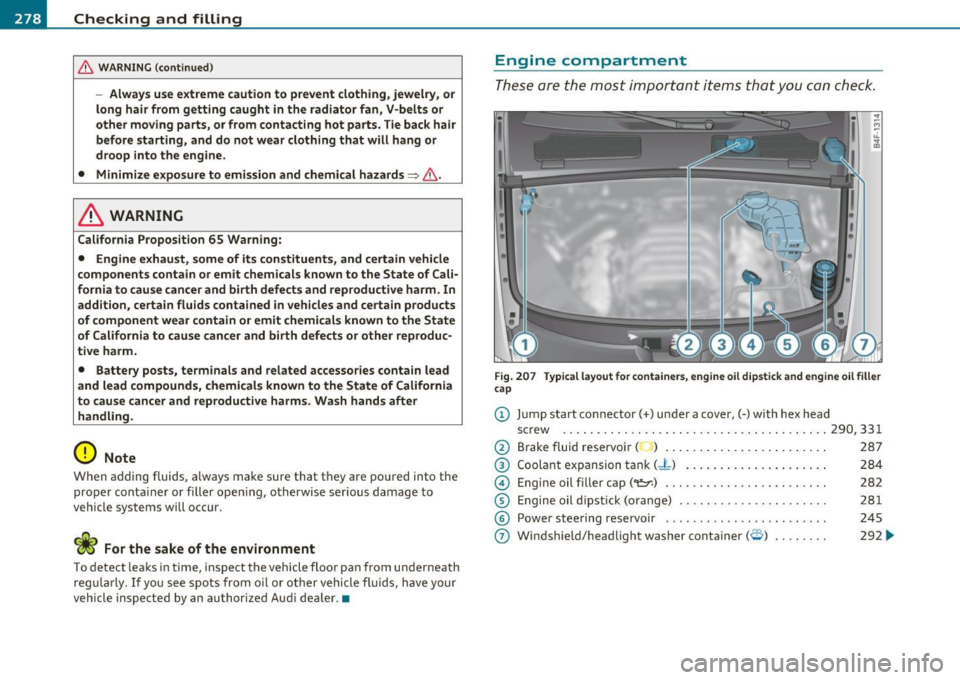
These are th e most importa nt it ems that you can ch eck .
Fig. 207 Typic al layout for container s, engine oil dip st ic k an d eng ine o il fill er
cap
©
@
®
©
®
J u mp start co nnector( +) u nder a cover,(-) w ith hex head
screw . .... . .. .... .. .. .. . ...... ......... . .. .. 290, 331
B rake fluid reservoi r ( ) . . . . . . . . . . . . . . . . . . . . . . . . 287
C oolant expa nsion tank
(J -) . . . . . . . . . . . . . . . . . . . . . 284
E ngin e oil fi ller cap
('1::r. ) . .... ....... ...... .... . .
Engine oil dipstick (o range) .................. ... .
© Power steering reservoir .................... ... . 282
2 8 1
2 4 5
292 _,.
(j) Winds hiel d/head light washer conta iner ( O ) ....... .
Page 287 of 368

_____________________________________________ C_h_ e_ c_k _in --= g=--- a_n_ d_ f_ i_ll _i_n __.g=-- -•
Before you c hec k anythi ng in the engine compartment,
alwa ys r ead and heed all WARNINGS==> & in "Working in
the engine compartment" on
page 277.
- Turn off the ignition.
- Read the engine coolant level from the coolant expansion
tank==>
page 284, fig. 211. With a cold engine, the
coolant level should be between the "min" and "max"
markings . When the engine is wa rm, the level may be
sligh tly above the "max" marking .
The locat io n of the coolant expansion tank can be seen in the engine
compartment ill ustration ~
page 278.
To obta in an accurate reading, the engine must be sw itched off.
The expans ion tank in your vehicle is equ ipped with an electric coolant
level sensor .
When the coolan t level
is too low, the warn ing light in t he Au to-Che ck
System ~
page 2 7 will blink until you add coo lant and the level has
bee n restored to normal. Even though the re is an elect ric coolan t
level sensor, we still recommend you check the coolant leve l from
time to time .
Coolant loss
Coolant loss may ind icate a leak in the cooling system. I n the event of
coo lant loss, the cooling system should be inspected immed iately by
yo ur au tho rized A ud i dea le r.
It is not enough mere ly to add coolant.
In a
s e a le d system, losses can occur only if the bo iling point of the
coo lant is exceeded as a resu lt of overheating .
0 Note
Do not add any type of radiator leak sealant to your vehicle's engine
coo lant. Add ing radiator repa ir fluid may adverse ly affect the func
tion and performance of your cooling system and could result in
damage not covered by your New Vehicle Limited Warra nty. •
Safety first
Adding coolant
Be very careful when adding engine coolant.
B efore you check a nything in t he engine compartment,
always read and heed all WARNINGS==> & in "Working in
the engine compartment" on
page 2 77.
- Turn off the engine.
- Let the engine cool down .
- Place a th ick rag over the coolant expansion tank
==>
page 284 , fig. 211 and carefully twist t he cap counter
clockw ise ==>& .
- Add coolant .
- Twist the cap on again
tightly .
Replacement eng ine coolant must conform to exact spec ifications
~ page 284, "Coolant". Even in an emergency, if coolant additive
G 12++, G12+ or G12 is not available, do
not use a different addi tive .
Use plain water instead until you can get the correct additive and can
restore the correc t ratio. This should be done as soon as possible.
If you have lost a considerable amount of coolant, then you should
add co ld antifreeze and cold water only when the eng ine is co ld .
Always use
new engine coo lant w hen refilling.
Do not fill coolant above the "MAX" mark. Excess coolant will be
forced ou t th rough the p ress ure relief v alve in the cap when the
engine becomes hot .
& WARNING
• The cooling sy stem i s under pres su re a nd can get very hot.
Reduc e the ri sk of scalding from hot coolant by following the se
steps.
-Tu rn off the engine and allow it to co ol d own . _,.
Vehicle care Technical data
Page 288 of 368
___ C_ h_ e_c _k _i _ n _g ~ a_n _d_ f_il _l_in _ g _________________________________________ _
& WARNING (conti nu ed )
- Prote ct your face , hand s and arms from escaping fluid and
steam by covering the cap with a larg e, thick rag .
- Turn the cap slowly and ver y carefully in a counter-clockwise
direction while applying l ight, downward pre ssure on the top
of the cap.
- To avoid being burned, do not spill ant ifreeze or coolant on
the e xhaust system or hot engine parts. Under certain condi
tions, the ethylene glycol in engine coolant can catch fire .
• Antifreeze is poisonous. Always store antifreeze in its original
container and well out of the reach of children .
• If you drain the coolant, it mu st be caught and safely stored in
a proper container clearly marked "poison ".
0 Note
• Coolant pollutes the environme nt and could cause an eng ine fire.
Excess coo lant w ill be forced o ut throug h the pressure re lie f va lve in
the cap when the eng ine becomes hot .
• If , in an emergency, only wate r can be ad ded, the co rrect ratio
between water and antifreeze=.-
page 284 must be restored as soon
as possib le .
~ For the sake of the environment
Dra ined coolan t should no t be reused. A lways dispose of used coolant
w hile observ ing a ll enviro nmental regula tions .•
Radiator fan
The radiat or fa n sw itches on aut oma ticall y by itself .
The radiato r fa n is d rive n by t he eng ine v ia the V-bel t. T he viscous
cl utch regu lates the speed of t he fan according to the tempe rature of
the coolant . An auxiliary e
lectric rad iator fan* sw itches on and off depend ing o n
c oo lant tempe rature and other vehicle o per at ing condi tions.
After you sw itch the eng ine off, the aux iliary fa n can con tinue running
for up to 10 m inutes -even w it h the ignition off. It ca n even switch on
agai n later by itse lf ::::.- & , if
• the tempera ture of the engine coolant rises due to the heat build
up fro m the eng ine in the eng ine comp artme nt, or
• the engine compartment heats up because the vehicle is par ked in
in tense s unligh t.
& WARNING
• To reduce the risk of personal injury never touch the radiator
fan .
• The auxiliary electric fan is temperature controlled and can
switch on suddenly even when the engine is not running .
• The auxiliary radiator fan switches on automatically when the
engine coolant reaches a certain temperature and will continue to
run until the coolant temperature drops .•
Page 357 of 368

Alphabetical index -________________ fNi'II
Unleaded fuel .... .... ... .. .. . .. . 271
What should I do with an old battery? ...
292
EPC
See E lectronic power control ........ 14
ESP
See Electronic stabilizat ion program (ESP)
14
Event Data Recorder (EDR) ............ 240
Exhaust tail pipes
Cleaning ................ .... .... 264
Expansion tank ..................... 284
Ex terior lighting in the mirror housing ... 61
Eyeglass es compa rtment .............. 9S
F
Fan
Radiator ............... .. .. .. .. . 286
Fastening Booster seats .................... 225
Convertible child safety seats .. ..... 223
Infant seats .............. .... .. . 222
Fastening eyelets .................... 84
Flat tire Changing . .. ........... ...... .. . 318
Floor mats ......................... 180
Fog lights ................. ........ . 60
Folding master key with remote control .. 3 7
Foot pedals .. .. ... ........ .. .. .. .. . 180
For the sake of the environment
Gasoline fumes and the environment 273
Letting your engine warm up ...... . 109
Controls and equip
ment Safety first
Reducing engine noise
by early upshifting
8
Refueling . .. ..... .. .. .. ......... 273
Saving fuel by early upshifting ........ 8
Using the rear window defogger ..... 101
Front airbags Descript ion . ...... .. .. .. .. ....... 199
How they work ................. .. 204
Front ashtray ........................ 91
Front fog lights .. ................. .. . 60
Front seats ... .. ..... ...... ...... .. . 75
Adjusting .. .. .. ........ ......... 177
Chi ld restraints in the front seat . ... 197
Fro nta l collisions and the laws of physics 186
Fuel Additives .... .. .... .. .. ......... 271
Blended gasoline ................. 271
Consumption ............ .... .. .. . 34
Filler neck ....................... 272
Fuel gauge ...... ............. .... 10
Gasoline ..................... ... 271
Gasoline additives ................ 272
Low fuel leve l . . . . . . . . . . . . . . . . . 10, 30
Octane rating . .. ................. 271
Recommendation . ......... .... .. 271
Refuelling ....... .... .. .. ....... 273
Reserve .................. ... .. .. . 10
T ank capacity .................... 341
Unlocking the fuel filler flap by hand . 275
Fuse arrangement ................. .. 325
G
Garage door opener (Homelink ®) .. .. .. 169 Gas d
ischarge lamps .. ... .... ... .... . 329
Gauges Engine coolant temperature .......... 8
Fuel gauge ... ... .. ............... 10
Speedometer ..................... 10
Tachometer . .... .. ... ............. 9
Trip odometer ............ ...... .. 10
General illustration Instrum ents and contro ls ............ 7
Glossary of tire and loading terminology 294
Glove compartment . .. .... .... .. ..... 94
cd changer .. .... .. .... ........... 94
emergency unlocking .............. 94
Valet key function ................. 40
Gross Vehicle Weight Rating (GVWR) ... 339
H
Head restraints ..................... 179
Adjusting ............... ... ... .. 179
Front seats ........ ............... 81
Rear seats .. .. .. .. ............... 81
Headlight washer reservoir ... ........ 292
Headlights ......................... . 58
Adaptive Light .............. ...... 61
Defective . .. .. .. .. ... ............ 21
Front fog lights ................... 60
Headl ight range control defective .. .. 31
Switching off ............ ... .. .. .. 58
Switching on ............ ...... ... 58
Washer system ... ................ 67
Xenon headlights ... ... ... ......... 58
Heated outside mirrors ............... 71
Vehicle operation Vehicle care Do-it-yourself service Technical data
Page 361 of 368

___________________________________________ A_ l::.. p _h _a_ b_ e_t _ic _a_ l_ in_ d _ e_x __ _
R
Radiator fan ................... .... 286
Rain sensor . ................... ... .. 66
Rain sensor defect ive ............... .. 30
Reading lights
Front ................... ... .. .. ..
63
Rear .. ......... ... ... ...... ..... 64
Rear ashtray ........................ 91
Rear fog lights ......... ...... .. .. .. .. 60
Rear lid
Escape handle ..... ..............
316
Open ing and closing .. .. ..... ..... . 46
Valet key function ...... ..... .. .. .. 40
Rear light
Defective .............. .. .... .. ..
21
Rear seat bench .......... .. .. .. .. .. .. 83
Rear view camera Park ing mode
2 ... ... .... .... .... 163
Park ing mode 1 .............. ... . 162
Rear view mirror
Inside rear view mirror . . . . . . . . .
69, 70
Rear window defogger ........ .... .. . 101
Rear window shelf . .. .. ... ....... ..... 80
Rear window sun shade ............... 65
Red symbols ... ... ........ .... .... .. 25
Refuelling . ................... .. .. . 273
Release lever for hood ............... 276
Remote control garage door opener
(Homelink ®) ........... .... ... .
169
Remote control key ................. .. 38
Unlocking and locking ..... ......... 42
Controls and equip
ment Safety first
Remote rear lid release
... .. ...... .. .. 46
Repair manua ls . ... .... ............. 344
Repairs
Airbag system ...................
209
Replacing a fuse . .... ............... 325
Replacing light bulbs . .. .. .. .. ....... 329
Replacing tires and wheels .... ... .. .. . 306
Reporting Safety Defects ........ 183, 184
Reset button .. ...... .. .. .. .......... 10
Residual heat . .. .. ............... ... 98
Retractor .......................... 189
Rims
Cast alloy ...... .... .. ... ... .....
263
Roof rack ... ................ ... .. .. . 87
Loading ................ .. .. .. .. . 88
Mounting locations .... ............ 88
Roof weight ................. ... .. ... 88
s
Safe driving habits ..... .. ..... ... ... 17 4
Safety belt position .... ....... ......
190
Safety belt height adjustment .. .. .. 192
Safety belts worn by pregnant women ...
191
Safety belt pretens ioner
Service and disposal ..............
194
Safety belt pretensioners .. .. .. .. .. ... 193
Safety belt warning light .. ...... . 15,185
Safety belts . .. .. .... ............. .. 189
cleaning . ............... .. .... .. 269
Danger to passengers who do not wear a
safety belt .. ........... ...... ..
187
Fastening . .... ............. .... . 189
height adjustment ........ ... .. ... 192
Improperly worn . .. .............. 193
Not worn . .... ..... ...... ... ... . 187
Safety belt position ............ .. . 190
Safety instructions .. .. .. .. .... .. . 188
Securing child safety seats ...... .. . 227
Special considerations for pregnant
women .... . .... ... . .. .. .. .. .. .
191
Unfastening . .... ... .. .. .. .. .. .. . 192
Warning/indicator light ........... 185
Why YOU MUST wear them ....... .. 185
Worn properly ...... ...... .. .. .. . 188
Safety compliance sticker . .. .. .. .. .... 338
Safety equipment ................ .. . 17 4
Safety features for occupant restraint and protection .... . .. ..............
17 4
Safety guidelines Seat adjustment ... .... ...........
75
Safety instructions
Engine compartment ........ .. ...
277
for side curtain airbags .. ... ..... .. 216
for using child safety seats .. .. .. .. . 220
for using safety belts ...... .... .. . 188
Monitor ing the Advanced Airbag System .
208
Safety lock
Ignition key, automatic transmission
109
Seat adjustment Adjusting the seatback .. ...........
77
Adjusting upper thigh support ....... 78
Driver's seat . ................. .. .. 75
Driver's seat memory ........... ... 79
Front passenger's seat .... .. ....... 76
Vehicle operation Vehicle care Do-it-yourself service Technical data