cooling AUDI S6 2011 User Guide
[x] Cancel search | Manufacturer: AUDI, Model Year: 2011, Model line: S6, Model: AUDI S6 2011Pages: 370, PDF Size: 87.15 MB
Page 288 of 370
lffll __ C_h_ e_c _k _i_n -=g ,.,__ a_n_ d_ f_ i_ l _li _n _,g:,_ __________________________________________ _
Engine cooling system
Coolant
The engine coolant performs two functions: it keeps the
engine from o ve rheat ing and it prote cts the engine from
free zing in the winter .
The cooling system is sealed and genera lly requ ires little attention .
Th e cooling system has been fi lled a t the factory w it h a permanent
coo lant which does not need to be changed. The coolant consists of a
mixture of water and the man ufacturer's glycol-basedcoo lant add i
tive Gl2++ a ntifreeze with ant i corrosion additives (50% for USA
mode ls; 60% for Canadian mode ls). This mixture bot h assures the
necessary frost protec tion and p rotects metal components i n the
engine's cooling system from corrosion and scaling . It a lso ra ises the
boiling point of the coolant.
Do not reduce the concentration of the coolant in the summer by
adding p lai n water . The proport ion of coolant additive must be at
least 50 % but not more than 60 % to maintain ant ifreeze protection
and coo ling efficiency. If the coolant frost protect ion is too low, the
coo lant co uld freeze and damage the veh icle heating and eng ine
cooling system .
For year-ro und d riving, antifreeze is added at t he factory for temper
atures down to:
• - 31°F( -35°C)USA
• - 40 °F ( -40 °C) Canada .
You can mix the G12 ++ coo lant additive with other add it ives (G12 + or
G 12) . Always check with yo ur a utho rized Aud i dea ler .
& WARNING
Before you check anything in the engine compartment, always
read and heed all WARNINGS=>
& in "Working in the engine
compartment " on
page 279.
0 Note
• Before winter sets in, have the coolant checked to see if the
coo lant additive in you r vehicle is s ufficient to meet the climate
condi tions. This is especially important if you live in a region where
the winter is extreme ly cold. If necessary, increase the proport ion of
c oo lan t add it ive to 60%.
• When adding coolant additive to your cooling system, remember:
- We recommend using only coo lant add it ive G 12++ (check the
label) for your vehicle . This coolant additive is available at autho
r ized A ud i deale rs. Othe r ty pes of antifreeze can s ignifica ntly
reduce corrosion protection. The resulting corrosion can cause a
loss o f coolant and serious engine damage .
• Do not add any type of radiator leak sealant to you r vehicle's
eng ine coolant. Adding rad iator repair fl uid may adversely affect the
function and performa nce of your coo ling system and could resu lt in
d a mage not covered by your New Vehicle Limi ted W arranty. •
Checking the engine coolant level
The engine coolant level can be checked with a quick
glance .
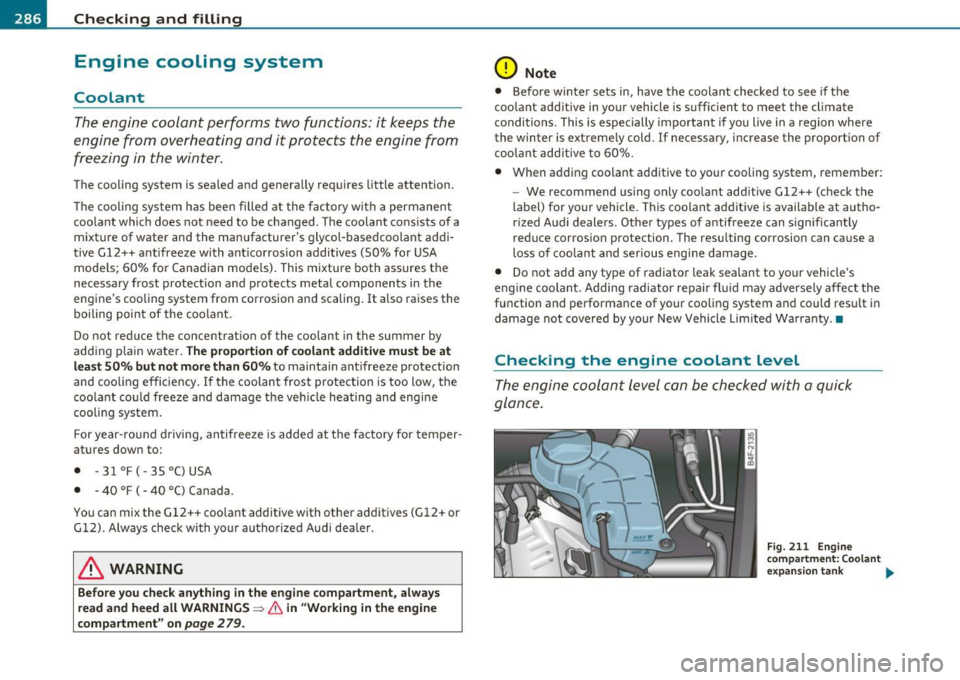
Fig. 211 En gine
compa rtm ent : C oolant
ex pa nsio n tank ..
Page 289 of 370
___________________________________________ C_ h_e _c_ k_ i_ n -=g=-- a_ n_ d_ f_ i_ll _i_n -=g "-- _lffllll
Before you c hec k anythi ng in the engine compartment,
alwa ys r ead and heed all WARNINGS==> & in "Working in
the engine compartment" on
page 279.
- Turn off the ignition.
- Read the engine coolant level from the coolant expansion
tank==>
page 286, fig. 211. With a cold engine, the
coolant level should be between the "min" and "max"
markings . When the engine is wa rm, the level may be
sligh tly above the "max" marking .
The locat io n of the coolant expansion tank can be seen in the engine
compartment ill ustration ~
page 280.
To obta in an accurate reading, the engine must be sw itched off.
The expans ion tank in your vehicle is equ ipped with an electric coolant
level sensor .
When the coolan t level
is too low, the warn ing light i n th e Au to-Che ck
System ~
page 2 7 will blink until you add coo lant and the level has
bee n restored to normal. Even though the re is an elect ric coolan t
level sensor, we still recommend you check the coolant leve l from
time to time .
Coolant loss
Coolant loss may ind icate a leak in the cooling system. I n the even t of
coo lant loss, the cooling system should be inspected immed iately by
yo ur au tho rized A ud i dea le r.
It is not enough mere ly to add coolant.
In a
s ealed system, losses can occur only if the bo iling point of the
coo lant is exceeded as a resu lt of overheating .
0 Note
Do not add any type of radiator leak sealant to your vehicle's engine
coo lant. Add ing radiator repa ir fluid may adverse ly affect the func
tion and performance of your cooling system and could result in
damage not covered by your New Vehicle Limited Warra nty. •
Safety first
Adding coolant
Be very careful when adding engine coolant.
B efore you check a nything in t he engine compartment,
always read and heed all WARNINGS==> & in "Working in
the engine compartment" on
page 279.
- Turn off the engine.
- Let the engine cool down .
- Place a th ick rag over the coolant expansion tank
==>
page 286 , fig. 2 11 and carefully twist t he cap counter
clockw ise ==>& .
- Add coolant .
- Twist the cap on again
tightly .
Replacement eng ine coolant must conform to exact spec ifications
~ page 286, "Coolant". Even in an emergency, if coolant additive
G 12++, G12+ or G12 is not available, do
not use a different addi tive .
Use plain water instead until you can get the correct additive and can
restore the correc t ratio. This should be done as soon as possible.
If you have lost a considerable amount of coolant, then you should
add co ld antifreeze and cold water only when the eng ine is co ld .
Always use
new engine coo lant w hen refilling.
Do not fill coolant above the "MAX" mark. Excess coolant will be
forced ou t th rough the p ress ure relief v alve in the cap when the
engine becomes hot .
& WARNING
• The cooling sy stem i s under pres su re and can get very hot.
Reduc e the ri sk of scalding from hot coolant by following the se
steps.
-Tu rn off the engine and allow it to co ol down . _,.
Vehicle care Technical data
Page 357 of 370

Alphabetical index -________________ fNi'II
Energy management ...... .. .. ..... 96
Fan .................... ... ... .. 100
Heated seats, front .............. . 103
Key coded setting ........ ...... ... 96
Recirculation mode (automatic) .. ... 104
Recommended sett ings ............ 96
Residual heat ..................... 99
Setting the temperature ............ 99
Switching air cooling on/off .... ... .. 99
Synchronization . ... .............. lOS
Turning on and off ....... ...... .. .. 99
Using climate control economically .. 102
Clock ................ .... .. .... .... . 9
Closing Power sunroof ... .. ... ... .. .. . .... S4
Coat hooks ........... ..... .... ... ... 9S
Cold ti re inflation pressure ..... .. ..... 299
Compass mirror ........ ...... .. .... .. 73
Compliance . ... ................ .... 349
Consumer Information . . . . . . . . . . 18S, 346
Contacting NH TSA .... .............. 18S
Continuously Variable Transmission (CVT)
See multit ronic ® ................. 152
Convenience key .................... . 47
Dr iver messages ....... ... .. .. ... . 112
Locking vehicle ...... ....... .. .... . 49
START button ............. .. ... .. 110
Starting engine .. ............. .. . 110
S TOP button ............ .. .. .... . 111
Switching eng ine off .............. 111
Switching on ignition ......... .. ... 110
Unlocking vehicle ................ .. 48
Convertible child safety seats ..... .... 225
Controls and equip
ment Safety first
Convert
ible lock ing retractor
Activating ............... .. ...... 231
Deactivating ..................... 232
Us ing to secure a chi ld safety seat .. 229,
231
Coolant system ..................... 286
Cooling System Expans ion tank ..... .. .. ... .... .. 286
Cruise control Changing speed ..... ... .......... 117
Presetting your speed ... .......... 117
Switching off . .. ................. 117
Switching on .................. .. 116
Warning/indicator lights ........ .. . 16
See also Adaptive Cruise Control .... 119
Cruising range ... ................ .... 34
(upholder .... ............. .. .. . 89,90
D
Damp ing
See Adaptive A ir Suspens ion ...... .. 168
Data . .... ....................... .. 343
Data record er .. . .... .. ... .......... 242
Date display ......................... . 9
Daytime running lights . . . . . . . . . . . . 58, 59
Declaration of compl ia nee
Adaptive Cruise Contro l ... ......... 349
Audi side assist .. .. . .. ...... .. ... 349
Cell phone package . .............. 349
Convenience key .... .. .. .. .. ..... 349
E lectronic immobilizer ............ 349 Homelink
® universal remote control . 349
Remote control key .. ....... ... ... 349
def What does this mean when it appears in
the trip odometer disp lay? .. .. ..... 10
Defective light bulb warn ing ......... .. 21
Defrosting/defogging the windows .. .. . 100
Defrosting/defogging w indows ........ 101
Determining correct load limit ....... .. 304
Digital clock . ........ ................ 9
Digital compass ..................... 73
Digital speedometer .................. 21
Dimensions ............ ... .. .. ..... 341
Dipstick Reading the dipstick properly ....... 283
Distance control system
See Adaptive Cruise Control ... .. .. . 119
Doors Power ch ild safety lock .. ....... .... 47
Driver information system ............. 19
Digital speedometer ............... 21
Driver information messages ........ 24
Open door or rear lid warning . ....... 21
Outs ide temperature display ........ 20
Sound system disp lay .............. 20
Driver seat
See Seating position .............. 178
Driver's seat ... .... .. .... ........... 76
Driver's seat memory ................. 79
Activating remote control key ....... 80
Recalling a seat pos it ion . ... ..... ... 79
Storing a seat position .. ....... .... 79
Vehicle operation Vehicle care Do-it-yourself service Technical data