instrument panel AUDI S6 2011 User Guide
[x] Cancel search | Manufacturer: AUDI, Model Year: 2011, Model line: S6, Model: AUDI S6 2011Pages: 370, PDF Size: 87.15 MB
Page 200 of 370

........ _A_ i_rb _ a_,g,:;._ s_, y'- s_ t_e _m ________________________________________________ _
costs o r ev en t he lack of v ehicle da mage is no t necessar ily an ind ica
t ion of whe the r an a irbag should inflat e or not.
S ince th e cir cums tances will vary cons idera bly betw een one co llision
and another, it is not possible to define a range o f vehicle spee ds that
w ill co ver eve ry p oss ible kin d and a ngle o f im pact th at w ill alw ay s
tri gg er the a irba gs. Im portant facto rs inclu de, for examp le, the
n at ure (h ard or s oft) of th e obje ct whi ch th e c ar hits , th e ang le of
impact, vehicle speed, etc. The front air bags will also not inflate in
s ide or r ear coll isions , or in roll-ove rs.
Always remember: Airbags w ill deploy only once, an d on ly in certa in
kinds of co llisio ns. Your safety be lts are a lways there to offer protec
t ion in those s ituatio ns in which airbags ar e no t sup pose d to d eploy,
or w hen they have alrea dy de ploye d; for examp le, when your ve hicl e
st rike s or is st ruc k b y ano ther veh icle a fter t he first collision .
T hi s is just one of the reasons w hy an airbag is a s upplementa ry
restra in t a nd is no t a su bst itute for a safe ty bel t. Th e air bag sy stem
works most effectively when used with the safety be lts . Therefore,
always p rope rly wear y ou r safety belts => page 187 .
& WARNING
Sitting too close to the steering wheel or instrument panel will
decrease the effectiveness of the airbags and will increase the risk
of personal injury in a collision.
• Never sit closer than 10 inches (25 cm) to the steering wheel or
instrument panel.
• If you cannot sit more than 10 inches (25 cm) from the
steering wheel, investigate whether adaptive equipment may be
available to held you reach the pedals and increase your seating
distance from the steering wheel.
• If you are unrestrained, leaning forward, sitting sideways or
out of position in any way , your risk of injury is much higher.
• You will also receive serious injuries and could even be killed if
you are up against the airbag or too close to it when it inflates - even with an Advanced Airbag.
& WARNING (co ntinued )
• To reduce the risk of injury when an airbag inflates, always
wear safety belts properly=>
page 191, "Safety belts ".
• Always make certain that children age 12 or younger always
ride in the rear seat. If children are not properly restrained, they
may be severely injured or killed when an airbag infl ates .
• Never let children ride unrestrained or improperly restrained in
the vehicle. Adjust the front seats properly.
• Never ride with the backrest reclined.
• Always sit as far as possible from the steering wheel or the
instrument panel =>
page 178.
• Always sit upright with your back against the backrest of your
seat.
• Never place your feet on the instrument panel or on the seat.
Always keep both feet on the floor in front of the seat to help
prevent seriou s injuries to the legs and hips if the airbag inflates.
• Never recline the front passenger's seat to transport objects .
Items can also move into the area of the side airbag or the front
airbag during braking or in a sudden maneuver. Objects near the
airbags can become projectiles and cause injury when an airbag inflates .
& WARNING
Airbags that have deployed in a crash must be replaced .
• Use only original equipment airbags approved by Audi and
installed by a trained technician who has the neces sary tools and
diagnostic equipment to properly replace any airbag in your
vehicle and assure system effectiveness in a crash.
• Never permit salvaged or recycled a irbags to be installed in
your vehicle. •
Page 202 of 370

___ A_ i_r _b _a _, g,:;._ s_, y._ s _ t_e _m ________________________________________________ _
defined in the electronic control unit~ page 209, "PASSENGER AIR
BAG O FF light ".
Always remember, a child safety seat or infant carr ier installed on the
front seat may be struck and knocked out of position by the rapidly
inflating passenger's airbag in a frontal collision. Th e airbag could
greatly reduce the effectiveness of the child restraint and even seri
ously injure the child during inf lation .
For this reason, and because the back seat is the safest place for chil
dren -whe n proper ly restrained accord ing to their age and size -we
st rong ly recommend that children always sit in the back seat
~ page 219, "Child Safety".
& WARNING
A child in a rearward -facing child safety seat installed on the front
passenger seat will be seriously injured and can be killed if the
front airbag inflates - even with an Advanced Airbag System.
• The inflating airbag will hit the child safety seat or infant
carrier with great force and will smash the child safety seat and
child against the backrest, center armrest, door or roof .
• Always install rear-facing child safety seats on the rear seat.
• If you must install a rearward facing child safety seat on the
front passenger seat because of exceptional circumstances and
the PASSENGER AIR BAG OFF light does not come on and stay on,
immediately install the rear-facing child safety seat in a rear
seating position and have the airbag system inspected by your
Audi dealer.
• Forward-facing child safety seats installed on the front
passenger's seat may interfere with the deployment of the airbag
and cause serious personal injury to the child.
& WARNING
If, in exceptional circumstances , you must install a forward-facing
child restraint on the front passenger's seat:
& WARNING (continued)
• Always make sure the forward-facing seat has been designed
and certified by its manufacturer for use on a front seat with a
passenger front and side airbag.
• Never put the forward-facing child restraint up against or very
near the instrument panel.
• Always move the passenger seat into its rearmost position in
the seat's fore and aft adjustment range, as far away from the
airbag as possible before installing the forward-facing child
restraint. The backrest must be adjusted to an upright position.
• Make sure that the PASSENGER AIR BAG OFF light comes on
and stays on all the time whenever the ignition is switched on.
& WARNING
To reduce the risk of serious injury, make sure that the
PASSENGER AIR BAG OFF light will be displayed whenever a child
restraint is installed on the front passenger seat and the ignition
is switched on .
• If the PASSENGER AIR BAG OFF light does not stay on, perform
the checks described
~ page 208 , "Monitoring the Advanced
Airbag System ".
• Take the child restraint off the front passenger seat and install
it properly at one of the rear seat positions if the PASSENGER AIR
BAG OFF light does not stay on.
• Have the airbag system inspected by your Audi dealer immedi
ately.
• Always carefully follow instructions from child restraint manu
facturers when installing child restraints.
& WARNING
If, in exceptional circumstances , you must install a forward or
rearward-facing child restraint on the front passenger 's seat:
Page 204 of 370

___ A_ i_r _b _a _, g,:;._ s_, y._ s _ t_e _m ________________________________________________ _
& WARNING (conti nued)
• Airbag work mo st effectivel y when us ed with p roperly worn
safety belts .
• Therefore, always wear your safety belts and make sure that
everybody in your veh icle is properly restrained .
& WARNING
A person on the front passenger seat , especially infants and small
c hildren, will receive seriou s injuries and can even be killed by
being too close to the a irbag when it inflates.
• Although the Advanced Airbag System in your vehicle is
designed to turn off the front passenger a irbag if an infant or a
small child is on the front passenger seat, nobody can absolutely
guarantee that deployment under these special conditions is
impossible in all conceivable situations that may happen during
the useful life of your vehicle.
• The Advanced Airbag System can deploy in a ccordance with the
" low risk" option under the U.S. Federal Standard if a child that is
hea vier than the t ypical one-year old child is on the front
passeng er seat and the other condition s for airbag deployment
are met.
• Accident statistics have shown that children are generally safer
in the rear seat area than in the front seating position .
• For their own safety, all children , especially 12 years and
younger, should always ride in the back properly res trained for
their age and size. •
Advanced front airbag system
Your vehicle is equipped with a front Advanced Airbag System in
compliance wit h Unit ed St ates Fe d er al Motor Vehi cle Safe ty Standar d
208 as applicab le at the time your vehicle was manufactured . The front Advanced A
irbag System supplements the safety belts to
prov ide ad ditional prote ct ion for th e d river's and front passenger's
heads and uppe r bodies in fro nta l crashes. The ai rbags i nflate only in
fronta l impacts when the vehicle dece leration is high enoug h.
Th e front Adva nced A irbag Sys tem for the fron t seat oc cupan ts is not
a s ubstitute for your safety be lts. Rathe r, it is part o f the overall occu
p an t restr aint sy stem in y our ve hicl e. Always remembe r that the
airbag system ca n only help to protect you, if you are sitting upr ight,
we aring your sa fe ty be lt and we aring it prope rly. T his is why you and
your passengers must always be properly restra ined, not just because
t he law requires you to be.
Th e A dvan ced A irbag Syst em in your veh icle has been c ertified to
meet the "low r isk" req uir ements fo r 3 an d 6 year-old c hildren on the
pas senge r side and ve ry small ad ults o n the dr ive r side. T he low r is k
dep loyment cr iteria a re intended to help reduce the risk of injury
t hroug h in teraction wi th the front a irbag tha t can oc cur, fo r ex am ple,
by being too close to the steering wheel and instrument panel whe n
t he air bag i nflates .
In add it ion , the system has been cert ified to comply with t he
"supp ression" requirements of the Safety Standa rd, to t urn off the
front airbag for infants 12 mont hs old and young er w ho are
restrained on the front passenger seat in child restra ints that are
listed in the Standard=>
pag e 221, "Child restra ints and A dvan ced
Airbags".
"Su pp ression" req uires t he front a irbag on the passenger side to be
t ur ned off if:
• a child up to about one year of age is restra ined on the front
passenge r seat in one of t he rear-faci ng or forwa rd-facing infant
restraints listed in Federa l Motor Vehicle Safety Standard 208 w it h
w hich the Adv anced Airbag Sys tem in yo ur vehicle w as ce rt ified. Fo r a
list ing of the child restra ints that were used to certify your vehicle's
c omp li a nce with the US Safety Stand ard =>
page 22 1,
• weight less than a thresho ld level stored in the contro l unit is
detec ted on t he fro nt p assenger se at.
Page 206 of 370

111 ....... _A_ i_rb _ a_,g,:;._ s_, y'- s_ t_e _m ________________________________________________ _
& WARNING (conti nued)
• If you must install a rearward facing child safety seat on the
front p assenger seat because of e xceptional circumstan ce s and
the PASSENGER AIR BAG OF F light does not come on and stay on ,
immed iately in stall the rear-facing child safety seat in a r ea r
seating position and have the airbag system inspected by your
Audi dealer.
& WARNING
If, in exceptional circumstances, you must in stall a forward-facing
child restraint on the front passenger 's seat:
• Always make sure the forward-facing seat has been d esigned
and certified b y its manufacturer for use on a front seat with a
pas senger front and side airbag.
• Never put the forward-facing child restraint up against or very
near the instrument panel.
• Always move the passenger seat into its rearmo st position in
the seat 's fore and aft adjustment range, as far away from the
airbag as possible , before in stalling the forward-facing child
restraint. The backrest must be adjusted to an upright position.
• Make sure that the PASSENGER AIR BAG OFF light comes on
and stays on all the t ime whenever the ignition is switched on .•
Advanced Airbag System components
The front passenger seat in your veh icle has a lot of very important
parts o f the A dvanced A irbag System in it. These p arts incl ude t he
we ight-sens ing mat, sensors, wiring, brackets, and more. The func
t ion o f the sys tem in t he front passenger sea t is che cked by the elec
tron ic contro l unit when the ignit ion is on . The contro l unit mo nitors
t he Advanced Air bag System and t urns the airbag indica tor ligh t on
when a malfunction in t he system compone nts is detected. The func
tion of the a irbag indicator light is descr ibed in greater detail be low. Because the front passenger seat co
nta ins important parts of t he
Adv anced Ai rbag System, you mus t tak e ca re to p reve nt i t from be ing
damaged . Damage to the seat may p revent the Advanced A irbag for
the front passenge r seat from do ing its job in a crash .
The front Advanced Airbag System consists of the
following:
• Cras h sensors in the front of the ve hicle tha t meas ure vehicle
acc elera tion/de ce le ra tion to prov ide info rm ation to the Advanced
Airbag System about the severity of the crash .
• An e lec tron ic contro l unit, w it h i ntegr ate d crash sensors fo r front
and side i mpacts . The control unit "dec ides" w het her to fire the front
airbags based o n the information rece ived from the c rash sensors .
T he contro l unit also "decides" whether the safety be lt prete nsioners
should be activated.
• An Advanced Airbag with gas generator fo r the driver inside the
s teer in g wheel hub.
• An Advanced Airbag with gas generator inside the instrument
p ane l for the front p assenge r.
• A weight-sensi ng mat under the upho lstery padd ing of the front
passenge r seat cushion that measu res the tota l we ight on the se at.
The informat ion registered is sent continuously to the electronic
c ont rol uni t to re gulate deploymen t of t he fr ont Adv anced A irbag o n
the passenger side .
• An air ba g mon itoring syste m and indi ca tor ligh t in the in strume nt
cl uster =>
page 208.
• Th e PASSENGER AIR BAG OFF lig ht comes on an d stays on in t he
center of the instrument panel=>
page 209, fig. 184 and tells you
w hen the fron t A dvan ced A irb ag on t he passe nger side has been
turned off.
• A senso r below t he safety belt latch for t he front seat passenge r
to meas ure the tens ion on the safety belt . The tension on the safety
be lt a nd the we igh t regis tere d by the weig ht-sensing mat help t he
control un it "dec ide" w hethe r th e front airbag fo r the front
passenge r seat should be turned of f or not =>
page 19 9, "Chi ld
restraints on the front seat -some important things to know". ._
Page 211 of 370

_______________________________________________ A_ ir_ b_ a_,,,g '--- s.:.y _s _t_ e _ m ___ _
PASSENGER AIR BAG OFF light
·~ .~~I f -
-a• -· ... JI •
-a II .. ~ ----- -
• II _, -
MSSENGEIIAIRBAGOfF
Fig. 184 Section from
the instrument panel:
PASSENGER AIR BAG
OFF light
The PASSENGER AIR BAG OFF light is located in the center of the
instrument panel~ fig. 184.
Th e
PASSENGER AIR BAG OFF light will come on and stay on to tell
you when the front Advanced Airbag on the passenger side has been turned
off by the electronic control unit. Each time you turn on the
ign ition, the
PASSENGER AIR BAG OFF light will flash fo r a few
seconds and:
• will stay on if the front passenger seat is not occupied,
• will stay on if there is a small child or child restraint on the front
passenge r seat,
• will go out if the front passenger seat is occupied by an adult as
registe red by the weight-sens ing mat.
The
PASSENGER AIR BAG OFF light must come on and stay on if the
ign ition is on and
• a car bed has been installed on the front seat, or
• a rearward-facing child restraint has been installed on the front
passengerseat,or
• a forward-facing child restraint has been insta lled on the front
passenger seat, or
• the weight registe red on the front passenger seat is equal to or
less than the combined weight of a typical 1 year-o ld restrained in
Controls and equip
ment Safety first
Vehicle operation
one of the rear-facing or forward-facing infa nt restraints listed in
Federal Motor Vehicle Safety Standard 208 with w hich the Adva nced
Airbag System in your vehicle was certified .
If the front passenger seat is not occupied, the front airbag wi ll not
dep loy, and the
PASSENGER AIR BAG OFF light will stay on. Never
install a rearward-facing child restraint on the front passenger seat,
the safest pla ce fo r a child in any kind of chi ld restraint is at one of the
seating positions on the rear seat~
page 199, "Child restraints on
t he front seat-some impo rtant things to know" and~
page 219,
"Child Safety" .
If the PASSENGER AIR BAG OFF light comes on when one of the
conditions listed above is met, be sure to check the light regu larly to
make certain that the
PASSENGER AIR BAG OFF lig ht stays on
continuously whenever the ignition is on.
If the PASSENGER AIR BAG
OFF
light does not appear on and does not stay on all the t ime, stop
as soon as it is safe to do so and
• reactivate the system by turning the ignition
off and then turning
it on again;
• remove and reinstall the ch ild restraint. Make sure that the child
restraint is properly installed and that the safety belt fo r the front
passenger seat has been correctly routed through the child restraint
as described in the child restraint manufacturer's instructions;
• make sure that the convertible locking feature on the safety belt
for the front passenge r seat has been activated and that the safety
belt has been pulled t ight. The belt must not be loose or have loops
of slack so that the senso r be low the safety belt latch on the seat can
do its job~
page 229.
• make sure that things that may increase the weight o f the chi ld
and child safety seat are not being transported on the front
passenger seat;
• make sure that the safety belt tension sensor is not blocked.
Shake the safety belt latch on the front passenge r seat back and
forth;
• If a strap or tether is be ing used to tie the child safety seat to the
front passenger seat, make sure that it is not so tight that it causes .,
Vehicle care Do-it-yourself service Technical data
Page 213 of 370
Airbag system -----------------=--=---
& WARNING (co ntinued )
seating position and have the airbag system inspected by your
Audi dealer .
• A tight tether o r other strap on a rearward -facing child
restraint attached to the front pa ssenger seat can put too much
pressure on the weight -sensing mat in the seat and register more
weight than i s actually on the seat . The heavier weight regi stered
can make the system work as though an adult were on the seat
and deploy the Advan ced Airbag when it mu st be suppre ssed
causing serious or even fatal injury to the child .
• If , in exceptional circumstanc es, you must install a forward
facing child restraint on the front passenger seat, always move
the seat into its rearmost po sition in the seat' s fore and aft adjust
ment range, as far away from the airbag as possible . The backrest
must be adjusted to an upright position. Make sure that the PASSENGER AIR BAG OFF light comes on and stays on all the time
whenever the ignition is switched on.
& WARNING
• If the PASSENGER AIR BAG OFF light doe s not go out when an
adult is sitting on the front passenger seat after taking the steps
described above, make sure the adult is properly seated and
restrained at one of the rear seating positions.
• Have the airbag system inspected by your Audi dealer before
transporting anyone on the front passenger seat.
[ i ] Tips
If the we ight-sens ing mat in the front passenger seat detects an
em pty seat , the front airbag on the passenge r side will be t urne d off,
and the PASSENGER AIR BAG OFF light will stay on .•
Controls and equip ment Safety first Vehicle operation
Repair, care and disposal of the airbags
Parts of the airbag system are
insta lled at many different places on
your Audi . Ins tall ing, remov ing, serv icing o r rep airi ng a pa rt in an
area of the vehicle ca n damage a part of a n airbag system and prevent
t ha t sys tem from working prope rly in a coll is io n.
Th ere are some importa nt things you have to know to ma ke sure t hat
the effectiveness of the system will not be impai red and that
dis ca rded compo nents do not cause injury or po llute t he e nvir on
ment .
& WARNING
Improper care , serv icing and repair procedures can increase the
risk of personal injury and death by preventing an airbag from
deploying when needed or deploying an airbag unexpectedly:
• Never cover, obstruct, or change the steering wheel horn pad or
airbag cover or the instrument panel or modify them in any way .
• Never attach any objects such as cupholders or telephone
mountings to the surfaces covering the airbag units .
• For cleaning the horn pad or instrument panel, use only a soft ,
dry cloth or one moistened with plain water . Solvent s or cleaners
could damage the airbag cover or change the stiffness or strength
of the material so that the airbag cannot deploy and protect prop
erly.
• Never repair, adjust, or change any part s of the airbag system .
• All work on the steering wheel, instrument panel , front seats
or electrical sy stem (including the installation of audio equip
ment, cellular telephones and CB radios, etc. ) must be performed
by a qualified technician who has the training and special equip ment necessary .
• For any work on the airbag system, we strongly recommend
that you see your authorized Audi dealer or qualified workshop.
• Never modify the front bumper or parts of the vehicle body . ..,_
Vehicle care Do-it-yourself service Technical data
Page 232 of 370
• .___C_ h_ il_d _ S_a _ f_ e _ t--= y '------------------------------------------------
& WARNING (cont inued)
• If the backrest is not securely latched, the child and the child
restraint will be thrown forward together with the backrest and
will strike parts of the vehicle interior. The child can be seriously
injured or killed.
• Never install rear-facing child safety seats or infant carriers on
the front passenger seat. A child will be seriously injured and can be killed when the passenger airbag inflates.
• The inflating airbag will hit the child safety seat or infant
carrier with great force and will smash the child safety seat and
child against the backrest, center armrest, door or roof .
• Always install rear-facing child safety seats or infant carriers
on the rear seat.
• Forward-facing child safety seats or infant carriers installed on
the front passenger's seat may interfere with the deployment of
the airbag and cause serious injury to the child.
• It is safer to install a forward -facing child safety seat on the
rear seat.
• Always read and heed all WARNINGS whenever using a child
restrained in a vehicle is being used~
page 219. Special precau
tions apply when installing a child safety seat on the front
passenger seat~
page 199, "Child restraints on the front seat -
some important things to know".
L1}. WARNING
Always take special precautions if you must install a forward or
rearward -facing child restraint on the front passenger's seat in
exceptional situations:
• Whenever a forward or rearward-facing child restraint is
installed on the front passenger seat, the PASSENGER AIR BAG
OFF light must come on and stay on whenever the ignition is
switched on.
& WARNING (co ntinued )
• If the PASSENGER AIR BAG OFF light does not come on and
stay on, perform the checks described
~ page 208, "Monitoring
the Advanced Airbag System".
• Take the child restraint off the front passenger seat and install
it properly at one of the rear seat positions if the PASSENGER AIR
BAG OFF light does not stay on whenever the ignition is switched
on.
• Improper installation of child restraints can reduce their effec
tiveness or even prevent them from providing any protection.
• An improperly installed child restraint can interfere with the
airbag as it deploys and seriously injure or even kill the child.
• Always carefully follow the manufacturer's instructions
provided with the child safety seat or carrier.
• Never place additional items on the seat that can increase the
total weight registered by the weight-sensing mat and can cause injury in a crash.
L1}. WARNING
Forward-facing child restraints:
• Always make sure the forward-facing seat has been designed
and certified by its manufacturer for use on a front seat with a
passenger front and side airbag .
• Never put the forward-facing child restraint up, against or very
near the instrument panel.
• Always move the passenger seat into its rearmost position in
the seat's fore and aft adjustment range, as far away from the airbag as possible before installing the forward-facing child
restraint . The backrest must be adjusted to an upright position.
• Make sure that the PASSENGER AIR BAG OFF light comes on
and stays on all the time whenever the ignition is switched on . _.
Page 270 of 370

-~_C_ le_ a_n_ i_ n_ g=- a_ n_d___. p_ ro_ t_e _c_ t_ i_o _n ___________________________________________ _
detergent. Apply the water with a damp cloth o r sponge a nd pat the
fabr ic dr y wi th a n ab sorb ent , dr y clot h.
Sta ins from choco late or makeup should have dete rge nt paste (e.g.
ox -gall soap) ru bbed into them . Afterwards, remove t he soap w ith
w at er ( damp s ponge).
Alcoho l can be used to treat sta ins from grease , oil, lipstick or a ba ll
po int p en. Melte d gre ase o r dye mus t be p atted o ff usi ng absorbe nt
material. It may be necessary to ret reat t he areas with detergent
paste a nd water .
In the case of ge nera l soili ng o f th e upholste ry an d cover mater ia l, we
recommend hiring a specialist that has the equ ipment to clean the
sea t cover s and o ther fab ric su rf a ces by sh am poo ing and s pray
extractio n.
& WARNING
Always read and heed all WARNINGS and the information
~ page 260 .
(I) Tips
Ope n Velcro fasteners on yo ur clothing can damage the sea t cover.
Please make su re t hat Velc ro fasteners are closed .•
Plastic parts and instrument panel
Always use a clean cloth moistened in clear water to clean t hese
a reas. For pers iste nt dirt use a n Audi appr oved
solvent-free plas tic
cleaner /protectant.
& WARNING
Solvents can change the properties of some plastics and make it harder for the airbag to deploy.
& WARNING (co ntinued )
• Never clean the instrument panel or the surface of airbag
modules with cleaning products that contain solvents.
• Products containing solvents will make the surface of this part
porous.
• Serious injuries can result if plastic parts come loose when the
airbag is deployed .
• Always read and heed all WARNINGS and other information
~page 260.
0 Note
Cleaning agents contai ning solvents will attack the mate rial and can
c hange the w ay it behave s.•
App lies to vehicles: with na tural leather
Natural leather
A udi makes gre at effo rts to main tain the propert ies,
natura l loo k and f eel of inte rio r le a th er .
General
We offe r m any di fferen t types o f lea ther on ou r ve hicl es. Most are
differen t types of nappa leat her, which has a smooth s urface and
comes in va rious co lo rs .
Th e int ensity of the colo r de ter min es th e vi sual cha ra cte ris tic s an d
appea rance. If the s urface o f the leathe r has a typical natu ral look,
t hen the le a the r is a nappa lea ther tha t has bee n left in a relat ively
natura l condition. This leat he r offers partic ularly good comfort a nd
brea thes wel l. Fine veins, closed gr ains, insec t bit e s, sk in fol ds , and
subt le variations i n color rema in v isib le. These character ist ics demon
stra te t hat the ma ter ia l is na tural.
N at ural nappa leat her i s not cov ered by a colo r finish.
It is therefor e
more sensitive to soiling and wea r, which is somethin g you need to ..,
Page 280 of 370
ffl __ C_h_ e_c _k _i_n -=g :a,__ a_n_ d_ f_ i_ l _li _n _,g;._ __________________________________________ _
Checking and filling
Engine hood
Releasing the engine hood
The engine hood is released from inside the vehicle.
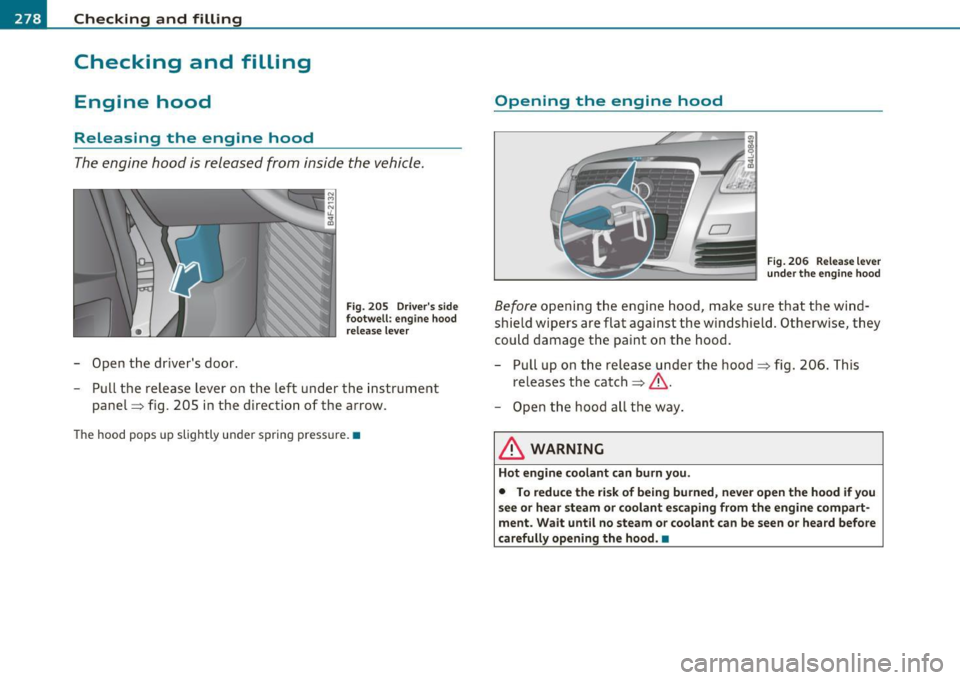
-Open the driver's door.
Fig. 205 Driver's side
footwell: engine hood
release lever
- Pull the release lever on the left under the instrument
panel => fig. 205 in the direction of the arrow.
The hood pops up slightly under spring pressure. •
Opening the engine hood
Fig. 206 Release lever
under the engine hood
Before opening the engine hood, make sure that the wind
shield wipers are flat against the windshield. Otherwise, they
could damage the paint on the hood.
Pull up on the release under the hood=> fig. 206. This
releases the catch =>
&.
- Open the hood all the way.
& WARNING
Hot engine coolant can burn you.
• To reduce the risk of being burned, never open the hood if you
see or hear steam or coolant escaping from the engine compart
ment. Wait until no steam or coolant can be seen or heard before
carefully opening the hood. •
Page 330 of 370

-L_!F~U:!_:S~ e~ s ~ a~ n~ d~b~ u~l~b ~s ~-------------------------------------------
Fuse assignment, cockpit driver's side
Fig. 234 Cockpit
driver's side: fuse
panel layout
No. Consume r
3 Engine management
4
5
6
7
8
9
10
12
13
Oil level sensor
Climate control, tire pressure monitoring sys
tem Electronic Stabilization Program (ESP), clutch
sensor
Diagnostic connector
Homelink control unit
Automatic dimming interior mirror
Adaptive Cruise Control Diagnostic connector
Switch module steering column
15 Instrument cluster, control module Gateway
16 Telephone, cell phone
17 Electronic Stabili zation Program (ESP)
18 Headlight electronics, left-side
Amps
5
5
5
5
5
5
s
5
10
10
10
5
10
5
No. Con sum er
19 Rain sensor
20 Heated washer nozzles
21 Seat adjustment (driver)
22 MMI display
23 Electromechanical park ing brake
31
32
33
34
36
37
38
39
40
41
42
43
Back-up light switch, transmission, engine com
ponents
I ntelligent power module driver (footwell light
and front headlights , horn, wiper system, elec
trically adjustable steering wheel)
Intelligent power module driver (lights left-side)
I ntelligent power module driver
(lights right-side)
Headlight washer system
Electronic Stabilization Program (ESP)
Wiper system Door control module left-side
Horn
Heater fan
Control module electronic ignition lock/elec tri
cally adjustable steering wheel
Rear windshield wiper (Avant)
44 Power window opener (left-side)
Amps
5
5
10
5
5
15
30
25
25
30
25
30
15
25
40
30
15
35
-
•