parking brake AUDI S6 2012 User Guide
[x] Cancel search | Manufacturer: AUDI, Model Year: 2012, Model line: S6, Model: AUDI S6 2012Pages: 298, PDF Size: 74.43 MB
Page 103 of 298
Automatic Transmission
multitronic ®
Introduction
Appl ies to vehicles: with multitr oni c
Your veh icle is equipped with an electronically
controlled,
continuously variable transmis
sion
(multitronic ®). In contrast to convention
al automatic transmi ssions using shifting op
erations, the transmission ratio in the contin
uously variab le transmission is changed con
tinuously. This optimizes the comfort level
and conserves fuel.
The gear ratio in the transmission is selected
(upshift and downshift) completely automati
cally as a function of the defined driving pro
grams.
If desired, the driver can also select the gears
manually (tiptronic mode).
Instead of the torque converter in convention
al automatic transmissions, your multitronic ®
transmission uses a multidisk clutch for pow
er transmission . Therefore, the "creep behav
ior" of the veh icle dur ing idling when tempo
rarily stopped in selecto r lever pos it ion 0/S or
R is less pronounced.
Driving the automatic transmission
A ppl ies to vehicles: with multitr onic
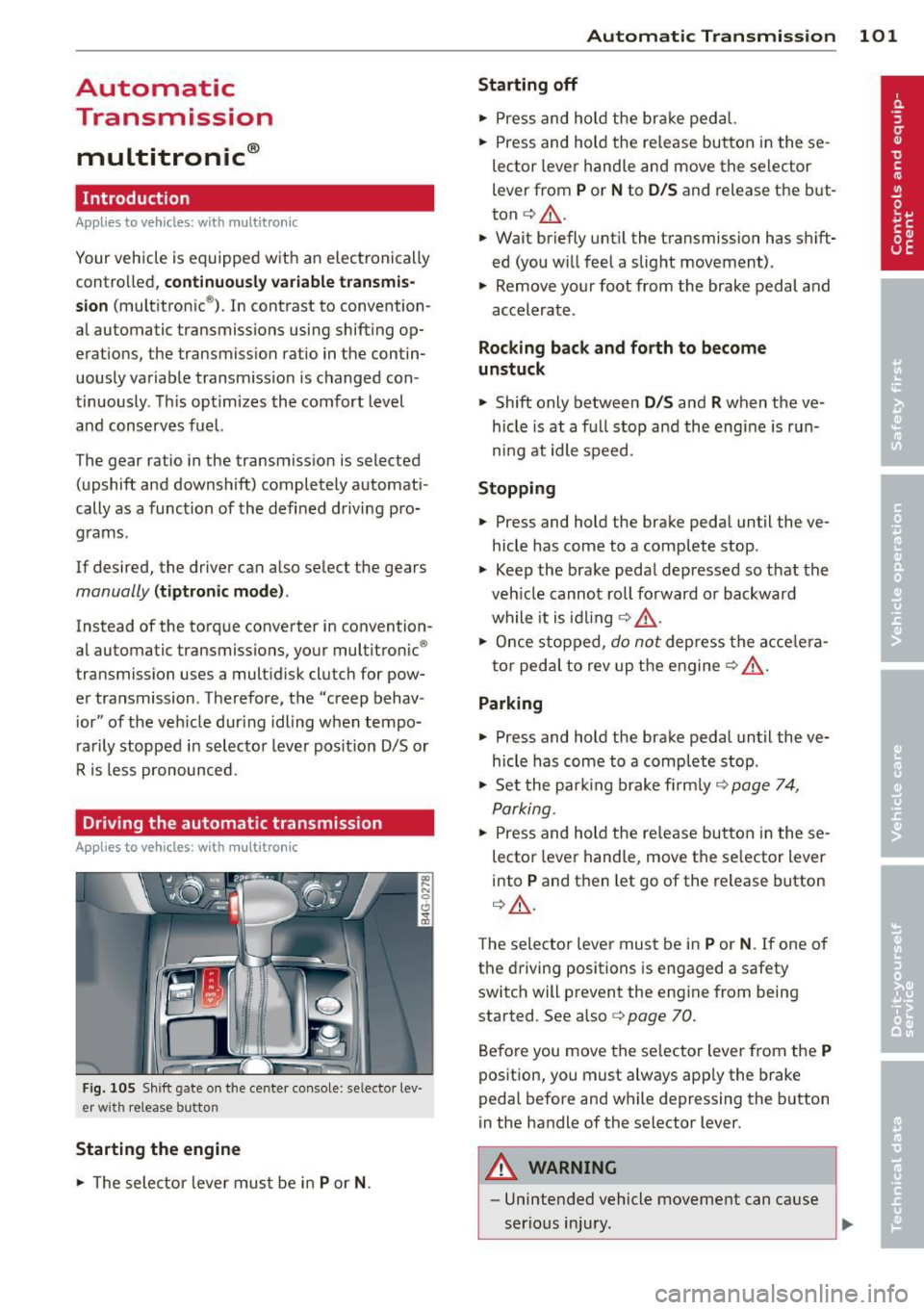
Fig . 105 Shift gate on the cente r console: se lecto r lev
er wi th release button
Starting the engine
• The selector leve r must be in P or N. Automatic Transmission 101
Starting off
•
Press and hold the brake pedal.
• Press and hold the re lease button in these
lector lever handle and move the selector
lever from
P or N to D/S and release the but
ton
c:> _&. .
.,. Wait briefly until the transmission has shift
ed (you will feel a slight movement) .
.,. Remove your foot from the brake pedal and
accelerate .
Rocking back and forth to become
unstuck
.,. Shift only between D/S and R when the ve
hicle is at a full stop and the engine is run
ni ng at idle speed .
Stopping
.,. Press and hold the brake pedal until the ve
hicle has come to a complete stop .
• Keep the brake pedal depressed so that the
veh icle cannot roll forward or backward
while it is idling
c:> _&. .
• Once stopped, do not depress the acce le ra
tor peda l to rev up the engine
c:> _&. .
Parking
.,. Press and hold the brake pedal until the ve
hicle has come to a complete stop .
• Set the park ing brake firmly
c:> page 7 4,
Parking .
• Press and hold the release button in these
lector lever handle, move the se lector lever
into
P and then let go of the release button
c:> _&..
The selector lever must be in P or N. If one of
the driving positions is engaged a safety
switch will prevent the eng ine from being
started . See also co
page 70.
Before you move the selector lever from the
P
position, you must always app ly the brake
pedal before and while depressing the button
in the handle of the selector lever.
A WARNING
-- Unintended vehicle movement can cause
serious injury.
Page 104 of 298
102 Autom atic Tran smi ssi on
-When the selector lever is in a driving
position, the veh icle may creep, even at
id le speed. Therefore do not release
the park ing brake or foot brake until
you are ready to move, because power
is transmitted to the wheels as soon as
a driving posit ion is engaged.
- Do not accelerate while selecting a
driving position. At this time the en
g ine must be at idle speed so that un
d ue stress is no t placed on the clutches
in the t ransmission.
- Remembe r: Even when stopped briefly
with the automatic transmission in D/S
or R, engine power is being transmit
ted to the whee ls. Yo ur vehicle could
"creep" forward or backward . When
stopped, keep the brake peda l fully de
pressed and use the parking brake if
necessary to keep the vehicle from roll
ing .
-If the selector lever is unintentionally
moved into N wh ile you are driving, take
yo ur foot off the accele rator pedal and
wa it for the engine to return to idle
speed befo re selec ting a drivi ng position.
- Never shift into R or P when the veh icle is
in mo tion.
- Never get out of the dr iver's seat when
the engine is runn ing.
- If you must get out of the vehicle, move
the se lector lever securely into the P po
si ti on a nd apply the park ing brake fi rm ly.
- If the eng ine must remain running, never
have any driv ing pos ition engaged when
chec king under the hood. Make sure the
selector lever has securely engaged and
is locked in P with the parking brake
firmly set¢
page 214, Engine comport
ment .
Otherwise, any increase in engine
speed may set the vehicle in mot ion,
even with the parking brake applied.
Selector lever positions
Applies to vehicles: wit h mult itronic
This section describes the selector lever posi
tions and driving ranges.
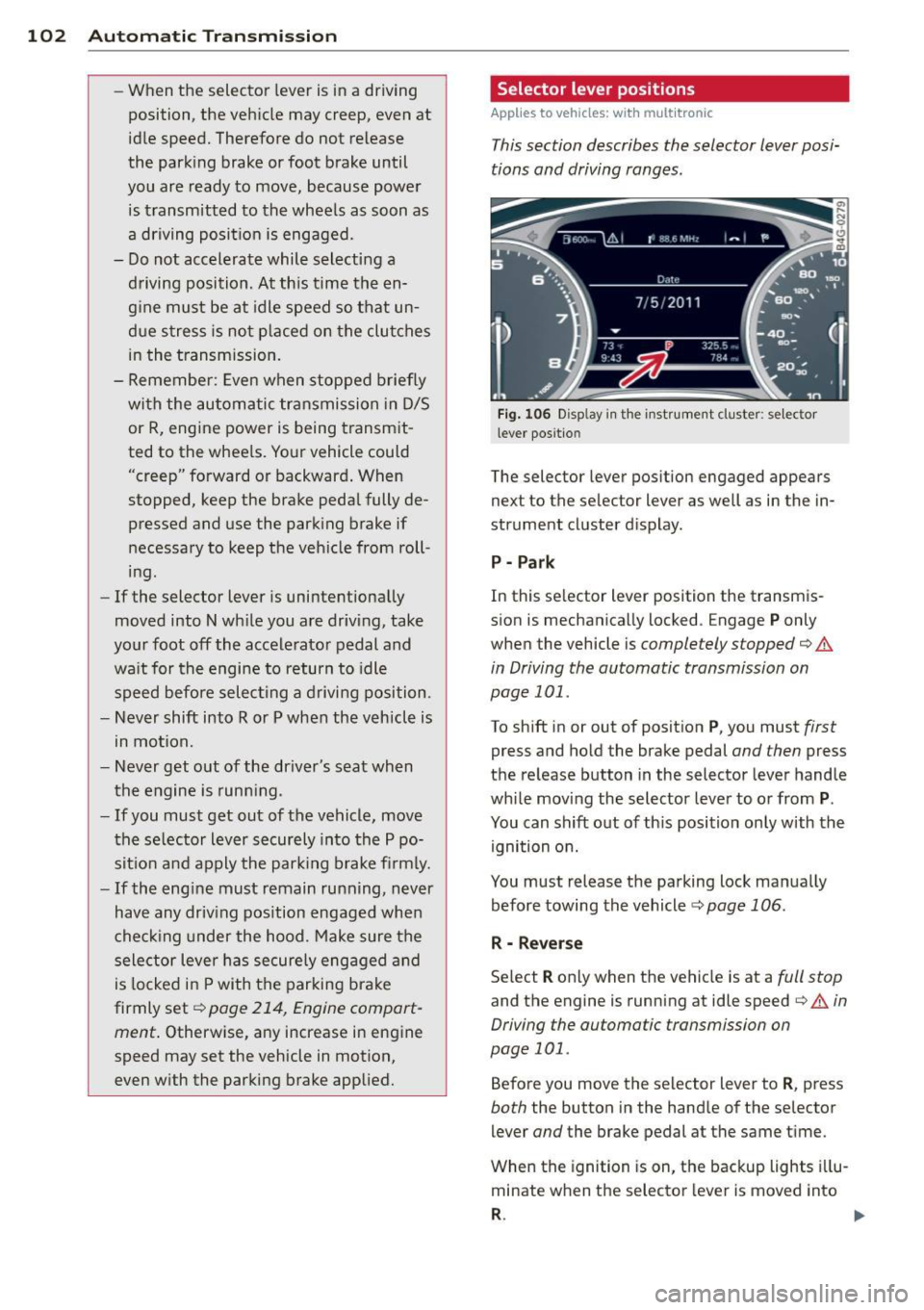
F ig . 106 Display in th e inst rument cluster: se lector
l ever positio n
The selector lever position engaged appears
next to the selector lever as well as in the in
strument cluster d isplay.
P - Par k
In this se lector lever position the transm is
sion is mechanically locked . Engage
P only
when the vehicle is
completely stopped¢.&
in Driving the automatic transmission on
page 101 .
To shift in or out of posit ion P , you must first
press and hold the brake pedal and then press
the re lease button in the selector lever handle
whi le moving the selector lever to o r from
P .
You can shift out of th is position only with the
ignition on.
You must release the parking lock manually before towing the vehicle ¢
page 106.
R - Reverse
Se lect R only when the vehicle is at a full stop
and the engine is running at idle speed¢.& in
Driving the automatic transmission on
page 101.
Before you move the selector lever to R , press
both the button in the hand le of the se lector
lever
and the brake pedal at the same t ime.
When the ignition is on, the backup lights i llu
minate when the selector lever is moved into
R . 1111-
Page 109 of 298
Driving the automatic transmission
Applies to vehicles: with tiptronic
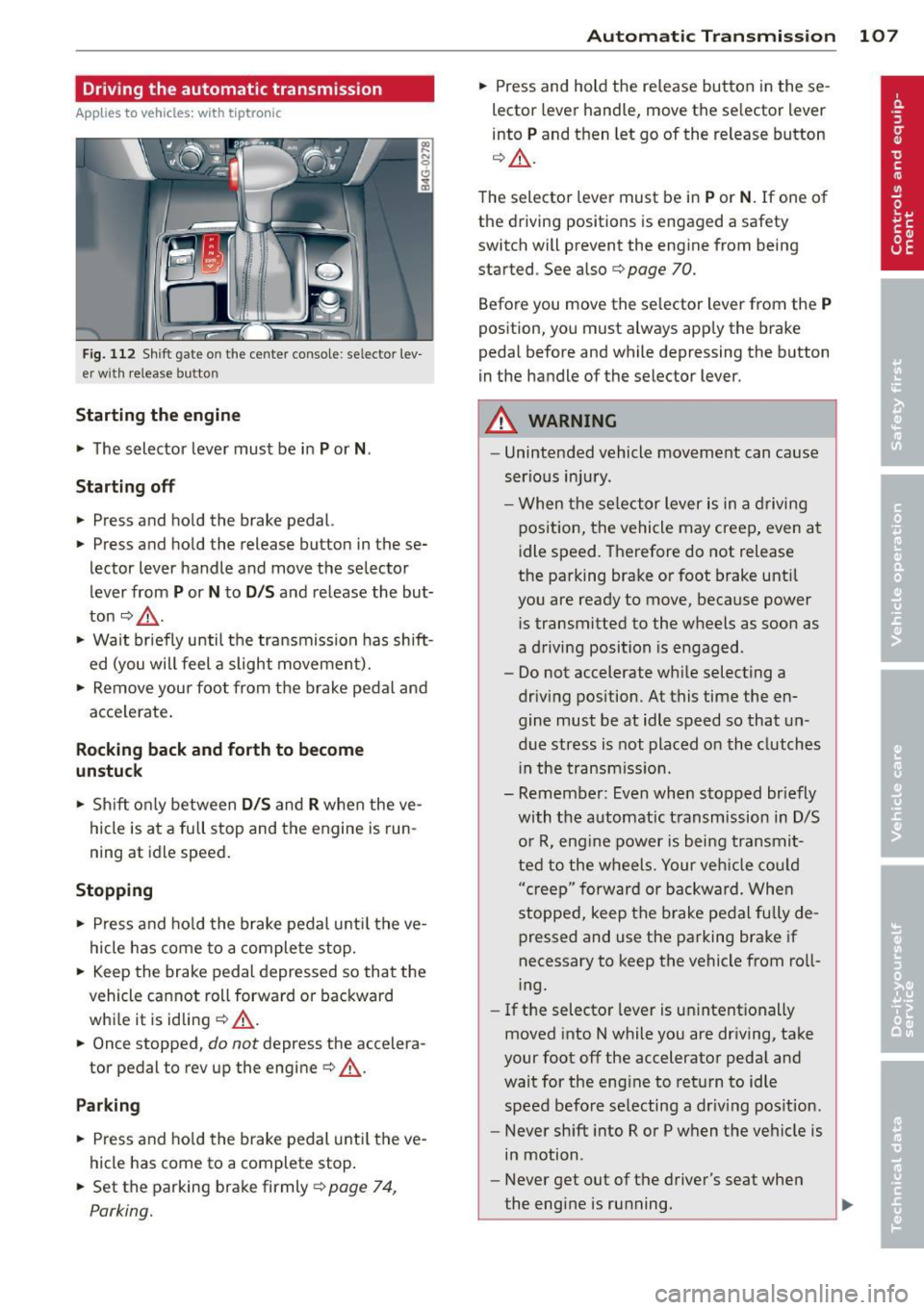
Fig. 112 Shift gate on the center conso le: selector lev
er w ith release button
Startin g the engine
~ The selector lever must be in P or N.
St arting off
~ Press and hold the brake pedal.
~ Press and hold the release button in these
lector lever handle and move the selector
lever from
P or N to D /S and release the but
ton
c:> _& .
~ Wait briefly until the transmission has shift
ed (you will feel a slight movement).
~ Remove your foot from the brake pedal and
acce lerate .
Rocking back and forth to become
un stu ck
~ Shift on ly between D /S and R when the ve
hicle is at a fu ll stop and the engine is run
ning at idle speed.
St opping
~ Press and ho ld the brake pedal unti l the ve
hicle has come to a complete stop.
~ Keep the brake pedal depressed so that the
vehicle cannot roll forward or backward
whi le it is idling
c:> .&._ .
~ Once stopped, do not depress the accelera
tor pedal to rev up the engine
c:> .&._ .
Park ing
~ Press and ho ld the brake pedal unti l the ve
hicle has come to a complete stop .
~ Set the parking brake firmly r=;,page 74,
Parking.
Automatic Tra nsmi ssi on 10 7
~ Press and hold the re lease button in these
lector lever handle, move the se lector lever
into
P and then let go of the release button
q A .
The selector lever must be in P or N . If one of
the driving positions is engaged a safety
switch will prevent the engine from being
started . See also
r=;, page 70.
Before you move the se lector lever from the
P
position, you must always app ly the brake
pedal before and while depressing the button
in the handle of the selector lever.
A WARNING
- Unintended vehicle movement can cause
serious injury .
- When the se lector lever is in a d riving
position, the vehicle may creep, even at
idle speed. Therefore do not release
the parking brake or foot brake until
you are ready to move, because power
i s transmitted to the wheels as soon as
a driving position is engaged.
- Do not accelerate while selecting a
driv ing position. At this time the en
gine must be at idle speed so that un
due stress is not placed on the clutches
i n the transmiss io n.
- Remember: Even when stopped br iefly
with the automatic t ransmission in D/S
o r R, eng ine power is bei ng transmit
ted to the wheels. Your veh icle cou ld
"creep" forward or backward. Whe n
stopped, keep the b rake pedal fully de
pressed and use the parking brake if
necessary to keep the vehicle from ro ll
i ng.
- If the selector lever is un intent ionally
moved into N while you are driving, take
your foot off the accelerator peda l and
wait for the eng ine to retu rn to idle
speed before selecting a dr iv ing pos ition.
- Never sh ift into R or P when the vehicle is
in motion .
- Never get out of the driver's seat when
the eng ine is ru nning.
Page 110 of 298
108 Automatic Transmission
-If you must g et out of the vehicle, move
the selector lever securely into the P po
sition and apply the parking brake f irmly.
-If the engine must remain running, never
have any driving position engaged when
checking under the hood. Make sure the
selector lever has securely engaged and
is locked in P with the parking brake
firmly set
r:!;> page 214, Engine compart
ment.
Otherwise, any increase in engine
speed may set the vehicle in motion,
even with the parking brake applied.
Selector lever posit ions
Appl ies to vehicles: with tiptronic
This section describes the selector lever posi
tions and driving ranges.
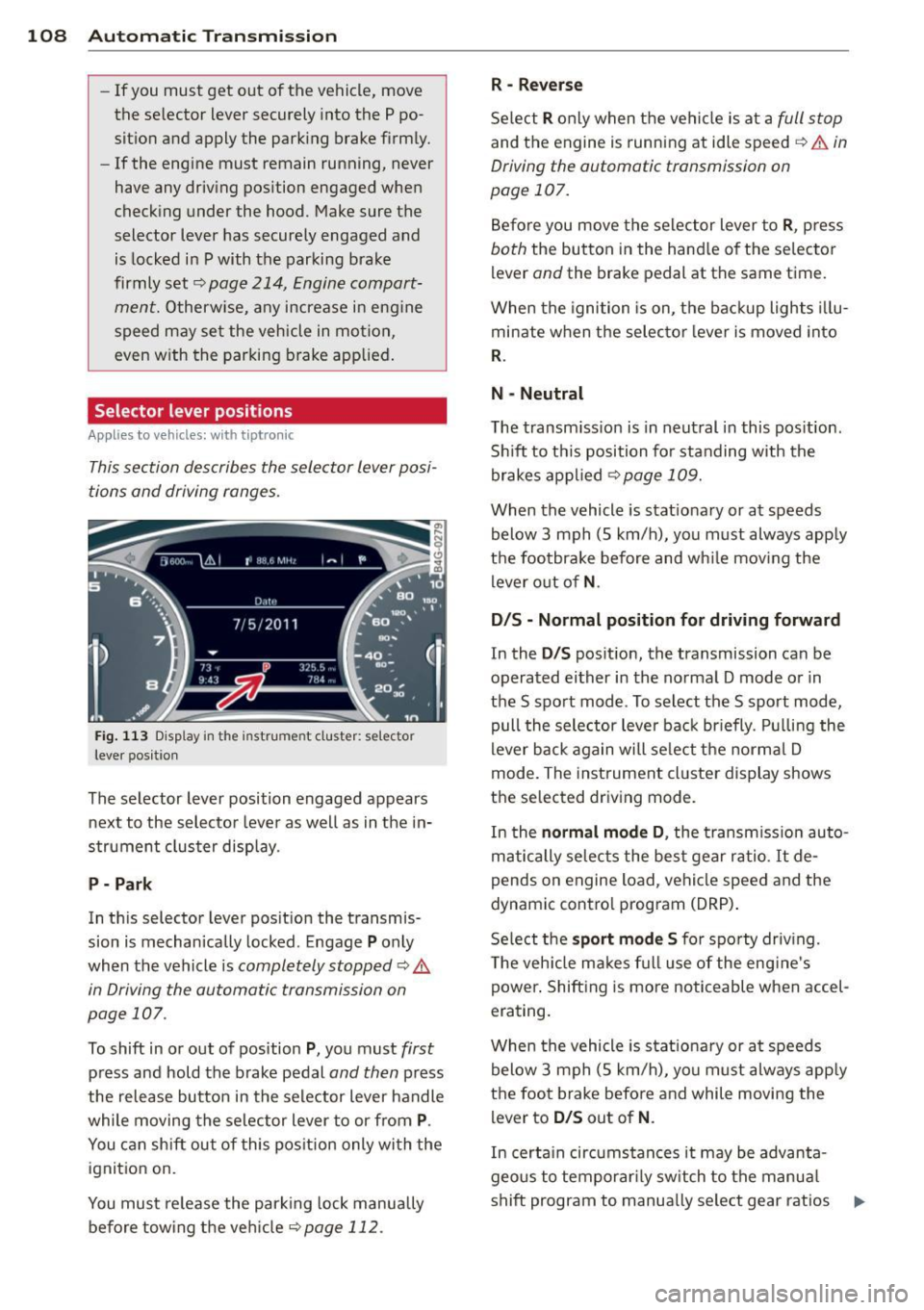
Fig. 113 Display in the instrume nt cluster: se lector
lever pos itio n
The selector lever position engaged appears
next to the selector lever as well as in the in
strument cluster display.
P - Park
In this selecto r lever position the transmis
sion is mechanically locked . Engage
P only
when the vehicle is
completely stopped ¢ A
in Driving the automatic transmission on
page 107 .
To shift in or out of position P, you must first
press and hold the brake pedal and then press
the release button in the selector lever handle
while moving the selector lever to or from
P.
You can shift out of this position only with the
ignition on.
You must release the parking lock manually
before towing the vehicle
<:!;>page 112.
R -Reverse
Select R only when the vehicle is at a full stop
and the engine is running at idle speed r:!;> ,& in
Driving the automatic transmission on
page 107.
Before you move the selector lever to R, press
both the button in the handle of the selector
l ever
and the brake pedal at the same time.
When the ignition is on, the backup lights illu
minate when the selector lever is moved into
R.
N - Neutral
The transmission is in neutral in this position .
Shift to this position for standing with the
brakes applied
<:!;>page 109.
When the vehicle is stationary or at speeds
below 3 mph (5 km/h), you must always apply
the footbrake before and while moving the
lever out of
N.
D/S - Normal position for driving forward
In the D/S position, the transmission can be
operated either in the normal D mode or in
the S sport mode . To select the S sport mode,
pull the selector lever back briefly. Pulling the
lever back again will select the normal D
mode. The instrument cluster display shows
the selected driving mode.
In the
normal mode D , the transmission auto
matically selects the best gear ratio.
It de
p ends on engine load, vehicle speed and the
dynamic control program (DRP).
Select the
sport mode S for sporty driving.
The vehicle makes full use of the engine's
power. Shifting is more noticeable when accel
erating.
When the vehicle is stationary or at speeds
below 3 mph (5 km/h), you must always apply
the foot brake before and while moving the
lever to
D/S out of N .
In certain circumstances it may be advanta
geous to temporarily switch to the manual
shift program to manually select gear ratios .,..
Page 122 of 298

120 Homelink®
Homelink®
Universal remote
control
General information
Applies to vehicles: with Home link® universal remote
control
The Homelink universal remote control can
be programmed with hand-held transmitters
from existing equipment.
Using the Homelink universal remote control,
you can operate equipment such as garage
doors, property gates and house lights from
ins ide your vehicle .
Using the Homelink universal remote control,
you can replace up to three separate hand
held transmitters for equipment on your
property with just one universal remote con
trol. Most of these transmitters are used to
ope rate ga rage doo rs and property gates. The
individual transmitters are programmed at
the front bumper. That is where the control
module is located.
The transmitters must be programmed first in
order to operate systems using the Homelink
universal remote control.
.&_ WARNING
-
-Never use the Homelink ® transmitter
with any garage door opener that does have not the safety stop and reverse fea
ture as requ ired by federal safety stand
ards. This includes any garage door open
er model manufactured before April 1, 1982.
- A garage door opener which cannot de
tect an object, signa ling the door to stop
and reverse does not meet current feder
al safety standards . Using a garage door
opener witho ut these features increases
risk of serious injury or death.
- For safety reasons never release the
parking brake or start the engine while
anyone is standing in front of the vehicle .
- A garage door or an estate gate may
sometimes be set in motion when the Homelink
® remote control is being pro
grammed. If the device is repeatedly ac
tivated, this can overstrain motor and
damage its electr ical components - an
overheated motor is a fire hazard!
- To avoid possible injuries or property
damage, please always make absolutely
certain that no persons or objects are lo
cated in the range of motion of any
equ ipment being operated.
(D Tips
- If you would like additional information
on the Homelink ® Universal Transceiver,
Homelink compatible products, or to
purchase other accessories such as the
Homelink® Light ing Package, please
contact Homelink at 1-800 -355-3515 o r
on the Internet at www.homelink .com.
- For Declaration of Comp liance to United
States FCC and Industry Canada regula
tions¢
page 281.
Page 123 of 298

Programming transmitters
Applies to vehicles: with Horne link
You con program the buttons in the Home
Link universal remote control located in the
vehicle headliner.
F ig. 129 Contro l u ni t in th e headlin er
Fig. 130 Left front a rea of the b um per
Programming a button
M 0
9 C)
~
• Make sure your veh icle is within operating
range of the remote controlled garage door
opener.
• Set the parking brake¢
A in General infor
mation on page 120.
• Switch the ignition on. Do not start the en
gine!
• There are two ways to program a button :
press the button that you would like to pro
gram . The MMI will display instructions to
guide you through the programm ing . Or
• Select : IC ARI funct ion button >
Car systems
control button > Vehicle settings > Garage
door opener> Program garage door open
er .
• Se lect the button that you would like to
program.
• Follow the instructions in the MMI.
• If the garage door opening must also be
synchronized w ith the Homelink module,
Homelink ® 121
refer to the owner's manua l for the garage
door opener .
Using the programmed button
• Press the programmed button¢ A in Gen
eral information on page 120
to open the
garage door. The light @will blink or turn
on.
• Press the button again to close the garage
door ¢
A in General information on
page 120.
Erasing the button programming
• Select: !CAR !function button> Car systems
function key > Vehicle settings > Garage
door opener > Clear program settings
>
Yes.
Displaying the version/status/country
code
• Select: I CAR ! function button > Car systems
contro l button > Vehicle settings > Garage
door opener > Version information .
You can program both fixed code and rolling
code systems using these instructions.
Programming a button
The requ ired distance between the handheld
transmitter and the Homelink modu le in the
bumper depends on the system that you are
programming. You may have to try several
times.
Each of the buttons can be reprogrammed in
dividually. The procedure is the same as for in
itial programming .
¢page 121, Programming
a button.
Erasing the button programming
Individual buttons can be reprogrammed. Fol
low the same steps used when first program
ming the button.
If you would like to erase all programmed but
tons at the same time, select Erase button
programming.
Page 205 of 298
different weight distribution. Safety, perform
ance and economy w ill greatly depend on how
carefu lly you load yo ur trailer and operate
your rig.
B efore you actua lly tow your trailer, practice
turning, stopping and backing up in a n area
away from traffic. Keep practicing until you
have become comp letely fam iliar with the way
your veh icle- trailer comb inat ion behaves and
responds .
Backing up is d ifficu lt and requires practice .
Backing up with a tra iler genera lly requires
steer ing action opposite to that when backing
up your vehicle without a trailer .
M aintain a g reater distance between your ve
hi cle and the one in front of you. You will need
more room to stop. To compensate for the
trailer, you will need a larger than norma l
turn ing radius.
When passing, remember that yo u cannot ac
celerate as fast as you normally would be
cause of the added load . Make s ure you have
e nough roo m to pass . After passing, allow
p lenty of room fo r your tra ile r befor e chang
in g la nes aga in.
Avoid jerky sta rts, sharp turns or rapid lane
cha nges.
(D Tips
- Do not tow a tra iler during the break- in
period of you r vehicle.
- If you t ow a trailer, your A udi may re
quire more frequent maintenance due to
the ext ra load
¢ page 2 78 .
Parking on a slope
Do not park on a slope with a trailer. If i t can
not be avoided, do so only after doing the fol
lowing:
When parking:
.. Apply the foot b rake .
.. Have someone place chocks under both the
vehicle and the trailer wheels.
Trailer towin g 203
.. W ith chocks in place, slowly release t he
brakes unt il the whee l choc ks absorb the
load .
.. Turn the whee ls towards t he curb .
.. App ly the parking brake.
.. Select the
P selector lever position .
When restarting after parking:
.. App ly the foot brake.
.. Sta rt the engine .
.. Select the
D/S selector lever position.
.. Release the park ing brake and s low ly pull
out a nd away from the wheel c hocks .
.. Stop and have someone retr ieve the wheel
chocks .
(D Tips
If you move the selector leve r of the auto
matic transmission to
P before applying
the p arking bra ke a nd before blo cking the
whee ls, y o u m ay h ave t o use more fo rce
lat er to move the lever out of the
P p osi
tion .
•
•
Page 222 of 298
220 Checking and filling
Checking and filling Engine hood
Releasing the engine hood
The engine hood is released from inside the
vehicle .
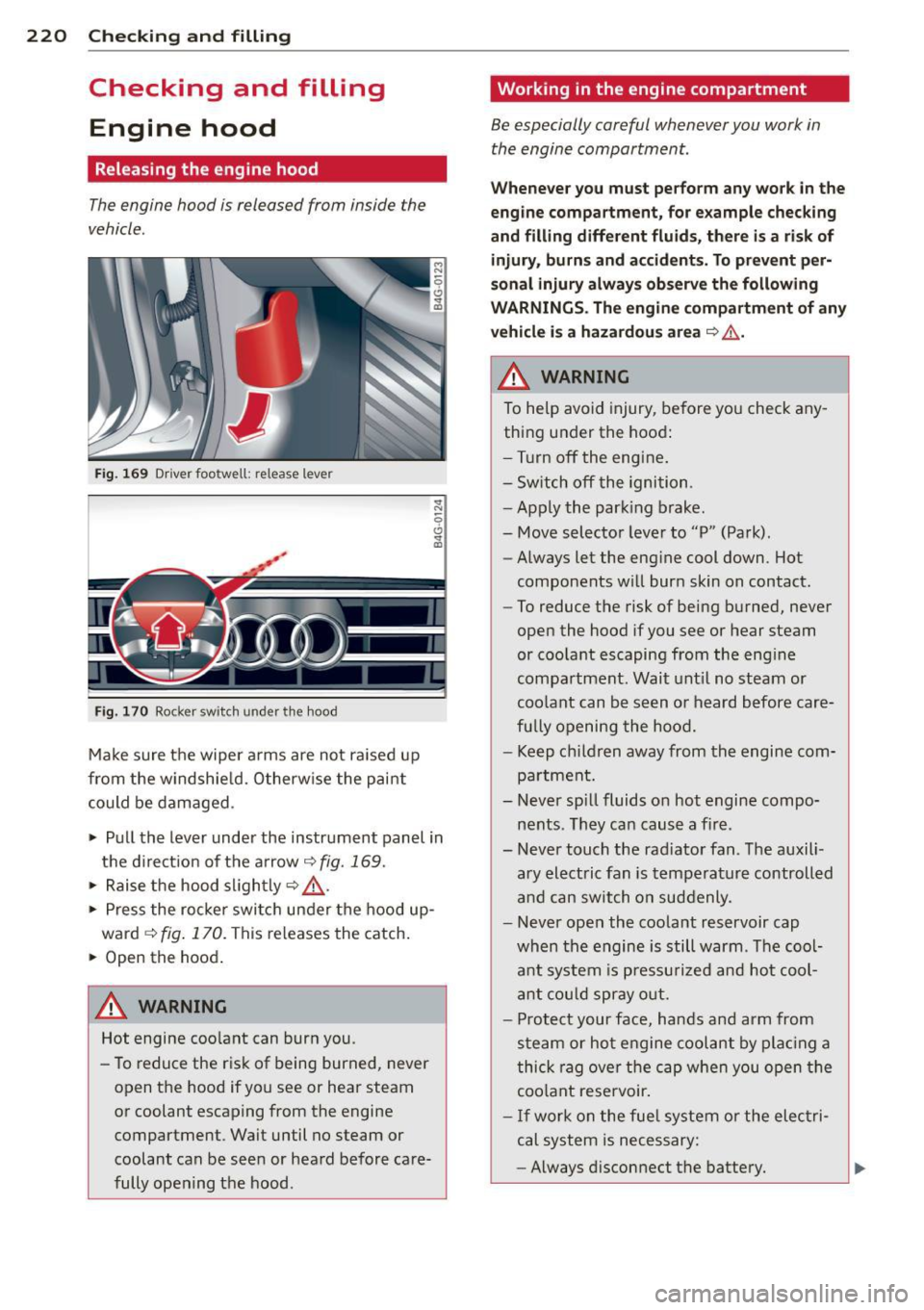
Fig. 169 Driver foo twell: release lever
Fig. 170 Rocker switch un der the hood
Make sure the wiper arms are not raised up
from the windshield. Otherwise the paint
could be damaged .
.,. Pull the lever under the instrument panel in
the direction of the arrow
~ fig. 169.
.,. Raise the hood slightly~.&_ .
... Press the rocker switch under the hood up
ward
~ fig. 170. This releases th e catch.
... Open the hood.
&_ WARNING
Hot engine coolant can burn you.
- To reduce the risk of being burned, never
open the hood if you see or hear steam
or coolant escaping from the engine compartment . Wait until no steam or
coolant can be seen or heard before care
fully opening the hood .
' Working in the engine compartment
Be especially careful whenever you work in
the engine compartment.
Whenever you must perform any work in the
engine compartment, for example checking
and filling different fluids, there is a risk of injury, burns and accidents. To prevent per
sonal injury always observe the following
WARNINGS. The engine compartment of any
vehicle is a hazardous area
~ ,&. .
/n.. WARNING
To help avoid injury, before you check any
thing under the hood:
- Turn off the engine.
- Switch off the ignition .
- Apply the parking brake.
- Move selector lever to "P" (Park) .
- Always let the engine cool down. Hot
components will burn skin on contact.
- To reduce the risk of being burned, never
open the hood if you see or hear steam
or coolant escaping from the engine
compartment. Wait until no steam or
coolant can be seen or heard before care
fully opening the hood.
- Keep children away from the engine com
partment.
- Never spill fluids on hot engine compo
nents . They can cause a fire .
- Never touch the radiator fan. The auxili
ary electric fan is temperature controlled
and can switch on suddenly .
- Never open the coolant reservoir cap
when the engine is still warm . The cool
ant system is pressurized and hot cool
ant could spray out.
- Protect your face, hands and arm from
steam or hot engine coolant by placing a
thick rag over the cap when you open the
coolant reservoir.
- If work on the fuel system or the electri
cal system is necessary:
- Always disconnect the battery.
Page 260 of 298
258 What do I do no w?
• Unhook the ca rgo floor before closing the
rear lid.
Securing the replaced tire
• The fault whee l will not fit inside the spare
wheel wel l. Sto re it in the luggage compart
ment and sec ure it so that it does not slide
¢ page 59.
• Unhook the cargo floor before closing the
rear lid.
U sing the spar e tire (compact spare tir e)
The compact spare tire is on ly intended for
emergencies until you can reach a repair shop.
Replace it as quickly as possible with a stand
ard wheel and tire.
There are some restrictions on the use of the
compact spare tire. The compact spare tire
has been designed specifically for your type of
vehicle. It must not be swapped with a com pact spare t ire from another type of veh icle.
Snow chain s
For technical reasons, the use of snow chains
on the compact spare tire is not permitt ed .
I f you do have to dr ive w ith snow cha ins and a
front tire fails, mo unt the spare wheel w ith
tire instead of a rear t ire. Install the snow
cha ins on the rear tire and use it to rep lace
the defective front tire .
A WARNING
-Never use the spare tire if it is damaged
or if it is worn down to the tread wear in
dicators.
- If the spare tire is more than 6 years o ld,
use it only in an emergency and w ith ex
treme caution and careful driving.
- The spare tire is intended only for tem
porary and short-term use. It should be
replaced as soon as possible w ith the
normal wheel and t ire.
- After mounting the compact spare tire,
the tire pressure must be checked as
soon as poss ible. The tire pressure of the
compact spare tire must be 4.2 bar; oth
erwise, you risk hav ing an accident. -
Do not drive faster than 50 mph (80 km/
h). Yo u risk having an accident.
- Avoid full-thrott le acceleration, heavy
braking, and fast cornering. You risk hav
ing an accident.
- Never drive using more than one spare
wheel and tire. You r isk having an acci
dent.
- Normal summer or winter tires must not
be mounted on the compact spare wheel
rim.
- For technical reasons, the use of tire
chains on the spare tire is not permitted.
If it is necessary to drive with tire chains,
the spare wheel must be mounted on the
front ax le in the event of a flat in a rear
tire. The new ly available front wheel
m ust then be instal led in place of the
rear whee l w ith the flat tire. Installing
the tire chain be fore mounting the whee l
and tire is recommended.
- Loose items in the passenger compart
ment can cause serious personal injury
during hard brak ing or in an accident.
- Never store the inflatable spare t ire or
jack and too ls in the passenger com
partment.
- Always store all jacking equipment,
tools, and the inflatable spare t ire in
the luggage compartment.
- Tighten the knurled retai ning screw for
the inflatable spare tire securely .
Changing a wheel
Before changing a wheel
Observe the following precautions for your
own and your passenger's safety when chang
ing a wheel .
• After you experience a t ire failure, pu ll the
car we ll away from moving traffic and try to
reach level ground before you stop
¢ ,& .
• All passengers should lea ve the car and
move to a safe location (for instance, behind
the guardrail)¢ ,&.
• Engage the parking brake to prevent your
veh icle from rolling unintentionally¢,& . ..,
Page 261 of 298
• Move select or lever to p osition P q ,& .
• If you are towing a trailer, unhitch the trail
er from your veh icle.
• Take the
jack and the spare t ir e out of the
luggage compartment
q page 257,
q page 257.
A WARNING
You or your passengers cou ld be injured
while changing a whee l if you do not fol
low these safety precautions:
- If you have a f lat t ire, move a safe dis
tance off the road. Turn off the eng ine,
turn the emergency f lashers on and use
other warning devices to alert o ther mo
torists.
- Make su re that passengers wait in a safe
pla ce away from the ve hicle and well
away from the road and traffic.
- T o help preven t the veh icle from mov ing
sudden ly and possibly slipping off the
jack, always fully set the parking brake
and block the whee l diagonally opposite
the wheel being changed . When one
front wheel is lifted off the ground, plac
ing the Automat ic Transm iss ion in "P"
(Park) will
not prevent the vehicle from
moving.
- Before you change a wheel, be sure the ground is level and fi rm. If necessa ry,
use a sturdy board under the jack.
- After installing the spa re wheel, make
sure that you replace the flat tire/whee l
in its sto rage area properly and tighten
the kn u rled re taining screw securely.
Changing a wheel
When you change a wheel, follow the se
quence described below step-by-step and in
exa ctly that order .
-
1. Remove the decorati ve wheel cov er* . For
mo re deta ils see also
Q page 260, Deco
rative wheel covers
o r q page 260,
Wheels with wheel bolt caps.
2 . Loosen the wheel b olts q page 260.
What do I do now? 259
3. Locate the proper mounting point for the
4.
5.
6.
7.
8.
9 .
jack and align the jack below that point
q page 261.
Raise the car with the jack q page 261.
Remove the wheel with the flat tire and
then insta ll
th e spare c> page 262.
Tighte n all wheel bolts lightly.
Lower the vehicle wi th the jack.
U se the wheel bolt w rench and
firmly
t ighten a ll wheel bolts q page 260 .
Replace the decora tive wheel co ver*.
A WARNING
A lways read and fo llow all WARNINGS and
informat ion¢
& in Raising the vehicle on
page 261
and r::> page 263.
After changing a wheel
A wheel change is not complete without the
doing the following .
• Replace the too ls and the jac k in their prop
er locat ion .
• The fault whee l wi ll not fit inside the spare
wheel well. Store it in the luggage compart
ment and secure it so that it does not slide
r::>page 59.
• Check the tire pressure on the spare wheel
immed iate ly after mounting it.
• As soon as possib le, have the
tightening
torqu es
on all wheel bolts c hec ked with a
t o rque wrenc h. The co rrec t tighte ning tor
que is
90 ft lb (120 Nm).
• Have the flat tire
replaced as soon as possi
b le.
(D Tips
- I f you not ice that the wheel bo lts a re
corroded and difficult to turn while
changing a tire, they should be rep laced
before you check the tightening torque.
- Drive at reduced speed until you have the
tightening torques checked. ..,_
•
•