ABS AUDI S6 2012 Owner's Manual
[x] Cancel search | Manufacturer: AUDI, Model Year: 2012, Model line: S6, Model: AUDI S6 2012Pages: 298, PDF Size: 74.43 MB
Page 232 of 298
230 Check ing and filling
Before you check anything in the engine com
partment,
always r ea d and heed all W ARN
INGS
¢ A in Working in the engine compart
ment on page 220.
• Read the brake fluid leve l from the brake
fluid reservoir
¢ fig. 175. The brake fluid
l evel must be between the
"MIN" and
"MAX" markings .
The location of the brake fluid reservoir can be
seen in the engine compartment illustration
co page 222.
The fl uid level may drop slightly after some
time due to the automatic adjustment of the brake pads . This is not cause for alarm .
I f the b rake fluid level falls
considerably be
l ow the "MIN" mark, the brake wa rning/indi
cator light- (U.S.
models) ;II (Canadian
models) will come on
¢ page 14. Do not con
tinue to operate the vehicle. The comp lete
brake system shou ld be thoroughly checked
by an authorized Audi dealer or other quali
fied fac il ity and the cause corrected. If the
brake fluid level is too low, the brake warn ing/
i ndicator light w ill illuminate. Contact an au
thor ized Audi dealer
imm ediatel y.
Changing brake fluid
Have the brake fluid changed by an experi
enced technician .
Brake fluid absorbs moistu re from the a ir . If
the water content in the brake fluid is too
h igh, corrosion in the brake system may result
after a per iod of t ime . The bo iling po int of the
b rake fluid w ill also decrease considerably and
dec rease braking per formance.
Therefore, the brake flu id must be changed
ev ery tw o y ear s. Always use new b rake fluid
which confo rms to Fede ral Motor Vehicle
Standard "FMVSS 1 16 DO T 4".
The brake flu id rese rvoi r can be difficult to
r each, therefo re , we re commend that yo u
have the brake fl uid changed by yo ur a utho r
ized
Audi dealer. Your dea ler has the correct tools, the
right brake flu id and t he know -how
to do this for you.
A WARNING
-- Brake flu id is poisonous. It must be stor-
ed only in the closed or igina l container
out of the reach of children!
- Brake failure can resu lt from o ld or inap
propriate brake f lu id. Observe these pre
cautions:
- Use only brake f luid that meets SA E
spe cifi cation
J 17 03 and conforms to
Federa l Motor Vehicle Standard 1 16 .
Always chec k with your authorized A udi
dealer to make sure yo u are using the
correct brake fluid. The cor rect type of
brake flu id is also ind icated on the
brake f lu id reservoir.
- The brake fluid must be new. Heavy use
of the brakes can cause a vapor lock if
the brake fluid is left i n the system too
long . This can se riously affect the effi
c iency of the brakes as well as your
safety . T h is i:ou ld result in an ai;i;ident.
(D Note
Brake fluid will damage the pai nt of you r
vehicle .
@ For the sake of the environment
Because of the prob lem of proper disposal
of brake fluid as well as the spec ial too ls
r equired and the necessary expertise, we
r ecommend that yo u have the brake flu id
changed by yo ur autho rized Aud i dea le r.
Battery
General information
Under normal operat ing cond itions, the bat
te ry in your Audi does not need any ma inte
nance. With
high outside temperatures or
long da ily drives we recommend that you have
the e lectrolyte leve l che cked by a se rv ice fa
c il ity. The electroly te leve l should also be
chec ked each time the battery is cha rged
¢ page 233 .
Page 233 of 298
Have the battery checked when you take your
vehicle in for service. Yo u are well advised to
replace a battery that is older than 5 years .
W ith certa in types o f airbag deployment, the
battery is disconnec ted from the vehicle elec
trica l system for safety reasons
c::> &. in Re
pair, care and disposal of the airbags on
page 158.
Disconn ecting the battery terminal s
Some vehicle functions (power w indow regu
l ators, for example) are lost if the battery ter
minals are disconnected . These functions have
to be re learned after the battery terminals are
connec ted again. To prevent this, the battery
should only be disconnected from the vehicle
e lectrical system when absolutely necessary
for repairs .
Vehicles not driven for long period s
If you do not drive your vehicle over a period
of several days or weeks, electrical compo
nents are gradually cu t back or switched off .
This reduces energy consumption and main
tains starting capability over a longer per iod
c::> page 194. Some of the convenience func
tions may not operate, s uch as the inte rior
lights o r power seat adjus tme nt. The conven
i ence functions will be ava ilable again when
you switch on the ignition and start the en gine.
Winter operation
D uring the winter months, ba ttery capaci ty
t ends to decrease as tempe rat ures d rop . This
is because more powe r is also consumed while
starting , and the headlights, rear window de
fogger, etc., are used more often.
Avoid unnecessary power cons umption, par
ticularly in c ity t ra ff ic or when t raveling on ly
short distances. Let your a uthorized Audi
dealer check the capac ity of the vehicle bat
tery before winter sets inc::>
page 233. A well
charged battery w ill not only prevent starting
problems whe n the weather is cold, but will
also last longer .
Checkin g and fillin g 231
(D Tips
If your vehicle is left standing for seve ral
weeks at extremely low temperatures, the
vehicle battery shou ld be removed and
stored where it w ill not freeze. This will
prevent it from be ing damaged and having
to be replaced .
Working on the battery
Be especially careful when working on or near
the battery.
The battery is located in the l uggage compart
ment under the floor. Before you check any
th ing in the luggage compartment,
read and
h eed all WARNINGS
c::> &_ .
Always heed the safety warnings , when work
ing on the vehicle battery or the vehicle e lec
trical system to prevent injury.
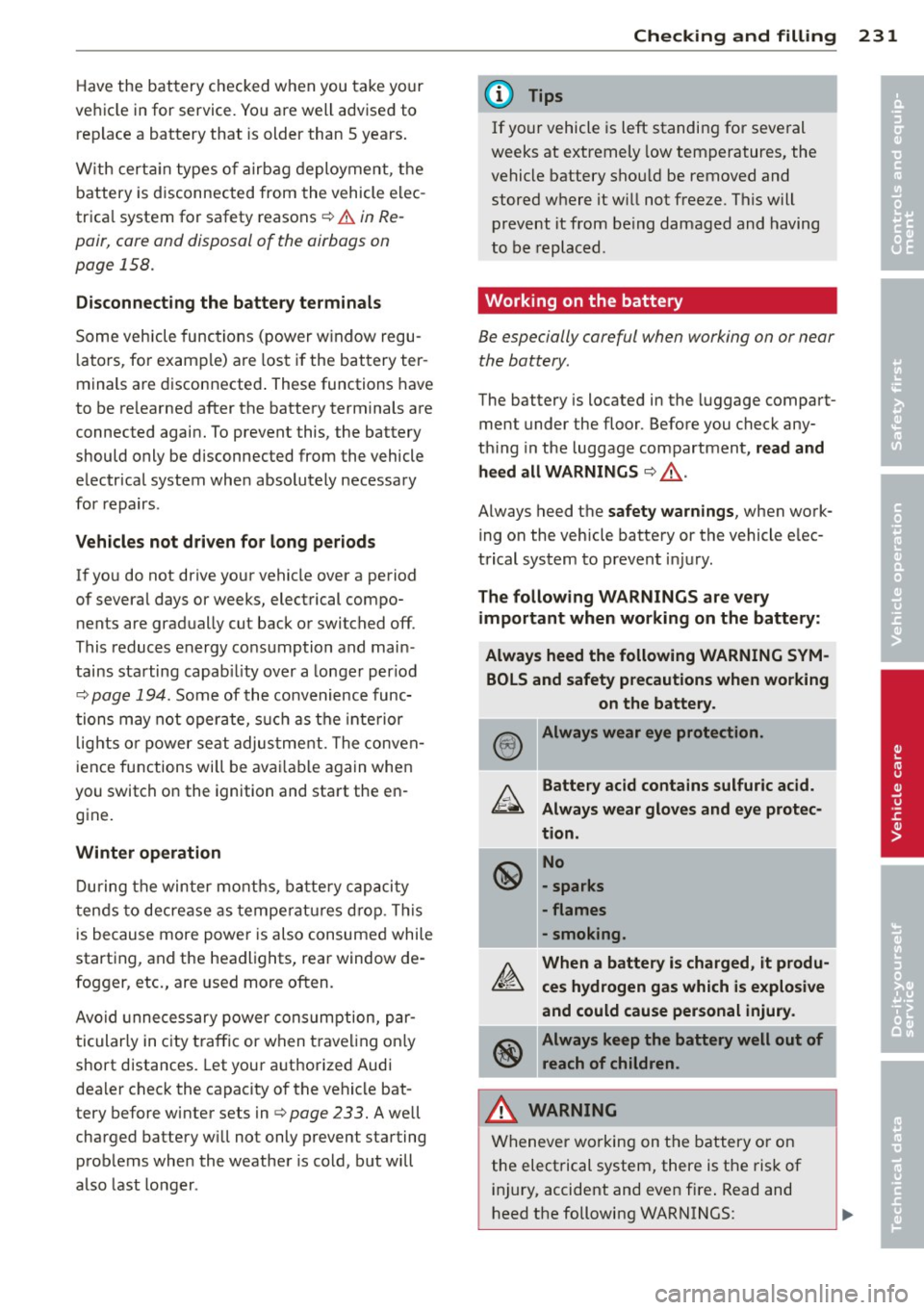
The following WARNINGS are very
important when working on the battery:
Alw ays heed the follo wing WARNING SYM
BOLS and safety precautions when working on the battery.
@
®
Always wear eye protection.
Battery acid contains sulfuric acid.
Always w ear gloves and eye prot ec
tion .
No
- sparks
-flames
- smoking .
When a battery i s charged, it produ
ce s hydrogen gas wh ich is e xplosive
and could cause per sonal injury .
Always keep the battery well out of ]
reach of children .
_& WARNING ~
Whenever working on the battery o r on
the electrical system, there is the risk of injury, accident and even fire . Read and
heed the following WARNINGS:
•
•
Page 256 of 298

254 Tires and wheels
When the malfunction indicator is illuminat
ed, the system may not be able to detect or
signal low tire pressure as intended . TPMS
malfunctions may occur for a variety of rea
sons, including the installation of replace ment or alternate tires or wheels on the vehi
cle that prevent the TPMS from funct ioning
properly . Always check the TPMS malfunction
telltale after replacing one or more t ires or
wheels on your veh icle to ensure that the re
placement or alternate tires and wheels allow
the TPMS to continue to function properly.
Tire pressure indicator appears
Applies to vehicles: with tire p ressure mo nitoring syste m
The tire pressure indicator in the instrument
cluster informs you if the tire pressure is too
low or if there is a system malfunction.
Fig. 183 Display : underinflatio n warning
Fig. 184 Display : Syste m mal functio n
Using the ABS sensors, the tire pressure moni
toring system compares the tire tread circum
ference and vibration characteristics of the in
d ividual tires. If the pressure decreases in one
or more tires, th is is indicated in the instru
ment cluster with a warning symbol
'9] and a
message
<=>fig . 183.
The tire pressure monitoring system must be
reset via MMI each time the pressures are ad- justed
(e.g. when switching between partial
and full load pressure) or after changing or re
placing a tire on your vehicle <=>
page 255. You
can find the recommended tire pressures for
your vehicle on the label on driver' s side B-pil
lar
<=> page 239 .
Tire tread circumference and vibration charac
teristics can change and cause a tire pressure
warning if:
- the tire pressure in one or more tires is too
low,
- the tire has structural damage,
- the tire pressure was changed, wheels rotat -
ed or replaced but the TPMS was not reset
<=> page 255.
Warning symbols
'9] Loss of pressu re in at least one t ire r=> & .
Check the tire or tires and replace or repa ir if
necessary. The indicator light
'9] in the instru
ment cluster also illuminates
<=>page 12 .
Check/correct the pressures of all four tires
and reset TPMS via MMI.
••MIS, ( Ti re Pressure Monitoring System) Tire
pressure! System malfunction .
If IIMIS, appears after switching the ignition
on or while driving
r::!> fig. 184 and the indica
tor light
'9] in the instrument cluster blinks
f or approximately one minute and then stays
on, there is a system malfunction . See your
authorized Audi dealer as soon as possible .
A WARNING
--If the tire pressure indicator appears in
the instrument cluster display, one or more of your tires is significant ly under
inflated. Reduce your speed immediately
and avoid any hard steer ing or braking
maneuvers. Stop as soon as possible and
check the tires and their pressures. In
flate the tire pressure to the proper pres
sure as indicated on the vehicle's tire
pressure label
<=>page 239. Driving on a
significantly under- inflated tire causes
the tire to overheat and can lead to tire
failure. Under-inflation also is likely to
Page 257 of 298
impair the vehicle's handling and stop
ping ability.
- The driver is responsible for maintaining
the correct tire pressures. You must
check the tire pressures regularly.
- Under certain conditions (such as a spor
ty driving style, winter conditions or un paved roads), the pressure monitor indi
cator may be delayed.
- Ask your authorized Audi dealer if run
flat tires may be used on your vehicle.
Your vehicle registration becomes invalid
if you use these tires when not permit
ted. Damage to your vehicle or accidents could also result.
(0 Tips
- The tire pressure monitoring system stops working when there is an ESP/ABS malfunction.
- Using snow chains may result in a system malfunction .
- To ensure a proper TPMS function use
AUDI Original Tires which are marked
with "AO" or "RO" on the tire sidewall.
¢page 246.
-The tire pressure monitoring system on
your Audi was syntonized using tires with
the "AO" or "RO " identification. We rec
ommend using these tires.
Reset tire pressure monitoring system
Applies to vehicles: with tire pressure monito ring system
If the tire pressure is adjusted, wheels are ro
tated or changed, the TPMS must be reset via
MMI.
"' Switch on the ignition.
"' Select in the MMI: !CAR !function button>
Car systems control button > Servicing &
checks > Tire pressure monitoring > Store
tire pressures> Yes, store now.
@ Tips
Before resetting the TPMS, the current
pressures of all four tires must correspond
to the specified values. Adjust the tire
Tires and wheels 255
pressure and reset the pressure in the tire
pressure monitoring system according to
the load you are carrying
c::!;> page 239.
- Do not store the tire pressures if you are
driving with snow chains. Otherwise , a
system malfunction may occur.
•
•
Page 295 of 298
Tire pressure monitoring system .... .. . 253
Loss of air pressure .......... ... .. . 254
Malfunct ion ..... ....... .... ... .. . 254
Resetting tire pressures .... .. .. .. .. . 255
Tires .. .... .. .. ............. .. .. ... 235
Service life . . . . . . . . . . . . . . . . . . . . . . . 245
Speed rating letter code ............ 247
T ire manufacturing date ............ 247
Tire specifications ........ .. .. .. .. . 247
Tread depth ............. .... .. ... 245
Uniform tire quality grading .. .. ... .. 249
W inter t ires ..... .. ...... .. .. .. .. . 250
T ires and vehicle load limits ... ... .. .. . 243
Tires and wheels Checking tire pressure ..... .. .. .. .. . 241
Cold tire inflation pressure ....... .. . 239
Dimensions ................. ... ... 246
General notes .................. ... 23S
Glossary of tire and loading terminolo-
gy .. .. ... . .... ............. .. .. . 236
Low aspect ratio tires ...... .. .. .. .. . 252
New tires and wheels ......... .... .. 246
Replacing ............ ...... .... .. 247
Snow chains ............. .... .. ... 251
Tires and vehicle load lim its .. .. .. .. . 243
Wheel bolts ............. .. .. .. .. . 252
Winter tires ................ ... ... 250
Tire serv ice life ............. ... ... .. 245
T ools . .... .. .. ............. .. .. ... 257
Torn or frayed safety belts ..... .. .. .. . 136
T ouch-up paint ............. ... ... .. 208
Towing Tow truck procedures ......... ..... . 270
TPMS Tire pressure monitoring system .. .. . 254
Trailer towing ................ ... ... 201
Operating instructions ..... .. .. .. .. . 201
Technical requirements . . . . . . . . 201, 202
Trailer towing tips ........ .. .. .. .. . 202
Transmission multitronic ........... ...... .... .. 101
tiptronic . . . . . . . . . . . . . . . . . . . . . . . . . 106
T ransmission ma lfunction (indicator
light) . . . . . . . . . . . . . . . . . . . . . . . . 106, 111
Transport Canada .................. . 131
Tread Wear Indicator (TWI) ...... . ... . 245
Inde x 293
Trip odometer ..... .................. 26
What does it mean when DEF appears in
the tr ip odometer display? ........ .. . 26
T runk
refer to Luggage compartment ... .. .. . 59
Trunk escape handle ..... ....... .... . 256
Trunk lid
refer to Rear lid . . . . . . . . . . . . . . . . . . . . 36
T urn signals . .. .. .. .... ........... .. . 43
Warning/indicator lights ............. 22
u
Undercoating ... .. ................. 209
Unfastening safety belts ............. 138
Unidirectional tires ... ............... 235
Uniform tire quality grading .......... 249
Unlocking Power locking switch ........... .... . 35
Remote control . . . . . . . . . . . . . . . . . . . . 34
Using the key .. ... ...... ........... 35
V
Valet parking . . . . . . . . . . . . . . . . . . . . . . . . 38
Vanity mirrors ..... .................. 45
Vehicle-care products .. .. .... ........ 204
Vehicle electrical system . . . . . . . . . . . . . . 17
Vehicle identification label .......... .. 274
Vehicle Identification Number (VIN) .. .. 274
Vehicle jack .......... ......... 257,261
Vehicle literature ...... ......... .. .. .. 5
Ventilation . . . . . . . . . . . . . . . . . . . . . . . . . 63
w
Warning/indicator lights . . . . . . . . . . . . . . 12
Airbag system . .. .. ............... . 18
Anti-lock braking system (ABS) ... .. .. . 19
Brake system . . . . . . . . . . . . . . . . . . . . . . 14
Cruise control . . . . . . . . . . . . . . . . . . . . . . 22
Electromechanical parking brake ... .. . 16
Electronic power control . . . . . . . . . . . . . 20
Electronic stabilization program (ESP) . . 19
Generator . . . . . . . . . . . . . . . . . . . . . . . . . 17
Instrument cluster . . . . . . . . . . . . . . . . . . 11
Malfunction Indicator Lamp (MIL) ... .. 20
•
•