ignition AUDI S6 2012 Repair Manual
[x] Cancel search | Manufacturer: AUDI, Model Year: 2012, Model line: S6, Model: AUDI S6 2012Pages: 298, PDF Size: 74.43 MB
Page 233 of 298
Have the battery checked when you take your
vehicle in for service. Yo u are well advised to
replace a battery that is older than 5 years .
W ith certa in types o f airbag deployment, the
battery is disconnec ted from the vehicle elec
trica l system for safety reasons
c::> &. in Re
pair, care and disposal of the airbags on
page 158.
Disconn ecting the battery terminal s
Some vehicle functions (power w indow regu
l ators, for example) are lost if the battery ter
minals are disconnected . These functions have
to be re learned after the battery terminals are
connec ted again. To prevent this, the battery
should only be disconnected from the vehicle
e lectrical system when absolutely necessary
for repairs .
Vehicles not driven for long period s
If you do not drive your vehicle over a period
of several days or weeks, electrical compo
nents are gradually cu t back or switched off .
This reduces energy consumption and main
tains starting capability over a longer per iod
c::> page 194. Some of the convenience func
tions may not operate, s uch as the inte rior
lights o r power seat adjus tme nt. The conven
i ence functions will be ava ilable again when
you switch on the ignition and start the en gine.
Winter operation
D uring the winter months, ba ttery capaci ty
t ends to decrease as tempe rat ures d rop . This
is because more powe r is also consumed while
starting , and the headlights, rear window de
fogger, etc., are used more often.
Avoid unnecessary power cons umption, par
ticularly in c ity t ra ff ic or when t raveling on ly
short distances. Let your a uthorized Audi
dealer check the capac ity of the vehicle bat
tery before winter sets inc::>
page 233. A well
charged battery w ill not only prevent starting
problems whe n the weather is cold, but will
also last longer .
Checkin g and fillin g 231
(D Tips
If your vehicle is left standing for seve ral
weeks at extremely low temperatures, the
vehicle battery shou ld be removed and
stored where it w ill not freeze. This will
prevent it from be ing damaged and having
to be replaced .
Working on the battery
Be especially careful when working on or near
the battery.
The battery is located in the l uggage compart
ment under the floor. Before you check any
th ing in the luggage compartment,
read and
h eed all WARNINGS
c::> &_ .
Always heed the safety warnings , when work
ing on the vehicle battery or the vehicle e lec
trical system to prevent injury.
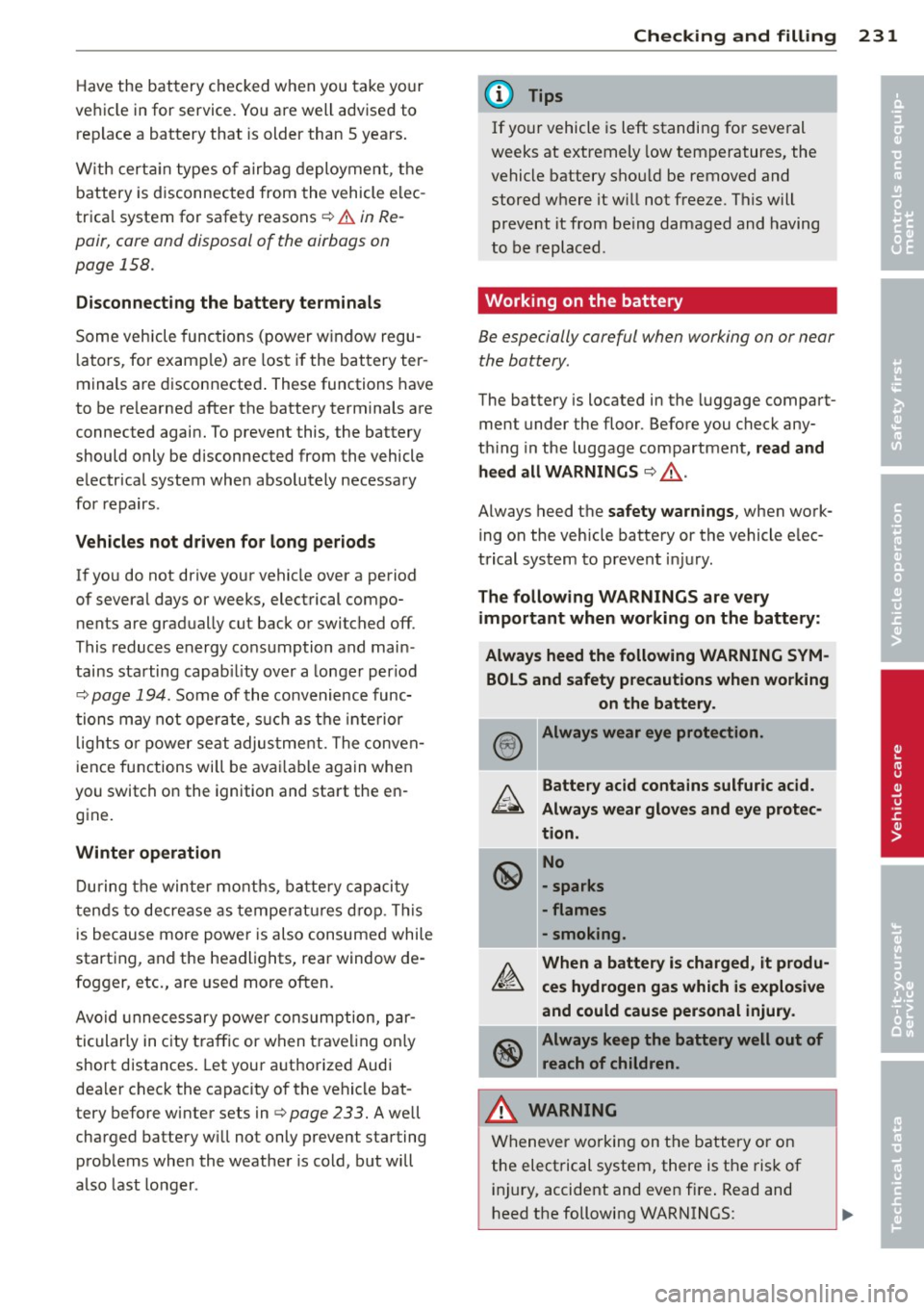
The following WARNINGS are very
important when working on the battery:
Alw ays heed the follo wing WARNING SYM
BOLS and safety precautions when working on the battery.
@
®
Always wear eye protection.
Battery acid contains sulfuric acid.
Always w ear gloves and eye prot ec
tion .
No
- sparks
-flames
- smoking .
When a battery i s charged, it produ
ce s hydrogen gas wh ich is e xplosive
and could cause per sonal injury .
Always keep the battery well out of ]
reach of children .
_& WARNING ~
Whenever working on the battery o r on
the electrical system, there is the risk of injury, accident and even fire . Read and
heed the following WARNINGS:
•
•
Page 234 of 298

232 Checking and filling
-Always wear eye protection. Do not let
battery acid or any lead particles get on
your skin or clothing . Shield your eyes .
Explosive gases can cause blindness or
other injury .
- Battery acid contains sulfuric acid . Sulfu
ric acid can cause blindness and severe
burns .
- Always wear gloves and eye protection.
Do not tilt the battery because acid
could leak out of the ventilation open
ings.
- If you get battery acid in your eyes or
on your skin, immediately rinse with
cold water for several minutes and get
medical attention .
- If you should ingest any battery acid,
seek medical attention immediately.
- Do not expose the battery to an open
flame, electric sparks or an open light.
- Do not smoke.
- Do not interchange the positive and neg-
ative cables.
= When working on the battery , be sure
not to short-circuit the terminals with
tools or other metal objects. This would cause the battery to heat up very quickly,
which could lead to damage or explosion
and personal injury.
- When a battery is charged, it produces hydrogen gas which is explosive and
could cause personal injury .
- Always keep the battery well out of the
reach of children .
- Before work is done on the electrical sys tem, disconnect the negative ground cable.
- Before performing any work on the elec
trical system, switch
off the engine and
ignition as well as any electrical equip
ment . The negative cable on the battery
must be disconnected . If you are just go
ing to replace a light bulb, then it is
enough to switch
off the lights.
- Before disconnecting the battery, switch
off the anti-theft alarm system! Other
wise you will set off the alarm. -
When disconnecting the battery, first
disconnect the negative cable and then
the positive cable.
- Before reconnecting the battery, make
sure all electrical consumers are switch
ed off. Reconnect the positive cable first
and then the negative cable . Never inter
change the cables - this could start a fire!
- Never charge a frozen or a thawed-out
battery .
It could explode! If a battery has
frozen, then it must be replaced . A dis
charged battery can freeze over at 32 °F
(0 °C) .
-Make sure the vent hose is always attach
ed to the opening on the side of the bat
tery .
- Never use batteries which are damaged.
There is the danger of an explosion! Al
ways replace a damaged battery.
A WARNING
California Proposition 6S Warning:
- Battery posts, terminals and related ac
cessories contain lead and lead com
pounds, chemicals known to the State of
California to cause cancer and reproduc
tive problems. Wash hands after han
dling.
(D Note
- Do not disconnect the vehicle battery
when the ignition is on or when the en gine is running, otherwise, you will dam
age electronic components in the electri
cal system.
- If your vehicle is going to stand for a
long period of time without being driven,
protect the battery from "freezing", oth
erwise it will be damaged and will then
have to be replaced .
Page 256 of 298

254 Tires and wheels
When the malfunction indicator is illuminat
ed, the system may not be able to detect or
signal low tire pressure as intended . TPMS
malfunctions may occur for a variety of rea
sons, including the installation of replace ment or alternate tires or wheels on the vehi
cle that prevent the TPMS from funct ioning
properly . Always check the TPMS malfunction
telltale after replacing one or more t ires or
wheels on your veh icle to ensure that the re
placement or alternate tires and wheels allow
the TPMS to continue to function properly.
Tire pressure indicator appears
Applies to vehicles: with tire p ressure mo nitoring syste m
The tire pressure indicator in the instrument
cluster informs you if the tire pressure is too
low or if there is a system malfunction.
Fig. 183 Display : underinflatio n warning
Fig. 184 Display : Syste m mal functio n
Using the ABS sensors, the tire pressure moni
toring system compares the tire tread circum
ference and vibration characteristics of the in
d ividual tires. If the pressure decreases in one
or more tires, th is is indicated in the instru
ment cluster with a warning symbol
'9] and a
message
<=>fig . 183.
The tire pressure monitoring system must be
reset via MMI each time the pressures are ad- justed
(e.g. when switching between partial
and full load pressure) or after changing or re
placing a tire on your vehicle <=>
page 255. You
can find the recommended tire pressures for
your vehicle on the label on driver' s side B-pil
lar
<=> page 239 .
Tire tread circumference and vibration charac
teristics can change and cause a tire pressure
warning if:
- the tire pressure in one or more tires is too
low,
- the tire has structural damage,
- the tire pressure was changed, wheels rotat -
ed or replaced but the TPMS was not reset
<=> page 255.
Warning symbols
'9] Loss of pressu re in at least one t ire r=> & .
Check the tire or tires and replace or repa ir if
necessary. The indicator light
'9] in the instru
ment cluster also illuminates
<=>page 12 .
Check/correct the pressures of all four tires
and reset TPMS via MMI.
••MIS, ( Ti re Pressure Monitoring System) Tire
pressure! System malfunction .
If IIMIS, appears after switching the ignition
on or while driving
r::!> fig. 184 and the indica
tor light
'9] in the instrument cluster blinks
f or approximately one minute and then stays
on, there is a system malfunction . See your
authorized Audi dealer as soon as possible .
A WARNING
--If the tire pressure indicator appears in
the instrument cluster display, one or more of your tires is significant ly under
inflated. Reduce your speed immediately
and avoid any hard steer ing or braking
maneuvers. Stop as soon as possible and
check the tires and their pressures. In
flate the tire pressure to the proper pres
sure as indicated on the vehicle's tire
pressure label
<=>page 239. Driving on a
significantly under- inflated tire causes
the tire to overheat and can lead to tire
failure. Under-inflation also is likely to
Page 257 of 298
impair the vehicle's handling and stop
ping ability.
- The driver is responsible for maintaining
the correct tire pressures. You must
check the tire pressures regularly.
- Under certain conditions (such as a spor
ty driving style, winter conditions or un paved roads), the pressure monitor indi
cator may be delayed.
- Ask your authorized Audi dealer if run
flat tires may be used on your vehicle.
Your vehicle registration becomes invalid
if you use these tires when not permit
ted. Damage to your vehicle or accidents could also result.
(0 Tips
- The tire pressure monitoring system stops working when there is an ESP/ABS malfunction.
- Using snow chains may result in a system malfunction .
- To ensure a proper TPMS function use
AUDI Original Tires which are marked
with "AO" or "RO" on the tire sidewall.
¢page 246.
-The tire pressure monitoring system on
your Audi was syntonized using tires with
the "AO" or "RO " identification. We rec
ommend using these tires.
Reset tire pressure monitoring system
Applies to vehicles: with tire pressure monito ring system
If the tire pressure is adjusted, wheels are ro
tated or changed, the TPMS must be reset via
MMI.
"' Switch on the ignition.
"' Select in the MMI: !CAR !function button>
Car systems control button > Servicing &
checks > Tire pressure monitoring > Store
tire pressures> Yes, store now.
@ Tips
Before resetting the TPMS, the current
pressures of all four tires must correspond
to the specified values. Adjust the tire
Tires and wheels 255
pressure and reset the pressure in the tire
pressure monitoring system according to
the load you are carrying
c::!;> page 239.
- Do not store the tire pressures if you are
driving with snow chains. Otherwise , a
system malfunction may occur.
•
•
Page 266 of 298
264 Fuses and bulbs
Fuses and bulbs
Fuses
Replacing fuses
Fuses that have blown will have metal strips
that have burned through.
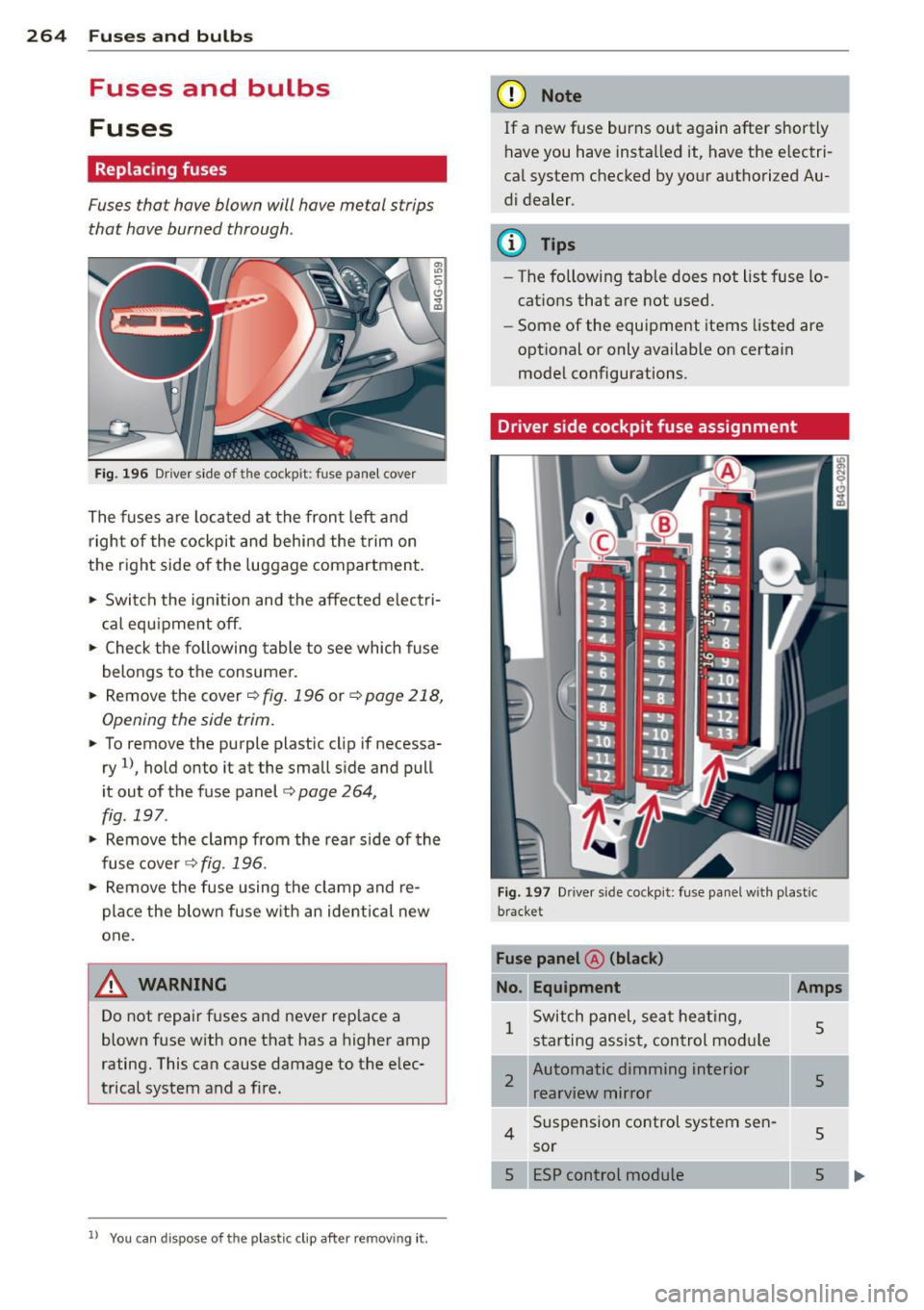
Fig. 196 Driver side of the cockpit: fuse panel cover
The fuses are located at the front left and
right of the cockpit and behind the trim on
the right side of the luggage compartment.
• Switch the ignition and the affected electri
cal equ ipment off.
• Check the following table to see which fuse
belongs to the consumer.
• Remove the cover ¢
fig. 196 or¢ page 218,
Opening the side trim.
• To remove the purple plastic cl ip if necessa
ry
ll, hold onto it at the small side and pull
it out of the fuse panel
c:> page 264,
fig. 197 .
• Remove the clamp from the rear side of the
fuse cover <>
fig. 196 .
• Remove the fuse using the clamp and re
place the blown fuse w ith an ident ical new
one.
A WARNING
Do not repair fuses and never replace a
blown fuse with one that has a higher amp
rating. This can cause damage to the elec
trical system and a fire.
ll You can dis pose of the plastic clip after re moving it.
(D Note
If a new fuse burns out again after shortly
have you have installed it, have the electri
cal system checked by your authorized Au
di dealer .
(D Tips
-The following table does not list fuse lo
cations that are not used.
- Some of the equipment items listed are
optional or only available on certain
model configurations.
Driver side cockpit fuse assignment
Fig. 197 Drive r side cockpit: fuse panel with plastic
bracket
Fuse panel @ (black)
No. Equipment Amps
1
Switch panel, seat heating,
5 starting assist, control module
2
Automatic dimming interior
s rearview mirror
4
Suspension control system sen-
5 sor
ESP control module
5
Page 268 of 298
266 Fuses a nd bulb s
Fuse panel @ (black )
No . Equ ipment Amps
=
8
Headlight range adjustment/
5/7,5
adaptive lighting system
10 Left headlight (headlight with
7,5
adaptive light)
Fuse p anel
@ (brown )
No .II Equ ipm ent
II Amp s
1 Climate control 10
2 Climate control system blower 40
3 Diagnostic connector 10
4 Electrical ignition lock 5
5 Power steering column adjust-
ment
5
Steering column switch module 10
7 Power steer
ing column adjust-
ment 25
8 Light switch
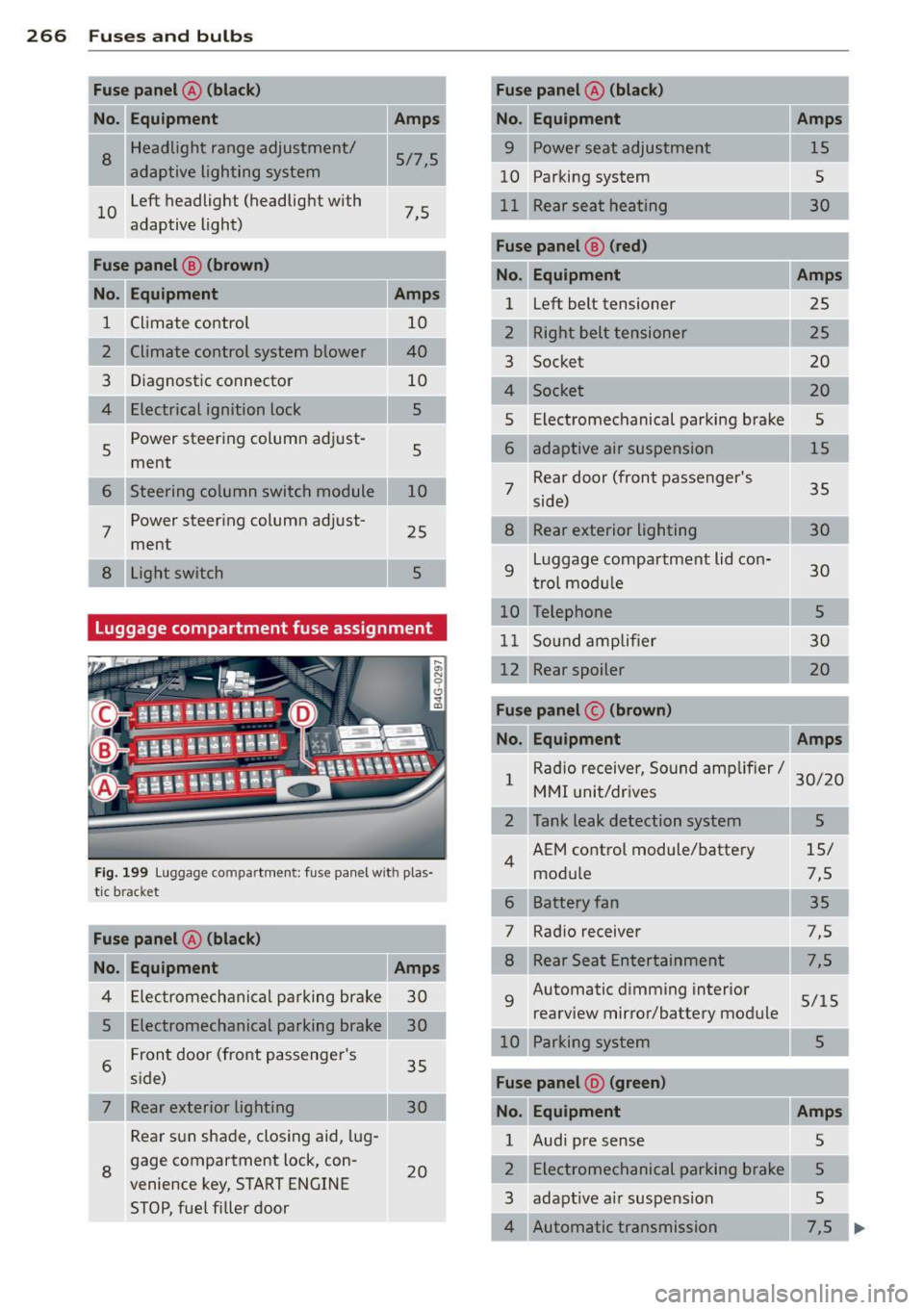
Luggage compartment fuse assignment
Fig. 199 Luggage compartment: fuse panel with plas·
tic bracket
Fuse panel @ (bl ack )
No. II Equipment
I[ Amp s
4 E lectromechanical parking brake 30
5 Electromechanical parking brake 30
6 Front door (front passenger's
35
side)
7 Rear exterior lighting Rear sun shade, closing aid, lug
s gage compartment lock, con
venience key, START ENGINE
STOP, fuel filler door 30
20
-Fuse pane
l@ (blac k) I
No. Equipm ent Amps
=· 9 Power seat adjustment 15
10 Parking system
s
30
Fus e pane l
B (red)
No . Equipment Amps
1 Left belt tensioner
25
Right belt tensioner 25
3 Socket 20
20
Electromechanical parking brake
5
adaptive air suspension 15
7 Rear door (front passenger's
35
side)
Rear exterior lighting 30
9
Luggage compartment lid con-
30
t rol module
10 Telephone 5
11 Sound amp lifier 30
12 Rear spoiler 20
Fuse pane l c (b rown )
No. Equipment Amps
1 Rad
io receiver, Sound amplif ier/
30/20
MMI unit/dr ives
2 Tank leak detection system 5
AEM control module/battery 15/
4
module 7,5
6 Battery fan 35
Rad io receiver
7,5
7,5
9
Automatic dimming interior
5/15
rearview mirror/battery module
Parking system 5
Fu se pan el o (gre en)
No. Equipment Amps
1 Audi pre sense 5
2 Electromechanical parking brake 5
3 adaptive a
ir suspension
5
Automatic transmission 7,5
...
Page 276 of 298

2 7 4 General information
General information
Explanation of
technical data
Some of the technical data listed in this man
ual requires further explanation .
The technical data for your vehicle is listed in
the charts starting on
r:::> page 2 76. This sec ·
tion provides general information, notes and restrictions which apply to this data .
Vehicle identification
The key data is given on the vehicle identifica·
tion number (VIN) plate and the vehicle data
sticker.
Fig. 209 Veh icle Ide ntific atio n Number (VlN) p late: lo
cation on driver 's sid e das h panel
Fig. 210 Th e vehicle identi fication label -inside the
luggage co mpa rtmen t
The Vehicle Identification Number (VIN)
is located on the driver's side so that it is visi
b le from the outside through the windshield
r:::> fig . 209. You can also display the Vehicle
Identification Number of your vehicle in the
MMI. Select: Function button
ICAR ! > Car sys
tems
> VIN number . The
vehicle identification label
is located in the luggage compartment in the
spare wheel wel l.
The label¢
fig. 210 shows the following vehi
cle data :
(D Production control No .
@ Vehicle identification No.
® Type code number
@ Type designation/engine output in Kilo·
watts
® Engine and transmission code letter
@ Paint No./Interior
(f) Optional equipment No.'s
Vehicle data 2 to 7 are also found in your War·
ranty
& Maintenance booklet.
The safety compliance sticker
is you r assurance that your new vehicle com
plies with all applicable Federal Motor Vehicle
Safety Standards which were in effect at the
time the vehicle was manufactured . You can
find this sticker on the left door jamb.
It
shows the month and year of production and
the ve hicle ident ification number of your vehi ·
cle (perforation) as well as the Gross Vehicle
Weight Rating (GVWR) and the Gross Axle
Weight Rating (GAWR) .
The high voltage warning label
is located on the lock carr ier .
The spark ignition system complies with
the Canadian standard ICES-002.
Weights
Gross Vehicle Weight Rating
The Gross Vehicle Weight Rating (GVWR), and
the Gross Axle Weight Rating (GAWR) for
front and rear are Listed on a sticker on the
left door jamb.
The Gross Vehicle Weight Rating includes the
weight of the basic vehicle plus full fuel tank,
oi l and coolant, plus maximum load, wh ich in·
eludes passenger weight (lSO lbs/68 kg per
Ill>
Page 281 of 298

complexity of today's automobi les, have
steadi ly reduced the scope of maintenance
and repairs which can be carried out by vehicle
owners.
Also, safe ty and e nvir onm en tal con
cerns p lace very strict limits on the na ture of
repairs and adjustments to engine and trans
miss io n pa rts which an owner can perform .
Maintenance, adjustments and repa irs usua lly
require special tools, testing dev ices and oth
er equipment avai lab le to specially trained
workshop personnel in order to assure prope r
performance, reliab ility and safety of the vehi
cle and its many systems .
Improper ma intenance, adjustments and re
pa irs can impair the operation and reliability
of your vehicle and even void your vehicle war ranty. The refo re, p roof of servici ng in accord
ance w ith the maintenance sched ule may be a
condition for upholding a poss ible war ranty
claim made within the warranty period.
Above all, operational safety can be adversely
affected, crea ting unnecessary risks for you
and your passengers.
If in doubt about any servicing, have it done
by your authorized Audi dealer or any other
properly equipped and q ualified workshop .
We strong ly urge you to give you r a uthorized
Audi dealer the opportunity to perform all
schedu led maintenance and necessary repairs .
Your dea ler has the facilities, or iginal parts
and trained spec ialists to keep your vehicle
running properly .
Performing limit ed m aintenance you rself
The fo llowing pages describe a limited num
ber of procedures which can be performed on
your vehicle with ordinary too ls, should the
need arise and trained personnel be unavaila
b le. Before performing any of these proce
dures, always thoroughly read all of the app li
cable text and carefully follow the instruc
tions given . Always rigorously obse rve the
WARNINGS provided .
Before you check anything in th e engine
compartment, a lway s re ad and heed all
Con sumer In formation 2 79
WARNINGS ¢ & and ¢ & in Working in the
engine comportment on page 220 .
A WARNING
-Ser ious personal injury may occur as a re
sult of improperly performed mainte nance, adjustments or repa irs.
-Always be extremely careful when work ing on the vehicle. Always follow com
mon ly accepted safety pract ices and gen
eral common sense . Never r isk personal
lnJU ry .
- Do not attempt any of the ma intenance ,
checks or repairs descr ibed on the fol
lowing pages if you are not fully fam iliar
wit h these or othe r pro cedures with re
spect to t he veh icle, or are uncerta in how
to p roceed .
- Do not do any work without the proper
too ls and equipment. Have the necessary
work done by your authorized A udi deal
er or another proper ly equipped and
qualified workshop .
- The engine compartment o f any motor
veh icle is a potentially hazardous area.
Never reach into the area around or
touch the rad iator fan. It is temperature
contro lled and can switch on suddenly -
even when the engine is
off . The radiator
fan switches on automat ically when the
coo lant reaches a certai n temperature
a nd will cont inue to run until the coo lan t
temper ature drops.
- Always sw itch
off the ignition before any
one gets under the vehicle.
- Always support your veh icle with safety
stands if it is necessary to work under
neath the vehicle . The j ack s upplied with
the vehicle is not adequate for this pur
pose and cou ld co llapse causing serio us
personal i njury .
-If you must work unde rneath the vehicle
with the wheels on the ground, a lways
make sure the vehicle is on leve l ground,
that the wheels are a lways securely
blocked and that the engine cannot be
started.
•
•
Page 287 of 298
Child safety . ... .... .... ... .. .. .. ... 168
Convertible locking retractor . . . . . . . . . 179
Important safety instructions fo r using
chi ld safety seats . . . . . . . . . . . . . . . . . . 17 2
Important things to know when dr iv ing
with chi ldren ............... ... ... 168
Tether anchors ... .. ...... .. .. .. .. . 185
Tet her straps ......... ...... .... .. 185
Ch ild safety lock
Reardoo~ .............. .... .. .... 37
Ch ild safety sea ts ....... ... .. .. .. ... 174
Booster seats .... ..... ... .. .. .. ... 177
Convertible c hild seats . ... .. .. .. .. . 175
Convertible locking retractor .. .. .. .. . 179
H ow do I properly install a child safety
seat in my vehicle? ............ ... .. 172
Infant seats . . . . . . . . . . . . . . . . . . . . . . 17 4
Install ing .. ................ ... ... 179
I nstal ling a chi ld restraint using the
L A T C H sys tem . . . . . . . . . . . . . . . . . . . . . 184
L A TCH sys tem ............ .. .. .. .. . 184
L owe r ancho rages ..... ... .. .. .. .. . 183
M ounting and releasing the ancho rage
hook .... .. .. .. ........... .. .. ... 184
Safety instructions ........ .. .. .. .. . 172
C igare tte lig hte r . . . . . . . . . . . . . . . . . . . . . 54
C lea ning and protection .......... .... 204
A lcantara (synthet ic suede) ..... ... .. 213
E ng ine compartment ...... .. .. .. .. . 214
E xha ust tail pipes ......... .. .. .. .. . 210
Fa brics and fabr ic coverings .. .. .. .. . 210
I ns trumen t panel . ..... ... .. .. .. .. . 2 11
Interior . . . . . . . . . . . . . . . . . . . . . . . . . . 210
L eather .... .. .... .... ... .. .. .. ... 212
MMI disp lay/controls ...... .. .. .. .. . 210
P lastic and v inyl .......... .. .. .. .. . 207
Plastic pa rts ... .. .. ...... .. .. .. .. . 211
Safety belts . . . . . . . . . . . . . . . . . . . . . . 213
tr im str ips .... ........... ... ... .. 208
T rim str ips . ............. .... .. ... 207
Climate control Air vents . ................ ... ... ... 65
Climate controls . . . . . . . . . . . . . . . . . . . . . 63
Climate con trol (four-zone)
Opera tion . . . . . . . . . . . . . . . . . . . . . . . . . 66
Climate control (three-zone) Operation . . . . . . . . . . . . . . . . . . . . . . . . . 64
C lock ..... .. .. ... .. ..... ... .. .. .... 26
Inde x 285
Closing
Sliding/ti lting s unroof ... .... ... .. .. . 39
Cold tire infla tion p ress ure ............ 239
Coming home . .. .. ................. . 43
Compac t spa re tire ... . ... .... ... .. .. 257
Compartments . . . . . . . . . . . . . . . . . . . . . . 55
Compliance ... .. .. .. . .. ... .... ... .. 281
Consumer Informa tion.......... 131, 278
Consumption (fuel) .. . ... .... ... .. .. . 24
Contacting NHTSA ... . .. ..... ... .. .. 131
Convenience key . . . . . . . . . . . . . . . . . . . . . 34
Star ting t he engine . . . . . . . . . . . . . . . . . 70
Stopping the eng ine (S TAR T E NGINE
S TOP b utton) . . . . . . . . . . . . . . . . . . . . . . 72
Switching the ignition on .... ... .. .. . 70
U nlocking and loc kin g vehicle . ... .. .. . 34
Conve rtib le child safe ty seats ..... .... 175
Convertib le loc king retractor
Activating . . . . . . . . . . . . . . . . . . . . . . . . 181
Deact ivat ing . .. .. .. . .. .... .... .. .. 182
U si ng to secure a child safety seat 1.79, 181
Coolant
refer to E ng ine coolant ......... .... 227
Cooling mode (automat ic climate control) 66
Cooling mode (climate control) . . . . . . . . . 64
Cornering light .. .. ................. . 95
Cruise cont ro l
Changi ng speed . ... . .. ..... ... .. .. . 76
Presetting your speed ... .... ... .. .. . 77
Switching off . . . . . . . . . . . . . . . . . . . . . . 77
Switching on . . . . . . . . . . . . . . . . . . . . . . . 76
Warning/ind icator lights ........ .. .. . 22
( upholder .. .... .. .................. 55
D
Data ....... .. .. .. ... ............ .. 276
Data recorder . . . . . . . . . . . . . . . . . . . . . . 189
Date d isp lay . ..... ... .. .. ..... ... .. . 26
Dayt ime runn ing lights ... .. .. ... ... .. . 41
Declarat ion of compliance
Adaptive cruise control ......... .. .. 281
Audi s ide ass ist .. ................. 281
Ce ll phone package . ............... 281
Co nvenience key .. .. . .. .. .. ... ... .. 281
El ectronic immob ilizer .......... .... 281
•
•