child lock AUDI S6 2013 User Guide
[x] Cancel search | Manufacturer: AUDI, Model Year: 2013, Model line: S6, Model: AUDI S6 2013Pages: 306, PDF Size: 76.92 MB
Page 135 of 306
A WARNING ,~
To help prevent poisonous exhaust gas
from being drawn into the vehicle, always
keep the rear lid closed while driving .
- Never transport objects larger than
those fitting completely into the luggage
area because the rear lid cannot be fully
closed.
- If you absolutely must drive with the rear
lid open, observe the following notes to
reduce the risk of poisoning:
- Close all windows,
- Close the power roof*,
- Open all air outlets in the instrument
panel,
- Switch off the air recirculation,
- Set the fresh air fan to the highest
speed.
A WARNING
Always make sure that the doors, all win dows, the power roof* and the rear lid are
securely closed and locked to reduce the
risk of injury when the vehicle is not being
used.
- After closing the rear lid, always make
sure that it is properly closed and locked.
- Never leave your vehicle unattended es
pecially with the rear lid left open. A
child could crawl into the vehicle through
the luggage compartment and close the
rear lid becoming trapped and unable to
get out. Being trapped in a vehicle can
lead to serious personal injury.
- Never let children play in or around the
vehicle .
- Never let passengers ride in the luggage
compartment. Vehicle occupants must
always be properly restrained in one of
the vehicle's seating positions.
Gj) Tips
-Air circulation helps to reduce window fogging. Stale air escapes to the outside
through vents in the trim panel. Be sure
to keep these slots free and open .
-
Driving Safely 133
-The tire pressure must correspond to the
load. The tire pressure is shown on the
tire pressure label. The tire pressure la
bel is located on the driver's side B-pillar.
The tire pressure label lists the recom
mended cold tire inflation pressures for
the vehicle at its maximum capacity
weight and the tires that were on your
vehicle at the time it was manufactured. For recommended tire pressures for nor
mal load conditions, please see chapter
~page 244.
Tie-downs
The luggage compartment is equipped with
four tie-downs to secure luggage and other
items.
Use the tie-downs to secure your cargo prop
erly<>
page 132, Loading the luggage com
partment.
In a collision, the laws of physics mean that
even smaller items that are loose in the vehi
cle will become heavy missiles that can cause
serious injury. Items in the vehicle possess en
ergy which vary with vehicle speed and the
weight of the item. Vehicle speed is the most
significant factor.
For example , in a frontal collision at a speed
of 30 mph (48 km/h), the forces acting on a 10-lb (4.5 kg) object are about 20 times the
normal weight of the item. This means that
the weight of the item would suddenly be about 200 lbs. (90 kg) . You can imagine the
injuries that a 200 lbs . (90 kg) item flying
freely through the passenger compartment
could cause in a collision like this.
A WARNING
Weak, damaged or improper straps used
to secure items to tie-downs can fail dur
ing hard braking or in a collision and cause
serious personal injury.
-Always use suitable mounting straps and properly secure items to the tie-downs in
'
•
•
Page 142 of 306
140 Safety belts
To provide maximum protection, safety belts must always be positioned correctly on the
wearer 's body .
.,. Adjust the front seat and head restraint
properly ¢
page 50, General recommenda
t ions .
.,. Make sure the seatback of the rear seat
bench is in an upright position and securely
latched in place before using the belt¢,&.
.,. Hold the belt by the tongue and pull it
evenly across the chest and pelvis ¢ ,& .
.,. Insert the tongue into the correct buckle of
your seat until you hear it latch securely
¢fig. 151.
.,. Pull on the belt to make sure that it is se-
curely latched in the buckle.
Automatic safety belt retractors
Every safety belt is equipped with an automat
ic belt retractor on the shoulder belt. This fea
ture locks the belt when the belt is pulled out
fast, during hard braking and in an accident.
The belt may also lock when you drive up or
down a steep hill or through a sharp curve. During normal driv ing the belt lets you move
freely.
Safety belt pretensioners
The safety belts are equipped with a belt pre
tensioner that helps to tighten the safety belt
and remove slack when the pretensioner is ac
tivated ¢
page 143. The function of the pre
tensioner is moni tored by a warning light
¢ page 19.
Switchable locking feature
Every safety belt except the one on the driver
seat is equipped with a switchable locking fea
ture that
must be used when the safety belt is
used to attach a child seat. Be sure to read the important information about this feature
¢ page 182 .
.,& WARNING
Improperly positioned safety belts can
cause serious injury in an accident
¢ page 140, Safety belt position.
-Safety belts offer optimum protection
only when the seatback is upright and
belts are properly positioned on the
body .
- Always make sure that the rear seat
backrest to which the center rear safety
belt* is attached is securely latched
whenever the rear center safety belt is
being used.
If the backrest is not secure
ly latched, the passenger will move for
ward with the backrest during sudden
braking, in a sudden maneuver and espe
cially in a crash.
- Never attach the safety belt to the buck
le for another seat. Attaching the belt to
the wrong buckle will reduce safety belt
effectiveness and can cause serious per
sonal injury .
- A passenger who is not properly restrain
ed can be seriously injured by the safety
belt itself when it moves from the stron
ger parts of the body into critical areas like the abdomen .
- Always lock the convertible locking re
tractor when you are securing a child seat in the vehicle¢
page 184 .
(D Tips
For information on safety belt pretension
ers, refer to ¢
page 143.
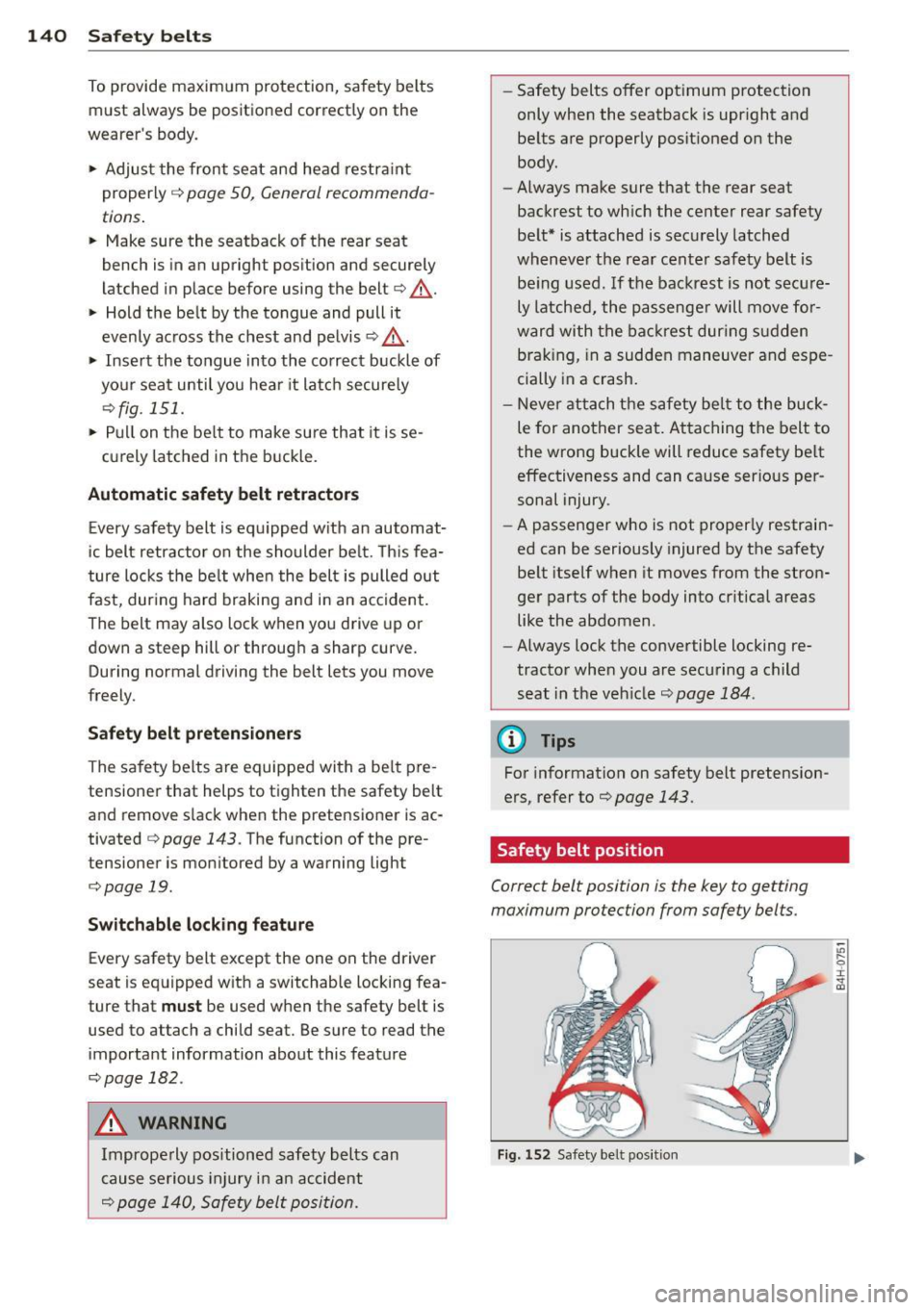
Safety belt position
Correct belt position is the key to getting
maximum protection from safety belts.
Fig. 152 Safety bel t position
"' .... 0
~ CD
Page 152 of 306
150 Airbag system
~fig. 157. The general location of the airbags
is marked "AIRBAG".
There is a lot you need to know about the air bags in your vehicle. We urge you to read the
detailed information about airbags, safety
belts and child safety in this and the other
chapters that make up the owner's literature.
Please be sure to heed the WARNINGS -they
are extremely important for your safety and
the safety of your passengers, especially in
fants and small children.
A WARNING
Never rely on airbags alone for protection.
- Even when they deploy, airbags provide
only supplemental protection .
- Airbag work most effectively when used
with properly worn safety belts.
- Therefore, always wear your safety belts
and make sure that everybody in your ve
hicle is properly restrained .
- Always hold the steering wheel with both
hands on the outside of the steering
wheel rim at the 9:00 o'clock and 3 :00
o'clock positions to help reduce the risk
of personal injury if the driver's airbag in
flates.
- Never hold the steering wheel at the 12
o'clock position or with your hands any
where inside the steering wheel or on the
steering wheel hub. Holding the steering
wheel the wrong way increases the risk
of severe injury to the arms, hands, and
head if the driver airbag deploys.
A WARNING
Objects between you and the airbag will
increase the risk of injury in a crash by in
terfering with the way the airbag unfolds
and/or by being pushed into you as the air
bag inflates.
-Always make sure nothing is in the front
airbag deployment zone that could be
struck by the airbag when it inflates.
- Objects in the zone of a deploying airbag
can become projectiles when the airbag deploys and cause serious personal
in
jury.
- Never hold things in your hands or on
your lap when the vehicle is in use.
- Never place accessories or other objects
(such as cup holders, telephone brackets,
note pads, navigation systems, or things
that are large, heavy, or bulky) on the
doors; never attach then to the doors or
the windshield; never place them over or near or attach them to the area marked
,,A IRBAG" on the steering wheel, instru
ment panel or the seat backrests; never
place them between these areas and you
or any other person in the vehicle.
- Never attach objects to the windshield
above the passenger front airbag, such
as accessory GPS navigation units or mu
sic players. Such objects could cause seri
ous injury in a collision, especially when
the airbags inflate.
- Never recline the front passenger seat to
transport objects. Items can also move
into the deployment area of the side air
bags or the front airbag during breaking
or in a sudden maneuver. Objects near
the airbags can fly dangerously through
the passenger compartment and cause
injury, particularly when the seat is re
clined and the airbags inflate.
A person on the front passenger seat, es
pecially infants and small children, will re
ceive serious injuries and can even be kil
led by being too close to the airbag when
it inflates.
- Although the Advanced Airbag System in
your vehicle is designed to turn off the
front passenger airbag if an infant or a
small child is on the front passenger
seat, nobody can absolutely guarantee
that deployment under these special
conditions is impossible in all conceiva
ble situations that may happen during
the useful life of your vehicle.
~
Page 161 of 306
-The PASSENGER AIR BAG OFF light must
come on and stay on if the ignition is on
and . ..
- a car bed has been installed on the front
passenger seat, or
- a rearward -facing chi ld restraint has been
installed on the front passenger seat, or
- a fo rward-facing child restraint has been in
stalled on the front passenger seat,
- and if the e lectr ica l capacitance registered
on the front passenger seat is equal to or
l ess than the combined capacitance of a typ
ical 1 year-old infant and one of the rear
ward-facing or forward -facing child re
straints listed in Federal Motor Veh icle Safe
ty Standard 208 w ith which the Advanced
Airbag System in your vehicle was certified.
If the front passenger seat is not occupied,
the front airbag will not deploy, and the
PAS ·
SENGER AIR BAG OFF
light will stay on . Nev
er install a rearward-facing child restra int on
the front passenger seat, the safest place fo r
a child in any kind of child restraint is at one
of the seating positions on the rear seat
¢ page 147, Child restraints on the front seat
- some important things to know
and
¢ page 171, Child Safety.
If the PASSENGER AIR BAG light comes
on ...
If the PASSENGER AIR BAG OFF light comes
on when one of the conditions listed above is met, be sure to check the light regularly to
make certa in that the
PASSENGER AIR BAG
OFF
light stays on cont inuous ly whenever the
ignit ion is on.
If the PASSENGER AIR BAG
OFF
light does not appear on and does not
stay on all the time, stop as soon as it is safe
to do so and
- react ivate the system by turning the ignition
off for more than 4 seconds and then turn
i ng it on agai n;
- remove and reinstall the child restraint .
Make sure that the child restraint is properly
installed and that the safety be lt fo r the
front passenger seat has been correctly
routed through the child rest raint as descri-
Airbag system 159
bed in the child restraint manufacturer's in
structions;
- make sure that the convertible locking fea
t u re on the safety belt for the front passen
ger seat has been activated and that the
safety belt has been pulled tight.
- make sure t hat no electrical device (s uch as
a laptop, CD p layer, e lectronic games device
or power inverter) is placed or used on the
front passenger seat if the device is connect
ed to the 12-volt socket or the cigarette
lighter socket;
- make sure that no seat heater has been ret
rofitted or otherwise added to the front pas
senger seat;
- make sure that nothing can interfere with
the safety belt buckles and that they are not
obstructed;
- make sure that there are no wet objects
(such as a wet towel) and no water or other
liquids on the front passenger seat cushion .
If the PASSENGER AIR BAG light still
does not come on ...
If the PASSENGER AIR BAG OFF light still
does not come on and does not stay on con
tinuously (when the ignition is switched on),
- take the child restraint off the front passen-
ger seat and install it properly at one of the
rear seat positions . Have the airbag system
inspected by your Audi dealer immed iate ly.
- move the child to a rear seat position and
make sure that the child is properly restrain
ed in a child restra int that is appropriate for
its size and age.
The PASSENGER AIR BAG light should
NOT come on ...
T he PASSENGER AIR BAG OFF lig ht should
NOT come on when the ignition is on and an
adult is sitting in a proper seating position on
the front passenger seat . If the
PASSENGER
AIR BAG OFF
light comes on and stays on or
flashes for about 5 seconds wh ile driving, un
der these c ircumstances, make sure that:
- the adult on the front passenger seat is
properly seated on the center of the seat •
•
Page 177 of 306
@ Tips
The child seats listed in categories A to C
have been statically tested by Audi only for
the Advanced Airbag function.
Important safety instructions for using
child safety seats
Correct use of child safety seats substantially
reduces the risk of injury in an accident!
As the driver, you are responsible for the safe
ty of everybody in the vehicle, especially chil
dren:
~ Always use the right child safety seat for
each child and always use it properly
q page 177.
~ Always carefully follow the child safety seat
manufacturer's instructions on how to route
the safety belt properly through the child
safety seat.
~ When using the vehicle safety belt to install
a child safety seat, you must first activate
the convertible locking retractor on the
safety belt to prevent the child safety seat
from moving
r::!) page 182.
~ Push the child safety seat down with your
full weight to get the safety belt really tight
so that the seat cannot move forward or
sideways more than one inch (2.5 cm).
~ Secure unused safety belts on the rear seat
9 page 177.
Always remember: Even though your vehicle is
equipped with an Advanced Airbag system, all
children , especially those 12 years and young
er, should always ride in the back seat proper
ly restrained for their age and size.
.&, WARNING ,~
Not using a child safety seat, using the
wrong child safety seat or improperly in
stalling a child restraint increases the risk
of serious personal injury and death .
- All vehicle occupants and especially chil
dren must always be restrained properly
whenever riding in a vehicle.
Child Safety 175
- An unrestrained or improperly restrain
ed child can be injured or killed by be
ing thrown against the inside of the ve
hicle or by being ejected from it during
a sudden maneuver or impact.
- An unrestrained or improperly restrain
ed child is at much greater risk of injury
or death by being struck by an inflating
airbag.
- Commercially available child safety seats are required to comply with U.S . Federal
Motor Vehicle Safety Standard (FMVSS)
213 (in Canada CMVSS 213).
- When buying a child restraint, select
one that fits your child and the vehicle.
- Only use child restraint systems that
fully contact the flat portion of the
seat cushion . The child restraint must
not tip or lean to either side . Audi does
not recommend using child safety
seats that rest on legs or tube-like
frames. They do not provide adequate
contact with the seat.
-Always heed all legal requirements per
taining to the installation and use of
child safety seats and carefully follow
the instructions provided by the manu
facturer of the seat you are using.
- Never allow children under 57 inches
(1.45 meters) to wear a normal safety
belt. They must always be restrained by a
proper child restraint system. Otherwise,
they could sustain injuries to the abdo
men and neck areas during sudden brak
ing maneuvers or accidents.
- Never let more than one child occupy a
child safety seat.
- Never let babies or older children ride in
a vehicle while sitting on the lap of an
other passenger .
- Holding a child in your arms is never a
substitute for a child restraint system.
- The strongest person could not hold
the child with the forces that exist in
an accident. The child will strike the in
terior of the vehicle and can also be
struck by the passenger. •
•
Page 179 of 306
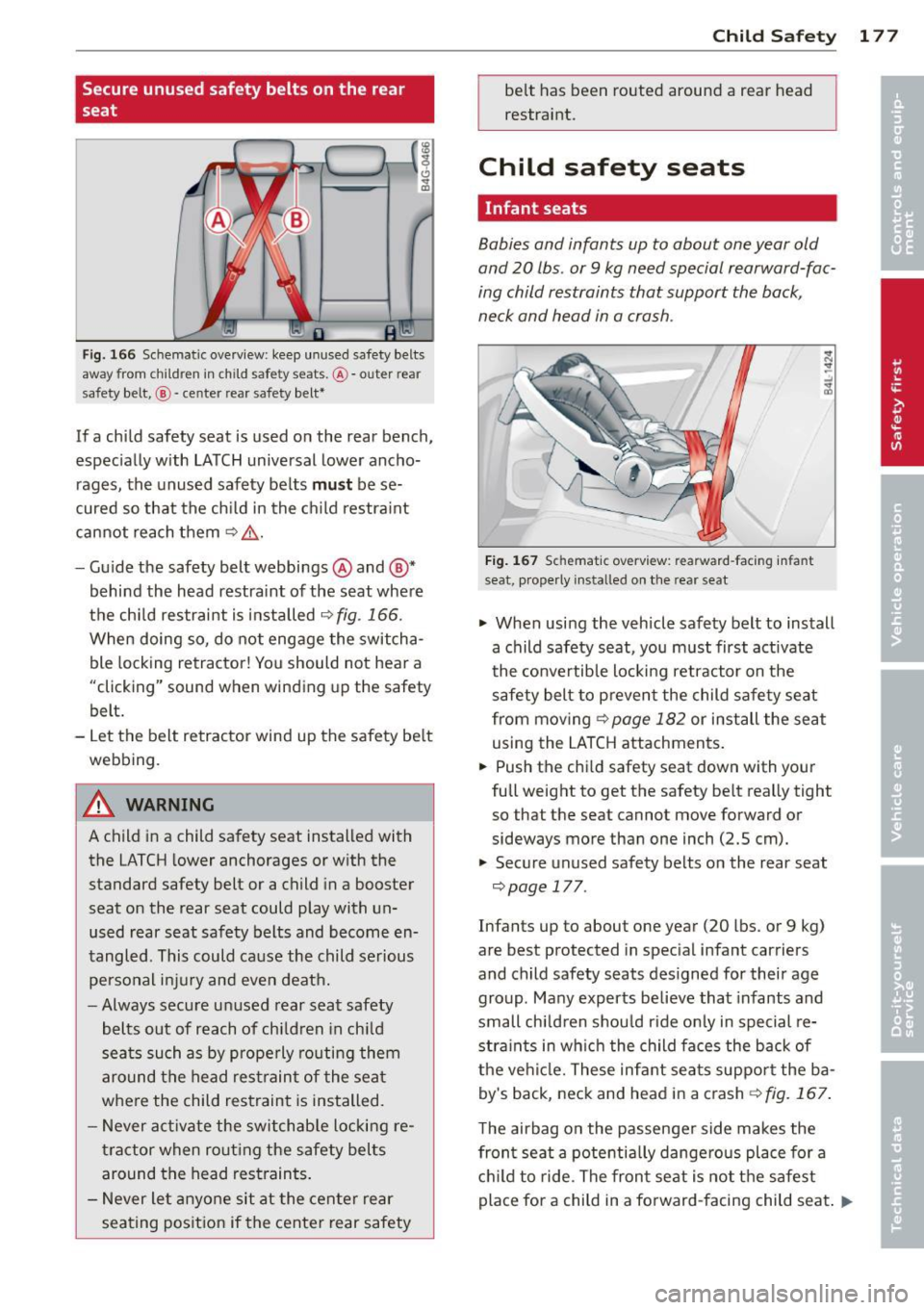
Secure unused safety belts on the rear
seat
F ig. 166 Schematic overview: keep unused safety belts
away from chi ldren in child safety seats. @-outer rear
safety belt,
@-center rear safety belt*
If a child safety seat is used on the rear bench,
espec ially with LATCH universal lower ancho
rages, the unused safety belts
must be se
cured so that the ch ild in the ch ild restra int
cannot reach them
Q ,&. .
- Gu ide the safety belt webbings@and @*
behind the head restraint of the seat whe re
the ch ild restrai nt is installed
Q fig . 166.
When doing so, do not engage the switcha
ble locking retractor! Yo u should not hear a
"clicking" sound when winding up the safety
belt.
- Let the belt retractor wind up the safety belt
webbing.
A WARNING
A child in a child safety seat installed with
the LATCH lower anchorages or w ith the
standard safety belt or a child in a booster
seat on the rear seat could play with un
used rear seat safety belts and become en
tangled. This could ca use the child serious
personal i nju ry and even death.
- Always secure un used rear seat safety
belts out of reach of chi ld ren in ch ild
sea ts such as by p rope rly routing them
around the head res traint of the seat
whe re the child restraint is installed.
- Never act ivate the sw itchab le locking re
t ractor when rout ing the safety belts
around the head res traints .
- Never le t anyone sit at the center rear
sea ting pos it ion if the cente r rear safety
Child S afety 177
be lt has been ro uted around a rear head
restraint.
Child safety seats
Infant seats
Babies and infants up to about one year old
and 20 lbs. or
9 kg need special rearward-fac
ing child restraints that support the back,
neck and head in a crash .
Fig. 167 Schemat ic overv iew: rearward -facing infant
seat, properly installed on the rear seat
~ When using the vehicle safety belt to install
a child safety seat, you must first activate
the convertible locki ng retractor on the
safety belt to preven t the child safe ty seat
from mov ing
Qpage 182 or install the seat
using the LATCH attachments .
~ Push the child safety seat down with your
full weight to get the safety belt really tight
so that the seat cannot move forward or
sideways more than one inch (2.5 cm).
~ Secure unused safety belts on the rear seat
Qpage 177.
Infants up to about one year (20 lbs. or 9 kg)
are best protected in special infant car riers
and child safety seats designed for their age
group. Many experts be lieve that infants and
small chi ld ren shou ld r ide o nly in special re
str aints in wh ic h t he child faces the back of
the ve hicle. These infant seats suppo rt the ba
by's back, neck and head in a crash ¢
fig. 167.
T he airbag on the passenger side makes the
fron t seat a pote ntia lly dange ro us place for a
c hi ld to ride. The fron t se at is not t he safest
place for a child in a fo rward -facing child seat . ..,_
Page 180 of 306
1 78 Child S afet y
It is a very dangerous place for an infant or a
larger child in a rearward-facing seat.
.&_ WARNING
Not using a child safety seat, using the
wrong chi ld safety seat or improperly in
stalling a child restraint increases the risk of serious personal injury and death in a
crash .
- Never install rear-facing ch ild safety
seats or infant carriers on the front pas senger seat -even with an Advanced Air
bag System. A child wi ll be seriously in
jured and can be k il led when the inflat
ing airbag hits the child safety seat or in
fant ca rrier with great force and smashes
the chi ld safety seat and chi ld aga inst
the backrest, center armrest, door or roof
c:> page 147, Child restraints on the
front seat -some important things to
know.
- Always install rear-facing child safety
seats or infant carriers on the rear seat.
- Never install a rear-facing child restraint in the forward-facing direction. Such re
straints are des igned for the spec ial
needs of infants and very small children
and cannot protect them properly if the
seat is forward-fac ing.
- If you must install a rearward facing
child safety seat on the front passenger
seat because of exceptional circ umstan
ces and the
PA SS ENGER AIR BAG OFF
light does not come on and stay on, im
mediately install the rear -facing child
safety seat in a rear seating position and
have the airbag system inspected by your
Audi dealer.
- Never place or use any electrical device
(such as a laptop, CD player, electron ic
games dev ice or power inverter) on the
front passenger seat if the device is con
nected to the 12-volt socket or the ciga
rette lighter socket.
- If a seat heater has been retrofitted or otherwise added to the front passenger
seat, never install any child restraint sys
tem on this seat. -
Make sure that there are no wet objects
(such as a wet towel) and no water or
other liquids on the front passenger seat
cushion .
- Never p lace objects on the seat (such as
a laptop, CO player, electronic games de
vice or power inverter) . These may influ
ence the electrical capacitance measured by the capacit ive passeng er detection
sys tem and can also fly around in an acci
dent and cause serious personal injury.
- Always read and heed all WARNINGS
whenever using a child restrained in ave
h icle is being used
c:>page 136, Safety
belts, ¢page 145, Airbag system
and
c> page 171, Important things to know .
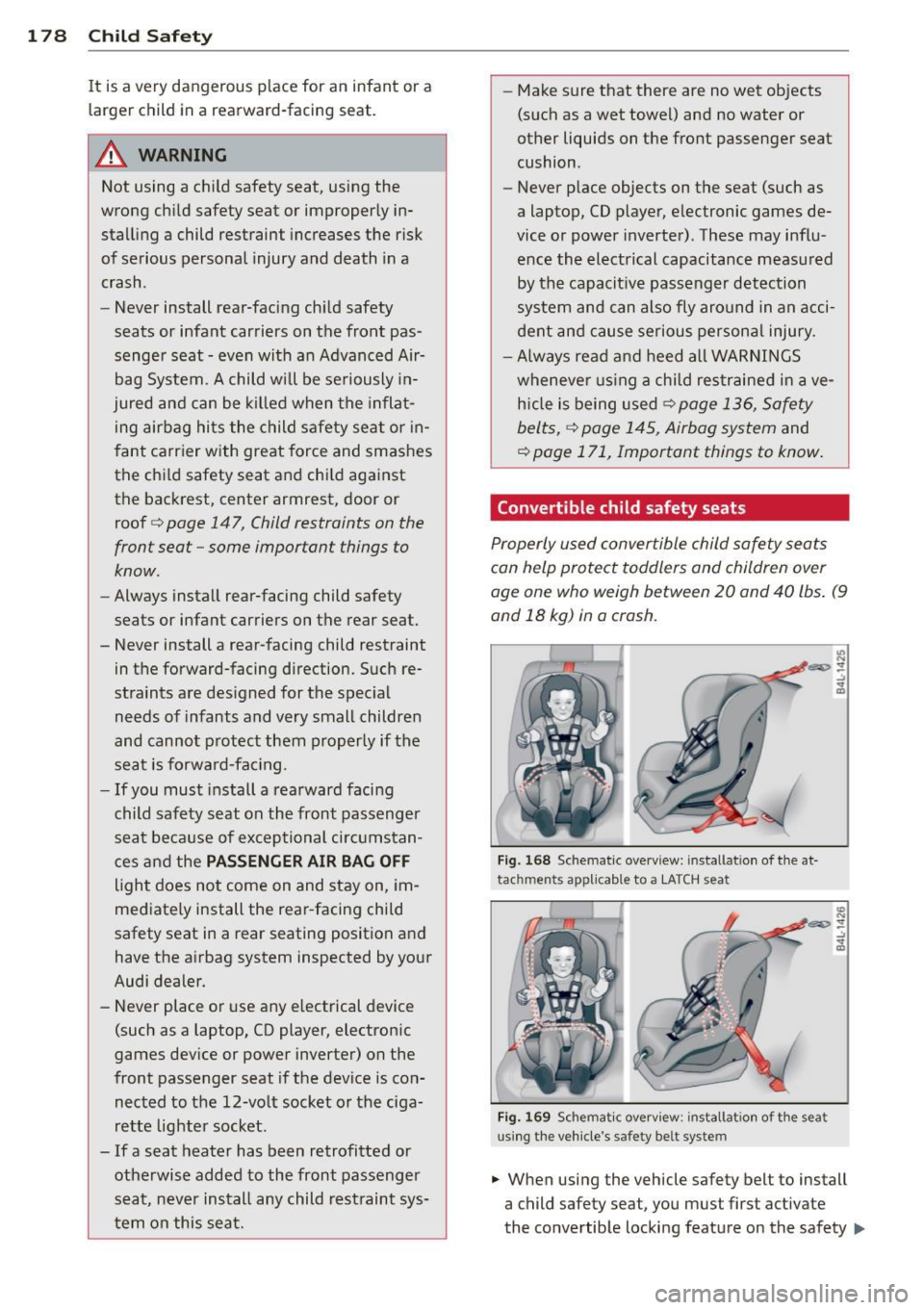
Convertible child safety seats
Properly used convertible child safety seats
can help protect toddlers and children over
age one who weigh between 20 and 40 lbs . (9
and 18 kg) in a crash.
F ig . 1 68 Schema tic overview: installat ion of the at
tac hments applicab le to a LA TCH seat
Fig . 1 69 Schemat ic overview: installat io n of t he sea t
using the vehicle 's safety be lt syste m
.,. When using the vehicle safety belt to install
a child safety seat, you must first activate
the convertible locking feature on the safety
Ill>
Page 182 of 306
180 Child Safety
-Always move the front passenger seat in
to the rearmost position of the passen
ger seat's fore and aft adjustment range,
and as far away from the airbag as possi
ble before installing the child restraint .
- Always make sure that nothing prevents
the front passenger's seat from being
moved to the rearmost position in its
fore and aft adjustment range.
- Always make sure the backrest is in an
upright position .
- Never place or use any electrical device
(such as a laptop, CD player, electronic
games device or power inverter) on the
front passenger seat if the device is con
nected to the 12-volt socket or the ciga
rette lighter socket.
- If a seat heater has been retrofitted or
otherwise added to the front passenger
seat, never install any child restraint sys
tem on this seat.
- Make sure that there are no wet objects
(such as a wet towel) and no water or
other liquids on the front passenger seat
cushion.
- Never place objects on the seat (such as
a laptop, CD player, electronic games de
vice or power inverter). These may influ
ence the electrical capacitance measured by the capacitive passenger detection
system and can also fly around in an acci dent and cause serious personal injury.
- Make sure that the
PASSENGER AIR BAG
OFF
light comes on and stays on all the
time whenever the ignition is switched
on.
- If the
PASSENGER AIR BAG OFF light
does not come on and stay on, immedi
ately install the forward-facing child seat
at a seating position on the rear seat and
have the airbag system inspected by your
authorized Audi dealer.
- Take the child restraint off the front pas
senger seat and install it properly at one
of the rear seat positions if the
PASSEN
GER AIR BAG OFF
light does not stay on
whenever the ignition is switched on.
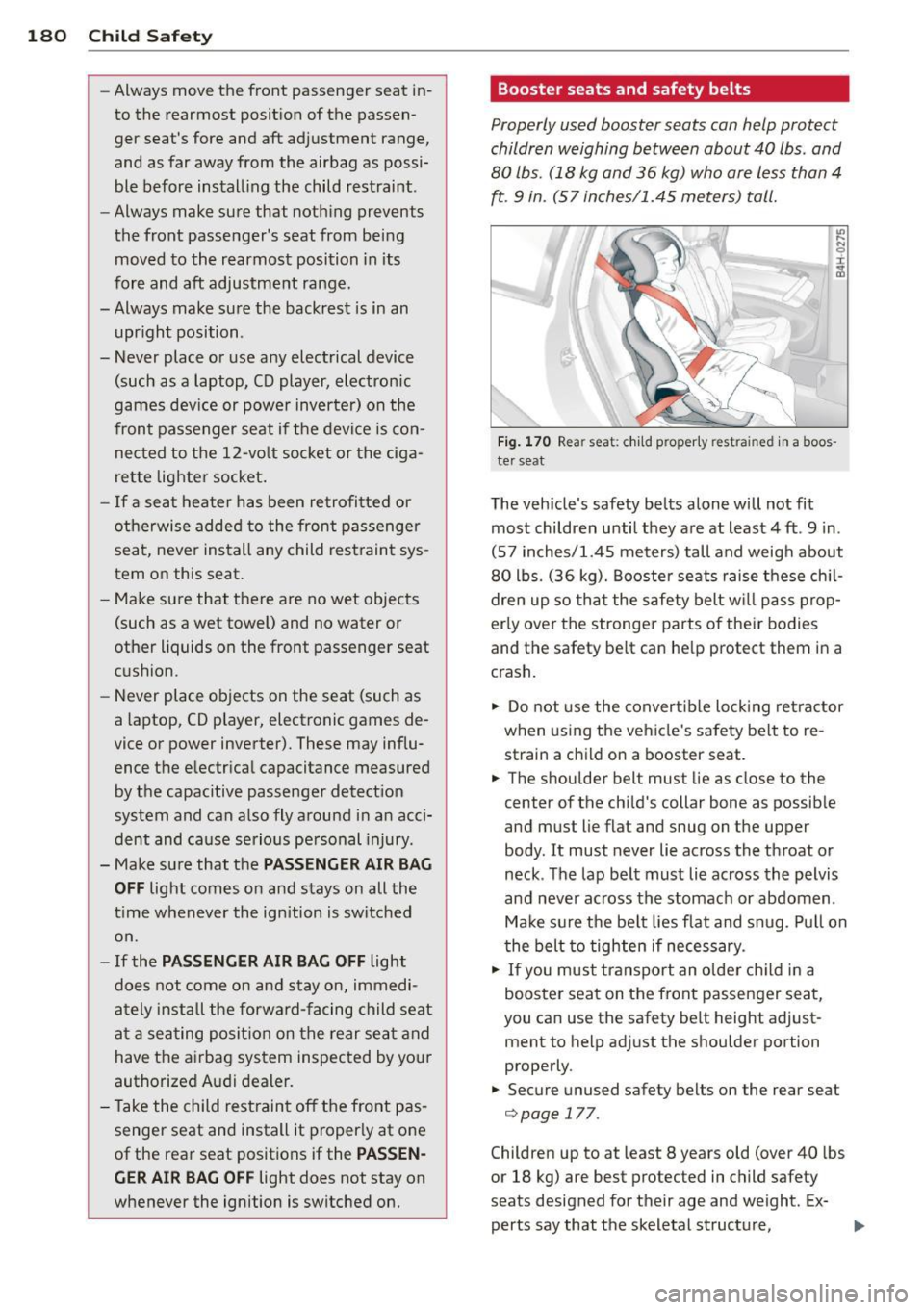
Booster seats and safety belts
Properly used booster seats can help protect
children weighing between about 40 lbs . and
80 lbs . (18 kg and 36 kg) who are less than 4
ft. 9 in. (57 inches/1.45 meters) tall.
Fig. 170 Rea r seat : child p rop erly res trained in a boos
te r se at
The vehicle's safety belts alone will not fit
most children until they are at least 4 ft . 9 in .
(57 inches/1.45 meters) tall and weigh about
80 lbs.
(36 kg). Booster seats raise these chil
dren up so that the safety belt will pass prop
erly over the stronger parts of their bodies
and the safety belt can help protect them in a
crash.
"" Do not use the convertible locking retractor
when using the vehicle's safety belt to re
strain a child on a booster seat.
"" The shoulder belt must lie as close to th e
center of the child's collar bone as possible
and mu st lie flat and snug on the upper
body.
It must never lie across the throat or
neck . The lap belt must lie across the pelvis
and never across the stomach or abdomen .
Make sure the belt lies flat and snug . Pull on
the belt to tighten if necessary .
"" If you must transport an older child in a
booster seat on the front passenger seat,
you can use the safety belt height adjust
ment to help adjust the shoulder portion
properly .
"" Secure unused safety belts on the rear seat
¢page 177.
Children up to at least 8 years old (ove r 40 lbs
or 18 kg) are best protected in child safety
seats designed for their age and weight . Ex-
perts say that the skeletal structure, ..,.
Page 184 of 306
182 Child Saf ety
- Never let a child ride in the cargo area of
your vehicle .
- Always remember that a chi ld leaning
forward, sitt ing s ideways or out of posi
t ion in any way during an acc ident can be
struck by a deploying airbag . This will re
sult in serious personal injury or death .
- If you must install a booster seat on the
front passenger seat because of excep
t ional circumstances the
PASSENGER
AIR BAG OFF
light must come on and
stay on, whenever the ignition is sw itch
ed on.
- If the PASSENGER AIR BAG OFF light
does not come on and s tay on, perform
the chec ks described ¢
page 157, Moni
toring the Advanced Airbag System.
- T ake the child rest raint off the front p as
senger seat and install it properly at one
of the rea r seat positions if the
PASS EN·
GER AIR BAG OFF
light does not stay on
whenever the ignition is switched on .
- Always read and heed all WARNINGS whenever using a child rest rained in ave
hicle is being used
¢ page 136, Safety
belts,¢ page 145, Airbag system
and
¢ page 171, Important things to know.
Installing a child safety
seat
Securing a child safety seat using a
safety belt
Safety belts for the rear seats and the front
passenger can be locked with the convertible
locking re tractor to properly secure child
safety seats.
The safety belts emergency locking retractors
for the rear seats safety belts and for the
fro nt passenger's seat safety belt have a con
vertible locking retracto r for child restra ints .
The safety belt must be locke d so that belt
webbing can not unreel. The ret ractor ca n be
activ ated to lock the safety be lt and p revent
the safety belt webbing from loosening up
d ur ing normal driv ing . A child sa fe ty seat can
on ly be proper ly installed whe n the safety belt is loc
ked so that the chi ld and child sa fety
seat wi ll stay in place.
Alw ays remember: Even tho ugh yo ur vehicle is
equipped wi th an A dvan ced Airbag system, all
c hi ldren, especially those 1 2 years and young
er, sho uld always ride in the back seat prope r
l y restra ined fo r the ir age and size.
A WARNING
Improperly installed ch ild safety seats in
crease the risk of serious personal injury
and death in a co llision.
- Always make sure that the safety belt re
tractor is locked when insta lling a child
safety seat. A n un locked safety belt re
trac to r cannot hold the child safety seat
in place dur ing norma l driving o r in a
crash.
- Always buckle the child safety seat firmly
in place even if a ch ild is not si tt ing in it.
A loose child sa fe ty se at can fly aroun d
du ring a s udden stop or in a collision .
- Always make sure that the rear seat
backres t to wh ich the center rear safety
belt * is attache d is sec urely latched
wheneve r the rea r ce nter safety belt is
be ing used to secure a child rest raint.
- If the backrest is not securely la tc h ed,
the child and the child restraint will be
thrown forward together with the back
rest and will strike parts of the vehicle
interior. The child can be seriously in
jured or killed.
- Never install rear-facing child safety
seats or infant ca rr ie rs o n the front pas
senger seat . A child will be serious ly in
jured and can be killed when the passen
ge r airbag inflates.
- The infla ting airbag will h it the ch ild
safety seat or infant carrie r w ith gr eat
for ce and will smas h the child safe ty seat
a nd child ag ai nst t he back res t, cen ter
a rmrest, doo r or roof.
- Always inst all rear-fa cing ch ild safety
se ats or in fa nt c arrie rs on the re ar se at.
Page 186 of 306
184 Child Saf ety
time whenever the ignition is switched
on.
- If the
PASSENGER A IR BAG OFF li g ht
does not come on an d stay on, immedi
ately install the rear-facing child safety
seat in a rear seating position and have
the a irbag system inspected by your Audi
dealer .
Activating the convertible locking
retractor
Use the convertible locking retractor to se
cure a child restraint.
A lways heed the child safety seat manufactur
er's instructions when install ing a ch ild re
straint in your vehicle. To activate the conver
tib le locking retractor:
,. Place the child restraint on a seat, prefera
bly on the rear seat .
,. Slow ly pull the be lt
all the wa y out .
,. Route it around or thro ugh the ch ild re
stra int be lt path¢ &.
,. Push the child sa fety seat down wit h your
f ull weight to get the safety belt rea lly tight .
,. Inse rt the be lt tongue into the buckle for
that seating position.
,. Gu ide the safety belt back into the retractor
until the belt lies flat and snug on the child
safety seat .
,. You should hear a "click ing" noise as the
belt w inds bac k into the ine rtia reel. Test the
conve rtible locking retractor by pull ing on
the belt . Yo u should no longe r be able to
pull the belt out of the ret ractor . The con
vertib le locking retractor is now activated .
,. Make sure that the red re lease button is fac
ing away from the ch ild restra int so that it
can be unbuck led quickly .
,. Pull on the be lt to make sure the safety belt
is properly t ight and fastened so that the
seat can not move forward or sideways more
t h an one i nch (2.5 cm).
A WARNING
Using the wrong child restraint or an im
p roperly installed chi ld restraint can cause
se rious pe rsonal injury or death i n a c rash .
- Always make sure that the safety belt re-
tractor is loc ked when insta lling a child
safety seat. A n un locked safety belt re
tracto r cannot hold the child safety seat
in place dur ing no rma l driving o r in a
crash.
- Always buckle the child safe ty seat firmly
in pl ace even if a ch ild is not si tt ing in it.
A loose child safety seat can fly around
du ring a s udden stop or in a crash .
- Always make sure the se at b ackrest to
which the child res traint is installed is in
an upright pos ition and securely latche d
into place and cannot fold fo rward. Oth
erwise, the seatback with the child sa fety
seat attached to it could fly forward in
the event of a n accident or other emer
gency si tuation.
- Always read and heed all WAR NINGS
wheneve r us ing a child restrained in ave
h icle is being used~
page 171. Special
p reca utions apply w hen insta lling a child
s afety sea t on the front passenger seat
¢ page 147, Child restraints on the front
seat -some important things to know.
-
Deactivating the convertible locking
retractor
The convertible locking retractor for child re
straints will be deactivated automatically when the belt is wound all the way bock into
the retractor.
,. Press the red b utton on the safety belt
buckle. The be lt tong ue will pop o ut of the
buckle.
,. Guide the safety be lt a ll the way back into
its stowed position .
Always let the safety be lt retract completely
into its stowed position. The safety belt can
now be used as an ordinary safety belt w ith
out the convertible locking retracto r fo r child
r est raints .
...