heating AUDI S6 2013 User Guide
[x] Cancel search | Manufacturer: AUDI, Model Year: 2013, Model line: S6, Model: AUDI S6 2013Pages: 306, PDF Size: 76.92 MB
Page 82 of 306
80 On the road
The stored speed and the ind icator light
A;(l)~i~ (US mo dels) 1,'I (Canadian mode ls) a p
pea r in the instrument cluster d isp lay
c::> fig. 81. The display may vary, depending on
the type of d isplay in your vehicle .
This informat ion is also shown briefly in the
Head -up Display*.
The speed is kept constant v ia an engine o ut
put adjustment or active b rake intervention.
A WARNING
- Always pay attention to traffic even when
the cruise control is switched on. You are
always responsible for your speed and
the distance between your vehicle and
other vehicles .
- For safety reasons, the cruise control
should not be used in the city, in stop
and-go traff ic, on twist ing roads and
when road conditions are poor (such as ice , fog, grave l, heavy ra in and hydro
planing) -risk of accident.
- Turn
off the cruise control temporar ily
when entering turn lanes, highway exit lanes o r in construc tion zones.
- Please note that inadvertently "rest ing"
yo ur foot on the accelerator peda l causes
the cruise control not to brake . T his is
because the cr uise control is overridden
by the d river's acce leration .
- If a brake system malfunc tion such as
overheating occurs when the cruise con
tro l system is switched on, the braking
function in the system may be switched
off. The other cruise control functions re
ma in active as long as the indicator light
[~;rn~i~ (US models) !Ill (Canad ian mod
els) is on .
(j) Tips
The brake lights illuminate as soon as the
brakes decelerate automat ica lly.
Changing speed
Applies to veh icles: w ith cru ise control
., To increase/decrease the speed in inc re
ments, tap the lever in the
0 10 direc tion
c::> fig . 80
., To increase/decrease the speed quic kly,
hold t he lever in the
0 10 direction until
the desired speed is displayed.
You can also press the accelerator pedal down
to increase your speed, e.g . if you want to
pass someone . The speed you saved earlier
will res ume as soon as you release the acceler
ator pedal.
If, however, you exceed your saved speed by
6 mph (10 km/h) for longer than 5 m inutes,
the cr uise control wi ll turn
off temporari ly.
The green symbol
A;(l)~i~ (US mode ls) 1,'I
(Canadian mode ls) in the display will go out
but the saved speed rema ins the same .
Presetting your speed
Applies to veh icles : w ith cru ise control
You can preset your desired speed while the
vehicle is not moving.
., Switch on the ignition.
., Pull lever into position
(D c::> fig . 80.
., Press t he lever in the 0 or 0 direction to
increase or decrease your speed .
., Release the lever to save that speed .
This function makes it possible, for examp le,
to save the speed you want before dr iving on
the h ighway. Once on t he h ighway, act ivate
the cru ise control by pulling the lever toward
(D .
Switching the system off
Applies to veh icles: w ith cruise control
Temporary deactivation
., Press the b rake pedal, or
., Press the leve r into posi tion @(n ot clicked
into place)
c::> fig. 80, or
... Drive for longer t han 5 min utes at more
than 5 mph (10 km/h) above the stored
speed.
Page 112 of 306
110 Automatic Tran sm iss ion
Kick-down
Applies to vehicles: with multitron ic/S tronic/t iptronic
Kick-down enables maximum acceleration .
Applies to ve hicle s w ith a multit ro nic ®
t ra nsmission
When you depress the accelerator pedal be
yond the resistance po int, the transmission
downshifts into a lower gear ratio depend ing
on the vehicle speed and engine speed. As l ong as the accelerator peda l is depressed, the
engine speed is a utomat ica lly regulated for
maximum accelera tion.
Appli es to veh icl es with a S tronic ®-/ ,
tiptronic tran smi ssion
When you dep ress the accele rator pedal be
yond the resistance po int, the a utomat ic
transmission downshifts into a lower gear, de
pending on vehicle speed and engine speed.
The upshift into the next higher gear takes p lace once the maximum specified engine
speed is reached.
A WARNING
,-
Please note that the drive wheels can spin
if kick-down is used on a smooth slippery
road - there is a risk of skidding .
Launch Control Program
Applies to vehicles: with S tronic
The Launch Control Program provides the
best acceleration possible when starting from
a stop .
Requirement : The engine must be at operat
ing temperature and the steering wheel must
not be turned .
.. Press the
I~ O FF I button ¢ page 194 while
the engine is running. The
IJ indica tor light
illuminates in the instrument cluster and
Sta bilization contr ol (ESC ): Off Warn ing!
R educed stabi lit y
appears in the dr iver in
fo rmat io n system disp lay .
.. Move the selecto r lever to posit ion D/S to
select sport mode (5) or select
D yna mic
mode in Audi dr ive select c:> page 99 .
.. Press the b rake pedal strongly with you r left
foot and hold it down for at least 1 second .
.. At the same time, press the accelerator
pedal down complete ly with your r ight foot
until the engine reaches and mainta ins a
high RPM .
.. Remove your foot from the brake pedal
w ith in
5 seconds c:> ,&. .
_&. WARNING
-Always adapt your dr iving to the tr aff ic
f low.
- Onl y use the Launch Cont ro l Program
when road and t raff ic condi tions a llow i t
and other d rivers w ill not be endangered
or annoyed by your driving and the vehi
cle 's acceleration.
- Please note that the driving wheels can spin and the vehicle can b reak away
when ESC is switched off, especially
when the road is slippery .
- Once the vehicle has started moving,
press the
1 1' OFFI button brief ly to turn
the ESC on .
(D Tips
- The transmission temperature may in
crease signif icantly after using the
launch control program. If that happens,
the program may not be ava ilable for a
few minutes. It w ill be available again af
ter a cool-down per iod.
- When accelerating using the launch con
tro l program, all vehicle parts are subject
to heavy loads . This can resu lt in in
creased wear .
Transmission malfunction
Applies to vehicles: with multitronic/S tronic/tiptronic
[O] Tran smi ssi on: Pr ess brake pedal and se
lect gear again
Press the brake peda l and select the desired
selector lever position again. You can the n
continue d riving .
[O] Transmi ssion overheating: Plea se drive
con servatively
Page 195 of 306
ESC includes and/or works together with the
anti-lock brake system (ABS) , brake assist sys
tem, anti -slip regulation (ASR) , electronic dif
ferential lock (E DL) and e lectronic interaxle
d ifferential lock*. ESC is swi tched on all the
time. In certain situat ions when you need less
traction , you can switch off ASR by pressing
the button
[ru ~ fig . 177 . Be sure to switch
ASR on again when you no longer need less
traction.
Anti-lock braking system (ABS)
ABS prevents the wheels from locking up
when braking. The vehicle can still be steered even during hard braking . Apply steady pres
sure to the brake pedal. Do not pump the ped
al. A puls ing in the brake pedal indicates that
the system is he lping you to brake the vehicle.
Brake assist system
The brake assist system can decrease brak ing
d istance.
It increases braking power when the
driver presses the brake pedal quickly in emer
gency situations. You must press and hold the
brake pedal until the situation is over . In
vehicles with adaptive cruise control* , the
brake assist system is more sensitive if the
d istance detected to the vehicle ahead is too
small.
Anti-slip regulation (ASR)
ASR reduces engine power when the drive
wheels begin to spin and adapts the force to
the road condit ions. This makes it eas ier to
s tart, accelerate and drive up hills.
Electronic differential lock (EDL)
The EDL brakes wheels that are spinn ing and
transfers the drive power to the other drive
wheel or whee ls if the vehicle is equipped with
all-whee l drive*. This function is available up
to about 75 mph (120 km/h).
I n extreme cases , EDL automatically switches
off to help keep the brake on the braked wheel
from overheating. EDL wi ll switch on again au
tomatically when conditions have returned to
normal.
Intelligent technology 193
Electronic interaxle differential lock*/
selective wheel torque control*
The electronic interaxle differential lock (front
whee l drive) or the se lective wheel torque
cont rol (all-wheel dr ive) operates when dr iv
ing through curves . The front wheel on the in
s ide of the curve or both wheels on the inside
of the curve are braked selectively as needed .
T his min imizes sliding in the front wheels and
allows for more precise driving through
curves . Th e applicable system may no t acti
vate when driv ing in wet or snowy conditions.
A WARNING
-
-ESC, ABS, ASR, EDL and the electronic in
teraxle differential lock function* cannot
overcome the laws of physics. This is es
pecially important on slippery or wet
roads . If the systems begin acting to sta
bilize your vehicle, you should immedi
ately change your speed to match the
road and traffic conditions. Do not let
the increased safety provided by these
systems tempt you to t.;1ke risks. Doing
so will increase the risk o f a loss of vehi
cle control, collision and serious personal
injuries.
-Always adapt your speed to road, traffic
and weather conditions . The risk of los
ing control of the vehicle increases when
driving too fast, espec ially through
curves and on slippery or wet roads, and
when dr iving too close to vehicles up
ahead . ESC, ABS, the brake assist sys
tem, EDL, ASR and the elec tronic inter
axle differential lock function* cannot
prevent collisions .
- Always accelerate with special care on
even, smooth surfaces such as those that
are wet or covered with ice and snow.
The drive wheels can spin even with
these assistance systems that cannot al
ways he lp to red uce the risk of loss of ve -
hicle control. .,.
•
•
Page 200 of 306
198 Intelligent technology
Vehicle stands for an e xte nded period
If you do not drive you r vehicle over a pe riod
of several days or weeks, elec trical compo
nents are grad ually cut back or switched off.
This reduces energy cons umption and main
tains starting capab ility over a longer period.
Some of the conven ience f unctions may not
ope rate, such as the inter ior lights or the
power seat adjustment. T he conven ience
f u nctions w ill be ava ilable again when you
switch on t he ignit io n and start the engi ne.
With the engine turned off
If you listen to t he radio, for example, with
the eng ine turned off or use othe r MMI func
tions, the battery is b eing d ischa rged .
I f starting capab ility is jeopa rdized due to en
ergy consumpt ion, the following warning ap
pears in the MMI disp lay:
Please start the engine soon or the system
will be turned off.
T he warning ind icates that the system will be
turned off automatically afte r 3 m inutes. If
you wish to cont inue using the f unctions, you
have to start the engine.
With the engine running
A ltho ugh elect ric al e nergy is genera ted when
the veh icle is being driven, the bat tery can be
come d ischarged. This ha ppens most ly w hen
litt le energy is be ing generated and a great
deal consumed and the battery 's state of
charge is not optimal.
To br ing the ene rgy balance back into equili
brium, cons umers which require especially
large amo unts of energy are temporarily cut
back or switched off. Heating systems in par
ticular requ ire a great dea l of energy. If you
n otic e, fo r example, that the heated seats * or
the heated rea r window a re not heat ing, t hey
h ave been te m po rar ily cu t bac k or swi tched
o ff . T hese sys tems will be availa ble again as
soon as the energy ba lance has been restored .
You will a lso not ice that engin e idl e spe ed has
been in cr eased sligh tly. This i s norm al and no t
a ca use fo r con cern. By incre asin g engi ne idle speed
the a dditional energy requi red is gener
ated and the battery is charged.
Page 202 of 306
200 Driving and en vir onm ent
Catalytic converter
It is very important that your emission con
trol system (catalytic converter) is function
ing properly to ensure that your vehicle is run
ning in an environmentally sound manner .
• Always use lead-free gasoline¢ page 220,
Fuel supply.
• Never run the tank down all the way to
empty .
• Never put too much motor oil in your en-
gine ¢
page 230, Adding engine oil~-
., Never try to push- or tow -start your veh icle.
The catalytic converter is an eff ic ient "clean
up" device built into the exhaust system of
the vehicle. The catalytic converter burns many of the pollutants in the exhaust gas be
fore they are released into the atmosphere.
The exclusive use of unleaded fuel is critically
important for the life of the cata lytic conve rt
e r and proper functioning of the engine.
& WARNING
-
- Do not park o r operate the vehicle in
areas where the hot exhaust system may
come in contact with dry grass, brush,
fuel spill or other material which can cause a fire.
- Do not apply additional undercoating or
rustproofing on or near the exhaust
man ifold, exhaust p ipes, catalytic con
verter or heat shields . During driving, the
substance used for undercoating could
overheat and cause a fire .
@ Note
-Be aware that just one tank filling with
leaded fuel will already seriously de
grade the performance of the catalytic
conve rter .
- Do not exceed the correct engine oil level
¢ page 230.
-Do not drive until the fuel tank becomes
completely empty. The eng ine could mis
fire . U nburned f uel could a lso get into the exhaust system and this co
uld cause
the cata lytic converter to overheat .
- Do not switch off the ignition while the
vehicle is moving .
- Do not continue to ope rate your veh icle
under these conditions, as otherwise fuel
can reach the catalytic converter. This
cou ld result in overheating of the con
verter, requir ing its replacement.
- To assure efficient operation of the Emis
sion Control System:
- H ave your vehicle maintained properly
and in accordance w it h the service rec
ommendat ions in your Warranty &
M ain tenance book let.
- L ack of prope r maintenance as we ll as
improper use of the vehi cle will impair
the function of the em iss ion contro l
system and could lead to damage .
@ For the sake of the environment
Even when the Emiss ion Control System is
operat ing proper ly, the exha ust gas can
have a sul fur -li ke exhaust gas smell under
some operating states . This depends on
the sulfur content of the fuel being used .
Using a different brand of fue l may help,
or f il li ng the tank with lead-free super
grade gasoline .
Avoid damaging the
vehicle
When you are d rivi ng on poor roads, or over
c u rbs, steep ramps, etc., ma ke certai n that
low- ly ing parts s uch as spoilers and exha ust
system parts do not bottom o ut and get dam
aged.
T his is espe cially true for ve hicles with low
s lung chassis (spor ts chassis)* and fully load
ed vehicles .
Page 204 of 306
202 Driving and environment
Avoid full throttle
Driving at moderate speeds saves fuel and
improves your mileage.
.,. Try and keep well below your car's maxi-
mum speed.
Accelerating gently reduces fuel consump
tion, engine wear, and does not disturb the
environment.
Fu el consumption, exhaust emissions and en
gine noise increase disproportionately at high
speeds. If you drive at approximately three
quarters of top speed, fuel consumption will
be reduced by one half. Never drive faster
than the posted speed limit and weather con
ditions permit .
Reducing unnecessary idling
Even when your car is just idling it burns up
fuel.
.,. Shut the engine off when you are not driv
ing the vehicle .
... Do not warm up the veh icle by letting the
engine run at idle .
The idling phase is automat ically reduced for
vehicles w ith the Start/Stop system .
It is effi
cient to switch
off the engine in vehicles with
out the Start-Stop-System when stopped at
railroad crossings and long red lights . Turning
the engine
off for just 30-40 seconds saves
more f uel than is burned by starting the en
gine again.
It takes a long time for the engine to wa rm up
fully when it is running at idle. However, wear
and noxious emissions are especially high
when the engine is warming up. So you should
drive away as soon as you start the engine and
avoid running at high rpms while the engine is
still warming up.
([) Note
Do not leave engine idling unattended af
ter starting. If warning lights should come
on to indicate improper operation, they would
go unheeded. Extended idling also
produces heat, which could result in over
heating or other damage to the veh icle or
other property .
Regular maintenance
A badly tuned engine unnecessarily wastes a
lot of fuel.
.,. Have your vehicle serviced at regu la r inter-
vals .
By having your veh icle reg ularly se rviced by an
Audi dealer he lps to ensure that it runs prop
erly and economically. The condition of your
vehicle not only affects its safety and ability to
ho ld its value, it also affects
fuel consump
tion .
Check your oil each time you fill your tank.
The amou nt of oi l used is related to engine
load and speed.
It is normal for the oil consumption of a new
engine to reach its lowest value after a certain
mileage has been driven .
You must drive your veh icle about 3,000 miles
(5,000 kilometers) before you can properly
assess oil consumpt ion.
This also app lies to fuel consumption and en
gine output .
(D Note
-Have your veh icle ma inta ined properly
and in accordance with the service rec
ommendations in your Warranty
& Main
tenance booklet. Lack of proper ma inte
nance as well as improper use of the ve
hicle will impair the function of the
em ission control system and could lead
to damage.
- Do not alter or remove any component of
t he Emission Control System unless ap
proved by the manufacturer .
- Do not alter or remove any device, such
as heat shields, switches, ignition wires,
valves, which are designed to protect
your vehicle's Emission Control System
Page 221 of 306
Engine compartment
Be especially careful when cleaning the en
gine compartment.
A lw ays s witch off the ign ition befor e clean
ing the eng in e
c:> & .
Plenum panel
Remove leaves from the plenum pane l in front
of the windshield under the engine compart
ment. This prevents the water drain ho les
from becoming blocked, and it prevents de
bris from entering the veh icle inter ior through
the heating and ventilation ducts .
Corro sion protecti on
The engine compartment and transmission
have been corrosion-protected at the factory.
Good anti-corrosion treatment is very impor
tant, particular ly in the winter . If the vehicle
is frequent ly driven on salt treated roads, the
entire engine compartment and plenum panel
should be thoroughly cleaned at the end of
winter and retreated to prevent sa lt damage.
At the same time, the underside of the vehicle
should be washed as we ll.
If the engine compartment is cleaned at any
time with grease removing solut ions
1>, or if
you have the engine washed, the anti-corro
sion treatment is a lmost always removed as
well.
It is therefore essential to have a long
lasting co rrosion protection reapp lied to a ll
surfaces, seams, joints and components in the
engine compartment.
A WARNING
Be aware: The engine compa rtment of any
motor vehicle is a potentially hazardous
area.
- Before working in the engine compart
ment, be s ure to read the in format ion
c:> page 225.
- Before reaching into the front pane l, al
ways switch off the ignition. Otherwise,
l ) Use only the correct cleaning sol utions. Never use gas
oline or diesel fuel.
Cleaning and protec tion 219
the windshield wiper system could unin
tentionally be switched on, possibly
causing personal injury from the moving
wiper linkage.
- Never reach into the area around or
touch the radiator fan. The aux iliary fan
is temperature controlled and can sw itch
on suddenly - even when the ignition is
off.
- Do not wash, wax o r dry the eng ine with
the engine running. Moving or hot parts could injure you.
- Do not clean the underside of the chas
sis, fenders, wheel covers, or other ha rd
to reach parts without protect ing your
hands and arms. You may cut yourself on
sharp-edged metal parts .
- Always read and heed all WARNINGS and
o ther info rmation
c:> page 208.
•
•
Page 234 of 306
232 Check ing and filling
Engine cooling system
Coolant
The engine coolant performs two functions: it
keeps the engine from overheating and it pro
tects the engine from freezing in the winter .
The cooling system is sealed and generally re
quires little attention.
The cooling system has been filled at the fac
tory with a permanent coolant which does not need to be changed. The coolant consists of a
mixture of water and the manufacturer's gly
col-based coolant additive Gl3 ant ifreeze
with ant icorros ion add itives (50% for USA
models; 60% for Canad ian models). This mix
ture both assu res the necessary frost protec
tion and protects metal components in the
engine's cooling system from corrosion and
scaling. It also raises the boiling point of the
coolant.
Do not reduce the concentration o f the coo l
ant in the summer by adding plain water .
The
propo rtion of coolant add it iv e mu st be at
l eas t 50 % but not mo re than 6 0%
to main
tain antifree ze protection and cooling efficien
cy. If the coolant frost protect ion is too low,
the coolant could freeze and damage the veh i
cle heating and eng ine cooling system .
For year-round driving, antifree ze is added at
the factory for temperatures down to:
- -31°F(-35°C)USA
- - 40 ° F ( -40 °C) Canada.
A WARNING
Before yo u check anything in the engine
compartment, always read and heed all
WARNINGS
c:> &. in Working in the engine
compartment on page 225.
- Before winter sets in, have the coolant
checked to see if the coo lant addit ive in
your vehicle is suffic ient to meet the cli
mate cond itions. Th is is especially impor
tant if you live in a region where the w in- ter is extreme
ly cold . If necessary, in
crease the proportion of coo lant additive
to 60%.
- When adding coolant additive to your
cooling system, remember:
- We recommend us ing only coolant ad
d itive Gl2++ or G l3 (check the labe l)
fo r your vehicle. This coolant additive is
ava ilable at a utho rized Aud i dea le rs.
Other types of antifreeze can sign ifi
cantly reduce corros ion protection. The
res ulting corrosion can cause a loss of
coolant and serious engine damage.
- Do not add any type of radiator leak seal
ant to yo ur vehicle's engine coolant .
Add ing radiator repair flu id may adverse
ly affect the function and performance of
your cooling system and could resu lt in
damage not covered by your New Veh icle
Limited War ranty.
Checking the engine coolant level
The engine coolant level can be checked with
a quick glance .
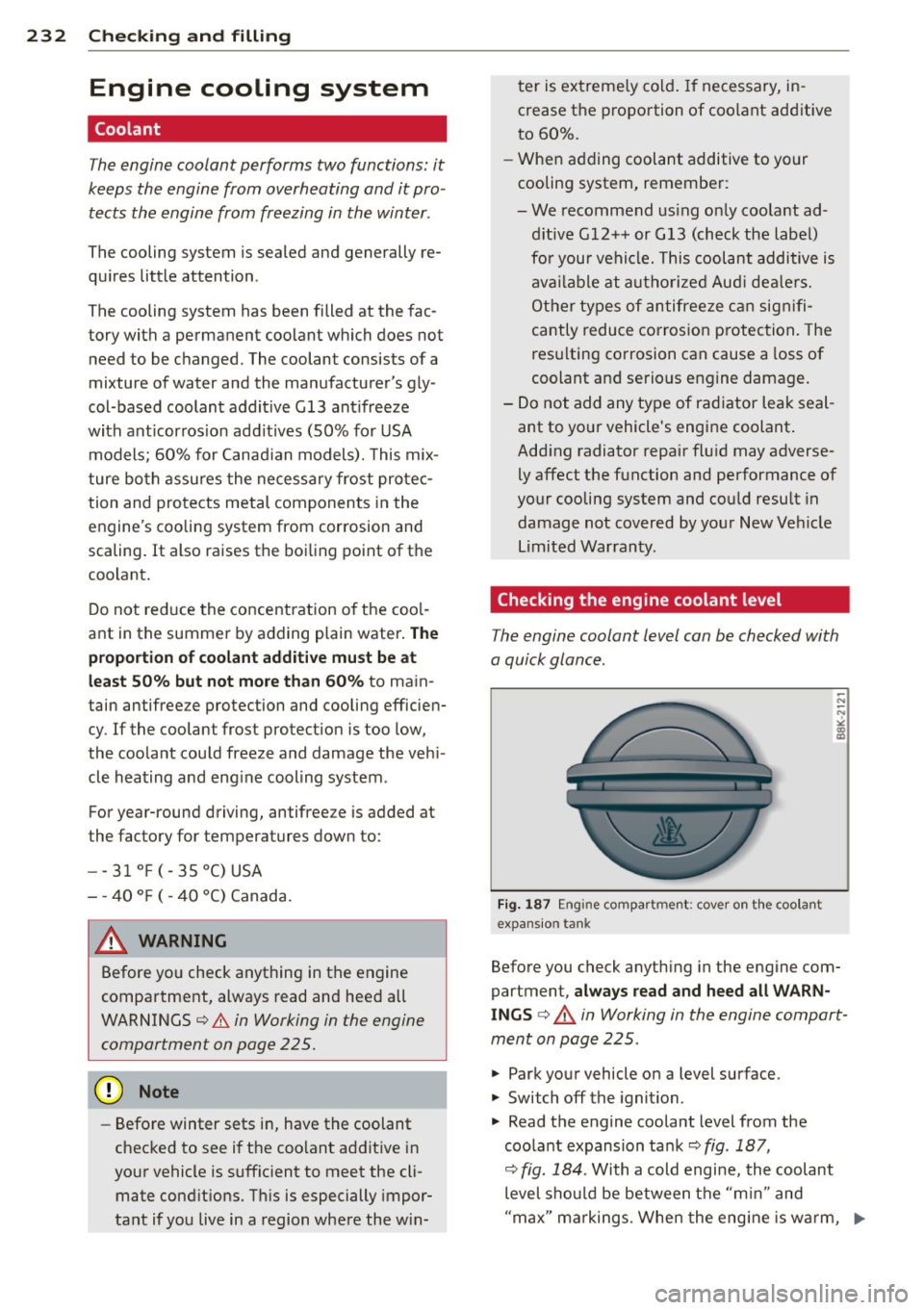
Fig. 1 87 Engin e compar tmen t: cover on t he coo la nt
expansio n ta nk
Before you check anyth ing in the engine com
partment,
alwa ys read and heed all WARN
I NGS c:> &. in Working in the engine compart
ment on page 225 .
.. Park your vehicle on a level surface .
.. Switch off the ignition.
.. Read the engine coolant level from the
coola nt expansion tank
c:> fig . 187,
c:> fig. 184 . With a cold engine, the coolant
level shou ld be between the "min" and
"max" markings. When the eng ine is wa rm, ..,.
Page 235 of 306
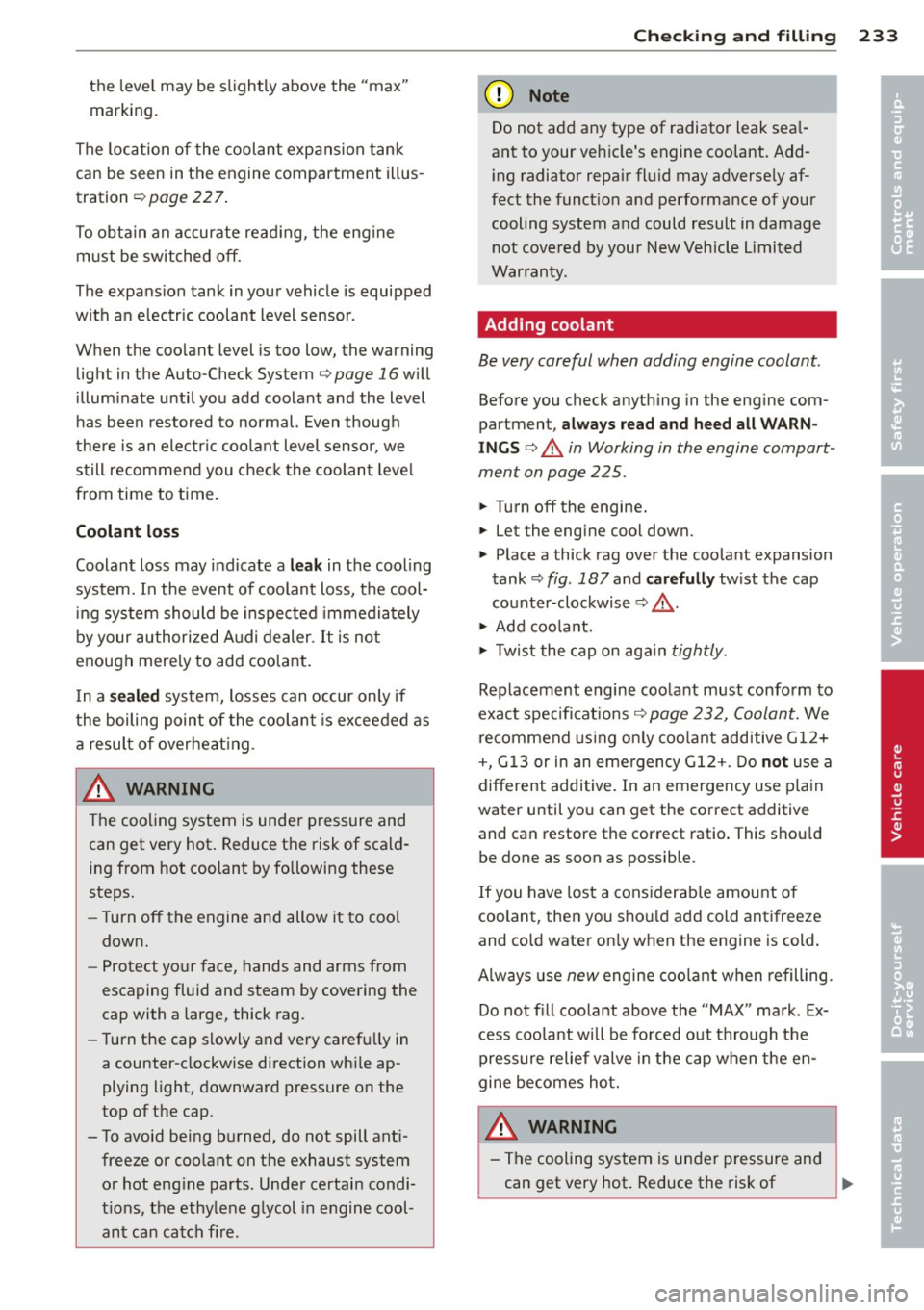
the level may be slightly above the "max"
marking .
The location of the coolant expansion tank
can be seen in the engine compartment illus
tration ¢ page 22 7.
To obtain an accurate reading, the engine must be switched
off.
The expansion tank in your vehicle is equipped
with an electric coolant level sensor.
When the coolant level is too low, the warning
light in the Auto-Check System ¢page 16will
illuminate until you add coolant and the level
has been restored to normal. Even though
there is an electric coolant level sensor , we
still recommend you check the coolant level
from time to time.
Coolant loss
Coolant loss may indicate a leak in the cooling
system. In the event of coolant loss, the cool
ing system should be inspected immediately
by your authorized Audi dealer.
It is not
enough merely to add coolant.
In a
sealed system, losses can occur only if
the boiling point of the coolant is exceeded as
a result of overheating.
& WARNING
The cooling system is under pressure and
can get very hot. Reduce the risk of scald
ing from hot coolant by following these
steps.
- Turn
off the engine and allow it to cool
down.
- Protect your face, hands and arms from
escaping fluid and steam by covering the
cap with a large, thick rag.
- Turn the cap slowly and very carefully in
a counter-clockwise direction while ap
plying light, downward pressure on the
top of the cap.
- To avoid being burned, do not spill anti freeze or coolant on the exhaust system or hot engine parts . Under certain condi
tions, the ethylene glycol in engine cool
ant can catch fire .
Checking and filling 233
@ Note
Do not add any type of radiator leak seal
ant to your vehicle's engine coolant. Add
ing radiator repair fluid may adversely af
fect the function and performance of your
cooling system and could result in damage not covered by your New Vehicle limited
Warranty .
Adding coolant
Be very careful when adding engine coolant.
Before you check anything in the engine com
partment,
always read and heed all WARN
INGS ¢ & in Working in the engine compart
ment on page 225 .
.,. Turn
off the engine .
.,. let the engine cool down.
.,. Place a thick rag over the coolant expansion
tank ¢ fig .
187 and carefully twist the cap
counter-clockwise ¢&_ .
.,. Add coolant.
.,. Twist the cap on again tightly.
Replacement engine coolant must conform to
exact specifications ¢ page
2 32, Coolant. We
recommend using only coolant additive G12+
+, G13 or in an emergency G12+. Do
not use a
different additive. In an emergency use plain
water until you can get the correct additive
and can restore the correct ratio. This should
be done as soon as possible.
If you have lost a considerable amount of
coolant, then you should add cold antifreeze
and cold water only when the engine is cold.
Always use new engine coolant when refilling.
Do not fill coolant above the "MAX" mark. Ex
cess coolant will be forced out through the pressure relief valve in the cap when the en
gine becomes hot.
A WARNING
- The cooling system is under pressure and
can get very hot. Reduce the risk of
II-
•
•
Page 274 of 306
272 Fuses and bulbs
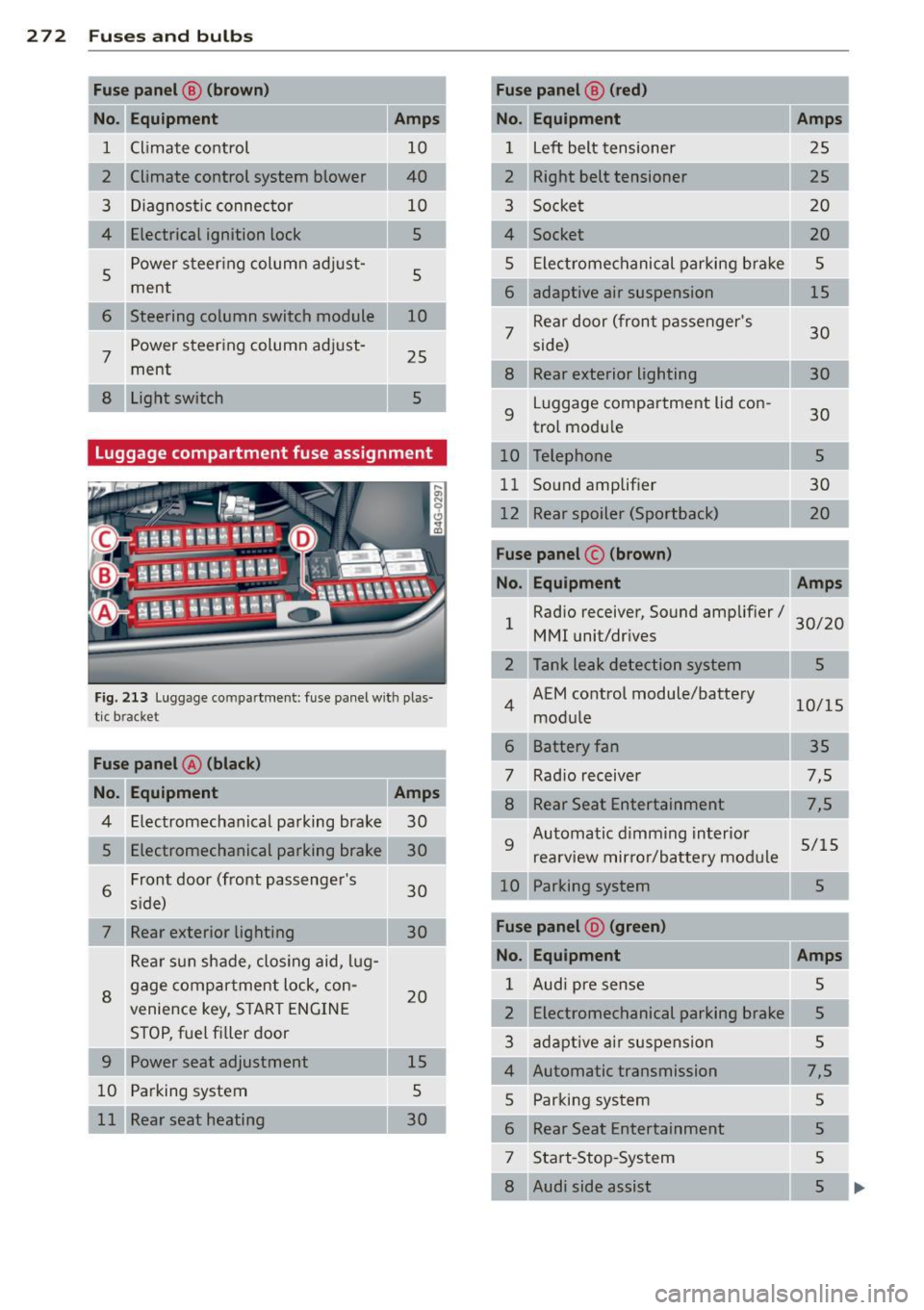
Fuse panel @ (brown)
No. Equ ipment Amps
Climate control 10
Climate control system blower 40
3
D iagnost ic connec tor 10
4 Electrical ignition lock 5
5
Power s teer ing column adju st-
ment
5
6 Steering column switch module 10
7
Power steering column ad just -
ment
25
8 Light switch 5
Luggage compartment fuse assignment
F
ig . 2 13 Lu ggage compar tment: fuse pa nel w ith plas
t ic bracket
Fu se panel A (black )
No. Equipment Amps
Electromechanical pa rking brake 30
Electraomechanical parking brake 30
6
Front door (front passenge r's
30 s ide)
7 Rear exterior lighting 30
Rea r su n shade, closing aid, lug-
8 gage
comp artment lock, con-
20
venience key, S TA RT E NGIN E
STOP, fuel fi ller door
9 Power seat adjustment 15
1 0
Pa rking system 5
11
Rear seat heating 30
Fuse panel @ (red )
No. Equipment Amps
1 Left belt tensioner 2 5
2 25
3
Socke t 20
4
Socket 20
5
Ele ctrome chanic al p arking b ra ke 5
6 adaptive air suspension 15
7
Rear door (fron t passenger's
30 side)
8 Rear exterior lighting
30
9
L
u ggage compartment lid con-
30 trol mod ule
Telephone
5
11
So und amplif ier 30
12
Rear spoiler (Sportback) 20
Fuse panel © (brown)
No . Equipment Amps
1 Radio receiver, Sound amplifier/ 3 0/ 20
MMI unit/dr ives
Tank lea k detec tion sys tem
5
4 AEM co ntrol module/battery 10/15
mo dule
Battery fan
35
Rad io rec eiver 7,5
7 ,5
9
Automatic dimm ing in terior 5/15
rea rv iew mirror /ba ttery m od ule
10 Parking system 5
Fuse panel @ (green)
No. Equipment Amps
1 Audi pre sense 5
2
Electromechanical parking brake 5
3 ad a pt ive air suspen sio n 5
4
Automatic transmission 7,5
5
Parki ng sys tem 5
6 Rear Seat Entertainment 5
7
Start -Stop-System 5
8 Audi side assist 5