fuel AUDI S6 2013 Owner's Manual
[x] Cancel search | Manufacturer: AUDI, Model Year: 2013, Model line: S6, Model: AUDI S6 2013Pages: 306, PDF Size: 76.92 MB
Page 224 of 306
222 Fuel supply and filling your fuel tank
transport fuel to use for your lawn mower,
snow blower, etc., be very careful and al
ways observe local and state laws regard
ing the use, transportat ion and storage of
such fuel containers. Make certain the con
tainer meets industry standards (ANSI/
AS TM F852 -86) .
(D Note
Never drive your vehicle until the fuel tank
is completely empty. The irregular supply
of fuel can cause misfiring. Gasoline could
enter the exhaust system and damage the
catalyt ic converter.
Refuelling
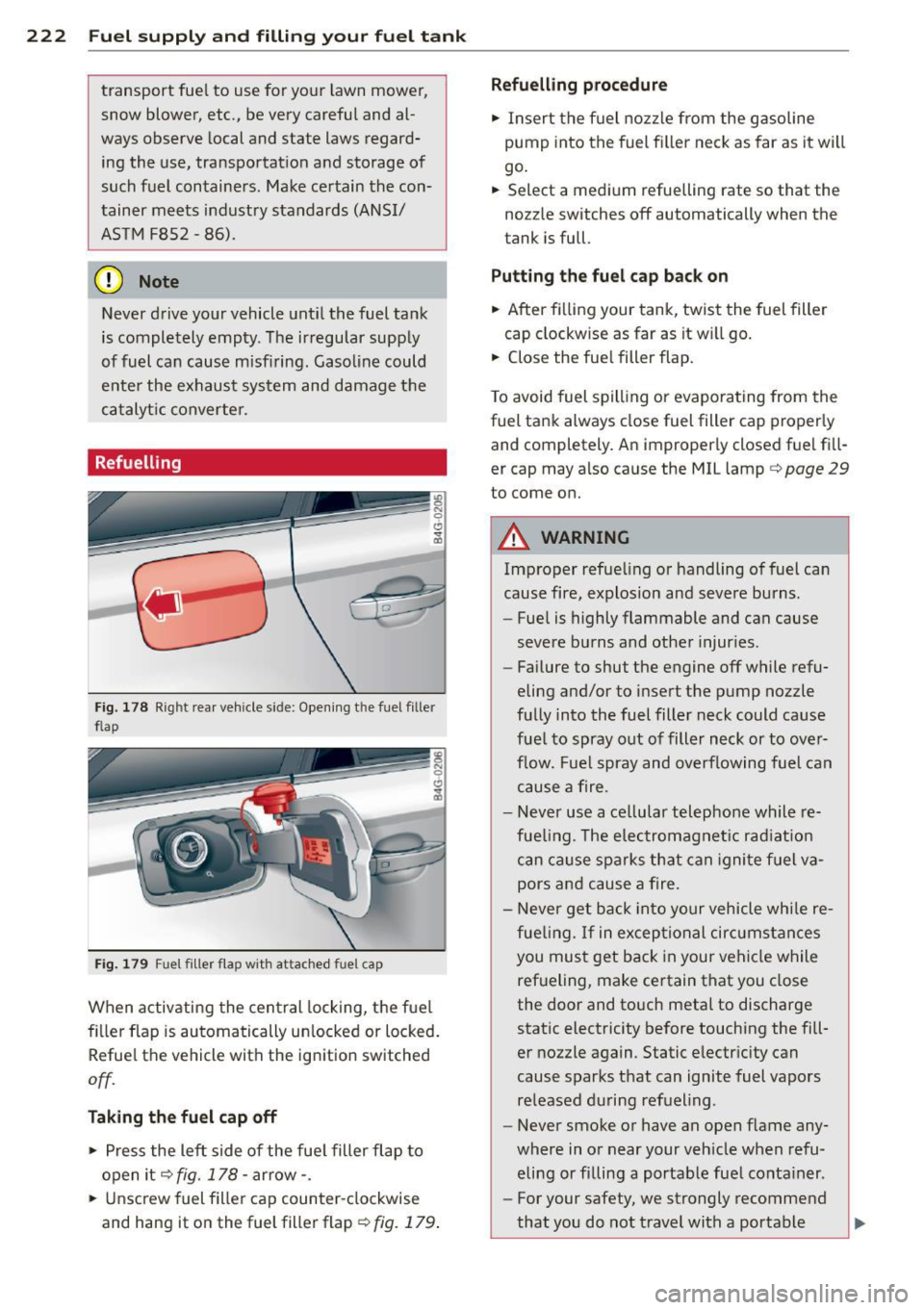
Fig. 178 Right rear vehicle side: Opening the fuel filler
flap
Fig . 179 Fuel filler flap with attached fuel cap
When activating the central locking, the fuel
fi ller flap is automatically un locked or locked.
Refuel the vehicle with the ignition switched
off.
Taking the fuel cap off
~ Press the left side of the fue l filler flap to
open it¢
fig. 178 -arrow-.
~ Unscrew fuel filler cap counter-clockwise
and hang it on the fuel filler flap¢
fig. 179.
Refuelling procedure
~ Insert the fu el nozzle from the gasoline
pump into the fuel filler neck as far as it will
go .
~ Select a medium refuelling rate so that the
nozzle switches off automatically when the
tank is full.
Putting the fuel cap back on
~ After fi lling your tank, twist the fuel filter
cap clockwise as far as it w ill go.
~ Close the fue l filler flap.
T o avoid fuel spilling or evaporating from the
fuel tank always close fuel filler cap properly
and completely. An improperly closed fuel fill
er cap may also cause the MIL lamp¢
page 29
to come on.
A WARNING
Improper refue ling or handling of fuel can
cause fire, explosion and severe burns.
- Fuel is highly flammable and can cause
severe burns and other injur ies.
- Failure to shut the engine
off while refu
eling and/or to insert the pump nozzle
fully into the fuel filter neck could cause
fuel to spray out of filler neck or to over
flow. Fuel spray and overflowing fuel can
cause a fire.
- Never use a cellular telephone while re
fue ling. The electromagnet ic rad iat ion
can cause sparks that can igni te fuel va
pors and cause a fire.
- Never get back into your vehicle whi le re
fueling.
If in exceptional circumstances
you must get back in your vehicle while
refueling, make certain that you close
the door and touch metal to discharge
static electricity before touching the fill
er nozzle again. Static electricity can
cause sparks that can ignite fuel vapors
released during refueling.
- Never smoke or have an open flame any
where in or near your veh icle when refu
eling or filling a portable fuel container.
- For your safety, we strongly recommend
that you do not travel with a portable
Page 225 of 306
fuel container in your vehicle. The con
tainer, full or empty may leak and co uld
cause a fire, especially in a crash.
- If, under exceptional circumstances, yo u
must transport a portable fuel container,
please observe the following:
- Never fi ll a po rtable fue l container
while it is anywhe re in or on the vehicle
(for examp le, in the luggage compar t
ment, or on the tr unk). Static electric i
ty can bui ld up while fi lling and can ig
n ite fue l vapors causing a fire .
- Always p lace a portable fuel container
on the gro und before filling.
- Always keep the fi ller nozzle comp lete
ly inside the po rtable conta iner before
and during filling.
- If filling a portable container made of
metal, the filler nozz le must always be
i n contact with the container. Th is w ill
he lp prevent static electricity from dis
charging and cause a fi re .
- Never sp ill fuel inside the vehicle or
luggage compartment. Fue l vapors are
h ighly f lammable .
- Always observe local and state/provin
cial laws regard ing the use, storage
and tra nsporta tion of fuel co ntainers .
- Make certai n the fuel container meets
industry standards (ANSI/ ASTM
F 8 52 -86) .
(D Note
If any f uel has spilled onto t he car, it
should be removed immediate ly to prevent
damage to the paint.
~ For the sake of the environment
As soon as the correctly operated nozzle sw itches off automatically fo r the fi rst
time, the tank is full. Do not try to add more fue l because fue l may spill out . In
add it io n, th e expans io n sp ace in the fuel
t ank will be fi lled -cau sin g the fue l to
over flow whe n it be come s w arm a nd pol
lu te the env iro nment.
Fu el suppl y and filli ng your fuel t ank 223
@ Tips
- Ru nning your eng ine whi le refue lli ng
may cause vapors to escape or even
cause fuel to sp ill out of the tank. T his
would then shut off the fuel nozzle be
f o re the ta nk is f ull.
- Do not refuel you r vehicle with the ign i
tion switched on. The fuel gauge may
ot herwise not i nd icate the correct fue l
lev el after r ef u ell ing .
- The fue l filler flap of yo ur vehicle is not
locked when you lock t he ve hicle from
t he insid e.
Fuel filler flap emergency release
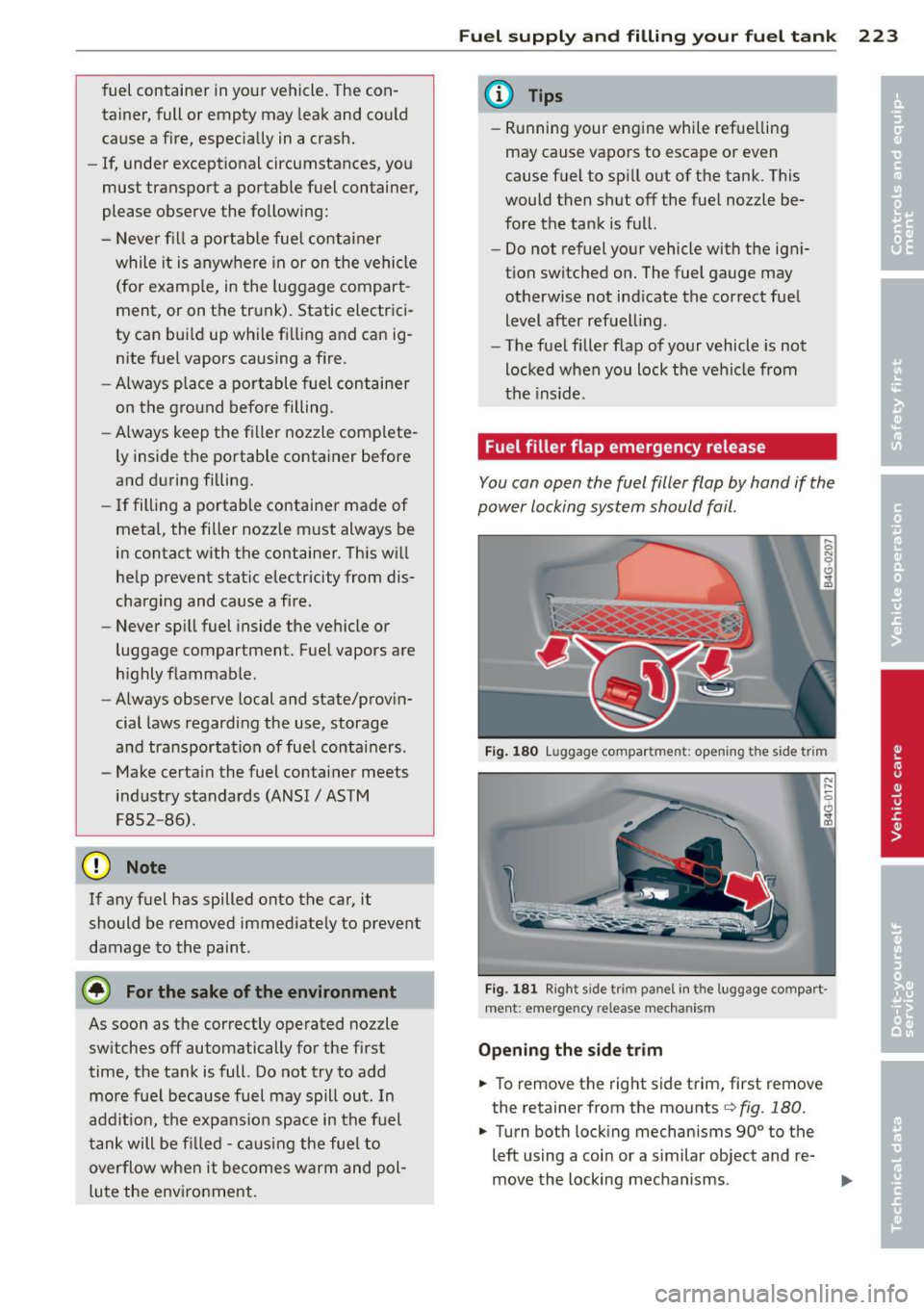
You can open the fuel filler flap by hand if the
power locking system should fail .
Fig. 180 Lug gage compa rtm ent: ope ning th e side trim
Fig . 181 Right s ide tri m pane l in th e luggage com part ·
m ent : eme rge ncy re lease mechan is m
Opening the side trim
.. To remove the right side t rim, first remove
the retainer from the mounts
¢ fig. 180.
.. Turn bot h lock ing mechan isms 90° to the
left using a coin or a s imilar object and re-
move the locking mechanisms .
IIJ,,
Page 226 of 306
224 Fuel supply and filling your fuel tank
• Tilt the retainer upward and p ull the tr im
o ut. Lay the trim down on its side, because
there is an e lectrical wire on the bac k.
Fuel filler door emergency rel ease
The eme rgency re lease me chan ism is loc ated
behind the right side t rim pa ne l in the lug
gage compartment.
• Loosen the loop ¢
fig. 181 from the retain
er and then pull on the loop ca refully ¢0.
• Press on the le ft side of the fuel fille r door
to open
¢fig. 178 .
(D Note
Onl y pull o n the loop un til you fee l resis t
ance . You will not hear it release. Other
w ise you cou ld damage the emergency re
lease mechanism.
Page 231 of 306
temperatures stay below freezing point for l ong periods.
Detergent add itives in the o il w il l make fresh
oil look dark after the eng ine has been run
ning fo r a short time . This is norma l and is not
a reason to change the oi l more often than
recommended.
D am ag e or m alfun ction s due to lack of
ma intenanc e
It is essential that you change your oil at the
r ecommended inte rva ls using only engine o il
t hat complies wi th A udi oi l standard
VW 502 00 . Your Limited New Vehicle War
ranty does not cover damage or malfunctions
d ue to fa ilure to fo llow recommended mainte
nance and use requ irements as set forth in
the Audi Owner's Manua l and Warranty
&
Maintenance book let . Your dea ler will have to
deny warranty coverage u nless you present to
the dea ler p roof in the fo rm of Serv ice or Re
pa ir Orde rs that all s chedu led maintenance
wa s pe rformed in a t imely manner .
Engine oil consumption
The engine in your vehicle dep ends on an ade
quate amount of oil to lubricate and cool all
of its moving parts.
In o rder to provide effective lubrication and
cool ing of i nternal engine components, a ll in
ternal comb ustion eng ines consume a cert ain
amo unt of o il. Oil cons umption varies from
engine to engine and may change significantly
over the life of the engine. Typ ica lly, engines
with a specified break-in per iod (see
¢
page 199) consume more oil during the
break-in per iod than they consume after oil
consumption has stabilized .
Under norma l conditions, the rate of oil con
sumpt ion depends on the quality and viscosity
of the oil, the RPM (revo lutions per m inute) at
which the engine is operated, the amb ient
temperature and road condit ions. Furthe r fac
tors ar e the amount of o il d ilution from wate r
condensation or fuel residue and the ox ida
tion level of the oi l. As any engine is s ubje ct to
Checkin g and fillin g 229
wear as m ileage builds up, the oil consump
tion may increase over time until replacement
of worn components may become necessary.
Wi th a ll these variab les coming into p lay, no
standard rate of oil consumpt ion can be es
tablished or specified. There is no alternative
to regular and frequent check ing of the o il lev
el, see
Note .
If the yellow engine oil leve l warning symbo l
in the instrument cluster
II li ghts up, you
sho uld check the oil leve l as soon as possib le
¢
page 230. Top off the oil at your earliest
convenience ¢
page 230.
A WARNING
Before you check anythi ng i n the engine
com partment, always read a nd heed all
WARNINGS¢ .&.
in Working in th e engine
c ompartment on page 225.
(D Note
D riving w ith an insufficient o il level is like
ly to cause sever e damage to the engine .
(D Tips
- The oil pressure warning display. is
not an indicator of the oil le vel. Do not
rely on it . Instead, check the oil level in
your engine at regu lar intervals, pref
erably ea ch time you refuel, and always
before going on a long trip .
-If you have the impression yo ur engi ne
c ons umes ex ce ss ive amoun ts of o il, we
recommend that you consul t your Au di
de aler to have the cause of your concern
properly diagnosed . Keep in mind that
the accurate meas urement of o il con
sumption requires great care and may
take some t ime. Y our Audi dea ler has in
struct ions about how to measure oil con
sumption accurately.
-
•
•
Page 243 of 306
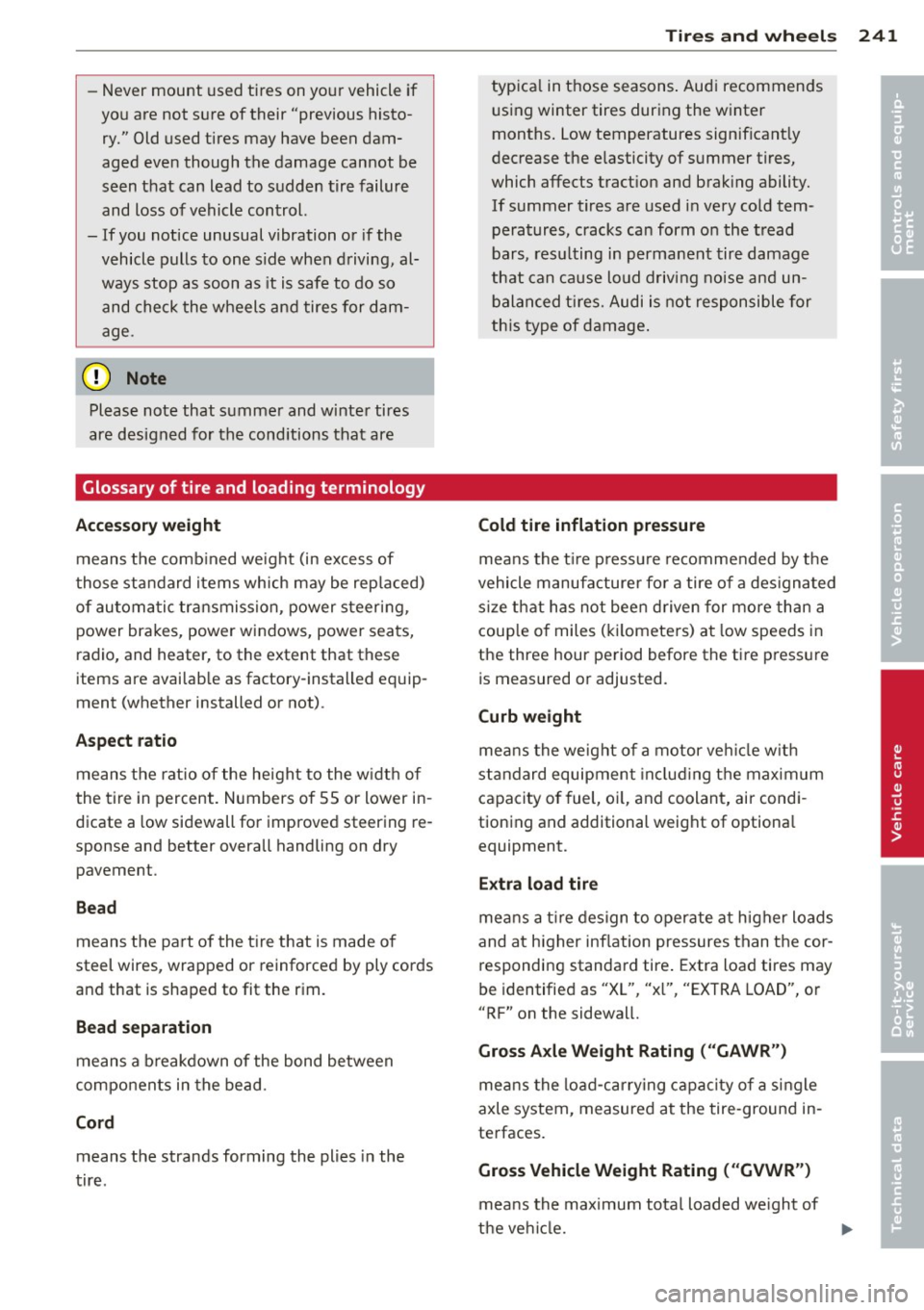
-Never mount used tires on yo ur vehicle if
yo u are not sure of their "previous histo
ry." Old used tires may have been dam
aged even though the damage cannot be
seen that can lead to sudden tire failure
and loss of vehicle control.
- If you notice unusual vibration or if the
vehicle pulls to one side when d riving, al
ways stop as soon as it is safe to do so
and check the wheels and tires for dam
age .
(D Note
Please note that summe r and wi nte r tires
are designed for the cond itions that are
Glossary of tire and loading terminology
Accessory weight means the comb ined weight (in excess of
those sta ndard items which may be rep laced)
of au toma tic transmission, power steer ing ,
power brakes, power windows, power seats,
radio, and heater, to the extent that these
items are availab le as factory-installed equip
ment (whether installed or not) .
Aspect ratio
means the rat io o f the height to the w idth of
the tire in percent . Numbers of 55 or lower in
dicate a low sidewall for improved steering re
sponse and better overa ll handling on dry
pavement .
Bead
means the part of the t ire t hat is made o f
steel wires, wrapped or reinforced by ply cords
and that is shaped to fit the r im.
Bead separation
means a b reakdown of the bond between
components in the bead .
Cord means the strands forming the plies in the
tire.
Tire s an d wheel s 241
typica l in those seasons . Aud i recommends
using winter tires during the winter
months . Low temperatures signif icant ly
dec rease the e lasticity of summer t ires,
which affects tract ion and brak ing ability.
If summer t ires are used i n very co ld tem
peratures, cracks ca n form o n the tread
bars , res ulting in perma nen t tire damage
that can cause loud driving noise and un
bala nced ti re s. Audi i s not respon sible for
th is type of damage .
Cold tire inflation pressure
means the t ire p ress ure recommended by t he
vehicle manufacture r fo r a tire o f a des ignated
s ize t hat has not bee n driven for more than a
coup le o f miles (k ilometers) at low speeds in
the three hour period before the tire press ure
is m easured or adjusted.
Curb weight
me ans the we ight of a motor ve hicle with
st andard equipmen t incl ud ing the max imum
capacity of fuel, oi l, and coolant, air condi
tioning and additional weig ht of optiona l
equipment.
Extra load tire
means a t ire design to oper ate a t higher load s
and at higher inflation pressures than the cor
responding standa rd tire . Extra load tires may
be identified as "XL", "x l", "EXTRA LOAD", o r
"RF" on the sidewal l.
Gross Axle Weight Rating ("GAWR")
me ans the load-ca rry ing capac ity of a single
axle system , measured at the tire -ground in
te rfaces.
Gross Vehicle Weight Rating ( "GVWR ")
mea ns the maximum total loaded we ight of
the ve hicl e. .,..
•
•
Page 250 of 306
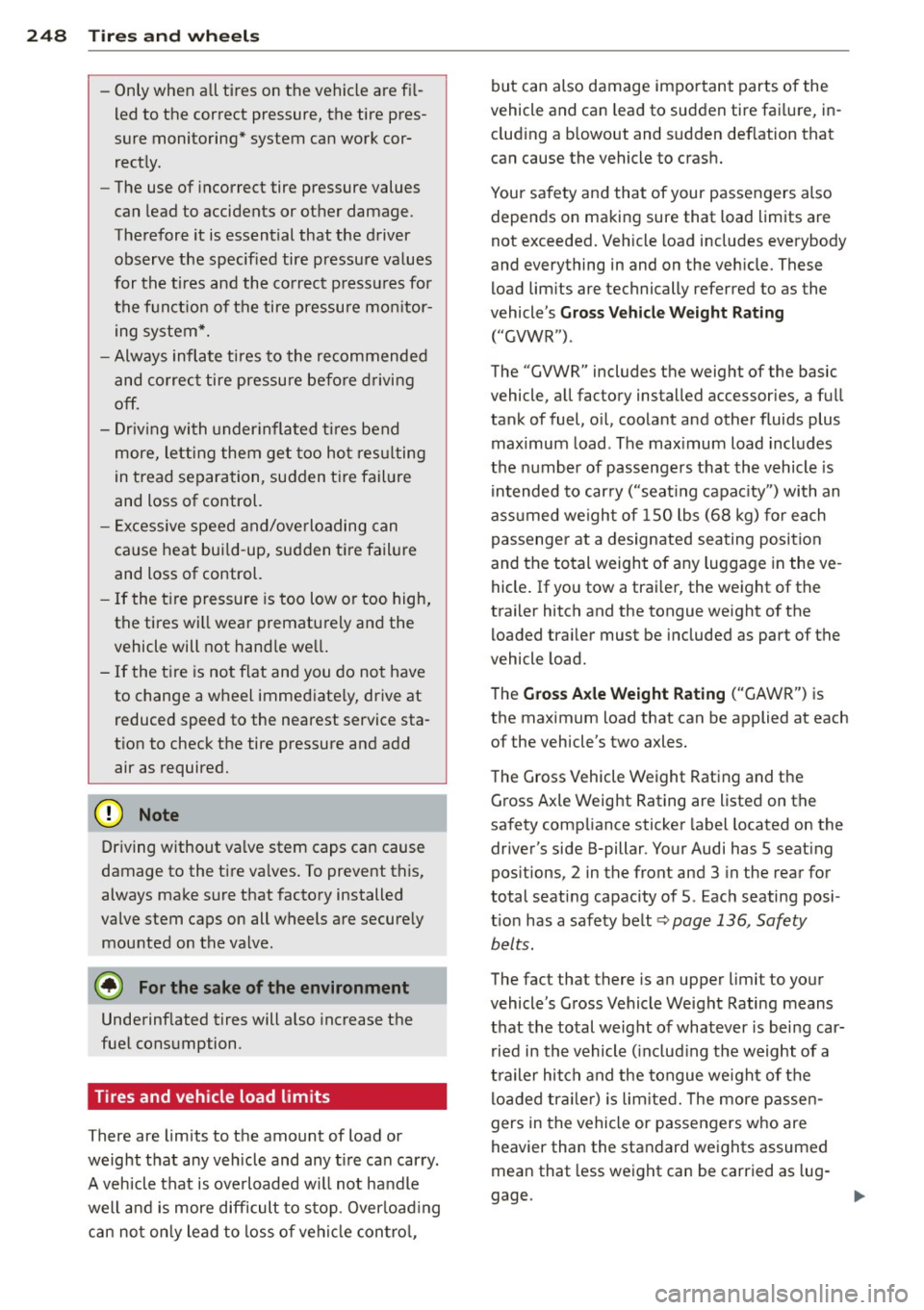
248 Tire s and whee ls
- Only when all tires on the vehicle are fi l
led to the correct pressure, the tire pres
sure monitoring* system can work cor rectly.
- The use of incorrect tire pressure values
can lead to accidents or other damage.
Therefore it is essential that the driver observe the specified tire pressure values
for the tires and the correct pressures for
the funct ion of the tire pressure mon itor
ing system*.
- Always inflate t ires to the recommended
and correct tire pressure before driving
off.
- Driv ing with under inflated ti res bend
more, letting them get too hot resu lting
in tread separation, sudden ti re fail ure
and loss of control.
- Excess ive speed and/overloading can
cause heat bui ld -up, sudden ti re fail ure
and loss of control.
- If the tire press ure is too low or too high,
the tires wi ll wear prematurely and the
vehicle will not hand le we ll.
- If the tire is not flat and you do not have
to change a wheel immediate ly, drive at
reduced speed to the nearest service sta
t ion to check the tire pressure and add
air as required.
Driving without va lve stem caps can cause
damage to the tire va lves. To prevent this,
always make sure that factory installed
valve stem caps on all wheels are securely mounted on the valve.
@) For the sake of the environment
Underinf lated tires will a lso increase the
fuel consumption.
Tires and vehicle load limits
There are limits to the amount of load or weight that any veh icle and any t ire ca n carry.
A veh icle that is overloaded w ill not handle
well and is more difficult to stop. Over load ing
can not on ly lead to loss of veh icle contro l, but can also damage important parts of the
vehicle and can lead to sudden tire fai lure, in
clud ing a b lowout and sudden deflation that
can cause the vehicle to crash.
Your safety and that of your passengers also depends on making sure that load limits are
not exceeded. Vehicle load includes everybody
and everything in and on the veh icle. These
load lim its are technically referred to as the
vehicle's
G ro ss Vehicl e We ight R ating
("GVWR").
The "GVWR" includes the weight of the basic
vehicle, all factory installed accessories, a full
tank of fuel, o il, coolant and other fluids plus
maximum load. The max imum load includes
the number of passengers that the vehicle is
intended to car ry ("seat ing capac ity") with an
ass umed we ight of 150 lbs (68 kg) for each
passenge r at a designated seating position
and the total weight of any luggage in the ve
hicle . If you tow a trai ler, the weight of the
trailer hitch and the tongue weight of the
loaded tra iler must be included as part of the
vehicle load.
The
G ro ss Axle We ight R ating ("GAWR") is
the maximum load that can be applied at each of the vehicle's two axles.
The Gross Vehicle Weight Rating and the Gross Axle Weight Rating are listed on the
safety comp liance sticker label located on the
driver's side B-pillar . Your Audi has 5 seat ing
pos itions, 2 in the front and 3 in the rear for
total seating capacity of 5 . Each seating posi
t ion has a safety belt
Q page 136, Safety
belts.
The fact that there is an upper limit to your
vehicle's Gross Vehicle Weight Rating means
that the total weight of whatever is being car
ried in the vehicle ( includ ing the weight of a
t ra ile r hi tch and the tongue weigh t of the
loaded tra iler) is lim ited. The more passen
gers in the vehicle or passengers who are
heavier than the standard weights assumed
mean that less weight can be carried as lug-
gage.
~
Page 260 of 306
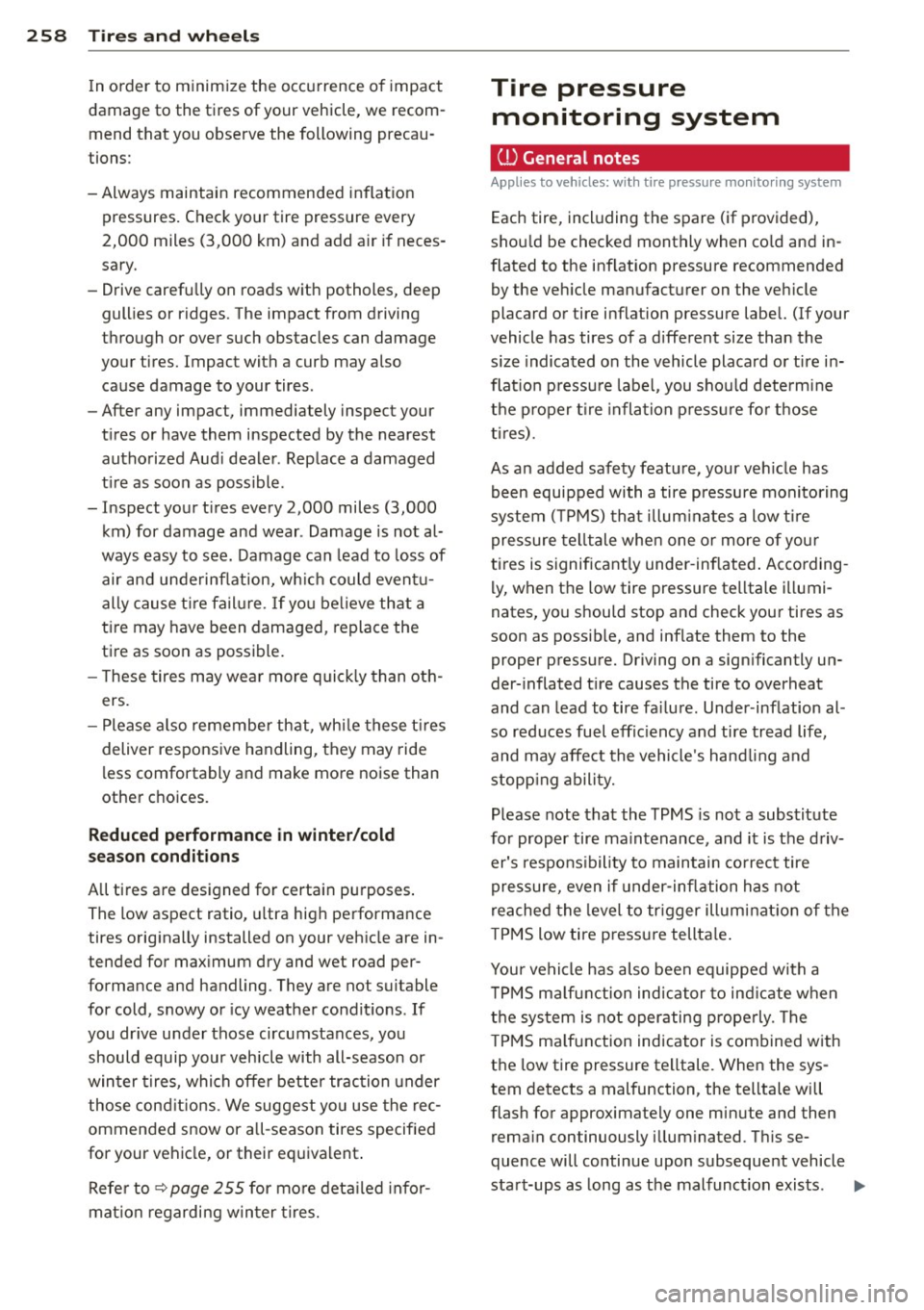
258 Tires and wheels
In order to minimize the occurrence of impact
damage to the tires of your vehicle, we recom
mend that you observe the following precau
tions :
- Always maintain recommended inflation
pressures. Check your tire pressure every
2,000 miles (3,000 km) and add a ir if neces
sary.
- Drive carefu lly on roads with potholes, deep
gullies or ridges. The impact from driving
through or over such obstacles can damage
your tires. Impact with a curb may also cause damage to your tires.
- After any impact, immediately inspect your
tires or have them inspected by the nearest
authorized Aud i dealer . Replace a damaged
t ir e as soon as possible .
- Inspect your t ires every 2,000 miles (3,000
km) for damage and wear . Damage is not al
ways easy to see. Damage can lead to loss of
air and underinflation, wh ich could event u
ally cause t ire failure.
If you believe that a
ti re may have been damaged, replace the
tire as soon as possible.
-These tires may wea r more quickly than oth
ers.
- Please also remember that, while these tires
deliver responsive handling, they may ride
less comfortably and make more noise than
other choices.
Reduced performance in winter/cold
season conditions
All tires are designed for certain purposes .
The low aspect ratio, ultra high performance
tires originally installed on your vehicle are in
tended for max imum dry and wet road per
f ormance and handling . They are not suitable
for cold, snowy or icy weather cond it ions.
If
you dr ive under those circumstances, you
should equip your vehicle with all-season or
winter tires, which offer better traction under
those conditions . We suggest you use the rec
ommended snow or all-season tires specified
for your vehicle, or their equiva lent .
Refer to~
page 255 for mo re detailed infor
mation regarding w inter tires.
Tire pressure
monitoring system
ill General notes
Applies to veh icles: w ith tire pressure monito ring system
Each tire, including the spare (if provided),
shou ld be checked monthly when co ld and in
flated to the inf lation pressure recommended
by the vehicle manufacturer on the vehicle
placard or tire inflation pressure label. (If your
vehicle has tires of a different size than the
s iz e indicated on the vehicle placard or tire in
flat io n pressu re label, you shou ld dete rmin e
the proper tire inflation pressure for those
tires) .
As an added safety feature, your veh icle has
been equipped with a tire pressure monitoring
system ( TPMS) that illuminates a low tire
pressure telltale when one or more of your
tires is significant ly under -inflated . Acco rding
ly, when the low tire pressure te lltale illumi
nates, you shou ld stop and check your tires as
soon as possib le, and inflate them to the
proper pressure. Driving on a sign ificantly un
der-inflated tire causes the tire to overheat
and can lead to tire fa ilure . Under -inflation al
so reduces fuel effic iency and tire tread life,
and may affect the vehicle 's hand ling and
stopp ing ability.
Please note that the TPMS is not a substitute
for proper tire ma intenance, and it is the driv
er's respons ibility to maintain correct tire
pressure, even if under -inflation has not
reached the level to trigger illumination of the
T PMS low tire p ressu re tellta le .
Your vehicle has also been equipped with a
TPMS malfunction indicator to ind icate when
the system is not operating properly . Th e
T PMS ma lfunction indicator is combined with
the low tire pressure telltale. When the sys
tem detects a malfunction, the telltale will
flash for approximately one minute and then
rema in con tinuously illuminated . Th is se
quence will continue upon subsequent vehicle
start-ups as long as the malfunct ion exists . .,.
Page 273 of 306
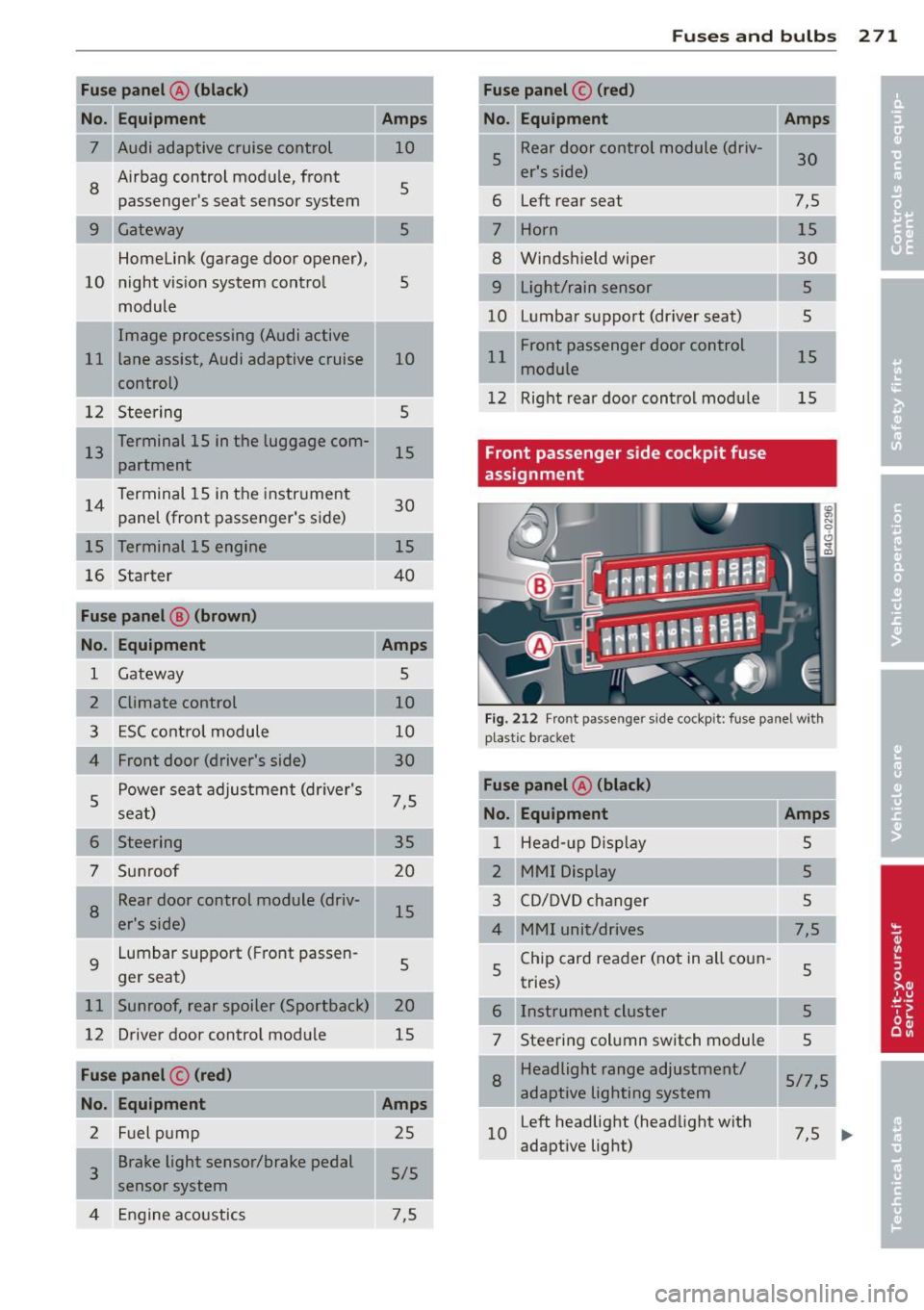
Fuse panel@ (black )
No. Equipment Amps
= = 7 Audi adaptive cruise control 10
8
Airbag control module, front
5
passenger's seat sensor system
Gateway 5
Homelink (garage door opener),
10 night vision system control
5
module
Image processing (Audi active
11 lane assist, Audi adaptive cruise
10
control)
12 Steering 5
1 13 Terminal 15 in the luggage com-
15
partment
14 Terminal 15 in the
instrument
30
panel (front passenger's side)
15 Terminal 15 engine 15
16 Starter 40
Fuse panel
B (brown)
No. Equipment Amps
1 Gateway 5
2 Climate control 10
3 ESC control module 10
Front door (driver's side) 30
s
Power seat adjustment (driver's
7,5
seat)
6 Steering 35
7 Sunroof 20
8
Rear door control module (driv-
15
er's side)
9 Lumbar support (Front passen
-
5
ger seat)
11 Sunroof, rear spoiler (Sportback) 20
12 Driver door control module
15
Fuse panel
c (red)
No. Equipment Amps
2 Fuel pump 25
3 Brake light sensor/brake pedal
sensor system 5/5
4 Engine acoustics 7,5
Fuses and bulbs
-Fuse panel © (red)
No.
u Equipment
5 Rear door
control module (driv-
er's side)
6 Left
rear seat
Horn
Windshield wiper
9 Light/rain sensor
10 L
umbar support (driver seat)
11 Front passenger door control
module
12 Right rear door control modu le
Front passenger side cockpit fuse
assignment Amps
30
7,5 15
30 5
5
15
15
Fig. 212 Front passenger side cockpit: fuse panel wit h
p last ic bracket
Fuse panel A (black)
No. Equipment
Amps
1 Head-up Display 5
2 MMI Display 5
3 CD/DVD changer 5
4 MMI unit/drives
7,5
5 Chip card reader (not in all coun
-
5
tries)
6 Instrument cluster
5
7 Steering column switch module
5
8
Headlight range adjustment/
5/7,5
adaptive lighting system
10 Left
headlight (headlight with
7,5
adaptive light)
I
271
...
Page 274 of 306
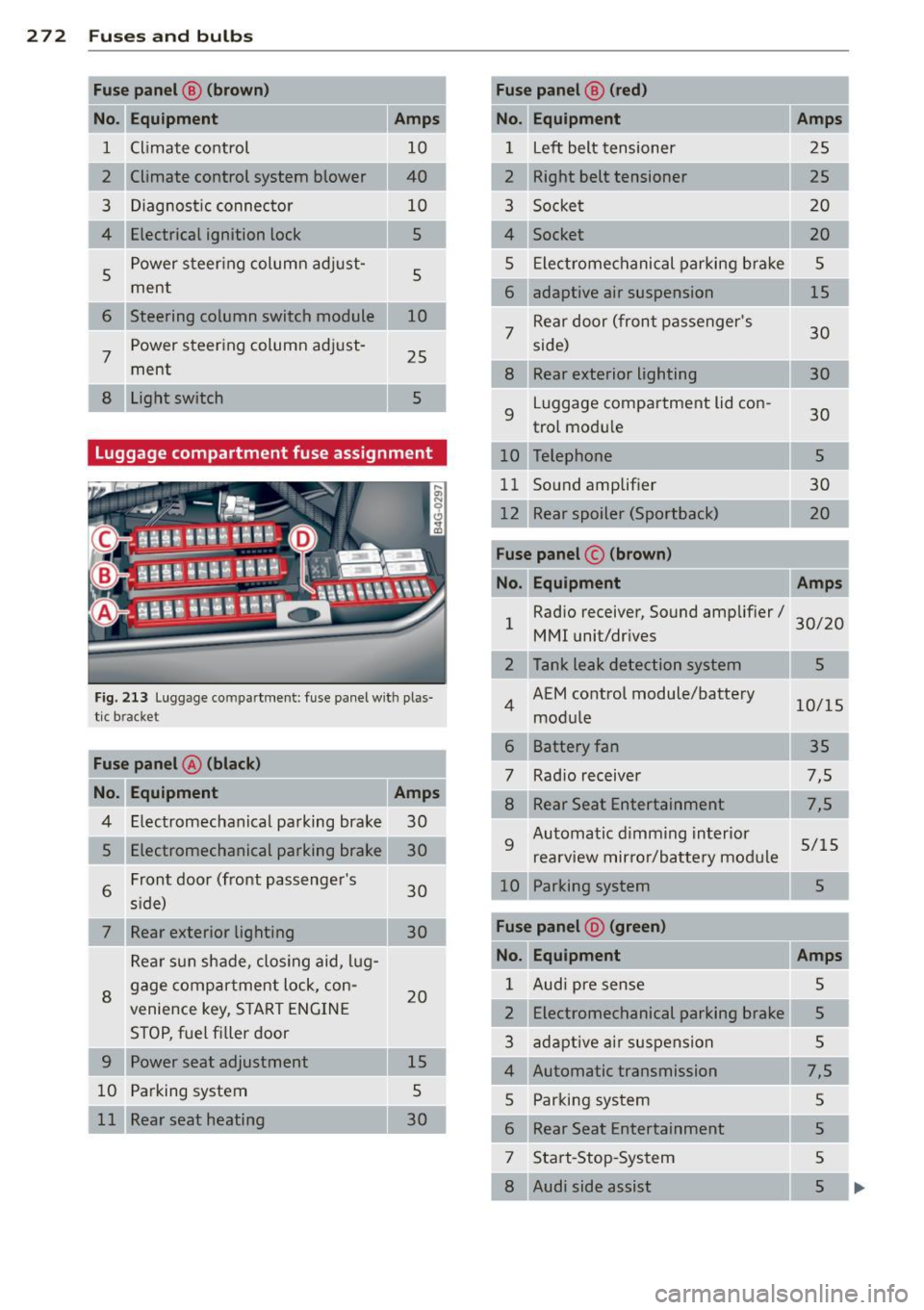
272 Fuses and bulbs
Fuse panel @ (brown)
No. Equ ipment Amps
Climate control 10
Climate control system blower 40
3
D iagnost ic connec tor 10
4 Electrical ignition lock 5
5
Power s teer ing column adju st-
ment
5
6 Steering column switch module 10
7
Power steering column ad just -
ment
25
8 Light switch 5
Luggage compartment fuse assignment
F
ig . 2 13 Lu ggage compar tment: fuse pa nel w ith plas
t ic bracket
Fu se panel A (black )
No. Equipment Amps
Electromechanical pa rking brake 30
Electraomechanical parking brake 30
6
Front door (front passenge r's
30 s ide)
7 Rear exterior lighting 30
Rea r su n shade, closing aid, lug-
8 gage
comp artment lock, con-
20
venience key, S TA RT E NGIN E
STOP, fuel fi ller door
9 Power seat adjustment 15
1 0
Pa rking system 5
11
Rear seat heating 30
Fuse panel @ (red )
No. Equipment Amps
1 Left belt tensioner 2 5
2 25
3
Socke t 20
4
Socket 20
5
Ele ctrome chanic al p arking b ra ke 5
6 adaptive air suspension 15
7
Rear door (fron t passenger's
30 side)
8 Rear exterior lighting
30
9
L
u ggage compartment lid con-
30 trol mod ule
Telephone
5
11
So und amplif ier 30
12
Rear spoiler (Sportback) 20
Fuse panel © (brown)
No . Equipment Amps
1 Radio receiver, Sound amplifier/ 3 0/ 20
MMI unit/dr ives
Tank lea k detec tion sys tem
5
4 AEM co ntrol module/battery 10/15
mo dule
Battery fan
35
Rad io rec eiver 7,5
7 ,5
9
Automatic dimm ing in terior 5/15
rea rv iew mirror /ba ttery m od ule
10 Parking system 5
Fuse panel @ (green)
No. Equipment Amps
1 Audi pre sense 5
2
Electromechanical parking brake 5
3 ad a pt ive air suspen sio n 5
4
Automatic transmission 7,5
5
Parki ng sys tem 5
6 Rear Seat Entertainment 5
7
Start -Stop-System 5
8 Audi side assist 5
Page 282 of 306
280 General information
General information
Explanation of
technical data
Some of the technical data listed in this man
ual requires further explanation .
The technical data for your vehicle is listed in
the charts starting on
r:::> page 282. This sec
tion provides general information, notes and restrictions which apply to this data.
Vehicle identification
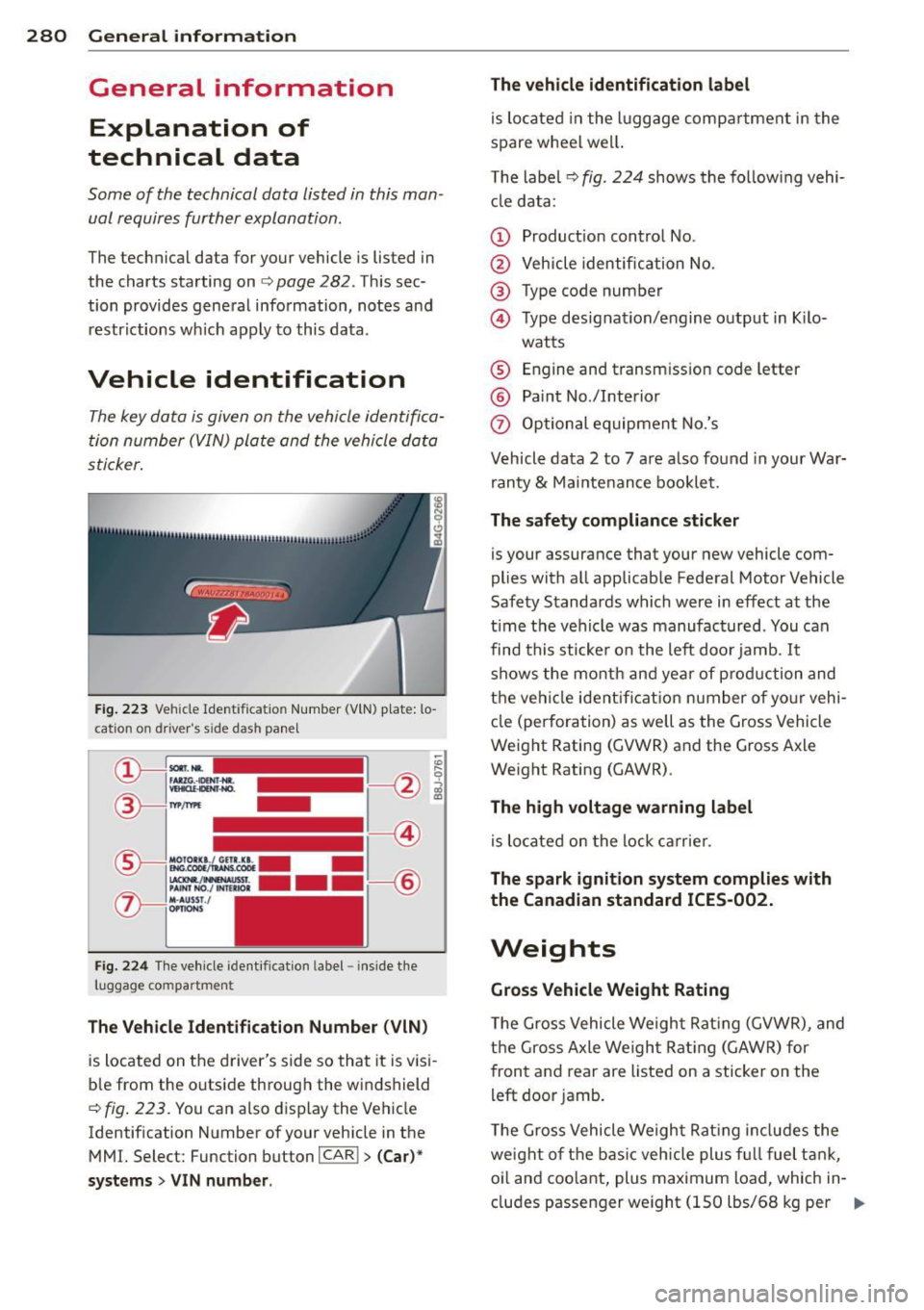
The key data is given on the vehicle identifica
tion number (VIN) plate and the vehicle data
sticker .
Fig. 223 Veh icle Ide ntificat io n Number (VlN) p late: lo
cation on driver 's s ide das h panel
Fig. 224 The vehicle identi fication label -inside the
luggage co mpa rtmen t
The Vehicle Identification Number (VIN)
is located on the driver's side so that it is visi
ble from the outside through the windshield
r:::> fig . 223. You can also display the Vehicle
Identification Number of your vehicle in the
MMI. Select: Function button
I CAR ! > (Car) *
systems
> VIN number . The
vehicle identification label
is located in the luggage compartment in the
spare wheel well.
The label¢
fig. 224 shows the follow ing vehi
cle data :
(D Product ion control No .
@ Vehicle identification No.
® Type code number
@ Type designation/engine output in Kilo-
watts
® Engine and transmission code letter
@ Paint No./Interior
(f) Optional equipment No.'s
Vehicle data 2 to 7 are also found in your War
ranty
& Maintenance booklet.
The safety compliance sticker
is your assurance that your new vehicle com
plies with all applicable Federal Motor Vehicle
Safety Standards which were in effect at the
t ime the vehicle was manufactured . You can
find this sticker on the left door jamb .
It
shows the month and year of production and
the vehicle ident ification number of yo ur vehi
cle (perforation) as well as the Gross Vehicle
Weight Rating (GVWR) and the Gross Axle
Weight Rating (GAWR) .
The high voltage warning label
is located on the lock carrier.
The spark ignition system complies with
the Canadian standard ICES-002.
Weights
Gross Vehicle Weight Rating
The Gross Vehicle Weight Rat ing (GVWR), and
the Gross Axle Weight Rating (GAWR) for
front and rear are listed on a sticker on the
left door jamb.
The Gross Vehicle Weight Rating includes the
weight of the bas ic vehicle plus fu ll fuel tank,
oi l and coo lant, plus maximum load, which in
cludes passenger weight (150 lbs/68 kg per
Ill>