brake light AUDI S6 2013 Owner's Guide
[x] Cancel search | Manufacturer: AUDI, Model Year: 2013, Model line: S6, Model: AUDI S6 2013Pages: 306, PDF Size: 76.92 MB
Page 207 of 306
Make sure that the cooling system has enough
f luid .
Tire pressure
When tow ing a trai ler, inflate the t ires of your
vehicle to the cold tire pressure listed under
"Full load" on the label located on the driver's
side B-pillar (visible when the door is open).
Inflate trailer tires to trai ler and tire manufac
turers' specifications.
Lights
Check to make sure both veh icle and trailer
lights are working properly.
Safety chains
Be sure tra iler safety cha ins are properly con
nected from the trailer to the hitch on the ve
hicle. Leave enough slack in the chains to per
mit turning corners . When you install safety
chains, make sure they wi ll not drag on the
road when you are driving.
The chains should cross under the tra ile r
tongue to prevent it from dropping in case of
sepa ration from the hitch.
Adjusting the Audi drive select
Make sure the veh icle is on a level surface be
fore hitching up the tra iler and before adjust
in g the tongue weight. The vehicle must be in
auto or comfort dr iving mode and not raised
qpage 98, q(D .
Make sure that the vehicle is lowe red. In Info
tainment, se lect:
ICARI f u nction button> Low
er
control button.
If you must drive under poor road condit ions,
you can raise the veh icle
after coupling the
traile r or
after adjusting the tongue weight
qpage 100.
- Changes in temperatu re or load can af
fect the height of the veh icle.
- Always se lect
auto or comfort mode.
Otherwise, the tongue load spec ified for
you r vehicle will no longer be applicable.
Trailer towing
Driving instructions
Driving with a trailer always requires extra
care and consideration .
To obtain the best possible handling of vehicle
and trailer, please note the following:
... Do not tow a loaded trailer when your car it
self is not loaded.
... Be especially careful when passing other
veh icles.
... Observe speed lim its .
... Do not dr ive at the maximum permissible
speed.
... Always apply brakes early .
... Monitor the temperature gauge.
Weight distribution
Towing a loaded trailer with an empty car re
sults in a highly unstable distribution of
weight. If this cannot be avoided, drive at very low speeds only to avoid the risk of losing
steering control.
A "balanced" rig is easier to operate and con
trol. This means that the tow vehicle should
be loaded to the extent possible and permissi
ble, while keeping the trailer as light as possi
ble under the circumstances. Whenever possi
ble, transfer some cargo to the luggage com
partment of the tow vehicle while observing
tongue load requirements and vehicle loading
considerations.
Speed
The higher the speed, the more difficult it be
comes for the driver to contro l the rig. Do not
drive at the maximum permissible speed. Re
duce your speed even more if load, weather or
wind conditions are unfavorable -particularly
when going downhill.
Reduce vehicle speed
immediately if the trail
er shows the slightest sign of swaying.
Do not
try to stop the swaying by accelerating.
Observe speed limits. In some areas, speeds
for vehicles towing trailers are lower than for
regular vehicles. .,.
205
•
•
Page 208 of 306
206 Trailer towing
Always apply brakes early. When driving
downhill, shift into a lower gear to use the en
g ine braking effect to slow the vehicle . Use of
the brakes alone can cause them to overheat
and fail.
Coolant temperature
The coolant temperature gauge¢ page 11
must be observed carefully. The coolant tem
perature can increase if you drive on long in
clines in a low gear at high engine speeds. Re
duce your speed immediately if the LEDs in
the top part of the display turn on .
For more information about indicator lights,
refer to. ¢
page 16 .
A WARNING
Anyone not properly restrained in a mov
ing vehicle is at a much greater risk in an
accident . Never let anyone r ide in your car
who is not properly wear ing the restraints
provided by Aud i.
Trailer towing tips
Important to know
Your vehicle handles differently when towing
a trailer because of the additional weight and
different weight distribution . Safety, perform
ance and economy w ill greatly depend on how
carefully you load your trailer and operate
your rig .
Before you actually tow your trailer, practice
turn ing, stopp ing and back ing up in an area
away from traffic. Keep practicing until you
have become comp lete ly familiar with the way
your ve hicle-trai ler comb ination behaves and
responds.
Backing up is difficult and requires practice .
Backing up with a tra iler generally requi res
steering act ion opposite to that when backing
up your vehicle without a trailer.
Maintain a greater distance between your ve
hicle and the one in front of you. You will need
more room to stop. To compensate for the trailer, you wi
ll need a larger than normal
turning radius.
When passing, remember that you cannot ac
celerate as fast as you norma lly would be
cause of the added load. Make sure you have
enough room to pass . After passing, a llow
plenty of room for your trailer before chang
ing lanes again.
Avoid jerky starts , sharp turns or rapid lane
changes.
(D Tips
- Do not tow a trailer during the break-in
period of your vehicle.
- If you tow a trailer, your Audi may re
quire more frequent maintenance due to
the extra load¢
page 285.
Parking on a slope
Do not park on o slope with a trailer. If it can
not be avoided, do so only after doing the fol
lowing:
When parking:
.,. App ly the foot brake .
.. Have someone pla ce chocks under both the
vehicle and the trailer wheels.
.. With chocks in place, slowly release the
brakes until the whee l chocks absorb the
load .
.. Turn the wheels towards the curb .
.. Apply the parking brake.
.. Select the P selector lever posit ion .
When restarting after parking:
.. Apply the foot brake.
.. Start the engine.
.. Select the D/S selector lever position .
.. Release the parking brake and slowly pull
out and away from the wheel chocks .
.,. Stop and have someone retr ieve the wheel
chocks .
Ill-
Page 210 of 306
208 Cleaning and protection
Cleaning and protect ion
General information
Regular core preserves vehicle value .
Any automobile is exposed to industrial
fumes, corrosive road salt, etc. A well cared
for Audi can look like new many years after
purchase . Regular and correct care w ill con
tr ibute to maintaining the beauty and value of
your Aud i.
Furthermore, good care may be a condition
for substantiating a warranty claim should
corrosion damage or paint defects occur.
Your author ized Audi dealer has a variety of
dedicated vehicle-care products and can ad
vise which ones to use for cleaning the exter i
or and interior of your vehicle .
Whether you use products recommended by
Audi or other commercially available clean ing
agents, please make sure you apply them cor
rectly .
A WARNING
-Cleaning agents may be poisonous. Keep
them out of the reach of children.
- Heed all caut ion labels.
- Always read directions on the container
before using any product . Follow the di
rect ions carefu lly.
- Most chemical cleaners are concentrated
and have to be diluted.
- Use spot removing fluids only in well
ventilated areas.
- Do not use gasoline, kerosene, d iesel
fuel, nail pol ish remover or other volatile
fluids. They may be toxic, flammable or
hazardous in other ways. Do not wash,
wax or dry the vehicle with the ignit ion
on or the engine running.
- Do not clean the undersides of chassis,
fenders, wheel covers, etc. without pro
tecting your hands and arms. You may cut yourself on sharp-edged metal parts. -
Moisture and ice on brakes may impair
brak ing eff ic iency
c::> page 194 , General
information.
Test the brakes carefully
each time you wash the vehicle .
@ For the sake of the environment
Select only environ mentally friendly clean
ing products. Leftover cleaning products
should not disposed of in the household
waste .
Care of exterior
Washing
Frequent washing protects the vehicle .
The best p rotection against environmental in
fluences is
frequent washing and waxing . How
often this is required depends on:
- How much the veh icle is used
- Where the vehicle is parked (garage, in the
open under trees, etc.)
- The seasona l and weather conditions
- Environmental influences
T he longer b ird droppings, insects, tree resin,
road and industria l gr ime, tar, soot, road salt
and other materials remain on the vehicle body, the more lasting their destructive ef
fects will be . High temperatures caused by ex
posure to intense sunlight intensify the corro
sive effect, particularly when humidity is high as well.
Under certain circumstances,
weekly washing
may be necessary. Under other conditions, a
monthly washing and waxing may be ade
quate .
After the winter, the underside of the vehicle
should be thoroughly washed, preferably in a
professional car wash.
Vehicles with matte finish paint
c::> page 210.
A WARNING
-A lways read and heed all WARNINGS and
other information
c::> page 208.
Page 216 of 306
214 Cleaning and protec tio n
To preserve the deco rative appearance of the
cast a lloy whee ls , some specia l care is neces
sary. In addit ion to road dirt and sa lt, brake
dust is also corros ive. If left on for too long,
brake dust can cause pitt ing.
Use only specia l
acid-free cleaners formulated
for a lloy rims. Safe products are available at
your Aud i dealer. Never leave the cleaner on
the r ims longer than spec ified on the label. If
not rinsed off promptly, the acid conta ined in
some cleaners can attack the threads on the
wheel bolts.
Never use abras ive or metal polishing clean
ing agents . If the protective coating has been
ch ipped, e .g . by k icked up road dirt, touch it
up as soon as poss ible.
A WARNING
- Moisture and ice on brakes may affect
braking efficiency
Q page 194, General
information .
Test the brakes caref ully
each time you wash the vehicle.
- Always read and heed all WARNINGS and
other information ¢
page 208.
-
Body cavity sealing
The body cavity sealing does not need to be
checked.
A ll body cavities wh ich could be affected by
corrosion have been thoroughly protected at
the facto ry.
This sealing does not require any inspection or
addit ional treatment . If any wax should seep
out of the cav ity when the ambient tempera
ture is high, it can be removed w it h a plastic
scrape r and a suitab le solven t.
A WARNING
So lvents can be dange rous.
- Benzine is flammable and toxic.
If you
use benzine for removing the wax, keep
sparks, flame and lighted cigarettes
away. Never dump benzine on t he
ground, into open streams or down sew
age drains. -
Be s ure to observe all safety and environ
mental regulat ions. Follow all instruc
tions on the container .
- Always read and heed all WARNINGS and
other information
Q page 208.
Chassis
Hove the undercoating checked for damage
from time to time .
The lower body shell of your Aud i is also thor
oughly protected against corrosion .
Any damage to the undercoat ing ca used by
road hazards should be repaired prom ptly.
A WARNING
r----
Too much undercoating in the wrong p la-
ces can cause a fire.
- Do not app ly additional under coating or
r u stp roof ing on or nea r the exhaust
manifold, exhaust pipes, catalytic con
verter or heat shields . While driving, the
substance used fo r undercoating could
overheat and cause a fire.
-
- Always read and heed a ll WARNINGS and
other information
Q page 208.
Exhaust tail pipes
Road salt and other corrosive materials will
damage the material in the exhaust tail pipes
if they are not cleaned regular ly. Do not clean
the tail pipes with wheel cleaner, pa int polish,
chr ome polish or other ab rasive clea ners.
Clean the tail pipes with ca r c are products
t h at are suitable fo r stainless steel.
Your authorized Aud i dea ler can provide clean
ing produc ts tha t have been tested and ap
proved for yo ur vehicle .
Care of interior
Infotainment components
The MMI/RSE* display may be cleaned wit h a
soft clot h and commercia lly-available "LCD
cleaner ". The clot h should be coated lightly ..,
Page 227 of 306
Checking and filling Engine hood
Releasing the engine hood
The engine hood is released from inside the
vehicle .
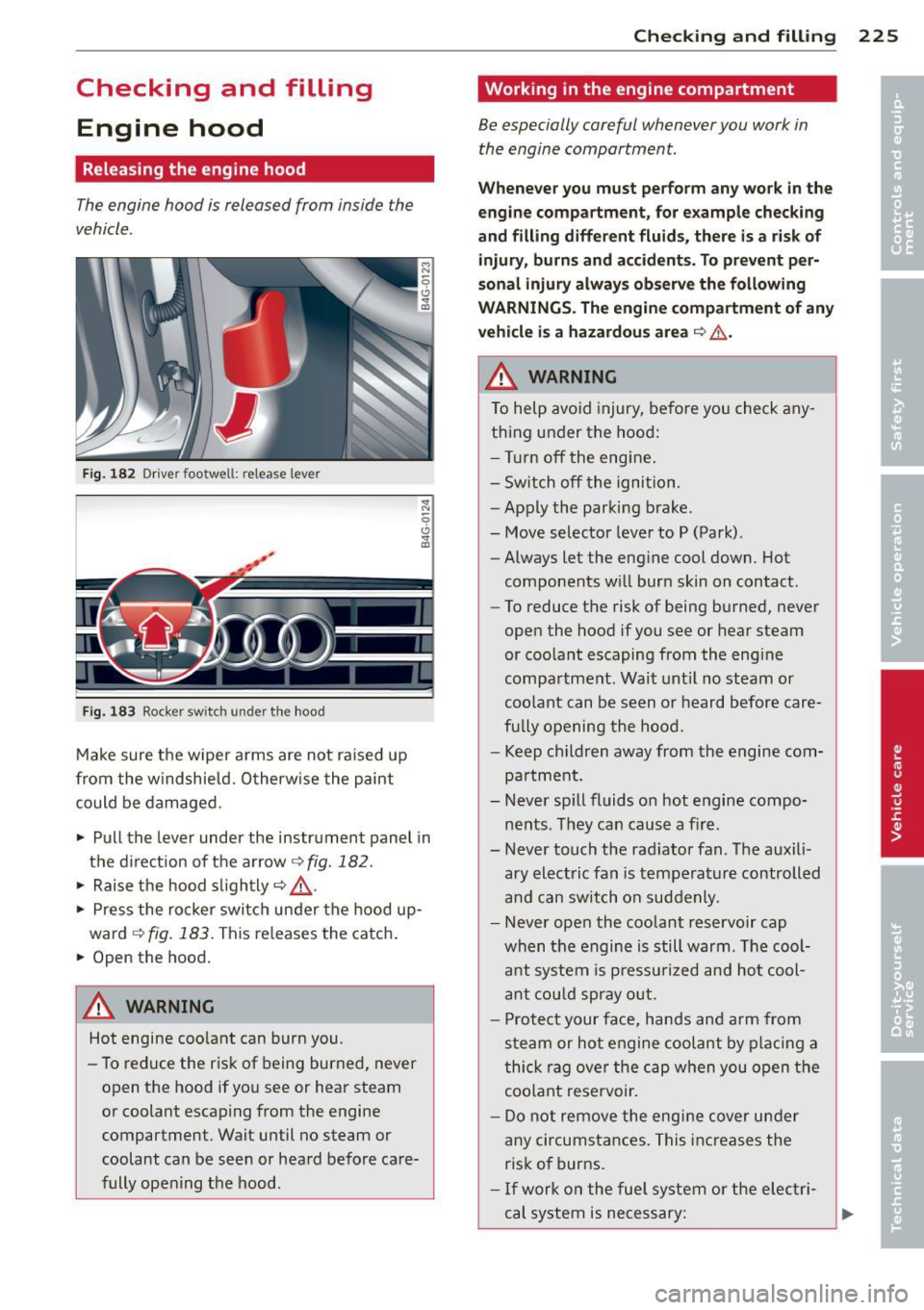
Fig. 182 Dr iver footwell: release leve r
Fig. 183 Rocker switch under the hood
Make sure the wiper arms are not raised up
from the w indshield. Otherw ise the paint
could be damaged.
.. Pull the lever under the instrument panel in
the d irect ion of the arrow
<=> fig. 182.
.. Raise the hood slightly <=>_& .
.. Press the rocke r switc h under the hood up
ward
<=> fig. 183 . This re leases the catch .
.. Open the hood .
A WARNING
Hot engine coo lant can burn you.
- To reduce the r isk of being burned, never
open the hood if you see or hear steam
or coolant escaping from the engine
compartment . Wait until no steam or
coolant can be seen or heard before care
fully opening the hood.
Checkin g and fillin g 225
Working in the engine compartment
Be especially careful whenever you work in
the engine compartment.
Wh ene ve r y ou must perform an y wo rk in the
eng ine com pa rtm ent , for e xample checking
a nd filling diff ere nt fluids, th ere is a risk of
inju ry, burn s and accid ent s. To pr event per
so nal injury alwa ys observe the foll owing
WARNING S. The engin e compartment of an y
v e hicle i s a h az a rdou s are a
<=> ,&.
h WARNING
To help avoid injury, be fore yo u check any
thing under the hood:
- Turn off the engine .
- Sw itch off the ignition .
- Apply the parki ng brake.
- Move selector leve r to P (Park) .
- Always let the engine cool down. Hot
components w ill burn skin on contact .
- To reduce the risk of being burned, never
open the hood if you see or hear steam
or coo la nt escaping from the engine
compa rtment. Wait unt il no steam or
coolant can be seen o r heard before care
fu lly opening the hood.
- Keep ch ildren away from the engine com
pa rtment.
- Never sp ill fluids on hot engine compo
nents . They can cause a fire .
- Never touch the rad iator fan. The auxili
ary electric fan is temperat ure controlled
a nd can sw itch on suddenly .
- Never open the coolant reservoir cap
when the engine is still warm . The cool
a nt system is p ressu rized and hot cool
a nt cou ld spray o ut.
- Protect your face, hands and arm from
steam or hot engine coolant by plac ing a
thick rag ove r the cap when you open the
coo lant rese rvoir.
- Do not remove the engine cover under
any circumstances. This inc reases the
ris k of burns.
- If work on the fue l system o r the elec tri
cal system is necessary:
Page 229 of 306
Checking and filling 22 7
Engine compartment
Engine compartment overview
These are the most important items that you can check.
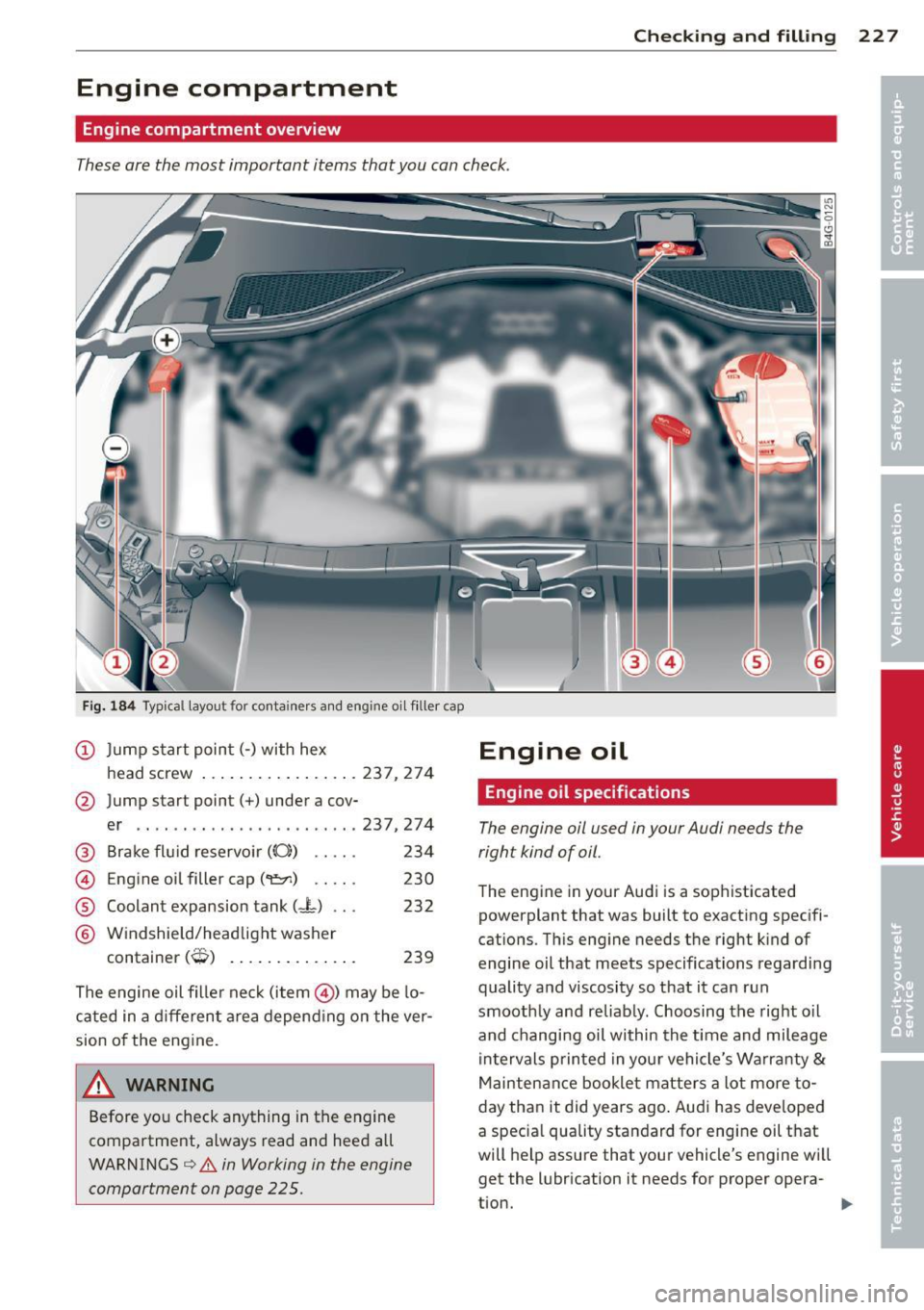
Fig. 184 Typical layout for conta iners and engine o il filler cap
@ Jump start poin t(-) with hex
head screw .. .............. . 237,274
@ Jump start point(+) under a cov-
®
©
®
©
er .. .. ... ..... ...... ...... 237,274
Brake fluid r eservo ir
((0)) . . . . . 234
Eng ine oil filler cap
("1:::r.) . . . . . 230
Coolant expansion tank
(-L) .. .
Windshield/headlight washer
t . ('"') con ainer O ......... .... .
232
239
The engine oil filler neck (item@) may be lo
cated in a different area depending on the
ver
sion of the eng ine.
Before you check anything in the engine
compartment, always read and heed all
WARNINGS
c::> &. in Working in the engine
compartment on page 225.
Engine oil
Engine oil specifications
The engine oil used in your Audi needs the
right kind of oil.
The engine in your Audi is a sophisticated
powerplant that was built to exacting specifi
cations. This eng ine needs the right kind of
engine oil that meets specifications regardi ng
quality and viscosity so that it can run smoothly and reliably. Choosing the right oil
and changing oil within the time and mileage
intervals p rinted in you r vehicle's Warranty
&
Maintenance booklet matters a lot more to
day than it did years ago . Audi has developed
a special quality standard for engine oil that
will hel p assure that your vehicle's engine will
get the lubrication it needs for proper opera
tion.
Page 236 of 306
234 Checking and filling
scalding from hot coolant by following
these steps .
- Turn off the eng ine and a llow it to cool
down.
- Protect your face, hands and arms from escaping flu id and steam by cover ing
the cap with a large, thick rag .
- Turn the cap slowly and very carefully
i n a counter-clockwise direction while
apply ing l ight, downwa rd p ress ure on
the top of the cap .
- To avo id being burned, do not sp ill an
tifreeze or coolant on the exhaust sys
tem or hot engine parts . Under certain
conditions, the ethylene glyco l in en
gine coolant can catch f ire .
- Antifreeze is poisonous . Always store an
tifreeze in its or iginal container and we ll
out of the reach of children .
- If you drain the coolant, it must be
caught and safely stored in a proper con
tainer clear ly marked "poison".
@ Note
- Coolant po llutes the env ironment and
could cause an engine fire . Excess coo l
ant will be forced out through the pres
sure re lief valve in the cap when the en
gine becomes hot.
- If, in an emergency, on ly water can be
added, the correct ratio between water
and antifreeze
c::> page 232 must be re
stored as soon as possible .
@ For the sake of the environment
Drained coolant should not be re used. Al
ways dispose of used coolant while observ
ing all environmental regulat ions .
Radiator fan
The radiator fan switches on automatically by
itself
An auxiliary e lectr ic radiator fan switches on
and off depending on coolant temperature
and other vehicle operating cond itions. After you switch the engine off, the aux
iliary
fan can cont inue running for up to 10 minutes
- even w it h the ignition off. It can even switc h
on again later by itself
c::> .&. , if
- the temperatu re of the engine coo lant rises
due to the heat build-up from the engine in
the engine compartment, or
- the engine compartment heats up because
the vehicle is parked in intense sunlight.
A WARNING
-- To reduce the risk of persona l injury nev-
er touch the radiator fan.
- The a uxiliary electric fan is temperat ure
contro lled and can sw itch on suddenly
even when the engine is not running.
- The auxiliary radiator fan switches on a u
tomatically when the engine coo lant
reaches a certain temperature and will
continue to run until the coolant temper
ature drops .
Brake fluid
Checking brake fluid level
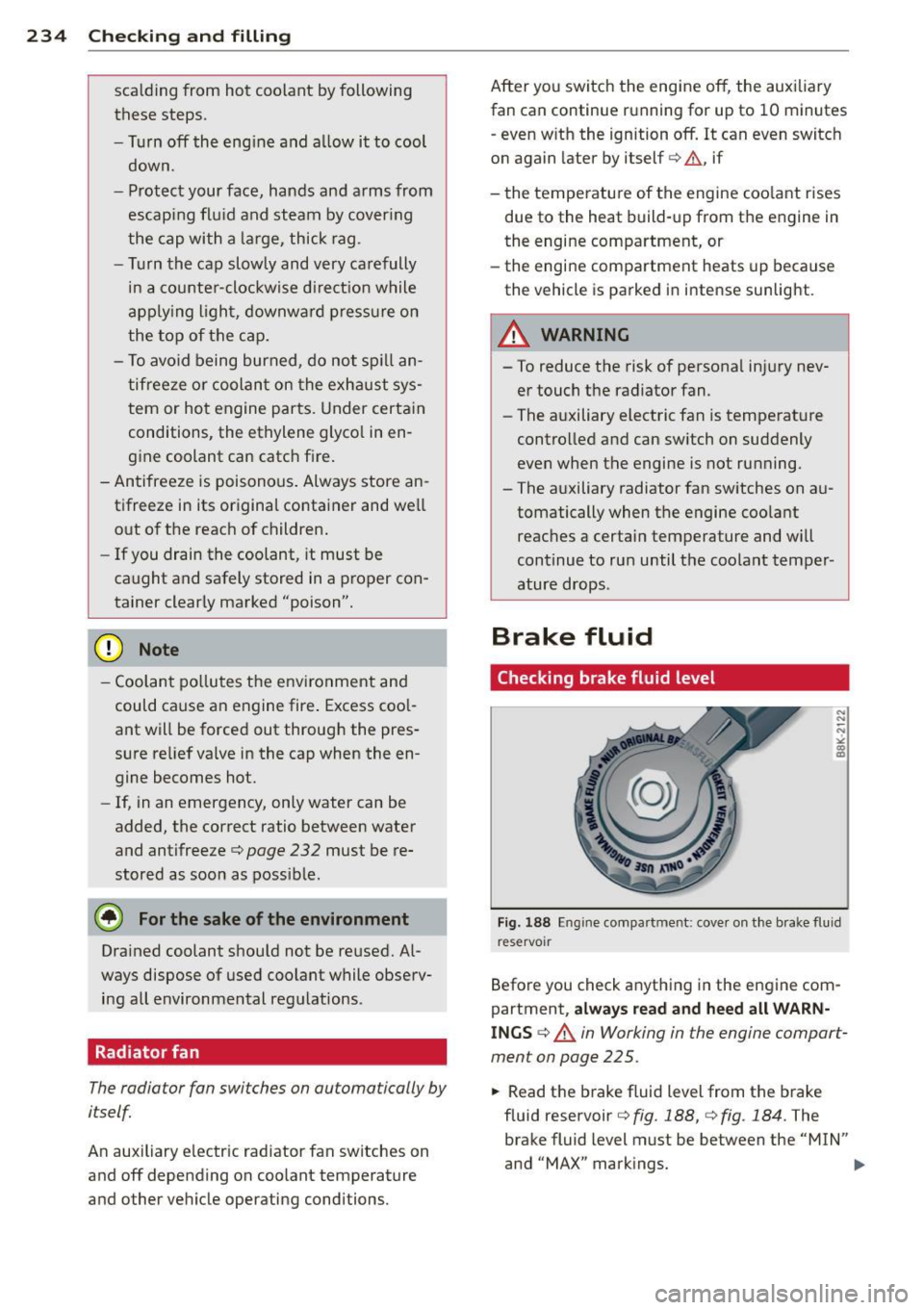
Fig. 1 88 En gin e compa rtme nt: cove r on t he brake fluid
reservoi r
Before you check anything in the engine com
partment,
always read and heed all WARN
INGS c:> A in Working in the engine compart
ment on page 225.
.,. Read the brake fluid level from the brake
fluid reservoir
c::> fig. 188, c:> fig . 184. The
brake fluid level must be between the "MIN"
and "MAX" markings.
IJ>
Page 237 of 306
The location of the brake fl uid reservo ir can be
seen in the engine compartment illustration
c::> page227.
The fl uid level may drop slightly after some
time due to the automatic adjustment of the
brake pads. This is not cause for alarm .
If the brake fluid level falls considerably be
l ow the "MIN" mark, the bra ke wa rning/ind i
cator light
1111 (U .S . models)/ . (Canadian
models) will come on
c::> page 15. Do not con
tinue to operate the vehicle. The comp lete
brake system sho uld be thoroughly checked
by an author ized Audi dealer or other quali
fied fac ility and the cause corrected . If the
brake fluid level is too low, the brake warn ing/
i ndicator light w ill illuminate . Contact an au
thor ized Audi dealer
imm ediately .
Changing brake fluid
Have the brake fluid changed by an experi
enced technician .
Brake fluid absorbs moisture from the a ir. If
the water content in the brake fluid is too
h igh, corrosion in the brake system may result
after a per iod of t ime . The bo iling po int of t he
brake fluid w ill also decrease consider ably and
dec rease b raking per formance.
Therefore, the brake flu id must be changed
ever y two years . Always use new b rake fluid
whi ch confo rms to Fede ral Motor Vehicle
Standard "FMVSS 1 16 DO T 4".
The brake flu id rese rvoir ca n be difficult to
r eac h, therefo re , we re commend that yo u
have the brake fl uid changed by y our autho r
i z ed
Audi dealer . Your deale r has the correct
too ls, the right brake fluid and the know -how
to do this for you .
A WARNING
-Brake fluid is po isonous . It must be stor
ed only in the closed orig inal container
out of t he reac h of children!
- Brake fa ilure can result from old o r inap
propr iate brake fluid. Observe these pre
caut ions:
Checkin g and fillin g 235
-Use only brake f luid that meets SAE
spec ificat ion
J 1703 and conforms to
Federal Motor Ve hicle Standard 116.
Always check with your autho rized Audi
dealer to make sure yo u are using the
correct brake fluid . The correct type of
brake f lu id is also ind icated on the
brake flu id rese rvoi r.
- The bra ke fluid must be new. Heavy us e
of the brakes can cause a vapo r lock if
the b ra ke fluid is left i n the system too
l ong . This can se riously affec t the effi
ciency of the b rakes as well as your
safety . This co uld resu lt in an accident.
(D Note
B rak e fluid wi ll damage the pa int o f you r
vehicle .
~ For the sake of the environment
Because o f the p rob lem of pro per disposal
of bra ke fluid as well as the spe cial too ls
r equired an d the necessary exper tise, we
r ecommend that yo u have the brake flu id
changed by yo ur authorized Aud i dea le r.
Battery
General information
U nder normal ope ra ti ng cond itions , the bat
te ry in yo ur Audi doe s not need any ma inte
nance. With
high outside tempera tures or
l ong daily drives we recommend that you have
the e lectrolyte level checked by a service fa
c ili ty. The electrolyte leve l should a lso be
checked each t ime the battery is charged
c:> page 237.
Have the battery checked when yo u take your
vehicle in for service. You are well advised to
replace a batte ry that is older than 5 years .
Wi th certain types of airbag deployment, the
battery is disconnected from the vehicle elec
trical system for safety reasons
c> & in Re
pair , care and disposal of the airbags on
page 161.
~
•
•
Page 270 of 306
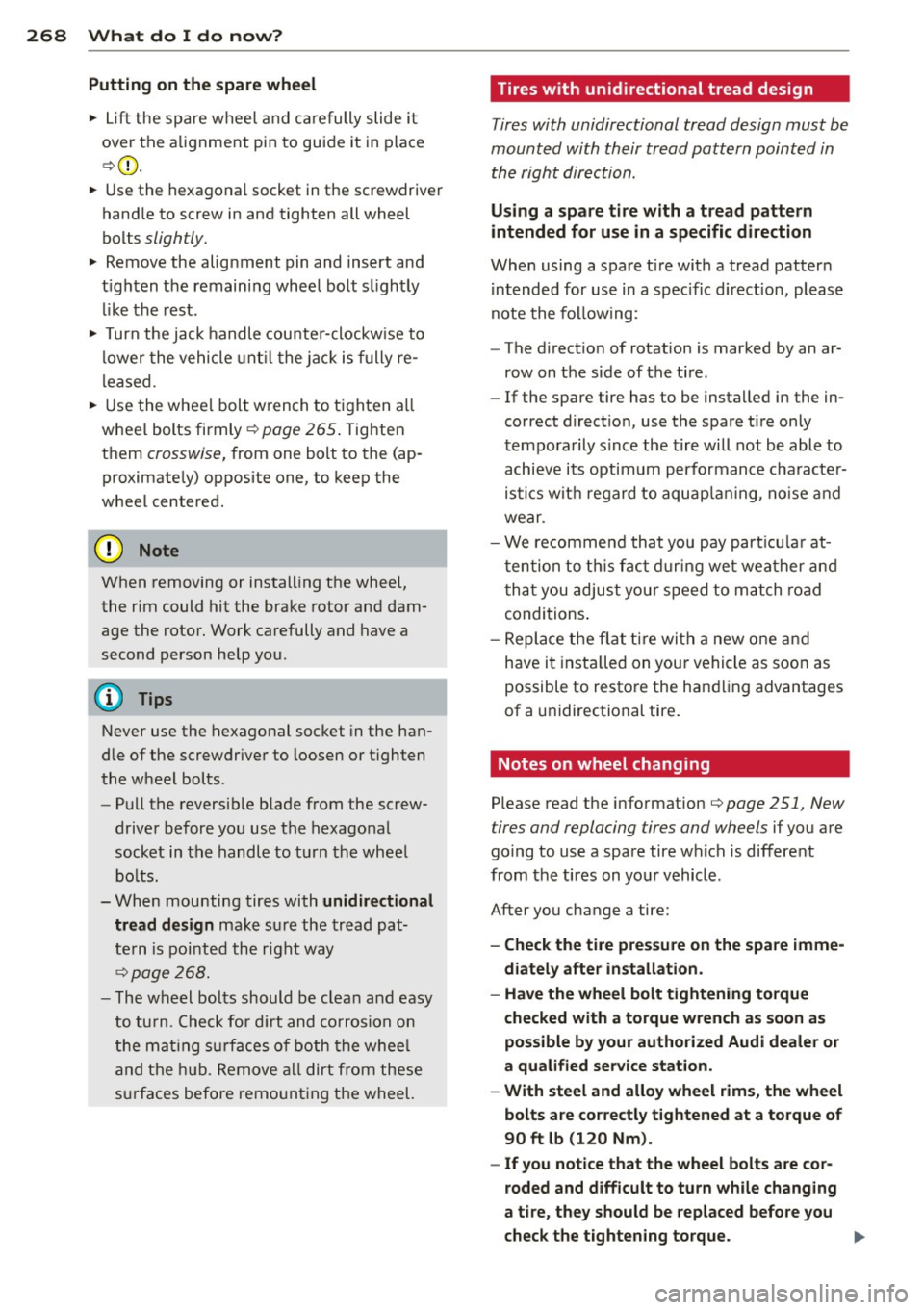
268 What do I do no w?
P uttin g on the spare wheel
.. Lift the spare wheel and ca refully slide it
over the alignment pin to guide it in place
¢ (D .
.. Use the hexagonal socket in the screwdriver
handle to screw in and tighten all wheel
bolts
slightly.
.. Remove the alignment pin and insert and
t ighten the remaining wheel bolt slightly
L ike the rest .
.. Turn the jack handle cou nter -clockw ise to
lower the vehicle unt il the jac k is fully re
leased.
.. Use the wheel bolt wrench to tighten all
wheel bolts firmly¢
page 265 . Tighten
them
crosswise, from one bolt to the (ap
proximately) opposite one, to keep the
wheel centered.
When removing or installing the wheel,
the rim could hit the brake rotor and dam
age the rotor. Work carefully and have a
second person help you .
(j) Tips
Never use the hexagonal socket in the han
dle of the screwdriver to loosen or t ighten
the wheel bolts .
- Pull the reversible blade from the screw
driver before you use the hexagonal
socket in the handle to turn the wheel bo lts.
- When mounting tires with
unid irectional
tread design
make sure the tread pat
tern is pointed the right way
¢ page 268.
-The wheel bolts should be clean and easy
to tu rn . Check for d irt and corrosion on
the mat ing su rfaces of both the whee l
and the h ub. Remove al l dirt from these
surfaces before remo unting the wheel.
Tires with unidirectional tread design
Tires with unidirectional tread design must be
mounted with their tread pattern pointed in the right direction .
Using a sp are t ire w ith a tre ad pattern
intended for use in a specific direction
When using a spare t ire with a tread patter n
intended for use in a spec ific d irection , please
note the following :
- The direct ion of rotation is marked by an ar
row on the side of the tire .
- If the spare tire has to be installed in the in
correct direct ion, use the spare tire only
temporarily s ince the tire will not be able to
achieve its optimum performance cha racter
isti cs wit h regard to aquap lan ing, no ise and
wear .
- We recommend that you pay part icu la r at
t ention to th is fact d uring wet wea ther and
t ha t you adjust you r speed to match road
conditions .
- Replace the fl at tir e with a new one and
have it insta lled on you r vehicle as soon as
possible to restore the handling advantages
of a u nidirectional tire .
Notes on wheel changing
Please read the information¢ page 251, New
tires and replacing tires and wheels
if you a re
going to use a spare tire which is different
from the ti res on your vehicle .
After you change a tire:
- Check the tire pre ssure on the spar e imm e
diately after install ation.
- Have th e whe el bolt tight ening torqu e
c hecked with a torque wrench as soon a s
pos sible by your author ized Audi de aler or
a q ualified service stat ion.
- With steel and allo y wheel r im s, the wheel
bolt s ar e cor re ctl y tightened at a torque of
90 ft lb (1 20 Nm ).
- If you noti ce th at the wheel bolts are cor
roded and diffi cult to turn while changing
a ti re , they should be repl aced before you
check the t ightening torque. .,..
Page 273 of 306
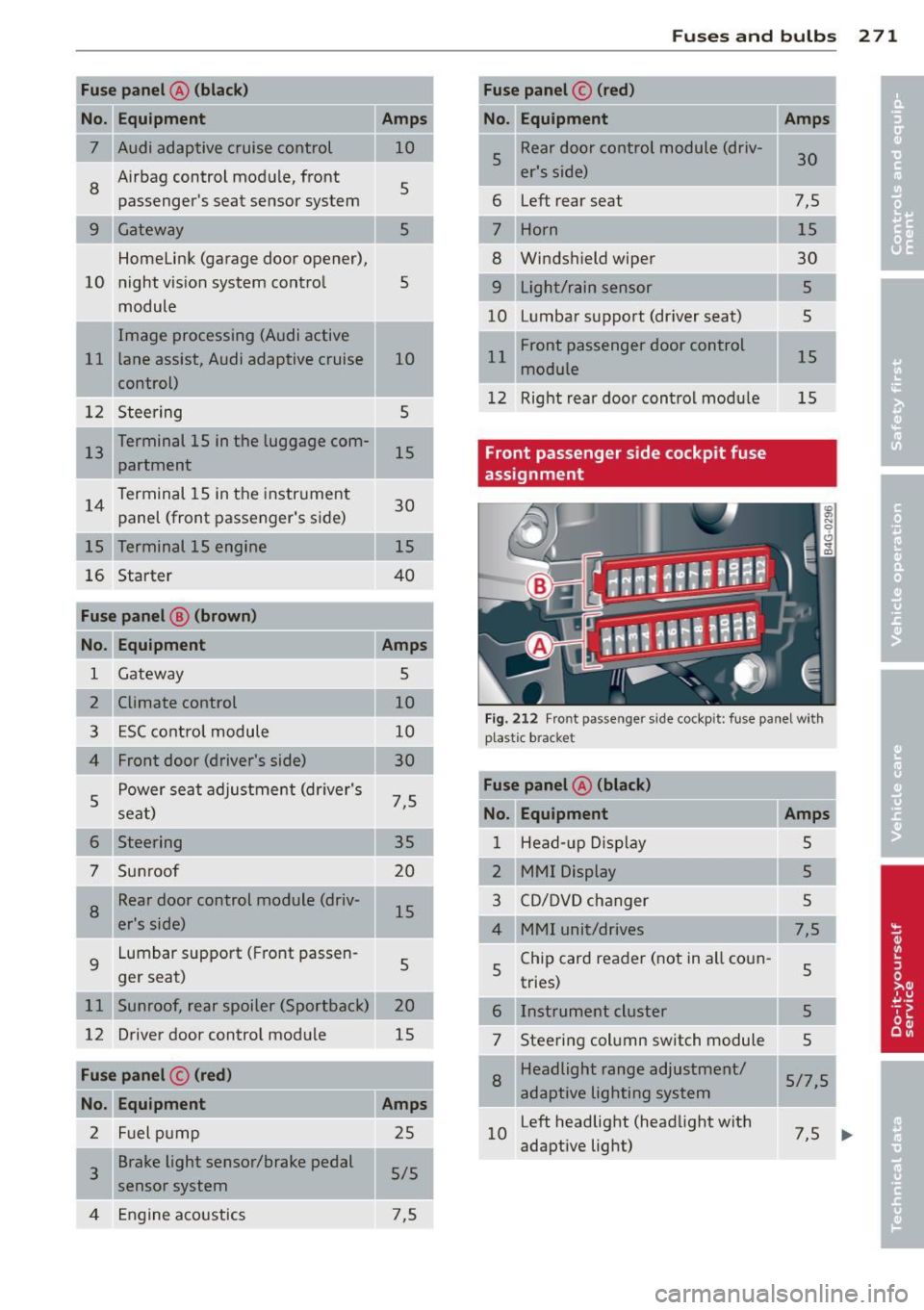
Fuse panel@ (black )
No. Equipment Amps
= = 7 Audi adaptive cruise control 10
8
Airbag control module, front
5
passenger's seat sensor system
Gateway 5
Homelink (garage door opener),
10 night vision system control
5
module
Image processing (Audi active
11 lane assist, Audi adaptive cruise
10
control)
12 Steering 5
1 13 Terminal 15 in the luggage com-
15
partment
14 Terminal 15 in the
instrument
30
panel (front passenger's side)
15 Terminal 15 engine 15
16 Starter 40
Fuse panel
B (brown)
No. Equipment Amps
1 Gateway 5
2 Climate control 10
3 ESC control module 10
Front door (driver's side) 30
s
Power seat adjustment (driver's
7,5
seat)
6 Steering 35
7 Sunroof 20
8
Rear door control module (driv-
15
er's side)
9 Lumbar support (Front passen
-
5
ger seat)
11 Sunroof, rear spoiler (Sportback) 20
12 Driver door control module
15
Fuse panel
c (red)
No. Equipment Amps
2 Fuel pump 25
3 Brake light sensor/brake pedal
sensor system 5/5
4 Engine acoustics 7,5
Fuses and bulbs
-Fuse panel © (red)
No.
u Equipment
5 Rear door
control module (driv-
er's side)
6 Left
rear seat
Horn
Windshield wiper
9 Light/rain sensor
10 L
umbar support (driver seat)
11 Front passenger door control
module
12 Right rear door control modu le
Front passenger side cockpit fuse
assignment Amps
30
7,5 15
30 5
5
15
15
Fig. 212 Front passenger side cockpit: fuse panel wit h
p last ic bracket
Fuse panel A (black)
No. Equipment
Amps
1 Head-up Display 5
2 MMI Display 5
3 CD/DVD changer 5
4 MMI unit/drives
7,5
5 Chip card reader (not in all coun
-
5
tries)
6 Instrument cluster
5
7 Steering column switch module
5
8
Headlight range adjustment/
5/7,5
adaptive lighting system
10 Left
headlight (headlight with
7,5
adaptive light)
I
271
...