ESP AUDI S6 2013 Repair Manual
[x] Cancel search | Manufacturer: AUDI, Model Year: 2013, Model line: S6, Model: AUDI S6 2013Pages: 306, PDF Size: 76.92 MB
Page 196 of 306
194 Intelligent technology
@ Tips
-ABS and ASR on ly work correctly when
all four wheels are equipped w ith identi
cal tires. Different tire sizes can lead to a
reduction in engine power.
- You may hear noises when the systems
described are working.
- If the indicator light
DJ or 11:11 (USA
models) 1i] (Canada models) appears,
there may be a malfunction¢
page 20,
c> page 19.
Switching on and off
ESC
turns on automatically when you start
the engine.
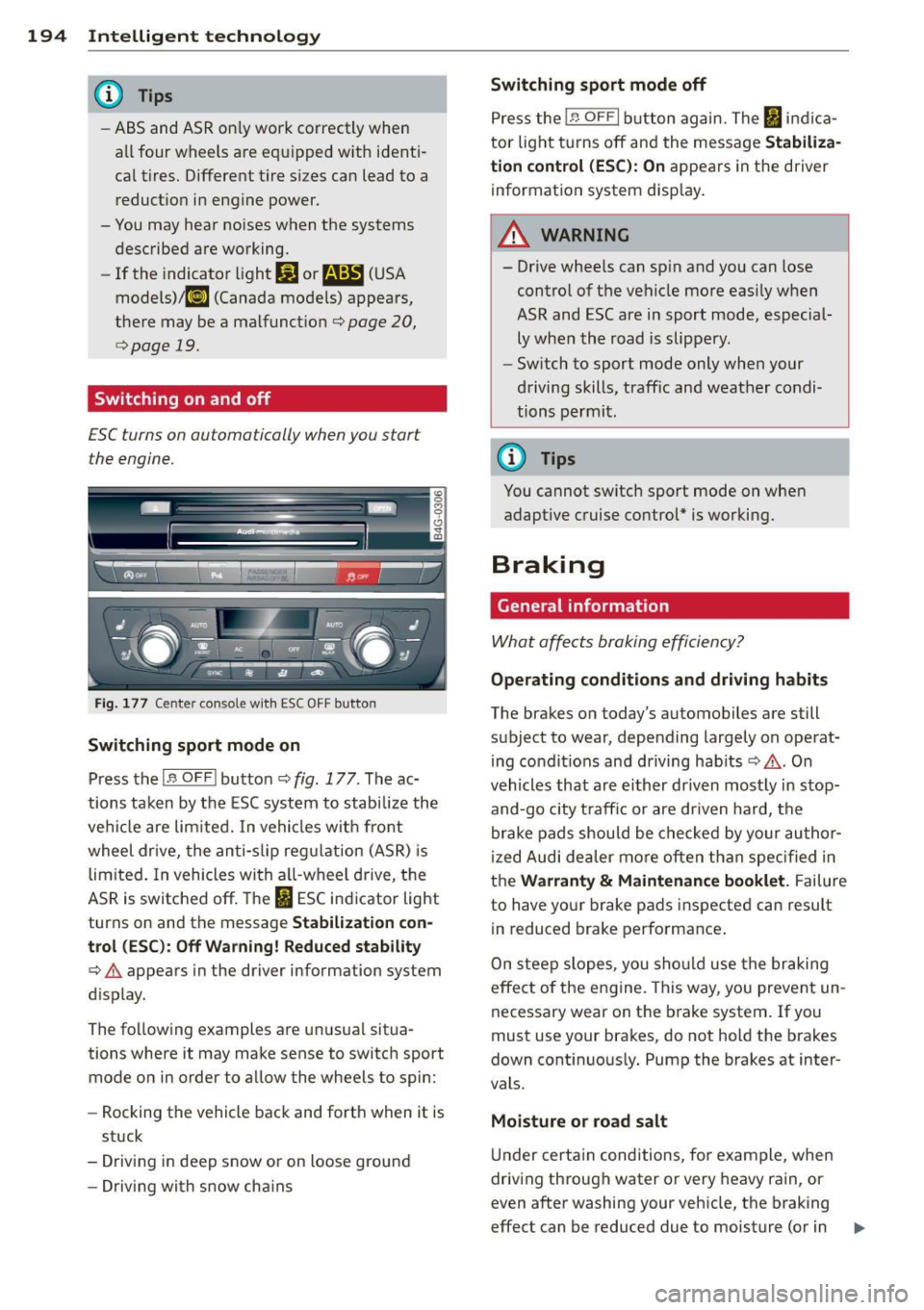
Fig. 177 Center console w it h ESC OFF button
Switching sport mode on
Press the I~ OF FI button c::> fig . 177. The ac
tions taken by the ESC system to stabilize the
vehicle are limited. In vehicles with front
wheel drive, the anti-slip regulation (ASR) is
limited. In vehicles with a ll-wheel drive, the
ASR is switched off. The
It) ESC indicator light
turns on and the message
Stabilization con
trol (ESC): Off Warning! Reduced stability
¢.&. appears in the driver information system
d isplay.
The following examples are unusual situa
tions where it may make sense to switch sport
mode on in order to allow the wheels to spin:
- Rocking the vehicle back and forth when it is
stuck
- Driving in deep snow or on loose ground
- Driving with snow cha ins
Switching sport mode off
Press the 1.$ OF FI button again. The I indica
tor light turns off and the message
Stabiliza
tion control (ESC): On
appears in the driver
information system display .
A WARNING
-
-Drive wheels can spin and you can lose
control of the vehicle more easily when
ASR and ESC are in sport mode, especial
ly when the road is slippery.
- Sw itch to sport mode only when your
driving skills, traffic and weather condi
tions permit.
@ Tips
You cannot sw itch sport mode on when
adaptive cruise control* is working.
Braking
General information
What affects braking efficiency?
-
Operating conditions and driving habits
The brakes on today's automobiles are still
subject to wear, depending largely on operat
ing condit ions and driving hab its
c::> .&. . On
vehicles that are either driven most ly in stop
and-go city t raff ic or are driven hard, the
brake pads should be checked by your author
ized Audi dea ler more often than specified in
the
Warranty & Maintenance booklet. Failure
to have your brake pads inspected can result
in reduced brake performance .
On steep slopes, you should use the braking
effect of the engine . This way, you prevent un
necessary wear on the brake system. If you
must use your brakes, do not hold the brakes
down continuously. Pump the brakes at inter
vals .
Moisture o r road salt
Under certain conditions, for example, when
driving through water or very heavy rain, or
even after washing your vehicle, the braking
effect can be reduced due to moisture (or in .,,_
Page 200 of 306
198 Intelligent technology
Vehicle stands for an e xte nded period
If you do not drive you r vehicle over a pe riod
of several days or weeks, elec trical compo
nents are grad ually cut back or switched off.
This reduces energy cons umption and main
tains starting capab ility over a longer period.
Some of the conven ience f unctions may not
ope rate, such as the inter ior lights or the
power seat adjustment. T he conven ience
f u nctions w ill be ava ilable again when you
switch on t he ignit io n and start the engi ne.
With the engine turned off
If you listen to t he radio, for example, with
the eng ine turned off or use othe r MMI func
tions, the battery is b eing d ischa rged .
I f starting capab ility is jeopa rdized due to en
ergy consumpt ion, the following warning ap
pears in the MMI disp lay:
Please start the engine soon or the system
will be turned off.
T he warning ind icates that the system will be
turned off automatically afte r 3 m inutes. If
you wish to cont inue using the f unctions, you
have to start the engine.
With the engine running
A ltho ugh elect ric al e nergy is genera ted when
the veh icle is being driven, the bat tery can be
come d ischarged. This ha ppens most ly w hen
litt le energy is be ing generated and a great
deal consumed and the battery 's state of
charge is not optimal.
To br ing the ene rgy balance back into equili
brium, cons umers which require especially
large amo unts of energy are temporarily cut
back or switched off. Heating systems in par
ticular requ ire a great dea l of energy. If you
n otic e, fo r example, that the heated seats * or
the heated rea r window a re not heat ing, t hey
h ave been te m po rar ily cu t bac k or swi tched
o ff . T hese sys tems will be availa ble again as
soon as the energy ba lance has been restored .
You will a lso not ice that engin e idl e spe ed has
been in cr eased sligh tly. This i s norm al and no t
a ca use fo r con cern. By incre asin g engi ne idle speed
the a dditional energy requi red is gener
ated and the battery is charged.
Page 202 of 306
200 Driving and en vir onm ent
Catalytic converter
It is very important that your emission con
trol system (catalytic converter) is function
ing properly to ensure that your vehicle is run
ning in an environmentally sound manner .
• Always use lead-free gasoline¢ page 220,
Fuel supply.
• Never run the tank down all the way to
empty .
• Never put too much motor oil in your en-
gine ¢
page 230, Adding engine oil~-
., Never try to push- or tow -start your veh icle.
The catalytic converter is an eff ic ient "clean
up" device built into the exhaust system of
the vehicle. The catalytic converter burns many of the pollutants in the exhaust gas be
fore they are released into the atmosphere.
The exclusive use of unleaded fuel is critically
important for the life of the cata lytic conve rt
e r and proper functioning of the engine.
& WARNING
-
- Do not park o r operate the vehicle in
areas where the hot exhaust system may
come in contact with dry grass, brush,
fuel spill or other material which can cause a fire.
- Do not apply additional undercoating or
rustproofing on or near the exhaust
man ifold, exhaust p ipes, catalytic con
verter or heat shields . During driving, the
substance used for undercoating could
overheat and cause a fire .
@ Note
-Be aware that just one tank filling with
leaded fuel will already seriously de
grade the performance of the catalytic
conve rter .
- Do not exceed the correct engine oil level
¢ page 230.
-Do not drive until the fuel tank becomes
completely empty. The eng ine could mis
fire . U nburned f uel could a lso get into the exhaust system and this co
uld cause
the cata lytic converter to overheat .
- Do not switch off the ignition while the
vehicle is moving .
- Do not continue to ope rate your veh icle
under these conditions, as otherwise fuel
can reach the catalytic converter. This
cou ld result in overheating of the con
verter, requir ing its replacement.
- To assure efficient operation of the Emis
sion Control System:
- H ave your vehicle maintained properly
and in accordance w it h the service rec
ommendat ions in your Warranty &
M ain tenance book let.
- L ack of prope r maintenance as we ll as
improper use of the vehi cle will impair
the function of the em iss ion contro l
system and could lead to damage .
@ For the sake of the environment
Even when the Emiss ion Control System is
operat ing proper ly, the exha ust gas can
have a sul fur -li ke exhaust gas smell under
some operating states . This depends on
the sulfur content of the fuel being used .
Using a different brand of fue l may help,
or f il li ng the tank with lead-free super
grade gasoline .
Avoid damaging the
vehicle
When you are d rivi ng on poor roads, or over
c u rbs, steep ramps, etc., ma ke certai n that
low- ly ing parts s uch as spoilers and exha ust
system parts do not bottom o ut and get dam
aged.
T his is espe cially true for ve hicles with low
s lung chassis (spor ts chassis)* and fully load
ed vehicles .
Page 204 of 306
202 Driving and environment
Avoid full throttle
Driving at moderate speeds saves fuel and
improves your mileage.
.,. Try and keep well below your car's maxi-
mum speed.
Accelerating gently reduces fuel consump
tion, engine wear, and does not disturb the
environment.
Fu el consumption, exhaust emissions and en
gine noise increase disproportionately at high
speeds. If you drive at approximately three
quarters of top speed, fuel consumption will
be reduced by one half. Never drive faster
than the posted speed limit and weather con
ditions permit .
Reducing unnecessary idling
Even when your car is just idling it burns up
fuel.
.,. Shut the engine off when you are not driv
ing the vehicle .
... Do not warm up the veh icle by letting the
engine run at idle .
The idling phase is automat ically reduced for
vehicles w ith the Start/Stop system .
It is effi
cient to switch
off the engine in vehicles with
out the Start-Stop-System when stopped at
railroad crossings and long red lights . Turning
the engine
off for just 30-40 seconds saves
more f uel than is burned by starting the en
gine again.
It takes a long time for the engine to wa rm up
fully when it is running at idle. However, wear
and noxious emissions are especially high
when the engine is warming up. So you should
drive away as soon as you start the engine and
avoid running at high rpms while the engine is
still warming up.
([) Note
Do not leave engine idling unattended af
ter starting. If warning lights should come
on to indicate improper operation, they would
go unheeded. Extended idling also
produces heat, which could result in over
heating or other damage to the veh icle or
other property .
Regular maintenance
A badly tuned engine unnecessarily wastes a
lot of fuel.
.,. Have your vehicle serviced at regu la r inter-
vals .
By having your veh icle reg ularly se rviced by an
Audi dealer he lps to ensure that it runs prop
erly and economically. The condition of your
vehicle not only affects its safety and ability to
ho ld its value, it also affects
fuel consump
tion .
Check your oil each time you fill your tank.
The amou nt of oi l used is related to engine
load and speed.
It is normal for the oil consumption of a new
engine to reach its lowest value after a certain
mileage has been driven .
You must drive your veh icle about 3,000 miles
(5,000 kilometers) before you can properly
assess oil consumpt ion.
This also app lies to fuel consumption and en
gine output .
(D Note
-Have your veh icle ma inta ined properly
and in accordance with the service rec
ommendations in your Warranty
& Main
tenance booklet. Lack of proper ma inte
nance as well as improper use of the ve
hicle will impair the function of the
em ission control system and could lead
to damage.
- Do not alter or remove any component of
t he Emission Control System unless ap
proved by the manufacturer .
- Do not alter or remove any device, such
as heat shields, switches, ignition wires,
valves, which are designed to protect
your vehicle's Emission Control System
Page 207 of 306
Make sure that the cooling system has enough
f luid .
Tire pressure
When tow ing a trai ler, inflate the t ires of your
vehicle to the cold tire pressure listed under
"Full load" on the label located on the driver's
side B-pillar (visible when the door is open).
Inflate trailer tires to trai ler and tire manufac
turers' specifications.
Lights
Check to make sure both veh icle and trailer
lights are working properly.
Safety chains
Be sure tra iler safety cha ins are properly con
nected from the trailer to the hitch on the ve
hicle. Leave enough slack in the chains to per
mit turning corners . When you install safety
chains, make sure they wi ll not drag on the
road when you are driving.
The chains should cross under the tra ile r
tongue to prevent it from dropping in case of
sepa ration from the hitch.
Adjusting the Audi drive select
Make sure the veh icle is on a level surface be
fore hitching up the tra iler and before adjust
in g the tongue weight. The vehicle must be in
auto or comfort dr iving mode and not raised
qpage 98, q(D .
Make sure that the vehicle is lowe red. In Info
tainment, se lect:
ICARI f u nction button> Low
er
control button.
If you must drive under poor road condit ions,
you can raise the veh icle
after coupling the
traile r or
after adjusting the tongue weight
qpage 100.
- Changes in temperatu re or load can af
fect the height of the veh icle.
- Always se lect
auto or comfort mode.
Otherwise, the tongue load spec ified for
you r vehicle will no longer be applicable.
Trailer towing
Driving instructions
Driving with a trailer always requires extra
care and consideration .
To obtain the best possible handling of vehicle
and trailer, please note the following:
... Do not tow a loaded trailer when your car it
self is not loaded.
... Be especially careful when passing other
veh icles.
... Observe speed lim its .
... Do not dr ive at the maximum permissible
speed.
... Always apply brakes early .
... Monitor the temperature gauge.
Weight distribution
Towing a loaded trailer with an empty car re
sults in a highly unstable distribution of
weight. If this cannot be avoided, drive at very low speeds only to avoid the risk of losing
steering control.
A "balanced" rig is easier to operate and con
trol. This means that the tow vehicle should
be loaded to the extent possible and permissi
ble, while keeping the trailer as light as possi
ble under the circumstances. Whenever possi
ble, transfer some cargo to the luggage com
partment of the tow vehicle while observing
tongue load requirements and vehicle loading
considerations.
Speed
The higher the speed, the more difficult it be
comes for the driver to contro l the rig. Do not
drive at the maximum permissible speed. Re
duce your speed even more if load, weather or
wind conditions are unfavorable -particularly
when going downhill.
Reduce vehicle speed
immediately if the trail
er shows the slightest sign of swaying.
Do not
try to stop the swaying by accelerating.
Observe speed limits. In some areas, speeds
for vehicles towing trailers are lower than for
regular vehicles. .,.
205
•
•
Page 208 of 306
206 Trailer towing
Always apply brakes early. When driving
downhill, shift into a lower gear to use the en
g ine braking effect to slow the vehicle . Use of
the brakes alone can cause them to overheat
and fail.
Coolant temperature
The coolant temperature gauge¢ page 11
must be observed carefully. The coolant tem
perature can increase if you drive on long in
clines in a low gear at high engine speeds. Re
duce your speed immediately if the LEDs in
the top part of the display turn on .
For more information about indicator lights,
refer to. ¢
page 16 .
A WARNING
Anyone not properly restrained in a mov
ing vehicle is at a much greater risk in an
accident . Never let anyone r ide in your car
who is not properly wear ing the restraints
provided by Aud i.
Trailer towing tips
Important to know
Your vehicle handles differently when towing
a trailer because of the additional weight and
different weight distribution . Safety, perform
ance and economy w ill greatly depend on how
carefully you load your trailer and operate
your rig .
Before you actually tow your trailer, practice
turn ing, stopp ing and back ing up in an area
away from traffic. Keep practicing until you
have become comp lete ly familiar with the way
your ve hicle-trai ler comb ination behaves and
responds.
Backing up is difficult and requires practice .
Backing up with a tra iler generally requi res
steering act ion opposite to that when backing
up your vehicle without a trailer.
Maintain a greater distance between your ve
hicle and the one in front of you. You will need
more room to stop. To compensate for the trailer, you wi
ll need a larger than normal
turning radius.
When passing, remember that you cannot ac
celerate as fast as you norma lly would be
cause of the added load. Make sure you have
enough room to pass . After passing, a llow
plenty of room for your trailer before chang
ing lanes again.
Avoid jerky starts , sharp turns or rapid lane
changes.
(D Tips
- Do not tow a trailer during the break-in
period of your vehicle.
- If you tow a trailer, your Audi may re
quire more frequent maintenance due to
the extra load¢
page 285.
Parking on a slope
Do not park on o slope with a trailer. If it can
not be avoided, do so only after doing the fol
lowing:
When parking:
.,. App ly the foot brake .
.. Have someone pla ce chocks under both the
vehicle and the trailer wheels.
.. With chocks in place, slowly release the
brakes until the whee l chocks absorb the
load .
.. Turn the wheels towards the curb .
.. Apply the parking brake.
.. Select the P selector lever posit ion .
When restarting after parking:
.. Apply the foot brake.
.. Start the engine.
.. Select the D/S selector lever position .
.. Release the parking brake and slowly pull
out and away from the wheel chocks .
.,. Stop and have someone retr ieve the wheel
chocks .
Ill-
Page 214 of 306
212 Cleaning and protec tio n
Waxing and Polishing
Wa xing
A good wax coating protects the vehicle pa int
to a large extent aga inst the environmental
factors listed under~
page 208, Washing and
even against slight sc ratches .
You can use a liquid car wax to protect your pa int as soon as one week after your veh icle
has been del ivered.
Even if you regularly use a
w axi ng process in
automatic car washes, we recommend that
you manually apply a coat of wax to give the pa int ext ra protection , particularly if wate r no
l onge r beads on the clean paint.
Protect p lastic body parts with car wax in the
same way as the vehicle body.
During warm weather dead insects tend to
collect on the front bumper and on the for
ward area of the hood . They are much easier
to remove from pai nt that is waxed
often.
Poli shing
Polish your vehicle only if the paint has lost its
shine and the gloss cannot be brought back
with wax.
If the polish used does not contain preserva
tive compounds, the paint must be waxed af
terwards .
_&. WARNING
Always read and heed all WARNINGS and
other information
~ page 208 .
(D Note
Do not use car wax on
- matte or anod ized metal trim
- rubber or rubber-like trim.
Trim strips
Metal trim needs special core.
For environmental reasons, Audi fabricates
the br igh t tr im strips and t rim pieces from
pu re chromium-free a luminum. Dirt and ma
rks on the trim strips shou ld be
removed wit h a
pH-b ala nce d cleaning agent
(do not use a chrome cleaner). Audi dealers
carry clean ing products which have been test
ed for use on your vehicle and are not harmful
to the environment.
To avoid corrosion on the exter ior trim strips,
only a pH-ba lanced solution should be used
for the windsh ield washer.
_&. WARNING
"'--
A lways read and heed all WARNINGS and
other information
~page 208.
Plastic and vinyl
Plastic needs special core.
Use a clean, damp cloth or sponge to remove
dust and light surface dirt. For other soil, use
a lukewarm all-purpose cleaning so lution or a
mild saddle soap for v inyl tr im . Remove water
spots and traces of soap with a clean, damp cloth or sponge . Use a clean, soft cloth to rub
dry.
Grease, tar or oil stains can be removed with a
clean cloth or sponge soaked with all-purpose
cleaner or with a solvent designed espec ially
to clean v inyl.
Occas ionally apply a colorless vinyl or leather
preservative to retain the material's luster
and pliability .
_&. WARNING
"--
Always read and heed all WARNINGS and
other i nformation
~ page 208.
Aluminum trim
Use only neutral-pH products to remove spots
and deposits from a luminum sur faces.
Chrome care products and a lkaline cleaners
will attack a luminum surfaces and can dam-
age them over time. .,.
Page 218 of 306
216 Cleaning and protec tio n
8_ WARNING
Always read and heed all WARNINGS and
the information <=>
page 208.
(D Tips
Open Velcro fasteners on your clothing can
damage the seat cover. Please make sure
that Velcro fasteners are closed.
Plastic parts and instrument panel
Always use a clean cloth moistened in clear
water to clean these areas . For pers istent dirt
use an Audi approved
so lve nt-fr ee plastic
cleane r/protectant.
8_ WARNING
So lvents can change the propert ies of
some plastics and make it harder for the
airbag to dep loy.
-
- Never clean the instr ument pane l or the
surface of airbag modules with cleaning
products that contain solvents.
- Products containing solvents will make the surface of th is part porous.
- Serious injur ies can result if plastic parts
come loose when the airbag is deployed .
- Always read and heed all WARN INGS and
other information <=>
page 208 .
(J;) Note
Clean ing agents containing solvents will
attac k the mater ial a nd can change the
way it behaves.
Trim and molding
Trim and mo lding in the vehicle interior can
be cleaned w ith a dry microfiber cloth. To pre
vent scratches, do not use any cleaning solu
tions.
Natural leather
Applies to vehicles: wit h natural leather
Audi makes great efforts to maintain the
properties, natural look and feel of interior leather.
General
We offer many d ifferent types of leather on
our vehicles. Most are d ifferent types of nappa
leather, which has a smooth surface and
comes in various colors .
The intensity of the co lor determines the visu
al characterist ics and appearance . If the sur
face of the leather has a typ ica l natural look,
then the leather is a nappa leather that has
been left in a relat ively natura l condit ion. This
leather offe rs particularly good comfort and
breathes we ll. Fine veins, closed grai ns, insect
bites, skin fo lds, and subt le va ria tions in color
remain visible . These characteristics demon
strate that the material is natura l.
Natura l nappa le ather is not covered by a co l
o r finish.
It is therefore more sensit ive to soil
ing and wear, which is something you need to
consider if children, animals or other factors
might prove to be part icu larly hard on the
leather.
By contrast, leather types that are covered by
a colored finish layer are more durable . This
has a positive effect on the leather's resist
ance to wear and soiling in dai ly use. On the
other hand, the typical characteristics of natu
ral leather are barely or not apparent . Howev
er, th is does not mean that the leathe r itself
is of inferior quality .
Care and handling
Because of the exclusive nature of the types of
leather that Audi uses and their unique prop
erties (such as sens it ivity to oils, grease, soil
ing, etc.), you will need to be somewhat care
ful with these leathers, and a ce rtain type of
ca re is req uired. For example, dark clothing
mater ials can disco lor le athe r seats (especia l
ly if such clothing is damp and was not dyed
correct ly). Dust and dirt particles in pores ,
folds, and seams can have an abrasive effect .,..
Page 219 of 306
and can damage the leather surface as well as
weaken seams .
The leather sho uld be cleaned reg ularly as
needed. After having been used for a re latively
l ong time, your leather seats will acquire a
rich aged finish. This is a characteristic of nat
ura l leather and a sign of true quality .
I n o rder to maintain the va lue of th is natura l
p roduct over the life of your vehicle, you
should follow the recommendations below :
(D Note
-To keep yo ur leather from bleach ing out,
do not a llow it to be exposed to bright
sunlight for long periods of time. If you
have to leave the vehicle parked outside
for long periods, cover the leather to
protect it from d irect exposure to sun
light.
- Sharp objects on clothing, such as zip
pers, rivets or sharp pieces on be lts can
leave permanent scratches or scrape
marks on the surface of the leather .
- After each time you clean the leather and
at regu lar inte rva ls, use a leather preser
vat ive creme that conta ins UV-blockers
and that wor ks into the leather. This
c reme will no urish and moistur ize the
l eather, helping i t to brea the and stay
supple .
It also helps to b uild up a protec
tive coating on the s urface .
- Clean the lea ther every 2 -3 months,
and clean any areas that get soiled.
- Remove fresh mar ks made by ba llpoint
pens, ink, lipstick, shoe polish, e tc. as
soon as possib le .
- Preserve the colo r of the lea ther as need
ed by using a special colored leather care
creme to to uch up areas of uneven co lor.
Cleaning and protec tion 217
Cleaning and caring for leather
upholstery and trim
App lies to vehicles : with natural lea ther
Natural leather requires special care and at
tention .
Normal cleaning
.. Clean so iled areas with a slightly moistened
cotton or woolen cloth .
More stubborn dirt
.. More st ubborn dirt can be removed using a
cloth saturated with a mild soap solut ion (2
tablespoons mild liquid soap).
.. Never allow the soap solution to saturate
the leather, and make certain that no water soaks into the seams.
.,. Wipe off the soap so lution with a soft, dry
cloth.
Cleaning spots
.. Remove fresh wat er-based spots (such as
coffee, tea, juices, blood) with an absorbent
cloth or pape r towel.
.. Remove fresh
greas e or oil-ba sed spot s
(such as bu tte r, mayonnaise, chocola te) with
an absorbent cloth or paper towel, or use
the cleaner from the leather care kit if the
spot has not yet penetrated into the surface
of the leather.
.. Use an oil/grease dissolving spray, if
oil/
grease spot s ha ve dried on.
.. Remove specific k inds of spots (ballpoint
pen, felt marker, fingerna il polish, water
based pa int, shoe po lish, etc.) with a spot
remover specifically fo rmu lated for leather.
Leather care
.. Every half year use an approved leather care
product (available from your Audi dealer) to
care for the leather .
.,. App ly the product very spar ingly.
.. Wipe it off with a damp clot h.
If you have any q uestions about clean ing and
caring for the leather in your vehicle, it is best
to contact you r authorized Audi dea ler, who
will be g lad to help you and tell you abo ut o ur
full range of leather care prod ucts, such as : .,..
•
•
Page 221 of 306
Engine compartment
Be especially careful when cleaning the en
gine compartment.
A lw ays s witch off the ign ition befor e clean
ing the eng in e
c:> & .
Plenum panel
Remove leaves from the plenum pane l in front
of the windshield under the engine compart
ment. This prevents the water drain ho les
from becoming blocked, and it prevents de
bris from entering the veh icle inter ior through
the heating and ventilation ducts .
Corro sion protecti on
The engine compartment and transmission
have been corrosion-protected at the factory.
Good anti-corrosion treatment is very impor
tant, particular ly in the winter . If the vehicle
is frequent ly driven on salt treated roads, the
entire engine compartment and plenum panel
should be thoroughly cleaned at the end of
winter and retreated to prevent sa lt damage.
At the same time, the underside of the vehicle
should be washed as we ll.
If the engine compartment is cleaned at any
time with grease removing solut ions
1>, or if
you have the engine washed, the anti-corro
sion treatment is a lmost always removed as
well.
It is therefore essential to have a long
lasting co rrosion protection reapp lied to a ll
surfaces, seams, joints and components in the
engine compartment.
A WARNING
Be aware: The engine compa rtment of any
motor vehicle is a potentially hazardous
area.
- Before working in the engine compart
ment, be s ure to read the in format ion
c:> page 225.
- Before reaching into the front pane l, al
ways switch off the ignition. Otherwise,
l ) Use only the correct cleaning sol utions. Never use gas
oline or diesel fuel.
Cleaning and protec tion 219
the windshield wiper system could unin
tentionally be switched on, possibly
causing personal injury from the moving
wiper linkage.
- Never reach into the area around or
touch the radiator fan. The aux iliary fan
is temperature controlled and can sw itch
on suddenly - even when the ignition is
off.
- Do not wash, wax o r dry the eng ine with
the engine running. Moving or hot parts could injure you.
- Do not clean the underside of the chas
sis, fenders, wheel covers, or other ha rd
to reach parts without protect ing your
hands and arms. You may cut yourself on
sharp-edged metal parts .
- Always read and heed all WARNINGS and
o ther info rmation
c:> page 208.
•
•