brake fluid AUDI S6 2013 Owners Manual
[x] Cancel search | Manufacturer: AUDI, Model Year: 2013, Model line: S6, Model: AUDI S6 2013Pages: 306, PDF Size: 76.92 MB
Page 5 of 306
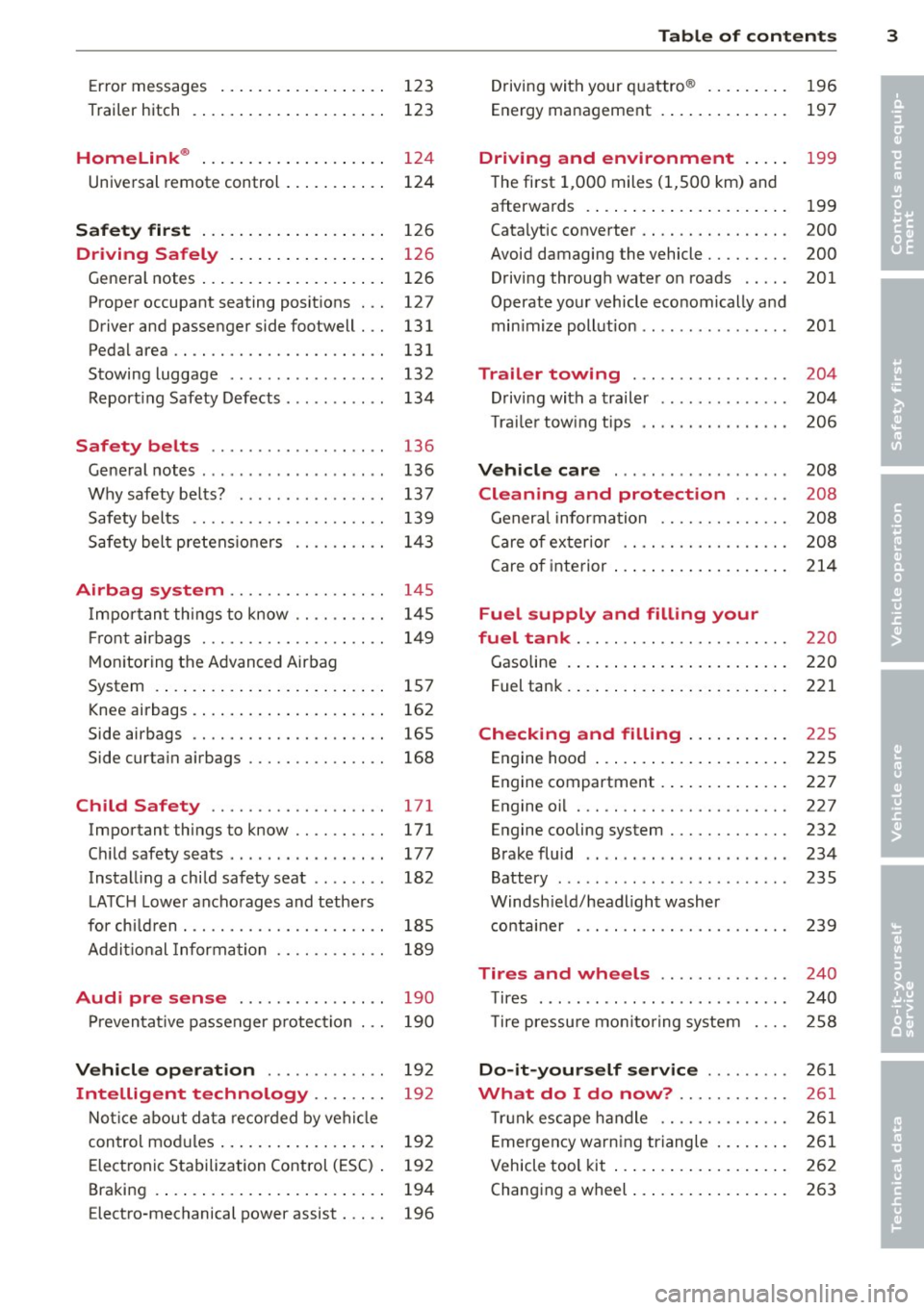
Error messages . . . . . . . . . . . . . . . . . . 123
Trailer hitch . . . . . . . . . . . . . . . . . . . . . 123
Homelink ® . . . . . . . . . . . . . . . . . . . . 124
Universal remote control . . . . . . . . . . . 124
Safety fir st . . . . . . . . . . . . . . . . . . . . 126
Driving Safely . . . . . . . . . . . . . . . . . 126
Gene ral notes . . . . . . . . . . . . . . . . . . . . 126
Proper occupant seating posit ions . . . 12 7
Driver and passenger side footwell . . . 131
Pedal area . . . . . . . . . . . . . . . . . . . . . . . 131
Stowing luggage . . . . . . . . . . . . . . . . . 132
Report ing Safety Defects . . . . . . . . . . . 134
Safety belts . . . . . . . . . . . . . . . . . . . 136
Ge neral notes . . . . . . . . . . . . . . . . . . . . 136
Why safety be lts? . . . . . . . . . . . . . . . . 137
Safety belts . . . . . . . . . . . . . . . . . . . . . 139
Safety bel t pre tens io ners . . . . . . . . . . 1 43
Airbag system . . . . . . . . . . . . . . . . . 145
I mpo rtant th ings to know . . . . . . . . . . 145
Fr ont airbags . . . . . . . . . . . . . . . . . . . . 1 49
M on itoring the Advanced Airbag
System . . . . . . . . . . . . . . . . . . . . . . . . . 157
Knee airbags . . . . . . . . . . . . . . . . . . . . . 162
Side airbags . . . . . . . . . . . . . . . . . . . . . 165
Side curta in a irbags . . . . . . . . . . . . . . . 168
Child Safety . . . . . . . . . . . . . . . . . . . 171
Important things to know . . . . . . . . . . 171
C hi ld safety seats . . . . . . . . . . . . . . . . . 177
Install ing a child safety seat . . . . . . . . 182
L ATC H Lower ancho rages and tethe rs
for ch ild ren . . . . . . . . . . . . . . . . . . . . . . 185
Addit ional Information 189
Audi pre sense . . . . . . . . . . . . . . . . 190
P reven tat ive passenger p rotection 190
Vehicle operat ion . . . . . . . . . . . . . 192
Intelligent technology . . . . . . . . 19 2
Not ice about da ta re cor ded by veh icle
control mod ules . . . . . . . . . . . . . . . . . . 192
Elect ronic Stabilization Control (ESC) . 192
Braking . . . . . . . . . . . . . . . . . . . . . . . . . 194
E lectro-mechanical power assist . . . . . 196
Table of contents 3
Driving with your q uattro ® . . . . . . . . . 196
Energy management . . . . . . . . . . . . . . 197
Driving and environment . . . . . 199
The first 1,000 miles (1,500 km) and
afterwards . . . . . . . . . . . . . . . . . . . . . . 199
Catalytic converter . . . . . . . . . . . . . . . . 200
Avoid damaging the vehicle . . . . . . . . . 200
Drivi ng throug h wate r on roads . . . . . 201
Operate your vehicle economically and
min imize poll ution . . . . . . . . . . . . . . . . 201
Trailer towing . . . . . . . . . . . . . . . . . 204
D rivi ng with a trailer . . . . . . . . . . . . . . 204
T ra ile r tow ing tips . . . . . . . . . . . . . . . . 206
Vehicle care . . . . . . . . . . . . . . . . . . . 208
Cleaning and protection . . . . . . 208
General infor mation . . . . . . . . . . . . . . 208
Care of ex ter ior . . . . . . . . . . . . . . . . . . 208
Care of interior . . . . . . . . . . . . . . . . . . . 214
Fuel supply and filling your
fuel tank . . . . . . . . . . . . . . . . . . . . . . .
220
Gasoline . . . . . . . . . . . . . . . . . . . . . . . . 220
F uel tank. . . . . . . . . . . . . . . . . . . . . . . . 221
Checking and filling . . . . . . . . . . . 225
Engine hood . . . . . . . . . . . . . . . . . . . . . 225
Engine compartment . . . . . . . . . . . . . . 227
Engine oi l . . . . . . . . . . . . . . . . . . . . . . . 227
Engine cooling system . . . . . . . . . . . . . 232
Brake fluid . . . . . . . . . . . . . . . . . . . . . . 234
Battery . . . . . . . . . . . . . . . . . . . . . . . . . 235
Windsh ield/headlight washer
co ntaine r . . . . . . . . . . . . . . . . . . . . . . . 239
Tires and wheels . . . . . . . . . . . . . . 240
T ires . . . . . . . . . . . . . . . . . . . . . . . . . . . 240
T ire pressu re mo nitoring system 258
Do-it-yourself service . . . . . . . . . 261
What do I do now? . . . . . . . . . . . . 261
T ru nk escape handle . . . . . . . . . . . . . . 261
E mergency warn ing triangle . . . . . . . . 261
Vehicle tool kit . . . . . . . . . . . . . . . . . . . 26 2
Changing a wheel . . . . . . . . . . . . . . . . . 263
•
•
Page 16 of 306
![AUDI S6 2013 Owners Manual 14 Instrum ent s and w arn ing /indic ato r light s
Canada models:
[I]
Anti-lock braking system (ABS)
defective ./
¢ page20
•
Worn brake pads
¢ page20
:rm
Electromechanical par](/img/6/57588/w960_57588-15.png "AUDI S6 2013 Owners Manual 14 Instrum ent s and w arn ing /indic ato r light s
Canada models:
[I]
Anti-lock braking system (ABS)
defective ./
¢ page20
•
Worn brake pads
¢ page20
:rm
Electromechanical par")
14 Instrum ent s and w arn ing /indic ato r light s
Canada models:
[I]
Anti-lock braking system (ABS)
defective ./
¢ page20
•
Worn brake pads
¢ page20
:rm
Electromechanical parking brake
¢ page 74
g
Tire pressure monitoring system
./
¢page258
Tire pressure monitoring system
••w;~, ¢ page258
Im
Electronic power control ./
¢ page 21
I Malfunction indicator Lamp (MIL)
111!
./
¢ page21
.,
Engine speed limitation
¢ page 21
I.
Engine oil level
¢ page 18
•
Engine oil sensor
¢ page 21
&1
Battery
¢ pagel7
Ill
Tank system
¢page 21
•
Windshield washer fluid level
¢page22
m
Windshie ld wipers
¢ page22
!I
Remote control key
¢page 71
m
Remote control key
¢ page 74
I!
Battery in remote control key
¢ page32
-.
l:J
Defective ligh t bulb warn ing
¢ page22
II
Rear fog light(s)
¢page22
II
Headlight range control
¢page22
- -
Ill
adaptive light *
¢page22
m
Light -/rain sensor faulty
¢ page 22
- -
•
Audi active lane assist *
¢page92
Im
T ransmission
¢ page 110
Im
Transmission
¢page 110
R1
Transmission
- S t ron ic ® ¢ page 110
•
Electronic steering column lock
¢page 18
- -
.,
Engine start system
¢page 18
£1.p
Electromechanical steering
¢page 196
•
Air suspens ion*
¢ page 18
Ill
Sport differential *
¢page22
Other indicator lights
II
II
I : I -._ I• 11
Turn signals ¢ page 23
USA model s: Cruise control *
¢page
79
,,_
...
Page 17 of 306
Instruments and warning/indicator lights 15
•
Canada models: Cruise contro l*
¢ page 79
ra
Adaptive cruise cont rol*
¢page8 4
--
Pl
Adaptive c ruise control*
¢ page84
I
Adaptive cruise control*
¢page8 4
•
Audi active lane assist*
¢ page 92
•
Start-Stop-System *
¢page 76
•
Start-Sto p-System *
¢page 76
•
High beam
¢page 43
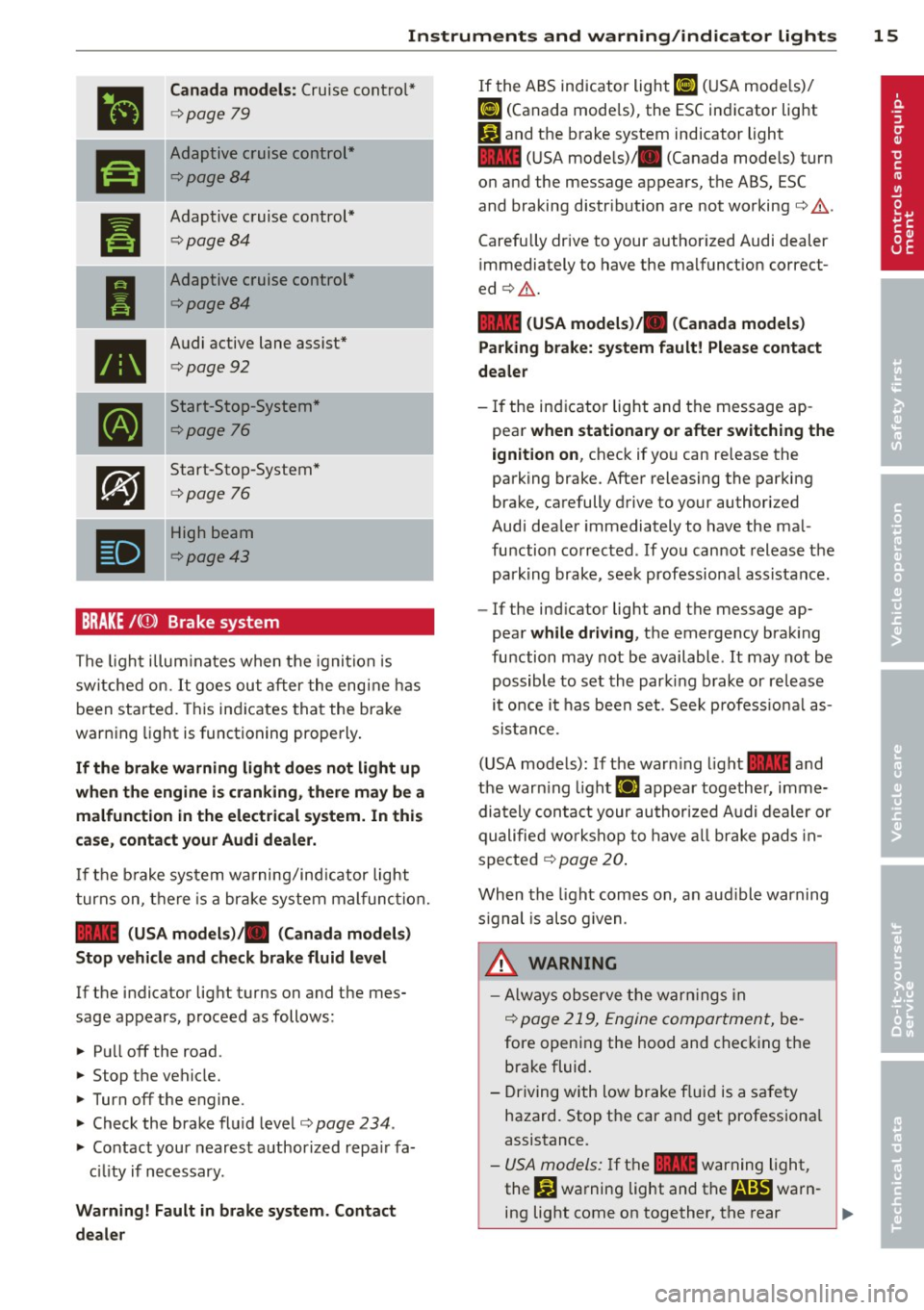
BRAKE/( ©) Brake system
The ligh t illum inates when t he igni tion is
sw itche d on.
It goe s ou t aft er the eng ine has
been st art ed. This in dicates tha t th e brake
warn ing light is functioning properly .
If the brake warning light does not light up
when the engine is cranking, there may be a
malfunction in the electrical system. In this
case , contact your Audi dealer.
If t he b rake sys tem warning/ind icator light
tur ns on, t here is a br ake system mal func tion.
1111 (USA models) ;II (Canada models)
Stop vehicle and check brake fluid level
If the indicator light t urns on and the mes
sage appears, p roceed as follows:
... Pu ll off the road .
... St op t he vehicle.
.,. Turn off t he e ngine.
.,. Check the brake flu id leve l<=>
page 234 .
... Contact your neares t authorized repa ir fa
c ili ty if n ecessary .
Warning! Fault in brake system . Contact
dealer
If the A BS indicator light ri] (U SA mode ls)/
ri] (Canada mode ls), the ESC in dicator light
Pl and the b rake system indicator light
1111 (U SA mode ls)/ . (Canada models) turn
o n and the message appears, the ABS , ESC
and braking distr ibut ion are not working<=> &..
Carefully drive to your author ized Audi dealer
immediately to have the malfunct ion correct
ed <=>&. .
1111 (USA models )/. (Canada models)
Parking brake: system fault! Please contact
dealer
- If the in dicator light and the message ap
pea r
when stationary or after switching the
ignition on ,
check if yo u can re lease the
parking brake. Afte r releasing the par king
brake, carefully d rive to your authorized
Aud i dea le r i mmediately to have the ma l
fu nction corrected . If yo u can not releas e th e
park ing brake , see k professiona l assistan ce.
- If the ind icator light and the message ap
pear
while dr iving , the emergency bra king
fu nction may not be available.
It may not be
po ssibl e to set th e par king b rake or re lease
i t once i t has been set . See k profess io na l as
s is tan ce.
( U SA mode ls) : If the war ning light
1111 a nd
the war ning light
£1 appear together, imme
dia tely con ta ct y our au thor ized A udi dealer or
qualifie d wor kshop to have all brake pad s in
spe cte d
¢ page 20.
When the light comes on , an aud ible warn ing
s ignal is also g iven .
A WARNING
-Always o bserve the warn ing s in
<=>
page 219, Engi ne compar tmen t, be
fore openi ng the hood and c hec kin g the
brake fluid .
- Driving with low brake f lui d is a safety
hazard. Stop t he car and get professiona l
assis tance .
- USA mode ls: I f t he 1111 war ning light,
the
G1 warning light and t he m!ID warn-
ing light come on together, the rear .,.
Page 18 of 306
16 Instrum ent s and w arn ing /indic ato r light s
wheels co uld lock up first under hard
braking. Rear wheel lock-up can cause
loss of vehicle control and an accident.
Have your vehicle repaired immediately
by your authorized Aud i dealer or a qua li
fied workshop. Drive slowly and avoid sudden, hard brake applications.
- Canada models: If the brake warn ing
light ., the
DJ warning light and the
ABS warning light
[iJ come on togethe r,
the rear wheels could lock up fi rst unde r
hard braking. Rear wheel lock-up can
cause loss of vehicle control and an acci
dent. Have your vehicle repaired immedi
ately by your authorized Audi dealer or a
qualified workshop. Dr ive slowly and
avo id sudden, hard brake applicat ions.
- If the brake warning/indicator light does not go out after a few seconds and the
park ing brake is released, or lights up
wh ile you are driving, the fluid level in
the brake f luid reservoir is too low . If you
believe that it is safe to do so, proceed
immediately at low speed to the nearest
authorized Audi dealer or qualified repair
facility and have the brake system in
spected.
- Always keep in mind that after several
brake applications, yo u will need greater
pressure on the brake peda l to stop your
vehicle. Do not re ly on stra ined brakes to
respond w ith maximum stopp ing power
in critical situations. You must allow for
increased brak ing distances . The extra
distance used up by fad ing brakes could
lead to an acc ident.
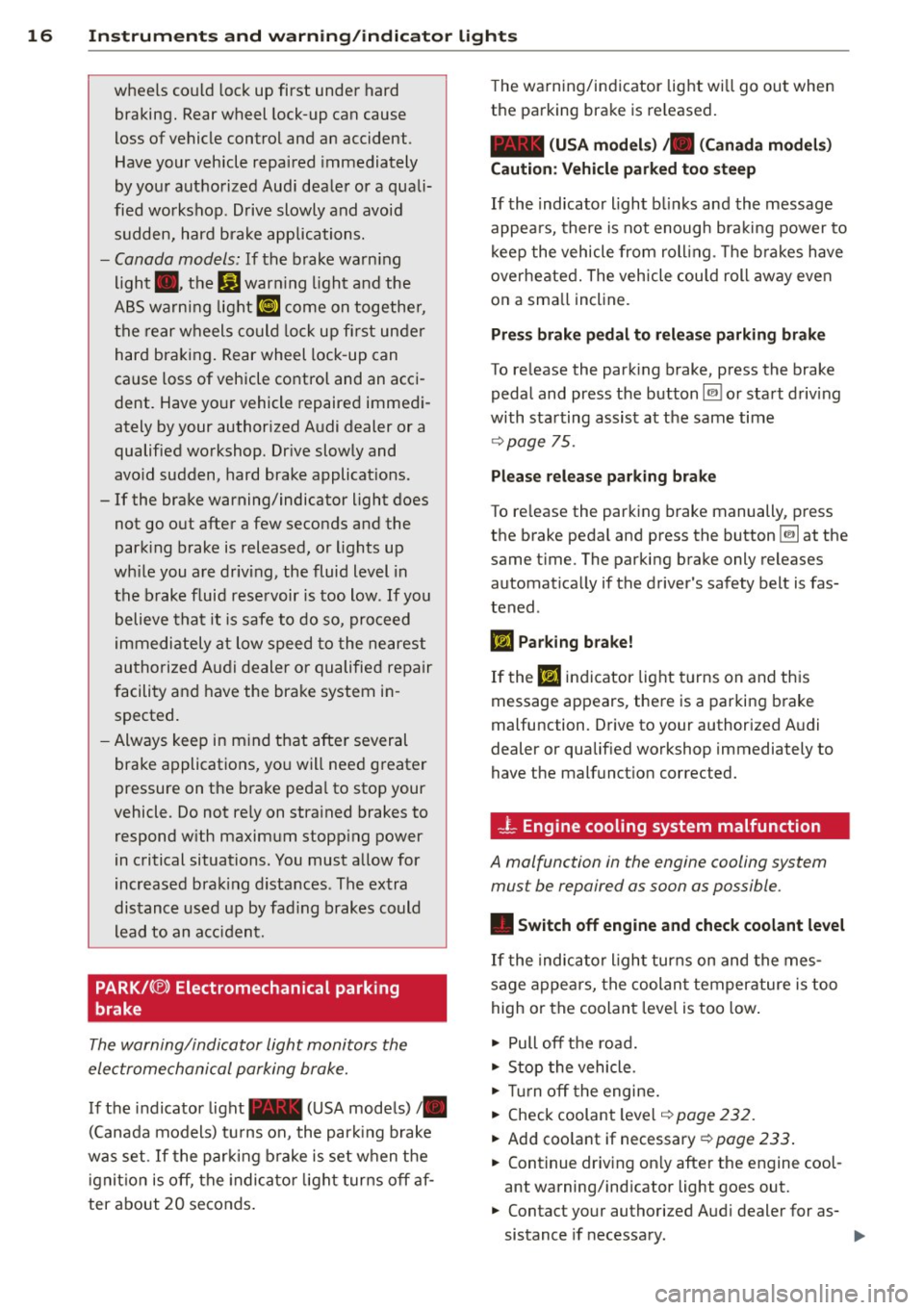
PARK/ (®) Electromechanical parking
brake
The warning/indicator light monitors the
electromechanical parking brake.
If the indicator light- (USA models)/ .
(Canada models) tu rns on, the park ing brake
was set . If the parking brake is set when the
ignit ion is off, the indicato r light turns off af
ter about 20 seconds . The warning/indicator light wi
ll go out when
the parking brake is re leased.
- (USA m odels) /. (C an ada mod els)
C a uti on: V eh icle p ark ed t oo stee p
If the indicator light b links and the message
appea rs, there is not enough braking power to
keep the vehicle from roll ing . T he b rakes have
overheated. The veh icle cou ld roll away even
on a sma ll incline.
Pr ess brake p edal to r ele ase parking brake
To release the park ing brake, press the brake
pedal and press the button
@ii or start driving
with starting assist at the same time
~ page 75.
Pl ease re le a se park ing brak e
To release the parking brake manually, press
the brake pedal and press the button
@ii at the
same t ime. The parking brake only releases
automat ica lly if the driver's safety belt is fas
tened .
IIJ Parking b rake!
If the IIJ indicator light turns on and th is
message appears, there is a parking brake
malfunction. Drive to your authorized Audi
dealer or qualif ied workshop immediately to
have the malfunct ion corrected.
- L Engine cooling system malfunction
A malfunction in the engine cooling system
must be repaired as soon as possible .
• Switch off engin e and check coolant le vel
If the indicator l ight turns on and the mes
sage appea rs, the coolant temperature is too
high or the coolant leve l is too low .
"' Pull off the road.
"' Stop the vehicle .
"' Tur n off the engine.
"' Check coolant level ~
page 232.
"'Add coolant if necessary ~ page 233.
"' Continue driving on ly after the engine cool
ant warning/ind icator light goes out.
"' Contact your authorized Audi dealer for as
sistance if necessary .
Page 197 of 306
freezing conditions ice) on the brake pads. A
few careful brake applications sho uld d ry
off
the brake pads or remove any ice coatings.
When you are driving at h igher speeds wit h
the windshield wipers on, the brake pads will briefly touch the brake discs in regular inter
va ls so as to improve reaction t ime when brak
ing on wet surfaces. You the driver w ill not no
tice anything.
The effectiveness of the brakes can be reduced
when the vehicle is dr iven on a salt -covered
road and the brakes are not used . Here too,
you should clean
off accumulated salt coat ing
from brake discs and pads with a few careful
applications of the brake
¢ ,&..
Cor ro sion
There may be a tendency for dirt to bui ld up
on the brake pads and corrosion to form on
the discs if the car is not dr iven regularly or
only for short trips with little use of the brakes .
If the brakes are not used frequently, or if cor rosion has formed on the discs, it is advisable
to clean
off the pads and discs by braking
f irmly a few times from a moderately high
speed ¢,&. .
Fa ult s in the b rake system
If you should notice a sudden increase in
brake pedal travel, then one of the two brake
circu its may have failed
c> ,&..
Lo w brak e flu id le vel
Malfunctions can occur in the brake system if
the brake fluid level is too low . The brake fluid
level is monitored electronically.
Brake boo ste r
The brake booster works with vacuum pres
sure which is created only when the engine is
running ¢ ,&. .
Brake lining w ear statu s
Brake lining wear may be checked by vis ual in
spection of the condition of the brake pads
through the openings in the whee l. If neces-
Int ellig ent technolog y 195
sary, the wheel may be removed for this in
spection ¢
page 263 , Changing a wheel.
A WARNING
- You should perform braking maneuvers
for the purpose of cleaning the brake
system only if road conditions permit.
Other road users must not be put at risk -
you may cause an accident!
- Before descend ing a steep grade, reduce
speed and sh ift transmission into a lower
gear or lower dr iving range . Do not ride
the brakes or hold the pedal down too
long o r too often . Th is could cause the
brakes to get hot and diminish braking
efficiency .
- Do not "ride the brakes" by rest ing you r
foot on the pedal when you do not intend
to brake . This may cause the brakes to
overheat, p remature wear and increased
stopping distance.
- Under certain cl imatic and operating
conditions such as passing thro ugh wa
ter, dr iv ing in heavy rain or after washing
the vehicle, the effectiveness of the brakes can be reduced . In winter, ice can
accumu late on the brake pads, lin ings,
discs and drums . Carefully app ly brakes
for a test. Brakes will dry and ice coat
ings w il l be cleaned
off after a few care
fu l brake applicat ions.
- Driving for an extended period o f time on
salt- covered roads wi thout using your
brakes can a lso affect braking efficiency .
Clean
off accum ulated salt coating from
brake discs and pads with a few careful
brake applications.
- If you damage the front spoiler, or if you
install a different spoiler, be sure the air
f low to the front brakes is not obstruct
ed. Otherw ise the brake system could
overheat reducing the effectiveness of
the entire brake system.
- Failure of one brake circuit will impair
the braking capab ility result ing in an in
creased stopping distance . Avoid driving
the vehicle and have it towed to the near-
est A udi dealer or qualified wo rkshop.
~
•
•
Page 210 of 306
208 Cleaning and protection
Cleaning and protect ion
General information
Regular core preserves vehicle value .
Any automobile is exposed to industrial
fumes, corrosive road salt, etc. A well cared
for Audi can look like new many years after
purchase . Regular and correct care w ill con
tr ibute to maintaining the beauty and value of
your Aud i.
Furthermore, good care may be a condition
for substantiating a warranty claim should
corrosion damage or paint defects occur.
Your author ized Audi dealer has a variety of
dedicated vehicle-care products and can ad
vise which ones to use for cleaning the exter i
or and interior of your vehicle .
Whether you use products recommended by
Audi or other commercially available clean ing
agents, please make sure you apply them cor
rectly .
A WARNING
-Cleaning agents may be poisonous. Keep
them out of the reach of children.
- Heed all caut ion labels.
- Always read directions on the container
before using any product . Follow the di
rect ions carefu lly.
- Most chemical cleaners are concentrated
and have to be diluted.
- Use spot removing fluids only in well
ventilated areas.
- Do not use gasoline, kerosene, d iesel
fuel, nail pol ish remover or other volatile
fluids. They may be toxic, flammable or
hazardous in other ways. Do not wash,
wax or dry the vehicle with the ignit ion
on or the engine running.
- Do not clean the undersides of chassis,
fenders, wheel covers, etc. without pro
tecting your hands and arms. You may cut yourself on sharp-edged metal parts. -
Moisture and ice on brakes may impair
brak ing eff ic iency
c::> page 194 , General
information.
Test the brakes carefully
each time you wash the vehicle .
@ For the sake of the environment
Select only environ mentally friendly clean
ing products. Leftover cleaning products
should not disposed of in the household
waste .
Care of exterior
Washing
Frequent washing protects the vehicle .
The best p rotection against environmental in
fluences is
frequent washing and waxing . How
often this is required depends on:
- How much the veh icle is used
- Where the vehicle is parked (garage, in the
open under trees, etc.)
- The seasona l and weather conditions
- Environmental influences
T he longer b ird droppings, insects, tree resin,
road and industria l gr ime, tar, soot, road salt
and other materials remain on the vehicle body, the more lasting their destructive ef
fects will be . High temperatures caused by ex
posure to intense sunlight intensify the corro
sive effect, particularly when humidity is high as well.
Under certain circumstances,
weekly washing
may be necessary. Under other conditions, a
monthly washing and waxing may be ade
quate .
After the winter, the underside of the vehicle
should be thoroughly washed, preferably in a
professional car wash.
Vehicles with matte finish paint
c::> page 210.
A WARNING
-A lways read and heed all WARNINGS and
other information
c::> page 208.
Page 227 of 306
Checking and filling Engine hood
Releasing the engine hood
The engine hood is released from inside the
vehicle .
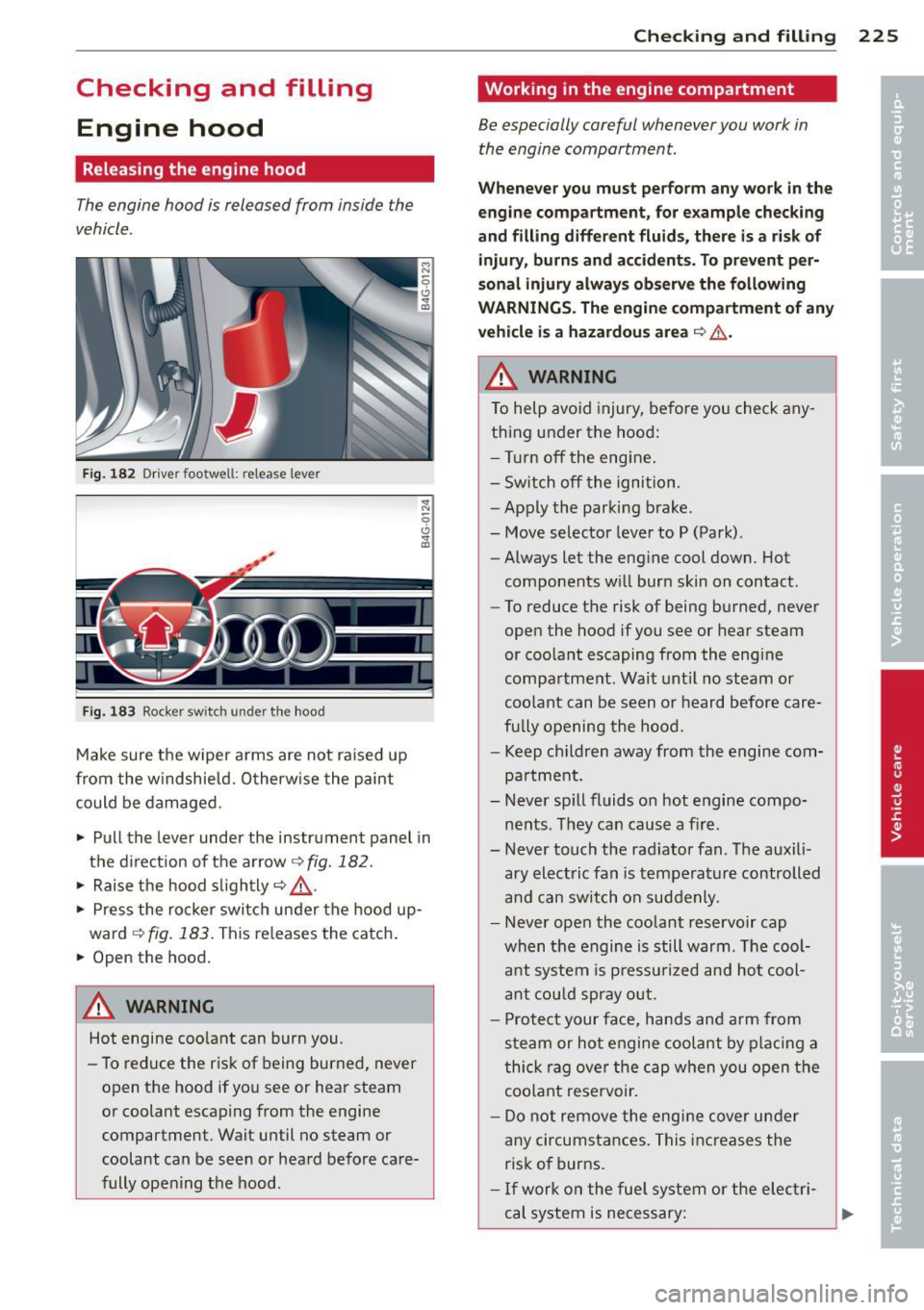
Fig. 182 Dr iver footwell: release leve r
Fig. 183 Rocker switch under the hood
Make sure the wiper arms are not raised up
from the w indshield. Otherw ise the paint
could be damaged.
.. Pull the lever under the instrument panel in
the d irect ion of the arrow
<=> fig. 182.
.. Raise the hood slightly <=>_& .
.. Press the rocke r switc h under the hood up
ward
<=> fig. 183 . This re leases the catch .
.. Open the hood .
A WARNING
Hot engine coo lant can burn you.
- To reduce the r isk of being burned, never
open the hood if you see or hear steam
or coolant escaping from the engine
compartment . Wait until no steam or
coolant can be seen or heard before care
fully opening the hood.
Checkin g and fillin g 225
Working in the engine compartment
Be especially careful whenever you work in
the engine compartment.
Wh ene ve r y ou must perform an y wo rk in the
eng ine com pa rtm ent , for e xample checking
a nd filling diff ere nt fluids, th ere is a risk of
inju ry, burn s and accid ent s. To pr event per
so nal injury alwa ys observe the foll owing
WARNING S. The engin e compartment of an y
v e hicle i s a h az a rdou s are a
<=> ,&.
h WARNING
To help avoid injury, be fore yo u check any
thing under the hood:
- Turn off the engine .
- Sw itch off the ignition .
- Apply the parki ng brake.
- Move selector leve r to P (Park) .
- Always let the engine cool down. Hot
components w ill burn skin on contact .
- To reduce the risk of being burned, never
open the hood if you see or hear steam
or coo la nt escaping from the engine
compa rtment. Wait unt il no steam or
coolant can be seen o r heard before care
fu lly opening the hood.
- Keep ch ildren away from the engine com
pa rtment.
- Never sp ill fluids on hot engine compo
nents . They can cause a fire .
- Never touch the rad iator fan. The auxili
ary electric fan is temperat ure controlled
a nd can sw itch on suddenly .
- Never open the coolant reservoir cap
when the engine is still warm . The cool
a nt system is p ressu rized and hot cool
a nt cou ld spray o ut.
- Protect your face, hands and arm from
steam or hot engine coolant by plac ing a
thick rag ove r the cap when you open the
coo lant rese rvoir.
- Do not remove the engine cover under
any circumstances. This inc reases the
ris k of burns.
- If work on the fue l system o r the elec tri
cal system is necessary:
Page 229 of 306
Checking and filling 22 7
Engine compartment
Engine compartment overview
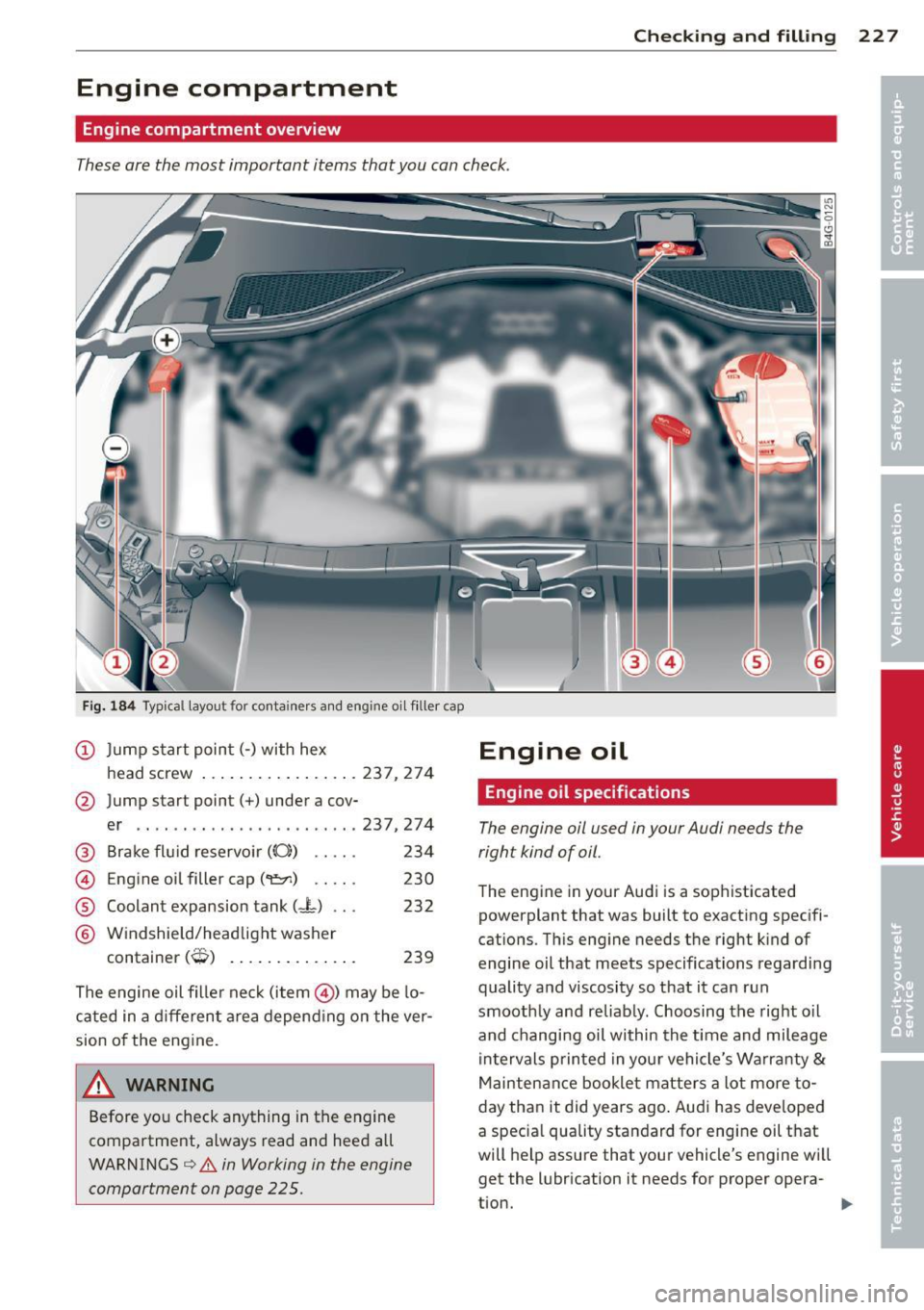
These are the most important items that you can check.
Fig. 184 Typical layout for conta iners and engine o il filler cap
@ Jump start poin t(-) with hex
head screw .. .............. . 237,274
@ Jump start point(+) under a cov-
®
©
®
©
er .. .. ... ..... ...... ...... 237,274
Brake fluid r eservo ir
((0)) . . . . . 234
Eng ine oil filler cap
("1:::r.) . . . . . 230
Coolant expansion tank
(-L) .. .
Windshield/headlight washer
t . ('"') con ainer O ......... .... .
232
239
The engine oil filler neck (item@) may be lo
cated in a different area depending on the
ver
sion of the eng ine.
Before you check anything in the engine
compartment, always read and heed all
WARNINGS
c::> &. in Working in the engine
compartment on page 225.
Engine oil
Engine oil specifications
The engine oil used in your Audi needs the
right kind of oil.
The engine in your Audi is a sophisticated
powerplant that was built to exacting specifi
cations. This eng ine needs the right kind of
engine oil that meets specifications regardi ng
quality and viscosity so that it can run smoothly and reliably. Choosing the right oil
and changing oil within the time and mileage
intervals p rinted in you r vehicle's Warranty
&
Maintenance booklet matters a lot more to
day than it did years ago . Audi has developed
a special quality standard for engine oil that
will hel p assure that your vehicle's engine will
get the lubrication it needs for proper opera
tion.
Page 236 of 306
234 Checking and filling
scalding from hot coolant by following
these steps .
- Turn off the eng ine and a llow it to cool
down.
- Protect your face, hands and arms from escaping flu id and steam by cover ing
the cap with a large, thick rag .
- Turn the cap slowly and very carefully
i n a counter-clockwise direction while
apply ing l ight, downwa rd p ress ure on
the top of the cap .
- To avo id being burned, do not sp ill an
tifreeze or coolant on the exhaust sys
tem or hot engine parts . Under certain
conditions, the ethylene glyco l in en
gine coolant can catch f ire .
- Antifreeze is poisonous . Always store an
tifreeze in its or iginal container and we ll
out of the reach of children .
- If you drain the coolant, it must be
caught and safely stored in a proper con
tainer clear ly marked "poison".
@ Note
- Coolant po llutes the env ironment and
could cause an engine fire . Excess coo l
ant will be forced out through the pres
sure re lief valve in the cap when the en
gine becomes hot.
- If, in an emergency, on ly water can be
added, the correct ratio between water
and antifreeze
c::> page 232 must be re
stored as soon as possible .
@ For the sake of the environment
Drained coolant should not be re used. Al
ways dispose of used coolant while observ
ing all environmental regulat ions .
Radiator fan
The radiator fan switches on automatically by
itself
An auxiliary e lectr ic radiator fan switches on
and off depending on coolant temperature
and other vehicle operating cond itions. After you switch the engine off, the aux
iliary
fan can cont inue running for up to 10 minutes
- even w it h the ignition off. It can even switc h
on again later by itself
c::> .&. , if
- the temperatu re of the engine coo lant rises
due to the heat build-up from the engine in
the engine compartment, or
- the engine compartment heats up because
the vehicle is parked in intense sunlight.
A WARNING
-- To reduce the risk of persona l injury nev-
er touch the radiator fan.
- The a uxiliary electric fan is temperat ure
contro lled and can sw itch on suddenly
even when the engine is not running.
- The auxiliary radiator fan switches on a u
tomatically when the engine coo lant
reaches a certain temperature and will
continue to run until the coolant temper
ature drops .
Brake fluid
Checking brake fluid level
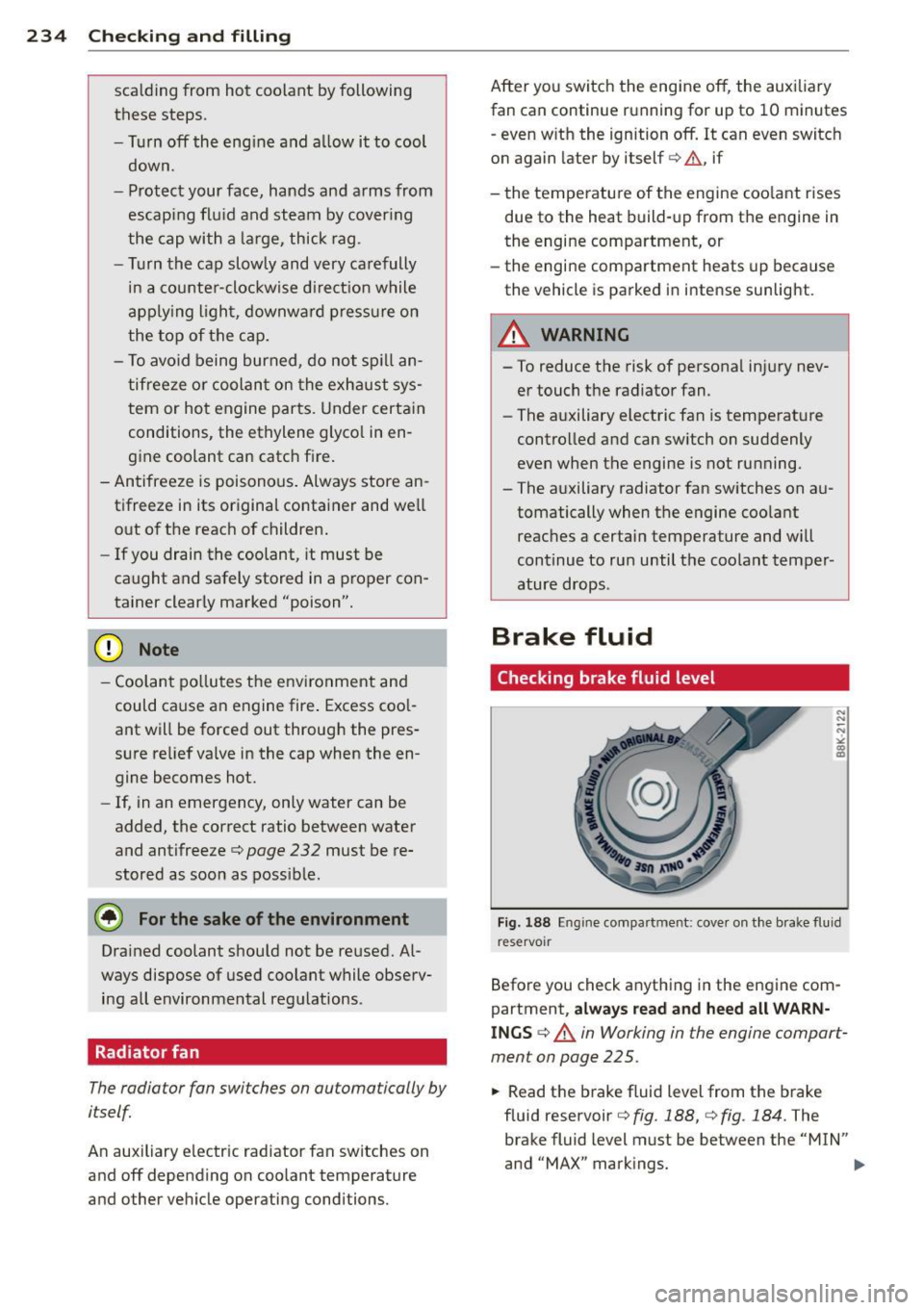
Fig. 1 88 En gin e compa rtme nt: cove r on t he brake fluid
reservoi r
Before you check anything in the engine com
partment,
always read and heed all WARN
INGS c:> A in Working in the engine compart
ment on page 225.
.,. Read the brake fluid level from the brake
fluid reservoir
c::> fig. 188, c:> fig . 184. The
brake fluid level must be between the "MIN"
and "MAX" markings.
IJ>
Page 237 of 306
The location of the brake fl uid reservo ir can be
seen in the engine compartment illustration
c::> page227.
The fl uid level may drop slightly after some
time due to the automatic adjustment of the
brake pads. This is not cause for alarm .
If the brake fluid level falls considerably be
l ow the "MIN" mark, the bra ke wa rning/ind i
cator light
1111 (U .S . models)/ . (Canadian
models) will come on
c::> page 15. Do not con
tinue to operate the vehicle. The comp lete
brake system sho uld be thoroughly checked
by an author ized Audi dealer or other quali
fied fac ility and the cause corrected . If the
brake fluid level is too low, the brake warn ing/
i ndicator light w ill illuminate . Contact an au
thor ized Audi dealer
imm ediately .
Changing brake fluid
Have the brake fluid changed by an experi
enced technician .
Brake fluid absorbs moisture from the a ir. If
the water content in the brake fluid is too
h igh, corrosion in the brake system may result
after a per iod of t ime . The bo iling po int of t he
brake fluid w ill also decrease consider ably and
dec rease b raking per formance.
Therefore, the brake flu id must be changed
ever y two years . Always use new b rake fluid
whi ch confo rms to Fede ral Motor Vehicle
Standard "FMVSS 1 16 DO T 4".
The brake flu id rese rvoir ca n be difficult to
r eac h, therefo re , we re commend that yo u
have the brake fl uid changed by y our autho r
i z ed
Audi dealer . Your deale r has the correct
too ls, the right brake fluid and the know -how
to do this for you .
A WARNING
-Brake fluid is po isonous . It must be stor
ed only in the closed orig inal container
out of t he reac h of children!
- Brake fa ilure can result from old o r inap
propr iate brake fluid. Observe these pre
caut ions:
Checkin g and fillin g 235
-Use only brake f luid that meets SAE
spec ificat ion
J 1703 and conforms to
Federal Motor Ve hicle Standard 116.
Always check with your autho rized Audi
dealer to make sure yo u are using the
correct brake fluid . The correct type of
brake f lu id is also ind icated on the
brake flu id rese rvoi r.
- The bra ke fluid must be new. Heavy us e
of the brakes can cause a vapo r lock if
the b ra ke fluid is left i n the system too
l ong . This can se riously affec t the effi
ciency of the b rakes as well as your
safety . This co uld resu lt in an accident.
(D Note
B rak e fluid wi ll damage the pa int o f you r
vehicle .
~ For the sake of the environment
Because o f the p rob lem of pro per disposal
of bra ke fluid as well as the spe cial too ls
r equired an d the necessary exper tise, we
r ecommend that yo u have the brake flu id
changed by yo ur authorized Aud i dea le r.
Battery
General information
U nder normal ope ra ti ng cond itions , the bat
te ry in yo ur Audi doe s not need any ma inte
nance. With
high outside tempera tures or
l ong daily drives we recommend that you have
the e lectrolyte level checked by a service fa
c ili ty. The electrolyte leve l should a lso be
checked each t ime the battery is charged
c:> page 237.
Have the battery checked when yo u take your
vehicle in for service. You are well advised to
replace a batte ry that is older than 5 years .
Wi th certain types of airbag deployment, the
battery is disconnected from the vehicle elec
trical system for safety reasons
c> & in Re
pair , care and disposal of the airbags on
page 161.
~
•
•