fuel AUDI S6 2014 User Guide
[x] Cancel search | Manufacturer: AUDI, Model Year: 2014, Model line: S6, Model: AUDI S6 2014Pages: 304, PDF Size: 76.32 MB
Page 65 of 304
_& WARNING
Weak, damaged or improper straps used
to secure items to the roof rack can fail
during hard braking or in a collision and
cause serious personal injury .
- Make sure the roof rack is installed exact
ly as specified above
c::;, page 61 .
-Always use suitable mounting straps for
securing items to the roof rack to help
prevent items from shift ing or fly ing for
ward.
- Items on the roof rack must always be
securely mounted .
- The use of a roof rack can negatively af
fect the way a vehicle handles . Cargo
that is large, heavy, bulky, long o r flat
will have a greater negative inf luence on
the vehicle 's aerodynamics, center of
gravity and overall handling . Always
drive slowly, avoid sudden braking and
maneuvers when transporting cargo on
the roof of your vehicle.
- Never exceed the maximum permissible
load carrying capacity of the roof of your
vehicle, the perm issible axle weights and
the permiss ible total weight of your vehi
cle
c::;, page 280, Weights .
@ For the sake of the environment
As a result of the increased wind resist
ance created by a roof rack, your veh icle is
using fuel unnecessarily. So remove the
roof rack after using it.
S ea ts a nd s to rage 63
Luggage compartment
Loading luggage compartment
Luggage i tems must be stowed securely.
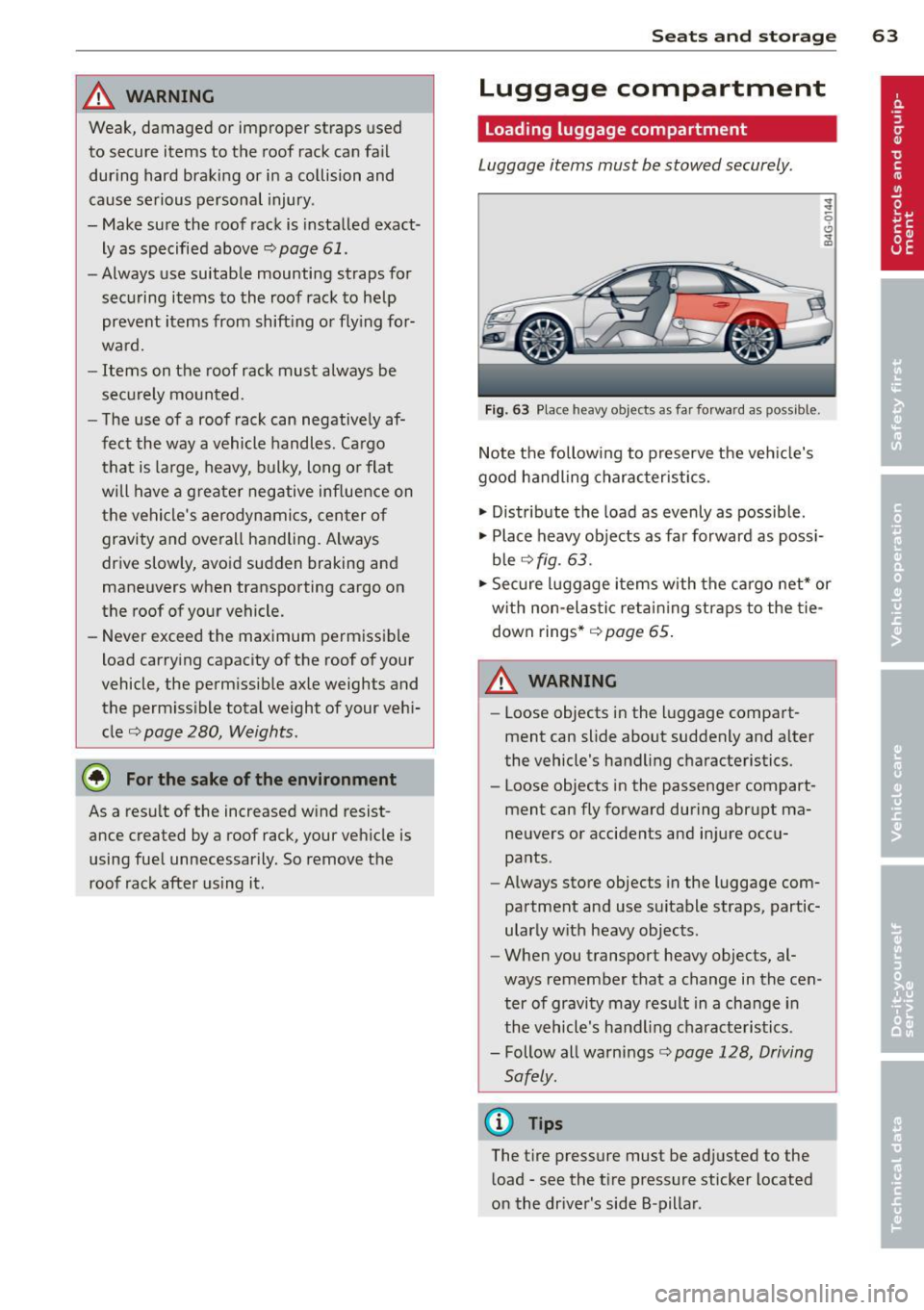
Fig. 63 P la ce h eavy o bject s as far forward a s possible .
Note the following to preserve the vehicle's
good handling charac teristics.
.., Distribute the load as evenly a s possible.
.., Place heavy objects as far forward as poss i
ble
c::;, f ig . 63 .
.., Secure luggage items with the cargo net* or
w ith non-elastic retain ing straps to the tie
down rings*
c::;, page 65.
A WARNING
- Loose objects in the l uggage compart
ment can slide about suddenly and a lter
the vehicle's handling characteristics.
- Loose objects in the passenger compart
ment can fly forward during abr upt ma
neuvers or accidents and injure occu
pants .
- Always store objects in the luggage com
partment and use suitable straps, partic
ularly with heavy objects .
-
-When you transport heavy objects, al
ways remember that a change in the cen
ter of gravity may result in a change in
the vehicle's handling characteristics.
- Follow all warnings
c::;, page 128, Driving
Safely .
(D Tips
The tire pressure must be ad justed to the
load -see the t ire pressure sticker located
on the dr iver's side B -pillar .
Page 81 of 304
Emergency braking
In the event that the conventional brake sys
tem fails or locks .
11-In an emergency, pull the switch C®) and
conti nue to pull it to slow your vehicle down
with the parking brake .
11-As soon as you release the sw itch C®) or ac-
celerate, the braki ng p rocess stops.
If you pull the sw itch (®) and hold it above a
speed of about 5 mph (8 km/h), the emergen
cy braking function is in itiated. The vehicle is
b ra ked at a ll four wheels by activating the hy
d raul ic br ake system. The b rake performance
i s sim ilar to making an emergency stop¢.&. .
I n o rder not to activate the emergency brak
i ng by m istake, an audible warning tone (bu z
z er) sounds when the switc h(®) is p ulled. As
soon as the switch(®) is released, or the accel
erator pedal is dep ressed, emergency braking
stops .
.&_ WARNING
Emergency braking shou ld only be used in
an emergency, when the normal foot brake
has failed or the brake pedal is obstructed.
Using t he parking brake to perform emer
gency braking will slow you r vehicle down
as if you had made a fu ll brake applicat ion.
The laws of phy sic s ca nnot be s uspended
eve n w ith ES C and its a ssoci ated compo
nents (ABS, ASR, EDL). In corners and
when road or weather conditions are bad,
a full brake application can cause the vehi
cle to skid or the rear end to break away -
r isking a n accident.
Start-Stop-System
Description
Appl ies to vehicles : wit h Start-Stop-System
The Start-S top -System can he lp increase fuel
economy and reduce C O2 emissions.
I n the Start-Stop-mode , the eng ine shuts off
automatically whe n the vehicle is stopped,
such as at a traffic light. The ig nit ion remains
On th e ro ad 79
switched on during this stop phase. The en
gine wi ll be a utomatica lly restarted when
needed .
T he las t Start -Stop-Sys tem se tting (on/off us
ing the b utton
10 «<1) will be restored when the
ignition is turned on. The LED in the
!0 •·1 but
ton t urns on when the Start-Stop-System is
switched off manually.
Basic requir ements for the Start -Stop
mode
- The driver 's door is closed.
- The driver' seat belt is latched.
- The hood is closed.
- The vehi cle must have bee n dr iven faster
t han
2.5 mph (4 km/h) since the las t stop.
- A t railer is not hitched to the ve hicle.
.&_ WARNING
- Never let the ve hicle roll with the eng ine
sw itched off. You co uld lose control over
the vehicle. This can lead to a collision
an d serio us in juries .
- The brake boo ster and the s teering sup
port do not work while the engine is
switched off . More force is required to
stop and to steer the veh icle.
- To reduce t he risk of injuries, make sure
that the Start-Stop -System is tu rned off
when working in the eng ine compart
ment¢
page 81.
([) Note
Always switch off the Sta rt -Stop-System
when driving through water¢
page 81.
Page 109 of 304
Automatic Transmission
multitronic, S tronic,
tiptronic
Introduction
App lies to vehicles: with multit ro nic/S tronic/t ipt ronic
The automat ic transm iss ion is controlled elec
tronically . The transmiss ion ups hifts or down
shifts automatically depend ing o n which drive
p rog ram is se lect ed.
When a
moderate driving style is used, the
tra nsmission selects the most econom ica l
d riving mode .
It will then change up early and
de lay the downshifts to g ive bette r fu el econ
omy.
The transmission switches to a sporty mode after a k ick- down or when the drive r uses a
sporty driving style ch aracte rized by quick ac
celerator peda l movements, heavy ac celera
tion, frequent ch anges in speed and traveling
at the maximum spee d.
I f desired, the drive r can a lso se lect the gears
manually ( tiptronic mode ) ¢ page 111.
Various automat ic transm issions may be in
stalled, depend ing o n the mode l:
multitronic transmi ssion
The mult itron ic transm ission is a continuously
variable transmission. Power is transferred us i n g a mu ltidisk clutch . In contrast to conven
tional automat ic transm iss ions using shift ing
ope rations, the transmiss ion ratio in the con
tinuously va riab le transm iss io n is changed
con tinuously. Th is op timi zes the com fort level
a nd co nserves fuel.
S tronic transmission
The S tronic is a dual -clutch transmission .
P owe r is transfe rred using two clutches that
wo rk ind ependen tly from one a nother. They
r e pl ace the tor qu e conve rter u sed in co nven
tional a utoma tic transm iss io ns an d allow t he
ve hicl e to accelerate without a no ticeable in
ter ruption in traction.
Automatic Transmission 107
tiptronic transmission
In the tipt ronic t ra nsm issio n, p ower is trans
f erred by a to rque converter .
Selector lever positions
Applies to vehicles: wit h mult itronic/5 tro nic/tiptro nic
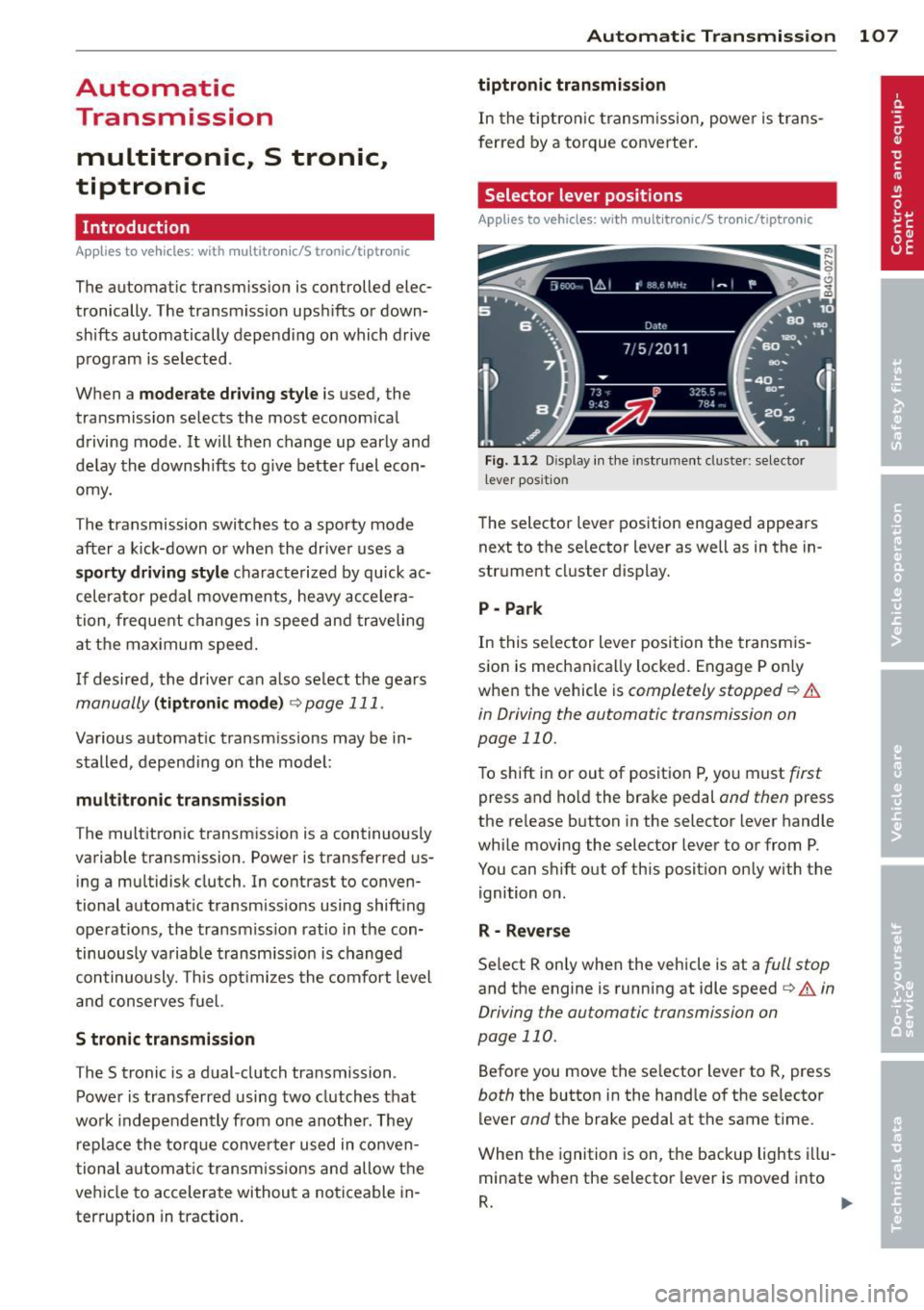
Fig . 1 12 Disp lay in th e inst rume nt cluster: selector
l ever pos itio n
The selector leve r pos ition engaged appears
next to the se lector lever as well as in the in
strument cluster d isp lay.
P -Park
In this se lector lever posi tion the transm is
s io n is mechanica lly locked. Engage P on ly
whe n the vehicle is
completely stopped¢&.
in Driving the automatic transmission on
page 110.
T o sh ift i n or out of posit io n P, you must first
press and ho ld the brake pedal and then press
the re lease b utton in the selector lever hand le
whi le moving the selector lever to or from P .
You can shift out of th is position only with the
ignition o n.
R -Reverse
Se lect R on ly when the vehicle is at a full stop
and the engine is running at idle speed¢ A in
Driving the automatic transmission on
page 110 .
Before you move the se lector lever to R, press
both the button in the hand le o f the selecto r
lever
and the brake pedal at the same t ime .
When the ignition is on, the backup lights illu
m inate when the selecto r lever is moved into
R. .,.
Page 204 of 304
202 Driving and en vir onm ent
Catalytic converter
Appl ies to vehicles: with gasoline e ngin e
It is very important that your emission con
trol system (catalytic converter) is function
ing properly to ensure that your vehicle is run
ning in an environmentally sound manner .
.. Always use lead-free gasoline¢ page 215,
Fuel supply .
.. Never run the tank down all the way to emp-
ty .
.. Never put too much motor oil in your engine
¢ page 229, Adding engine oil
The catalytic converter is an eff ic ient "clean
up" device built into the exhaust system of
the vehicle. The catalyti c converter burns
many of the pollutants in the exhaust gas be
fore they are released into the atmosphere.
The exclus ive use of unleaded fuel is cr itically
important for the l ife of the cata lytic convert
e r and proper functioning of the engine.
A WARNING
T he temperature of the exhaust system is
high, both when driving and after stopping
the engine .
- Never touch the exhaust tail pipes once
they have become hot. This could result
in burns.
- Do not park or operate the vehicle in
areas where the hot exhaust system may
come in contact with dry grass, brush,
fuel spill or other material which can
cause a fire.
- Do not apply additional undercoating or
rustproofing on or near the exhaust
man ifold, exhaust p ipes, catalytic con
verter or heat shields . During driving, the
substance used for undercoating cou ld
overheat and cause a fire.
@) Note
- Be aware that just one tank f illing with
leaded fuel will al ready seriously de
grade the perfo rmance of the cata lytic
conve rter. -
Do not exceed the correct engine oil level
¢page 229.
-Do not drive until the fue l tank becomes
completely empty . The engine co uld m is
fire . Unburned fuel could also get into
the exhaust system and this cou ld cause
the catalytic converter to overheat.
- Do not switch off the ignition while the
vehicle is mov ing .
- Do not continue to ope rate your vehicle
under these conditions, as otherwise fuel
can reach the catalyt ic converter. Th is
cou ld result in overheating of the con
verter, requir ing its replacement .
- To assure efficient operation of the Emis
sion Control System:
- Have you r vehicle maintained p roperly
and in accordance w ith the service rec
ommendations in your Warranty & Maintenance book let.
- Lack of prope r maintenance as we ll as
improper use of the vehicle wi ll impair
the function of the em ission contro l
system and could lead to damage.
@) For the sa ke of the en vironment
Even when the Emission Control System is
ope rat ing properly, the exhaust gas can
have a sulfur-like exhaust gas smell under
some operat ing states. This depends on
the sulfur content of the fuel being used .
Usi ng a different brand of fuel may help,
or f illing the tank with lead-free super
grade gasoline.
Diesel particulate filter
Applies to vehicles: with diese l eng ine
The diesel part icu late filter filters nearly all of
the soot pa rticles out of the exhaust . T he fil
te r cleans itself automat ica lly unde r no rma l
dr iv ing cond itions . If the filte r cannot clean it
self (for example, because you are on ly driving
short distances), the filter becomes clogged
with soot and the
II symbol for the diesel
particulate filter ill uminates ¢
page 22. ..,.
Page 205 of 304
A WARNING ,~
- Do not park your vehicle over flammable
materials such as grass or leaves because
the high temperature of the diesel par
t icu late filter cou ld start a fire .
- Do not apply an underbody protectant in the exhaust system area or a fire could sta rt.
Avoid damaging the
vehicle
When you are driving on poor roads, o r over
curbs, steep ramps, etc., make ce rtain that
l ow -lying parts such as spoi lers and exhaust
system parts do not bottom out and get dam
aged.
This is especially true for vehicles with low
slung chassis (sports chassis)* and f ully load
ed veh icles.
Driving through water
on roads
Note the following to avoid vehicle damage
when dr iv ing t hrough water, for example on
flooded roads:
- The water must not be any higher than the
bottom of the veh icle body.
- Do not drive faster than wa lking speed.
A WARNING
After driving through water, m ud, slush,
etc., the brakes may be slow to take effect
because of wet brake roto rs and pads. Dry
the brakes fi rst by brak ing carefully to re
sto re the full b raking effect.
- Vehicle components such as the eng ine,
transmission, suspension or e lectr ical
system can be severe ly damaged by driv
i ng th rough water.
- Always switch off the Start-Stop-System
when driving through water
r::;> pag e 79.
-
Dri vin g and en vironm ent 203
(D Tips
-Check t he dept h of the water before d riv
ing through it .
- Do not stop the vehicle, drive in reverse
or switch the e ngine off w hen driving
thro ugh water.
- Keep i n mind t hat oncoming vehicles
may create waves that raise the water
level and make it too deep for your vehi
cle to drive through safely.
- Avo id driving through salt water because
it can cause corros ion.
Shutting down vehicle
If you would like your vehicle to remain inop
erative for a longer period of t i me, contact an
Audi or other spec ia lized dealer. They can ad
vise you on necessary precautions e.g . corro
s io n prevention, maintenance and sto rage .
Pay attent io n to additional info rmation con
ce rning the bat tery. Refe r to ¢
page 235.
Operate your vehicle
economically and
minimize pollution
General
Your per sonal style of driving will de termine
the economy of your vehicle, as well as ex
haust and noise levels .
Fuel economy, environme nta l impact, and
wear on your eng ine, brakes and tires la rgely
depe nd on three fac to rs:
- your personal d riving style
- operati ng conditions
- technical limitat ions
If you ant ic ipate what you need to do next and
drive economica lly, yo u can easily cut yo ur
f uel consumpt ion by 10-15 percent. This sec
tion w ill give you some tips on how you can
help the env ironment and your pocketbook. •
•
Page 206 of 304
204 Driving and en vir onm ent
The consumption estimates as published
by ENVIRONMENTAL PROTECTION AGENCY
(EPA) and Transport Canada may not corre
spond to your actual consumption on the
road, which will vary depending upon vehi
cle load and speed, road and weather con
ditions, tr ip length, etc .
Drive smoothly and keep a lookout
ahead
Vehicles use the most fuel when they are ac
celerating.
• Avoid unnecessary accelerating and braking.
Vehicles use the mo st fuel when they are ac
celerating . If you anticipate what is go ing to
happen next, you will need to brake less and,
thus , accelerate less. Let the vehicle coast
wheneve r poss ible -for example when you see
that the next traffic l ight is red.
Avoid full throttle
Driving at moderate speeds saves fuel and
improves your mileage.
• Try and keep well below your car 's max imum
speed .
Accelerating gently reduces fuel consump
tion, engine wear, and does not disturb the
environment .
Fuel consumption, exhaust emissions and en
g ine no ise increase d isproportionately at high
speeds. If you dr ive at approximately three
quarters of top speed, fue l consumption will
be reduced by one half. Neve r dr ive faste r
than the posted speed limit and wea ther con
d itions permit.
Reducing unnecessary idling
Even when your car is just idling it burns up
fuel.
• Shut the engine off when you are not dr iv ing
the vehicle. •
Do not warm up the vehicle by letting the
engine run at id le .
T he id ling phase is automatically red uced for
vehicles with the Start/Stop system . It is effi
cient to switch off the engine in vehicles with
out the Start-Stop -System when stopp ed at
railroad crossings and long red lights. Tu rning
the engine off for jus t 30-40 seconds saves
more fuel than is burned by starting the en-
. . gme again .
It takes a long time for the eng ine to warm up
fully when i t is running at idle. However, wear
and noxiou s emissions are espec ially high
when the eng ine is warm ing up . So you should
drive away as soon as you start the engine and
avo id running at high rpms while the engine is
still warming up.
W Note
Do not leave engine idling unattended af
ter start ing . If wa rning lights should come
on to indicate improper operation, they
wo uld go unheeded . Ex tended idling also
produces heat, wh ich could res ult in ove r
heating or other damage to the ve hicle or
other property .
Regular maintenance
A badly tuned engine unnecessarily wastes a
lot of fuel.
• Have your veh icle serviced at reg ular in ter -
vals .
By having your ve hicle regu la rly se rviced by an
Audi dealer he lps to ensu re tha t it runs p rop
erly and economically . The condition of your
vehicle not only affects its safety and ability to
ho ld its va lue, it also affects
fuel con sump
tion .
Check your oil e ach time you
fill y our tank.
The amount of o il used is re lated to engine
load and speed.
It is normal for the oil consumption of a new
engine to reach its lowest value after a certa in
mileage has bee n driven . ..,.
Page 207 of 304
You must drive your vehicle about 3,000 miles (5,000 kilometers) before you can properly
assess oil consumption.
This also applies to fuel consumption and en
gine output.
(D Note
- Have your vehicle maintained properly
and in accordance with the service rec
ommendations in your Warranty
& Main
tenance booklet. Lack of proper mainte
nance as well as improper use of the ve
hicle will impair the function of the
emission control system and could lead
to damage .
- Do not alter or remove any component of
the Emission Control System unless ap
proved by the manufacturer.
- Do not alter or remove any device, such
as heat shields, switches, ignition wires,
valves, which are designed to protect
your vehicle's Emission Control System
and other important vehicle compo
nents.
Fewer short trips
Fuel consumption will always be relatively
high on short trips .
.,. Try to avoid driving short distances with a
cold engine .
The engine and catalytic converter have to reach their optimal
operating temperature to
reduce fuel consumption and noxious emis
sions effectively.
Just after starting, a cold engine in a mid-size
car only achieves a fuel economy of 6 -8 miles
per gallon (30-40 l/100 km). After about a
half a mile, fuel economy climbs to 12 mpg
(20 l/100 km). After about
2.5 miles (4 km),
the engine is at its proper operating tempera
ture and fuel economy has reached a normal
level. So you can see that you should avoid
short trips whenever possible.
Driving and environment 205
The outside temperature is also critical in this
regard. Your car consumes more fuel in the
winter than in the summer.
•
•
Page 214 of 304
212 Vehicle care and cleaning
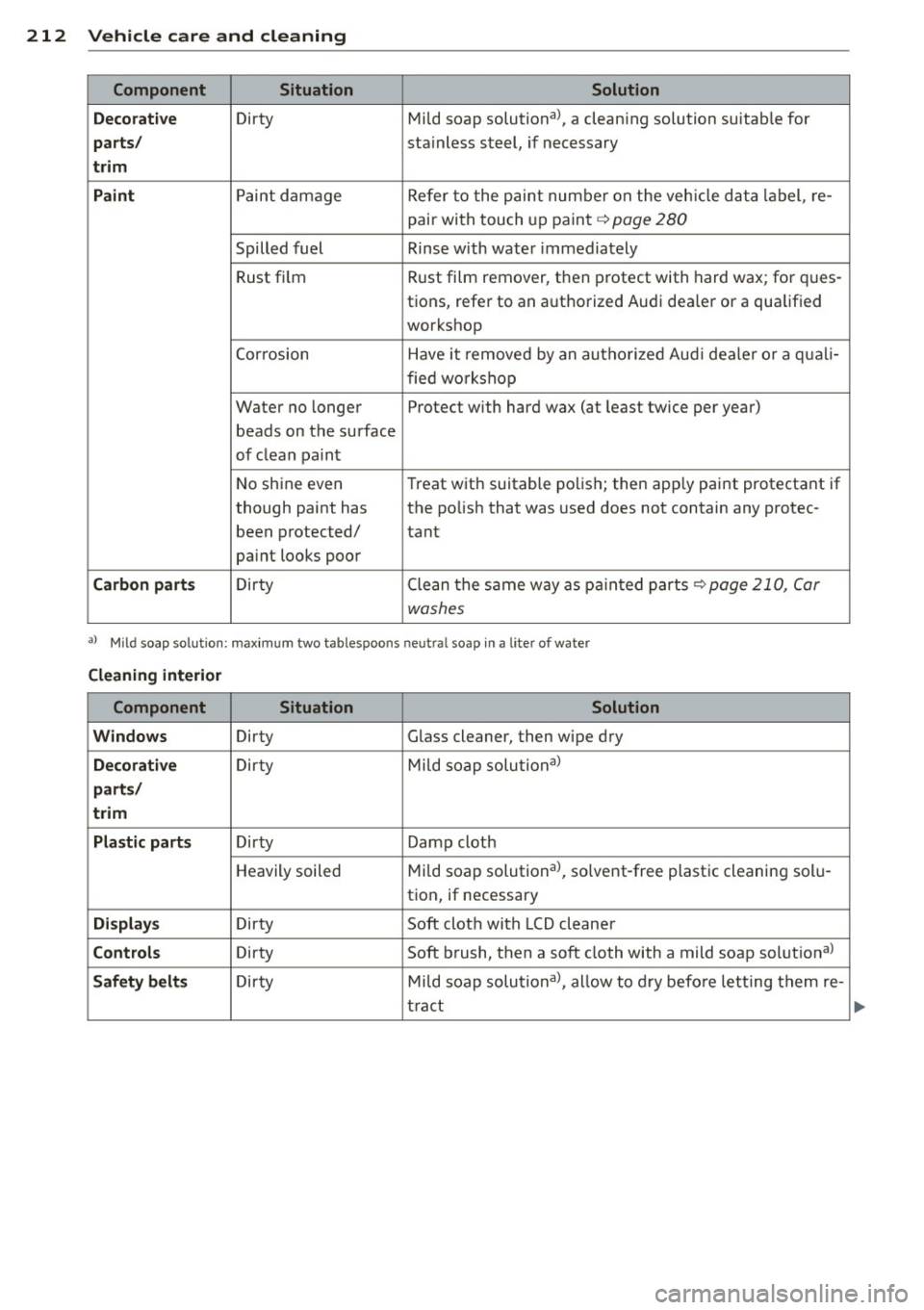
Component Situation Solution
Decorative
Dirty Mild soap solutional, a cleaning solution suitab le for
parts/ sta inless steel, if necessary
trim
Paint
Paint damage Refer to the paint number on the vehicle data label, re-
pair with touch up paint
q page 280
Spilled fuel Rinse with water immediately
Rust film Rust
film remover, then protect with hard wax; for ques-
tions, refer to an authorized Audi dea ler or a qualified
workshop
Corrosion Have it removed by an autho rized Aud i dealer or a quali-
fied workshop
Water no longer Protect with hard wax (at least twice per year)
beads on the surface
of clean paint
No shine even T
reat with suitable polish; then app ly paint protectant if
though paint has the polish that was used does not contain any protec-
been protected/
tant
pa int looks poor
Carbon parts Dirty Clean tlhe same way as painted parts qpage 210, Car
washes
a ) Mild soap so lution: maximum two tablespoons neut ra l soap in a lite r of water
Cleaning interior
Component Situation Solution
Windows
Dirty Glass cleaner, then wipe dry
Decorative Dirty Mild soap
solutional
parts/
trim
Plastic parts
Dirty Damp cloth
Heavily soiled Mild soap solutional, solvent-free plastic cleaning sol u-
tion, if necessary
Displays Dirty Soft cloth with LCD cleaner
Controls Dirty Soft brush, then a soft cloth with a mild soap solutional
Safety belts Dirty Mild soap solutional, allow to dry before letting them re-
tract
...
Page 217 of 304
Fuel supply and filling
your f uel tank
Gasoline
Fuel supply
Appl ies to vehicles: with gasoline e ngin e
Using the right fuel helps keep the environ
men t clean and preven ts engine damage.
Fuel recommendation
The fuel recomme nded fo r yo ur vehicle is un
leaded premium
g rade gasolin e. A udi recom
mends using TO P TIE R D etergent Gaso line
w it h a mi nimum oc tane ra ting o f 91 A KI (9 5
RON ). For more inform ation on TOP TIER De
t ergent Gasoline, please go to the off ici al
websi te (www .toptie rgas .com) .
T he recommended gasoline octane rating for
your eng ine can also be fo und o n a label loc at
e d on the ins ide of the fuel filler flap . This ra t
i ng may be specified as AK I or RO N.
Your veh icle may also be operated using un
l e ad ed regular g asoline with a min imum o c
tane rating of 87 AKI/91 RO N. However, using
87 AK I/91 RO N octa ne fue l w ill sli ght ly re
d uce eng ine perfo rmance .
Use unleaded ga soline only . Unleaded g aso
line is available th rougho ut the USA, Ca na da,
an d in most E uropean cou ntries . We recom
mend that you do not ta ke yo ur vehicle to
areas or countries where unleaded gasoline
may not be ava ilable.
F or mo re informat io n on refue ling your ve hi
cle, see
q page 217.
Octane rating
Octa ne rating ind icates a gaso line's ability to
r es ist engine d amag ing "kno ck" cau sed b y
p remature ign ition and detona tion. There fore,
buy ing the correct grade of gaso line is very
importa nt to he lp prevent possible engine
damage and a loss of engine performance.
Gasoline mos t common ly used in the Unite d
States an d Canada has the following octane
Fuel supply and filling your fuel tank 215
ra tings that can usu a lly be found on the fi ller
p ump :
- Premium Grad e: 9 1 -96 A KI
- Regular Grade: 87 - 90 AKI Explanation of the abbreviations:
AKI = Anti K nock In d ex = (R+M )/2 = (RO N
+MON )/2
RON= Resea rch O ctane Num ber
MO N= M otor Octane Number .
(D Note
-Do not use a ny fue l w ith octane rat ings
lower than 87 A KI or 9 1 RO N othe rwise
ex pensiv e engi ne damage w ill occur.
- Do
not use leaded gasoline . The use of
leaded gasoline w ill severely damage
yo ur v ehicl e's cata lytic conve rter a nd its
abi lity to co ntrol ex haust em issio ns.
Blended gasoline
Applies to vehicles: with gasoline engine
Use of gasoline containing alcohol or
MTBE (methyl tertiary butyl ether)
You may use unlea ded gasoline blen ded wi th
alcohol o r M TB E (commonly referred to as
oxygenates) if the blende d mixture meets the
f o llow ing criteria:
Blend of gasoline methanol (wood alcohol or
methyl alcohol)
- Anti -k n ock index mus t be 87 A KI or higher.
- Blend must contain no mor e than 3% meth-
anol.
- Blend must contain more than 2% co-sol -
vents .
Blend of gasoline and ethanol (grain alcohol
or ethyl alcohol)
- Anti -knoc k index must be 87 AKI or h igher.
- Blend must not co nta in mo re tha n 10 %
ethanol.
Blend of ga soline and MTBE
- Anti-knock index must be 87 AKI or high er. ..,.
•
•
Page 218 of 304
216 Fuel supply and filling your fuel tank
-Blend must contain not more than 1S%
MTBE.
Seasonally adjusted gasoline
Many gasoline grades are blended to perform
espec ially we ll for winter or summer driv ing.
During seasonal change-over, we suggest that
you fill up at busy gas stat ions where the sea
sonal adjustment is more likely to be made in
time.
(CT) Note
- Methanol fuels which do not meet these
requirements may cause corrosion and
damage to plastic and rubber compo
nents in the fuel system .
- Do not use fuels that fai l to meet the
specified criteria in this chapter.
- If yo u are unable to determine whether
or not a particular fuel blend meets the
specifications, ask your service station or
its fuel sup plier.
- Do not use fuel for which the contents cannot be identified.
- Fuel system damage and performance
problems resulting from the use of fuels
different from those specified are not
the respons ibility of Audi and are not
covered under the New Vehicle or the Emission Control System Warranties.
- If you experience a loss of fuel economy
or driveability and performance prob l ems due to the use of one of these fuel
blends, we recommend that you switch
to unblended fuel.
Gasoline additives
A major concern among many auto manufac
turers is carbon deposit build- up caused by
the type of gasoline you use.
A lthough gasoline grades differ from one
manufacturer to another, they have certain
things in common. All gasoline g rades contain
substances that can cause deposits to co llect
on vital engine parts, such as fuel injectors
and intake valves. Although most gasoline
brands include additives to keep engine and fuel
systems clean, they a re not equally effec
tive .
A udi recommends using TOP TIER Detergent
Gasoline. For more information on TOP TIER
Detergent Gasoline, please go to the official
website (www.toptiergas.com).
After an extended period of using inadequate
f uels, carbon deposit build-ups can rob yo ur
engine of peak performance.
(D Note
Damage or malf u nct ion due to poor fuel
quality is not covered by the Aud i New Ve
hicle Limited Warranty.
Diesel fuel
Applies to veh icles: w ith diesel engine
Always use ULSD (Ultra Low Sulfur Diesel) sul
fur content 15 ppm or less.
T he ULSD (U ltra Low Sulfur Diesel) meets the
ASTM-D-97S (grade 2).
Diesel fuel with a higher concentration than
ULSD-Diesel No. 2 ASTM 0975 and Bio-die
sel with a higher concentration than S
% like
B11, B20 or B100 are strictly prohibited.
Serv ice stat ion fue l pumps a re labeled with
the correct fuel information fo r easy recogn i
t ion by the user. If the diesel fuel pump is not
labeled ask the station operator what fue l is
being dispensed before filling up your vehicle.
Service stations offering Diesel fuel are gener
ally located on truck routes or major high
ways. Directories of Diesel fuel stations are
usually available at Diesel fuel stations.
Some states in the USA req uire permits to
purchase Diesel fuel. Check with your State
Motor Vehicle Department.
Diesel fuel may not be ava ilable outside the
USA and Canada. Be sure to check before trav-
eling to other countries . .,..