instrument panel AUDI S6 2014 User Guide
[x] Cancel search | Manufacturer: AUDI, Model Year: 2014, Model line: S6, Model: AUDI S6 2014Pages: 304, PDF Size: 76.32 MB
Page 156 of 304
154 Airbag sys te m
If the tota l electrical capacitance registe red
on the front passenger seat is more than that
of a typ ica l 1 year-old, but less than the
weight of a small adult, the front a irbag on
the passenger side may deploy (the
PA SSE N
GER AIR BAG OFF
li ght does not come on).
For e xample , the airbag m ay deploy if :
-a small child that is heavier than a typical 1
year-o ld child is on the front passenger seat
(regardless of whether the child is in one of
the chi ld seats listed
¢ page 175),
-a chi ld who has outgrown child restraints is
on the front passenger seat.
If the front passenger airbag is turned off, the
PASSENGER AIR BAG OFF light in the center
of the instrument panel wi ll come on and stay
on.
If the front passenger airbag deploys, the
F ederal Standard requires the airbag to meet
the " low risk" deployment criteria to help re
d uce the risk of injury through interaction
with the airbag. "Low risk" deployment occurs
in those crashes that take place at lower de
celerations as defined in the electronic control un it
¢ page 159.
Alw ays rem ember : Even though your vehicle
is equipped with Advanced Airbags, the safest
place for children is properly restrained on the
back seat . Please be sure to read the impor
tant information in the sect ions that follow
and be sure to heed a ll of the WARNINGS.
.&_ WARNING
To reduce the risk of injury when an airbag
inflates, a lways wear safety belts prope rly.
- If you are unrestrained, lean ing fo rward,
sitting sideways or out of position in any
way, your risk of injury is much higher.
- You w ill also receive serio us injuries and
cou ld even be killed if you are up against
the a irbag or too close to it when it in
flates - even with an Advanced Airbag
¢page 147.
.&_ WARNING
A child in a rearward-fac ing ch ild seat in
stalled on the front passenger seat will be
seriously injured and can be killed if the
front airbag inflates - even w ith an Ad
van ced A irbag System.
- Altho ugh the Advanced Airbag System in
your veh icle is designed to turn off the
front airbag when a rearward-facing
child restraint has been instal led on the
front passenger seat, nobody can abso
lutely g uarantee that dep loyment is im
possible in all conceivable situations that
may happen dur ing the usefu l life of your
veh icle.
- The inflating airbag will h it the ch ild seat
or infant carrier with great force and will
smash the child seat and child against
the backrest, center armrest, door, or roof.
- Always install rearward-facing ch ild re
straints on the rear seat .
- If you must install a rearward fac ing
child seat on the front passenger seat because of exceptional circumstances
and the
PASSENGER AIR BAG OFF light
does not come on and stay on, immed i
a tely insta ll the rear-facing child seat in a
rear seat ing pos ition and have the airbag
system inspected by your Audi dealer.
.&_ WARNING ,..___
If, in except iona l circumstances, you m ust
install a forward -facing child restraint on
the front passenger's seat:
- Always make sure the forward-facing
seat has been designed and certified by
its manufacturer for use on a front seat
with a passenger front and s ide a irbag.
- Never p ut the forward-facing child re
straint up against or very near the instru
ment panel.
- Always move the passenger seat into its
rearmost pos ition in the seat's fore and
aft ad justment range, as far away from
the airbag as possible, before install ing
the forward-fac ing ch ild restra int. The
-
Page 157 of 304
backrest must be adjusted to an upri ght
posit ion.
- Always make sure that t here is nothing
on the front passenger seat that will
cause the capacitive passenger detection
system in the seat to s ignal to the A irbag
System that the seat is occupied by a person when it is not, or to signal that it
is occupied by som eone who is heavier
than t he pe rson actually s itting on the
seat. The presence of additiona l obje cts
cou ld cause the passenger front airbag
to be t urned on when it sho uld be off, or
cou ld cause t he airbag to work in a way
that is different from the way it wou ld
have worked without the object on the
seat.
- Make sure that the
PASSENGER AIR BAG
OFF
light comes on and stays on all the
t ime whenever the ignition is switc hed
on.
Advanced Airbag System components
The front passenger seat in your vehicle has a
l ot of very important parts of the Advanced
A irbag System in it. These parts incl ude the
capac itive passenger de te ct ion sys tem, wir
ing, b racke ts, and more . The cont ro l uni t
monitors the system o n the front passenger
seat when the ign ition is switched on and
turns the airbag indicator light on when a
malfunct ion in the one of the system compo
nents is detected ¢
page 160. Because the
fro nt passenge r seat contains important parts
of the Advanced Airbag System, you must
take care to p revent it from bei ng damaged.
D amage to the seat may preven t the Ad
vanced A irbag System for the front passenger
seat from doing its job in a crash .
The front Advanced Airbag System
consists of the following:
-Crash sensors in the front of the veh icle that
measure ve hicle acceleration/dece le ration
to provide information to the Advanced Air bag System about the severity of the crash.
A irbag system 15 5
- An electron ic contro l unit, with integrated
crash sensors fo r front and side impacts .
T he control un it "decides" whether to f ire
the front a irbag s based on the informat ion
received from the crash sensors. The control
unit also "decides" whether the safety belt
pretens ione rs should be act iva ted .
- An Advanced A irbag w it h gas genera tor and
cont ro l valve for the driver ins ide the steer
ing wheel h ub.
- An Advanced A irbag w ith gas generator and
cont ro l valve inside the instrument panel for
the front passenger .
- A capacit ive passenger detection system un
derneath the front passenger seat cover .
This system measu res the ele ct rical capac i
t ance of the perso n in the seat. The informa
t ion registered is se nt cont inuo usly to the
elec tronic con trol un it to regu late dep loy
ment of the front Advanced Ai rbag on the
passenger side.
-An airbag monitoring system and ind icator
light in the instr ument cluster ¢
page 159.
-A senso r in each front seat registers the dis
tance between the respective seat a nd the
steering whee l or instrument panel. The in
formation reg istered is sent cont inuo usly to
the electron ic contro l unit to regulate de
ployment of the front Adva need A irbags .
- The
PASSENGER AIR BAG OFF li ght comes
on and stays on in the center of the instr u
ment panel ¢
page 160, fig. 160 and tells
you whe n the front Advanced Airbag on the
passenger side has been tu rned off.
- A senso r in the safety belt latch fo r the d riv
er and fo r the front seat passenger that
senses whethe r th at safety belt is latched or
no t and tra nsmi ts this informa tion to the
elec tronic con trol un it.
A WARNING
D amage to the fron t passenger se at can
p revent the front air bag from work ing
p roperly.
- Imp roper repai r or disassembly of the
front passenge r and dr iver seat will pre
vent the Advanced Airbag System from
functioning properly.
-
•
•
Page 159 of 304
things on the seat cushion can have the
same effect. If the front passenger fron
tal airbag is turned on, the
PASSENGER
AIR BAG OFF
light light will go out .
How the Advanced Airbag System
components work together
The fron t Advanced Airbag System and the
side airbags supplement the protection of
fered by the front three -point safety be lts
with p retensioners and load limiters and the
adjustab le head restraints to he lp reduce the
risk of injury in a wide range of accident and
crash situat ions. Be sure to read the impor
tant information about safety and heed the
WARNINGS in this chapter .
Dep loyment of the Advanced Airbag System
and the act ivation of the safety be lt preten
sioners depend on the dece lerat ion measured
by the crash sensors and registered by the
e lectronic control un it. The amount of infla
tion of the front airbags can also be adapted to the front seat posi tion, depend ing on the
d istance between the respective front seat
and the steering whee l or instrument panel as
registe red by sensors in the seats. Crash se
verity depends on speed and deceleration as
well as the mass and stiffness of the vehicle
or object involved in the crash .
On the passenger s ide, regard less of safety
be lt use, the front passenger f ronta l airbag
will be turned off if the electrical capacitance
measured by the capac itive passenger detec
tion system on the front passenger seat is less
tha n the amount programmed in the electron
ic control unit. The front passenger fronta l air
bag will a lso be turned off if the capa cita nce
measured by the system for the front pa ssen
ger seat equa ls t hat of an infant of abo ut one
yea r of age in one o f the child seats that was
used to cert ify the Advanced Airbag System
under Federal Motor Vehicle Safety Standard
208. The
PASSENGER AIR BAG OFF li ght
comes on and stays on to tell you when t he
front Adva nced Airbag System o n the passen
ger s ide has been turned off~
page 160 .
Airba g sy stem 15 7
A WARNING
To reduce the risk of injury w hen an airbag
in flates, always wear safety be lts p ro perly.
- If you are unrestra ined, leaning forward,
sitt ing s ideways or o ut of pos ition in any
way, your ris k of injury is m uc h higher.
- You will a lso receive serious injuries and
co uld even be killed if yo u are up aga inst
the airbag o r too close to it when it in
flates -even w it h an Advanced A irbag
~ page 147 .
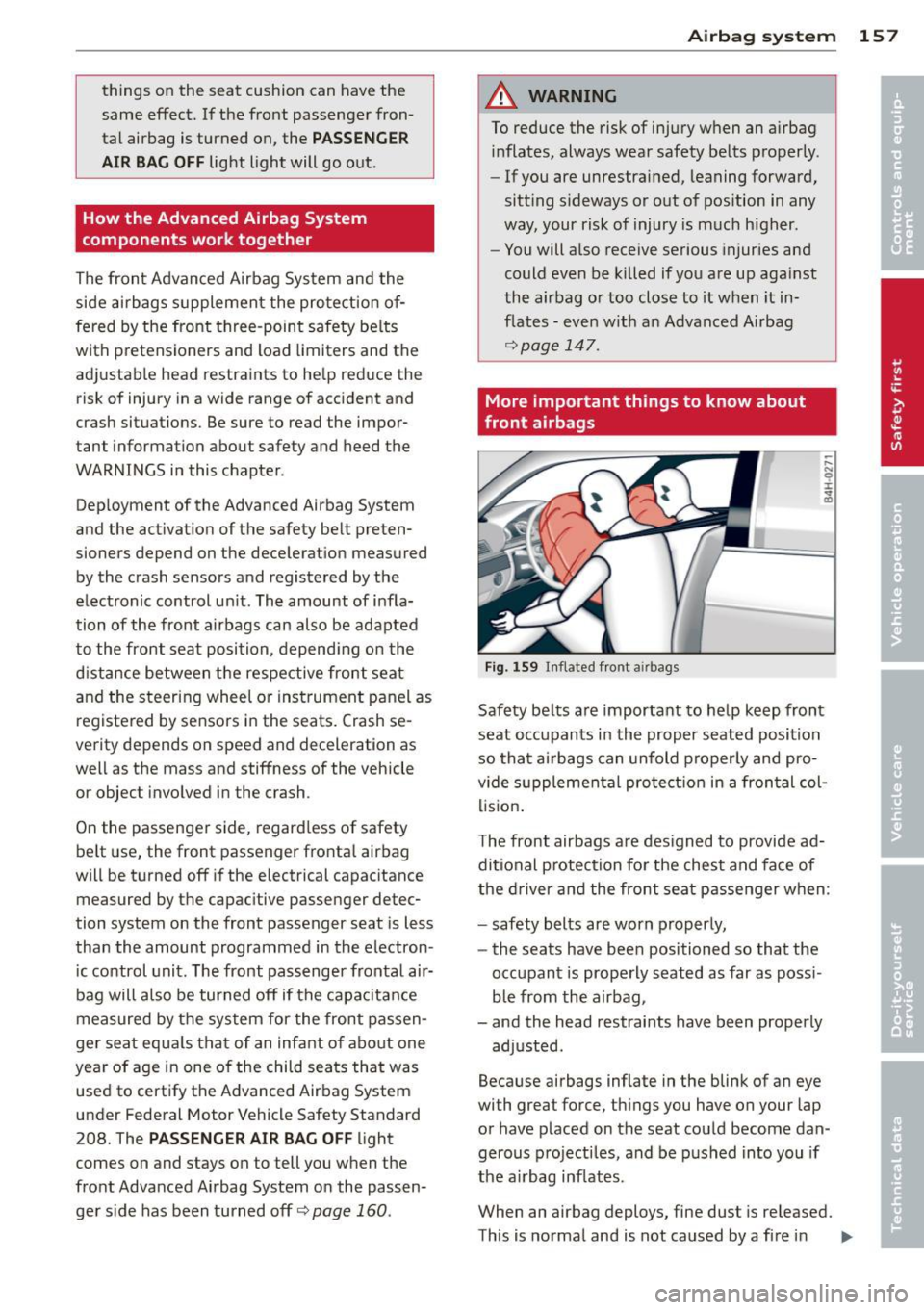
More important things to know about
front airbags
Fi g. 159 In flated front a irbags
Safety belts a re important to he lp keep front
seat occupants in the proper seated position
so that ai rbags can unfold p roper ly and pro
v ide s upplement al pro tect ion in a fron tal col
lis ion .
T he front airbags a re des igned to provide ad
di tional protection fo r the chest and fa ce of
the driver a nd the front seat p assenger when :
- safety belts are worn properly,
- the seats have been positioned so that the
occupant is properly seated as far as poss i
b le from th e airbag ,
- and the head restraints have been properly adjusted .
Because airbags inflate in the bli nk of an eye
with great force, th ings you have on your lap
or have p laced on the seat cou ld become dan
gerous p ro jecti les, and be pushed in to you if
t h e a irbag inf lates.
When an airbag deploys, fine dust is re leased.
This is norma l and is not caused by a fire i n .,,.
Page 161 of 304
-Never place or attach accessories or o th
er objects (such as cup hol ders, tele
phone brackets, large, heavy or bulky ob
jects) on the doors, over or near the area
marked ''AIRBAG" on the steering wheel,
instrument panel, seat backrests or be
tween those a reas and yourself. These
objects co uld cause injury in a crash, es
pecially when the airbags inflate .
- Never recline the front passe nger's seat
to transport objec ts. Items can also
move into the area o f the side airbag or
the front airbag during braking or in a
sudden maneuver . Objects near the air
bags can become project iles and cause
injury, part icularly when the seat is re
cl ined .
- Never place or transport ob jects on the
front passenger seat. Objects on the
front passenger seat could cause the ca pacitive senso r in the seat to s ignal to
airbag system that the seat is occupied
by a person when it in fa ct is not, o r that
the person on the se at is he avier than he
or she actually is. The change in electric
capacitance beca use of such objects can
cause the passenger front airbag to be
turned on when it sho uld be
off, or can
cause the airbag to work in a way that is
different from the way it wou ld have
worked w ithout objects on the seat.
- Always make sure that there is nothing
on the front passenger seat that will
cause the capacitive passenge r detection
system in the s eat to s ignal to the A irbag
System that the seat is oc cupied by a
pers on when it is not, or to sign al th at it
is occupied by someone who is heavier
than the pe rson actually s itting on the
seat . The presence of an object co uld
cause the passenger front a irbag to be
turned on when it sho uld be
off, or co uld
cause the airbag to work in a way that is
different from the way it wou ld have
worked w ithout the object on the seat. A
irbag
sys tem 159
A WARNING
The fine dust created when airbags deploy
can cause breathing prob lems fo r people
with a history of as thma or other breath
ing cond itions.
- To reduce the risk of breath ing problems,
those wi th asthma o r other respiratory
conditions s hou ld get fresh air r ight
away by get ting o ut o f the veh icle or
open ing win dows or do ors.
- If you are in a collision in which airbags
deploy, was h your ha nds and fa ce with
mild soap and wate r be fore eating.
- Be ca reful not to get the dust in to your
eyes, o r into any c uts or sc ratches.
- If the resid ue should get into your eyes,
f lus h t hem w ith wa te r.
Monitoring the
Advanced Airbag System
fl~ Airbag monitoring indicator light
Two separate indicators monitor the function
of the Advan ced Airbag System: the airbag
monitoring indi cator light and the
PASSEN
GER AIR BAG O FF
light.
The Advanced A irbag System ( includ ing the
electron ic co ntro l unit, sensor circu its and sys
tem wir ing) is monitored con tinuously to
make sure that it is functio ning properly
whenever the ignition is on. Each time you
switch on the ignition, the airbag monitor ing
indicator light
fl will come on for a few sec
onds (self diagnost ics).
The sy stem must be in spected when the
indicator light
I :
- does not come on when the ignition is
sw itched on,
- does not go out a few seconds after you
have switched on the ignit ion, or
- comes on while driv ing.
If an airbag system malfunc tion is detec ted,
the indicator light wi ll first start f lashing to
catch the driver's attention and then stay on
llo-
•
•
Page 162 of 304
160 Airbag system
continuously to serve as a constant reminder
to have the system inspected immediately.
If a malfunction occurs that turns the front
a ir bag on the passenger side off, the
PAS SEN
GER AIR BA G OFF
light will come on and stay
on whenever the ignition is on .
.&_ WARNING
An airbag system that is not functioning
properly cannot provide supplemental pro
tection in a frontal crash.
- If the airbag indicator light
c::> page 19
comes when the vehicle is be ing used,
have t he system inspected immediately
by your authorized Aud i dea ler . It is pos
sible that the airbag will inf late when it
is not supposed to, or w ill not inflate
when it sho uld.
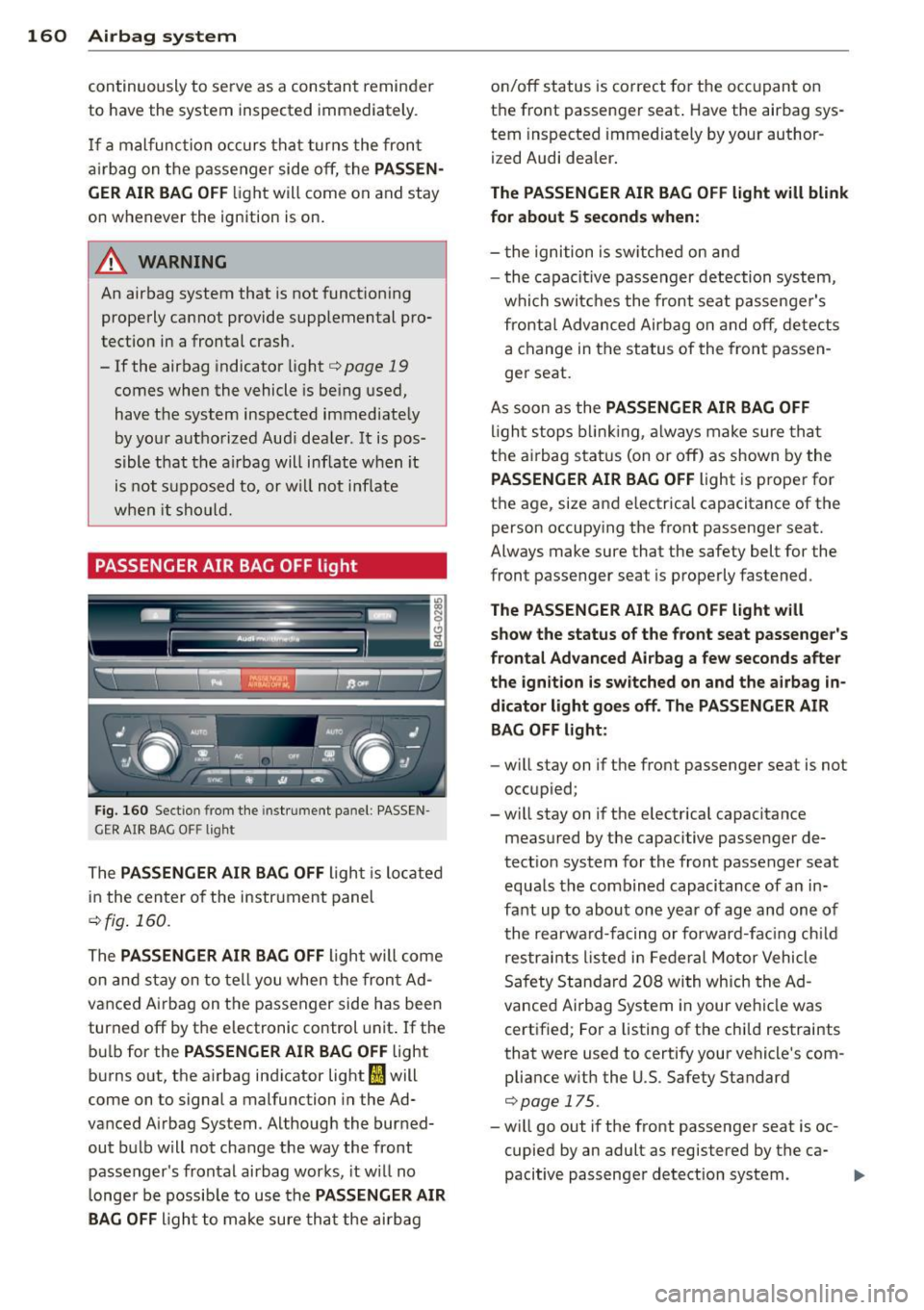
PASSENGER AIR BAG OFF light
Fig. 160 Section from the inst rument pa nel : PASSEN
GER AIR BAG O FF l ight
The PAS SENGER AIR BAG OFF Light is Located
in the center of the instrument panel
c::> fig . 160.
The PASSENGER AIR BAG OFF Light will come
on and stay on to tell you when the front Ad
vanced A irbag on the passenger side has been
turned off by the e lectronic control unit . If the
bu lb for the
PAS SENGER AIR BAG OFF Light
burns out, the a irbag ind icator light
fl will
come on to signal a malfunction in the Ad·
vanced Airbag System . Although the burned
out bulb will not change the way the front
passenger's frontal airbag works, it w ill no
L onger be possib le to use the
PAS SENGER AIR
BAG OFF
Light to make sure tha t the ai rbag on/off status is correct for the occ
upant on
the front passenger seat . Have the airbag sys
tem inspected immediately by your author
ized Audi dea ler.
The PASSENGER AIR BAG OFF light will blink
for about 5 second s when:
- t he ignition is sw itched on and
- the capacit ive passenger detection system,
which switc hes the front seat passenger's
frontal Advanced Airbag on and off, detects a change in the status of the front passen
ger seat.
As soon as the
PASSENGER AIR BAG OFF
l igh t stops b linking, a lways make sure tha t
the a irbag status (on or off) as shown by the
PAS SENGER AIR BAG OFF Light is proper for
the age, size and e lectrical capacitance of the
person occupy ing the front passenger seat.
Always make sure that the safety belt for the
front passenger seat is properly fastened .
The PASSENGER AIR BAG OF F light will
s ho w the status of the front seat pass enger 's
frontal Ad van ced Air bag a few seconds after
the ign ition is sw itched on and the airbag in
dicator light go es off. The PA SSENG ER AIR
BAG OFF li ght :
-will stay on if the front passenger seat is not
occupied;
- w ill stay on if the e lectrical capacitance
measured by the capacitive passenger de
tect ion system for the front passenger seat
equa ls the combined capacitance of an in
fant up to about one yea r of age and one of
the rearward-facing or forward-fac ing ch ild
restrai nts listed in Federal Motor Vehicle
Safety Standard 208 with which the Ad
vanced Airbag System in your vehicle was
certified; For a Listing of the child restraints
that were used to certify your vehicle's com
pliance with the U.S. Safety Standard
c::>poge 175.
- will go out if the front passenger seat is oc cupied by an adult as registered by the ca
pacitive passenger detection system.
Page 165 of 304
-Have the airbag system inspected by
your Audi dealer before transporting
anyone on the front passenger seat.
(D Tips
If the capacitive passenger detection sys
tem determines that the front passenger seat is empty, the frontal airbag on the
passenger side will be turned off, and the
PASSENGER AIR BAG OFF light will stay
on .
Repair, care and disposal of the airbags
Parts of the airbag system are installed at
many different places on your Audi. Installing,
removing, servicing or repairing a part in an
area of the vehicle can damage a part of an
airbag system and prevent that system from
working properly in a collision.
There are some important things you have to know to make sure that the effectiveness of
the system will not be impaired and that dis
carded components do not cause injury or pol
lute the environment.
A WARNING
Improper care, servicing and repair proce
dures can increase the risk of personal in
jury and death by preventing an airbag from deploying when needed or deploying
an airbag unexpectedly:
- Never cover, obstruct, or change the
steering wheel horn pad or airbag cover
or the instrument panel or modify them
in any way .
- Never attach any objects such as cup
holders or telephone mountings to the
surfaces covering the airbag units.
- For cleaning the horn pad or instrument
panel, use only a soft, dry cloth or one
moistened with plain water. Solvents or
cleaners could damage the airbag cover
or change the stiffness or strength of the
material so that the airbag cannot de
ploy and protect properly.
Airbag system 163
- Never repair, adjust, or change any parts
of the airbag system.
- All work on the steering wheel, instru
ment panel, front seats or electrical sys
tem (including the installation of audio
equipment, cellular telephones and CB radios, etc .) must be performed by a
qualified technician who has the training
and special equipment necessary.
- For any work on the airbag system, we
strongly recommend that you see your
authorized Audi dealer or qualified work
shop.
- Never modify the front bumper or parts
of the vehicle body.
- Always make sure that the side airbag
can inflate without interference:
- Never install seat covers or replace
ment upholstery over the front seat
backs that have not been specifically
approved by Audi.
- Never use additional seat cushions that
cover the areas where the side airbags
inflate.
- Damage to the original seat covers or
to the seam in the area of the side air
bag module must always be repaired
immediately by an authorized Audi
dealer.
- The airbag system can deploy only once .
After an airbag has been deployed, it
must be replaced with new replacement
parts designed and approved especially
for your Audi model version. Replace ment of complete airbag systems or air
bag components must be performed by
qualified workshops only. Make sure that
any airbag service action is entered in
your Audi Warranty
& Maintenance book
let under
AIRBAG REPLACEMENT RE
CORD .
-For safety reasons in severe accidents,
the alternator and starter are separated
from the vehicle battery with a pyrotech
nic circuit interrupter.
- Work on the pyrotechnic circuit inter
rupter must only be performed by a
qualified technicians who have the ...
L..._ _____________ _j ...
•
•
Page 168 of 304
166 Airbag system
How knee airbags work
Applies to vehicles: with knee airbags
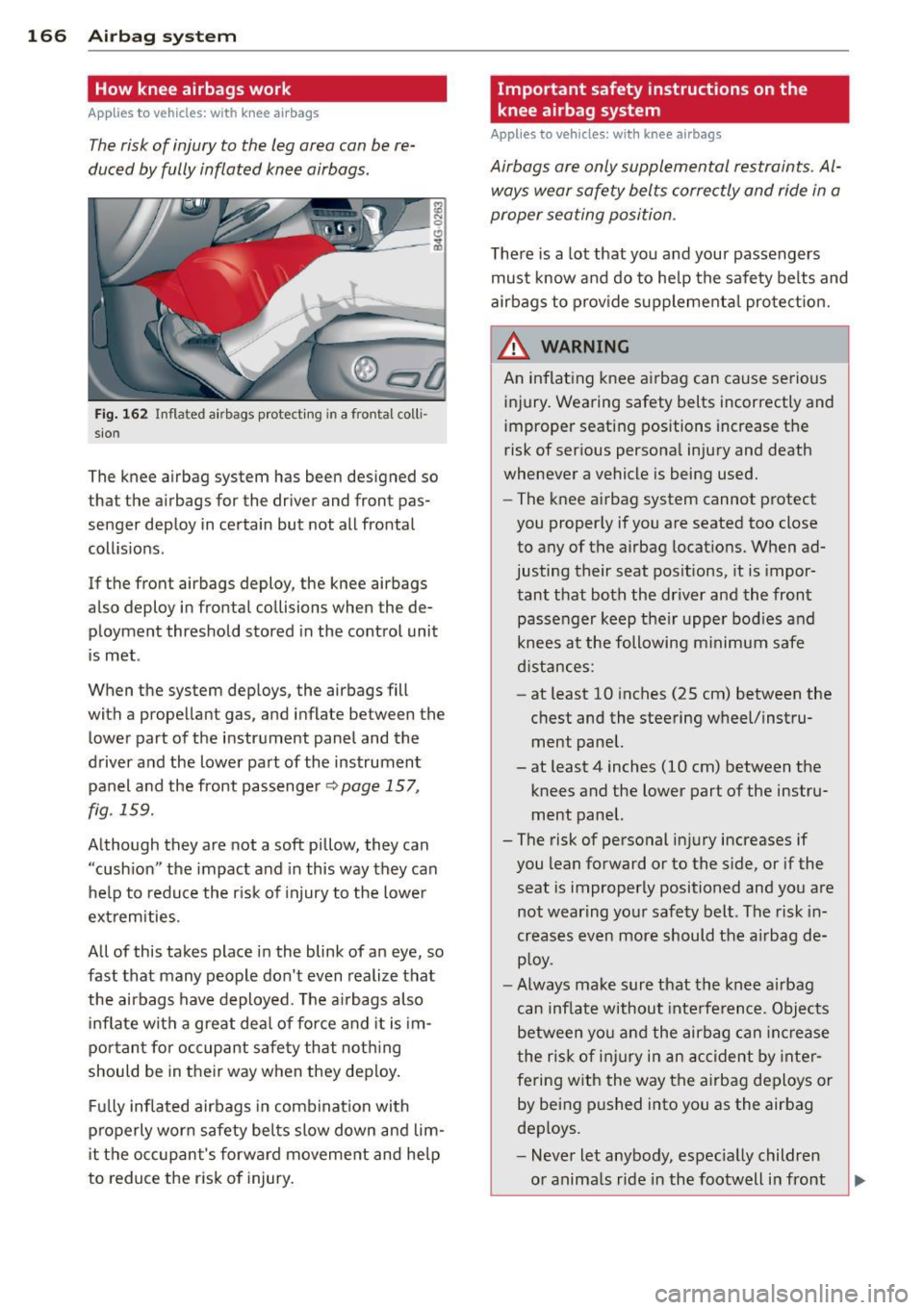
The risk of injury to the leg area can be re
duced by fully inflated knee airbags.
Fig. 162 Inflated airbags protecting in a frontal colli·
s io n
The knee airbag system has been designed so
that the a irbags for the driver and front pas
senger deploy in certain but not all frontal
collisions.
If the front airbags deploy, the knee airbags
a lso deploy in frontal collisions when the de
ployment threshold stored in the control unit
is met .
When the system deploys, the airbags fill
with a propellant gas, and inflate between the
lower part of the instrument panel and the
driver and the lower part of the instrument
panel and the front passenger
Q page 157,
fig . 159.
Although they are not a soft pillow, they can
"cush ion" the impact and in this way they can
help to reduce the risk of injury to the lower
extremities.
All of this takes place in the blink of an eye, so
fast that many people don't even realize that
the airbags have deployed . The airbags also
inflate with a great deal of force and it is im
portant for occupant safety that nothing
should be in their way when they deploy.
Fully inflated airbags in combination with
properly worn safety belts slow down and lim
it the occupant's forward movement and help
to reduce the risk of injury. Important safety instructions on the
knee airbag system
Applies
to vehicles: with knee airbags
Airbags are only supplemental restraints. Al
ways wear safety belts correctly and ride in a
proper seating position .
There is a lot that you and your passengers
must know and do to help the safety belts and
airbags to provide supplemental protection.
A WARNING
-An inflating knee airbag can cause serious injury. Wearing safety belts incorrectly and
improper seating positions increase the
risk of serious personal injury and death
whenever a vehicle is being used.
- The knee airbag system cannot protect
you properly if you are seated too close
to any of the airbag locations. When ad
justing their seat positions, it is impor
tant that both the driver and the front passenger keep their upper bodies and
knees at the following minimum safe
distances:
- at least 10 inches (25 cm) between the
chest and the steering wheel/instru
ment panel.
- at least 4 inches (10 cm) between the knees and the lower part of the instru
ment panel.
- The risk of personal injury increases if
you lean forward or to the side, or if the
seat is improperly positioned and you are
not wearing your safety belt . The risk in
creases even more should the airbag de
ploy .
- Always make sure that the knee airbag
can inflate without interference. Objects
between you and the airbag can increase
the risk of injury in an accident by inter
fering with the way the airbag deploys or
by being pushed into you as the airbag
deploys.
- Never let anybody, especially children
or animals ride in the footwell in front
Page 177 of 304
-Always read and heed a ll WARNINGS
whenever using a child restraint in ave
h icle
¢ page 138, Safety belts,
¢ page 147, Airbag system and
¢ page 173, Important things to
know.
(D Tips
Always replace child restraints that were
installed in a vehicle during a crash. Dam
age to a child rest raint that is not vis ible
could cause it to fail in another collis ion
situation.
Advanced front airbag system and children
Your vehicle is eq uipped with a front "Ad
vanced Airbag System" in compliance w ith
United States Federal Motor Vehicle Safety
Standard (FMVSS) 208 as applicable at the
time your veh icle was manufactured .
T he Advanced Airbag system in your vehicle
has been certified to meet the "low-risk" re
qu irements for 3-and 6-year old ch ildren on
the passenger s ide and small adults o n the
driver side. The low risk deployment criter ia
a re i ntended to reduce the risk of inju ry
through interaction with the a irbag that can
oc cu r, fo r example , by be ing too close to the
steering whee l and instrument panel when
the airbag inflates . In addition, the system
has been certified to comply with the "sup
press ion" requirements of the Safety Stand
ard, to turn off the front airbag for infants up
to 12 months who are restra ined on the front
passenger seat in ch ild restraints that are list
ed i n the Standard .
Even though your vehicle is equipped with an
Advanced Airbag system, all chi ldren, espe
cially those 12 years and younger, shou ld al
ways ride in t he back seat properly rest ra ined
fo r the ir age and s ize. Th e a irbag on t he pas
senger side makes the fro nt seat a poten tially
d a ngerous pla ce for a child to ride. The front
seat is not the safest place fo r a child in a fo r
ward-facing child safety seat . It can be a very
Child Sa fet y 175
dange rous place fo r an infant o r a larger child
in a rearward-facing seat.
T he veh icle's Advan ced Ai rb ag Sys tem has a
capacit ive passenger detec tion system in the
front passenger seat cush ion that can detect
the presence of a baby or a c hild in a child re
stra int system on this seat .
T he capaci tive passenge r detection system
r egisters the changes that result in an electri
ca l fie ld when a chi ld, a ch ild restraint, and a
baby blanket are on the front passenger seat .
The change in the measured capac itance due
to the presence of a child, a child restraint,
and a baby blanket on the front passenger
seat is related to the ch ild restraint system
rest ing on the seat . The meas ured capacitance
of a child res traint system va ries depend ing
o n the type of sys tem and specific m ake and
model.
T he elect rical capac itance of the va rious
types, ma kes, a nd models of child restra ints
spe cified by the U.S. Nationa l Highway Traff ic
Safety Administra tion (N HTSA) in the re levant
sa fety standard are stored in the Advanced
Airbag System contro l unit together with the
capacitances typical of infants and a 1-year
o ld child. W hen a child restraint is used on t he
front passenger seat with a typica l 1 year-old
infant, t he Advanced Airbag System compares
the capacitance measu red by the capacitive
passenger detection system with the data
s tored in the ele ctronic co ntrol unit.
Child restraints and Advanced front
airbag system
Rega rdless of the c hild restraint that you use,
make sure that it has been certified to meet
U nited States Federal Motor Vehicle Safety
Standards and has been certified by its manu
facturer for use with an airbag. A lways be sure
that the c hild restra int is properly installed at
o ne of the rear seating positions. If in excep
t iona l circumsta nces yo u must use it on the
fron t passenger sea t, ca re fully read all of the
i nformation on child sa fe ty and Advanced Air -
bags and heed all of the applicable ..,.
•
•
Page 222 of 304
220 Fuel supply and filling your fuel tank
Fuel filler flap emergency release
You can open the fuel filler flap by hand if the
power locking system should fail .
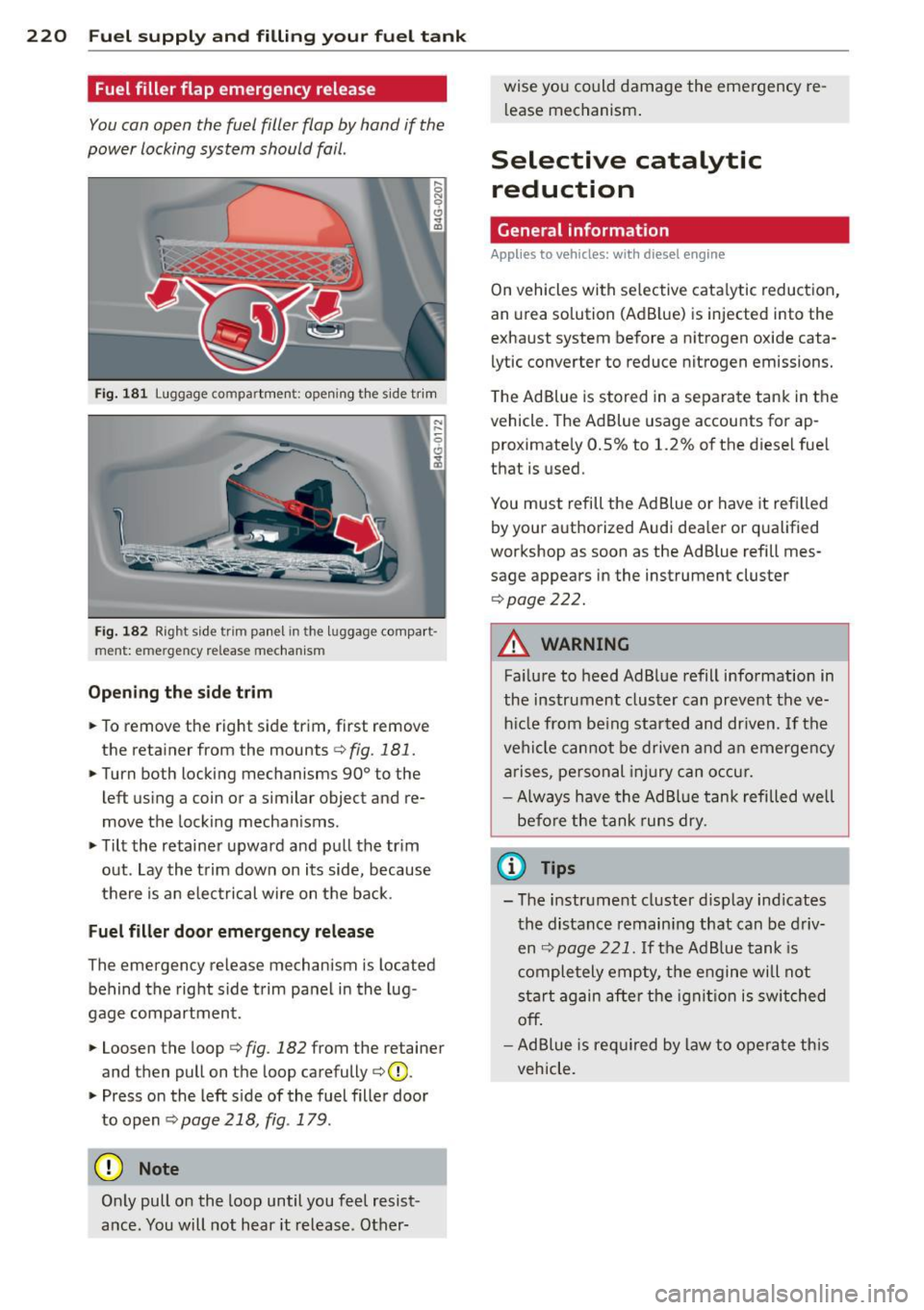
Fig. 181 Luggage co m partmen t: open ing the side tr im
Fig. 182 Right side trim panel in the lu ggage compar t
ment: e mergency release mechanism
Opening the side trim
• To remove the right side trim, first remove
the retainer from the mounts
¢ fig. 181.
• Turn both locking mechanisms 90° to the
left using a coin or a similar object and re
move the locking mechanisms.
• Tilt the retainer upward and pull the trim
out . Lay the trim down on its side, because
there is an electrical wire on the back.
Fuel filler door emergency release
The emergency release mechanism is located
behind the right side trim panel in the lug
gage compartment.
• Loosen the loop i:>
fig. 182 from the retainer
and then pull on the loop carefully i:>Q).
• Press on the left side of the fuel filler door
to open
i=> page 218, fig. 179.
(D Note
Only pull on the loop until you feel resist
ance. You will not hear it release . Other- wise you could
damage the emergency re
l ease mechanism .
Selective catalytic
reduction
General information
Applies to vehicles: with diesel engine
On vehicles with selective cata lytic reduction,
an urea solution (Ad B lue) is injected into the
exhaust system before a nitrogen oxide cata
lytic converter to reduce nitrogen emissions.
The Ad Blue is stored in a separate tank in the
vehicle. The Ad Blue usage accounts for ap
proximately 0.5% to 1.2% of the diesel fuel
that is used.
You must refill the Ad Blue or have it refilled
by you r authorized Audi dea ler or qualified
workshop as soon as the Ad Blue refill mes
sage appears in the instrument cluster
¢page 222.
A WARNING
-Failure to heed AdBlue refill information in
the instrument cluster can prevent the ve
hicle from be ing started and driven . If the
vehicle cannot be driven and an emergency
arises, personal injury can occur.
- Always have the AdBlue tank refilled well
before the tank runs dry.
(D Tips
-The instrument cluster display ind icates
the distance remaining that can be driv
en
c> page 221. If the Ad Blue tank is
completely empty, the engine will not
start again after the ignition is switched
off.
-Ad Blue is required by law to operate this
vehicle.
Page 226 of 304
224 Checking and filling
Checking and filling Engine hood
Releasing the engine hood
The engine hood is released from inside the
vehicle .
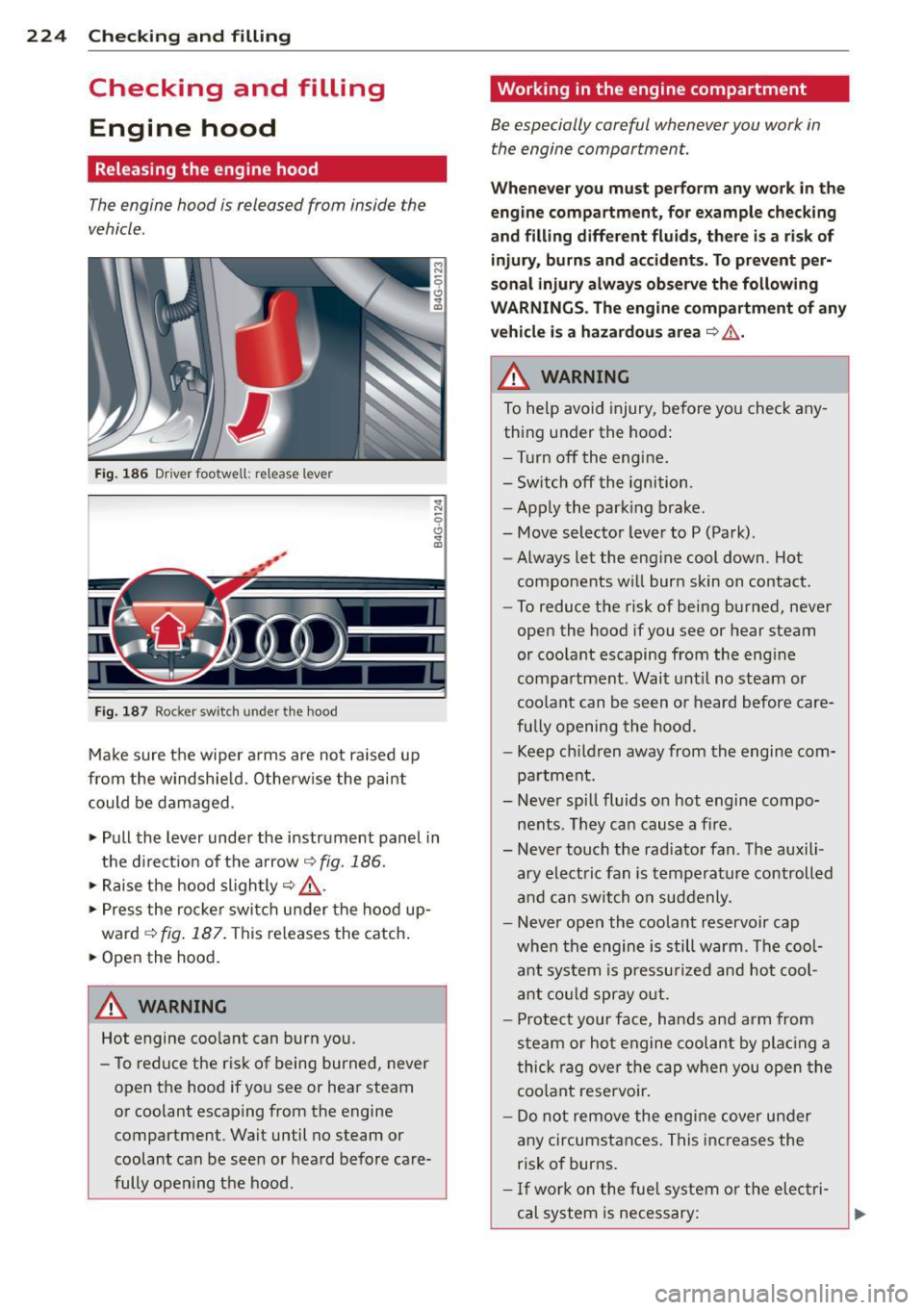
Fig. 186 Driver foo twell: release lever
Fig. 187 Rocker switch un der the hood
Make sure the wiper arms are not raised up
from the windshield. Otherwise the paint
could be damaged .
.,. Pull the lever under the instrument panel in
the direction of the arrow
¢ fig. 186.
.,. Raise the hood slightly¢,&. .
... Press the rocker switch under the hood up
ward
~ fig. 187. This releases the catch.
• Open the hood.
&_ WARNING
Hot engine coolant can burn you.
- To reduce the risk of being burned,
never
open the hood if you see or hear steam
or coolant escaping from the engine compartment . Wait until no steam or
coolant can be seen or heard before care
fully opening the hood .
'Working in the engine compartment
Be especially careful whenever you work in
the engine compartment.
Whenever you must perform any work in the
engine compartment, for example checking
and filling different fluids, there is a risk of injury, burns and accidents. To prevent per
sonal injury always observe the following
WARNINGS. The engine compartment of any
vehicle is a hazardous area
¢ ,&. .
A WARNING
To help avoid injury, before you check any
thing under the hood:
- Turn off the engine.
- Switch off the ignition .
- Apply the parking brake.
- Move selector lever to P (Park).
- Always let the engine cool down. Hot
components will burn skin on contact.
- To reduce the risk of being burned, never
open the hood if you see or hear steam
or coolant escaping from the engine
compartment. Wait until no steam or
coolant can be seen or heard before care
fully opening the hood.
- Keep children away from the engine com
partment.
- Never spill fluids on hot engine compo
nents . They can cause a fire .
- Never touch the radiator fan. The auxili
ary electric fan is temperature controlled
and can switch on suddenly .
- Never open the coolant reservoir cap
when the engine is still warm . The cool
ant system is pressurized and hot cool
ant could spray out.
- Protect your face, hands and arm from
steam or hot engine coolant by placing a
thick rag over the cap when you open the
coolant reservoir.
- Do not
remove the engine cover under
any circumstances. This increases the
risk of burns.
- If work on the fuel system or the electri
cal system is necessary: