ABS AUDI S6 2014 Owner's Manual
[x] Cancel search | Manufacturer: AUDI, Model Year: 2014, Model line: S6, Model: AUDI S6 2014Pages: 304, PDF Size: 76.32 MB
Page 236 of 304
234 Checking and filling
continue to run until the coolant temper
ature drops.
Brake fluid
Checking brake fluid level
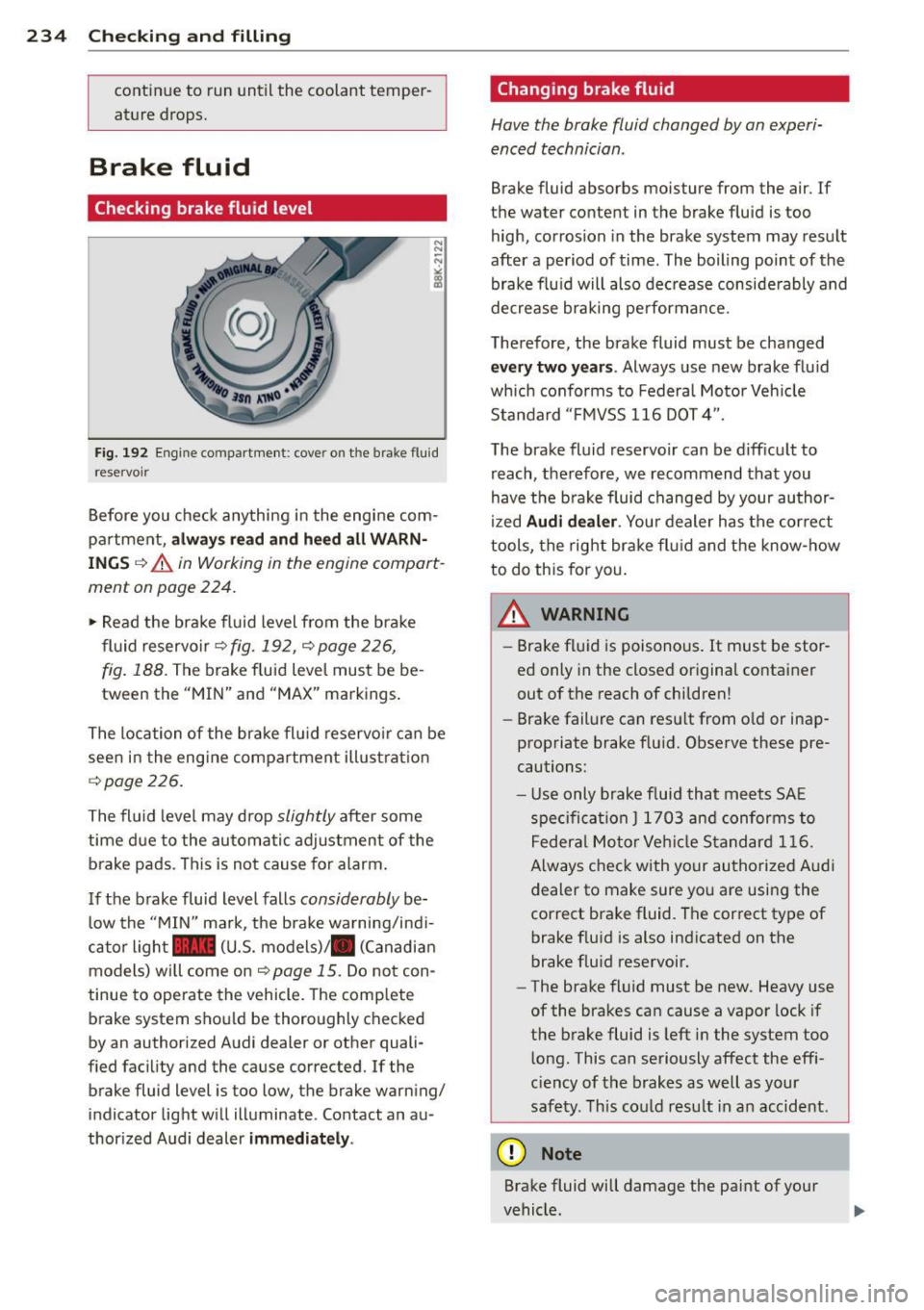
Fig. 192 Engine compartment : cove r on the brake fl uid
reservo ir
Before you check anything in the engine com
partment,
always read and heed all WARN
INGS ~ .&. in Working in the engine compart
ment on page 224.
.,. Read the brake fluid level from the brake
fluid reservoir~
fig. 192 , ~ page 226,
fig.
188. The brake fluid leve l must be be
tween the "MIN" and "MAX" markings .
The location of the brake flu id reservoir can be
seen in the engine compartment illustrat ion
~ page 226.
The fluid level may drop slightly after some
time due to the automatic adjustment of the
brake pads . Th is is not cause for alarm.
I f the brake fluid level falls
considerably be
lo w the "MIN" mark, the brake wa rning/indi
cator light
1111 (U.S. models)/ . (Canadian
models) will come on~
page 15. Do not con
tinue to operate the vehicle. The comp lete
brake system should be thoroughly checked
by an authorized Audi dealer or other quali
fied facility and the ca use corrected. If the
brake fluid level is too low, the brake warning/
indicator light w ill illuminate . Contact an au
thorized Audi dealer
immediately .
Changing brake fluid
Have the brake fluid changed by an experi
enced technician .
Brake fluid absorbs moisture from the air. If
the water content in the brake fluid is too
high, corrosion in the brake system may result
after a period of time . The boiling point of the
brake fluid will also decrease considerably and
decrease braking pe rformance .
Therefore, the brake fluid must be changed
every two years. Always use new brake flu id
which conforms to Federal Motor Vehicle
Standard "FM VSS 116 DOT 4".
The brake fluid reservoir can be diff icult to
reach, therefore, we recommend that you
have the brake fluid changed by your author
ized
Audi dealer . Your dealer has the correct
tools, the right brake fluid and the know-how
to do this for you.
A WARNING
- Brake fluid is poisonous . It must be stor
ed only in the closed original container
out of the reach of children!
- Brake failure can resu lt from o ld or inap
propriate brake fluid. Observe these pre
cautions:
- Use only brake fluid that meets SA E
specification
J 1703 and conforms to
Federal Motor Vehicle Standard 116.
Always check with your authorized Audi
dealer to make sure you are using the
correct brake fluid. The correct type of
brake flui d is also ind icated on the
brake fluid reservoir.
- The brake fluid must be new. Heavy use
of the brakes can cause a vapor lock if
the brake fluid is left in the system too
long. This can seriously affect the effi
c ie ncy of the brakes as well as your
safety. This could result in an accident.
(D Note
Brake fluid will damage the paint of your
vehicle .
Page 237 of 304
@ For the sake of the environment
Because of the pr oblem of proper d isposa l
of brake flu id as we ll as the special tools
requ ired and the necessary expert ise, we
recommend that you have the brake fluid
changed by your author ized Audi dealer .
Battery
General information
Under normal operating conditions, the bat
tery in your Audi does not need any mainte
nance. With
high outside temperatures or
long daily dr ives we recommend that you have
the electro lyte level checked by a service fa
cility . The electrolyte level shou ld also be
checked each time the battery is charged
¢ page 237.
Have the battery checked when you take your
ve hicle in for service . Yo u are well adv ised to
replace a battery that is older than 5 yea rs .
W ith certa in types of a irbag deployment, t he
b attery is d isconnected from the vehicle elec
tr ica l system for safety reasons¢.&.
in Re
pair, core and disposal of the airbags on
page 163.
Disconnecting the battery terminals
Some vehicle functions (power w indow regu
lators , for example) are lost if the battery ter
m inals a re d isconnected. These func tions have
to be re lea rned after the batte ry term inals a re
connected agai n. T o prevent this , the bat tery
should only be d isconnec ted from the vehicle
e lec tric al system when absolu tely necessa ry
for repairs .
Vehicles not driven for long periods
If you do not drive you r vehicle over a period
of severa l days or weeks, ele ctrical compo
nen ts are gr adually cut b ack o r swi tched off .
This redu ces energy cons umption and main
tains starting capab ility over a longer per io d
¢
page 199. Some of the co nvenience func
tions may not operate, s uch as the inte rior
lights or power seat adjustme nt. The conven-
Checkin g and fillin g 235
ience funct ions w ill be available again when
yo u sw itch on the ign ition an d start the en
gine.
Winter operation
D ur ing the w inte r mon ths, bat tery ca pa city
tends to decrease as tempera tures drop . This
is beca use more power is a lso consumed wh ile
starting, and the headlights, rear window de
fogger, etc., are used mo re often.
Avoid unnecess ary powe r consumpt ion, pa r
ticu lar ly in city traffic o r when traveling only
sho rt distances. Let yo ur authorized A udi
dealer check the capacity of the vehicle bat
tery before w inter sets in¢
page 23 7. A well
charged battery will no t on ly prevent star tin g
problems w hen the weather is cold, but w ill
also last longer .
@ Tips
If your vehicle is left standing for seve ral
weeks at extremely low temperatures, the
vehicle battery s hou ld be removed and
stored where it will not freez e. This will
p reve nt it from be ing dam aged and having
to be repl aced .
Working on the battery
Be especially careful when working on or near
the bat tery.
The battery is located in the luggage compar t
ment under the floor . B efo re you che ck any
thi ng in the luggage compartment,
read and
heed all WARNINGS
¢ .&, .
Always heed the safety warnings , when work
i ng on the veh icle batte ry or t he vehicle e lec
t rical sys tem to p reven t inju ry.
The following WARNINGS are very
important when working on the battery:
Always heed the following WARNING SYM· BO LS and safety precautions when working
on the battery .
®
Always wear eye protection.
•
•
Page 261 of 304
remain continuously illuminated. This se
quence will continue upon subsequent vehicle
start-ups as long as the malfunction exists.
When the malfunction indicator is illuminat
ed, the system may not be able to detect or
signal low tire pressure as intended . TPMS
malfunctions may occur for a variety of rea
sons, including the installation of replace
ment or alternate tires or wheels on the vehi
cle that prevent the TPMS from functioning
properly . Always check the TPMS malfunction
telltale after replacing one or more tires or
wheels on your vehicle to ensure that the re
placement or alternate tires and wheels allow
the TPMS to continue to function properly.
Tire pressure indicator appears
Appl ies to vehicles: with tire pressur e monitoring sys te m
The tire pressure indicator in the instrument
cluster informs you if the tire pressure is too
low or if there is a system malfunction.
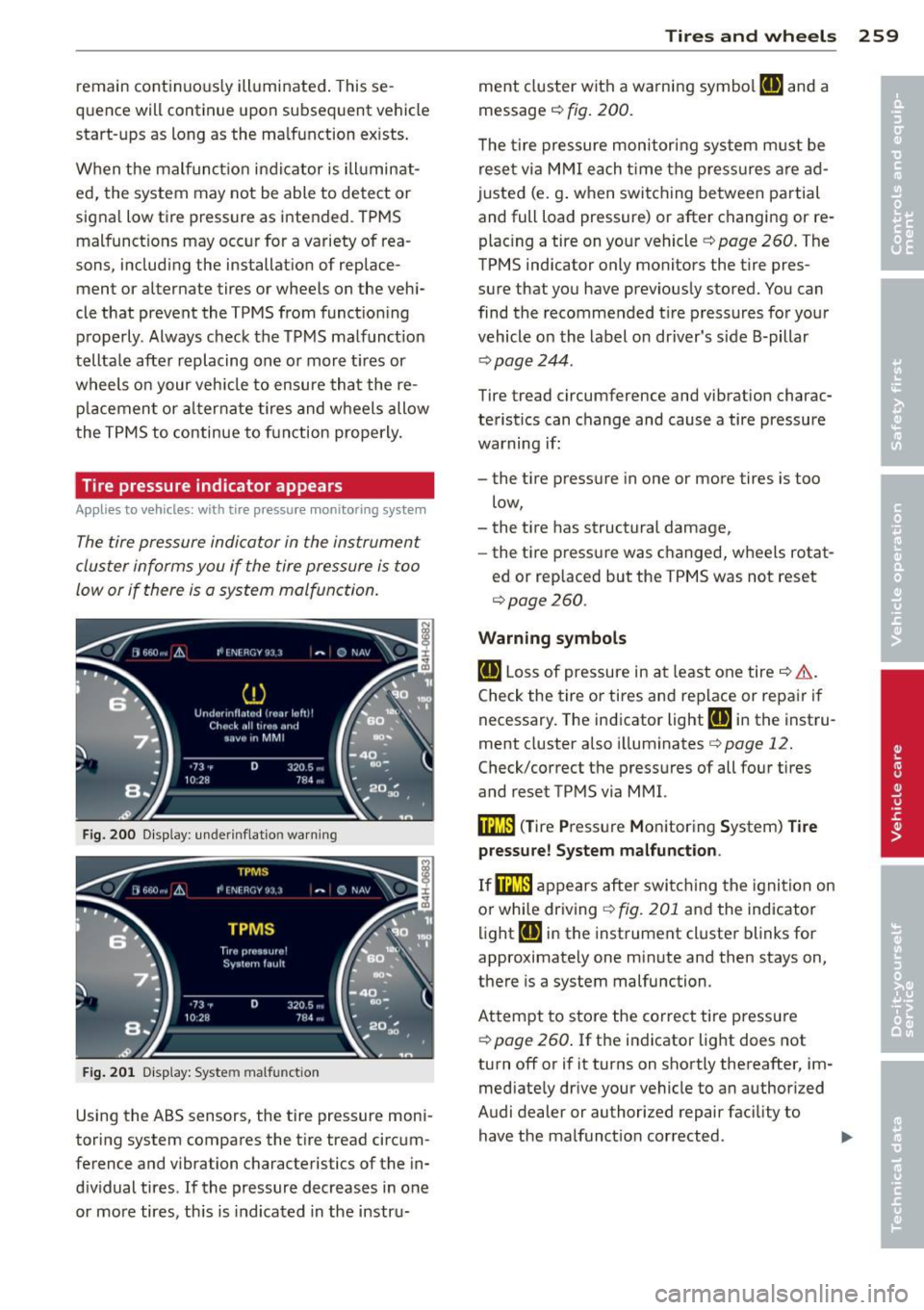
Fig. 200 Display : underinflation warning
Fig. 201 Display: System malfunction
Using the ABS sensors, the tire pressure moni
toring system compares the tire tread circum
ference and vibration characteristics of the in
dividual tires. If the pressure decreases in one
or more tires, this is indicated in the instru-
Tires and wheels 259
ment cluster with a warning symbol [I] and a
message
c::, fig. 200.
The tire pressure monitoring system must be
reset via MMI each time the pressures are ad
justed (e.g. when switching between partial
and full load pressure) or after changing or re
placing a tire on your vehicle
c::, page 260. The
TPMS indicator only monitors the tire pres
sure that you have previously stored. You can
find the recommended tire pressures for your
vehicle on the label on driver's side 8-pillar
~page 244.
Tire tread circumference and vibration charac
teristics can change and cause a tire pressure
warning if:
- the tire pressure in one or more tires is too
low,
- the tire has structural damage,
- the tire pressure was changed, wheels rotat-
ed or replaced but the TPMS was not reset
c::, page 260 .
Warning symbols
[I] Loss of pressure in at least one tire c::> &..
Check the tire or tires and replace or repair if
necessary. The indicator light
[I] in the instru
ment cluster also illuminates
c::>page 12.
Check/correct the pressures of all four tires
and reset TPMS via MMI.
i:mJ) (Tire Pressure Monitoring System) Tire
pressure! System malfunction .
If@m appears after switching the ignition on
or while driving
c::, fig. 201 and the indicator
light
[I] in the instrument cluster blinks for
approximately one minute and then stays on,
there is a system malfunction.
Attempt to store the correct tire pressure
c::, page 260. If the indicator light does not
turn off or if it turns on shortly thereafter, im
mediately drive your vehicle to an authorized
Audi dealer or authorized repair facility to
have the malfunction corrected.
Page 262 of 304
260 Tire s and wheel s
_&. WARNING
-If th e tire pressure indicator appea rs in
the instrument cluster d isplay, one or
more of your tires is s ignificantly under
inflated. Reduce your speed immediately
and avoid any hard stee ring or bra king
maneuvers . Stop as soon as possible and
check the t ires and the ir pressures. In
flate the tire pressure to the proper pres
sure as indicated on the vehicle 's t ire
pressure label
c> page 244. Driving on a
signif icant ly under-inflated tire causes
the tire to overheat and can lead to tire
failure. Under-inflation also is likely to impair the vehicle 's handling and stop
ping ab ility .
- The driver is responsible for ma inta ining
the correct tire pressures. You must che ck the t ire pressures regula rly.
- Under certain cond itions (such as a spor
ty driving style, winter condit ions or un
paved roads), the pressure mon itor ind i
c ator may be de layed.
- Ask your author ized Audi dealer if r un
flat tires may be used on your veh icle.
Yo ur vehicle regist rat ion becomes inval id
if yo u use these tires when not permit
ted . Damage to your vehicle or acc idents
cou ld also resu lt.
(D Tips
- The tire pressure monitoring system
stops working when there is an ESC/ABS
malfunction.
- Using snow chains may result in a system
malfunction.
- The tire pressure monitoring system on
you r A udi was develope d using t ires with
the "AO" or "RO" identification on the
tire sidewall ~
page 251 . We recom
mend using these t ires.
Reset tire pressure monitoring system
Applies to vehicles: with tire pressure monitoring system
If the tire pressure is adjusted, wheels are ro
tated or changed, the TPMS must be reset via
MMI .
.. Switch on the ignition.
.. Select in the MMI :
ICARI function button>
(Car)* system s control button > Servicing &
checks > Tire pres sure monitoring > Store
tire pre ssur es > Ye s, store now .
@ Tips
Do not sto re the tire pressure if there are
s now cha ins on the tire.
Page 301 of 304
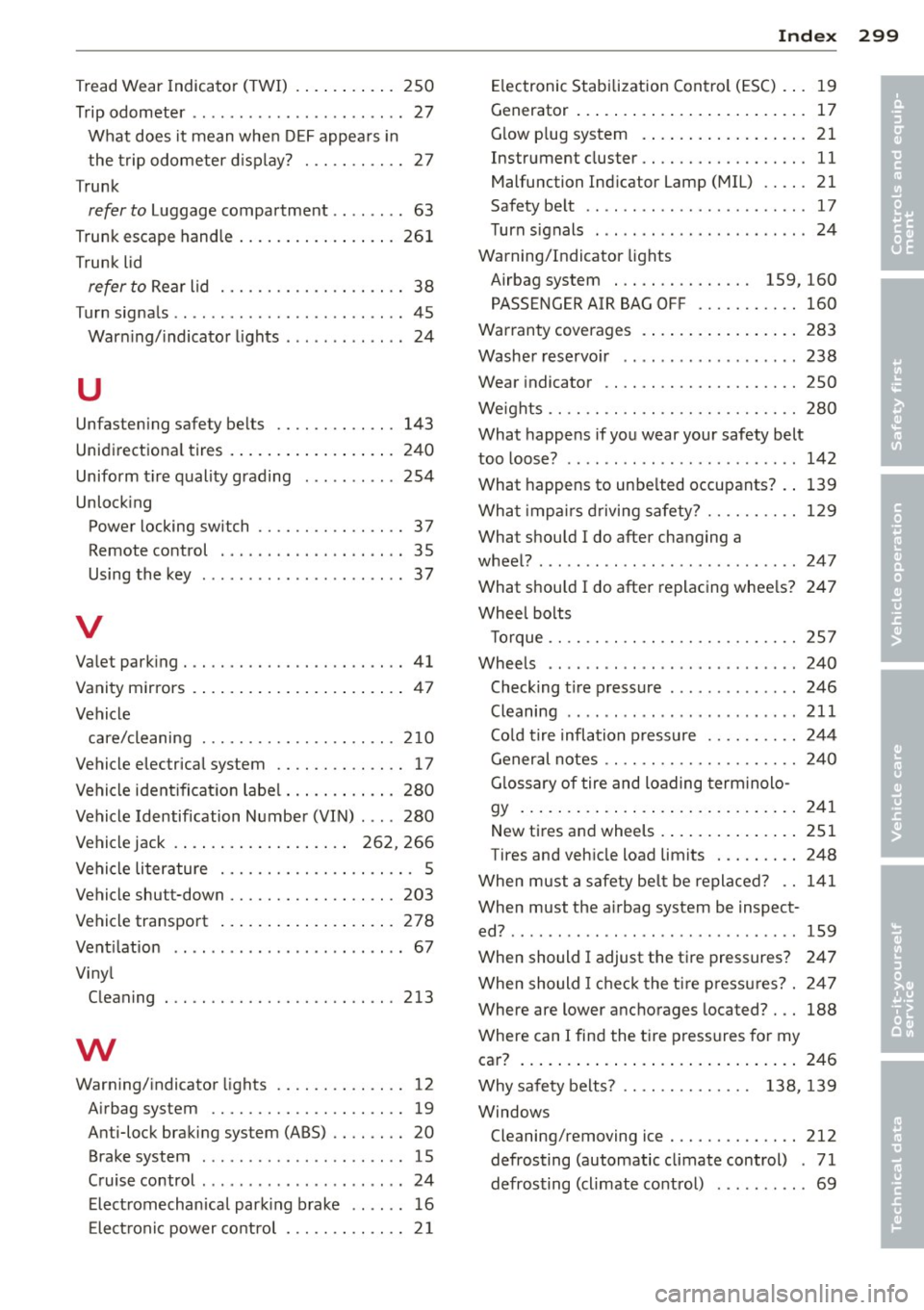
Tread Wear Indicator (TWI) . ... .. .. .. . 250
Trip odometer .................. .... . 27
What does it mean whe n DEF appears in
the trip odometer d isp lay? . .. .. .. .. .. 27
T runk
refer to Luggage compartment . . . . . . . . 63
Trunk escape hand le ..... ... .. .. .. .. . 26 1
Trunk lid
refer to Rear lid . . . . . . . . . . . . . . . . . . . . 38
T urn signa ls .. .................. .... . 45
War ning/ indicator lights . .. .. .. .. .. .. 24
u
Un fasten ing sa fety be lts 143
Unidirectiona l tires . ..... ... .. .. .. ... 240
Uniform t ire quality grading ..... . ... . 254
Unlock ing
Power locking switch . . . . . . . . . . . . . . . . 3 7
Remote control ....... ... ...... .. .. 35
Using the key ............... .... ... 37
V
Va let park ing . .... ......... .... .. .. .. 41
Vanity mirrors . ..... .. .... ... .. .. .... 47
Vehicle care/cleaning . ........... .. .. .. .. . 210
Vehicle electrical system .... .. .. .. .. .. 17
Vehicle ident ificat ion labe l ... .. .. .. .. . 280
Vehicle Identification Number (VIN) .... 280
Vehicle jack . . . . . . . . . . . . . . . . . . . 262, 266
Vehicle literature . . . . . . . . . . . . . . . . . . . . . 5
Vehicle shutt-down ......... .. .. .. .. . 203
Vehicle transport ....... ... .. .. .. .. . 278
Vent ilation .................. .... ... 67
Viny l
C leaning . .. .. .. ......... .. .. .. ... 213
w
Warn ing/ indicator lights .... .. .. .. .. .. 12
A irbag system ........... .... .. .. .. 19
Anti-lock braking system (ABS) .. .. .. .. 20
Brake system .... .. ...... .. .. .. .. .. 15
Cruise control . . . . . . . . . . . . . . . . . . . . . . 24
Elect romechanica l park ing brake ...... 1 6
E lect ronic power co ntro l . . . . . . . . . . . . . 2 1
Inde x 299
Electronic Stabilizat ion Cont ro l (ESC) . .. 19
Generator . . . . . . . . . . . . . . . . . . . . . . . . . 17
G low p lug system . . . . . . . . . . . . . . . . . . 21
Instrument cluster . . . . . . . . . . . . . . . . . . 11
Malfunc tion Ind icator Lamp (MIL) .. .. . 21
Safety be lt . . . . . . . . . . . . . . . . . . . . . . . . 17
T urn signals ... .. .. . .. .... .... .. .. . 24
Warning/I ndicator lights
Airbag system . . . . . . . . . . . . . . . 159, 160
PASSENGER AIR BAG OFF ........... 160
Warranty coverages .. . .. .. ..... ... .. 283
Washe r reservo ir ... ...... .......... 238
Wear indicator .. .. ................. 250
Weights .... .. .. .. .. .. ........... .. 280
What happens if you wear your safety belt
too loose? .. .. .. .. .. . .. .... .... .... 142
What happens to unbe lted occupants? . . 139
Wha t impai rs d riving safety? ...... .. .. 129
What should I do after changing a
whee l? ........ ... .. ............... 247
What shou ld I do after replacing whee ls? 247
Whee l bolts
T o rque .. .. .. .. .. .... ........... .. 257
Wheels ...... .. .... .......... ..... 240
Checking t ire p ressure ......... .... . 246
Cleaning ........ .. ............... 211
Co ld tire inflatio n pressure ...... .. .. 244
General notes .. .. .... ........... .. 240
G loss ary of tire and loading term inolo -
gy .. ... .. .. .... .. . .. .. ..... ... .. 241
New ti res and wheels . .. ..... ... .. .. 251
Tires and veh icle load limits ....... .. 248
When must a safety be lt be replaced? .. 141
When must the a irbag system be inspect-
ed? ........... ... .. ............... 159
When should I adjust the tire pressures? 247
When should I che ck t he ti re p ressu res?. 24 7
Where are lower anchorages located? . .. 188
Where can I find the t ire press ures fo r my
ca r? .. ... .. .. .... .. . .. .. ..... ... .. 246
Why safety belts? . . . . . . . . . . . . . . 138, 139
Windows Cleaning/removing ice . ...... ... .. .. 212
defrosting (automatic climate control) . 71
defros ting (cl imate control) . . . . . . . . . . 69
•
•