warning AUDI S6 2015 Owners Manual
[x] Cancel search | Manufacturer: AUDI, Model Year: 2015, Model line: S6, Model: AUDI S6 2015Pages: 314, PDF Size: 77.57 MB
Page 235 of 314
M N
0 <.J 'SI: ,.., \!) 1.1'1 ,.., 1.1'1 ,..,
&
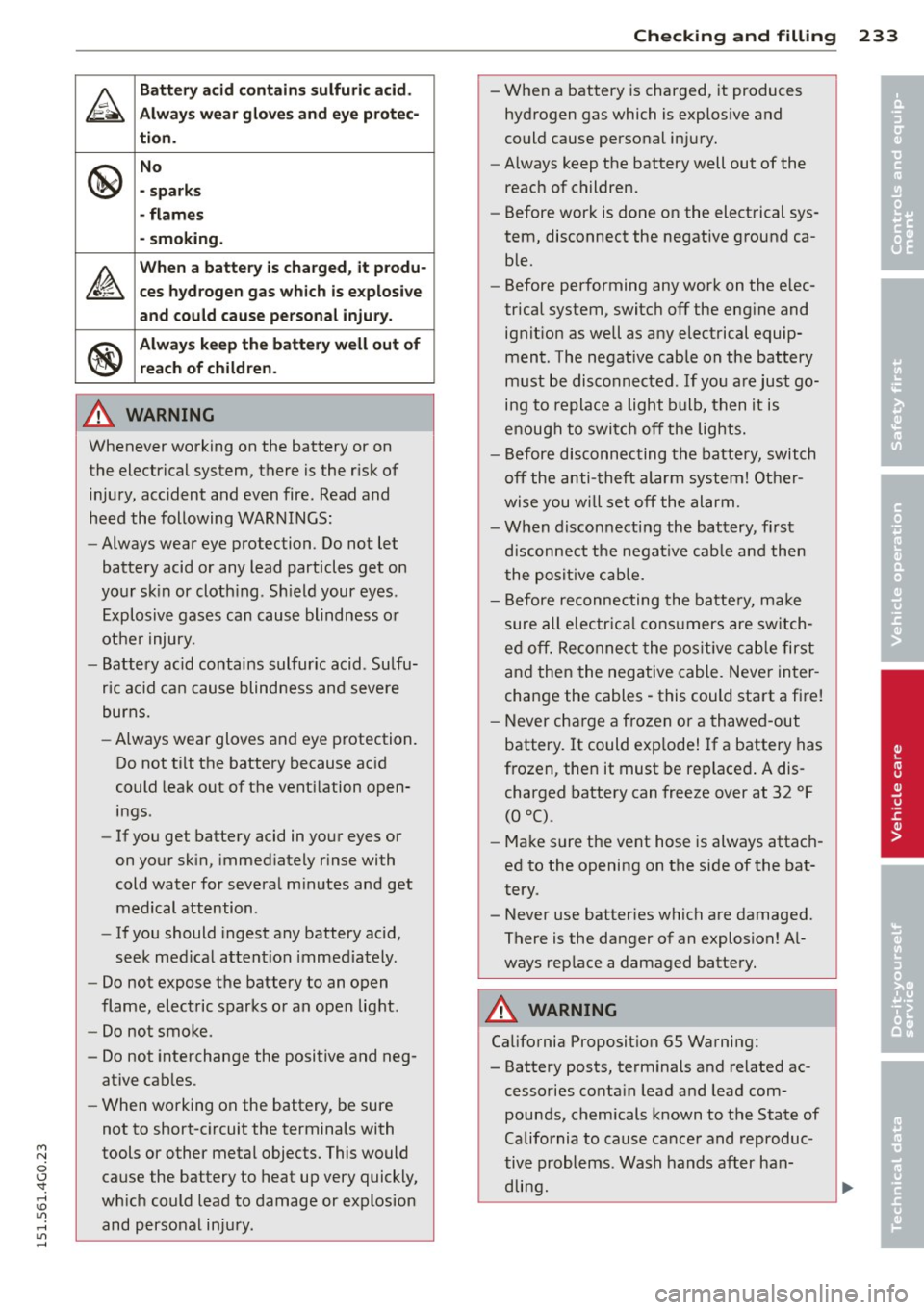
Battery acid contain s sulfuric acid .
Alw ay s w ea r g lov es and eye protec -
ti on.
@
No
-spa rk s
- flam es
- sm oking .
~
When a b attery is charged , it p rodu -
ce s hy d roge n ga s which i s ex plosi ve
.
and could cause personal injur y.
®
Alw ay s keep the batt ery well out of
rea ch of children.
A WARNING
Whenever working on the battery or on
the electrical system, there is the r isk of
injury, acc ident and even fire. Read and
heed the following WARNINGS:
- Always wear eye protection. Do not let
battery acid or any lead particles get on
yo ur sk in or cloth ing . Sh ield your eyes.
Explosive gases can cause blindness or
other injury.
- Battery acid contains sulfuric acid . Sulfu
ric acid can cause blindness and severe
burns.
- Always wear gloves and eye p rotection.
Do not tilt the battery because ac id
could leak out of the vent ilation open
ings.
- If you get battery acid in your eyes or
on your sk in, immed iately r inse with
cold water for severa l m inutes and get
medical attention .
- If you should ingest any battery acid,
seek med ical attention immediately.
- Do not expose the battery to an open
flame, electric sparks or an open light.
- Do not smoke.
- Do not interchange the positive and neg-
ative cab les.
- When working on the battery, be sure
not to short-c ircuit the terminals with
tools or other metal objects. This would cause the battery to heat up very quickly,
wh ich could lead to damage or explosion
and personal in ju ry.
Checkin g and fillin g
-When a battery is charged, it produces
hyd rogen gas which is explos ive and
could cause personal injury.
- Always keep the battery well out of the
reach of children.
- Before work is done on the elect rical sys
tem, disconnect the negative ground ca ble.
- Before performing any work on the e lec
trical system, switch off the eng ine and
ignit ion as well as any electrical equip
ment . The negative cable on the battery
must be disconnected. If yo u are just go
ing to replace a light bulb, then it is
enough to switc h off the lights.
- Before disconnecting the battery, switch
off the anti-theft alarm system! Other
wise you wi ll set off the al arm.
- When disconnecting the battery, first
discon nect the negat ive cab le and then
the posit ive cab le.
- Before reconnecting the batte ry, ma ke
sure all e lectr ica l consumers are sw itch
ed off . Re connect the pos it ive cable first
and then the negative cable. Neve r in ter
change the cables - this could start a fire!
- Never cha rge a frozen or a thawed-out
battery.
It could exp lode! If a battery has
frozen, then it must be replaced . A dis
charged battery can freeze over at 32
°F
(0 oc).
- Make s ure the vent hose is always attach
ed to the opening on the side of the bat
tery.
- Never use batteries which are damaged.
There is the danger of an explosion! A l
ways rep lace a damaged batte ry.
A WARNING
Ca lifornia Proposition 65 Warning:
- Battery posts, terminals and related ac
cessories conta in lead and lead com
pounds, chemicals known to the State of
Ca lifornia to cause cance r and reproduc
tive problems. Wash hands after han- dling.
~
233
•
•
Page 236 of 314

234 Checking and filling
(D Note
-Do not disconnect the vehicle battery
when the ignition is on or when the en
gine is running, otherwise, you will dam
age electronic components in the electri
cal system.
- If your vehicle is going to stand for a
long period of time without being driven,
protect the battery from "freezing", oth
erwise it w ill be damaged and w ill then
have to be replaced.
Battery charging
Starting the engine requires a well charged
battery.
Fi g. 19 3 Engine compartment : connectors for a charg ·
er and jump sta rt cables
Alway s re ad and h eed all WARNINGS below
c:> & and c:> & in Working on the battery on
page 233 .
• Switch off the ignitio n and all electrical con
sumers.
• Make sure the area is well vent ilated when
yo u charge the battery .
• Open the engine hood
i=!.> page 222.
• Open the red cover o n the pos itive pole
e!.>fig. 193.
• Connect the charger connectors according to
the instructions to the
jump start bolt s.
(Bolts under the red cover= "positive", Bolts
with hex head= "negative").
• Only now plug the mains lead for the charg
ing equipment into the wall outlet and turn
it on
c::> .&,. .
• Mak e sure th e charging rate is not over
30 amp s/14 .8 Volt .
• When the battery is fully charged: Turn the
charging equipment off and remove the
mains lead from the wall out let.
• Now remove the clamps for the charging
equ ipment.
• Close the red cover on the positive pole.
• Close the hood
c::> page 223 .
A discharged battery can freeze at tempera
tures of only 32 F
0 (0 °C). Allow a frozen bat
tery to thaw completely before attempting to charge it
c::> ,&. . However, we recommend not
u sing a thawed batte ry aga in because the bat
tery casing can be c racked due to ice fo rm a
t io n an d can leak battery a cid.
Battery charging (Maximum charging rate
of
30 amps/14.8 Volt )
When charg ing at low vo lt a ges (e.g. wi th a
trickle charger ), the battery cables do not
have to be disconnected firs t. T he battery
caps should
not be opened when charg ing a
battery .
It is no t necessa ry to remove the battery from
the luggage compartment, and it is a lso not
necessary to d isconnect the cab les .
Fast charging the battery (charging rate
above 14.8 Volts )
For technica l reasons do not use a battery
c h arger that uses voltage greater than
14.8
Volts to charge yo ur vehicle's battery.
Ln._ WARNING
--
Charging a battery can be dangerous.
- Always follow t he operati ng instructions
provided by the battery charger manu
facturer when charg ing your battery.
- Never cha rge a frozen battery . It may ex
p lode because of gas trapped in the ice.
Allow a frozen batte ry to thaw out f irst.
- Do not reuse batteries wh ich were fro
zen. The battery housing may have
cracked and weakened when the battery
froze.
Page 238 of 314

236 Checking and filling
The washer fluid container is marked with the
symbol$ on its cap
¢ fig . 194, ¢page 224,
fig. 188 .
.,. Before you check anything in the engine
compartment,
always read and heed all
WARNINGS ¢ A in Working in the engine
compartment on page
222 .
.,. Lift the filler cap tongue to add washer flu
id . You can fill the container to the top .
.,. Press the cap back onto the filler neck after
filling the container .
You can find the reservoir
capacity in the table
in¢
page 290.
C lean water sho uld be used when filling up. If
possible, use soft water to prevent sca ling on
washer jets. Always add a glass cleaner solu
tion (with frost protection in the winter).
Do not mix engine coolant antifreeze or
any other additives to f ill up the wind
shield washer reservoir.
Page 244 of 314
242 Tires and whee ls
Recommended inflation Sidewall
pressu re
means that portion of a tire be -
see
c:::> page 240, Cold tire infla-tween the tread and bead.
tion pressure.
Spe ed rating (letter code )
Reinforced tire
means the speed at which a tire
means a tire design to operate
is designed to be driven for ex-
at higher loads and at higher tended periods of time. The rat-
inflation pressures than the ings range from 93 mph (150
corresponding standard t ire .
km/h) to 186 mph (298 km/h)
Reinforced tires may be identi -
c:::> page 260. You may not find
fied as "XL", "xl", "EXTRA
this information on all tires be-
LOAD", or "RF" on the sidewall.
cause it is not required by law.
Rim The speed rating letter code,
means a meta l support for a where applicable
, is molded on
tire or a tire and tube assembly the tire sidewall and indicates
upon which the tire beads are the
maximum pe rmissible road
seated . speeds
c:::> A in Winter tires on
Rim diameter
page 264.
means
nominal diameter of the
Tire pressure monitoring
system
bead seat. If yo u change your
means a system that detects
wheel size, you will have to pur-
chase new tires to ma tch the when one or more of a vehicle's
new rim diameter . tires a
re underinflated and illu-
Rim size designation
m inates a low tire pressure
warning telltale.
means rim diameter and width.
Tread
Rim width
means that portion of a tire
means nominal distance be-
that comes into contact with
tween rim flanges. the road.
...
Page 250 of 314

248 Tires and wheels
Remember, your safety and
that of your passengers also de pends on making sure that load
limits are not exceeded . Vehicle
load includes everybody and ev
erything in and on the vehicle.
These load limits are technical
ly referred to as the vehicle's
Gross Vehicle Weight Rating ("GVWR"). The Gross Axle
Weight Rating ("GAWR") is the
maximum load that can be ap
plied at each of the vehicle's
two axles. The Gross Vehicle
Weight Rating and the Gross
Axle Weight Rating are listed
on the safety compliance stick
er label located on the driver's
side B-pillar. The tire pressure
label on your Audi lists the
maximum combined weight of
all of the occupants and lug
gage or other cargo that the ve
hicle can carry. For the location
of the tire pressure label
¢fig. 195.
.&_ WARNING
-
Overloading a vehicle can
cause loss of vehicle control,
a crash or other accident, se
rious personal injury, and
even death. -Carry
ing more weight than
your vehicle was designed to carry will prevent the ve
hicle from handling properly
and increase the risk of a
loss of vehicle control.
-The brakes on a vehicle that
has been overloaded may not be able to stop the vehi
cle within a safe distance.
-Tires on a vehicle that has
been overloaded can fail
suddenly causing loss of
control and a crash.
-Always make sure that the total load being transported
- inclu ding the weight of a
trailer hitch and the tongue
weight of a loaded trailer -
does not make the vehicle
heavier than the vehicle's
Gross Vehicle Weight Rat
ing.
A WARNING
-Incorrect tire pressures
and/or underinflation can lead to a serious or fatal ac
cident.
-Inco rrect tire pressures
and/or underinflation cause
increased tire wear and can .,.
Page 253 of 314
Tires and wheels 251
When should I check the tire -Incorrect tire pressure and/ •
pressure? or underinflation can cause • '
The correct tire pressure is es-increased tire wear and can
pecially important at high affect the handling of the
speeds . The pressure should
vehicle and stopping ability.
therefore be checked at least -Incorrect tire pressures
once a month and always be- and/or underinflation can
fore starting a journey. Do not also lead to sudden tire fail-
forget to check the tire pres- ure, including a blowout
sure for the spare wheel and sudden deflation, caus-
¢page 271. ing loss of vehicle control.
-The driver is responsible for
When should I adjust the
the correct tire pressures for ti re pressures?
Adjust the tire pressure to the all tires on the vehicle. The
applicable pressure values
load you are carrying. After
are located on a sticker on
changing a wheel
or replacing
the driver's side B -pillar.
wheels you have to adjust the
-Only when all tires on the
tire pressures on all wheels. In
vehicle are filled to the cor-
addition, you must then store
rect pressure, the tire pres-
the new tire pressures in the
sure monitoring system can
tire pressure monitoring sys-
work correctly.
tern
¢ page 267.
-The use of incorrect tire
.&, WARNING pressure values can lead to
Incorrect tire pressures and/ accidents or other damage.
or underinflation can lead Therefore it is essential that
sudden tire failure, loss of the driver observe the speci-
control, collision, serious per- fied tire pressure values for
sonal injury or even death. the tires and the correct
-When the warning symbol pressures for the function of
M (IJ appears in the instru-the tire pressure monitoring
N
0 ment cluster, stop and in- system. .,. <.J 'SI: ,....,
spect the tires. \!) 1.1'1 ,...., 1.1'1 ,....,
Page 255 of 314
M N
0 <.J 'SI: ,...., \!) 1.1'1 ,...., 1.1'1 ,....,
The "GVWR" includes the
weight of the basic vehicle, all
factory installed accessories, a
full tank of fuel, oil, coolant and other fluids plus maximum
load. The maximum load in
cludes the number of passen
gers that the vehicle is intend
ed to carry ("seating capacity")
with an assumed weight of 150 lbs (68 kg) for each pas
senger at a designated seating
position and the total weight of
any luggage in the vehicle. If
you tow a trailer, the weight of the trailer hitch and the tongue
weight of the loaded trailer
must be included as part of the
vehicle load.
The
Gross Axle Weight Rating
("GAWR") is the maximum load
that can be applied at each of
the vehicle's two axles.
The Gross Vehicle Weight Rat ing and the Gross Axle Weight Rating are listed on the safety
compliance sticker label locat
ed on the driver's side B-pillar.
Your Audi has 5 seating posi
tions, 2 in the front and 3 in the rear for total seating capacity
of 5. Each seating position has
Tires and wheels 253
a safety belt¢ page 136, Safe
ty belts.
The fact that there is an upper
limit to your vehicle's Gross Ve
hicle Weight Rating means that
the total weight of whatever is being carried in the vehicle (in
cluding the weight of a trailer
hitch and the tongue weight of
the loaded trailer) is limited.
The more passengers in the ve
hicle or passengers who are
heavier than the standard
weights assumed mean that less weight can be carried as
luggage.
The tire pressure label on your
Audi also lists the maximum combined weight of all of the
occupants and luggage or other
cargo that the vehicle can carry.
For the location of the label
¢ page 244, fig. 195.
A WARNING
-
Overloading a vehicle can
cause loss of vehicle control,
a crash or other accident, se
rious personal injury, and
even death.
-Carrying more weight than your vehicle was designed
•
•
'
'
• •
Page 259 of 314
M N
0 I.J "". rl I.O
"' rl
"' rl
_&. WARNING
Sudden tire failure can lead
to loss of control, a crash and serious personal injury!
-Never drive a vehicle when the tread on any tire is worn down to the wear indica
tors.
-
-Worn tires are a safety haz ard, they do not grip well on
wet roads and increase your risk of "hydroplaning" and
loss of control.
-Always keep chemicals that can cause tire damage, such
as grease, oil, gasoline and brake fluid away from tires .
-Tires age even if they are not being used and can fail
suddenly, especially at high
speeds. Tires that are more
than 6 years old can only be used in an emergency and
then with special care and at lower speeds.
-Never mount used tires on your vehicle if you are not sure of their "previous history." Old used tires may have
been damaged even though
the damage cannot be seen
that can lead to sudden tire
Tires and wheels 257
failure and loss of vehicle control.
New tires and replacing
tires and wheels
New tires and wheels hove to
be broken in.
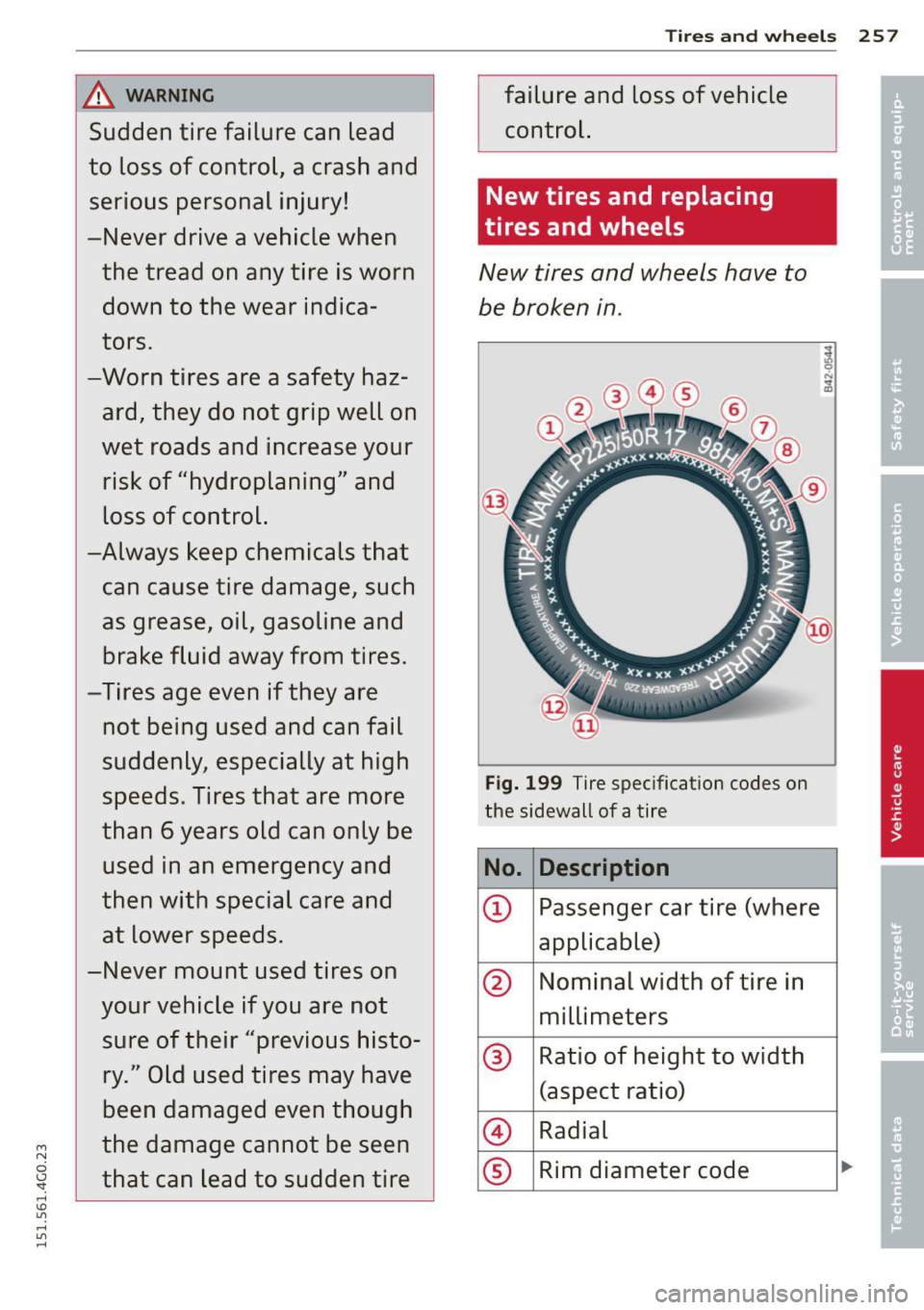
Fig. 199 Tire specification codes on
the sidewall of a tire
No. Description
CD Passenger car tire (where
applicable)
0 Nominal width of tire in
millimeters
® Ratio of height to width
(aspect ratio)
© Radial
® Rim diameter code
Page 263 of 314
M N
0 <.J 'SI: ,...., \!) 1.1'1 ,...., 1.1'1 ,....,
tires because they meet the highest standard s regarding
safety and driving characteris
tics when used correctly. Your
authorized Audi dealer will
gladly provide you with more
information.
Tire ply composition and materials used
The number of plies indicates
the number of layers of rubber
coated fabric in the tire. In gen
eral, the greater the number of
plies, the more weight a tire
can support. Tire manufactur
ers also must indicate the ma
terials in the tire, which include steel, nylon, polyester, and oth
ers.
Maximum Load Rating
This number indicates the max
imum load in kilograms and
pounds that can be carried by
the tire.
Tire quality grading for
treadwear, traction, and
temperature resistance
Tread wear, traction and tem perature grades¢
page 263.
Tires and wheels 261
Maximum Permissible
Inflation Pressure
This number is the greatest
amount of air pressure that
should ever be put in the tire under normal driving condi
tions.
A WARNING
- Using incorrect or unmatch
ed tires and
I or wheels or
improper tire and wheel
combinations can lead to
loss of control, collision and
serious personal injury.
-Always use tires, rims and wheel bolts that meet the specifications of original
factory-installed tires or
other combinations that have been specifically ap
proved by the vehicle manu
facturer.
-Tires age even if they are not being used and can fail
suddenly, especially at high speeds. Tires that are more
than 6 years old can only be
used in an emergency and
then with special care and at lower speeds.
-Never mount used tires on your vehicle if you are not
•
•
'
Page 266 of 314
264 Tire s and wheel s
Sustained high temperature can cause the
materia l of the tire to degenerate and reduce
tire life, and excessive temperature can lead
to sudden tire failure<=>,& .
The grade C corresponds to a level of perform
ance which a ll passenger car tires must meet
under the Federa l Motor Veh icle Safety Stand
ard No.
109. Grades Band A represent higher
levels of performance on the laboratory test
wheel than the m inimum required by law .
A WARNING
The traction grade assigned to this t ire is
based on stra ight-ahead braking traction
tests, and does not include acceleration,
corne ring, hydrop lan ing o r peak traction
character istics .
A WARNING ,.,.____
The temperature grade for this tire is es
tablished for a tire that is p roperly inflated
and not overloaded. Excessive speed, un
derinflation, or excessive loading, either
separate ly or in combination, can cause
heat buildup and possible tire fa ilure.
Winter tires
Winter tires can improve vehicle handling on
snow and ice. At temperatures below 45 °F
(7 °C) we recommend changing to winter
tires .
In some heavy snow areas, loca l governments
may require true winter or "snow" tires, those
with very deeply cut tread. These t ires should
only be used in pairs and be installed on all
four wheels. Make sure yo u purchase snow
tires that are the same size and const ruct ion
type as t he other tires on your ve hicle.
If your vehicle is equ ipped with all -wheel
drive*, this will improve t ract ion during w inter
d riving, even wit h the standard tires. Howev
e r, we strong ly recommend that you always
eq uip a ll four w heels on yo ur vehicle wi th cor
rectly fitted win ter tires or a ll-season tires,
when winte r road conditions are expected . This also improves the veh
icle's brak ing per
formance and reduces stopping distances.
Summe r tires p rovide less gr ip on ice and
snow.
Winter tires (snow tires) must always be fitted on all fou r wheels .
Ask your authorized Audi dealer or qualified
workshop for perm itted
winter tire siz es. Use
o n ly rad ial winter t ires .
Winter tires lose their effectiveness when the
tread is worn down to a depth of
0 .157 inch
(4 mm).
Only drive w ith w inter t ires under winter con
ditions. Summer t ires handle better when
there is no snow or ice on the roads and the
temperature is above 45 °F (7 °() .
If you have a flat tire, see notes on spare
wheel
<=>page 257.
Please a lways remember that winter tires may
have a lower speed rating than the tires origi
nally installed on your vehicle at the time it
was manufactured. P lease see<=>
page 260,
Speed rating (letter code)
fo r a listing of the
speed rating lette r codes and the max imum
speed at which the tires can be d riven .
The speed rating letter code (<=>
page 242) is
on the side wall of the t ire
c> page 257.
A WARNING ,.___
W inter t ires have maximum speed lim its
that may be lower than yo ur vehicle's max
i mum speed. Always know the max imum
speed before dr iv ing off. Never dr ive faster
than the speed permitted for yo ur specific
winter tires . This wi ll ca use damage to the
tires leading to an accident and ser ious
personal injury to you and your passen
gers.
A WARNING
'----
Driving faster than the maximum speed
for which the winter tires on your vehicle were designed can cause t ire failure in
cluding a blowout and sudden deflation,