ECU AUDI S6 2015 User Guide
[x] Cancel search | Manufacturer: AUDI, Model Year: 2015, Model line: S6, Model: AUDI S6 2015Pages: 314, PDF Size: 77.57 MB
Page 68 of 314
66 Seats and storage
Opening the trunk pass-through
.. Fold the center armrest in the rear forward
and out .
.. Pull the release handle ¢
fig. 69 and fold
down the cover of the pass -through in the
vehicle interior .
.. Open the rear lid .
.. Push the ski sack* through the opening from
the luggage compartment .
Securing the ski sack*
.. Insert the ski sack strap @¢ fig. 70 in the
center buck le @ .
.. Pull the safety belt taut on the free end of
the belt @.
A WARNING
-The ski sack is intended only for the
t ransportation of skis and other light ob
jects . To reduce the risk of serious per
sonal inj ury never t ransport heavy o r
pointed objects in the ski sack .
- When brak ing rapidly or during an acci
dent the load could be displaced and
cause injury to occupants .
- Sharp edges on the load must be covered
for protection . Always fasten the belt
tightly around the sack and its contents
¢ fig. 70.
(D Tips
- Never stow the ski sack away when it is
still wet or damp (for example, snow
melting from skis). Allow it to dry com
pletely before stowing it away.
- Position skis in the ski sack with the
pointed ends facing the front and ski
poles with the pointed ends facing the
rear.
Page 93 of 314

M N
0 <.J 'SI: ,...., \!) 1.1"1 ,...., 1.1"1 ,....,
Audi adaptive cru ise control and brakin g guar d 91
stopped vehicle or stationary obstacle
(end of a traff ic jam or veh icle that has
broken down in traffic).
- Always remember that the radar sensor
for the braking guard works only within
defined detection and range limits that
may prevent the proper detection of oth
er vehicles .
- The radar sensor's function and range
can be reduced by rain, snow and heavy
spray . Moving vehicles up ahead may not
be promptly detected or may not be de
tected at al l.
- Reflective surfaces in cl ud ing crash barr i
ers or tunnel ent rances may impair the
function of the radar sensor.
(D Tips
- You can ca ncel the braking w ith increas
i ng force that is initiated by the system
by b raking yo urself, by accelerating no
ticeab ly or by swerving.
- Bra king guard error messages
¢ page 91.
-Keep in m ind that braking guard can
brake unexpectedly . Always secure any
c ar go or objec ts that you are transpor t
i ng to reduce the risk of damage or in
ju ry.
Settings in the MMI
App lies to vehicles: with Audi adaptive cruise co ntrol
... Se lect: I CAR I function button > (Car )* sy s
tems
control button > Dri ve r assi st > Audi
bra king guard .
System -
Switch braking g uard On and Off .
When you sw itch the ignition on, the message
Audi b raking guard off appears if the system
is switched off.
Early w arning -The d istance and approach
warn ings in the disp lay can be switched
On /
Off .
@ Tips
- Your settings are automatica lly stored
and ass igned to the remote control key being used at the time the settings are
made
.
-If you res trict the ESC, the braking gua rd
also sw itches itself off¢
page 195 .
-Swi tch braking guard off when you a re
loading the vehicle onto a veh icle carrier,
t rain, ship or other type of transporta
tion . This can prevent undesired warn
ings from the braking guard system.
Messages
App lies to vehicles: wi th Audi ada ptive c ruise con tro l
Braking gu ard : off
T his dr iver message appears if the system is
turned off via the infotainment . Otherwise , if
the system is turned off, the information ap
pears every time shortly after the start of the
trip.
T he driver message a lso appears if the system
is not ava ilable d ue to a malfunction or if the
ESC is not switched on¢
page 195 . If this is
the case, the system w ill not provide warnings
about a poss ible collision.
B ra king guard : ac tiv ated
This dr iver message appears if sharp b rake
pressure was applied due to an acu te warning.
ACC: Unavailable!
ACC and Audi braking guard: not a vailable
The system cannot detect mov ing vehicles up
ahead correctly and is switched off . The sen
sors have been displ aced or are not working
proper ly. The Audi pre sense functions may a l
so be affected . Drive to your authorized Aud i
dealer or author ized Audi serv ice facility im
med iate ly to have the malfunction cor rected .
ACC: currently unavailable. No senso r vis ion
ACC and b rak ing guide: cu rrentl y una vaila
ble . No sensor vis ion
T h is mess age appears if the senso r view is ob
structed, for examp le by leaves, snow, heavy
spray or dirt. Clean the sensors
i=:> page 84,
rg .85 . ~
Page 103 of 314
M N
0 I.J "". rl I.O
"' rl
"' rl
vehicle ahead in a more conservative or sporty manner .
Engine sound*
The sou nd of the engine is adapted to these
lec ted mode and ranges from subtle to sporty.
(D Note
- Make sure there is eno ugh clearance
above and below the veh icle when park
i ng. The height of the vehicle can change
once it is parked due to temperature
fluctuations, changes to the load condi
tions and changes to the driving modes,
which can affect clearance.
- When transporting the vehicle on a car
carrier, train, ship or by other means, on
ly tie the vehicle down at the running
surface of the tires, which is the outer
circumference. Secur ing the vehicle at
the axle components, suspension struts
or tow ing eyes is not permitted because
the pressure in the air suspension struts
can change d uring transpor t. The vehicle
may not be sec ured s uff icient ly if this
happens.
- If you are going to tow a trailer, you
must activate the trailer ope rat ion mode
¢page 205 .
@ Tips
-In some mode ls, the m axim um vehicle
speed can on ly be reached in the Auto
and Dynami c modes.
- Se lecting the Dynami c mode results in
sporty shifting characteristics . The S
gear position engages automatically .
- In vehicles with sport differential*, the
D ynamic mode is deactivated when tow
ing a trai ler .
- In vehicles that have dynamic steering*,
operating noise is heard when starting or
Audi dri ve sele ct 101
stopping the engine. This does not indi
cate a prob lem .
Selecting the driving mode
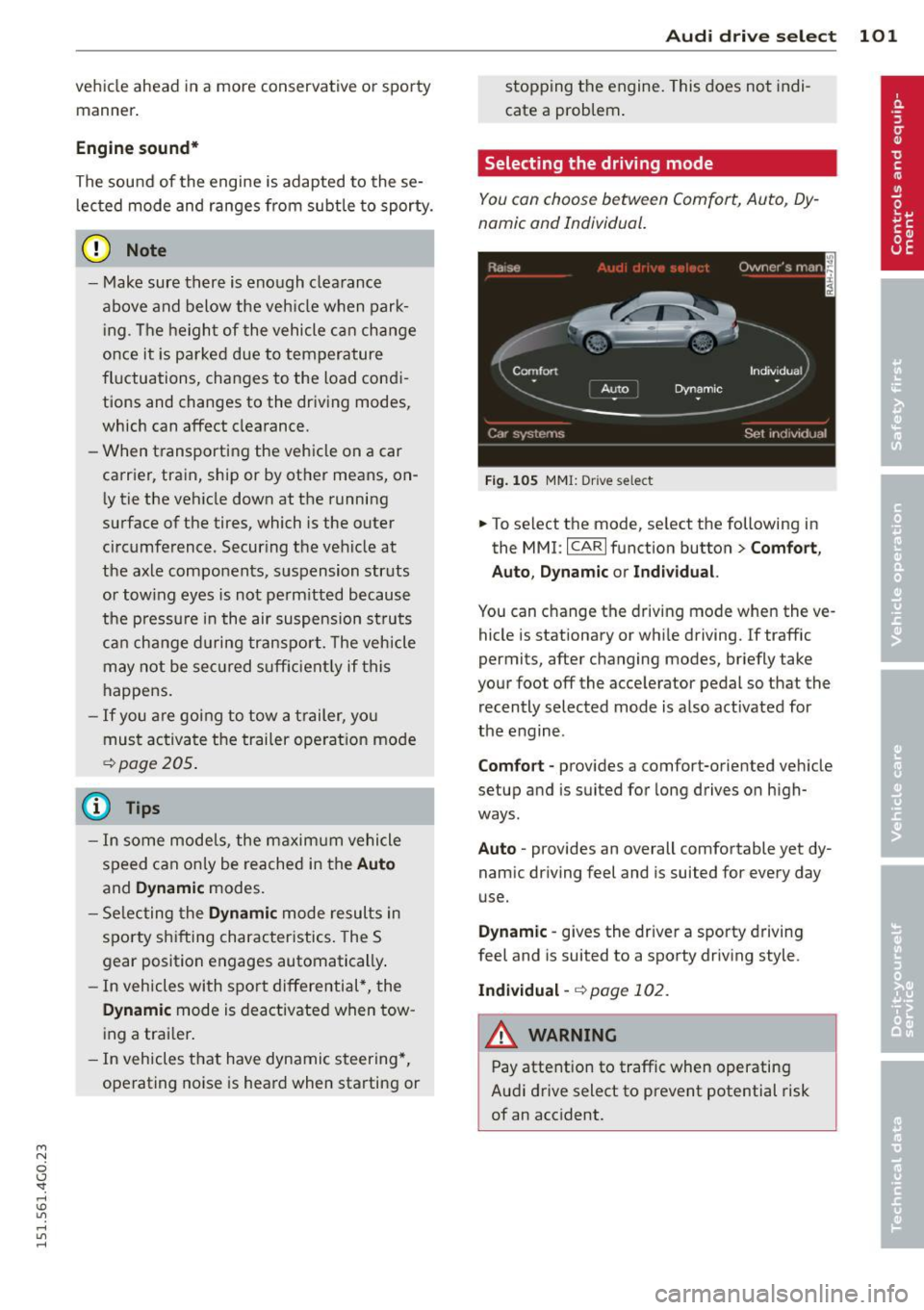
You con choose between Comfort, Auto, Dy
namic and Individual.
F ig . 1 05 MMI: Drive select
.,. To select t he mode, se lect the following in
the MMI : ICARlfunction button> Comfort,
A uto , Dynamic or In d iv idual.
You can c hange the driving mode when the ve
hicle is stationary or whi le driving. If traffic
permits, after changing modes, briefly take
your foot off the acce lerator pedal so that the
recently selected mode is also activated for
the engine .
Comfo rt -provides a comfort-oriented vehicle
setup and is suited fo r long drives on high
ways .
Auto -provides an overall comfortable yet dy
namic dr iving feel and is suited for every day
use.
D ynamic -gives the driver a sporty driving
feel and is suited to a sporty driv ing style .
Indi vidual -
¢ page 102.
WARNING
Pay attention to traffic when operating
Audi drive select to prevent potential risk
of an accident.
Page 112 of 314
110 Automatic Tran sm iss ion
multitronic transmission : Your vehicle is
equipped with
hill hold assist allowing you to
start while on an incline. The system is acti
vated when the brake pedal is pressed down
and held
f o r a few s econds . The brake pres
sure will hold for
a moment after the brake
pedal loosens to prevent the veh icle from roll
ing backwards whi le starting up .
A WARNING
- The veh icle can also roll when the engine
is stopped.
- Unintended veh icle movement can cause
serious injury .
- Never leave your vehicle with the eng ine
running wh ile in gea r. If you must leave
yo ur vehicle when the engine is running,
act ivate the park ing brake and move the
selector lever to P .
- Power is st ill transmitted to the whee ls
when the engine is running at idle . To
prevent the vehicle from "creeping", you
must keep your foot on the brake when
the engine is running and the selector
lever is in D/S or R or "tiptronic" mode is
selected.
- Do not press the accelerator pedal when
changing the selector lever pos ition
wh ile the vehicle is stat io nary and the
engine is running .
- Never shift into R or P wh ile driving .
- Before driv ing down a steep slope, re-
duce your speed and shift into a lower
gear with "tiptronic" .
- Do not ride the brakes or press the brake
pedal too often or too long when dr iving
down a hill. Constant braking causes the
brakes to overheat and substant ially re
duces b raking performance, inc reases
braking distance or causes comp lete fail
ure of the brake system.
- T o prevent the veh icle from rolling back
when stoppi ng on incl ines, always hold it
in place with the brake peda l or parking
brake.
- Never hold the veh icle on an incl ine with
a slipping clutch. The clutch opens auto
matically when it becomes too hot from the overload. An indicato
r lamp
ml illu
minates and a driver message appears
¢ page 112 when the clutch is overload
ed.
- If the engine must remain running, never
have any driving posit io n engaged when
checking under the hood . Make sure the
selector lever has securely engaged and is locked in P w it h the park ing brake set
¢ page 222 . Otherwise, any increase in
eng ine speed may set the vehicle in mo
tion, even with the parking brake ap plied .
(D Note
-S tronic- and tiptronic transmission :
When stopping on an incl ine , do not try
t o hold the vehicle in place by pressing
the acce lerator pedal while a driving gear
is se lected. This can cause the transmis
sion to overheat and can damage it. Acti
vate the parking brake or press the brake
peda l to prevent the vehicle from roll ing.
- S tronic- and tiptronic transmission : A l
lowing the vehicle to ro ll when the en
gine is stopped and the selector lever is
in N will damage the transmission be
cause it is not l ubricated unde r those cir
cumstances.
{!) Tips
For safety reasons, the parking brake is re
l eased automatically only when the d riv
er's safety belt is engaged in the buckle.
Hill descent control
The hill descent control system assists the
driver when driving down declines.
Hill descent contro l is activated when these
lector lever is in D/S and you press the brake
pedal. The transmission automatically selects
a gear that is su itable fo r the incline. H ill de
scent contro l tries to ma inta in the speed ach
ieved at the time o f braking, within phys ica l
and technical limitations. If may sti ll be nec -
essary to adj ust the speed with the brakes . ..,..
Page 131 of 314
M N
0 <.J 'SI: ,...., \!) 1.1'1 ,...., 1.1'1 ,....,
A WARNING ,~ ~
Front seat passengers who are unbelted,
out of position or too close to the airbag
can be seriously injured or killed by the air
bag as it unfolds. To help reduce the risk of
serious personal injury:
- Passengers must always sit in an upright
position and never lean against or place
any part of their body too close to the
area where the airbags are located.
- Passengers who are unbelted, out of po
sition or too close to the airbag can be
seriously injured by an airbag as it un
folds with great force in the blink of an
eye.
- Always make sure that there are at least
10 inches (25 cm) between the front
passenger's breastbone and the instru
ment panel.
- Always make sure that there are at least
4 inches (10 cm) between the front pas
senger's knees and the lower part of the
instrument panel.
- Each passenger must always sit on a seat of their own and properly fasten and
wear the safety belt belonging to that
seat .
- Before driving, always adjust the front
passenger seat properly .
- For adjustable head restraints : before
driving, always also adjust the head re
straints properly .
- Always keep your feet on the floor in
front of the seat. Never rest them on the
seat, instrument panel, out of the win
dow, etc. The airbag system and safety
belt will not be able to protect you prop
erly and can even increase the risk of in
jury in a crash.
- Never drive with the backrest reclined or
tilted far back! The farther the backrests
are tilted back , the greater the risk of in
jury due to incorrect positioning of the
safety belt and improper seating posi
tion.
- Children must always ride in child seats
¢ page 171. Special precautions apply
Driving Safely 129
when installing a child seat on the front
passenger seat¢
page 145.
Proper seating positions for passengers
in rear seats
Rear seat passengers must sit upright wi th
both feet on the floor consistent with their
physical size and be properly restrained whenever the vehicle is in use .
To reduce the risk of injury caused by an incor
rect seating position in the event of a sudden
braking maneuver or an accident, your pas
sengers on the rear bench seat must always
observe the following:
... For adjustable head restraints: adjust the
head restraint so the upper edge is as even
as possible with the top of your head . If that
is not possible, try to adjust the head re
straint so that it is as close to this position
as possible
¢page 130 .
... Keep both feet flat in the footwell in front of
the rear seat .
... Fasten and wear safety belts properly
¢page 139.
... Make sure that children are always properly
restrained in a child restraint that is appro
priate for their size and age
¢ page 171.
A WARNING
Passengers who are improperly seated on
the rear seat can be seriously injured in a
crash.
- Each passenger must always sit on a seat
of their own and properly fasten and
wear the safety belt belonging to that
seat.
- Safety belts only offer maximum protec
tion when the safety belts are properly
positioned on the body and securely
latched. By not sitting upright, a rear
seat passenger increases the risk of per
sonal injury from improperly positioned
safety belts!
- For adjustable head restraints: always adjust the head restraint properly so that
it can give maximum protection.
•
•
Page 133 of 314
M N
0 <.J 'SI: ,...., \!) 1.1"1 ,...., 1.1"1 ,....,
-never knee l on the seats
- never ride with the seatback reclined
- never lie down on the rear seat
- never lean up against the instrument pa nel
- never sit on the edge of the seat
- never sit s ideways
- never lean out the window
- never put yo ur feet out the window
- never put yo ur feet o n the ins trumen t panel
- never rest you r feet on the seat cushion o r
back of the seat
- never r ide in the footwe ll
- never r ide in the cargo area
A WARNING
Imprope r seat ing positions increase the
r is k of se rious personal injury and death
whenever a veh icle is being used.
- Always make sure that a ll vehicle occu
pants stay in a p ro per seat ing pos it ion
and are properly restra ined whenever the
vehicle is be ing used .
Driver and passenger
side footwell
Important safety instructions
Appl ies to vehicles: with knee a irbags
A WARNING
Always make s ure that the knee ai rbag can
inf late without interfe rence. Objects be
tween yourse lf and the airbag can increase
the risk of injury in an acc ident by interfer
ing w ith the way the a irbag deploys or by
being p ushed into you as the airbag de
ploys.
- No persons (ch ildren) or animals should
ride in the footwell in front of the pas
senger seat. If the airbag deploys, this
c an res ult in serious or fata l injuries.
- No objects of any k ind sho uld be car ried
in the footwell area in fron t of the driv
er's or passenger's seat. Bul ky objects
(shopping bags, for example) can ham
per or prevent p roper deployment of the
airbag. Small objects can be thrown
Dr iving Safel y 131
through the vehicle if the airbag deploys
and in jure you or your passengers.
Pedal area
Pedals
The pedals must always be free to move and
must never be interfered with by a floor mat
or any other object.
Make sure that a ll peda ls move free ly without
interference and that nothing prevents them
from return ing to their orig inal positions.
Only use floor mats that leave t he pedal area
free and can be secured with floor mat fasten
ers .
If a brake circ uit fai ls, increased brake pedal
trave l is required to bring the vehicle to a full
stop.
A WARNING
Pedals that can not move free ly can cause
loss of vehicle control and incr ease the risk
of ser ious injury.
- Never p lace any objec ts in the drive r's
footwell. An ob je ct cou ld get into the
pedal area a nd inte rfe re wi th pedal fun c
tion. In case of sudde n brak ing o r an a c
cident, yo u wou ld not be a ble to brake or
accelerate!
- Always ma ke su re th at nothing can fall
or move into the driver's footwel l.
Floor mats on the driver side
Always use floor mats that can be securely
attached to the floor mat fas teners and do
not in terfere with the free movement of the
pedals.
.,. Ma ke s ure t hat the floor ma ts are prope rly
secured an d cannot move and interfere wi th
the peda ls ~ _& .
Use only floor mats tha t leave the peda l area
u nobstru cte d a nd th at are firmly secured so
that they cannot slip o ut o f position. You can
II>
•
•
Page 134 of 314
132 Driving Safel y
obtain suitable floor mats from your
authorized Audi Dealer.
Fl oor mat fasteners a re installed in you r Audi .
Floor mats used in your vehicle must be at
tached to these fasteners . Properly secur ing
the floo r mats will p revent them from s liding
i nto pos itions tha t could inte rfe re wi th t he
pedals or impair safe operation o f your vehi cle
in other ways.
A WARNING
Pedals t hat cannot move freely can resu lt
in a loss of veh icle contro l and increase the
r isk of serious personal injury .
- Always make sure that floor mats are
properly secured.
- Never place o r insta ll floo r mats or other
floor coverings in the vehicle that cannot
be properly secured in place to prevent
them from slipping and interfering w it h
the pedals or the ability to control the
vehicle .
- Never place or install floor mats or other
floor coverings on top of a lready insta l
led floor mats . Additional floor mats and
other cove rings w ill reduce the si ze of
the pedal area and in terfere with the
peda ls.
- Always properly rei nstall and se cu re floor
mats that h ave been take n out for clean
ing.
- Always make su re th at ob je cts canno t
fa ll into the driver fo otwe ll wh ile the ve
hicle is moving . Objects can become
t rapped under t he b rake pedal and accel
erator peda l causing a loss of veh icle
control.
Stowing luggage
Loading the luggage compartment
All luggage and other objects must be prop
erly stowed and secured in the luggage com
partment.
Loose items in the luggage compartment can
sh ift suddenly, changing veh icle hand ling characteristics. Loose items can a
lso inc rease
t h e risk of serious persona l injury in a sudden
vehicle maneuve r o r i n a co llision .
.. Dis trib ute the load even ly in the luggage
compa rtment .
.. Always place and properly secure heavy
items in the luggage compartment as fa r
forward as possible .
.. Secure luggage using the tie-downs prov id
ed
¢ page 63, Luggage compartment .
.. Make sure that the rear seatback is securely
latched in place.
A WARNING
Imp roperly stored luggage or other items
can fly t hro ugh the vehi cle causing ser ious
personal injury in the event of hard brak
i ng or an accident . To help reduce the risk
of ser ious personal in ju ry:
- Always put o bjects, fo r example, luggage
or other heavy items in t he luggage com
pa rtment.
- Always secure o bjects in the luggage
compa rtment using the tie-down hoo ks
and suitable straps.
A WARNING
-
Heavy loads w ill influence the way yo ur ve-
hi cle handles. To help reduce the risk of a
l oss of cont ro l leading to serious personal
in Jury :
- Always keep in mind when transporting
heavy objects , tha t a change in the cen
ter of gravity can also cause changes in
veh icle handling:
- Always distribute the load as evenly as
poss ible.
- Place heavy objects as far forward in the luggage compartment as possible.
- Never exceed the Gross Axle We igh t Rat
ing or the Gross Vehicle We ight Ratin g
specif ied on the safety compliance stick
er on the left door jamb. Exceeding per miss ible weight standards can cause the
veh icle to slide and hand le diffe rently.
- Please observe information on safe dr iv
ing
¢ page 126.
Page 135 of 314
M N
0 <.J 'SI: ,...., \!) 1.1'1 ,...., 1.1'1 ,....,
A WARNING
To help prevent poisonous exhaust gas
from being drawn into the vehicle, always keep the rear lid closed while driving .
- Never transport objects larger than
those fitting completely into the luggage
area because the rear lid cannot be fully
closed.
- If you absolutely must drive with the rear
lid open, observe the following notes to
reduce the risk of poisoning:
- Close all windows,
- Close the power roof*,
- Open all air outlets in the instrument
panel,
- Switch off the air recirculation,
- Set the fresh air fan to the highest
speed.
A WARNING
Always make sure that the doors, all win dows, the power roof* and the rear lid are
securely closed and locked to reduce the
risk of injury when the vehicle is not being
used.
- After closing the rear lid, always make
sure that it is properly closed and locked.
- Never leave your vehicle unattended es
pecially with the rear lid left open. A
child could crawl into the vehicle through
the luggage compartment and close the
rear lid becoming trapped and unable to
get out. Being trapped in a vehicle can
lead to serious personal injury.
- Never let children play in or around the
vehicle .
- Never let passengers ride in the luggage
compartment. Vehicle occupants must
always be properly restrained in one of
the vehicle's seating positions.
Gj) Tips
-Air circulation helps to reduce window
fogging. Stale air escapes to the outside
through vents in the trim panel. Be sure
to keep these slots free and open .
-
Driving Safely 133
-The tire pressure must correspond to the
load. The tire pressure is shown on the
tire pressure label. The tire pressure la
bel is located on the driver's side B-pillar.
The tire pressure label lists the recom
mended cold tire inflation pressures for
the vehicle at its maximum capacity
weight and the tires that were on your
vehicle at the time it was manufactured.
For recommended tire pressures for nor
mal load conditions, please see chapter
~page 244.
Tie-downs
The luggage compartment is equipped with
four tie-downs to secure luggage and other
items.
Use the tie-downs to secure your cargo prop
erly~
page 132, Loading the luggage com
partment.
In a collision, the laws of physics mean that
even smaller items that are loose in the vehi
cle will become heavy missiles that can cause
serious injury. Items in the vehicle possess en
ergy which vary with vehicle speed and the
weight of the item. Vehicle speed is the most
significant factor.
For example , in a frontal collision at a speed
of 30 mph (48 km/h), the forces acting on a
10-lb (4.5 kg) object are about 20 times the
normal weight of the item. This means that
the weight of the item would suddenly be about 200 lbs. (90 kg) . You can imagine the
injuries that a 200 lbs . (90 kg) item flying
freely through the passenger compartment
could cause in a collision like this.
A WARNING
Weak, damaged or improper straps used
to secure items to tie-downs can fail dur
ing hard braking or in a collision and cause
serious personal injury.
-Always use suitable mounting straps and properly secure items to the tie-downs in
.
•
•
Page 136 of 314
134 Driving Safely
th e lu gg age compartment to help pre-Tel.: 1-888-327-4236 (TTY :
vent items from shiftin g or flying
1-800-424-9153) or forward as dange ro us m iss iles.
- When the rear seat back rest is folded
1-800 -424-9393
down, always use su itab le mounting
st raps a nd pro perly secure items to the
or you may write to:
t ie -downs in t he luggage com partmen t
NHTSA to help prev ent item s fro m flyi ng fo r-
w ar d as dang erous miss iles into th e pas-
U.S. Department of Transporta-
se ng er compartm ent .
tion - N ever at ta ch a child sa fety seat tet her
st rap to a tie- down.
1200 New Jersey Ave., S. E.
Reporting Safety
West Building
Washington, DC 20590
Defects
Applicable to U.S.A.
You can also obtain other infor-
mation about motor vehicle
If you believe that your vehicle safety from:
has a defect which could cause
a crash or could cause injury or http:/ /www. safe rca r. gov
death, you should immediately
Applicable to Canada
inform the National Highway If you live in Canada and you
Traffic Safety Admini stration
believe that your vehicle has a
(NHTSA) in addition to notify- defect that could cause a crash,
ing Audi of America, Inc. injury or death, you should im-
If NHTSA receives similar com- mediately inform Transport
plaints, it may open an investi- Canada, Defect Investigations
gation, and if it finds that a and Recalls. You should also no-
safety defects exists in a group tify Audi Canada.
of vehic les, it may order a recall
Canadian customers who wish
and remedy campaign. Howev- to report a safety-related de-
er , NHTSA cannot become in-
feet to Transport Canada, De-
volved in individual problems feet Investigations and Recalls,
between you, your dealer, or may either call Transport Cana-
Audi of America, Inc .
da toll-free at:
....
To contact the NHTSA , you may
either call:
Page 141 of 314
M N
0 I.J "". rl I.O
"' rl
"' rl
Important safety instructions about
safety belts
Safety belts must always be correctly posi
tioned across the strongest bones of your
body.
~ Always wear safety belts as illustrated and
described in this chapter.
~ Make sure that your safety belts are always
ready for use and are not damaged.
A WARNING
Not wearing safety belts or wearing them
improperly increases the risk of serious
personal injury and death. Safety belts can
work only when used correctly.
- Always fasten your safety be lts correctly
before driving off and make sure all pas
sengers are correctly restrained.
- For maximum protection, safety belts must always be positioned properly on
the body .
- Never strap more than one person, in
cluding small children, into any belt.
- Never place a safety belt over a child sit ting on your lap.
- Always keep feet in the footwell in front
of the seat while the vehicle is being d riv
en .
- Never let any person ride with their feet
on the instrument panel or sticking out
the window or on the seat.
- Never remove a safety belt while the ve
hicle is moving. Doing so will increase
your risk of be ing injured or killed.
- Never wear belts twisted.
- Never wear belts over rigid or breakable
objects in or on your clothing, such as
eye glasses, pens, keys, etc., as these may cause injury.
- Never allow safety belts to become dam
aged by being caught in door or seat
hardware .
- Do not wear the shoulder part of the belt
under your arm or otherwise out of posi
tion . Safety belts
139
- Several layers of heavy clothing may in
terfere with correct positioning of belts and reduce the overall effectiveness of
the system .
- Always keep belt buckles free of anything
that may prevent the buckle from latch
ing securely .
- Never use comfort clips or devices that
create slack in the shoulder belt . Howev
er, special clips may be requ ired for the
proper use of some child restraint sys
tems .
- Torn or frayed safety belts can tear, and
damaged belt hardware can break in an
accident. Inspect belts regularly.
If web
bing , bindings, buckles, or retractors are
damaged, have belts replaced by an au
thorized Audi dealer or qualified work
shop.
- Safety belts that have been worn and
loaded in an accident must be replaced
with the correct replacement safety belt
by an authorized Audi dealer. Replace
ment may be necessary even if damage
cannot be clearly seen . Anchorages that
were loaded must also be inspected.
- Never remove, modify, disassemble, or
try to repair the safety belts yourself.
- Always keep the belts clean. Dirty belts
may not work properly and can impair
the function of the inertia reel~
ta
ble Cleaning interior on page 211.
Safety belts
Fastening safety belts
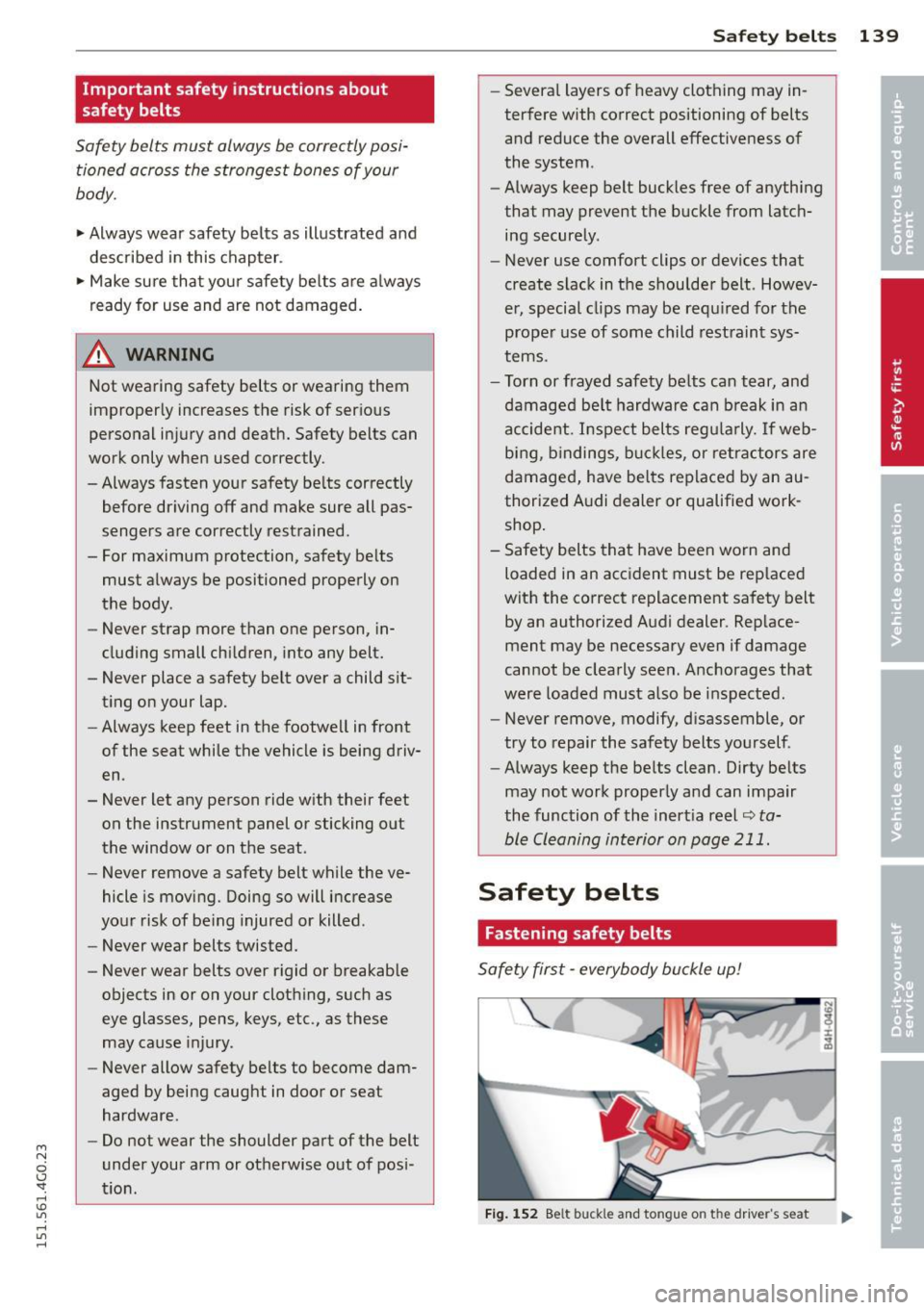
Safety first -everybody buckle up!
Fig. 152 Bel t b uckle and to ngue on the drive r's seat